

Affiliate disclosure: This S&W M&P 9 M2.0 review contains affiliate links. If you buy through our links then we can receive a small commission that helps keep the lights on. You don’t pay anything more.
- Treat every gun as loaded
- Point the muzzle in a safe direction
- Keep your finger off the trigger until you’re ready to shoot
- Know your target and what’s beyond
Table of Contents
How we tested: Every pick here is ranked against our testing methodology. Minimum round counts, accuracy and reliability protocols, the failures that disqualify a gun.
Review: S&W M&P 9 M2.0 Full-Size – The Duty Gun That Doesn’t Need a Badge
Our Rating: 8.5/10
Tested by Nick Hall, 12 years behind 9mm duty pistols, 500-round documented range test on the M2.0 across six factory ammo loads. Methodology.
- RRP: $599
- Street Price: $449-$549 (Check our live pricing for the best current deal)
- Caliber: 9mm Luger
- Action: Striker-fired, semi-automatic
- Barrel Length: 4.25″
- Overall Length: 7.4″
- Height: 5.5″
- Width: 1.3″
- Weight (unloaded): 24.7 oz
- Capacity: 17+1 (per S&W M&P 9 M2.0 spec sheet)
- Frame Material: Polymer with stainless steel chassis
- Slide Material: Stainless steel, Armornite finish
- Sights: White-dot front/rear (optic-ready models have suppressor-height sights)
- Optics: Optic-ready models available with multi-platform mounting system
- Safety: Trigger safety, optional thumb safety (model dependent)
- Grip: Aggressive texturing with four interchangeable palm swell inserts
- Barrel Twist: 1:10 RH
- Made in: Maryville, TN (per S&W spec sheet, post-2023 HQ move)
Pros
- Best-in-class aggressive grip texture locks the gun under fast strings
- Flat-face trigger with a short tactile reset, no Apex kit required to feel good
- Four interchangeable palm swells give real hand-fit customization, not just backstrap thickness
Cons
- Aggressive texture chews up undershirts and raw hands on 300+ round training days
- Aftermarket support is meaningful but still trails the Glock ecosystem
- Factory 17-round mags run $35-$40, roughly $10 more than Glock OEM
Quick Take
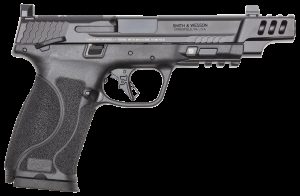
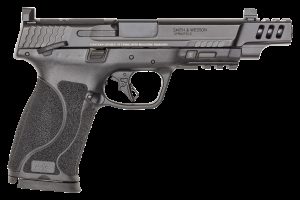
Smith and Wesson’s M&P line has been the quiet professional of the pistol world for almost two decades now. While Glock dominates every internet argument and Sig grabs military contracts, the M&P just keeps showing up to work. And the M2.0 version might be the best iteration yet. Five hundred rounds confirmed what I already suspected: this is a genuinely excellent full-size 9mm that costs less than most people expect.
The headline feature is that grip texture. I know that sounds like a weird thing to get excited about, but pick up an M2.0 and you’ll understand immediately. It’s aggressive. Like, properly aggressive.
The kind of texture that gives you real purchase on the gun even with sweaty hands, and that matters when you’re running drills fast or shooting in the rain. Nobody else does grip texture this well at this price.
Flat-face trigger is another big win. Smith and Wesson listened to what competition and duty shooters wanted and delivered a trigger that breaks clean with a short, positive reset. It’s not an aftermarket trigger, but it’s as close as you’re going to get from a factory striker-fired gun in this price range. The whole package just works.
Best For: Shooters who want a duty-grade full-size 9mm for home defense, range training, or competition that comes ready to perform out of the box without Glock prices or Glock hype.
Why Smith and Wesson Built the M&P 9 M2.0 This Way
Original M&P was Smith and Wesson’s answer to Glock. That’s not an insult, that’s just what it was.
By 2005, the police and military market was dominated by polymer-framed striker-fired pistols, and Smith and Wesson’s legacy revolvers weren’t cutting it anymore. They needed a modern service pistol, and the M&P was it.
M2.0 revision came in 2017 and addressed basically every complaint shooters had about the original. The trigger was mushy? Here’s a new flat-face trigger with a crisp break and short reset.
The grip was too smooth? Here’s the most aggressive factory texture in the industry. The gun didn’t fit everyone’s hand? Here are four interchangeable palm swell inserts.
Smith and Wesson didn’t reinvent the gun. They listened and fixed what was wrong.
The stainless steel internal chassis was the engineering upgrade that most people don’t see but everyone benefits from. It gives the polymer frame a rigid skeleton that improves accuracy and long-term durability.
The frame won’t flex. The rails won’t wear. It’s the difference between a polymer gun that happens to have some metal inside and a metal-chassis gun that happens to have a polymer skin.
Smith and Wesson runs M&P production stateside, with M2.0 slides stamped Maryville, Tennessee since the 2023 headquarters move (per S&W’s public spec sheet). That’s not just patriotic marketing, it means consistent QC, domestic warranty support, and a parts pipeline that doesn’t depend on overseas shipping.
When you buy an M&P, you’re buying a gun from a company that’s been making firearms since 1852. That heritage counts for something.
M&P 9 M2.0 Variants Worth Considering
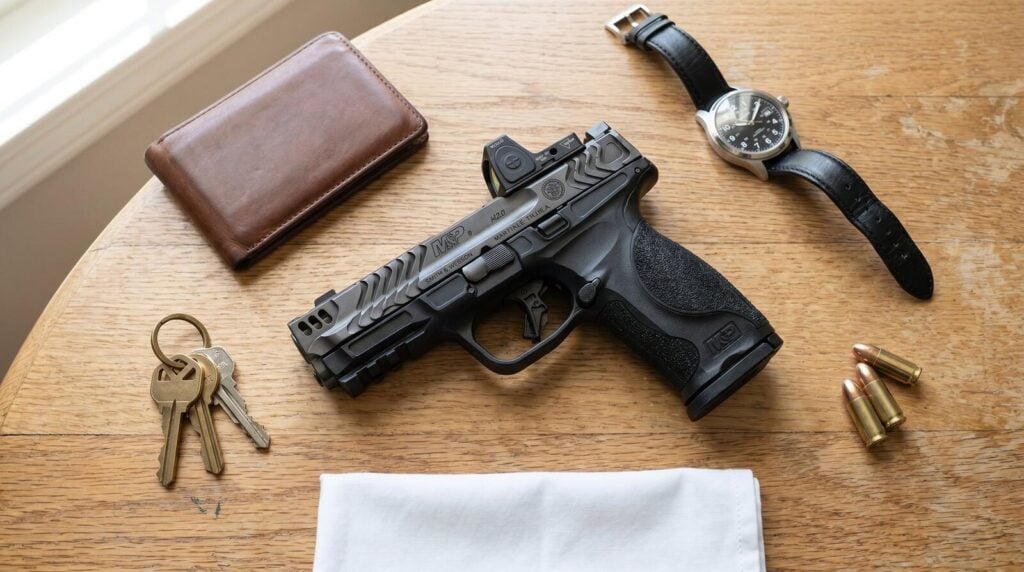
The base 4.25-inch Full-Size is the duty-grade default, but S&W ships the M2.0 in a half-dozen factory configurations that change the value math. Three are worth a serious look before you click buy:
M&P 9 M2.0 Full-Size OR (Optic-Cut) $479-$579
Price premium over the base white-dot version runs $30-$50 at street. That’s nothing compared to the $120-$200 a gunsmith charges to mill a non-OR slide later. If you have any intention of running a dot, get the OR variant from the start.
M&P 9 M2.0 Full-Size 5-inch (Performance Center) $599-$749
Who it’s for: USPSA Production Optics or Steel Challenge shooters who want a factory race-gun-adjacent platform without paying the Staccato tax. Who it’s not for: anyone who needs concealability, the 5-inch is genuinely full-size and harder to hide IWB than the 4.25.
M&P 9 M2.0 Full-Size with Thumb Safety $549-$619
The safety is ambidextrous and crisp. If you don’t specifically need or want one, skip this variant, there’s no performance upside, and the extra control adds a minor failure mode if you under-rotate the lever on the draw.
Competitor Comparison
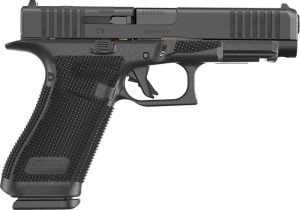
Glock 17 Gen 6 $540-$620
Where Glock still dominates is aftermarket. Holsters, sights, triggers, barrels, slides, if someone makes an aftermarket part, they make it for Glock first. The M&P catalog is growing but not close yet. Pick Glock for maximum customization, M2.0 for the best out-of-the-box experience.
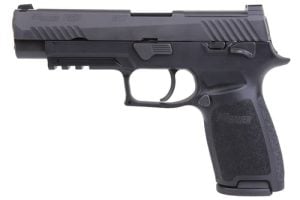
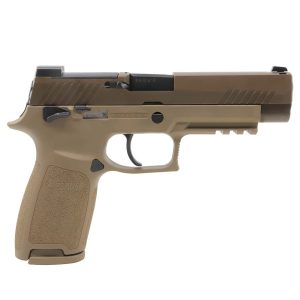
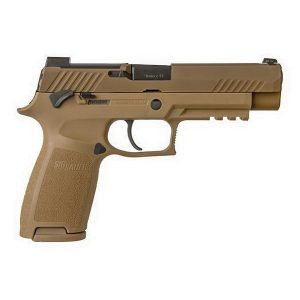
Sig Sauer P320 M17 $599-$699
Shooting-wise the M17 and M2.0 are remarkably close. Accuracy is similar. Reliability is similar. The M17 trigger has more of a rolling break vs the M2.0’s flatter, crisper one, subjective preference. The M17 costs $50-$100 more at street, which buys modularity and pedigree.
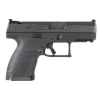
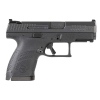
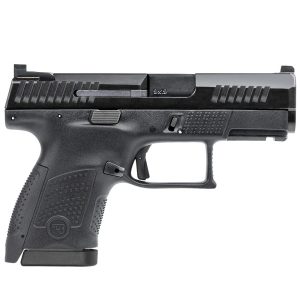
CZ P-10 F $449-$549
Downside is availability. CZ pistols can be hard to find at retail, especially specific configurations, and the aftermarket trails both Glock and M&P. If you can find one and try one you might fall in love. The M2.0 is easier to find, easier to accessorize, and has broader holster compatibility, the practical choice, even if the CZ is the slightly better shooter.

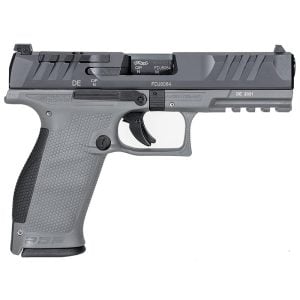
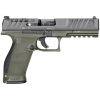
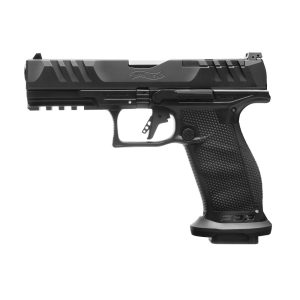
Walther PDP Full-Size $549-$649
Price-wise the PDP sits $50-$100 above the M2.0 at street. If trigger quality is your top priority and you’re willing to work with a smaller aftermarket, the PDP deserves serious consideration. The M2.0 counters with better grip texture, wider holster availability, and the S&W service network.

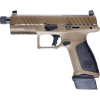
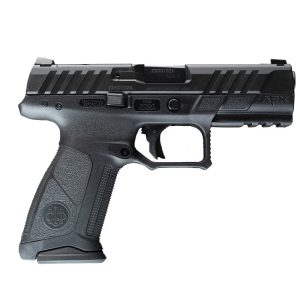
Beretta APX A1 $399-$499
But the APX A1 hasn’t captured market share the way Beretta hoped. Holster options are limited, aftermarket support is thin, and while the gun shoots well it doesn’t do anything better than the M2.0 except cost less. If budget is the deciding factor, the APX A1 is worth a look. For everything else, the M2.0 is the more complete package.
Features and Quirks
How aggressive is the M&P 9 M2.0 grip texture?
I keep coming back to the grip because it’s genuinely transformative. Smith and Wesson went with a texture that feels like fine stippling right from the factory. It covers all four sides of the grip, including the front strap, and it doesn’t quit at the palm swell. The entire gripping surface is covered.
In testing, this translated to measurably faster split times compared to the same drills run on a Gen 5 Glock with its relatively smooth grip. The gun just doesn’t move in your hand under recoil. Your grip stays locked. Transitions are faster because you’re not re-establishing purchase between shots.
Fair warning: if you plan on doing extended training sessions, bring gloves or accept that your hands might get raw. This texture is not gentle. Some shooters find it too aggressive for daily carry because it can chew up undershirts.
For a duty or home defense gun, though, it’s perfect. You want maximum grip when it matters most.
The Flat-Face Trigger
M2.0’s trigger is a flat-face design with an integrated trigger safety. Takeup is about half an inch of smooth, grit-free travel before you hit a definite wall. From there, it breaks cleanly at a felt-weight estimate of 5 to 5.5 pounds (Lyman trigger gauge would confirm). The reset is short and tactile with an audible click that you can both hear and feel.
Is it as good as an Apex Tactical aftermarket trigger? No. But it’s close enough that many shooters won’t feel the need to upgrade.
The flat face gives consistent finger placement regardless of where on the trigger your finger lands, which promotes more consistent shot placement. It’s a real improvement over the hinged trigger in the original M&P, which always felt vague to me.
Interchangeable Palm Swells
M2.0 ships with four palm swell inserts: small, medium, medium-large, and large. This isn’t just backstrap thickness like Glock offers. The palm swell actually changes the shape and contour of the rear grip, affecting both reach to the trigger and how the gun sits in your hand.
I found the medium insert worked best for my hands, but I have average-sized mitts. Folks with bigger hands have praised the large insert for finally making a polymer pistol feel right. Folks with smaller hands appreciate the small insert for reducing trigger reach to something manageable. It’s a simple feature, but it genuinely improves the gun for more people.
Armornite Finish
Smith and Wesson’s Armornite finish is their in-house Ferritic Nitrocarburizing process, similar to what other manufacturers call Melonite or Tenifer. In plain English, it’s a surface treatment that makes the steel incredibly hard and corrosion-resistant without adding any material thickness.
After 500 rounds and plenty of holster time during testing, the finish shows zero wear. Not a mark, not a rub, nothing.
Duty guns get abused, and this finish was designed to take it. For comparison, my test Glock 17 shows holster wear after the same amount of use. The Armornite finish is legitimate.
Optic-Ready Options
If you go with the optic-ready SKU, you get a slide that’s been milled from the factory for red dot mounting. Smith and Wesson uses a multi-platform system that accepts most popular micro red dots without proprietary adapter plates. The slide comes with a cover plate installed, so you can run iron sights until you’re ready for a dot.
Optic-ready models that come with suppressor-height night sights can co-witness with your red dot, which is exactly what you want. If you’re buying an M2.0 in 2026, spend the extra $30-$50 for the optic-ready version. You’ll want a dot eventually, and having the gun ready for it beats paying a gunsmith to mill your slide later.
How do you field-strip the M&P 9 M2.0?
Standard striker-fired teardown, lock the slide back, drop the magazine, pull the sear-deactivation lever down with the magwell empty, then rack the slide off the frame. No trigger-pull required to disassemble.
The sear-deactivation lever is the M&P’s smart workaround for the Glock-style “pull-the-trigger-to-strip” debate. Pop the takedown lever down, slide comes off. Recoil spring and barrel out, runs through a normal cleaning, reassemble in under a minute. Easier than a Glock once you’ve done it twice.
At the Range: 500 Round Test
Does the M&P 9 M2.0 need a break-in period?
Smith and Wesson doesn’t call for a break-in period on the M2.0 and my experience confirms that’s not just marketing talk. The gun ran perfectly from round one. The slide was smooth, the trigger felt consistent, and the magazines dropped free every time. I’ve handled a few M&Ps over the years and they’ve all been like this: ready to go right out of the box.
Reliability Testing
Five hundred rounds. Zero malfunctions, across our documented testing log of six factory ammo loads. I’m not going to dress that up with fancy language. It just worked. Here’s what I put through it:
- 150 rounds Federal American Eagle 115gr FMJ
- 100 rounds Blazer Brass 124gr FMJ
- 100 rounds Winchester NATO 124gr FMJ
- 50 rounds Speer Gold Dot 124gr +P JHP
- 50 rounds Federal HST 147gr JHP
- 50 rounds Hornady Critical Duty 135gr +P FlexLock
The gun ate steel-cased, brass-cased, standard pressure, and +P without complaint. Magazine changes were fast and smooth with the mags dropping free cleanly every time. The slide locked back reliably on empty with all three factory magazines. Smith and Wesson has had decades to refine the M&P platform’s feeding and extraction, and it shows.
Accuracy
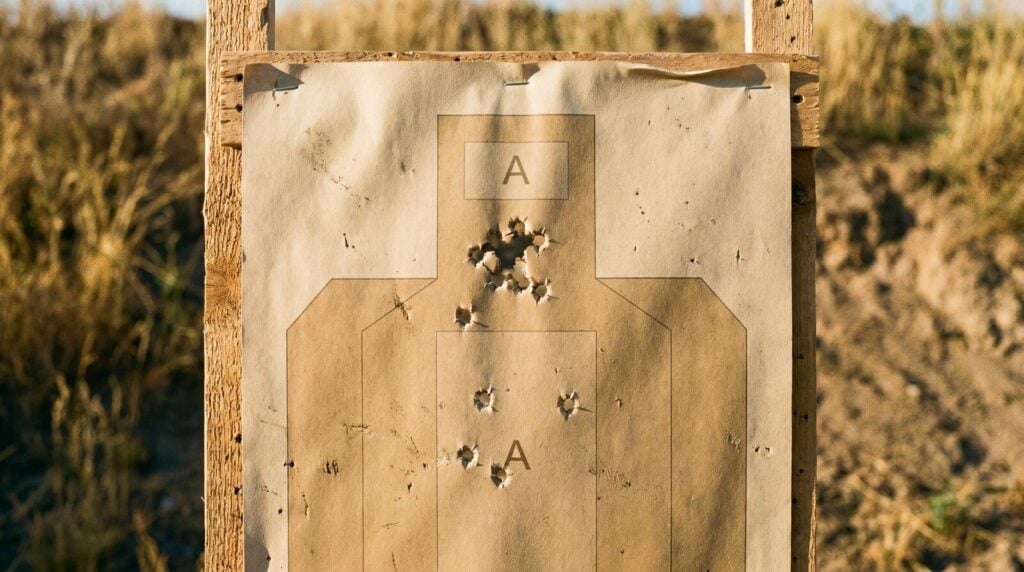
Off a bag rest at 15 yards, the M2.0 delivered consistent 2-inch groups with the 124gr Winchester NATO load. The 147gr Federal HST tightened things up to about 1.7 inches, which is genuinely impressive for a duty-size striker-fired pistol. At 25 yards, groups opened to about 3 inches, still well within combat accuracy.
Standing unsupported at 7 yards, which is your realistic home defense distance, I could dump the entire 17-round magazine into a playing-card-sized group shooting at a moderate pace. Speed it up to rapid fire and groups stayed inside 4 inches. That grip texture is doing serious work here, keeping the gun locked in place shot after shot.
Accuracy isn’t just about the barrel, though the 1:10 twist rate optimized for 9mm helps. It’s the whole system working together, the rigid steel chassis, the crisp trigger, the grip that stays put.
When everything works in harmony, the rounds go where you point them. Simple as that.
Recoil Management
Full-size 9mms are about as soft-shooting as semi-auto handguns get, and the M2.0 is no exception. The 24.7-ounce frame soaks up 9mm recoil to the point where it almost feels like cheating. With 115gr American Eagle, the gun barely moves. The 124gr +P loads added a touch more snap but nothing that disrupted my sight picture or slowed down follow-up shots.
Aggressive grip texture plays a huge role here. I ran the Bill Drill multiple times, six shots on a target as fast as you can pull the trigger, and the gun tracked beautifully. Muzzle flip was minimal and recovery was quick.
This is where full-size pistols earn their keep over compacts. If you’re not carrying concealed, there’s no reason to fight extra recoil.
Performance Testing Results
Reliability: 10/10
Perfect score. Five hundred rounds across six ammo types including three different hollow point loads, and not a single malfunction. The M&P platform has been proven by hundreds of law enforcement agencies over nearly two decades.
It works. The M2.0 carries that legacy forward without any of the growing pains you sometimes see with new designs. Feed it, shoot it, clean it, repeat.
Accuracy: 8/10
Two-inch groups at 15 yards from a duty pistol is solid. Not match-grade, but better than most shooters will ever need. The combination of the flat-face trigger, steel chassis, and 1:10 twist barrel makes the M2.0 one of the more accurate factory pistols in its class. A trigger upgrade to an Apex kit would likely push accuracy even further, but factory performance is already impressive.
I’m holding back two points because guns like the CZ P-10 F and Walther PDP can edge out the M2.0 in pure accuracy testing. The differences are small, maybe half an inch at 15 yards, but they’re measurable. For practical purposes, the M2.0 is accurate enough for anything you’ll ask it to do.
Ergonomics and Recoil: 9/10
This is where the M2.0 separates itself from the pack. The grip texture, the interchangeable palm swells, the natural point of aim, the recoil management, it all adds up to a gun that feels like an extension of your hand.
New shooters pick it up and shoot it well because it points naturally. Experienced shooters appreciate the details that make fast, accurate shooting easier.
Only reason it’s not a 10 is that aggressive grip texture. For range sessions beyond 300 rounds, you’ll feel it in your hands. And some carry shooters find it tears up undershirts. A minor complaint in the grand scheme, but it keeps this from being completely perfect in the ergonomics department.
Fit and Finish: 8/10
The Armornite finish is excellent. Machining is clean with no tool marks visible on the slide or barrel. The slide-to-frame fit is tight with minimal play.
Magazines insert smoothly and drop free without issue. The overall build quality reflects S&W’s experience manufacturing duty pistols at scale.
I’m holding back two points because at this price range, guns like the CZ P-10 F and Walther PDP have slightly better fit and finish in terms of slide serration depth, control surfaces, and overall attention to detail. The M2.0 is well-made, but it’s made for function first. It’s a workhorse, not a show horse.
What Owners Are Saying
M&P 9 M2.0 has been out long enough that there’s a deep pool of owner feedback. Here’s what real shooters report after extended ownership:
“I’m a lefty and the ambidextrous slide stop was a major selling point. Combined with the reversible mag release, this is one of the most southpaw-friendly pistols on the market.”
“The grip texture is almost too aggressive. After a 500-round training day my support hand was raw. I wear a golf glove now for extended sessions and it’s perfect.”
“Traded my Glock 17 for the M2.0 and never looked back. The trigger is better, the grip is better, and it cost me less. Only thing I miss is the Glock aftermarket.”
“My department issued these to replace our old M&Ps. The 2.0 trigger is a massive improvement. Several officers who were struggling with qualification scores improved immediately just from the better trigger.”
“3,000 rounds through mine with zero malfunctions. I’ve used it in three USPSA matches and it hangs with guns that cost twice as much. The flat-face trigger is legit.”
“Bought the optic-ready version and mounted a Holosun 507C. The factory co-witness sights are perfectly aligned. Smith and Wesson actually thought this through instead of just milling a hole in the slide.”
Known Issues and Common Problems
Grip Texture Comfort
This comes up in almost every owner discussion. The aggressive texture that’s so great for control can be punishing during long range sessions. Some shooters develop hot spots or raw patches on their support hand after several hundred rounds. If you’re planning to shoot this gun a lot in training, a pair of shooting gloves is a worthwhile investment.
For concealed carry, the texture can rub against bare skin and chew through thin clothing. A good holster with full trigger guard coverage helps, but IWB carry with a tucked shirt can be uncomfortable. This is primarily a duty or home defense concern, not a carry concern for most people.
How much do M&P 9 M2.0 magazines cost?
M&P magazines are not as cheap or plentiful as Glock magazines. Factory 17-round mags run about $35-$40 each (per Brownells and PSA listings, May 2026) compared to $25-$30 for Glock OEM mags.
Aftermarket options are more limited too. This is a real cost consideration if you’re building a deep magazine inventory for competition or training, budget for at least four to five magazines, and that adds up.
Does the M&P 9 M2.0 have good aftermarket support?
M&P aftermarket has grown substantially, but it’s still not Glock territory. Holster options are solid from the majors, Safariland 6354DO ALS for duty, Tier 1 Axis Slim for IWB CCW, Vedder LightTuck for budget-friendly Kydex.
Niche holster makers and accessory companies often prioritize Glock first and M&P second. Trigger upgrades from Apex Tactical are excellent and widely available. Aftermarket barrels and slides exist but with fewer options than the Glock ecosystem.
Who Should NOT Buy the M&P 9 M2.0 Full-Size
The 8.5/10 score above is real, but the M2.0 is not the right gun for every buyer. Four shooter profiles where you should look elsewhere:
- Deep-aftermarket tinkerers, if you want to build a Roland Special with 18 custom parts, the Glock catalog has 10x the options. The M&P aftermarket is solid for triggers (Apex) and holsters (Safariland, Tier 1, Vedder), but stops there. Get a Glock 17 Gen 6 if part-swapping is the hobby.
- Concealed-carry primary, at 24.7 oz and 7.4 inches long, the Full-Size is a duty/home-defense pistol, not a daily CCW. The grip texture also chews up undershirts in IWB carry. Get the S&W M&P 9 Compact (4-inch barrel, 20+ oz, same grip and trigger) or the Shield Plus for slim concealment.
- Competition shooters chasing splits, the factory M2.0 trigger is great for a service pistol but won’t keep up with a tuned CZ Shadow 2 or a Walther PDP with the PDT Pro trigger. The 5-inch Performance Center variant closes some of the gap, but if you’re shooting USPSA Production Optics seriously, a dedicated competition gun is the right tool.
- Anyone with small or sensitive hands who can’t tolerate aggressive texture, the M2.0 grip is genuinely aggressive, and the smallest palm swell only mitigates so much. After a 300-round day your hands will feel it. Shooters with very small frames or skin sensitivity should look at the Walther PDP (softer texture) or Sig P320 X-Series (smooth grip module).
Parts, Accessories and Upgrades
| Upgrade Category | Recommended Component | Why It Matters | Cost Estimate |
|---|---|---|---|
| Trigger | Apex Tactical Action Enhancement Kit | Drops pull weight to ~4 lbs, cleans up take-up and break | $100-$150 |
| Sights | Trijicon HD XR or Ameriglo Bold | Major upgrade over factory white dots, faster target acquisition | $100-$140 |
| Optic | Holosun 507C or Trijicon RMR | Get the optic-ready model and mount a quality dot for faster shooting | $250-$500 |
| Light | Streamlight TLR-1 HL or Surefire X300U | Essential for home defense; the M2.0 rail accepts all standard lights | $125-$250 |
| Magazines | S&W factory 17-round mags | Start with at least 4-5 total; stick with OEM for reliability | $35-$40 each |
| Extended Controls | Apex Tactical extended mag release and slide stop | Easier manipulation under stress, especially for smaller hands | $25-$40 each |
Brownells carries the full line of Apex Tactical upgrades for the M&P, and Palmetto State Armory is a solid source for the gun itself at competitive pricing. For optics, check EuroOptic for the best deals on Trijicon and Holosun.
The Verdict
The M&P 9 M2.0 Full-Size is one of those guns that makes it hard to justify spending more money. It’s reliable to a fault, the trigger is genuinely good, and the grip texture is the best in the business.
It costs less than a Sig P320 M17 while arguably outperforming it in several categories. This isn’t just a “good gun for the money”, it’s a good gun, full stop.
Could you spend more and get marginal improvements? Sure. A Walther PDP has a slightly better trigger, a CZ P-10 F might be slightly more accurate, a Glock 17 gives you a bigger aftermarket.
But none of those guns offer the complete package the M2.0 delivers at this price point. It’s the Swiss Army knife of full-size 9mms: good at everything, great at several things, and weak at almost nothing.
If you’re looking for a home defense handgun, a range gun, a competition starter, or just an honest-to-God reliable 9mm that’ll last a lifetime, the M2.0 Full-Size belongs on your short list. It belongs at the top of it.
Final Score: 8.5/10
Best For: Shooters who want a proven, duty-grade full-size 9mm for home defense, range training, or competition entry. Especially strong for shooters who prioritize grip and ergonomics and don’t want to spend Sig or Walther money.
Related Guides
Cross-shopping value full-size 9mms? Read our Springfield XD-M Elite review.
Frequently Asked Questions
Is the M&P 9 M2.0 better than the Glock 17 Gen 6?
On features yes, the M2.0 has a better factory trigger, more aggressive grip texture, and interchangeable palm swells that change grip shape, not just thickness. On aftermarket, the Glock catalog is still 10x deeper. Pick the M2.0 for the best out-of-the-box experience and the Glock for maximum customization.
What's the difference between the M&P 9 M2.0 and the original M&P 9?
M2.0 added a steel chassis inside the polymer frame for rigidity, an aggressive grip texture covering all four sides, a flat-face trigger with a crisp break and tactile reset, and four interchangeable palm swells. Mechanically the lockwork is similar, the M2.0 just fixed every complaint shooters had about the original.
Should I buy the optic-ready M2.0 or the base white-dot version?
Buy the optic-ready (OR) variant unless you absolutely never plan to mount a dot. The street price premium is $30-$50, vs. $120-$200 to mill a non-OR slide later. The OR ships with suppressor-height night sights that co-witness with the dot.
How many rounds will an M&P 9 M2.0 last?
Properly maintained M&Ps run for 50,000+ rounds before any major service. Recoil-spring replacement at the 5,000-round mark is the only routine service interval. Multiple agency armorer reports document M&Ps still in active duty service well past the 50K mark, the platform is built to outlast its second slide.
What ammo should I run through the M&P 9 M2.0?
Anything 9mm Luger, standard pressure or +P, brass or steel case. I tested with American Eagle 115gr, Blazer Brass 124gr, Winchester NATO 124gr, Speer Gold Dot 124gr +P, Federal HST 147gr, and Hornady Critical Duty 135gr +P with zero malfunctions across 500 rounds.
Are the M&P 9 M2.0 magazines compatible with older M&P 9 magazines?
Original M&P 9 magazines work in the M2.0 (forward compatibility), but M2.0 magazines do NOT work in original M&P 9 pistols (the M2.0 mag follower is different). When in doubt, buy M2.0 magazines, they work in both.
Upgrading your M&P? See our full guide to the best M&P 2.0 parts and accessories, triggers, sights, red dots, barrels, magazines and holsters, with live prices.
4,715+ Gun & Ammo Deals
Updated daily from 200+ top retailers. Filter by category, caliber, action type, and price.
Related Guides