
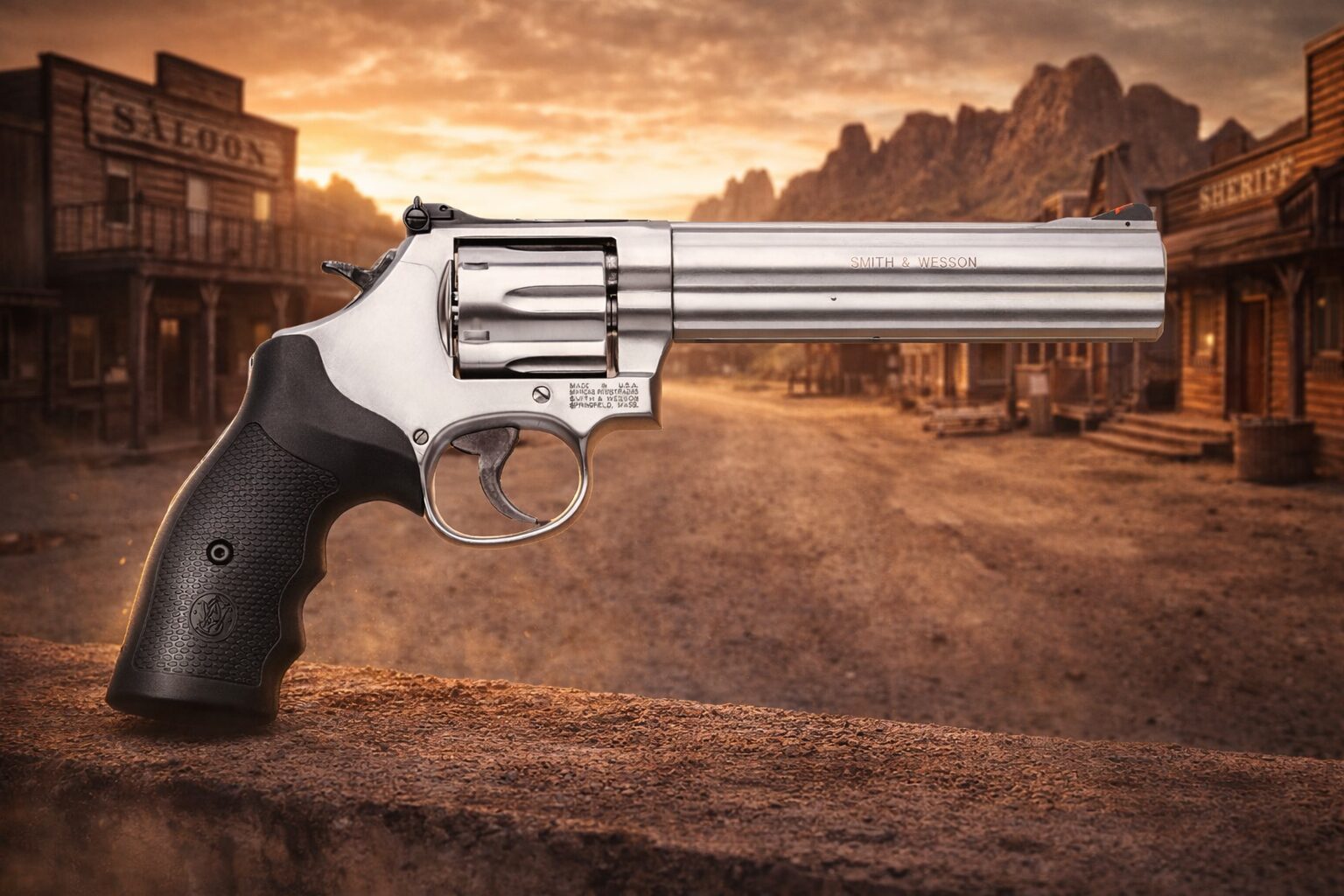
Affiliate Disclosure: This article contains affiliate links. If you buy through our links we earn a small commission and we get to keep bringing you cool guns like the Smith & Wesson 686 Plus.
- Treat every gun as loaded
- Point the muzzle in a safe direction
- Keep your finger off the trigger until you’re ready to shoot
- Know your target and what’s beyond
Spec as Tested
- Caliber: .357 Magnum / .38 Special
- Capacity: 7 Rounds (Plus Model)
- Weight: 44.2 oz (Empty)
- Barrel Length: 6″ Stainless Steel
- Current MSRP: $979.00
- Real World Pricing: $840.00+
- USA Gun Shop Rating: 9.2/10
S&W 686
History of the S&W 686
The Smith & Wesson 686 is one of the Godfathers of modern firearms. This specific model joined the world in the 1980s as the L Frame, but let’s get real. This is an old world six-shooter, or seven shooter in this case, and it’s lineage goes all the way back to 1857 and the Smith & Wesson Model 1.
Back to the 80s, and the L-Frame was the answer to the smaller K-frame’s durability problems. It couldn’t really handle modern 357 Magnum loads. This can, the stainless steel SW 686 can eat 357 Magnum all day long, every day.
It is a double-action/single-action revolver built on a medium-large frame that strikes a perfect balance between strength and portability. This is no carry gun by modern standards, not under your clothes at least, but the Smith and Wesson 686 is an old-favorite for woods carry in dangerous animal territory, home defense and pure target shooting.
Now the Smith and Wesson 686 has evolved to cover all those specialties, as well as the all-rounder base model. There’s a wild amount of these pistols out there, in different barrel lengths, configurations, and price bands.
In an era of polymer and strikers, the 686 is a slab of stainless steel and history. We’re looking specifically at the 686 Plus model, which squeezes an extra round into the cylinder for a total of seven, giving you that extra bit of insurance when things go sideways.
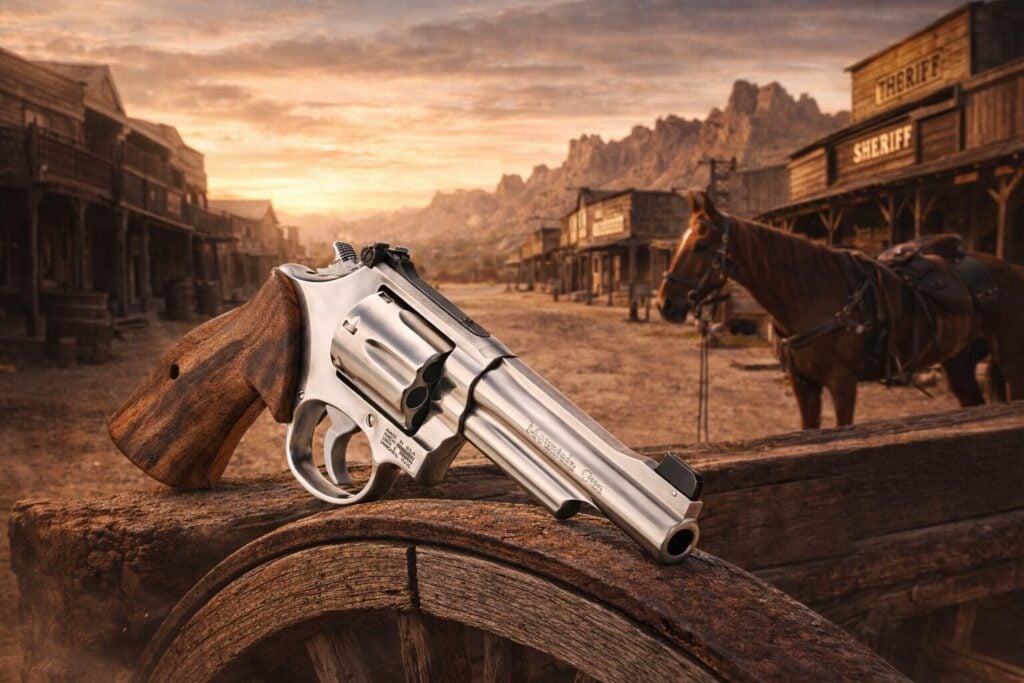
Quick Take: The King of the .357 Magnums
If you could only own one revolver for the rest of your life, this is likely it. The 686 offers a level of versatility that few firearms can match. You can feed it soft-shooting .38 Special for a relaxed day at the range, or load it with heavy .357 Magnum bear loads for a hike in the backcountry.
The build quality in 2026 remains high, though purists will still complain about the internal “Hillary Hole” locking mechanism. Despite the modern competition from the resurrected Colt Python and the Ruger GP100, the S&W 686 maintains the best balance of trigger quality, aftermarket support, and raw accuracy. It is a tool that feels like an heirloom.
Pros
- Built like a tank; handles full-house .357 loads with ease
- Excellent out-of-the-box single-action trigger
- The 7-round ‘Plus’ capacity offers a clear edge over 6-shot rivals
- Stunning stainless steel finish that resists corrosion
- Massive aftermarket for grips, holsters, and sights
Cons
- Internal lock (Hillary Hole) is still a point of contention
- The 6-inch barrel model is heavy for all-day carry
- Factory rubber grips are functional but lack soul
- Double-action pull can be heavy for beginners
- Recent price hikes have pushed it near the $1k mark
Best For: Home defense, hunting sidearms, and recreational shooters who want a firearm that will last longer than they will.
S&W 686 Plus
Competitor Comparison
S&W 686 vs Ruger GP100 – $770+
The Ruger GP100 is the 686’s main blue-collar rival. It’s built even beefier than the S&W, often described as a “brick of steel.” However, the 686 usually wins on trigger pull and aesthetics. The Ruger feels like a tool; the S&W feels like a precision instrument.
S&W 686 vs Colt Python – Approx. $1,000+
The Colt Python is the beauty queen. It has a higher polish and a distinct, buttery-smooth action. But it costs nearly double. In my experience, the 686 is more “duty-ready,” whereas the Python is something you’re afraid to scratch in the woods.
S&W 686 vs Taurus Raging Bull/Raging Hunter – $700+
Taurus is a cut-price alternative to the S&W, and the Raging Bull is a solid handgun. The Taurus Raging Hunter comes with a ported barrel and other tricks you see on the Performance Center handguns, for less than $900. It’s not quite as well put together, but it does the job.
S&W 686 vs Kimber K6s Target – $1,050+
The Kimber is a newer contender. It’s smaller and more refined for concealed carry. While the K6s has a phenomenal double-action trigger, it can’t handle the sheer volume of high-pressure magnums that the L-Frame 686 can without getting uncomfortable.
Want to check the prices of these and other firearms? Use our price comparison tool here.
And if you want a fuller list of the best 357 Magnum revolvers on sale. We got that too.
Find the Best Price in Seconds
Search once, compare 100+ trusted retailers instantly.
Who Should NOT Buy This Gun?
First, concealed carry newcomers should be cautious. Even the 4-inch model is heavy, and the 6-inch model we tested is nearly impossible to hide without a trench coat. If you want an everyday carry piece, look at the S&W 642 or a modern micro-compact 9mm.
Second, if you have very small hands or weak grip strength, the double-action trigger pull (approx. 12 lbs) can be a chore to master. While the single-action is light, you shouldn’t rely on cocking the hammer in a high-stress defensive situation.
Third, low-maintenance owners. Revolvers don’t jam like Glocks, but they do require specific cleaning. Carbon build-up on the cylinder face and under the extractor star can seize a revolver up if you don’t keep on top of the maintenance. They’ll go forever if you take care of them, but if gun cleaning isn’t your thing then get a Glock.
S&W 686 Variants and Models
- 686 Standard: The classic 6-shot configuration.
- 686 Plus: The 7-shot variant (Our recommendation).
- 686 Performance Center: Tuned triggers, vent ribs, and moon-clip cuts for competition.
- 686 Snubbie: 2.5-inch or 3-inch barrel for “compact” (heavy) carry.
- The 586: The carbon steel, blued version for those who prefer a dark, classic look.
That’s the snapshot. In truth you’ll be blown away by the sheer volume of 686 variants that come with everything from a 2 inch barrel for CCW through to a ported and counterweighted 6 inch barrel and beyond for serious shooters and hunters.
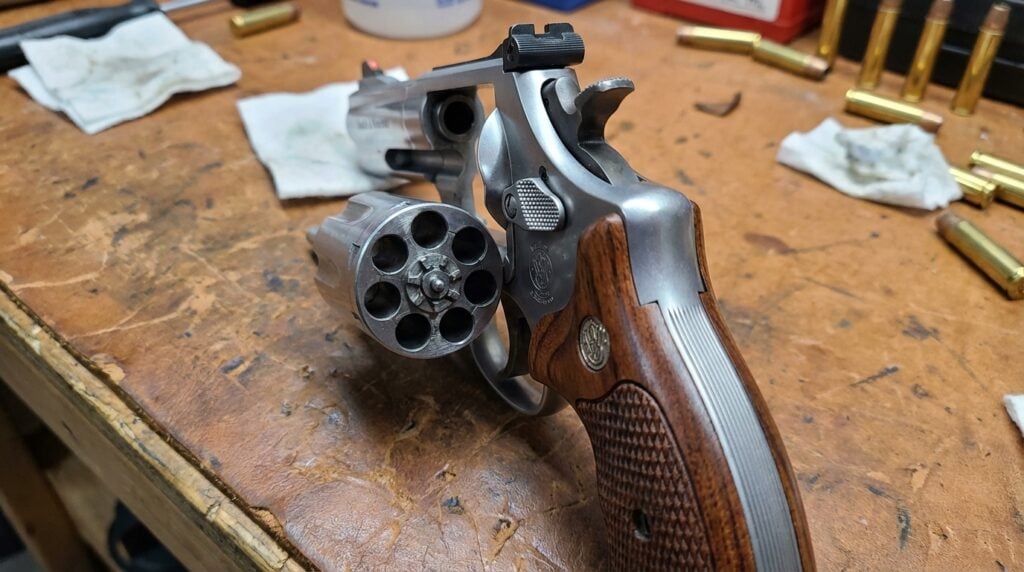
Smith & Wesson 686 Quirks and Features
The L-Frame Ergonomics
The L-Frame was the “Goldilocks” solution. The K-Frame (Model 19) was too light for constant magnums, and the N-Frame (Model 27) was too large for many hands. The 686 hits that sweet spot. The balance on the 6-inch model is front-heavy, which is exactly what you want to keep the muzzle down during rapid fire.
Stainless Steel Durability
S&W uses high-grade stainless steel that is remarkably resilient. I’ve carried 686s through rain, snow, and swampy humidity. A quick wipe-down with an oily rag is usually all it takes to keep it looking factory-new.
Adjustable Sights
Unlike fixed-sight revolvers, the 686 features a fully adjustable rear notch. This is critical because .357 Magnum and .38 Special have vastly different points of impact. You can zero this gun for your specific carry load, which is a luxury you’ll appreciate at 25 yards.
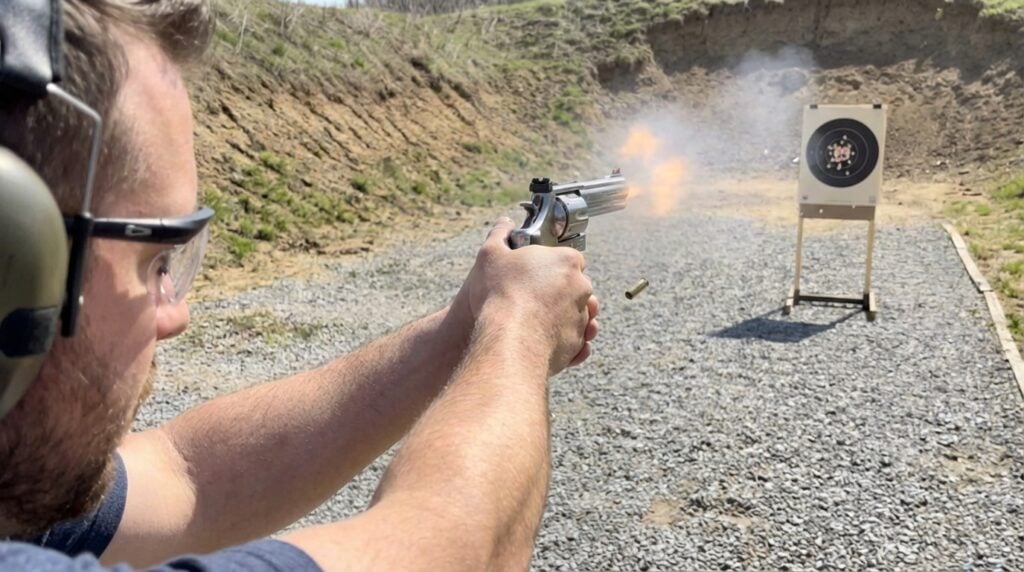
Range Time: 1,500 Round Test
We spent three days at the range with 1000 rounds of 158gr .38 Special FMJ and 500 rounds of 125gr .357 Magnum JHP.
Reliability
It’s a revolver. It doesn’t care about limp-wristing, and it doesn’t care about bullet profile. Every time the hammer fell, the gun went bang. We did experience some cylinder “drag” around the 400-round mark due to heavy carbon buildup on the front of the cylinder, but a 30-second wipe-down fixed it immediately.
Accuracy
This is where the 686 earns its keep. In single-action mode, the trigger breaks like a glass rod at about 3.5 lbs. At 15 yards, I was able to put 7 rounds into a group the size of a golf ball. Even in double-action, the pull is smooth and predictable, allowing for surprisingly accurate rapid fire.
Recoil Management
The full underlug barrel on the 6-inch model acts as a counterweight. Shooting .38 Specials feels like shooting a .22. When you step up to full .357 Magnums, there is a definite “thump” and a flash, but the weight of the steel frame soaks up the sting that usually ruins smaller revolvers.
Known Issues and Problems
The Hillary Hole. Since the early 2000s, S&W has included an internal locking hole just above the cylinder release. While failures are extremely rare, some enthusiasts fear the lock could engage under heavy recoil. Most shooters never notice it, but it remains a dealbreaker for a vocal minority.
Another issue is Cylinder Timing. On high-mileage guns, the cylinder might not perfectly align with the barrel. Always check for “play” when the hammer is cocked. On a new 2026 model, this shouldn’t be an issue, but it’s something to watch for after several thousand rounds.
Parts, Accessories & Upgrades
- Grips: The factory rubber is okay, but a set of Hogue Exotic Hardwood grips makes this gun look like a million bucks.
- Holster: For woods carry, the Galco DAO Strongside/Crossdraw holster is the industry standard.
- Speedloaders: Get the HKS 587-A speedloaders. They are cheap, reliable, and essential for the 7-shot Plus model.
- Sights: A fiber optic front sight from Dawson Precision makes the gun much faster to get on target in low light.
I think the best places for 686 parts & accessories include:
- Brownells: A solid bet for parts and accessories for pretty much every classic handgun.
- PSA: Another safe bet for gun parts of pretty much any description
- Optics Planet: Surprisingly massive selection of accessories, these guys are getting better and better.
The Verdict
The Smith & Wesson 686 is a masterpiece of mechanical engineering. It is one of the few firearms that is equally at home in a bedside safe, a hunting holster, or a display case. It is accurate, devastatingly powerful, and built to outlast its owner. In 2026, it remains the standard by which all other .357 Magnums are judged.
Overall Score: 9.2/10