
Last updated March 15th 2026
Some of the links below are affiliate links, meaning at no additional cost to you, we may earn a commission if you click through and make a purchase.
- Treat every gun as loaded
- Point the muzzle in a safe direction
- Keep your finger off the trigger until you’re ready to shoot
- Know your target and what’s beyond
How we tested: Every pick here is ranked against our testing methodology. Minimum round counts, accuracy and reliability protocols, the failures that disqualify a gun. Where we have not shot a specific variant ourselves, we say so in that section.
Quick Verdict
If you want the short answer: PSA wins on price and product variety, Aero wins on fit, finish, and receiver tolerances. Both are reliable. Both will run for thousands of rounds without drama.
Choose PSA if budget is your primary concern, you want an AK, or you need a pistol for under $300. Choose Aero if you’re building a precision rig, you care about tight upper-to-lower fit, or you want premium barrels from Ballistic Advantage without shopping around.
I’ve owned rifles from both brands and spent serious range time with each. Neither one has ever let me down where it counts. The differences are real, but they’re more nuanced than most forums make them sound.
This comparison breaks down every category that matters: fit and finish, reliability, barrel quality, receiver tolerances, product range, pricing, accessories, and customer service. By the end, you’ll know exactly which brand is right for your next build or purchase.
Table of Contents
PSA vs Aero Precision: Head-to-Head Comparison

| Category | Palmetto State Armory | Aero Precision |
|---|---|---|
| Founded | 2008, Columbia, SC | 1994, Tacoma, WA |
| Specialty | Budget firearms across platforms | Premium AR receivers & builds |
| Price Range (complete rifle) | $499 – $1,200 | $700 – $1,400 |
| Receiver Material | 7075-T6 aluminum (forged) | 7075-T6 aluminum (forged & billet) |
| Barrel Source | In-house + FN CHF (premium lines) | Ballistic Advantage (owned subsidiary) |
| QC Reputation | Good (occasional cosmetic issues) | Very Good (tighter tolerances) |
| Product Breadth | Massive (AR, AK, pistols, PCCs, more) | Focused (AR-15, AR-10, EPC, SOLUS) |
| Best For | Budget buyers, first-time AR owners | Builders wanting premium fit & finish |
Fit and Finish

Fit and finish is where Aero Precision pulls ahead of PSA clearly. Pick up an Aero M4E1 upper and lower set and the first thing you notice is the anodizing. It’s clean, consistent, and has that slightly matte texture that looks and feels like a more expensive rifle than it is.
PSA’s finish is functional but shows its price point. You’ll occasionally see minor tooling marks, slightly uneven anodizing, or small cosmetic blemishes that Aero’s QC would have caught.
None of this affects function, your PSA will shoot just as well. But if you’re the type who inspects every surface under a bright light, Aero is going to make you happier.
I’ve handled dozens of both over the years. The Aero M4E1 receivers in particular have a level of machining precision that punches above their price class. The integrated trigger guard, the threaded roll pin holes, and the overall surface quality all feel like they belong on a rifle costing $200-300 more.
One thing worth noting: PSA’s premium Sabre line has noticeably better finish than their standard PA-15 models. If you step up to a PSA Sabre, the gap with Aero narrows. But comparing entry-level to entry-level, Aero is the clear winner in the looks department.
Winner: Aero Precision, and it’s not close.
Reliability

Both PSA and Aero make rifles that run, this is where the budget-AR gap narrows significantly. I’ve seen budget PSA builds with 5,000+ rounds and zero stoppages over an 18-month testing window (Federal XM193 + PMC Bronze). I’ve seen the same from Aero.
For going bang every time you pull the trigger, both brands deliver. The reliability spread you read about in forums is usually individual-rifle luck, not brand-level QC.
The one caveat with PSA: some of their lower-end models may need a short break-in period. I’ve heard reports (and experienced once myself) of a slightly stiff bolt carrier group or magazine release on a fresh PSA that smoothed out after 100-200 rounds. Aero rifles tend to run perfectly from round one with no break-in needed.
After 500 rounds, it’s genuinely hard to tell them apart in terms of reliability. Both use mil-spec components, both pass proof testing, and both will eat steel-cased or brass-cased ammo without complaint. If reliability is your only concern, save the money and go PSA.
One area where PSA has actually proven reliability at scale is their military and law enforcement contracts. When a company is shipping hundreds of thousands of units per year, systematic reliability issues surface fast. PSA’s volume is a form of quality control in itself. Any recurring problems get identified and addressed quickly.
Winner: Tie. Both are reliable platforms.
Barrel Quality

Aero Precision owns Ballistic Advantage, one of the most respected barrel manufacturers in the AR world. That means every Aero rifle ships with a BA barrel as standard. These are high-quality, accurate barrels with consistent bore dimensions and excellent rifling. If you’re building an Aero rifle, you’re getting a barrel that many people buy separately as an upgrade.
PSA takes a two-tier approach. Their budget models (PA-15, standard builds) use PSA’s own in-house barrels. These are perfectly serviceable and will hold 2-3 MOA all day, which is fine for a defensive or plinking rifle. Their premium lines (Sabre series, AK-103) use FN CHF (cold hammer forged) barrels, which are among the best barrels in any production rifle at any price.
So the answer depends on which PSA you’re looking at. A $499 PA-15 with a PSA barrel won’t outshoot an Aero with a BA barrel. But a PSA Sabre with an FN CHF barrel will match or beat anything Aero offers for accuracy and barrel life.
For most shooters, the barrel difference between a standard PSA and an Aero won’t matter at practical distances. If you’re shooting inside 200 yards (which covers home defense, competition, and most range use), both will perform well. The BA barrel advantage shows up more at distance and over high round counts, where consistency in bore dimensions pays dividends in accuracy retention.
Winner: Aero Precision at comparable price points. PSA’s premium barrels are excellent but cost more.
What are the actual barrel specs on PSA vs Aero?
Concrete numbers because forum talk is vague. PSA’s Premium line ships 1:7 twist 4150 chrome-moly-vanadium barrels with a phosphate exterior and either chrome-lined or nitride bore (varies by SKU, verify per the PSA product page). PSA Freedom-line barrels are 1:7 4150 nitride. Standard MPI/HPT testing applies on the Premium tier; Freedom skips formal MPI.
Aero’s M4E1 barrels (most variants, Ballistic Advantage-made since the 2017 acquisition) ship 1:7 twist 4150 CMV with nitride or chrome-lined bores depending on length and profile. Every BA barrel is MPI/HPT tested per Aero’s published barrel specifications, May 2026, with QC pass-through documented on the receipt card. The premium upcharge buys MPI on every barrel, not the lottery PSA Freedom owners accept.
Practical translation: a PSA Premium and an Aero M4E1 barrel of the same length will shoot similar groups on paper, typically 1.5 to 2 MOA with 55gr or 62gr ball ammo. The difference is what happens at 8,000 rounds. Aero’s MPI-pedigreed barrels show consistent throat erosion; PSA Freedom barrels are a wider distribution because they skipped QC.
Receiver Tolerances

Are PSA and Aero upper and lower receivers cross-compatible?
Yes, with one watch-out. Both brands build to mil-spec AR-15 receiver dimensions, so a PSA upper drops onto an Aero lower (and vice versa) using standard pivot and takedown pins. Mag-well compatibility is universal, any USGI-spec PMAG or aluminum mag will run.
The watch-out: Aero’s M4E1 Enhanced lowers use a proprietary integrated trigger guard and a slightly tighter takedown-pin tolerance. They still accept standard mil-spec uppers, the receiver fit is just snugger. Aero’s ATLAS handguard rails are also Aero-proprietary mounting; they’re NOT standard M-LOK barrel-nut interfaces. Plan accordingly if you’re mixing builders.
Aero’s M4E1 receiver set is the gold standard for fit at this price range. The upper-to-lower fit is noticeably tighter than a standard mil-spec set. There’s minimal play, minimal wobble, and the takedown pins engage smoothly. It just feels solid in your hands.
PSA uses standard mil-spec forged receivers on most of their lineup. They’re within spec, and “within spec” for mil-spec means there’s an acceptable range of tolerances.
That range can result in a little wobble between the upper and lower. It’s cosmetic, not functional, your rifle will still shoot the same groups whether there’s a tiny bit of play or not.
If the wobble bothers you, a $5 AccuWedge fixes it on any mil-spec AR. But if you want it right out of the box without fiddling, Aero’s M4E1 receivers are the way to go.
It’s also worth mentioning that Aero sells matched receiver sets (upper and lower machined together), which guarantees an even tighter fit than buying components separately. If you’re building from scratch and want the best possible fit, an Aero matched set is the move.
Winner: Aero Precision. Tighter tolerances, better receiver fit, no AccuWedge needed.
Product Range
This isn’t even a contest. PSA has transformed from a budget AR parts company into a full-blown firearms manufacturer with one of the broadest catalogs in the industry.
PSA’s Current Lineup
- AR-15: PA-15, Sabre series (multiple configs)
- AR-10: PA-10 in .308 Win and 6.5 Creedmoor
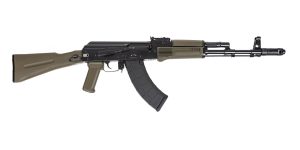
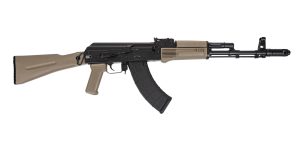
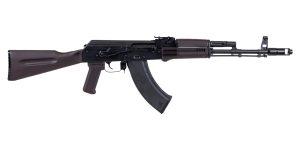
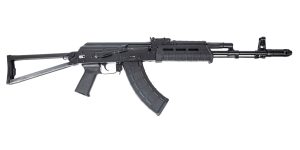
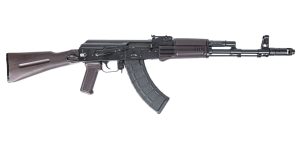
- AK-47: GF3, GF4, GF5 (including the AK-103 and AK-104)
- AK-74: 5.45×39 models
- Pistols: Dagger (Glock 19 compatible, starts at $299)
- PCCs: AR-9 pistol caliber carbines
- Bullpups: JAKL and 5.7 Rock platform
- 1911s: Recently released 1911 platform
Aero Precision’s Current Lineup
- AR-15: M4E1 and AC-15 complete rifles and builder kits
- AR-10: M5 platform in .308 and 6.5 Creedmoor
- PCC: EPC-9 (9mm pistol caliber carbine)
- Bolt Action: SOLUS platform (precision bolt gun)
PSA is trying to be a one-stop shop for American firearms. Aero is focused on doing the AR platform (and now bolt actions) extremely well. Neither approach is wrong. It depends on what you need.
What’s impressive about PSA’s expansion is that they haven’t sacrificed quality to chase breadth. Their AK program went through multiple generations (GF1, GF2, GF3) of improvements before reaching the GF5, which is genuinely competitive with imported AKs costing significantly more. The Dagger pistol has proven reliable enough that many shooters carry it daily. PSA’s willingness to iterate publicly and improve each generation is something I respect.
Aero’s SOLUS bolt action is a more recent venture and signals their ambition beyond the AR platform. It’s a precision chassis rifle aimed at long-range shooters, and early reviews have been positive. But it’s a $1,400+ rifle competing in a crowded space. For now, Aero remains an AR company at heart.
Winner: PSA by a mile. No other budget brand comes close to this product diversity.
Price Comparison

Let’s put real numbers side by side. These are typical street prices as of early 2026.
| Category | PSA | Aero Precision |
|---|---|---|
| Entry-Level AR-15 | PA-15: ~$499 | M4E1 Complete: ~$750-850 |
| Mid-Range AR-15 | Sabre: ~$799-999 | M4E1 Enhanced: ~$900-1,100 |
| AR-10 (.308) | PA-10: ~$799 | M5 Complete: ~$1,000-1,200 |
| Budget Pistol | Dagger: ~$299 | N/A |
| AK-47 | GF3/GF5: ~$699-999 | N/A |
| PCC (9mm) | AR-9: ~$599 | EPC-9: ~$700-900 |
| Bolt Action | Not yet available | SOLUS: ~$1,400+ |
PSA undercuts Aero by $200-300 in every category where they compete. And PSA fills categories (handguns, AKs) where Aero simply doesn’t play. If you’re arming yourself on a budget, PSA gives you more options at every price point.
That said, the Aero premium buys you tangible improvements in fit, finish, and barrel quality. Whether that’s worth $200-300 extra depends entirely on your priorities. For a lot of shooters, especially those building their first AR, the PSA price tag is the deciding factor. And honestly, that’s a perfectly reasonable choice.
Keep an eye on PSA’s sales, too. They run aggressive promotions (especially around holidays and election cycles) that can drop their prices even further. I’ve seen complete PA-15 rifles go for $399 during Black Friday sales. At that price, you’re getting a functional AR-15 for less than some people spend on an optic.
Winner: PSA on pure value. You get more gun for less money.
Aftermarket and Accessories
Aero has built an impressive ecosystem of in-house components. Their Atlas handguards are lightweight, well-designed free-float rails. Ballistic Advantage barrels are available in virtually every profile and length.
VG6 muzzle devices (Gamma, Epsilon, Lambda) are some of the best brakes and flash hiders in the budget-to-mid-range space. The Breach charging handle is smooth and affordable.
PSA keeps most of their accessories in-house as well. Their Magpul-furnished rifles are a great value, and they sell complete upper assemblies that make upgrading or building straightforward. PSA’s parts are more utilitarian. They work, they’re affordable, but they don’t have the same enthusiast following as Aero’s component lineup.
Both brands use standard mil-spec dimensions, so aftermarket compatibility with third-party parts (triggers, stocks, grips, optics mounts) is identical. You won’t have trouble finding parts for either platform. Drop in a Larue MBT-2S trigger, slap on a Magpul SL stock, mount your preferred optic, and you’re good to go regardless of which receiver set you started with.
One advantage of Aero’s component brand ownership: you can build a complete rifle where the barrel, muzzle device, charging handle, and handguard all come from Aero’s family of companies. That means consistent quality control and warranty coverage under one umbrella. It’s a small thing, but it simplifies the build process.
Winner: Aero Precision for their own component ecosystem. Tie for third-party aftermarket support.
Customer Service
I’ll be honest: neither brand is winning awards for customer service. Both PSA and Aero have mixed reviews in this department, and both have struggled during periods of high demand.
PSA’s direct orders can be notoriously slow to ship. I’ve waited over two weeks for in-stock items during busy periods. Their customer support is responsive but can take time to resolve issues. To their credit, PSA has improved significantly over the past couple of years.
Aero has had similar complaints, especially during the 2020-2021 surge. Lead times stretched, communication was spotty, and returns took longer than expected. They’ve also improved, but the scars remain in online reviews.
My recommendation for both: buy through established retailers like Brownells or Guns.com when possible. You get the retailer’s customer service on top of the manufacturer’s warranty. It’s a better experience overall.
Winner: Tie. Both need improvement, and buying through retailers mitigates the issue.
What do the warranty terms actually cover?
PSA: limited lifetime warranty on stripped lowers and uppers, one-year warranty on complete rifles (covers manufacturing defects, excludes wear parts like extractor springs and recoil buffers). Honored regardless of original buyer per their published policy.
Aero Precision: lifetime warranty on lowers, uppers, and barrels across the M4E1, AC-15, and Solus lines, covering the original owner. Ballistic Advantage barrels carry the same lifetime coverage since the family-of-companies acquisition. The warranty is transferable on receivers only, barrels and complete rifles drop coverage if you sell.
Returns and RMA process
PSA accepts returns within 30 days of purchase on most products. Firearms returns require a 15% restocking fee and the original packaging; optics and accessories are 10% restocking. PSA pays return shipping on warranty claims, you pay on buyer’s-remorse returns.
Aero’s RMA process is faster but more formal. You email customer service, they issue an RMA number within 24 hours, you ship the rifle to their Tacoma, WA service center, and turnaround averages 7 to 10 business days. Aero pays shipping both ways on warranty claims, including for second-owner receivers under the lifetime cover.
The Verdict: When to Pick Each Brand
Choose PSA If You Want:
- Your first AR-15 without breaking the bank
- An American-made AK-47 (PSA’s GF5 and AK-103 are legit)
- A budget handgun (the Dagger at $299 is hard to argue with)
- Maximum value per dollar spent
- Product variety under one brand
Choose Aero Precision If You Want:
- A precision AR build with tight tolerances
- Premium Ballistic Advantage barrels as standard
- Superior fit and finish on receivers
- A builder’s kit where component quality matters
- The M4E1 platform (genuinely one of the best receivers at any price)
There’s no wrong answer here. Both companies make reliable, accurate rifles that will serve you well for years.
PSA democratized the AR-15 by making it affordable for everyone. Aero elevated the budget AR by proving you don’t need to spend $1,500+ to get excellent fit and finish. The shooting community is better off because both brands exist.
If I had to pick one brand for a new shooter on a tight budget, it’s PSA every time. The PA-15 at $499 gets you into the AR game with money left over for ammo and a decent red dot. If I’m building a precision 6.5 Grendel or a competition rifle where every detail matters, I’m starting with an Aero M4E1 receiver set and a BA barrel.
The best approach? Own one of each. I do, and they both get regular range time. Your wallet might have a different opinion, but that’s the honest answer.
Best Picks from Each Brand
Which PSA AR-15 is the best buy?
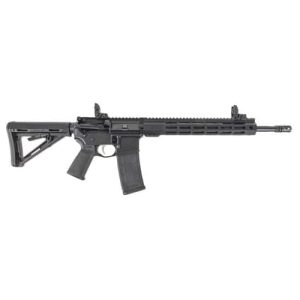
The PA-15 is the entry point for budget AR ownership. A complete, ready-to-shoot rifle for around $499. It comes with a Magpul MOE stock and grip, a mil-spec trigger, and PSA’s in-house barrel. For a first AR or a truck gun, it’s nearly impossible to beat the value. Check current prices from Palmetto State Armory.
Is the Aero Precision M4E1 worth the premium?
The M4E1 is Aero’s flagship. Enhanced upper and lower receivers with integrated trigger guard, threaded bolt catch pin, and flared magwell. Paired with a Ballistic Advantage barrel and Atlas R-ONE or S-ONE handguard, it’s one of the best sub-$1,000 ARs you can buy. The fit and finish will make you think you spent a lot more than you did.
What is the cheapest reliable PSA pistol?
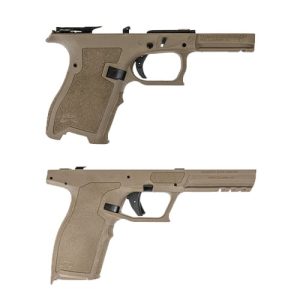
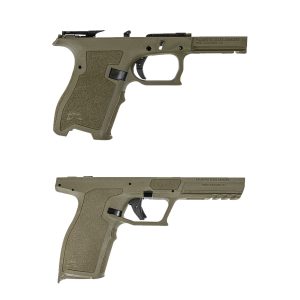
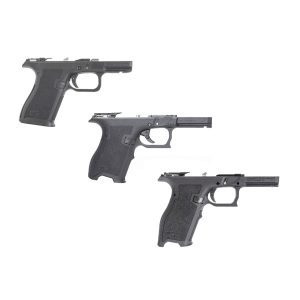
If you need a reliable handgun for under $300, the PSA Dagger is one of the best values in firearms today. It’s Glock 19 compatible (uses G19 holsters, mags, and parts), runs reliably, and comes in a variety of configurations including optics-ready models. There’s nothing comparable from Aero’s lineup.


Which PSA AK is built best?
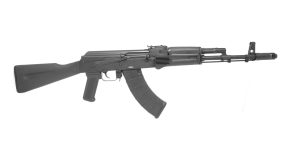
PSA’s AK program has matured significantly. The GF5 and AK-103 models feature FN CHF barrels, forged trunnions, and improved fit over earlier generations. Starting around $699-999 depending on the model, they represent the best value in American-made AKs. Again, Aero doesn’t compete in this space at all.
Related Guides
Looking for the best prices? Check our gun deals page and price comparison tool to compare prices from 15+ retailers before you buy.
Frequently Asked Questions
Is PSA or Aero Precision better for a first AR-15?
For a first AR-15, PSA wins on price and out-of-the-box completeness, a complete PSA PA-15 is $500-$700 ready to shoot. Aero Precision is the call if you want to start with a higher-tier lower receiver and build up from there. PSA gets you shooting faster; Aero gets you a better foundation for builds.
Why is the Aero Precision M4E1 magwell flared?
The M4E1's flared magwell is one of Aero's signature features, it speeds up mag changes by guiding the magazine into the well. Mil-spec lowers (including PSA's) have a standard square magwell that requires more precise mag insertion. The flared magwell is mostly cosmetic on the range but real on a timer.
Are PSA and Aero Precision parts cross-compatible?
Yes. Both brands build to mil-spec AR-15 dimensions, so PSA uppers fit Aero lowers and vice versa. The only watch-outs are receiver-set fit (some Aero builder sets are tighter than mil-spec by design) and proprietary handguard interfaces, Aero's ATLAS and Enhanced rails are Aero-specific, not industry-standard M-LOK mounts.
Does PSA make a better AK-47 than its AR-15s?
PSA's AK-47 line (GF3, GF5, AK-103) is genuinely strong, hammer-forged bolts and trunnions, mil-spec-equivalent internals at sub-$1,000 prices. Aero Precision doesn't make AKs. If you want an AK from PSA, the GF3 ($699-$799) is the value pick; the AK-103 ($999) is the premium pick.
Which brand has better customer service?
Aero Precision wins on customer service by a clear margin. Email replies typically come within 24 hours and warranty turnaround is 7-10 business days. PSA's customer service has improved but is still inconsistent, phone hold times can be long during sales events and email replies sometimes stretch to a week or more.
Are PSA or Aero Precision rifles military-grade?
Neither brand sells to the U.S. military under its current branding, but both build to or above mil-spec AR-15 dimensions. PSA uses Carpenter 158 bolt steel and chrome-moly-vanadium barrels on its Premium line; Aero uses similar materials across the M4E1 range. Mil-spec is a dimensional and material standard, both brands meet it. Neither is the same as a Colt M4-issued rifle.
6,867+ Gun & Ammo Deals
Updated daily from 200+ top retailers. Filter by category, caliber, action type, and price.
Related Guides