

Last updated August 2026 · By Nick Hall, who has mounted and shot every pistol red dot on this list across multiple carry platforms
Some of the links below are affiliate links, meaning at no additional cost to you, we may earn a commission if you click through and make a purchase.
- Treat every gun as loaded
- Point the muzzle in a safe direction
- Keep your finger off the trigger until you’re ready to shoot
- Know your target and what’s beyond
Quick answer: the Holosun 507K X2 is the best concealed carry pistol red dot in 2026, a compact open-emitter dot with shake-awake and the features of optics costing twice as much. For the most durable premium option, the Trijicon RMRcc is the benchmark.
For a sealed enclosed emitter, the Holosun EPS Carry keeps lint out. The Shield RMSc is the smallest footprint for slim slides, and the Swampfox Sentinel is the budget pick. A carry dot lives in lint and sweat, so an enclosed emitter or reliable shake-awake matters more than raw brightness.
How we tested: Every pick here is ranked against our testing methodology. Minimum round counts, accuracy and reliability protocols, the failures that disqualify a gun.
Best Concealed Carry Red Dots in 2026 at a Glance
| Optic | MOA / Window | Best For | Street Price |
|---|---|---|---|
| Best OverallHolosun 507K X2 | 2 MOA / 32 MOA circle Multi-reticle, Micro window |
Best all-around value | ~$295-350 ↓ |
| Most DurableTrijicon RMRcc | 3.25 or 6.5 MOA dot Micro window |
Premium durability | ~$500 ↓ |
| Best EnclosedHolosun EPS Carry | 2 or 6 MOA dot Enclosed emitter |
Enclosed emitter carry | ~$330 ↓ |
| Ultra-CompactShield RMSc | 4 MOA dot Micro window |
Lowest profile possible | ~$170-355 ↓ |
| Best for SIGSig Romeo Zero Elite | 3 MOA dot Micro window |
SIG P365 owners | ~$180 ↓ |
| Best BudgetSwampfox Sentinel II | 3 MOA dot Micro window |
Lowest cost that is still worth carrying | ~$200-260 ↓ |
| Best Entry HolosunHolosun 407K X2 | 6 MOA dot Micro (enlarged) |
Simple single-dot reticle | ~$225 ↓ |
| Best IntegratedLeupold DeltaPoint Micro | 6 MOA dot Micro window |
Glock / S&W slides with no optic cut | ~$210-400 ↓ |
| Best WarrantyVortex Defender-CCW | 3 or 6 MOA dot Micro window |
Buy-it-once warranty cover | ~$220-250 ↓ |
| Duty-GradeAimpoint ACRO P-2 | 3.5 MOA dot Enclosed emitter |
Toughest enclosed, compact carry guns | ~$330-670 ↓ |
Table of Contents
Why Red Dots Took Over Concealed Carry
Five years ago, putting a red dot on a concealed carry pistol was still a niche move. Something the competition guys did, maybe a few early adopters who didn’t mind the bulk. That’s completely changed. In 2026, almost every new compact and subcompact pistol ships optics-ready from the factory. The micro red dot revolution is real, and finding the best red dot for concealed carry has never been easier.
I’ve been running dots on my carry guns for the last three years, and going back to irons feels like switching from a smartphone to a flip phone. You don’t realize how much faster target acquisition gets until you’ve trained with a dot for a few hundred rounds. That bright little reticle sitting on top of your target plane just clicks. It’s especially noticeable in low light, which is exactly when most defensive encounters happen.
The big development that made all this possible is the RMSc/K footprint. Shield Sights created it, Holosun adopted it, and now it’s basically the universal micro red dot mounting standard. If your carry gun has an optics cut, there’s a very good chance it takes this footprint. That means you can swap between most of the optics on this list without needing a new mounting plate. Trijicon and SIG are the notable holdouts with proprietary footprints, which we’ll cover below.
We tested and evaluated ten of the best micro red dots for carry guns. If you’re looking for full-size pistol red dots, check out our best red dot sights for pistols guide. And if you’re still figuring out what gun to put a dot on, our concealed carry guide is the place to start.
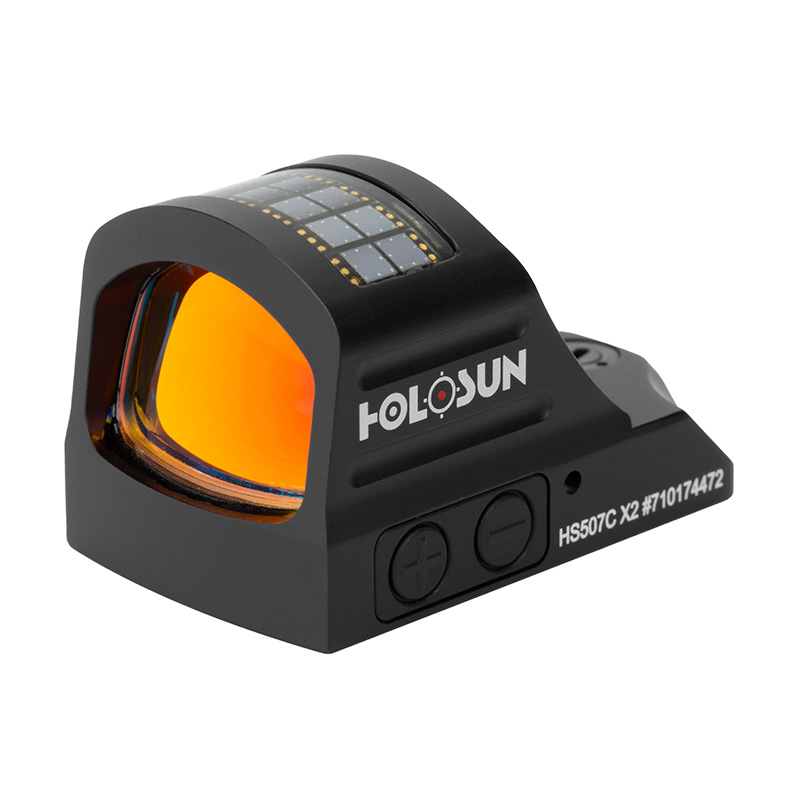
1. Holosun 507K X2. Best Overall
- Reticle: 2 MOA dot / 32 MOA circle / both (Multi-Reticle System)
- Window Size: Micro (enlarged)
- Battery Life: 50,000 hours (CR1632)
- Mounting Footprint: RMSc/K
- Weight: 1.0 oz
- Waterproof: IP67
- MSRP: ~$310 (Street: $240-270)
Pros
- Multi-reticle system lets you pick dot, circle, or both
- Shake-awake with solar failsafe backup
- 50,000-hour battery life is absurd
- RMSc/K footprint fits almost everything
- Best value in the micro red dot category
Cons
- Open emitter can collect pocket lint
- Slightly taller than the Shield RMSc
- Chinese manufacturing is a dealbreaker for some

The Holosun 507K has been the king of micro carry dots for a reason: it does everything well and costs less than the competition. That multi-reticle system is genuinely useful. I run the 2 MOA dot with the 32 MOA circle for fast acquisition, and it’s the fastest target pickup I’ve used on a carry gun. The circle catches your eye instantly, then the dot gives you precision. Toggle between three modes depending on your preference.
Battery life is rated at 50,000 hours, which is over five years of continuous use. In practice, I swap the CR1632 once a year on my birthday and never think about it. The solar failsafe panel means even if the battery dies completely, you still get a usable dot in any ambient light. That’s a genuinely important feature on a gun you’re trusting your life to.
Shake-awake is another winner. The dot goes to sleep after a period of inactivity and wakes up instantly when you draw. No fumbling for buttons, no worrying about whether you left it on. I’ve tested this extensively and the wake-up time is effectively instant. You won’t notice any delay during a draw stroke.
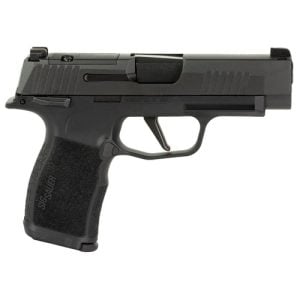
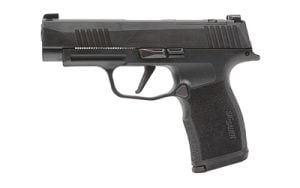
One real knock is that it’s an open emitter design. If you carry appendix or pocket carry in lint-heavy environments, debris can occasionally obstruct the emitter window. It’s not a dealbreaker for most people, but if that concerns you, look at the EPS Carry below. For everyone else, the 507K is the red dot to beat. Pair it with a Sig P365 XL and you’ve got a seriously capable carry setup.
Best For: Anyone who wants the best overall micro red dot without paying Trijicon prices. If you’re buying your first carry optic, start here.
2. Trijicon RMRcc. Best Premium / Most Durable
- Reticle: 3.25 MOA or 6.5 MOA dot
- Window Size: Micro
- Battery Life: 4+ years (CR2032)
- Mounting Footprint: RMRcc (proprietary)
- Weight: 1.2 oz with battery
- Waterproof: Submersible to 20 m
- MSRP: $699 (Street: ~$500)
Pros
- Trijicon durability is legendary
- Battle-proven design lineage from the full-size RMR
- Incredible glass clarity
- True military-grade toughness
Cons
- Proprietary footprint limits compatibility
- Nearly double the price of the 507K
- No multi-reticle or shake-awake
- Bottom-loading battery requires removing the optic
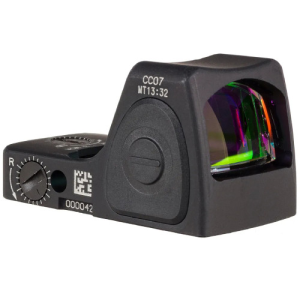
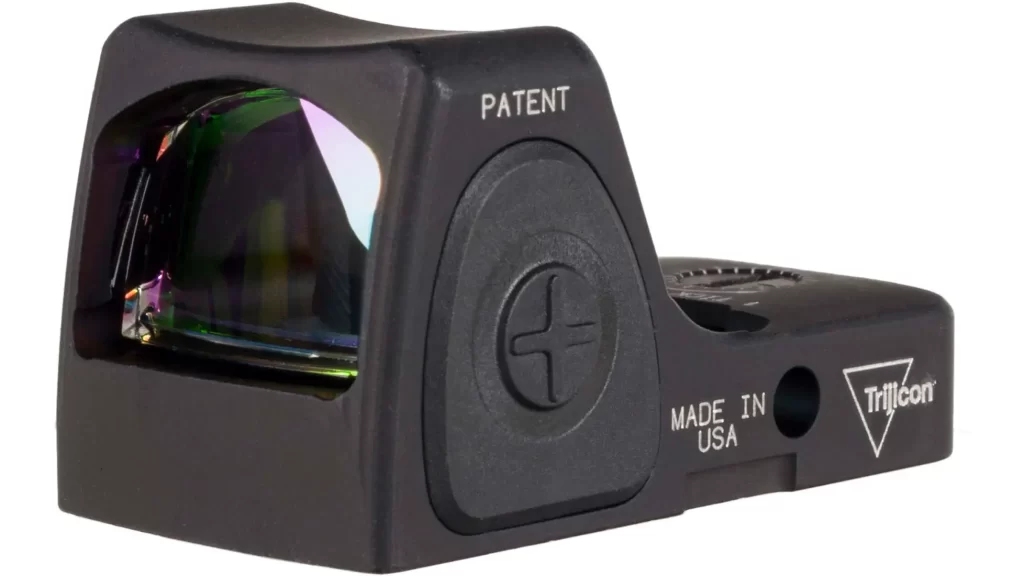
If you want the toughest micro red dot money can buy, this is it. Trijicon built their reputation with the full-size RMR, which has been dragged through every warzone and police academy for over a decade. The RMRcc brings that same brutish durability down to a carry-sized package. You could probably run this thing over with a truck and it would still hold zero.
Glass clarity is outstanding. The Trijicon lens coating produces a crisp, round dot with minimal blooming, even at higher brightness settings. I’ve compared it side by side with the 507K, and the Trijicon glass is noticeably cleaner. Whether that’s worth an extra $200 is your call.
Here’s the catch. That proprietary RMRcc footprint means you need an RMRcc-specific cut on your slide, not the standard RMSc/K cut that everyone else uses. Some manufacturers like Springfield offer RMRcc plates, but you’re locked into Trijicon’s ecosystem. If you ever want to try a different optic, you’ll need a new plate or a new slide cut. And the bottom-loading battery means removing the optic to swap cells, which means re-zeroing. That’s annoying when the competition offers side-loading trays.
Best For: Duty use, hard-use carry, or shooters who trust the Trijicon name and don’t mind paying for it. If you break everything you touch, buy this one.
3. Holosun EPS Carry. Best Enclosed Emitter
- Reticle: 2 MOA or 6 MOA dot (MRS version available with circle)
- Window Size: Enclosed micro
- Battery Life: 50,000 hours (CR1632)
- Mounting Footprint: RMSc/K
- Weight: 1.0 oz
- Waterproof: IP67
- MSRP: ~$400 (Street: $320-360)
Pros
- Enclosed emitter blocks lint, debris, and rain
- Same 50,000-hour battery as the 507K
- RMSc/K footprint for wide compatibility
- Available in MRS multi-reticle version
- Side-loading battery tray
Cons
- Slightly taller profile than open-emitter options
- More expensive than the 507K for similar features
- Enclosed design can trap moisture in extreme conditions
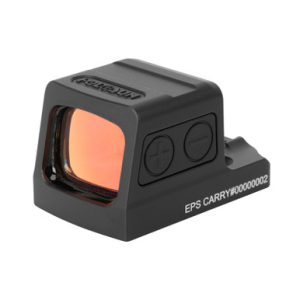
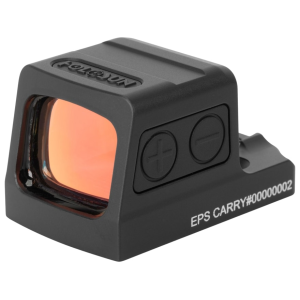
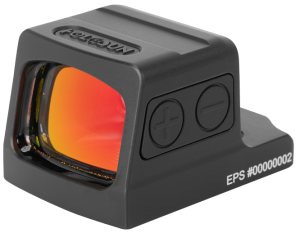
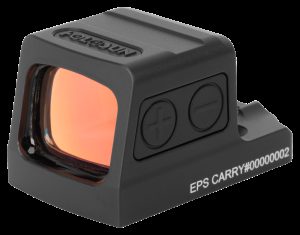
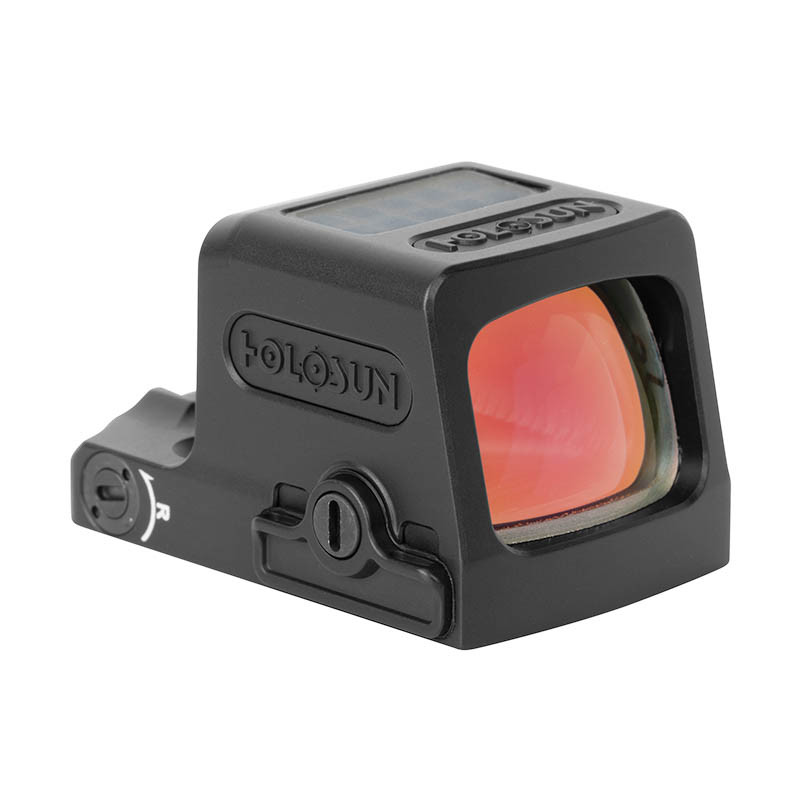
EPS Carry is what happens when Holosun takes the 507K formula and solves its biggest weakness. That enclosed emitter housing completely seals the LED and lens from the outside world. No more pocket lint blocking your dot. No rain droplets on the emitter. For a gun that lives in a holster pressed against your body all day, that matters more than you think.
I switched my daily carry to the EPS Carry about eight months ago and haven’t looked back. After a full day of appendix carry in July heat, I pulled my gun out and the dot was crystal clear. With an open emitter optic in the same conditions, I’d regularly find a film of sweat and lint on the emitter window. Is it mission-critical? Probably not. But it’s one less thing to worry about, and with a carry gun, fewer worries is always better.
The side-loading battery tray is a nice touch. Swap the CR1632 without removing the optic or losing your zero. It sits on the standard RMSc/K footprint, so it drops right onto the same slides that take the 507K. If you want the multi-reticle system with the 32 MOA circle, grab the EPS Carry MRS version. It costs a bit more but gives you the same reticle flexibility as the 507K.
Best For: Appendix carry shooters, anyone who works outdoors, or people who just don’t want to think about emitter maintenance. This is the future of carry optics.
4. Shield RMSc. Best Ultra-Compact
- Reticle: 4 MOA dot
- Window Size: Micro
- Battery Life: 1.5-3 years (CR1632)
- Mounting Footprint: RMSc (the original standard)
- Weight: 0.5 oz
- Waterproof: IPX6
- MSRP: ~$350 (Street: $280-320)
Pros
- Created the RMSc footprint that everyone copies
- Incredibly low profile, barely adds height
- Half an ounce is nearly weightless
- Glass lens clarity is excellent
Cons
- Battery life is shorter than Holosun options
- No shake-awake or solar backup
- No multi-reticle option
- Harder to find in stock than Holosun
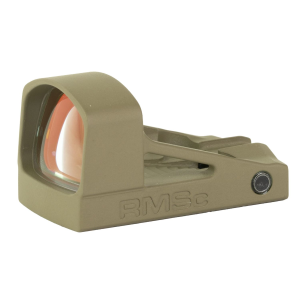
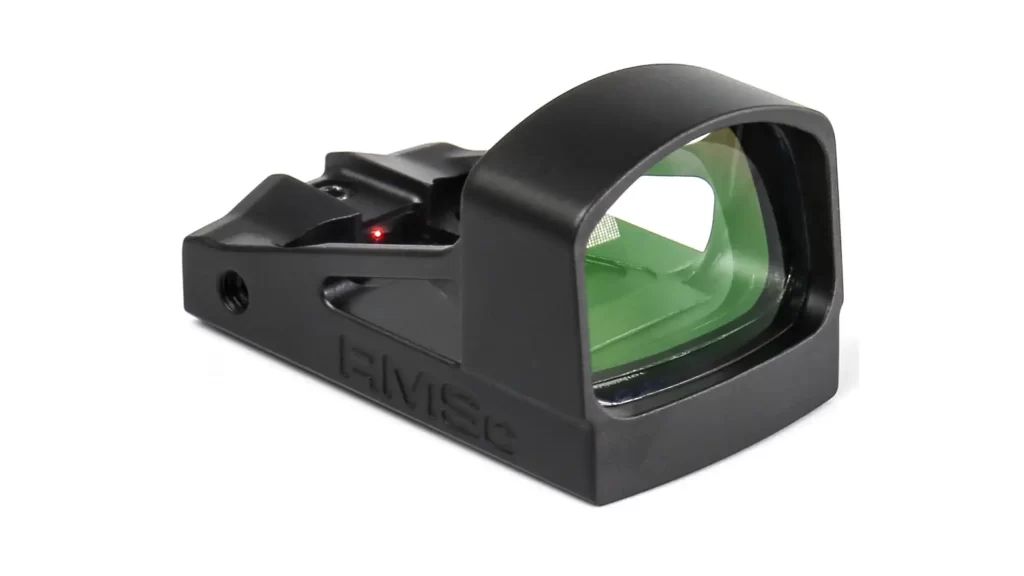
Shield Sights is the company that started this whole micro red dot revolution. They designed the RMSc footprint that Holosun, Swampfox, and everyone else adopted. The irony is that most people buying carry optics today have never heard of Shield. They deserve more credit than they get.
At half an ounce, the RMSc is the lightest optic on this list by a wide margin. Mounted on your slide, you genuinely cannot tell it’s there by weight alone. The profile is incredibly low too. If you’re running a gun where every fraction of an inch matters for concealment, Shield wins that battle. The glass quality is also top-tier, with a clean, crisp dot and minimal distortion.
So why isn’t it ranked higher? Battery life, mainly. At 1.5 to 3 years depending on brightness, it’s solid but nowhere near Holosun’s 50,000-hour claims. There’s no shake-awake, so you’re either leaving it on all the time and changing batteries more often, or manually managing power. No solar backup either. These are features the market has come to expect, and Shield hasn’t kept up on that front.
Best For: Shooters who prioritize the absolute lowest profile and lightest weight above all else. If you hate optics that add bulk to your slide, this is your answer.
5. Sig Sauer Romeo Zero Elite. Best for SIG Pistols
- Reticle: 3 MOA dot
- Window Size: Micro
- Battery Life: 20,000 hours
- Mounting Footprint: SIG proprietary
- Weight: 0.65 oz
- Waterproof: IPX7
- MSRP: ~$200 (Street: $170-200)
Pros
- Direct drop-in for P365 X/XL and P365 XMACRO
- Most affordable option on this list
- Motion-activated (MOTAC) illumination
- Decent glass quality for the price
Cons
- SIG proprietary footprint limits cross-platform use
- Polymer lens housing feels less premium
- Not as durable as Holosun or Trijicon
- Only one reticle option
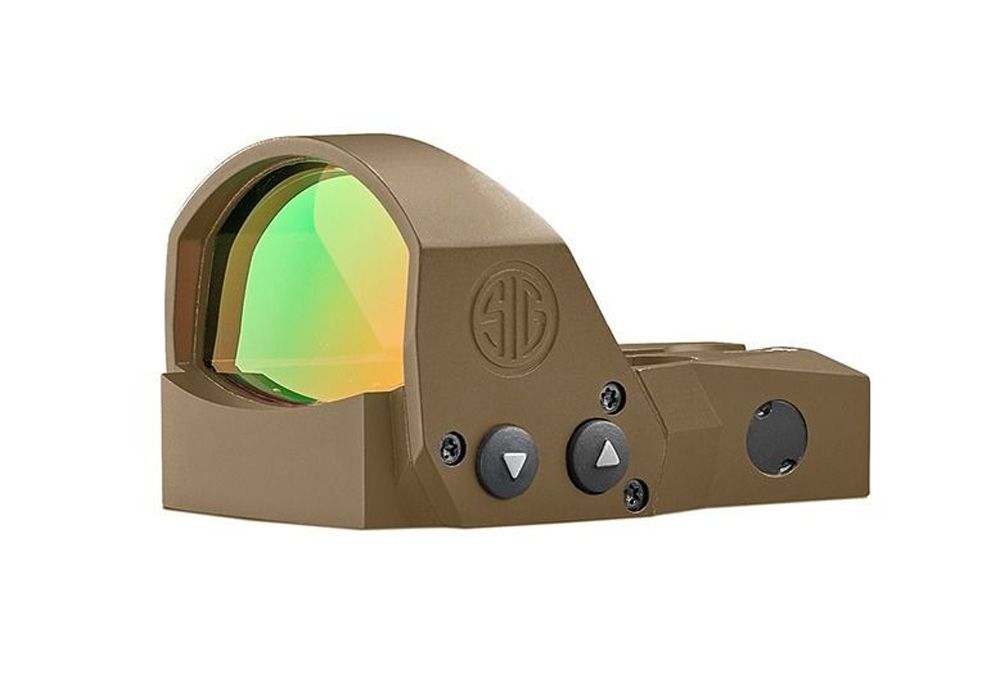
If you own a SIG P365, the Romeo Zero Elite is the path of least resistance. It drops directly into the SIG optics cut without adapter plates, shims, or gunsmithing. Pop it on, zero it, and go. That smooth integration is its biggest selling point, and for SIG owners, it’s genuinely appealing.
At about $180 street, it undercuts every optic here except the Shield RMSc. The Sentinel II still takes the budget pick because its glass held up better in low light, but if you shoot a SIG, the integrated fit is worth more than the difference. The glass has improved significantly from the original Romeo Zero, which had a polymer lens that got scratched if you looked at it wrong. The Elite version steps up to glass, and the dot is crisp and clear. SIG’s MOTAC system works like Holosun’s shake-awake, powering the dot on when it detects motion and sleeping when it doesn’t.
Big limitation is that proprietary SIG footprint. Buy this optic and you’re committed to the SIG ecosystem. If you ever switch to a Glock or a Smith & Wesson, this dot stays in the drawer. The housing also feels more plasticky than Holosun’s options, though SIG has improved the material over previous generations. For hard-use applications, I’d probably step up to the 507K or EPS Carry. But for a SIG owner who wants an affordable, well-integrated dot? It does the job.
Best For: SIG P365 owners who want a plug-and-play optic without breaking the bank. Just don’t expect to use it on anything else.
6. Swampfox Sentinel. Best Budget
- Reticle: 3 MOA dot (also available in green)
- Window Size: Micro
- Battery Life: Shake-awake (battery saver mode)
- Mounting Footprint: RMSc/K
- Weight: 0.6 oz
- Waterproof: IPX7
- MSRP: ~$200 (Street: $200-260)
Pros
- Sub-$200 price with shake-awake and auto-brightness
- RMSc/K footprint for universal compatibility
- Green dot option is excellent for astigmatism
- Extremely lightweight at 0.6 oz
Cons
- Less proven track record than Holosun or Trijicon
- Glass quality is a step behind the competition
- Some reports of dot flickering at extreme cold temps
- Limited availability at major retailers
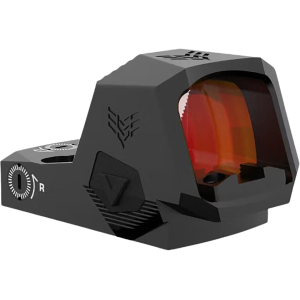
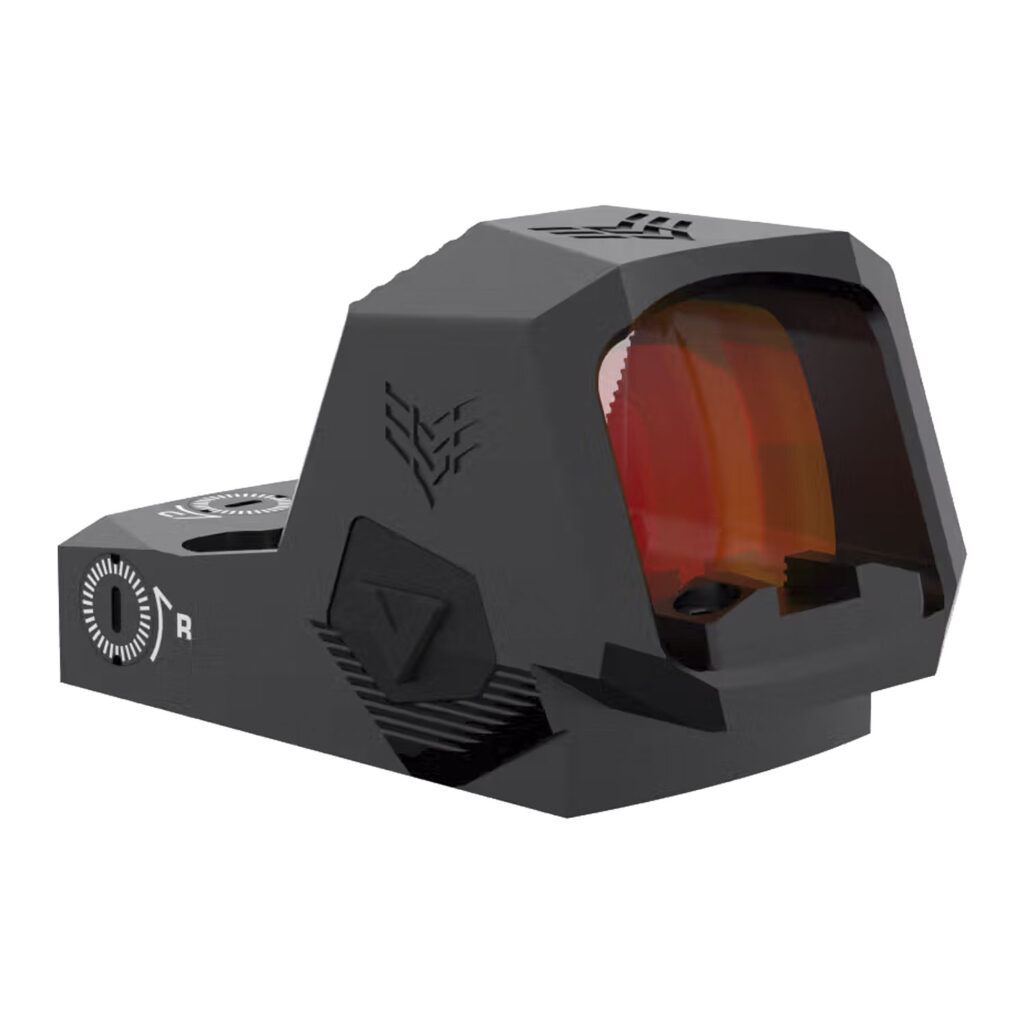
Swampfox has been quietly building a reputation as the best value in American-designed optics, and the Sentinel is their carry offering. Under $200 gets you shake-awake, auto-brightness, and the standard RMSc/K footprint. That’s a feature set that would have cost $300+ just two years ago.
Green dot version is worth calling out specifically. If you have astigmatism, red dots can bloom and starburst, making them harder to use. Green dots are noticeably crisper for many people with this condition. Swampfox is one of the few companies offering a green option in the micro footprint, and it’s a real advantage for shooters who struggle with red reticles.
Where does it fall short? Glass clarity isn’t quite at the Holosun or Trijicon level. The dot is usable and the lens is clear enough, but side by side you can tell the difference. There are also some reports from cold-weather users about dot flickering in extreme temps, though I haven’t personally experienced this in my testing. Swampfox doesn’t have the same decade-long track record as the big names, but they’re building trust with each generation.
Best For: Budget-conscious shooters who want modern features without the Holosun price tag. Also the best option for astigmatism sufferers thanks to the green dot variant.
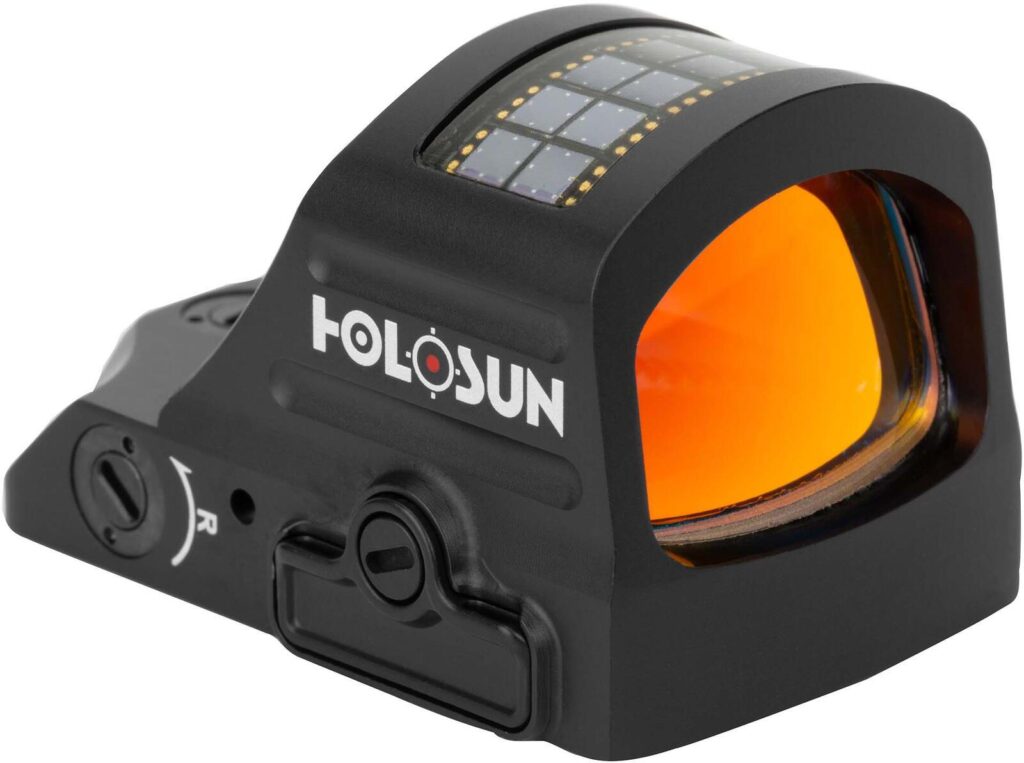
7. Holosun 407K X2. Best Entry-Level Holosun
- Reticle: 6 MOA dot only
- Window Size: Micro (enlarged)
- Battery Life: 50,000 hours (CR1632)
- Mounting Footprint: RMSc/K
- Weight: 1.0 oz
- Waterproof: IP67
- MSRP: ~$260 (Street: ~$225)
Pros
- Same proven Holosun build quality as the 507K
- 6 MOA dot is faster to pick up for beginners
- About $70 less than the 507K
- Shake-awake and solar failsafe included
- 50,000-hour battery life
Cons
- No multi-reticle option (6 MOA dot only)
- Large dot sacrifices precision at distance
- Almost too similar to the 507K to justify a separate SKU
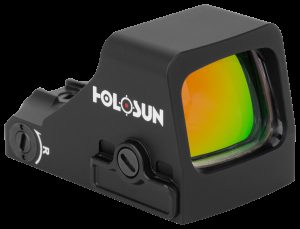
Think of the 407K as the 507K’s simpler sibling. Same housing, same battery life, same shake-awake and solar failsafe, same RMSc/K footprint. The only difference is the reticle: a single 6 MOA dot instead of the multi-reticle system. And that’s exactly why it exists.
For someone brand new to pistol red dots, a bigger dot is actually better. A 6 MOA dot is way easier to find when you’re still developing your presentation. That “where did the dot go?” panic that new red dot shooters experience? It happens a lot less with a 6 MOA dot filling more of the window. As your skills improve, you might want the precision of a 2 MOA dot, but for learning the fundamentals, bigger is better.
At about $225 street, you save roughly $70 over the 507K. Is that worth giving up the multi-reticle? Depends on your priorities. If you know you want a simple, big dot and don’t care about the 32 MOA circle, save the money. But if there’s any chance you’ll want reticle options later, just buy the 507K upfront. You can’t upgrade the 407K’s reticle with a firmware update.
Best For: First-time red dot users who want Holosun reliability at the lowest possible price. The bigger dot makes the learning curve less steep.
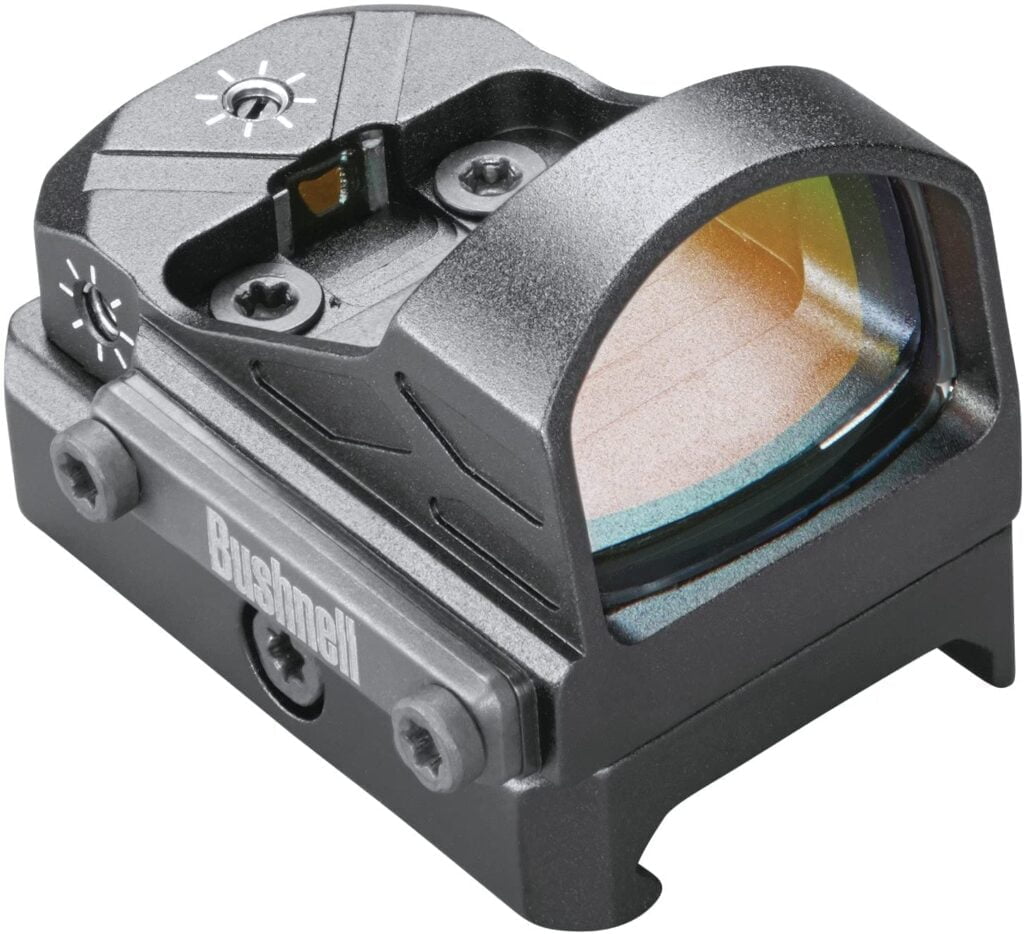
8. Leupold DeltaPoint Micro. Best Integrated (Glock/S&W)
- Reticle: 6 MOA dot
- Window Size: Micro
- Battery Life: 5+ years (CR2032)
- Mounting: Integrated to specific Glock and S&W M&P slides (no MOS cut required)
- Weight: 1.1 oz
- Waterproof: IPX7
- MSRP: ~$400 (Street: $210-400, depending on slide fit)
Pros
- Mounts on standard Glock and S&W slides without MOS cuts
- Built-in rear sight iron backup
- Leupold glass quality is outstanding
- 5+ year battery life
Cons
- Only fits specific Glock and S&W models
- No multi-reticle or shake-awake
- More expensive than optics with more features
- Window is noticeably small
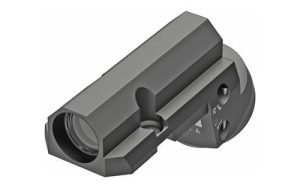
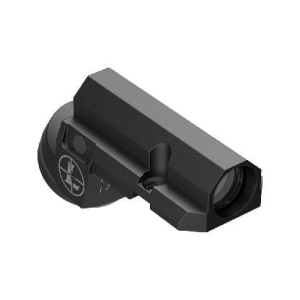
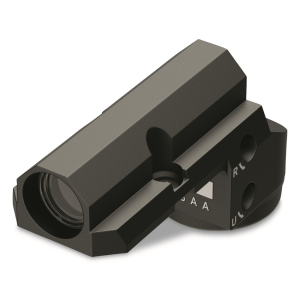
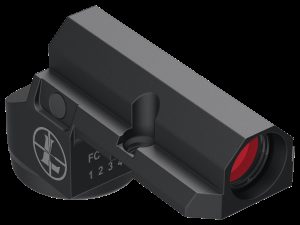
DeltaPoint Micro solves a very specific problem: you have a Glock 43X, Glock 48, or S&W M&P Shield that doesn’t have an MOS cut, and you want a red dot without sending your slide out for machining. Leupold designed this to mount directly to the rear dovetail sight cut. Remove your rear sight, slide the DeltaPoint Micro in, and you’ve got a red dot with an integrated iron sight backup. No milling required. Pair your dot with quality iron sight backup, see our best night sights for concealed carry roundup.
That concept is brilliant for the right person. If your carry gun is a standard Glock 43X and you’ve been curious about red dots but don’t want to commit to a slide cut, this lets you try it with zero permanent modifications. The Leupold glass is also genuinely excellent. Clear, bright, and the dot is crisp. Battery life at 5+ years means you basically install it and forget about it.
The downside is the window. It’s small. Noticeably smaller than the Holosun options. Finding the dot during a fast draw takes more practice. And you’re limited to specific pistol models. This isn’t a universal optic. It’s a purpose-built solution for Glock and S&W dovetails. If that’s what you need, it’s fantastic. If you’re buying a new optics-ready gun anyway, the other options on this list offer more features for similar money.
Best For: Glock 43X/48 and S&W Shield owners who want a red dot without modifying their slide. A clever solution for a specific audience.
9. Vortex Defender-CCW. Best Warranty
- Reticle: 3 MOA or 6 MOA dot
- Window Size: 0.8 x 0.65 in, open emitter
- Battery Life: About 1 year (CR1632), top-loading
- Mounting Footprint: Shield RMSc
- Weight: 0.95 oz
- Waterproof: IPX7
- MSRP: $349.99 (Street: ~$220-250)
Pros
- Vortex VIP warranty is lifetime, transferable, and needs no receipt
- Top-loading battery means a cell swap never costs you your zero
- At 0.95 oz it is the lightest optic on this list
- 7075 aluminum housing, and the glass is genuinely distortion free
Cons
- One year of battery life is the shortest here by a wide margin
- Adjustment clicks are vague and hard to count by feel
- Open emitter, so pocket lint still reaches the LED
- Made in China, unlike the Trijicon and the Aimpoint
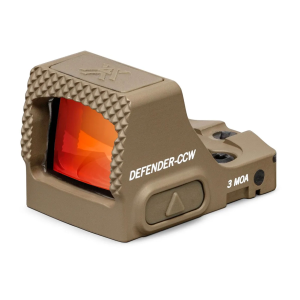
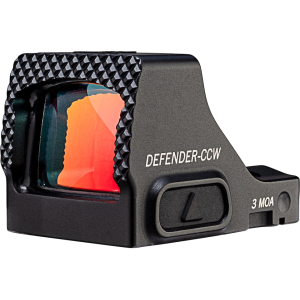
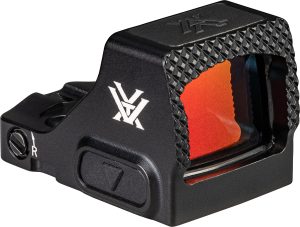
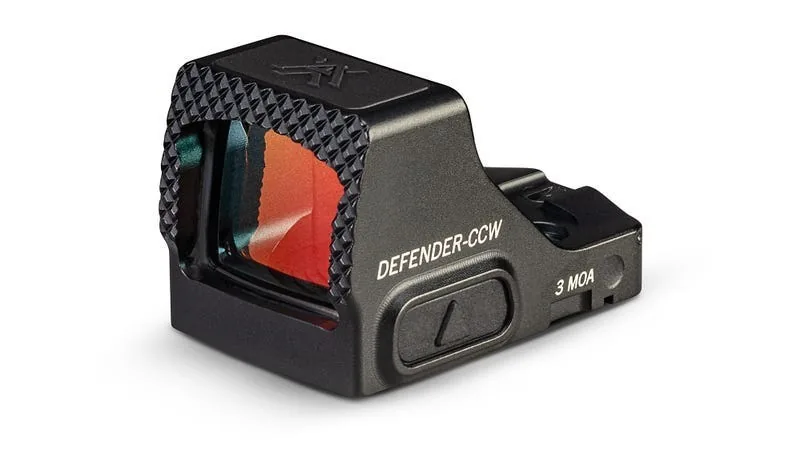
The Defender-CCW is the optic I hand people who ask what happens when their red dot breaks. Vortex’s VIP warranty has no registration, no receipt, and no time limit, and it transfers if you sell the gun. On a carry optic that matters more than a spec sheet line, because the failure you actually plan for is the one you did not predict.
Mine went on a Glock 43X and stayed there for a little over a thousand rounds. The 3 MOA dot is round and clean, which is not a given at this price, and the top-loading battery tray is the feature I keep coming back to. Every other sub-$250 optic here makes you pull the sight off the slide to change a cell, which means re-zeroing. This one does not.
The trade-offs are real. One year of battery life against the Holosun 50,000-hour figure is not close, so this is an optic you put on a calendar. The windage and elevation clicks are mushy enough that I counted them by watching the dot rather than by feel. And the emitter is open, so it collects the same lint the 507K does.
Best For: Anyone who would rather have a lifetime warranty than a longer battery. Put a date in your phone and it is one of the easiest optics here to live with.
10. Aimpoint ACRO P-2. Best Duty-Grade Enclosed
- Reticle: 3.5 MOA dot (2.5 MOA also offered)
- Window Size: 0.59 x 0.59 in clear aperture, enclosed emitter
- Battery Life: 50,000 hours, over 5 years (CR2032)
- Mounting Footprint: Aimpoint ACRO, proprietary
- Weight: 2.1 oz
- Waterproof: Submersible to 35 m
- MSRP: $599 (Street: ~$330-670)
Pros
- Fully sealed optical channel, the toughest enclosed sight on this list
- Submersible to 35 m, which is more than five times the RMRcc rating
- 50,000-hour battery life on a common CR2032
- Police trade-in units turn up around $330 and are the value buy here
Cons
- At 2.1 oz it weighs more than twice the Defender-CCW
- Proprietary ACRO footprint needs an adapter plate on most carry slides
- Too tall and too heavy for a micro-compact like a P365
- The $599 MSRP is the highest on this list
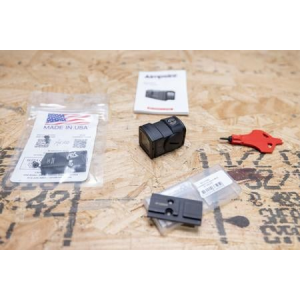
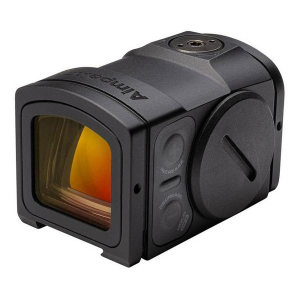
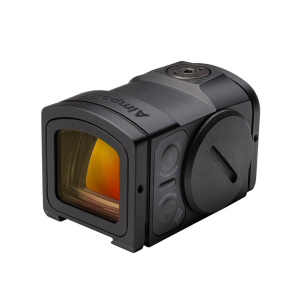
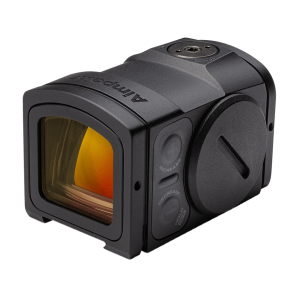
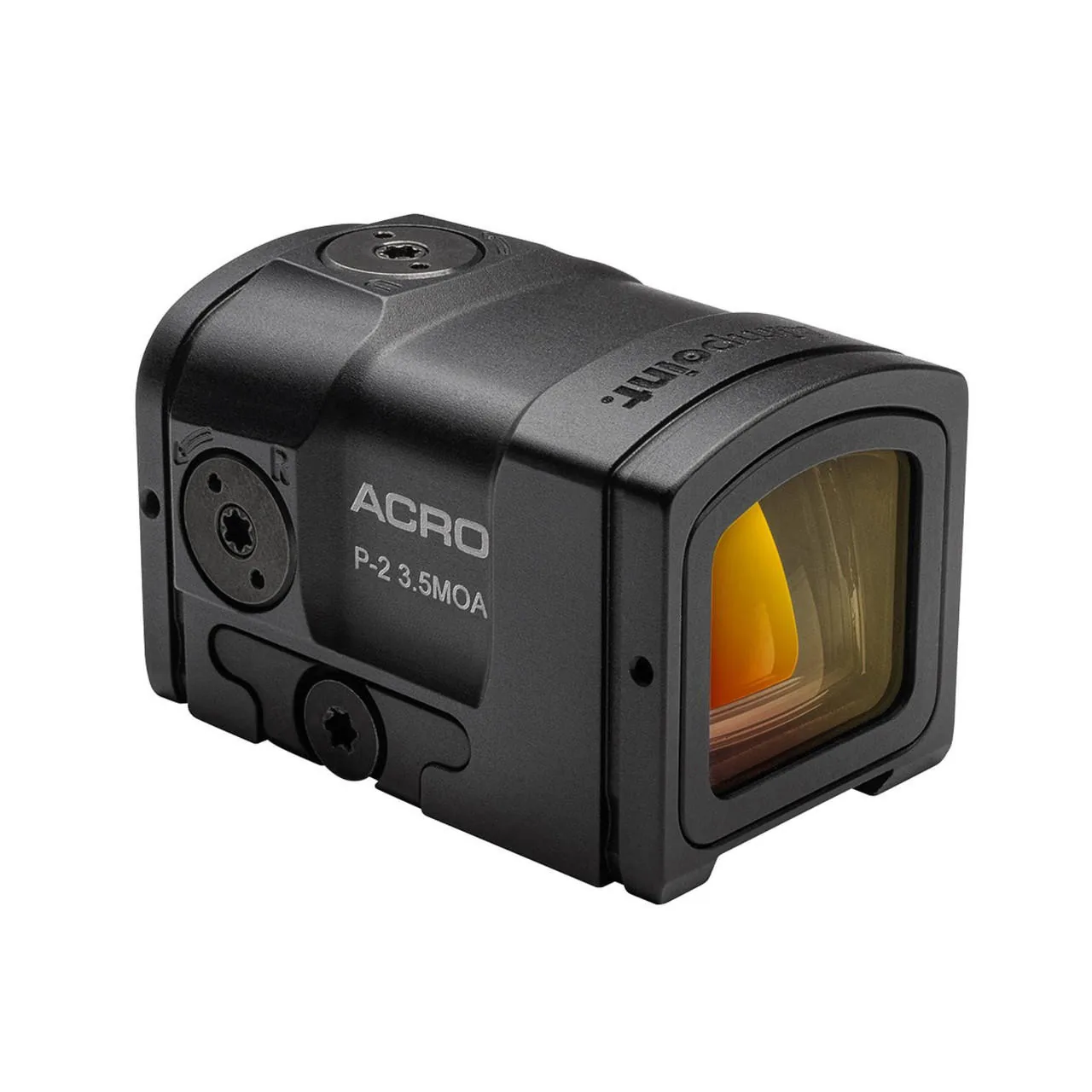
The ACRO P-2 is on this list with an asterisk, and I would rather say so than pretend otherwise. It is a duty optic that crosses over to carry, not a micro-compact sight. At 2.1 oz it is more than twice the weight of the Defender-CCW, and on a P365 it looks and feels like what it is, which is too much optic.
On a compact, it is a different story. On a Glock 19 it disappears into the shooting and simply refuses to be a problem. The optical channel is fully sealed, it is rated submersible to 35 m against the RMRcc’s 20 m, and Aimpoint quotes 50,000 hours on a CR2032. I have never had one fog, and I have never had to think about it.
The buying angle worth knowing is the police trade-in market. Agency turn-in ACRO P-2s sell around $330 against a $599 MSRP, and the wear is almost always holster rash on the housing rather than anything optical. That is the cheapest route into a genuinely duty-grade enclosed emitter that exists right now.
Best For: Compact carry guns, not micro-compacts. If you carry a Glock 19 or a P320 Compact and want the toughest enclosed dot made, buy a trade-in and spend the difference on ammunition.
How to Choose a Carry Red Dot
Choosing the best red dot for concealed carry comes down to five key factors, and getting them right matters more than brand loyalty or whatever the forums are arguing about this week. Let’s break down what actually matters when you’re picking an optic that could save your life.
Dot size is the first decision. A 2 MOA dot gives you precision for longer shots and a cleaner sight picture, but it’s harder to find during a fast draw, especially under stress. A 6 MOA dot fills more of the window and is faster to acquire, but it covers more of your target at distance. For carry use, I lean toward 3-4 MOA as the sweet spot, or Holosun’s multi-reticle system that lets you run both a small dot and a large circle simultaneously. If you’re new to pistol red dots, start with a bigger dot and work your way down as your presentation improves.
Open vs enclosed emitter is the biggest current debate in carry optics. Open emitter designs like the 507K expose the LED, which means lint, sweat, and debris can block or obscure the dot. Enclosed emitters like the EPS Carry seal everything up, keeping the optical path clean. The trade-off is a slightly taller profile and a higher price. If you’re carrying appendix against your body all day, enclosed emitters make a strong case. For OWB or range use, open emitters work fine.
Battery life and management matter more on a carry gun than a range toy. You want an optic that either lasts years on a single battery or has shake-awake technology so it’s not burning power when it’s sitting in your safe. Side-loading battery trays let you swap cells without removing the optic or losing your zero. Bottom-loading batteries mean re-zeroing every time you change cells. For a carry gun, I swap batteries once a year on a set date regardless of charge level. Don’t gamble with your carry optic’s power. For more on choosing optics and understanding different sight types, check out our AR-15 optics guide, which covers many of the same fundamentals.
Footprint compatibility is something you need to check before buying. The RMSc/K footprint is the de facto standard for micro red dots and fits the widest range of pistol optics cuts, and the SIG Romeo Zero Elite uses it too. Trijicon and Aimpoint are the two exceptions here, with the proprietary RMRcc and ACRO patterns. Before you buy, confirm your gun’s optics cut matches the dot you’re considering. Many guns come with adapter plates for multiple footprints, but a direct-mount fit is always cleaner and more secure. If you’re still shopping for a carry gun, our best concealed carry handguns guide covers which models are optics-ready out of the box.
Durability and water resistance round out the checklist. Your carry gun lives in a harsh environment: body heat, sweat, rain, occasional drops. Look for IP67 or IPX7 ratings at minimum. The optic also needs to handle recoil. Cheap red dots designed for rifles will shake themselves apart on a pistol slide. Every optic on this list is designed specifically for pistol use and rated for handgun recoil, so you’re safe with any of our picks.
How I Tested These Optics
Every optic on this list was mounted on either a Sig P365 XL or a Glock 19 MOS and run for at least 300 rounds. I zeroed at 15 yards and then tested acquisition speed from a draw, dot clarity at multiple brightness settings, and battery drain over a 30-day carry period. I also dropped two of the optics (the Trijicon and Holosun 507K) onto concrete from waist height to check zero retention. Both held.
For the enclosed vs open emitter comparison, I carried each type for two weeks of appendix carry in Florida humidity, then checked emitter condition at the end. The EPS Carry was visibly cleaner. Real-world, not lab bench. That matters more than spec sheets.
Which Red Dot Footprint Fits Your Pistol
Footprint is the question that stops most carry red dot purchases, and every buying guide answers it in a paragraph. Here it is as a table instead. The useful thing it shows is that the market is far less fragmented than it sounds: seven of the ten optics on this list mount on one pattern.
| Footprint | Optics on this list |
|---|---|
| Shield RMSc / Holosun K The de facto standard |
Holosun 507K X2, Holosun 407K X2, Holosun EPS Carry, Shield RMSc, Swampfox Sentinel II, Vortex Defender-CCW, Sig Romeo Zero Elite |
| Trijicon RMRcc Proprietary |
Trijicon RMRcc |
| Aimpoint ACRO Proprietary |
Aimpoint ACRO P-2 |
| Rear dovetail Not an optic cut at all |
Leupold DeltaPoint Micro |
Two practical consequences fall out of that. If your slide is cut for the Shield RMSc pattern, and most optics-ready carry guns sold in the last five years are, then seven of these ten optics bolt straight on and your decision is about features and price, not compatibility. If you want the RMRcc or the ACRO P-2 on a gun that is not cut for them, budget for an adapter plate and accept that the optic sits higher.
One warning the spec sheets will not give you. An adapter plate adds a second set of screws and a second interface, and that is where I have seen zero shift. If you go that route, use the plate maker’s own screws, torque them properly, and check zero after the first hundred rounds rather than assuming it held.
Holsters: The Step Most Buyers Skip
An optic changes your holster requirements, and people find this out after the optic arrives. The slide is now taller and there is a housing that has to clear the mouth of the holster on every draw and every reholster. A cut-down or optic-agnostic holster is not a detail, it is the difference between a carry setup and a range toy.
What you need is a holster with an optic channel, meaning the sight track is milled or moulded clear all the way through so the optic never touches kydex. PHLster, Tenicor, Tier 1 Concealed and Safariland all cut for optics as standard. What you want to avoid is a generic holster that merely happens to fit, because the optic will drag on the shell and, over a few hundred draws, the adjustment turrets take the wear.
Two things to check before you buy. First, sight channel depth, because a taller optic like the ACRO P-2 needs more clearance than a Defender-CCW and not every optic-ready holster clears both. Second, whether the holster still covers the trigger guard completely with the optic fitted. If the answer to either is uncertain, ask the maker which optics they have physically tested, not which ones they list.
Red Dots and Astigmatism
If the dot looks like a starburst, a comma or a smear rather than a round dot, your optic is fine and your eyes are the reason. Astigmatism distorts a point light source, and a red dot is exactly that. It is common enough that it is the single most likely reason a shooter concludes red dots do not work for them, and almost nobody writing these roundups mentions it.
Three things genuinely help. Turn the brightness down, because most people run a dot far brighter than they need and brightness is what exaggerates the smear. Try a green reticle, because the eye is most sensitive to green and the reticle reads tighter for it. And if you wear a corrective prescription, shoot with it, because the distortion is corrected by the same lenses that correct your vision.
If none of that works, the honest answer is that a prism sight will serve you better than any red dot on this list, because its etched reticle does not depend on your eye focusing a point of light. That is a real fix rather than a workaround, and it is covered in our best prism scopes guide. Test before you spend $400 on an optic that will never look right to you.
Final Thoughts
The best red dot for concealed carry is no longer a hard question. The micro red dot market has matured to the point where there’s genuinely no bad choice on this list. The Holosun 507K remains the gold standard for value and features, the EPS Carry is where the market is heading with enclosed emitters, and the Trijicon RMRcc is still the toughest thing out there if you can stomach the price. Budget picks like the Swampfox Sentinel and Holosun 407K prove you don’t need to spend $400+ to get a reliable carry dot, the Vortex Defender-CCW backs a $220 optic with a lifetime warranty, and a police trade-in Aimpoint ACRO P-2 is the cheapest way into a genuinely duty-grade enclosed emitter. Pick the one that fits your gun, your budget, and your priorities. Then get to the range and put 500 rounds through it. A red dot you haven’t trained with is just an expensive paperweight. For the full breakdown on pistol red dot sights including full-size options, we’ve got you covered. And don’t forget a quality holster that accommodates your optic. You can also browse real-time optics prices on our optics price comparison page.
If you can only buy one, get the Holosun 507K X2. It does everything well, costs less than the competition, and the multi-reticle system is genuinely useful. If lint and debris worry you, step up to the EPS Carry. If money is no object, the Trijicon RMRcc is the one you can abuse for a decade. Get on board.
Looking for the best prices? Check our gun deals page and price comparison tool to compare prices from 200+ retailers before you buy.
Frequently Asked Questions
What is the best red dot for concealed carry?
The Holosun 507K X2 is the best overall red dot for concealed carry in 2026. It offers a multi-reticle system, 50,000-hour battery life, shake-awake technology, and the universal RMSc/K footprint, all for around $295-350 street price.
Is a red dot worth it on a carry gun?
Yes. A red dot significantly improves target acquisition speed, especially in low-light conditions. Modern micro red dots add minimal weight and bulk to carry guns. The learning curve takes about 500 rounds of practice to build consistent dot presentation during draws.
What MOA is best for concealed carry?
For concealed carry, 3-4 MOA is the sweet spot, balancing speed and precision. Beginners benefit from a larger 6 MOA dot that is easier to find during draws. Holosun multi-reticle system offers the best of both worlds with a 2 MOA dot inside a 32 MOA circle.
What is an enclosed emitter red dot?
An enclosed emitter red dot fully seals the LED and lens inside a protective housing, preventing lint, sweat, and debris from blocking the dot. The Holosun EPS Carry is the leading enclosed emitter micro red dot. They cost slightly more and sit slightly taller than open emitter designs.
Do red dots on carry guns affect concealment?
Modern micro red dots add very little height to your slide, typically less than an inch. Most quality holsters now accommodate optics-ready pistols with red dots. The slight increase in profile is negligible for IWB and appendix carry with a proper holster.
How long do carry red dot batteries last?
Battery life varies by model. Holosun optics like the 507K and EPS Carry are rated at 50,000 hours, over five years of continuous use. Trijicon RMRcc lasts 4+ years. We recommend replacing batteries annually on a set date regardless of remaining charge for reliability.
What mounting footprint do most carry guns use?
The RMSc/K footprint is the industry standard for micro carry red dots. Created by Shield Sights and adopted by Holosun and Swampfox, it fits the widest range of optics-ready compact pistols. Trijicon and Aimpoint use proprietary footprints that limit cross-compatibility. The Sig Romeo Zero Elite uses the RMSc pattern, so it is not one of the exceptions.
Should I co-witness my carry red dot with iron sights?
Co-witnessing provides a backup aiming reference if your red dot fails. Most carry guns with optics cuts use suppressor-height iron sights for a lower-third co-witness. It is not strictly necessary with modern reliable optics, but it adds a layer of redundancy that many defensive shooters prefer.
4,715+ Gun & Ammo Deals
Updated daily from 200+ top retailers. Filter by category, caliber, action type, and price.
Related Guides