

Last updated May 2026 · By Nick Hall, CCW instructor (carries through commutes daily)
Some of the links below are affiliate links, meaning at no additional cost to you, we may earn a commission if you click through and make a purchase.
- Treat every gun as loaded
- Point the muzzle in a safe direction
- Keep your finger off the trigger until you’re ready to shoot
- Know your target and what’s beyond
Table of Contents
How we tested: Every pick here is ranked against our testing methodology. Minimum round counts, accuracy and reliability protocols, the failures that disqualify a gun.
The Car Changes Everything About Concealed Carry
You’ve got your permit. You’ve trained at the range. You can draw from concealment in under two seconds standing up. Great. Now sit down, strap a seatbelt across your body, and try it again.
That’s the reality of carrying concealed in a car. Everything you practiced standing up goes sideways the moment you’re pinned into a bucket seat with a lap belt cinched across your waist and a shoulder strap running directly over your gun. Your range of motion is cut in half. Your draw stroke is compromised. And depending on where you’re driving, the laws governing how you carry might change every time you cross a state line.
I carry every single day, and I’ll be honest: it took me a while to figure out vehicle carry. It’s not just about where the gun sits. It’s about access, retention, legality, and what happens when you see those blue lights in your rearview mirror. Most concealed carry training doesn’t cover any of this, which is a problem because a lot of us spend more time in our vehicles than anywhere else.
So let’s break down vehicle carry the right way. What works, what doesn’t, and the legal traps that can turn a responsible gun owner into a felon without even knowing it. If you’re new to concealed carry in general, start there first. This guide assumes you already know the basics and you’re ready to deal with the unique headaches that come with carrying in a car.
Keep the Gun on Your Body
Let’s get this out of the way first: the best place for your gun in a car is on your body. Always. A gun on your person goes wherever you go. When you step out to grab gas, walk into a store, or suddenly need to exit the vehicle in a hurry, it’s right there. No reaching under seats. No fumbling with a console-mounted holster while someone is smashing your window.
Appendix carry (AIWB) is probably the best option for vehicle carry, and it’s what I use daily. The gun sits right in front of your body, between your belt line and your belly button. When you’re seated, your hand drops naturally to the grip. The seatbelt doesn’t cross over the gun like it does with strong-side carry. You can draw without having to lean forward or fight the belt. It just works.
That said, AIWB in a car does take some adjustment. The muzzle points more directly at your thigh when you’re seated, which makes holster selection critical. You want a quality kydex holster with full trigger guard coverage. No exceptions. And if the gun digs into your thigh uncomfortably, try adjusting the ride height or adding a slight forward cant. A wedge on the back of the holster can also change the angle enough to make it comfortable for long drives.
Strong-side IWB at 3 or 4 o’clock is tougher in a car. The gun gets sandwiched between your body and the seat, the seatbelt can ride directly over the grip, and drawing requires you to lean forward to clear the seat back. It’s doable, but it’s slower and more awkward. Cross-draw (carrying on your weak side for a cross-body draw) actually has some appeal in a vehicle because your hand naturally crosses your body toward the gun. But cross-draw has its own problems, and most training doesn’t support it. If you’re interested in exploring different holster and carry position options, check out our best concealed carry holsters guide.
Bottom line: keep the gun on your body if you can. Everything else is a compromise.
Vehicle Holster Mounts
Alright, I just told you to keep the gun on your body. But I also know that some of you are going to mount a holster in your car anyway, so let’s talk about doing it right instead of doing it stupid.
Console mounts are the most popular option. These bolt or clamp to the side of your center console and hold the gun in a kydex holster at a natural draw angle. Companies like Alien Gear and Crossbreed make purpose-built systems for this. The draw is fast because the gun is right there between your legs, and you don’t have to fight a seatbelt to get to it. The downside? When you leave the car, the gun stays in the car. That means you’re either reholstering on your body before you step out (which is a whole process), or you’re leaving a gun in an unattended vehicle. Neither is ideal.
Seat-mounted holsters attach to the side or underside of your driver’s seat, usually with a bracket system. These keep the gun more hidden but can be harder to access quickly. Depending on your seat position and body type, the draw angle can be weird. I’ve seen setups where the gun was technically accessible but required the kind of contortion that would get you killed in a real emergency.
Then there are magnet mounts. These are just strong magnets that stick to a surface and hold the gun by the slide. They’re cheap, simple, and terrible for retention. A hard turn, a fender bender, or a curious kid in the back seat can send your gun flying. I don’t recommend magnet mounts for vehicle carry. Period. The retention just isn’t there. If you have children or passengers of any kind, a magnet mount is irresponsible.
If you do go with a vehicle mount, make sure it uses a proper holster with active retention, not just friction. And think about what happens in a crash. At 40 mph, an unsecured gun becomes a projectile. That’s not a hypothetical. It’s physics.
Drawing from a Seated Position
Here’s something that almost nobody practices: drawing from concealment while buckled into a car seat. And it shows. Watch people try it for the first time and you’ll see a lot of fumbling, muzzle sweeping, and general chaos. Don’t be that person.
The seatbelt is enemy number one. If you carry AIWB, the belt typically doesn’t interfere much because it crosses your chest and lap, leaving the appendix area relatively clear. But with strong-side carry, the belt can pin your cover garment against the gun. You need to practice sweeping the belt out of the way with your support hand while your strong hand goes for the gun. That’s a two-hand operation in a space designed for zero extra movement.
Your draw stroke in a car is going to be different than your standing draw. You can’t fully extend your arms inside a vehicle. The ceiling is right there. The steering wheel is in the way. You’re drawing to a compressed ready position, not full extension. Practice this. Dry fire in your car (unloaded, obviously, and with no ammunition anywhere nearby). Get used to what you can and can’t do in that confined space.
One thing most people don’t think about: the car door is cover. Well, concealment at least, and the engine block is actual cover. If someone approaches your vehicle with bad intentions, your best move might be to exit the vehicle and use the door and engine block as a barrier. But you can’t do that if your gun is stuck in a console holster you can’t access while unbuckling your seatbelt. This is why on-body carry wins again. You unbuckle, open the door, and you’re armed and moving.
If you want to get serious about this, take a vehicle tactics class. Several training schools offer them. It’s humbling and absolutely worth the time. For more on practicing your draw, see our draw from concealment guide.
Legal Minefields
Vehicle carry law is a mess. There’s no polite way to say it. What’s perfectly legal in one state will get you arrested in the next, and the rules for carrying in a vehicle are often completely different from carrying on foot. Even within the same state.
Some states treat your car as an extension of your home. In those states (Texas, for example), you can carry a loaded handgun in your vehicle without any permit at all. Other states require the gun to be unloaded and locked in a case in the trunk. Some states say it has to be visible, which is the exact opposite of what your CCW permit allows when you’re walking around. It’s confusing by design.
The glove box is a particularly tricky spot. In some states, a gun in the glove box is considered concealed (requiring a permit). In others, it’s considered secured storage. In a few, the glove box doesn’t count as concealed at all because it’s “part of the vehicle.” You absolutely need to know your state’s rules on this before you shove a Glock in there and call it good.
Crossing state lines is where things get really ugly. The Firearm Owners Protection Act (FOPA) provides “safe passage” if you’re transporting a firearm through a state where it would otherwise be illegal, as long as the gun is unloaded and locked in a container separate from ammunition, and it’s legal where you started and where you’re going. Sounds straightforward, right? It’s not. Several states (looking at you, New Jersey and New York) have arrested people mid-transit despite FOPA protections. The law says you’re protected. The cop who pulls you over at 2 AM on the New Jersey Turnpike might not agree.
Know the laws for every state you’ll drive through. Not just your destination. Every state in between. USCCA publishes a free reciprocity map that’s worth bookmarking before any cross-state trip. We have a full state-by-state gun law breakdown that covers vehicle carry specifics. Use it before your next road trip.
Traffic Stops
Getting pulled over while carrying is one of those situations that shouldn’t be stressful but absolutely is. Your heart rate goes up, you’re thinking about where the gun is, you’re wondering if you need to say something. Let’s simplify this.
First: hands on the steering wheel. Visible. Don’t reach for your registration, don’t dig in the glove box, don’t move at all until the officer is at your window and tells you what they need. This is basic common sense but it’s worth stating because adrenaline makes people do dumb things.
Second: know your state’s duty to inform law. Some states require you to immediately tell the officer you’re carrying a concealed weapon. Others only require you to disclose if asked directly. A few have no requirement at all. Regardless of the law, I personally think it’s smart to inform the officer early and calmly. Something like “Officer, I want to let you know I have a valid carry permit and I am currently armed.” Keep your hands visible when you say it. The officer will tell you what they want you to do next.
What you absolutely do NOT do is reach toward the gun. Don’t try to show them the gun. Don’t try to hand them the gun. Don’t say “I have a gun” without the context of having a permit. Be calm, be polite, follow instructions. Most officers appreciate the heads up and the professionalism. Some might ask you to step out while they secure the weapon. That’s fine. Cooperate.
The worst thing you can do is act nervous and evasive. The second worst thing is to reach for something without being told to. Just be a normal, cooperative human being and the stop will go fine 99.9% of the time.
Road Rage and De-Escalation
I’ll say this bluntly: if you carry a gun, you lose every argument on the road. Every single one. Someone cuts you off? You lose. Someone flips you off? You lose. Someone brake-checks you and screams at you through their window? You lose that one too. Congratulations.
This isn’t weakness. It’s the reality of carrying a lethal weapon. Any confrontation that escalates while you’re armed has the potential to end with someone dead. That means you don’t engage. You don’t gesture. You don’t follow. You don’t pull alongside them to give them a piece of your mind. You drive away. Take the next exit. Let them go. Swallow your pride. It tastes bad but it beats a murder charge.
Brandishing laws are serious and often misunderstood. In most states, showing your gun to intimidate someone during a road rage incident is a felony. Not a misdemeanor. A felony. That means you lose your carry rights forever. Even putting your hand on your gun in a threatening manner can qualify as brandishing in some jurisdictions. The bar is lower than most people think.
The only time your gun comes out is when you are facing an imminent threat of death or serious bodily harm and you cannot retreat. Sitting in a car, you can almost always retreat. Drive away. That’s your first, best, and most legally defensible option. If someone exits their vehicle and approaches yours with a weapon, that’s a different calculus entirely. But you’d better be right, and you’d better be able to articulate exactly why you couldn’t just drive away. For more on the mindset of carrying, check out our concealed carry tips and techniques.
Kids and Passengers
Having kids in the car changes the vehicle carry equation completely. A gun in a console mount is now within reach of little hands. A gun in a holster mounted to the seat might be right next to where your teenager sits. Retention isn’t just about keeping the gun secure in a crash. It’s about keeping unauthorized hands off it at all times.
If you carry on your body, this is largely a non-issue. The gun is on you, in a proper holster, covered by your garment. A child can’t access it without you knowing. But the moment you take the gun off your body and put it somewhere in the vehicle, you’ve created an access problem. Kids are curious. They find things. They don’t respect the rules you think they understand.
Talk to your family about what to do during a traffic stop. Your spouse or partner should know you’re carrying and should know the drill: stay calm, don’t mention the gun in a panicked way, let you handle the interaction with the officer. Older kids should understand that if a police officer pulls the family over, everyone stays quiet and still. This isn’t about fear. It’s about routine.
And if you have passengers who don’t know you carry, think carefully about whether a vehicle-mounted holster is appropriate. Not everyone is comfortable around firearms, and springing that surprise on a coworker during a carpool is a great way to create a very awkward HR conversation. On-body concealed carry avoids this entirely because nobody knows you’re armed. That’s the whole point.
Locking the Gun in the Car (When You Can’t Carry In)
Sooner or later you’re going to walk into a building where your gun isn’t allowed. Federal buildings. Post offices. Schools. Courthouses. Some hospitals. Bars in certain states. The list varies by jurisdiction, but it’s longer than most people realize. When that happens, you need a plan for the gun, and “leave it on the seat” is not the plan.
A vehicle gun safe is the right answer. The Hornady RAPiD Vehicle Safe, Vaultek LifePod 2.0, and Console Vault are the three I trust most. Each bolts down (or anchors via cable to a seat frame) and accepts a quick-access biometric or RFID lock. The point is twofold: deter the smash-and-grab thief who breaks your window for the GPS and finds a free pistol, and meet the locked-container requirement that several states impose on vehicle storage.
Hide the safe. A gun safe sitting on the passenger seat in plain view is an advertisement. Mount it under the driver seat with the included cable lock looped through the seat frame, or in a console box that bolts in. Anchor it. An unanchored safe is a portable safe (with your gun inside) the moment a thief gets through the window.
Don’t leave the gun in the car overnight in your driveway. Every “gun stolen from car” headline I’ve read in the last decade follows the same script: parked overnight, window smashed, glovebox or center console rifled. The fix isn’t a better safe, it’s bringing the gun inside the house at the end of the day. The vehicle safe is for hour-long stops at the post office, not for sleeping arrangements.
Best Guns for Vehicle Carry
You don’t need a special gun for vehicle carry. Whatever you carry on your body every day is probably fine in the car too. That said, compact and subcompact pistols tend to work better in the confined space of a vehicle than full-size duty guns. Less bulk means less interference with the seatbelt, a more comfortable seated position, and an easier draw from concealment when your range of motion is limited.
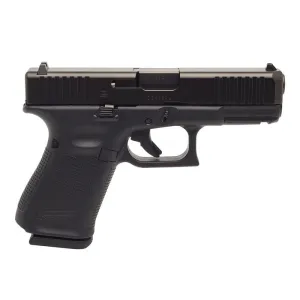
The Glock 19 is basically the gold standard for this. It’s small enough to carry comfortably AIWB all day but big enough to actually shoot well if you need to. 15+1 rounds of 9mm, dead reliable, and it fits every holster system on the planet. If I had to pick one gun for all-around concealed carry including vehicle carry, this is it. Not a hot take. Just reality.
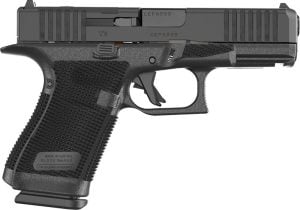
Sig P365 XL. The slim profile threads through a seatbelt better than the chunkier P365 stack-mag, and the longer slide gives you a sight radius that matters for accurate fire from a seated, off-balance position. 12+1 standard, optics-cut, and it carries well AIWB even with a lap belt locked across it.
S&W Shield Plus. 1-inch thick at the slide, 10+1 capacity, and the flat-face trigger gives you a clean break even when you’re rushing and pulling from a less-than-perfect grip. The slim footprint is the standout for vehicle carry. It doesn’t push into your hip when the seatbelt locks across it during a hard stop.
Glock 43X. If you’re a Glock guy and the 19 is too much in the cab of a small car, the 43X gives you 10+1 in a single-stack-ish footprint with the same trigger and manual of arms. The 43X MOS is optics-ready if you want to mount a red dot for low-light situations through tinted windows.
Smith & Wesson M&P 2.0 Compact. The 4-inch M&P 2.0 Compact in 9mm is a sleeper pick for vehicle carry. 15+1 capacity, optics-cut, and the polymer frame eats recoil in a way that matters when your shooting platform is “the driver’s seat of a Honda Civic.” Comparable to the Glock 19 footprint with arguably better ergonomics for some hand sizes.
The takeaway: there is no single perfect vehicle carry gun. Pick something compact-to-midsize, run it through a seatbelt drill at the range, and confirm you can draw and put rounds on target from a seated position before you commit. The gun matters less than the practice.
Final Thoughts
Vehicle carry isn’t something you can just wing. The confined space changes how you access your gun, the seatbelt changes how you draw, and the law changes depending on which side of a state line you’re on. That’s a lot of variables stacked on top of each other.
Keep the gun on your body whenever possible. Practice drawing from a seated, belted position until it’s second nature. Know the laws in your state and every state you drive through. And for the love of everything, don’t let road rage turn you into a felon.
Carrying in a car is part of carrying every day. Get it right and it’s just another part of your routine. Get it wrong and the consequences range from uncomfortable to catastrophic. Put in the work. It matters.
Looking for the best prices? Check our gun deals page and price comparison tool to compare prices from 200+ retailers before you buy.
Frequently Asked Questions
Is it legal to carry a loaded gun in my car?
It depends entirely on your state. Some states like Texas treat your vehicle as an extension of your home and allow loaded carry without a permit. Others require the gun to be unloaded and locked in the trunk. Check your specific state laws before carrying loaded in a vehicle.
Do I need to tell police I have a gun during a traffic stop?
Some states have a duty to inform law that requires you to immediately disclose you are carrying. Others only require disclosure if asked directly. Regardless of legal requirements, voluntarily informing the officer calmly and with your hands visible is generally the smart move.
Can I keep a gun in my glove box?
Glove box rules vary wildly by state. Some states consider a glove box concealed carry requiring a permit. Others treat it as secure vehicle storage. A few states have specific glove box exemptions. Know your state law before storing a firearm there.
Is a vehicle mount holster safe?
A quality console or seat mount with proper kydex retention can be reasonably safe. Magnet mounts are not safe and should be avoided. Any vehicle mount must account for crash forces, child access, and the fact that the gun stays in the car when you leave.
Can I carry a concealed weapon in a rental car?
If you have a valid carry permit, you can generally carry in a rental car the same as your own vehicle under state law. However, rental company policies may prohibit firearms. Violating their policy could void your rental agreement, though it is typically not a criminal issue.
What about carrying in parking lots and private property?
Many states have parking lot laws that protect your right to keep a gun in your locked vehicle even on private property that bans firearms. However, some employers and property owners can restrict carry on their premises. Check your state statutes on parking lot protections.
Should I get a vehicle-specific holster?
Only if on-body carry truly does not work for your situation. A vehicle-specific holster is always a compromise because the gun stays in the car when you exit. If you do get one, choose a system with active retention and a proper kydex shell, not a magnet mount.
What is the FOPA safe passage act?
The Firearm Owners Protection Act allows you to transport firearms through states where they would otherwise be illegal, as long as the gun is unloaded, locked in a container, and separate from ammunition. It must be legal at your origin and destination. Some states like New Jersey have arrested people despite FOPA protections.
4,659+ Gun & Ammo Deals
Updated daily from 200+ top retailers. Filter by category, caliber, action type, and price.
Related Guides