

Last updated 19 May 2026 after running both shotguns through a 250-round side-by-side at the range.
Some of the links below are affiliate links, meaning at no additional cost to you, we may earn a commission if you click through and make a purchase.
- Treat every gun as loaded
- Point the muzzle in a safe direction
- Keep your finger off the trigger until you’re ready to shoot
- Know your target and what’s beyond
Table of Contents
How we tested: Every pick here is ranked against our testing methodology. Minimum round counts, accuracy and reliability protocols, the failures that disqualify a gun.
Mossberg 500 vs 590: What’s Actually Different?
The Mossberg 500 and 590 look nearly identical. Same aluminum-alloy receiver. Same dual action bars. Same tang-mounted safety sitting right where your thumb lands. Hand someone both pump shotguns without labels and they’d have a hard time telling them apart at first glance. The differences live under the surface, and they’re the kind that change which gun you actually want to buy.
This isn’t a case where one Mossberg pump shotgun is “better” and the other is junk. The 500 has been in production since 1961 and has crossed the 12-million-units-sold mark, the best-selling pump-action in American history.
The 590 was developed in the 1980s to win U.S. military contracts and ended up fielded by every branch of the armed forces. Both are proven, reliable platforms. The Mossberg 500 vs 590 question is really about which set of trade-offs fits what you actually need.
I’ve run both extensively. The 500 lives in my truck, mostly because I swap a 24-inch slug barrel onto it every November for deer season. A 590A1 sits in the safe by the bed because eight rounds of 12 gauge beats six rounds of 12 gauge in a scenario I hope never happens. Here’s the honest breakdown of what separates them.
Side-by-Side Comparison
| Feature | Mossberg 500 | Mossberg 590 | Mossberg 590A1 |
|---|---|---|---|
| Year introduced | 1961 | 1987 | 1987 (3443G upgrade 2003) |
| Magazine tube | Closed (barrel nut) | Open-ended | Open-ended |
| Capacity (18.5″ tactical) | 5+1 | 8+1 | 8+1 (9-shot on 20″ SKU 51660) |
| Barrel attachment | Barrel nut on mag tube | Retaining nut at muzzle | Retaining nut at muzzle |
| Barrel material | Standard steel | Standard steel | Heavy-wall steel |
| Sights (tactical) | Bead | Bead or ghost ring | Ghost ring standard |
| Receiver | Aluminum alloy | Aluminum alloy | Aluminum alloy |
| Trigger guard | Polymer | Polymer | Aluminum |
| Safety | Tang-mounted | Tang-mounted | Tang-mounted |
| Bayonet lug | No | Available | Standard |
| Mil-spec tested | No | No (passes 3443E informally) | MIL-S-3443G certified |
| Weight (18.5″ barrel) | ~7.0 lbs | ~7.25 lbs | ~7.5 lbs |
| MSRP (current tactical SKU) | ~$450 | ~$592 | ~$861 |
The Magazine Tube: This Is the Real Difference
Everything else is secondary to this. The Mossberg 500 uses a closed magazine tube. The barrel screws onto a nut at the front end of the tube, and that design caps how many shells the tube can hold. With an 18.5-inch tactical barrel, you max out at 5+1.
The 590 flips the script with an open-ended magazine tube, the barrel attached separately by a retaining nut at the muzzle. That lets Mossberg run the tube all the way forward, giving you 8+1 capacity with the same 18.5-inch barrel, three extra rounds without adding an inch to the gun. The 20-inch heavy-wall 590A1 (SKU 51660) actually hits a full 9-shot capacity, which puts it within shouting distance of some defensive semi-autos.
The 590’s open-tube design also gets you a clean-out cap, pop the front cap off and the magazine spring and follower drop right out for cleaning. The 500’s closed system makes that a more involved job. For home defense, those three extra rounds matter. For waterfowl, they don’t (federal law plugs you at 3 anyway). For range work or a 3-gun stage, more is always more.
Barrel Compatibility: Where People Get Confused
This trips people up constantly. Mossberg 500 and 590 barrels are not interchangeable. They attach differently because of the magazine tube design above. A 500 barrel threads onto the mag tube nut. A 590 barrel hangs off a retaining nut at the muzzle. Look like the same gun, but the front halves don’t talk to each other.
This matters if you want one receiver that swings between a short tactical barrel and a longer hunting barrel. With a 500, Mossberg sells a huge catalog of barrels, 18.5″ cylinder bore, 24″ rifled slug, 28″ vent rib for waterfowl, 22″ turkey choke. The aftermarket support is bigger still.
Want to drop a 28-inch vent rib for ducks on Saturday morning and a slug barrel for deer on Sunday? Easy. The 500’s barrel-swap system is one of the biggest reasons it’s outsold every other pump in America.
The 590’s barrel selection is much thinner. Most factory 590 barrels are tactical-length 18.5″ or 20″ cylinder bore. Mossberg does make a few longer 590-compatible barrels, but the catalog doesn’t come close to the 500’s. So if you want a do-everything Mossberg pump that hunts on Saturday and sits by the bed on Monday, the 500 is the more versatile platform. The 590 is the dedicated tool.
What the Mossberg 500 Gets Right
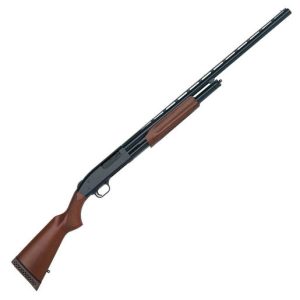
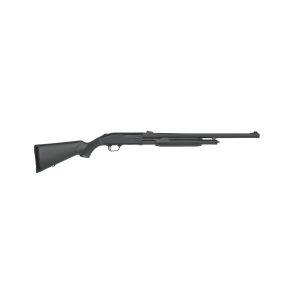
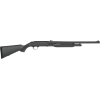
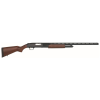
The Mossberg 500 is the most versatile pump shotgun ever made. Full stop. The barrel-interchange system means you can buy one receiver and outfit it for clays, waterfowl, deer slug, turkey, and home defense by swapping barrels. Some 500 combo packs ship with two barrels in the box for under $500.
It’s lighter than the 590 by about a quarter pound, which adds up if you’re carrying it through the woods all day. The action is smooth and reliable. Dual extractors yank shells out of the chamber no matter how dirty things get. The tang safety is ambidextrous and intuitive, thumb forward, ready to fire. After six-plus decades of production, the aftermarket support is essentially infinite.
Price is the other major win. A basic Mossberg 500 in 12 gauge starts around $400 to $480, depending on configuration. That’s a lot of shotgun for the money. I’ve seen them go on sale for under $350 during holiday promotions, which is genuinely insulting to every competitor in the segment.
If you need one pump shotgun that does everything, the 500 is probably the right answer. It won’t be the best at any single thing, but it’ll be good at all of them. That kind of versatility has a real-world value that’s hard to quantify until your needs change and the gun still fits.
The Mossberg 500 Family: One Receiver, Many Configurations
Mossberg sells the 500 in more flavors than most ice cream shops. The lineup gets confusing fast, so here’s the short version. The 500 Persuader and 500 Tactical are the 18.5-inch synthetic home-defense configurations, basically the same gun with minor cosmetic and accessory differences. The 500 Cruiser ditches the buttstock for a pistol grip, intended for tight quarters but harder to shoot accurately.
The 500 Mariner wears a Marinecote finish that survives salt spray, built for boat-deck and dock-house duty. The 500 ATI Tactical bolts on an ATI T3 six-position adjustable stock for shooters who need length-of-pull flexibility, at an MSRP around $773. The 500 JIC (Just In Case) ships in a sealed tube with a pistol grip, a survival-cache shotgun.
Then there’s the Maverick 88, the budget sibling built on the same action, covered in its own section below. The takeaway: when the 500 platform has 8+ active SKUs ranging from $290 to $773, finding “the” Mossberg 500 means picking a configuration, not just a model. The receiver is the same workhorse across all of them.
What the Mossberg 590 Gets Right
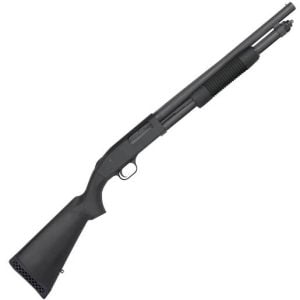
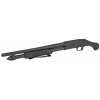
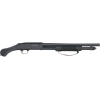
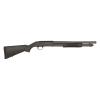
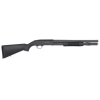
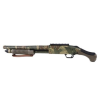
The 590 is a purpose-built fighting shotgun. Not a hunting gun that can also defend your home. Not a versatile all-rounder. It’s a combat platform the U.S. military adopted for a reason, and every design choice points at that mission.
Eight-plus-one rounds of 12 gauge without a reload. In a home defense scenario, that’s a meaningful advantage over the 500’s 5+1. The extended magazine tube gives you near-semi-auto capacity in a pump-action platform that basically never malfunctions. No gas system to foul. No inertia spring to short-stroke. Rack, bang, rack, bang. Every single time.
The 590 also feels more solid in the hand. It’s a quarter pound heavier than the 500, and that weight lives mostly in the extended tube and barrel area. The forward-weighted balance helps the gun track where you point it during rapid target transitions, useful for 3-gun stages or shoot-house drills. The optional ghost-ring sights and heat shield round out the package.
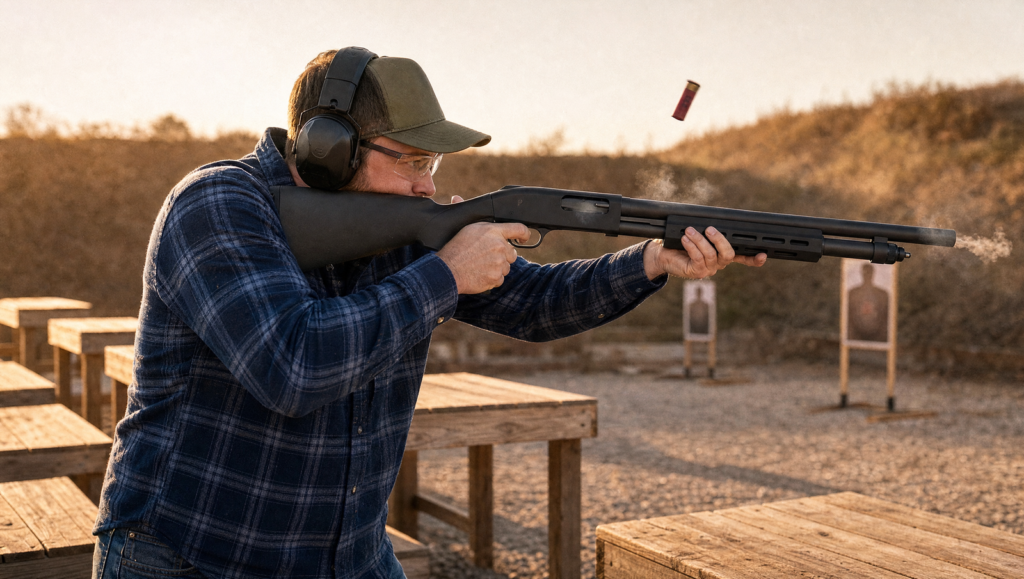
For dedicated home defense or any tactical use case, the 590 is the better tool. Not even close. The capacity alone justifies the price premium over the 500.
The 590 Family: Tactical, Retrograde, Shockwave, 590M, 590S
The 590 lineup is smaller than the 500’s but more interesting. The 590 Tactical (SKU 50778) is the standard 6+1 or 8+1 synthetic configuration at $592 MSRP. The 590A1 Tactical (51660) adds the heavy-wall barrel, aluminum trigger guard, ghost-ring sights, and bayonet lug at $861 MSRP, the version the military actually buys.
The 590A1 Retrograde (51665) is the curveball, same 590A1 mechanicals dressed in walnut furniture instead of synthetic, $1,169 MSRP. It looks like a Vietnam-era trench gun and patterns like a modern fighting shotgun. The 590 Shockwave (50659) is the 14.375-inch firearm-classified version with a Raptor pistol grip, ATF-classified as a “firearm” rather than a short-barreled shotgun, $592 MSRP and immensely popular as a truck gun.
Two newer variants sit at the edges. The 590M is the magazine-fed version that uses 5, 10, 15, or 20-round detachable box magazines instead of the tube, solving the 590’s only real weakness (slow reload) at the cost of bulk. The 590S (Optic Ready) is engineered to feed 1¾-inch Aguila MiniShells without an OPSol Mini-Clip adapter, getting you up to 13+1 capacity in a standard tube.
590 vs 590A1: Is the Upgrade Worth It?
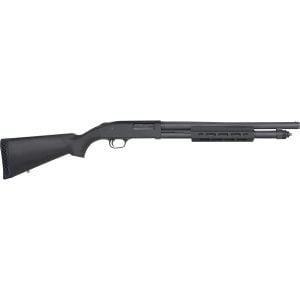
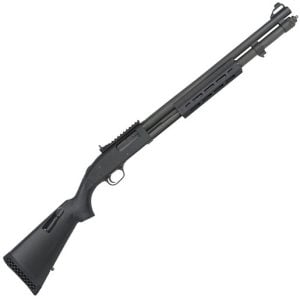
The 590A1 takes everything the standard 590 does and adds three mil-spec upgrades: a heavy-wall barrel, an aluminum trigger guard, and certification to MIL-S-3443G. It’s the version the U.S. military actually buys and has been buying since 2003, when the 3443G test protocol replaced the older 3443E standard.
The heavy-wall barrel is thicker steel that resists denting and adds the durability needed for bayonet use (yes, it has a bayonet lug standard). In practical terms, it also makes the gun a touch front-heavy, which most shooters appreciate for recoil management on full-power 00 buck. The aluminum trigger guard replaces the polymer unit on the standard 590, eliminating any chance of the guard cracking in extreme cold or under heavy use.
Is it worth the extra $270 or so over the standard 590? For most civilians, honestly, probably not. The standard 590’s barrel is plenty durable for home defense and weekend range work. You’re unlikely to ever stress the polymer trigger guard enough to break it. The MIL-S-3443G certification is a peace-of-mind feature, not a performance one.
That said, the 590A1 has a built-like-a-tank feel that’s hard to describe until you handle one. It just feels overbuilt in the best way. If you want the absolute toughest pump money can buy and the price difference doesn’t bother you, the A1 is the move. If budget matters, the standard 590 gives you 95% of the capability. Our full 590A1 review goes deeper on the differences.
Military Heritage: Why the 590A1 Wears the Mil-Spec Badge
O.F. Mossberg & Sons has been making firearms in North Haven, Connecticut since 1919, founded by Oscar Frederick Mossberg, a Swedish immigrant who’d previously designed for Iver Johnson and Marlin. The 500 was the company’s breakout pump, designed by Carl Benson in the late 1950s and launched in 1961. The 590 came later, in 1987, specifically to answer a U.S. military requirement for a higher-capacity combat shotgun.
The 590 passed the MIL-S-3443E test protocol in 1987, a 3,000-round endurance run plus salt fog, mud, sand, and drop-test torture. When the Navy asked for a thicker barrel to survive bayonet drills and breaching work, Mossberg responded with the 590A1 and got it certified to the updated MIL-S-3443G standard in 2003. The U.S. Army re-orders 590A1s on an ongoing basis, most recently a 24,000-unit contract in 2024.
The Marines, Army, Navy, and Air Force all field 590A1s for boarding actions, base security, less-lethal deployment, and breaching rounds. The Benelli M4 semi-auto has supplanted the 590A1 in some front-line roles, but the Mossberg pump is still the workhorse for support units. When civilians buy a 590A1, they’re buying the exact gun the Navy buys, same barrel profile, same trigger guard, same MIL-S-3443G stamp.
What About the Maverick 88?
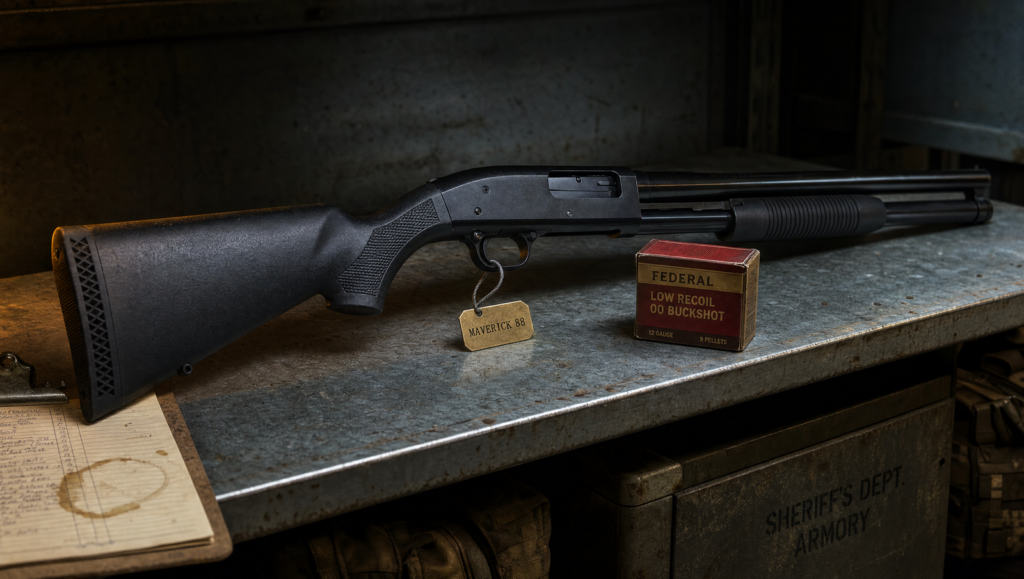
Can’t talk about the 500 without mentioning its budget sibling. The Maverick 88 is built on the same action as the Mossberg 500 but manufactured in Mossberg’s Eagle Pass, Texas facility (it used to be Mexico) with cost-saving changes. The safety moves from the tang to a crossbolt behind the trigger guard. The forend is pinned rather than using an action slide tube nut. The finish is rougher and the parts kits use less-finished steel.
But here’s the thing: the Maverick 88 accepts Mossberg 500 barrels. You get the same barrel-interchange versatility at a street price of around $230 to $280 (MSRP is $290). That is insane value. The 88 All-Purpose ships with a 28-inch field barrel; the 88 Security comes with the 18.5-inch cylinder bore for home defense. If you’re on a strict budget and want a pump that runs, the Maverick 88 is the answer.
The crossbolt safety is the biggest functional downgrade. It’s not ambidextrous, and it’s not as intuitive as the tang-mounted safety on the 500 and 590. If you’re left-handed or trained on tang safeties, this matters. Otherwise, it’s a minor thing. The Maverick 88 goes bang every time you pull the trigger, and at that price, complaining feels silly.
For Home Defense: 500 or 590?
590 wins for dedicated home defense, hands down. More rounds in the tube, purpose-built tactical design, ghost-ring sights available, heat shield as an option, and a gun that was literally designed for combat. If this shotgun is going to live beside the bed and its only job is protecting your family, the 500 vs 590 question answers itself, get the 590.
But if your home defense shotgun also needs to pull double duty as a hunting gun, a clay gun, or a truck gun, the 500 is the smarter buy. Drop a 28-inch vent rib on for Saturday morning at the sporting clays course and swap the 18.5-inch cylinder bore back on when you get home. Try doing that with a 590, you’ll run out of barrel options before you finish your coffee.
One thing both Mossberg pump shotguns share: the tang safety. In a high-stress situation, a safety that sits right where your thumb naturally rests is a big deal. You don’t have to think about it. Thumb forward, safe off, ready to go. The Remington 870 and Maverick 88 both use crossbolt safeties that demand more deliberate manipulation. It’s a small thing until it matters.
For ammo, both guns run 2¾-inch and 3-inch shells equally well. Either will pattern a 9-pellet 00 buck load into a 6-inch group at 7 yards through a cylinder bore, plenty for any defensive distance you’ll see inside a house. The 590S is the only Mossberg pump that reliably cycles 1¾-inch Aguila MiniShells without an OPSol Mini-Clip adapter, which is a niche but real consideration if you want maximum tube capacity with reduced recoil.
For Hunting: The 500 Wins Easily
This one isn’t even a debate. The Mossberg 500’s barrel interchangeability makes it the obvious choice for hunters. Set it up for waterfowl with a 28-inch vent rib and full choke, swap to a 24-inch rifled slug barrel for deer season, and bolt on a 22-inch turkey barrel with an extra-full choke for spring gobblers. Same receiver, three different guns, one safe slot.
The 590 can technically hunt with its 18.5 or 20-inch barrel, but you’re limited on range and pattern density compared to a proper hunting barrel. Good luck finding a 590-compatible vent rib for sporting clays, they exist but they’re scarce and expensive. The platform was never meant for upland or duck blinds.
The 500 also comes in 20 gauge and .410 bore, which opens it up to youth shooters, smaller-framed adults, and small-game hunters. The 590 and 590A1 are 12 gauge only. For a full survey of the lineup, our best Mossberg shotguns guide breaks every variant down by use case.
Aftermarket Support: Magpul, Mesa Tactical, Knoxx, OPSol
Both the Mossberg 500 and 590 share the same receiver dimensions, which means most aftermarket stocks fit both guns. The Magpul SGA is the popular synthetic upgrade, replaces the factory stock with a length-adjustable, sling-friendly polymer unit at around $130. The Magpul MOE forend pairs with it and adds M-LOK slots for lights and accessories. Mesa Tactical’s Urbino stock and Sureshell side-saddle shell carrier are the go-to LE and competition picks.
The Knoxx SpecOps NRS recoil-reducing stock and Hogue OverMolded are the cheaper alternatives. For weapon lights, the Streamlight TL-Racker integrates a light directly into the forend, while Surefire’s forend lights bolt on conventionally. Crimson Trace’s LaserSaddle adds a laser to the side of the receiver without permanent modifications.
For maximum capacity on a budget, the OPSol Mini-Clip drops into a standard 500 or 590 magazine well and lets the gun cycle 1¾-inch Aguila MiniShells, getting you up to 14+1 capacity with reduced-recoil mini-shells. The 590S is the only factory Mossberg that runs mini-shells without the clip. Smart workaround if you don’t want to spring for a new gun.
Who Should NOT Buy a Mossberg Pump
The Mossberg 500 and 590 are honest, capable shotguns, but they’re not the right choice for every buyer. Here’s who should look elsewhere:
- The competition 3-gun shooter on a serious budget for speed. A Beretta 1301 Tactical or Benelli M4 semi-auto cycles faster than any pump and reloads more efficiently from a side-saddle. The 590A1 is great for stages, but it’s not a top-finish gun.
- The recoil-sensitive shooter looking for a primary home defense gun. Even with low-recoil 00 buck, a 12-gauge pump kicks. A semi-auto bleeds energy through the gas system; a pump dumps all of it into your shoulder. A 20-gauge Mossberg 500 helps, but a Benelli M4 in 12 gauge with reduced-recoil ammo is gentler still.
- The bird hunter who wants one gun for upland and waterfowl. Both platforms will technically do the job, but a Beretta A300 or Benelli SBE3 semi-auto cycles 3″ magnums smoother, swings better on flying birds, and weighs about the same. The 500’s hunting versatility is real but it’s not optimized.
- The left-handed shooter who wants a Maverick 88. The 88’s crossbolt safety isn’t ambidextrous and runs the wrong direction for southpaws. Spend the extra $150 on a Mossberg 500 with the tang safety, best lefty-friendly pump in production.
- The buyer who wants a factory-warrantied detachable-magazine shotgun. The 590M solves this, but it’s a niche product with limited mag availability. A Mossberg 940 Pro Tactical or Beretta 1301 with mag extension is the cleaner answer if box mags or fast reloads are the deciding factor.
The Verdict: Which Should You Buy?
Buy the Mossberg 500 if you want one pump shotgun that does everything reasonably well. Hunting, home defense, clays, truck gun. The barrel-swap system and lower price make it the better value for anyone who needs versatility. It’s been the best-selling pump-action shotgun in America for decades and there’s a reason for that.
Buy the Mossberg 590 if home defense is the primary mission and you want maximum capacity in a proven tactical platform. The 8+1 (or 9-shot on the 20-inch 590A1) capacity and purpose-built design make it the superior defensive shotgun in the Mossberg 500 vs 590 matchup. Spring for the 590A1 if you want MIL-S-3443G toughness and the budget allows. Spring for the 590A1 Retrograde if you want walnut furniture on a fighting gun.
Buy the Maverick 88 if your budget is under $300 and you just need a reliable pump that works. It does the same job as the 500 with minor compromises around the safety and finish. No shame in that game.
Whichever Mossberg pump you choose, you’re getting a tang safety, dual extractors, dual action bars, and a track record measured in millions of units sold over more than half a century. You really can’t go wrong on either side of the 500 vs 590 question, just match the gun to the mission.
Related Guides
- Mossberg 590A1 Review
- Mossberg 500 Review
- Best Pump Action Shotguns
- Best Mossberg Shotguns
- Best Shotguns for Home Defense
- Best Home Defense Shotgun Under $500
- Best Shotgun Ammo for Home Defense
Frequently Asked Questions
Related: Choosing a defensive shotgun? Read our full Benelli M4 vs Mossberg 590 comparison.
What is the main difference between the Mossberg 500 and 590?
The primary difference is the magazine tube design. The 500 has a closed magazine tube where the barrel screws onto a nut at the end of the tube, limiting capacity to 5+1 with an 18.5-inch barrel. The 590 uses an open-ended magazine tube with the barrel attached separately, allowing 8+1 capacity with the same barrel length. This design difference also means barrels are not interchangeable between the two models.
Can you swap barrels between a Mossberg 500 and 590?
No, Mossberg 500 and 590 barrels are not interchangeable. They use different attachment methods because of the magazine tube design difference. The 500 barrel threads onto a nut on the magazine tube, while the 590 barrel is held by a retaining nut at the muzzle end. The 500 has far more barrel options available, including hunting, slug, and sporting barrels. The 590 barrel selection is mostly limited to tactical lengths.
What is the difference between the 590 and 590A1?
The 590A1 adds three upgrades over the standard 590: a heavy-wall barrel made from thicker steel, an aluminum trigger guard replacing the polymer one, and mil-spec testing to MIL-S-3443G. The A1 also typically comes with a bayonet lug as standard. It costs about $150 more than the standard 590 and is the version purchased by the U.S. military.
Which is better for home defense, the 500 or 590?
The 590 is the better dedicated home defense shotgun because of its 8+1 capacity and purpose-built tactical design. Three extra rounds without reloading is a significant advantage in a defensive scenario. However, if your home defense shotgun also needs to serve as a hunting or sporting gun, the 500 is more versatile thanks to its barrel interchangeability system.
Does the Mossberg 590 have a bayonet lug?
The bayonet lug is available on some 590 models and comes standard on the 590A1. It accepts the M9 bayonet used by the U.S. military. While a bayonet is unlikely to be useful for civilian home defense, the lug is part of the military heritage of the 590 platform. Some aftermarket accessories also mount to the bayonet lug.
Is the trigger guard different on the 500, 590, and 590A1?
The Mossberg 500 and standard 590 both use polymer trigger guards. The 590A1 upgrades to an aluminum trigger guard that is more durable in extreme temperatures and under heavy use. The polymer guards on the 500 and 590 are adequate for civilian use and rarely cause issues, but the aluminum guard on the A1 is one of the upgrades that earned it mil-spec certification.
How does the Maverick 88 compare to the Mossberg 500?
The Maverick 88 is built on the same action as the Mossberg 500 but is manufactured in Mexico with cost-saving changes. The safety moves from a tang-mounted position to a crossbolt behind the trigger guard, the forend is pinned rather than using an action slide tube nut, and the finish is rougher. However, the 88 accepts Mossberg 500 barrels, giving it the same versatility at a street price of around $220 to $280.
What gauge options are available for the 500 and 590?
The Mossberg 500 is available in 12 gauge, 20 gauge, and .410 bore, making it suitable for a wide range of shooters and applications. The 590 and 590A1 are available in 12 gauge only. If you need a pump shotgun in 20 gauge or .410 for youth shooters, smaller-framed adults, or small game hunting, the 500 is your only Mossberg option.
4,659+ Gun & Ammo Deals
Updated daily from 200+ top retailers. Filter by category, caliber, action type, and price.
Related Guides