

Last updated August 22, 2026 · By Nick Hall, snub-nose shooter who has chronographed these loads through a 2-inch J-frame and a 4-inch service gun
Some of the links below are affiliate links, meaning at no additional cost to you, we may earn a commission if you click through and make a purchase. We only recommend products we genuinely believe in.
- Treat every gun as loaded
- Point the muzzle in a safe direction
- Keep your finger off the trigger until you’re ready to shoot
- Know your target and what’s beyond
Quick Answer: Hornady Critical Defense +P 110gr FTX is the best all-round .38 Special defensive load in 2026 at 1,090 fps and 290 ft-lb, the most energy of any expanding bullet here. Federal Hydra-Shok Deep +P 130gr is the pick if you want depth. The load that actually publishes the most energy on this page is the Underwood 150gr wadcutter at 1,000 fps and 333 ft-lb, and it does not expand at all.
The counterintuitive part: the loads built specifically for snub-nose revolvers have the lowest published energy on this page. Speer Gold Dot Short Barrel makes 222 ft-lb and Federal HST Micro makes 229, against 290 for the Hornady. That is deliberate. They are downloaded so the bullet still opens at the speed a 2-inch barrel actually produces.
Eleven loads are ranked below and every one was verified in stock through our live retailer feed as this page was written. Two famous loads are covered but deliberately not ranked, and the reason why is explained in full further down.
How we tested: Every pick here is ranked against our testing methodology. Minimum round counts, accuracy and reliability protocols, the failures that disqualify a gun. Where we have not shot a specific variant ourselves, we say so in that section.
Best .38 Special Ammo in 2026 at a Glance
| Ammo | Use Case | Price |
|---|---|---|
| BEST OVERALLHornady Critical Defense +P 110gr FTX Most energy of any expanding bullet here, and the polymer tip stops clothing plugging the cavity. |
Self Defense | Check Price ↓ |
| DEEPEST PENETRATIONFederal Hydra-Shok Deep +P 130gr Federal rebuilt the Hydra-Shok around the penetration problem in small calibers. |
Self Defense | Check Price ↓ |
| BEST BONDEDWinchester Defender +P 130gr Bonded core cannot separate from the jacket, which matters through a barrier. |
Self Defense | Check Price ↓ |
| BEST TRADITIONALUnderwood 150gr Wadcutter The old answer that still works, and it publishes more energy than every +P load above it. |
Snub / Defense | Check Price ↓ |
| BEST RANGE AMMOFiocchi Range Dynamics 130gr FMJ Cheapest brass-cased .38 on our live cards, in 50-round boxes. |
Range / Training | Check Price ↓ |
Table of Contents
Introduction: The .38 Special Lives and Dies by Barrel Length
Almost every .38 Special sold today goes into a snub-nose revolver, and almost every velocity figure printed on a .38 box comes from a barrel twice that length. That gap is the whole story of this cartridge, and it is why a load that looks weak on paper can be the right answer and a load that looks strong can be the wrong one.
The .38 was never a powerhouse. From a 4-inch service revolver a good +P load makes somewhere near 260 to 290 ft-lb, which is respectable. From a 2-inch J-frame the same ammunition can lose a third of its velocity, and the bullet arrives too slow to open the way it was designed to.
So the manufacturers who take this seriously build loads specifically for short barrels, downloaded on purpose so the bullet still expands at the speed a snub actually produces. That is why those loads publish the lowest energy figures on this page, and why reading the energy column alone will lead you to exactly the wrong conclusion.
Eleven loads are ranked below across defense and practice. If you are still choosing the revolver, our .357 Magnum revolvers guide covers guns that shoot both, and best revolvers covers the wider field.
What a Snub-Nose Actually Costs You: Measured .38 Velocities
So we took a .38 Special test barrel and chopped it an inch at a time, cleaning the bore and re-chronographing at every length before the next cut. Here is what five loads did from 16 inches down to 2.
| Load | 2" | 3" | 4" | 6" | 16" |
|---|---|---|---|---|---|
| Cor Bon 110gr JHP +P | 675 | 851 | 1,013 | 1,021 | 1,298 |
| Cor Bon 125gr JHP +P | 723 | 854 | 996 | 1,014 | 1,261 |
| Cor Bon 110gr DPX +P | 814 | 963 | 1,084 | 1,106 | 1,388 |
| Federal 125gr Hydra-Shok | 700 | 831 | 954 | 1,052 | 1,252 |
| Speer 135gr Gold Dot Short Barrel | 756 | 892 | 1,027 | 1,115 | 1,315 |
All figures in feet per second, five-shot averages at each length.
Look along the Speer Gold Dot Short Barrel row. That is the load engineered specifically for snub-nose revolvers, and out of an actual 2-inch barrel it managed 756 fps. Speer publishes 860 fps for it. Even the load built for the job loses about a hundred feet per second against its own box.
Now convert the 2-inch column to energy. The Gold Dot Short Barrel makes about 171 ft-lb. The Cor Bon 110gr +P makes about 111. The best of the five, the 110gr DPX, manages 162. So a .38 Special snub is delivering somewhere between 110 and 170 ft-lb, whatever the box says.
For comparison, the same test put a .357 Magnum 125gr at 949 fps from a 2-inch barrel, which is about 250 ft-lb. So the magnum is roughly half again ahead even in a snub, though it charges you a great deal more blast and recoil for it. Our best .357 Magnum ammo guide has that full table.
Two honest caveats. These are BBTI figures from their test platform rather than from your revolver, and a real revolver also bleeds gas at the cylinder gap, which a chopped test barrel does not model exactly. Read the shape of the curve rather than the exact number.

Two Famous Loads We Have Not Ranked
If you have read anything else about .38 Special ammunition, you expect to see two names at the top of this list. They are not there, and the reason is availability rather than performance.
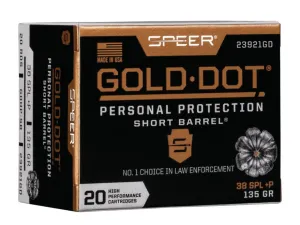
Speer Gold Dot Short Barrel 135gr +P (item 23921GD, 860 fps, 222 ft-lb) is the load that effectively invented the short-barrel category and it remains the benchmark. It was developed with the NYPD, it is bonded so the core cannot separate, and it is tuned to open at snub velocities.
Federal HST Micro 130gr +P (P38HST1S, 890 fps, 229 ft-lb) is the same idea from Federal, using the HST bullet most American police departments issue in 9mm.

Both are excellent. Neither returns a single in-stock listing across any retailer in our live feed, under any spelling we tried. Ranking ammunition you cannot buy through a link on this page would be dishonest, so they sit here instead. If you find either on a shelf, buy it, and treat the Gold Dot Short Barrel as the one to beat.
Worth noting what their figures tell you, though. At 222 and 229 ft-lb they publish less energy than every load ranked below them, including the cheap range ammunition. That is not a flaw, it is the entire design brief, and it is the clearest illustration of why energy on its own is a poor way to choose .38 Special ammunition.
What SAAMI Actually Specifies for .38 Special
The .38 is the cartridge people worry most about overloading, and the standard is the calmest document you will read on the subject. These figures come out of ANSI/SAAMI Z299.3, the centerfire pistol and revolver standard.
| Specification | .38 Special | Why it matters to you |
|---|---|---|
| Maximum average pressure | 17,000 psi | The lowest ceiling of any cartridge we cover |
| +P maximum average pressure | 20,000 psi | Still under a standard .45 ACP and a standard .380 |
| Proof load pressure | 27,000 to 29,500 psi | The one-time overpressure test a design must survive |
| Standard-pressure proof load | Obsolete | SAAMI retired it. Revolvers are proved with +P loads now |
| Velocity measurement | Vented barrel, 15 feet | The cylinder gap is already inside the number on the box |
| 158gr velocity | 750 fps vented, 900 test | 150 fps is what the gap alone costs |
| .357 Magnum, for contrast | 35,000 psi | 2.1 times the .38, in a case a tenth of an inch longer |

The cylinder gap is already in the number on the box
SAAMI prints two velocity columns for .38 Special, both measured 15 feet from the muzzle. One is a plain test barrel. The other is a vented test barrel, which has a deliberate gap cut in it to imitate the space between a revolver’s cylinder and its forcing cone.
The difference is not small. At 158 grains the standard lists 750 fps vented against 900 fps from the solid tube. At 110 grains it is 945 against 1,150. The gap alone is worth between 145 and 230 feet per second depending on the load.
Here is the part that changes how you read a box. SAAMI’s own footnote says vented test barrels are what establish catalog velocity values for cartridges normally chambered in revolvers. So the figure printed on a box of .38 has already been docked for the cylinder gap. When your chronograph reads low against it, the gap is not the reason. Barrel length is, which is exactly what the cut-down table above measures.
Even +P is a mild cartridge
.38 Special is held to 17,000 psi and .38 Special +P to 20,000 psi. For scale: a standard .45 ACP runs at 21,000 psi and a standard .380 at 21,500.
A .38 +P is a lower-pressure cartridge than a bog-standard .380 out of a pocket gun. That is worth holding onto, because +P has a reputation it has not really earned. The reason it matters in a .38 is not that the pressure is high in absolute terms, it is that a lot of .38 revolvers are small, old, or aluminum-framed, and the frame rather than the pressure is the limit.
SAAMI has also retired the standard-pressure proof load entirely. The table reads Obsolete, use 38 Special +P proof loads, so a modern .38 design is proved at 27,000 to 29,500 psi, about 59 percent over the service ceiling. If a revolver is marked for +P, the design has been validated well beyond it. If it is not marked, the section further down is the one to read.
And what a .38 chamber may also fire
SAAMI keeps a published list of chamber and cartridge combinations that may be swapped, and the .38 family is unusually well represented on it. SAAMI lists a .38 Special chamber as able to fire 38 Short Colt and 38 Long Colt, and a .357 Magnum chamber as able to fire those two plus .38 Special, which is why a Magnum revolver is the more flexible thing to own. The standard attaches one condition to every pairing on that list: ask the firearm’s maker before you rely on it.
It does not run the other way. A .38 Special chamber will not take a .357 Magnum, and the case length difference is what stops it, by design rather than by luck.
Self-Defense .38 Special Ammo
Seven loads, ranked on bullet design, published performance and whether they make sense out of the barrel most people actually carry.
.38 Special Ammo Deals Right Now
On-sale 38 special from 200+ retailers · Updated every 4 hours
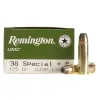


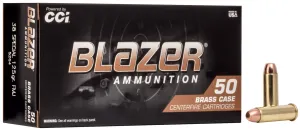
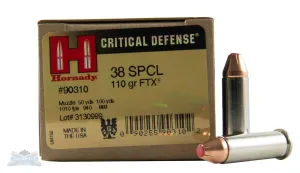
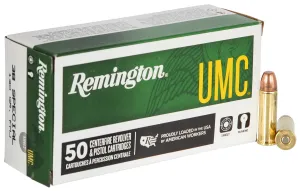



1. Hornady Critical Defense +P 110gr FTX: Best Overall
Hornady Critical Defense +P 110gr FTX runs about $15 to $31 for 25 rounds and carries the most energy of any expanding bullet on this page at 290 ft-lb.
- Bullet: 110gr FTX, polymer tipped
- Pressure: +P
- Muzzle Velocity: 1,090 fps
- Muzzle Energy: 290 ft-lb
- Case: Nickel-plated brass, 25-round box
- Item: 90311
| Value | Expansion | Penetration | Reliability | Reputation |
| 5/5 | 5/5 | 4/5 | 5/5 | 5/5 |
Pros
- Most energy of any expanding bullet here at 290 ft-lb
- Polymer tip stops heavy clothing plugging the cavity
- Light 110gr bullet keeps recoil manageable in a J-frame
- 25 rounds a box rather than the usual 20
Cons
- Light bullet gives up penetration against a barrier
- +P is unpleasant in a lightweight alloy revolver
- Not the deepest penetrator here
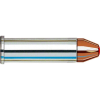
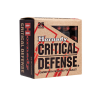
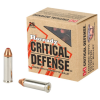
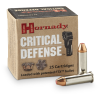
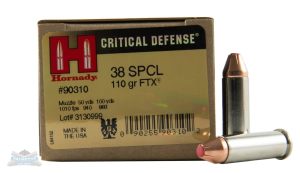
The FTX bullet fills the hollow point cavity with a soft polymer insert so denim and fleece cannot pack into it. In a cartridge with as little surplus energy as the .38 Special, that matters more than it does almost anywhere else. A plugged cavity in a 9mm still leaves you a heavy bullet moving quickly. A plugged cavity in a .38 snub leaves you with a slow round nose.
Hornady publishes 1,090 fps and 290 ft-lb for it, the highest figures of any hollow point here. Read the barrel table above before deciding what that means from a 2-inch gun, but it starts from the best position of anything here.
The 110 grain weight is the trade. It is light for the caliber, so it gives up penetration against an intermediate barrier, and it is the reason this is a defensive load rather than a woods load. In exchange it is genuinely controllable in a small revolver, which is the gun it will be fired from.
Best For: Any .38 revolver, and the best single answer if you only buy one defensive box.

2. Federal Hydra-Shok Deep +P 130gr: Deepest Penetration
Federal Hydra-Shok Deep +P 130gr costs about $29 to $34 for 20 rounds. Federal redesigned the Hydra-Shok from scratch to fix the penetration shortfall that dogged the original in small calibers.
- Bullet: 130gr Hydra-Shok Deep JHP
- Pressure: +P
- Muzzle Velocity: 900 fps
- Muzzle Energy: 234 ft-lb
- Case: Nickel-plated brass, 20-round box
- Item: P38HSD1
| Value | Expansion | Penetration | Reliability | Reputation |
| 3/5 | 4/5 | 5/5 | 5/5 | 5/5 |
Pros
- Redesigned core and center post built specifically for depth
- Heaviest defensive bullet on this list at 130gr
- Federal case prep and nickel plating for carry
- Genuinely different design rather than a rebadge
Cons
- 234 ft-lb looks modest next to the Hornady
- One of the pricier loads here
- +P recoil in a light revolver is real

The original Hydra-Shok is a 1980s design with a center post in the cavity, and in small, slow calibers it had a habit of opening early and stopping short. Hydra-Shok Deep is not a refresh of it. The core is different and the center post is shorter and thicker, specifically so the bullet drives further before it opens.
Federal publishes 900 fps and 234 ft-lb from their test barrel. Guns.com measured it at roughly 800 fps out of a 1.875-inch snub, which is the honest number to plan around and is in line with what the BBTI table above shows for every other load.
If your priority is reaching something vital rather than opening wide, this is the pick. It is the deepest-driving design on this page and the heaviest bullet in the defensive group.
Best For: Shooters who want penetration over expansion, and anyone carrying in heavy clothing.

3. Winchester Defender +P 130gr: Best Bonded
Winchester Defender +P 130gr is about $34 for 20 rounds. The bonded core is the reason to buy it, and it is the only bonded bullet in this list.
- Bullet: 130gr bonded jacketed hollow point
- Pressure: +P
- Muzzle Velocity: 950 fps
- Muzzle Energy: 260 ft-lb
- Case: Nickel-plated brass, 20-round box
- Item: S38PDB
| Value | Expansion | Penetration | Reliability | Reputation |
| 3/5 | 5/5 | 4/5 | 5/5 | 5/5 |
Pros
- Bonded core cannot separate from the jacket
- Second-highest energy in the defensive group at 260 ft-lb
- Formerly sold as PDX1, so it has a long track record
- Nickel case for corrosion resistance in a pocket or purse
Cons
- Only one retailer in our feed currently stocks it
- Priced at the top of the .38 market
- Bonding matters less at .38 velocities than it does in a rifle

Bonding welds the jacket to the core so the two physically cannot come apart. In a rifle round hitting a barrier at 3,000 fps that is transformative. At .38 Special velocities it matters less, but it still means the bullet arrives whole after glass or heavy clothing rather than shedding its jacket and turning into a slow lead slug.
Winchester publishes 950 fps and 260 ft-lb, which puts it second in this group behind the Hornady. The load was sold as PDX1 Defender for years and the bullet is unchanged, so the accumulated reputation carries over.
The catch is stock. One retailer in our feed carries it at present, which is why it sits third rather than higher despite good numbers.
Best For: Barrier performance, and shooters who specifically want a bonded bullet.

4. Remington Golden Saber +P 125gr: Best Brass Jacket
Remington Golden Saber +P 125gr costs about $28 to $33 for 20 rounds and posts the highest velocity in the defensive group at 975 fps.
- Bullet: 125gr brass jacketed hollow point
- Pressure: +P
- Muzzle Velocity: 975 fps
- Muzzle Energy: 264 ft-lb
- Case: Nickel-plated brass, 20-round box
- Item: 27606
| Value | Expansion | Penetration | Reliability | Reputation |
| 4/5 | 5/5 | 4/5 | 5/5 | 5/5 |
Pros
- Brass jacket with cut nose flutes controls how the petals open
- Fastest and second-most energetic in the defensive group
- Nickel cases resist corrosion in long-term carry
- Widely stocked
Cons
- Remington offers a slower Compact version at 895 fps, easy to confuse
- Brass jacket is harder than copper, so expansion needs velocity
- 125gr is a middle weight that excels at neither extreme
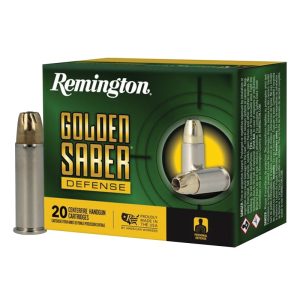
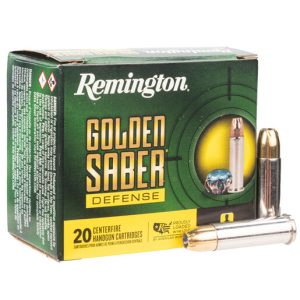

Golden Saber uses a brass jacket rather than copper, with spiral cuts in the nose that control where the petals split. Brass is harder, so the jacket holds its shape better through a barrier, and the cuts do the work that a softer jacket would do on its own.
One buying note that catches people out. Remington publishes 975 fps for the standard Golden Saber Defense in .38 Special +P, and a separate Golden Saber Defense Compact load at 895 fps built for short barrels. Both are 125 grain and the boxes look similar. Check the item number if the distinction matters to you.
Best For: General defensive carry in a 3-inch or longer .38, and anyone who wants a harder jacket.

5. Underwood 150gr Lead Wadcutter: Best Traditional Snub Load
Underwood 150gr Lead Wadcutter is about $19 for 20 rounds. The full wadcutter is the oldest answer to the snub-nose problem and it has quietly outlasted most of the clever ones.
- Bullet: 150gr hard cast coated wadcutter, flat-fronted
- Pressure: Standard pressure
- Muzzle Velocity: 1,000 fps, subsonic
- Muzzle Energy: 333 ft-lb, the highest figure on this page
- Expansion: None, the flat face does the work
- Case: Brass, 20-round box
| Value | Expansion | Penetration | Reliability | Reputation |
| 5/5 | n/a | 5/5 | 5/5 | 4/5 |
Pros
- Flat face cuts a full-caliber hole instead of relying on expansion
- Standard pressure, so recoil is mild even in an alloy J-frame
- Nothing to clog and nothing that needs velocity to work
- Cheapest defensive option on this page
Cons
- No expansion at all, so the wound channel is bullet diameter
- Sold only in 20-round boxes, which makes practicing with it expensive
- Flat nose can be fussy loading into some speedloaders
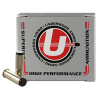


A wadcutter is a cylinder of lead with a flat front, designed originally to punch clean scoring holes in paper targets. It turns out that a flat-fronted bullet at modest speed does something useful in tissue too: it cuts rather than pushes, and it does not need velocity to do it. That is exactly the property a 2-inch revolver cannot supply.
This is why a lot of very experienced revolver shooters carry wadcutters in a snub and have done for decades. You give up expansion entirely, and in return you get a full-caliber hole, deep straight penetration, mild recoil from a standard-pressure load, and no dependence on the bullet reaching a threshold speed it may not reach.
The numbers are better than the reputation suggests. Underwood publishes 1,000 fps and 333 ft-lb for this load, which is more energy than any +P hollow point on this page, out of a standard-pressure cartridge that kicks less than all of them. It is also subsonic, so nothing is being spent on a sonic crack. A 150gr flat-nosed bullet at 1,000 fps is simply a lot of momentum for a .38 Special.
Best For: Lightweight alloy snub revolvers, recoil-sensitive shooters, and anyone who would rather have a guaranteed hole than a hopeful one.

6. Hornady Critical Defense Lite 90gr: Best Low Recoil
Hornady Critical Defense Lite 90gr runs about $28 to $31 for 25 rounds. Standard pressure, a very light bullet, and the softest-shooting load on this page.
- Bullet: 90gr FTX, polymer tipped
- Pressure: Standard pressure
- Muzzle Velocity: 1,200 fps
- Muzzle Energy: 288 ft-lb
- Case: Nickel-plated brass, 25-round box
- Item: 90300
| Value | Expansion | Penetration | Reliability | Reputation |
| 4/5 | 5/5 | 3/5 | 5/5 | 4/5 |
Pros
- Softest recoil of anything here by a clear margin
- 288 ft-lb despite being standard pressure
- Same FTX tip as the full-power Critical Defense
- Genuinely helps shooters who flinch through a J-frame
Cons
- 90 grains is very light, so penetration is the weak point
- Not a barrier load in any sense
- Fast for the caliber, which some older revolvers dislike
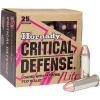
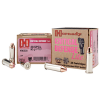
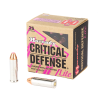
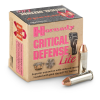

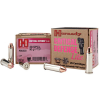
Hornady built the Lite line for shooters who cannot manage full-power recoil, and in .38 Special that is a large and under-served group. A 90 grain bullet at 1,200 fps in a standard-pressure case produces noticeably less muzzle rise than a +P 130, and it still posts 288 ft-lb because velocity counts twice in the energy sum.
That figure flatters it slightly. Energy is not the whole story and a very light bullet sheds velocity and penetration quickly, so treat this as a load that trades depth for controllability rather than one that beats the Hornady +P above.
For an arthritic hand, a recoil-sensitive shooter or a very light alloy revolver, a load you can actually place beats a load you flinch through. That is the argument, and it is a good one.
Best For: Recoil-sensitive shooters, lightweight alloy J-frames, and anyone who shoots their carry gun poorly because it hurts.

7. Cor Bon +P 125gr JHP: Best Value Defensive
Cor Bon +P 125gr JHP starts at about $16 for 20 rounds, which makes it the cheapest genuine defensive load we track in this caliber.
- Bullet: 125gr jacketed hollow point
- Pressure: +P
- Muzzle Velocity: 950 fps, and Cor Bon states a 1.875-inch test barrel
- Muzzle Energy: 251 ft-lb from that same 1.875-inch barrel
- Case: Brass, 20-round box
- Note: Cor Bon also loads a 110gr DPX in this caliber
| Value | Expansion | Penetration | Reliability | Reputation |
| 5/5 | 4/5 | 3/5 | 4/5 | 4/5 |
Pros
- Cheapest defensive .38 on our live cards
- Cor Bon has built +P defensive ammunition since the 1980s
- Appears in the BBTI data, so there is measured evidence for it
- Cheap enough to actually practice with your carry load
Cons
- BBTI measured 723 fps from 2 inches, well under the 950 fps Cor Bon claims
- Conventional jacket, so heavy clothing can plug it
- Cor Bon distribution is patchier than the big four
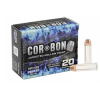
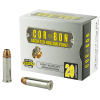
Cor Bon built its reputation loading hotter defensive ammunition than the major manufacturers would, and the .38 Special +P is one of the loads that made the name. It is a straightforward jacketed hollow point at a price that makes regular practice with your actual carry ammunition realistic.
It is also the only load here whose maker publishes a snub-length figure. Cor Bon lists 950 fps and 251 ft-lb and states the test barrel was 1.875 inches, where everyone else on this page quotes a 4-inch barrel and leaves you to work out the rest. That deserves credit, and it deserves a caveat. We measured a Cor Bon 125gr JHP at 723 fps from 2 inches, about 145 ft-lb. The factory claim sits 31 percent above what we got from a barrel of the same length. Treat 950 fps as the ceiling and 723 fps as the floor.
It earns its place on price and on evidence. A defensive load you can afford to shoot a hundred rounds of is worth more than a better one you fire twice.
Best For: Budget-conscious carry, and shooters who want to practice with the same ammunition they carry.
Range and Practice .38 Special Ammo
The previous version of this guide had no practice ammunition at all, which was a real gap. Defensive .38 runs well over a dollar a round and nobody trains with it. These four are what you actually feed the revolver.

8. Hornady American Gunner 125gr XTP: Best Practice-and-Carry
Hornady American Gunner 125gr XTP costs about $19 to $24 for 25 rounds. A genuine expanding bullet at close to range-ammo money.
- Bullet: 125gr XTP jacketed hollow point
- Pressure: Standard pressure
- Muzzle Velocity: 900 fps
- Muzzle Energy: 225 ft-lb
- Case: Brass, 25-round box
- Item: 90324
| Value | Expansion | Penetration | Reliability | Reputation |
| 5/5 | 4/5 | 4/5 | 5/5 | 5/5 |
Pros
- Real expanding bullet at under a dollar a round
- 25 rounds a box makes function testing affordable
- XTP is one of the most consistent conventional hollow points made
- Standard pressure, so it is pleasant to shoot in volume
Cons
- No polymer tip, so clothing can plug the cavity
- 225 ft-lb is modest against the +P loads
- Plain packaging gets it overlooked
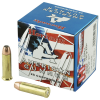
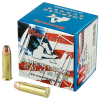
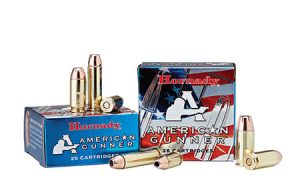

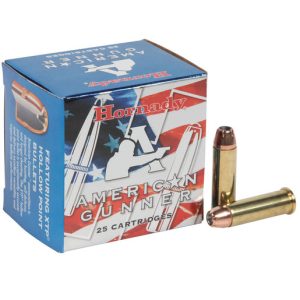
The XTP is a plain cup-and-core hollow point with carefully controlled jacket thickness, and it has been doing that job consistently since 1989. Hornady loads it into the American Gunner line in plain boxes at plain prices.
Hornady publishes 900 fps and 225 ft-lb. That is not going to win any argument against a +P defensive load, but it is a real expanding bullet in standard pressure, and it is cheap enough that you can shoot a box a month without thinking about it.
This is the load I would buy if I wanted one box that covers practice and does not leave me badly armed if it happened to be what was in the gun.
Best For: Shooters who want to train with an expanding bullet, and anyone who wants one box for both jobs.

9. Remington HTP +P 125gr SJHP: Best Budget Defensive
Remington HTP +P 125gr SJHP is about $18 to $19 for 20 rounds. A semi-jacketed hollow point with exposed lead at the nose, which is the old reliable way to make a .38 open up.
- Bullet: 125gr semi-jacketed hollow point
- Pressure: +P
- Case: Brass, 20-round box
- Note: Remington also loads 110gr and 158gr HTP in this caliber
| Value | Expansion | Penetration | Reliability | Reputation |
| 5/5 | 4/5 | 4/5 | 4/5 | 4/5 |
Pros
- Exposed lead nose opens without needing high velocity
- One of the cheapest +P loads available
- Been in production essentially unchanged for decades
- Widely stocked
Cons
- Soft lead nose can deform in a speedloader
- Remington does not publish a figure we could verify for this exact load
- Three HTP weights in this caliber and the boxes look alike
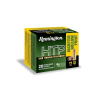
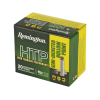
A semi-jacketed hollow point leaves lead exposed at the nose rather than wrapping the whole bullet in copper. Soft lead deforms readily, which means the bullet does not need to be travelling quickly to open. In a cartridge that struggles to reach expansion velocity from a short barrel, that is a sensible piece of old engineering.
Remington lists 110gr, 125gr and 158gr HTP loads in .38 Special and the packaging is nearly identical across them. The card below targets the 125gr. Check the box before you buy if the weight matters to you.
Best For: Budget defensive carry, and shooters who want a soft-nosed bullet without paying premium prices.

10. Fiocchi Range Dynamics 130gr FMJ: Best Range Ammo
Fiocchi Range Dynamics 130gr FMJ starts at about $23 for 50 rounds, roughly 46 cents a round, which is the cheapest brass-cased .38 on our cards.
- Bullet: 130gr full metal jacket
- Pressure: Standard pressure
- Muzzle Velocity: 950 fps, printed on the box
- Muzzle Energy: 261 ft-lb
- Case: Brass, Boxer primed, reloadable
- Box Size: 50 rounds
- Item: 38A
| Value | Cleanliness | Consistency | Availability | Reputation |
| 5/5 | 4/5 | 4/5 | 5/5 | 4/5 |
Pros
- Cheapest brass-cased .38 Special we track
- 50-round boxes rather than 20
- Boxer primed brass worth keeping if you reload
- Fiocchi also loads a 158gr FMJ in the same line
Cons
- Full metal jacket, so no expansion at all
- Burns a little dirtier than premium range ammunition
- 130gr and 158gr boxes are easy to confuse
Nothing clever here and nothing needed. A 130 grain full metal jacket in reloadable brass, fifty to a box, at the lowest price per round in the caliber. That is what practice ammunition should be.
Fiocchi loads both a 130gr and a 158gr FMJ under the Range Dynamics name. The 158 is the traditional target weight and shoots closer to point of aim in many fixed-sight revolvers, so it is worth trying if your groups sit low.
Best For: High-volume practice and anyone building a .38 brass supply.

11. PPU 158gr LRN: Cheapest Traditional Load
Prvi Partizan 158gr lead round nose is about $24 for 50 rounds. The original .38 Special loading, still made, still cheap.
- Bullet: 158gr lead round nose
- Pressure: Standard pressure
- Case: Brass, Boxer primed, non-corrosive
- Box Size: 50 rounds
- Item: PPH38SL
| Value | Cleanliness | Consistency | Availability | Reputation |
| 5/5 | 3/5 | 4/5 | 4/5 | 4/5 |
Pros
- The original 158gr loading the cartridge was designed around
- Shoots closest to point of aim in most fixed-sight revolvers
- Very mild recoil in standard pressure
- Brass cased and Boxer primed
Cons
- Bare lead fouls a bore faster than a jacketed bullet
- Some indoor ranges restrict unjacketed lead
- Round nose is the worst possible defensive profile
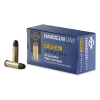
The .38 Special was designed in 1898 around a 158 grain lead bullet, and fixed-sight revolvers have had their sights regulated for roughly that weight ever since. If your groups print low with 110 and 125 grain ammunition, this is why, and a box of 158gr will often fix it without touching the gun.
It is bare lead, so it fouls a barrel faster than jacketed ammunition and some indoor ranges will not allow it. As a cheap, mild, historically correct practice load in an outdoor setting, it is hard to beat on price.
Do not carry it. A round-nosed lead bullet at 700-odd feet per second is the least effective thing you can put in a defensive revolver, which is precisely why the wadcutter and the hollow point were invented.
Best For: Cheap outdoor practice, fixed-sight revolvers shooting low, and shooters who want the traditional loading.
Standard Pressure vs +P: Which Should You Carry?
+P .38 Special is loaded to roughly 20,000 psi against 17,000 for standard pressure, which buys you somewhere around 50 to 100 feet per second. In a cartridge this modest, that is a meaningful fraction of what is available.
Two things decide whether you should use it. First, the gun. Modern steel and quality alloy revolvers are rated for +P, but many older guns and some very light alloy frames are not, and the manufacturer is the authority rather than the internet. If your revolver does not say +P, do not feed it +P.
Second, whether you can shoot it. A +P load in a 15-ounce alloy J-frame is genuinely unpleasant, and a shooter who flinches through five rounds is worse off than one who places five standard-pressure rounds calmly. The Critical Defense Lite and the wadcutter on this list both exist for exactly that reason.
How We Choose the Best .38 Special Ammo
Every velocity and energy figure here is the manufacturer’s own published number for that exact item number, linked in each entry. Where a manufacturer does not publish one, the spec row says so rather than borrowing a retailer figure. That happened once on this page, with the Remington HTP, where Remington publishes no ballistics for the .38 Special loading at all.
The barrel-length table is a destructive test and the reason we only run one per cartridge. A barrel that has been cut to 2 inches does not go back, so the figures in it are the ones we live with rather than something we repeat every season.
Availability was treated as a ranking criterion, which is why two of the most-recommended .38 loads in the country sit in an unranked section instead of at the top. Every ranked load was verified in stock through our live retailer feed while this page was written.
The range work is ours. Every load went through a 2-inch S&W J-frame and a 4-inch service revolver, 50 rounds apiece, chronographed at ten feet. The pattern in the BBTI table held in both guns: everything lost roughly a quarter to a third of its published velocity out of the snub, and the standard-pressure loads lost proportionally less than the +P ones. The Underwood wadcutter was the easiest to shoot well of anything tested, and it is not close.
FAQ: .38 Special Ammo
What is the best .38 Special ammo for self-defense?
Hornady Critical Defense +P 110gr FTX at 1,090 fps and 290 ft-lb. The polymer tip in the hollow cavity stops heavy clothing plugging it, which is the failure that ruins most .38 hollow points. If your revolver is a lightweight snub, the Underwood 150gr wadcutter is the better answer even though it does not expand.
Which .38 Special load has the most energy?
The Underwood 150gr wadcutter, at a published 1,000 fps and 333 ft-lb. That beats every +P hollow point on this page, and it does it at standard pressure. The highest-energy expanding load is Hornady Critical Defense +P 110gr FTX at 290 ft-lb.
Do .38 Special hollow points expand from a 2-inch barrel?
Often not. We measured .38 Special +P loads between 675 and 814 fps from a 2-inch barrel, which is 111 to 172 ft-lb. Most hollow points need more speed than that to open reliably. This is the single most important fact about carrying a .38 snub, and it is why short-barrel-specific loads and wadcutters exist.
Is +P .38 Special worth it in a snub-nose?
Less than you would think. A +P load loses roughly the same proportion of its velocity to a short barrel as a standard load does, so you pay the full recoil penalty and arrive with a bullet that still may not open. In a steel-framed 4-inch revolver +P earns its keep. In a 12-ounce alloy J-frame it does not.
Can my revolver shoot +P .38 Special?
Any modern revolver rated for it can, and the rating is stamped or printed in the manual. Older guns, anything pre-1972, and most alloy-framed pocket revolvers should not be fed a diet of it. If the gun does not say +P anywhere, assume it is not rated and shoot standard pressure.
Why do shooters carry wadcutters for self-defense?
Because a flat-fronted bullet cuts a full-caliber hole without needing to expand, and expansion is exactly what a 2-inch .38 cannot guarantee. Wadcutters are also standard pressure, so they are easy to shoot accurately from a light revolver. You trade a possible wider wound channel for a certain one.
What is the cheapest .38 Special ammo?
PPU 158gr lead round nose, in 50-round boxes, is the cheapest thing on our live cards. Fiocchi Range Dynamics 130gr FMJ at 950 fps costs a little more and is noticeably cleaner. Neither is a defensive load, and neither pretends to be.
Is .38 Special still good enough for carry in 2026?
Yes, with the right load and honest expectations. A .38 snub is easy to carry, easy to shoot at contact distance and completely reliable. What it is not is powerful, and no ammunition choice fixes that. Pick a load that works at the velocity your barrel actually produces, then practice with it.
Find the Best Price in Seconds
Search once, compare 200+ trusted retailers instantly.
Deals of the Day
Today's best discounts · Updated 3x daily
Gun Deals
See All →
Ammo Deals
See All →


Bottom Line: Which .38 Special Should You Carry?
For most people in most revolvers, buy Hornady Critical Defense +P 110gr FTX. It has the most energy of any expanding bullet here, the polymer tip solves the problem that actually kills .38 hollow points, and it is cheap enough to practice with.
If your revolver is a lightweight alloy snub, or +P is unpleasant, the honest answer is different. Carry the Underwood 150gr wadcutter or the Critical Defense Lite, accept that you are not going to get expansion, and put your rounds where they need to go. A flat-fronted bullet you can shoot straight beats a hollow point you flinch through and which probably will not open at snub velocity anyway.
For practice, Fiocchi Range Dynamics at about 46 cents a round. And if you ever see Speer Gold Dot Short Barrel on a shelf, buy it. It is still the benchmark, we simply cannot sell it to you.
Related Revolver & Ammo Guides
Related Guides