

Last updated March 30, 2026 · By Nick Hall, CCW instructor and home defense planner
This post contains affiliate links. If you buy something through a link, I may earn a commission at no extra cost to you.
- Treat every gun as loaded
- Point the muzzle in a safe direction
- Keep your finger off the trigger until you’re ready to shoot
- Know your target and what’s beyond
Quick Answer: A 5.56 AR-15 is the best home defense long gun for most shooters in 2026, manageable recoil, 30-round capacity, modular accessory support, and superior accuracy at any in-home distance. Pair it with quality 55-77 grain hollow-point loads (Federal Tactical Bonded, Hornady TAP) and a quality red dot or low-power variable optic.
Shotgun advantages: stopping power at room distances with quality buckshot (Federal Flite Control 00 Buck), and the lowest entry cost of any home-defense long gun (Mossberg 500 / Maverick 88 at $200-$350). Disadvantages: capacity (5-8 rounds typical), recoil under stress, slower follow-up shots. Pistol advantages: always available, accessible from a nightstand safe; disadvantages: lower terminal performance and harder to shoot accurately under stress.
The biggest mistake home defense buyers make is choosing the platform without committing to training. The AR-15 is the most capable home-defense gun by most metrics, but only with at least 200 rounds of dedicated practice plus malfunction drills. The shotgun is forgiving for the practiced shooter and brutal for the unpracticed one. Whatever you pick, train with it and pattern your defensive load.
Table of Contents
The Platform Question
Choosing a home defense platform is one of those questions where people get very tribal very fast. Shotgun guys swear by the pump. AR guys point to capacity and modularity. Pistol people note that a handgun goes with you everywhere the long guns can’t. Everyone is right about something and nobody is completely right. The actual answer depends on your situation, your household, and your skill level.
I’ve trained with all three seriously. I’ve taken courses where instructors challenged my assumptions about each platform. What I can tell you is that every platform has real advantages and real disadvantages for home defense specifically, and the person who claims one is unambiguously superior is oversimplifying. Let me break them down category by category.
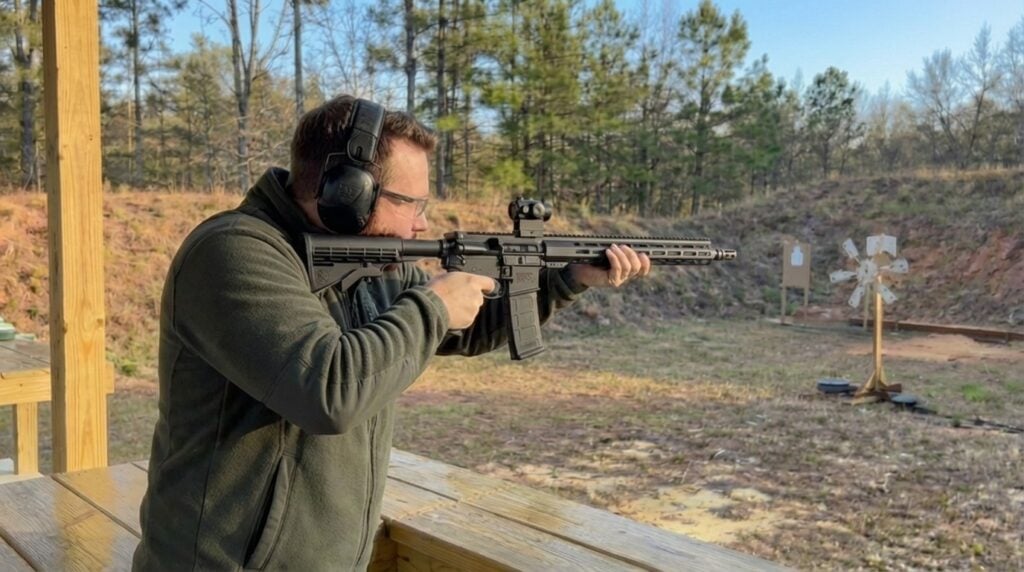
Category 1: Accuracy at Home Defense Distances
AR-15
Winner. At home defense distances (3-25 yards), the AR-15 is the easiest platform to shoot accurately for most people. The stock provides three points of contact. The trigger, while not match-grade in a base-model AR, is manageable. The sights or optic are at eye level. The recoil is mild enough that follow-up shots are fast. A red dot like the Aimpoint Acro, Holosun 510C, or EOTech 512 makes target acquisition fast and intuitive, and allows shooting with both eyes open. The AR-15 is simply more accurate faster for the average person than a shotgun or pistol under stress.
Shotgun
Very good. The common belief that shotguns don’t require aiming in a home defense situation is a dangerous myth. At 10 feet, a cylinder-bore 12 gauge 00 buck pattern is about the size of a fist. You still need to aim. That said, a shoulder-fired weapon with a stock is far easier to aim than a pistol, and the short sight radius matters less because you’re looking at the whole target. The shotgun is accurate enough for home defense. It’s just not quite as fast or as easy as a modern AR for most shooters.
Pistol
Hardest of the three. Pistols are the most difficult to shoot accurately, period. They have the shortest sight radius, two points of contact instead of three, and more recoil per unit of mass than a rifle. Under stress, pistol accuracy drops significantly for most people. That said, at 7-10 feet (the most common home defense distance), even a moderately trained shooter can hit center mass reliably with a pistol. The pistol is not hopeless for home defense. It’s just the hardest platform to run well under stress.
Winner: AR-15
Category 8: Training Curve
Shotgun
Simple but punishing. The pump shotgun has a simple manual of arms: rack, aim, fire. The concept is easy to teach. The challenge is managing the recoil, loading the tube under stress, and dealing with malfunctions (which are less common than in semi-autos but harder to clear). For someone who wants a reliable defensive tool with minimal training time, the shotgun’s simple manual of arms is appealing. But the recoil will discourage practice for some users, which defeats the purpose.
AR-15
Moderate. The AR-15 is not complicated, but it has more controls to learn than a shotgun: safety, charging handle, bolt catch, magazine release. Malfunction clearance is straightforward once trained but takes practice to make automatic. The good news is that the mild recoil makes practice enjoyable and affordable, which means you’ll actually train. The weapon is also the subject of more instructional content, classes, and resources than any other home defense platform.
Pistol
Steepest. The pistol requires the most training to run well. Stance, grip, sight alignment, trigger control, and malfunction clearance all require more practice than long guns. The weapon is harder to shoot accurately and the manual of arms varies more by model. That said, the pistol is the weapon you’re most likely to have with you in all circumstances, which makes training with it disproportionately valuable.
Winner: Shotgun (simplest) / AR-15 (best training ecosystem)
Overall Verdict
Based on the data and my experience, here is how I rank these platforms for a dedicated home defense role:
First choice for most people: AR-15. Better accuracy, higher capacity, lower recoil, better weapon light options, and counterintuitively better overpenetration characteristics with the right ammo. The main knock against it is cost and the SBR limitation for tight-space maneuvering, but a 16-inch AR-15 is workable in most homes. If your family includes shooters of different sizes and experience levels, the AR-15 is the most accessible long gun platform for everyone.
Second choice: Shotgun. Overwhelming terminal performance at home defense distances, simple manual of arms, and the lowest cost entry point. If you live in a state with magazine restrictions that limit your AR-15 capacity, the shotgun becomes more competitive. The main disadvantages are capacity, recoil, and reload complexity. Best suited for experienced shooters who practice regularly with the platform.
Third choice (long gun) or best choice (any location): Pistol. The pistol is the hardest platform to shoot well but the only one that goes with you everywhere. It is the most important firearm to train with. If you are going to have only one firearm for home defense, a quality 9mm pistol with a weapon light is a completely valid choice and allows you to keep the same weapon at your bedside and on your person. A pistol is not a second-best compromise. For many people it is the right answer.
AR-15 vs Shotgun vs Pistol, Specific Use-Case Questions
Which platform best handles a multi-attacker home invasion scenario?
The AR-15 offers the most consistent answer for multi-attacker scenarios. Higher round count between reloads, faster follow-up shots than a shotgun, and better controllability than a handgun under stress. The tradeoff is the AR-15’s muzzle blast in indoor environments, which favors a suppressed configuration for serious home-defense use. The handgun handles single-attacker scenarios with less wall-penetration risk but does not match the AR-15’s sustained-fire capability.
Which is genuinely the safest choice for households with children?
The platform you can secure consistently in a quick-access safe matters more than the platform itself. A handgun in a bedside biometric safe is more child-safe than an AR-15 in a closet without securing. The right question is not “which gun is safer” but “which gun integrates with quick-access safe storage that I can use under stress.” Most quick-access safes are designed around handgun dimensions.
Does the shotgun’s reputation as the “home defense gun” still hold up?
Partially. The shotgun was the optimal choice for home defense when AR-15 platforms were rare in civilian inventory and quality red-dot sights were expensive. In 2026, the shotgun retains advantages in close-range terminal performance and ammunition versatility, but the AR-15 with a quality red dot has caught up in most use-case categories. The shotgun remains the right answer for buyers who already own one and train with it; new buyers in 2026 may find the AR-15 a stronger starting point.
For a single-firearm household, which platform makes the most sense?
A handgun, almost always. The handgun integrates with concealed carry training, fits multiple household members’ physical capacities, and works in the confined spaces of a typical residential interior. A two-gun household pairs the handgun with a long gun for layered defense. The single-firearm answer is overwhelmingly the handgun for the largest set of buyers and use cases.
Related: For the full rundown of close-quarters options across shotguns, AR pistols, and PCCs, see our guide to the best CQB weapons.
Frequently Asked Questions
Is an AR-15 or shotgun better for home defense?
Both excel but in different ways. AR-15s offer 30-round capacity, lower recoil, and surprising wall-safety with 5.56. Shotguns deliver devastating per-shot energy and require less marksmanship. Your best choice depends on training level and home layout.
Is a pistol good enough for home defense?
Pistols are effective for home defense with proper training and quality ammunition. They are the most maneuverable option and can be operated one-handed to open doors or carry children. The tradeoff is they are harder to shoot accurately under stress.
Which home defense gun is easiest to use?
A pump shotgun is the easiest to use effectively with minimal training. Point and shoot is more forgiving with a spread pattern. An AR-15 with a red dot is the easiest to shoot accurately. Pistols require the most practice to use well.
Does an AR-15 over-penetrate more than a shotgun?
No, 5.56 rounds often penetrate fewer walls than 00 buckshot or pistol rounds. Lightweight 5.56 bullets fragment and tumble when hitting barriers. This makes a properly loaded AR-15 one of the more neighbor-safe home defense options.
What are the disadvantages of a shotgun for home defense?
Shotguns have limited capacity of 4-8 rounds, heavy recoil with full-power loads, slow reloads, and they are long and unwieldy in tight spaces. The manual pump action can also short-stroke under stress, causing malfunctions.
What are the disadvantages of a pistol for home defense?
Pistols are harder to shoot accurately under stress, deliver less energy per round than rifles or shotguns, and their short sight radius magnifies aiming errors. Most defensive shootings involve missed shots, and pistol rounds miss more often.
Can I use an AR-15 pistol for home defense?
AR-15 pistols with 10.5 to 11.5 inch barrels are excellent for home defense. They are more compact than full-length rifles while retaining most ballistic performance at indoor distances. The shorter length makes them easier to maneuver in hallways.
What is the best all-around home defense gun?
If you can only own one gun, a quality 9mm pistol with a weapon light is the most versatile choice. It handles home defense, can be carried concealed, and is the cheapest to train with. An AR-15 is better purely for home defense performance.
For the best new-production AK, read our Zastava ZPAP M70 review.
4,715+ Gun & Ammo Deals
Updated daily from 200+ top retailers. Filter by category, caliber, action type, and price.
Related Guides