

Affiliate disclosure: This Beretta 92FS review contains affiliate links. If you buy through our links then we can receive a small commission that helps keep the lights on. You don’t pay anything more.
- Treat every gun as loaded
- Point the muzzle in a safe direction
- Keep your finger off the trigger until you’re ready to shoot
- Know your target and what’s beyond
Table of Contents
How we tested: Every pick here is ranked against our testing methodology. Minimum round counts, accuracy and reliability protocols, the failures that disqualify a gun.
Review: Beretta 92FS, the Wonder Nine That Outlived Everyone Who Doubted It
Our Rating: 8.4/10
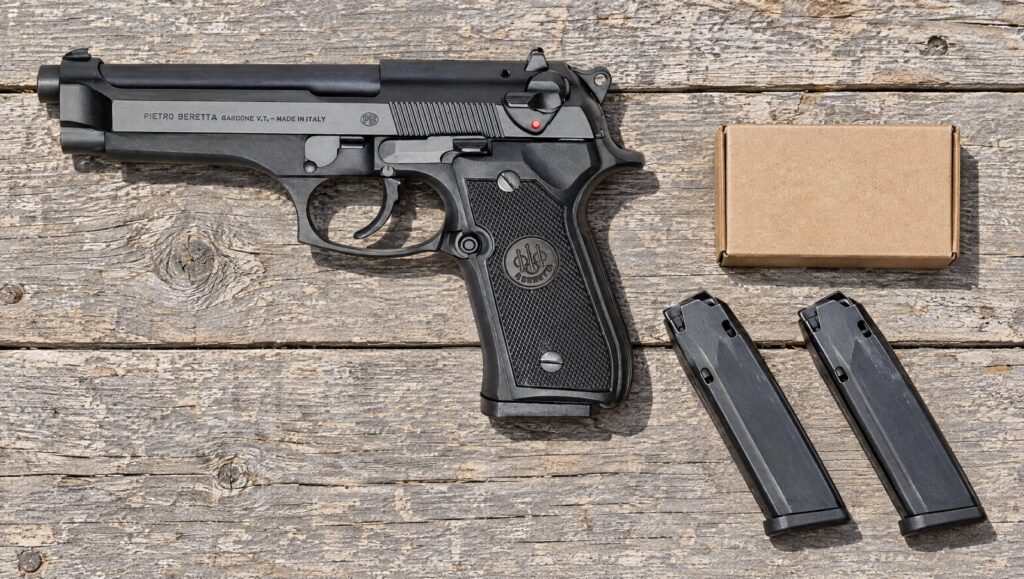
Here are the Beretta 92FS specs for the gun I tested, taken from Beretta’s own sheet for the current 15-round model.
- MSRP: $809
- Street Price: $699.99 (Use our live pricing for the best up to date deal)
- Caliber: 9mm Luger
- Action: DA/SA, hammer-fired, short-recoil locking block
- Barrel Length: 4.9 inches
- Overall Length: 8.5 inches
- Height: 5.4 inches
- Width: 1.5 inches
- Weight (unloaded): 33.3 oz
- Capacity: 15+1
- Frame Material: Aluminum alloy
- Slide Material: Steel, open-top design, Bruniton finish
- Sights: 3-dot, front blade machined into the slide, rear in a dovetail
- Safety: Ambidextrous slide-mounted safety-decocker, firing pin block
- Accessory Rail: None
- Grip: Checkered polymer panels
Pros
- Zero stoppages in my 1,000-round test
- Soft recoil from a 33.3 oz gun
- Light, clean single-action trigger break
- Open-top slide all but rules out stovepipes
Cons
- Big and heavy for concealed carry
- Long double-action reach punishes small hands
- No rail, no optics cut, awkward safety

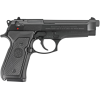
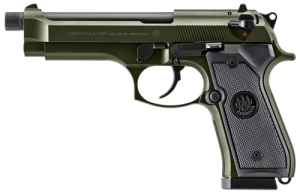
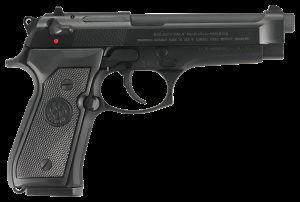
Quick Take
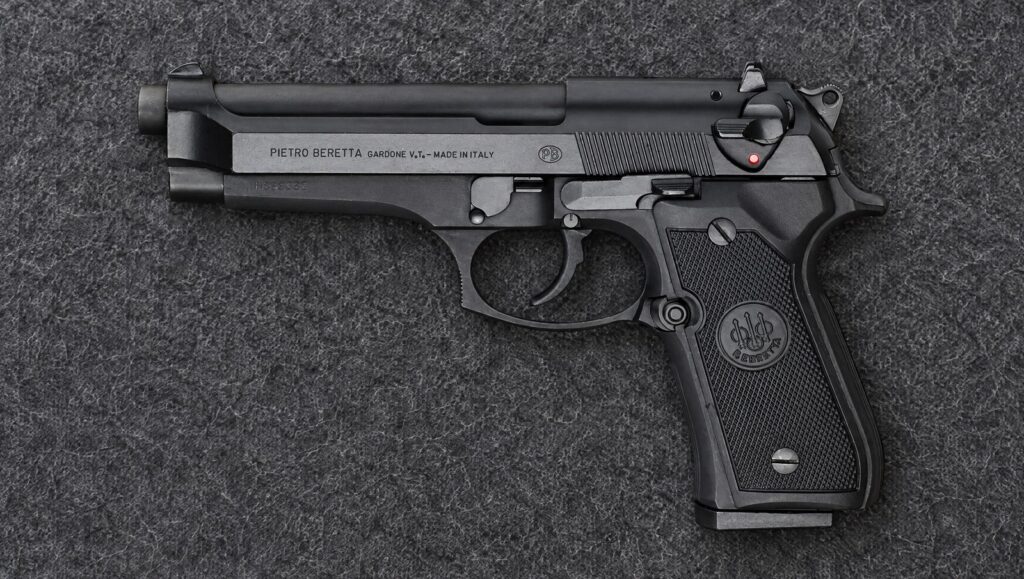
The Beretta 92FS is the pistol the US military picked to replace the 1911, and four decades later it’s still one of the softest-shooting semi-automatic 9mm handguns you can buy. This Beretta 92FS review is built on 1,000 rounds through my own Bruniton gun, fired across a 95-degree session in July 2025 and a 35-degree one in November 2025. It never stopped once.
That open-top slide, the part that looks dated next to a Glock, is a big part of the reason. The slide-mounted safety is the part I like least. If it bothers you too, our Beretta 92XI review covers the version with the safety on the frame.
It isn’t a carry gun by modern standards. It’s big, it’s heavy, and the double-action first shot has a reach that small hands hate. There is no rail for a light and no cut for a red dot either.
But as a home-defense pistol, a range workhorse, or a piece of living history you can shoot every weekend, the 92FS holds up against guns designed thirty years after it. The Beretta 92FS price on Beretta’s own list is $809. Our price card led at $699.99 on October 13, 2026, with a $619.99 row further down, so read every row before you buy. The short answer: yes, the Wonder Nine is still worth buying.
Best For: Home defense, range shooting, and anyone who wants the M9 experience in a gun they’ll shoot a lot. Skip it if you want a light, slim concealed-carry pistol, a weapon light, or a simple striker-fired manual of arms.
Why Beretta Built the 92FS This Way
The 92 was designed in 1975, and the US military adopted it as the M9 in 1985. The FS is the version that grew out of a problem. In 1988 the General Accounting Office reported that the M9 had 14 slide failures, and four shooters were hurt.
Beretta’s answer was an enlarged hammer pin. Its head rides in a groove under the slide and stops the back half from coming off the frame if a slide ever cracks. That one change turned the 92F into the 92FS, and it’s why the S on the slide is more than a letter. Where the FS sits among today’s 92X, 92XI, 92GTS and M9A4 is laid out in our Beretta 92 models explained guide.
Everything else about the design is built around soft, repeatable shooting. The open-top slide exposes most of the barrel, which looks unusual next to a Glock but leaves a fired case almost nothing to snag on. Beretta says the layout practically eliminates stovepiping, and my test backs that up.
Recoil is the other half of the design. A heavy steel slide on an alloy frame, with a barrel that moves straight back instead of tilting, soaks up recoil better than almost anything in 9mm.
Beretta wasn’t chasing concealment or weight, because the brief was a service pistol for soldiers and law enforcement officers who would fire it in the mud, drop it in the sand, carry it for years without much care, and stake their lives on it cycling every time. That’s the lens to judge the 92FS through, not the micro-compact carry race it was never trying to win.
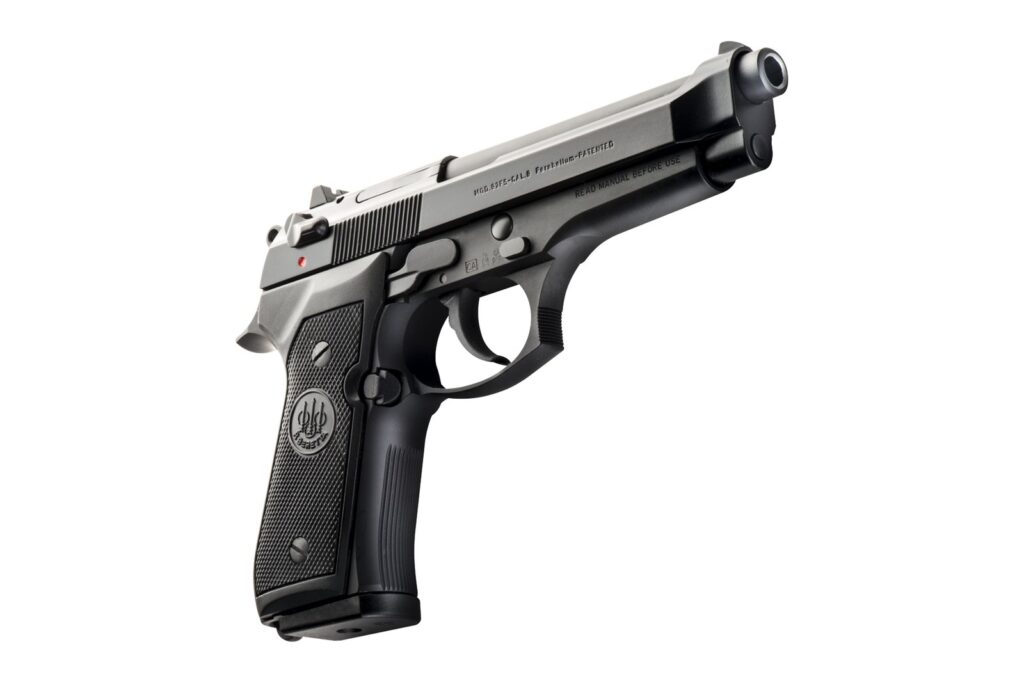
Variants: Which Beretta 92 Should You Buy?
The 92 series is deep. These are the four current models a 92FS shopper is most likely to compare, with Beretta’s own list prices as of October 2026. The rest of the family, from the single-action 92XI to the optics-ready M9A4, has its own guide, linked in the section above.
| Variant | Finish | Capacity | Beretta MSRP | Best For |
| 92FS | Black Bruniton | 15+1 | $809 | The baseline gun, and the one I tested |
| 92FS Inox | Satin stainless | 15+1 | $949 | Corrosion resistance and looks |
| M9 | Bruniton, military-style markings | 15+1 | $819 | The service-pistol experience |
| 92X RDO Full Size | Black, Vertec frame | 18+1 | $799 | A red dot and a weapon light |
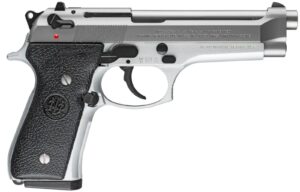
Same pistol, different metal. Beretta makes the slide, barrel and internal parts in stainless steel and anodizes the alloy frame to match, then adds soft rubber grips. The dimensions and the 33.3 oz weight match the black gun, so you’re paying the extra $140 for corrosion resistance and looks.
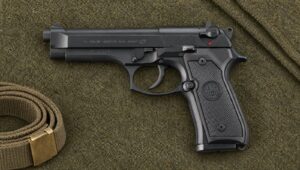
The M9 is the 92FS in uniform, so Beretta 92FS vs M9 comes down to markings and $10. Beretta’s spec sheet gives it the same 4.9-inch barrel, 8.5-inch length, 33.3 oz weight and 15-round magazine, with military-style markings on the Bruniton finish. Buy it for the history. It won’t shoot any differently from my test gun.
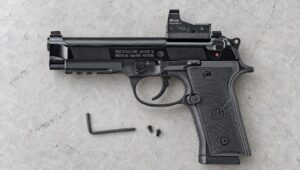
This is the one that fixes the 92FS’s two biggest gaps. It has a factory red-dot cut, a 3-slot Picatinny rail, a slimmer Vertec frame and 18-round magazines, and Beretta lists it for $10 less than the FS. You give up the classic lines and the plain slide.
Competitor Comparison
The Beretta 92FS has three natural rivals in 2026: the Sig Sauer P226, the CZ 75 SP-01 and the Glock 17 Gen 6. The first two are metal-framed DA/SA pistols like the Beretta, and the third is the striker-fired gun most buyers end up choosing between.
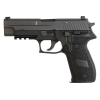
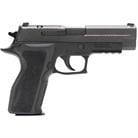
Sig Sauer P226 ($1,031.90 to $1,099.99)
The P226 is the closest thing the 92 has to a peer. It was the other finalist when the Army picked the Beretta in the 1980s, and it lost on price, not on performance. It runs a similar DA/SA system with a frame-mounted decocker instead of a slide safety, and I prefer that layout.
The Sig feels a touch more refined and points naturally. Its price card led about $400 above the 92FS card on October 13, 2026, and in my hands the two shoot about the same. If budget matters at all, the Beretta wins on value. Our SIG P226 review has the full test.
CZ 75 SP-01 ($714.11 to $871.99)
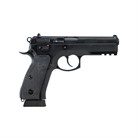
The CZ 75 is the other classic metal-framed DA/SA 9mm, and the SP-01 is the version most buyers cross-shop today. Its slide rides inside the frame rails, which gives it a low bore axis and a fantastic grip, and for me it points better than the 92. It has a rail, too.
The Beretta pulls ahead on price, on that open-top slide and on the sheer depth of its parts and holster market. The CZ is the enthusiast’s pick. The Beretta is the safe one. Our CZ 75 SP-01 review has the range results.
Glock 17 Gen 6 (from $620)
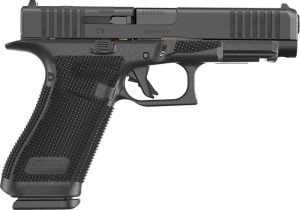
The Glock 17 shows you the trade the whole market made after the 92 was designed. The Army made the same trade in 2017, when it picked a polymer striker-fired Sig to replace the M9 and named it the Sig M17. The Glock is lighter and simpler, holds more rounds, takes a red dot, and its price card led lower than the 92FS card on the same day.
What it gives up is the 92’s recoil softness and that lovely single-action trigger. If you want a no-drama plastic gun, buy the Glock. If you don’t mind the weight, the Beretta is more fun every single range trip. I put the two side by side in Beretta 92FS vs Glock 17.
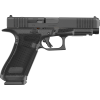
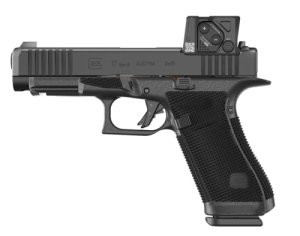

Verdict: The 92FS sits in a rare spot. It starts cheaper than the Sig and the CZ, and it’s more pleasant to shoot than the Glock. It loses on weight, concealment and modern add-ons, but as a full-size all-metal 9mm for the money, nothing on this list clearly beats it.
Testing Protocol
Every number in this Beretta 92FS review comes from one pistol and 1,000 rounds of 9mm, fired in three phases over two range sessions in July and November 2025.
Phase 1: Break-In
I ran the first 200 rounds of Winchester white box 115-grain FMJ straight out of the box, with a factory wipe-down and nothing more. No failures, no break-in drama. The slide felt slightly stiff for the first magazine or two, then smoothed out.
Phase 2: Reliability
The next 700 rounds were a mix: 150 more of the Winchester, 250 PMC Bronze 115-grain, 200 Federal American Eagle 124-grain, 50 Speer Gold Dot 124-grain +P and 50 range reloads. I shot the July 2025 session in 95-degree heat with sweat-slick hands, and the November 2025 session at around 35 degrees with gloves on.
Zero stoppages across the whole run. Not one failure to feed, fire, or eject.
And that’s the headline with this gun. The open-top slide throws empties up and away with room to spare, and hollow points fed off the magazine as smoothly as ball. The 50 reloads were grimy range-floor pickups a buddy handed me, and even those cycled. The brass landed in a tight pile about six feet to my four o’clock, the same spot all day.
About 150 of those rounds came from a Kydex outside-the-waistband holster, each string starting with the decocked double-action pull. That first shot is where this pistol asks the most of you.
Phase 3: Accuracy
The last 100 rounds went into paper: ten five-shot groups with each of two loads, off a bag at 15 yards. The 92FS printed 2 to 2.5-inch groups with the Federal 124-grain and tightened to about 1.75 inches with the Speer Gold Dot.
The single-action trigger is the reason: after that long double-action first shot the break is light and clean, and with more than six inches between the front and rear sights the gun is easy to hold on a two-inch target at that distance. Beretta says the 92FS beats the old military requirement of a 3-inch, 10-shot group at 50 meters. I did not shoot it that far, but nothing I saw at 15 yards makes me doubt it.
Ammunition Log
- Winchester white box 115gr FMJ, 350 rounds
- PMC Bronze 115gr FMJ, 250 rounds
- Federal American Eagle 124gr FMJ, 250 rounds
- Speer Gold Dot 124gr +P, 100 rounds
- Mixed range reloads, 50 rounds
Tracking and Observations
After 1,000 rounds I pulled the gun apart for a real look. Carbon buildup was normal and wiped off easily. The locking block showed clean, even wear with no cracks or peening on either wing, which is the thing to check on any 92 because the block takes the load on every shot and is the part that wears first. The Bruniton finish held up, with only faint holster wear on the muzzle edge.
What This Means for You
- Reliability: Total. Buy it and trust it for home defense without a second thought.
- Ammo preference: It ate everything, but it liked 124-grain loads best for accuracy.
- Maintenance: Field strip and clean it after each range day. It takes no tools and about a minute.
- Upgrade impact: Thin grips and a lighter hammer spring fix the two things I’d change. Nothing else needs touching.
- Accuracy expectation: Groups under 2.5 inches at 15 yards are realistic once you’ve learned the double-action first shot.
Performance Testing Results
The Beretta 92FS scored 9 out of 10 for reliability, accuracy, and fit and finish in my testing, and 8 out of 10 for ergonomics. Here is the evidence behind each score.
Reliability (9/10)
Zero malfunctions in 1,000 mixed rounds across two extreme-temperature sessions. That kind of record is why the M9 was the military’s standard sidearm for more than thirty years. The open-top slide is the unsung hero here, because with most of the barrel exposed there’s less surface for a case to hang up on during ejection, and nothing for a weak load or a tired extractor to wedge a spent case against.
I docked one point because the locking block is a known long-term wear part, not because anything failed.
Accuracy (9/10)
A 4.9-inch barrel, a long sight radius, and a clean single-action break make the 92FS shoot above its price on paper. My best groups came from the Speer Gold Dot at about 1.75 inches at 15 yards. The only thing standing between an average shooter and tight groups is learning to manage that double-action first round, which a little dry fire fixes fast.
Ergonomics and Recoil (8/10)
Recoil is soft. The heavy slide and straight-line barrel travel keep muzzle flip down, and follow-up shots come back on target fast, even with the +P Gold Dot.
The knock is the grip. The 92 has a wide, blocky grip and a long reach to the trigger in double action, and if your hands run small you’ll feel it on that first shot. The slide-mounted safety also forces an awkward thumb sweep that frame-safety and striker shooters won’t love.
Fit, Finish, and Quality Control (9/10)
This is where five decades of building the same pistol show. Slide-to-frame fit is tight with no rattle, the controls click positively, and the Bruniton coat is even and clean. Mine had no tool marks, no rough edges on the controls, and a barrel that locked up with zero play. Few polymer guns at this price are machined this well.
Technical Deep Dive
The Beretta 92FS specs explain most of how it shoots: a 4.9-inch barrel in an open-top steel slide, a falling locking block, and a DA/SA trigger on a 33.3 oz alloy-framed gun. This section takes those parts one at a time.
Slide and Barrel
The open-top slide, which Beretta calls the open-slide design, is the 92’s signature, and it’s not a styling choice. Cutting away the top of the slide over the barrel trims reciprocating mass and leaves a huge ejection window, which is a big part of why this gun doesn’t choke. If a case ever did hang up, it would be sitting in the open where you can reach it.
Locking System
Instead of a tilting Browning barrel, the 92 uses a falling locking block under the chamber, an idea lifted from the Walther P38. The barrel stays level through the cycle and travels straight back. It’s a key reason the gun shoots so flat. The trade is height: the barrel sits well above your hand, and the pistol feels tall next to a Glock or a CZ.
| Component | Specification | Benefit |
| Slide | Open-top steel, Bruniton | Huge ejection window, no stovepipes in my test |
| Locking block | Falling block, P38 type | Barrel stays level, flat shooting |
| Trigger | DA/SA, hammer-fired | Light, crisp single-action follow-up shots |
| Safety | Ambidextrous slide safety-decocker | Drops the hammer safely on a loaded chamber |
| Frame | Aluminum alloy, no rail | Keeps a big gun to 33.3 oz, but no light mount |
Trigger System
On my trigger gauge the double-action pull averaged 11 lb 6 oz over ten pulls, with a long arc. Single action broke at 4 lb 13 oz. It’s a classic combat trigger, not a target trigger, but it’s predictable.
A lighter “D” hammer spring, the part Beretta lists among the upgraded internals of its 92SB Repro, drops the double-action weight noticeably for very little money. Langdon Tactical sells a full spring kit if you want to go further.
Safety and Controls
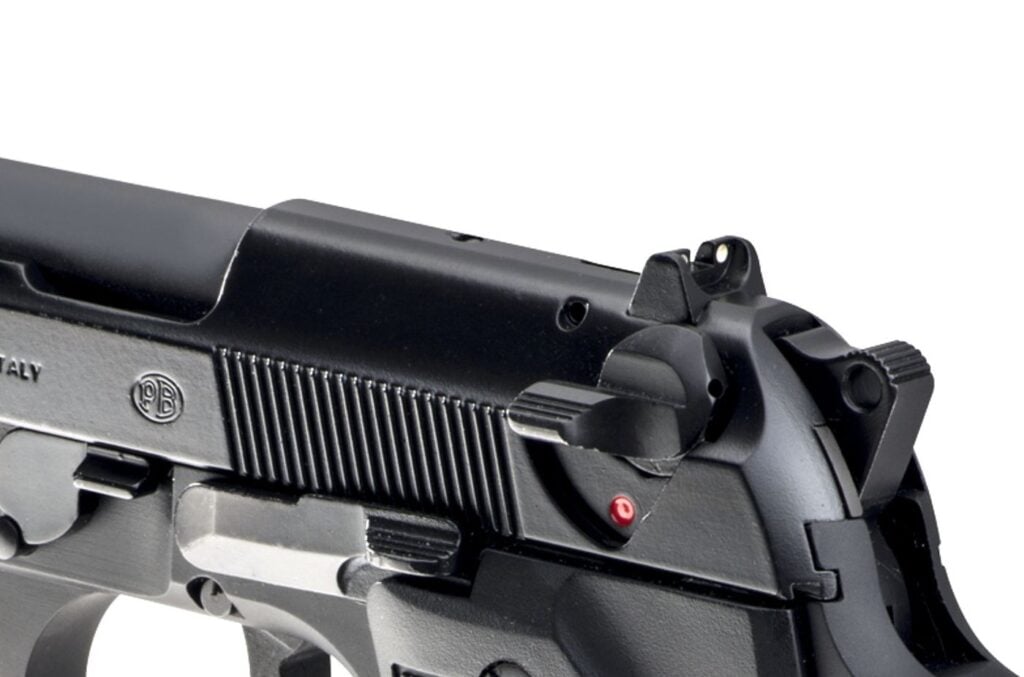
The lever on the slide does two jobs. Push it down and it drops the hammer safely on a loaded chamber and leaves the gun on safe. Push it back up and you’re ready to fire with a long double-action pull. A firing pin block backs it up, and the levers are on both sides of the slide.
Is it the fastest setup? No. The lever sits high, and it’s easy to sweep it down by accident when you rack the slide. That is the one habit this gun makes you train around.
Sights and Magazines
The sights are plain 3-dot. The rear sits in a dovetail, but the front blade is part of the slide, so a night-sight upgrade means gunsmith work on the front. Beretta saves user-replaceable front and rear sights for the Brigadier and the newer 92X guns.
The pistol ships with 15-round magazines. Beretta’s 18-round 90 Series magazine fits the 92FS too, and at $39 it’s the cheapest way to answer the capacity complaint.
Field Strip and Maintenance
Takedown needs no tools and no trigger pull. With the gun cleared, press the button on the right side of the frame, swing the disassembly latch down on the left, and the slide runs forward off the frame. The recoil spring, guide rod, barrel and locking block lift out in seconds.
I clean mine after every range day. A drop of oil goes on the locking block wings, the frame rails and the outside of the barrel, and that is the whole routine.
Parts, Accessories and Upgrades
The 92 series aftermarket is enormous after forty years in service. Spend your money in this order. The prices below are Beretta’s own list prices as of October 2026, and our guide to the best Beretta 92 parts and accessories has live prices on the grips, sights and springs.
| Upgrade Category | Recommended Component | Why It Matters | Cost Estimate |
| Trigger | “D” hammer spring or a Langdon Tactical spring kit | Lighter, smoother double-action pull | See our parts guide |
| Grips | Thin G10 panels | Slims the wide frame and shortens the reach | See our parts guide |
| Magazines | Beretta 18-round 90 Series magazine | Three more rounds in the same gun | $39 from Beretta |
| Safety | Beretta G decock conversion kit | The lever springs back to fire, so the safety can’t be left on | $69 from Beretta |
| Spare parts | Beretta third-generation locking block kit | The one wear part worth keeping in the range bag | $49 from Beretta |
What about a light? The frame has no rail, so a weapon light needs a rail-adapter grip or a different gun. If a light matters to you, start with a railed 92 like the one in our Beretta M9A1 review.
Common Problems and Solutions
- Locking block wear: The one real long-term issue. Blocks can crack at high round counts, so inspect yours at every cleaning. Beretta’s third-generation locking block kit costs $49 and fits the 92FS.
- Long DA reach for small hands: Install thin G10 grips and a “D” hammer spring, or learn a high grip and stage the trigger. The fix is cheap and it works.
- Safety swept on by accident: I’ve pushed the slide lever down more than once while racking the slide. Beretta’s G decock conversion kit, $69, makes the lever spring back to the fire position as soon as you let go.
Is the Beretta 92FS Good for Home Defense, Carry or the Range?
Home defense: yes, with one catch. Sixteen rounds, soft recoil and a long, deliberate first trigger pull are what you want in a bedside gun, and Beretta itself files the 92FS under home defense. The catch is the missing rail, so plan on a handheld flashlight, and load a proven self-defense round like the Gold Dot that shot best in my test. Our best home defense handgun guide has the railed alternatives.
Concealed carry: only if you’re committed. At 33.3 ounces empty, 8.5 inches long and 1.5 inches wide, it needs a stiff belt, a good concealed carry holster worn outside the waistband, and a cover garment. Plenty of people carried one on duty for decades. Very few choose to carry one now.
Range use: this is where it shines brightest. The weight that hurts on a belt makes it easy to shoot for 300 rounds in an afternoon, and it feeds cheap 115-grain ball without complaint. Our best 9mm ammo guide covers the loads worth buying.
Who Should NOT Buy the Beretta 92FS
This gun is excellent at what it does, but it’s the wrong call for several buyers. Be honest with yourself before you spend the money.
- The everyday concealed carrier: At 33.3 ounces and 1.5 inches wide, the 92FS is a lot to hide. Buy a Sig P365 or a Glock 43X instead.
- Small-handed shooters who hate DA: The double-action reach is long. If you can’t get a clean first-shot press even with thin grips, a striker gun like the Glock 19 will serve you better.
- The beginner who wants it simple: I wouldn’t pick the 92FS as a first gun for a beginner who wants one consistent trigger pull and no safety lever to think about. Look at the Glock 17 or an M&P 2.0.
- The light-and-optic buyer: The FS takes neither without gunsmithing or adapters. The Beretta 92X RDO has a rail and an optics cut, and Beretta lists it for $10 less.
- The tightest budgets: If the 92FS street price is a stretch, a Canik METE SFT or a used Gen 3 Glock gets you a reliable 9mm for a lot less.
Final Verdict
The short version of this Beretta 92FS review: the gun earned its reputation the hard way, in military and law enforcement holsters for more than three decades, and it still delivers. It’s soft-shooting and accurate, and it did not stop once in 1,000 rounds. For home defense or a full-size semi-automatic 9mm you’ll enjoy putting rounds through, it’s hard to do better at the current Beretta 92FS price.
It’s not the gun for deep concealment, for a weapon light, or for shooters who want the lightest, simplest pistol they can find, but if you can live with the weight and you learn that double-action first shot, the Wonder Nine rewards you every range trip. Forty years later, it has earned its keep.
Final Score: 8.4/10. Still one of the most reliable and pleasant full-size 9mm pistols you can buy, and a lot of steel and alloy for the money.
FAQ: Beretta 92FS
Is the Beretta 92FS still a good gun in 2026?
Yes. The 92FS is still one of the most reliable and soft-shooting full-size 9mm pistols you can buy. Mine ran 1,000 rounds of five different loads without a single stoppage, and the steel slide and alloy frame are built to a standard that is hard to find at the price. The trade-offs are weight, a long double-action first shot, and no rail or optics cut.
How many rounds does a Beretta 92FS hold?
The standard Beretta 92FS holds 15 rounds in the magazine plus one in the chamber. Beretta also lists a 10-round version for restricted states, and its 18-round 90 Series magazine fits the 92FS. As for how long the gun lasts, Beretta says the M9, the military twin of the 92FS, consistently fires over 35,000 rounds of commercial ammunition before a failure.
Is the Beretta 92FS good for concealed carry?
Not for most people. At 33.3 ounces empty, 8.5 inches long and 1.5 inches wide, it is large and heavy for daily concealment, and it needs a stiff belt, a good holster and a cover garment. It makes far more sense as a home-defense or range pistol. For carry, a Sig P365 or Glock 43X is a much better fit.
What is the difference between the Beretta 92FS and the M9?
Very little. M9 is the US military's name for the pistol, and Beretta's current spec sheets list the two with the same 4.9-inch barrel, 8.5-inch length, 33.3 oz weight and 15-round magazine. The commercial M9 wears military-style markings and lists at $819 against $809 for the 92FS. They shoot the same, so Beretta 92FS vs M9 is a question of which markings you want.
What ammo is best for the Beretta 92FS?
It ran everything I fed it, but 124-grain loads gave the best accuracy. Speer Gold Dot 124-grain +P shot the tightest groups in my test, about 1.75 inches at 15 yards, and it is a proven defensive load. For practice, any 115 or 124-grain FMJ from Winchester, PMC or Federal fed without a problem.
Beretta 92FS vs Glock 17, which is better?
It depends on what you want. The Glock 17 is lighter, simpler, holds more rounds and takes a red dot and a light. The Beretta 92FS shoots softer, has a much nicer single-action trigger and is more enjoyable at the range. For a no-fuss do-everything pistol pick the Glock. For shooting pleasure, the Beretta wins.
Does the Beretta 92FS have a rail?
No. The standard 92FS frame has no accessory rail and the slide has no optics cut, so a weapon light needs a rail-adapter grip. If you want a rail from the factory, Beretta's M9A1 adds a MIL-STD-1913 rail and the 92X RDO has a 3-slot Picatinny rail plus a red-dot cut.
Is the Beretta 92FS good for home defense?
Yes. It holds 15+1 rounds, recoils softly and has a long, deliberate double-action first pull, and Beretta itself lists it as a home-defense pistol. The one catch is that the frame has no rail, so plan on a handheld flashlight or a rail-adapter grip if you want a light on the gun.
Related: See where it ranks in our best Beretta pistols countdown.
3,979+ Gun & Ammo Deals
Updated daily from 200+ top retailers. Filter by category, caliber, action type, and price.