

Last updated May 21, 2026 · By Nick Hall, who has owned three used Sig P226s across German Eckernförde production, Exeter NH production, and a DAK police trade-in he later converted to DA/SA
Affiliate disclosure: USA Gun Shop is reader-supported. When you buy through links on our site, we may earn a small commission at no extra cost to you. Full disclaimer.
- Treat every gun as loaded
- Point the muzzle in a safe direction
- Keep your finger off the trigger until you’re ready to shoot
- Know your target and what’s beyond
Table of Contents
Is a Used Sig P226 Worth Buying in 2026?
A used Sig P226 sits in a weird sweet spot in the used handgun market. Old enough to be cheap, new enough to be parts-supported, and built tight enough that a worn-looking duty trade-in (see our complete used guns buyer guide) usually has more service life ahead than a brand-new polymer pistol of the same caliber.
The P226 has been in continuous production since 1984. That is forty-plus years of agency contracts, civilian sales, and steady mechanical refinement on the same hammer-forged barrel, alloy frame, and tilting-block locking system. A used 1996-vintage West German P226 with 5,000 documented rounds will lock up just as tight as a new 2026 Exeter NH gun, and will probably outlast its third owner.
The case against buying used is narrow. If you want a flat trigger out of the box, an optic-cut slide from the factory, or the modern striker-fired ergonomics of a P320, the P226 is the wrong gun new or used. If you want a DA/SA hammer gun with a decocker, a trigger that improves with 500 rounds of break-in, and the build quality that comes with a 1980s-engineered duty platform, used is the smart way to get there. The used vs. new guns analysis we ran across the broader market confirms the same math for the Sig platform specifically.
Used Sig P226 Price by Variant (2026)
Used Sig P226 prices break into four bands in 2026: police trade-ins at $450-$650, standard 9mm used at $600-$800, Mk25 and Tacops at $700-$900, and Legion at $900-$1,100. West German collectibles top out near $1,400 on clean Made-in-W.-Germany stamped examples.
| Variant | Used Price Range (2026) | New Equivalent | Sweet-Spot Listing | What You’re Getting |
|---|---|---|---|---|
| P226 DAK Police Trade-In | $450-$600 | Discontinued LE config | $485, .40 S&W with night sights | Holster wear, double-action-only Kellerman trigger, agency markings. The budget door into the platform. |
| Standard P226 9mm (US production) | $600-$800 | $849 (current) | $695, dealer consignment with case | Exeter NH production, DA/SA trigger, Nitron finish, factory steel sights. |
| P226 Mk25 (Navy SEAL contract) | $700-$900 | $1,229 (current) | $795, anchor-marked slide | Phosphate-coated internals, UID barcode plate, anchor logo on slide. Mil-spec corrosion resistance. |
| P226 Tacops | $700-$900 | $1,099 (when last produced) | $795, four 20-round mags included | Stainless slide, threaded barrel option, accessory rail, four extended magazines as standard. |
| P226 Legion | $900-$1,100 | $1,599 (current) | $985, X-Ray3 sights + G10 grips | Legion-grade short reset trigger, X-Ray3 sights, G10 grips, beavertail frame, PVD finish. |
| P226 X-Five Competition | $1,200-$1,800 | $1,899-$2,399 | $1,395, single-action trigger | Bull barrel, single-action trigger only, fully adjustable target sights, competition-grade build. |
| West German Eckernförde (1984-2011) | $900-$1,400+ | Not in production | $1,150, “Made in W. Germany” stamp | Stamped slide (not milled), hand-fit tolerances, three German proof marks. Collector premium. |
| P226 Stainless Elite | $850-$1,100 | $1,329 (when last produced) | $925, full stainless slide and frame | Full stainless construction, SRT trigger, beavertail, factory night sights. Discontinued ~2017. |
The pricing spread on a single variant comes down to round count, accessories, and source channel. A police trade-in DAK in .40 S&W from Palmetto State Armory runs $485 with the original three 12-round magazines and night sights. The same variant from a private GunBroker seller without paperwork lists $600 with one magazine and worn factory sights. Provenance and inspection matter more on the Sig platform than on a Glock.
The Sig DA/SA action has more parts to wear than a striker-fired Glock fire-control group. That extra complexity is why a verified-low-round-count Sig with original paperwork is worth a $100-$150 premium over an unknown-provenance gun of identical exterior condition.
Federal & Police Trade-In P226s
Federal trade-in P226s are the cheapest legitimate way into the platform. The dust cover is scuffed, the slide is occasionally stamped with an agency mark, and the barrel almost always rates 90%+ because cops fire qualification rounds twice a year, not range sessions every weekend.
A used Sig P226 federal trade-in typically comes from one of three sources. The DEA, ICE, NCIS, and the US Marshals all carried P226s through the 1990s and 2000s before transitioning to striker-fired platforms. The FBI Hostage Rescue Team (HRT) carried the P226 in 9mm and later .40 S&W as their dedicated tactical pistol. And several large municipal police departments (Houston, San Antonio, parts of NYPD specialized units) ran the P226 in .40 S&W as standard duty inventory through the 2000s and early 2010s.
The trade-in supply varies year to year as agency contracts expire. 2024 and 2025 saw heavy DEA P226 turnover; 2026 inventory leans more municipal-PD than federal.
The trade-in trail follows the platform’s contract life. Agencies typically run a duty handgun for 8-12 years, then sell the entire fleet back to a single broker (often Sig USA itself or RSR Group). The broker grades the inventory, ships it to civilian-market retailers (Classic Firearms, PSA, Aim Surplus), and the pistols enter consumer inventory at 50-70% off comparable new-pistol retail.
The math on these is unbeatable. A typical agency officer fires roughly 100-200 rounds per year in qualification courses. Over a 10-year service life, that’s 1,000-2,000 rounds. The Sig P226 is mechanically rated for 100,000+ rounds.
A police trade-in is mechanically 1-2% used. The exterior wear is real (holster rub on the dust cover, scratched grip panels, sometimes worn agency markings); the interior is essentially new.
Where to Find Federal Trade-In P226s
Classic Firearms is the volume leader on Sig P226 trade-ins as of 2026. Their inventory rotates weekly with batches of .40 S&W DA/SA and DAK pistols at $450-$550. Palmetto State Armory runs $20-$60 higher but consistently delivers better-graded condition examples with original magazines and night sights pre-installed. Aim Surplus rotates federal trade-ins less frequently but occasionally lists clean DEA and US Marshal pistols at $500-$650.
Used Sig P226 Legion: What the Premium Buys You
A used P226 Legion is what happens when Sig stops cost-engineering. The trigger breaks shorter and cleaner. The X-Ray3 sights actually work in low light. The G10 grips don’t peel like the old Hogue rubbers.
A used Sig P226 Legion runs roughly $950-$1,100. Legion-grade trigger, X-Ray3 sights, G10 grips, and a heft most shooters either love or sell within a month. The Legion lineup launched in 2016 as Sig’s answer to the “everything’s gone polymer striker-fired” market shift. The pitch was simple: take the proven P226 platform, hand-fit it, upgrade every wear part, and charge accordingly.
What you actually get versus a standard P226: a flat-faced or curved Legion-grade short reset trigger (SRT), X-Ray3 day-and-night sights with the tritium front and fiber-optic green dot, G10 Hogue grips with a distinct grip-frame texture, a beavertail frame insert that reduces hammer bite, a PVD or stainless slide finish, and a numbered Legion membership card.
On the used market the Legion premium runs $200-$300 over an equivalent standard P226 of the same era. The premium is sticky because Legion buyers tend to keep the pistol; secondary inventory is thinner than standard P226.
The decision-tree question is whether the Legion premium is worth it. For a shooter who runs a stock trigger and never replaces sights, no. For a competitive shooter or anyone who would otherwise pay $600 to upgrade trigger + sights + grips on a standard P226, yes. Used Legion pricing reflects this , the secondary market is thinner than standard P226 because buyers who paid Legion premium tend to hold the pistol.
The P226 Mk25: SEAL Contract or Marketing Stamp?
The Mk25 is the actual Navy SEAL contract P226. Phosphate-coated internals, anchor logo on the slide, and a UID barcode plate. The value premium is half engineering, half mythology, and worth understanding before you pay it.
The P226 Mk25 is the version of the P226 currently issued to Naval Special Warfare Command (NSWC) under an active contract. The mechanical differences from a standard P226 are real but subtle. Internal parts (slide rails, trigger group components, hammer) are phosphate-coated for saltwater corrosion resistance rather than Sig’s standard nitron finish. The barrel is the same hammer-forged design but treated separately. The slide carries an engraved anchor logo.
A Universal Identifier (UID) barcode plate on the dust cover lets NSWC track inventory across deployments. The plate is the easiest authentication tell from across a counter.
Authenticity matters because the Mk25 commands a $100-$200 premium over a standard P226, and counterfeits exist. Real Mk25 authentication tells: phosphate-finished internals visible when the slide is locked back (matte gray rather than black nitron), an anchor stamp on the right side of the slide near the slide release, a UID rectangular plate on the dust cover with serialized barcode, and Mil-spec markings near the muzzle.
Counterfeit Mk25s typically carry a stamped anchor without the phosphate internals. Lock the slide back and look at the rails: matte gray phosphate or black nitron tells you in one second.
For a shooter, the Mk25 is mechanically identical to a standard P226 in performance. The corrosion resistance matters if you live on the coast or carry concealed against skin in summer. The collector premium is the mythology , owning the actual pistol the SEAL teams carry. Whether that’s worth $200 to you is a personal question; it has no impact on accuracy or reliability.
Used Sig P226 DAK: The Trigger Nobody Warned You About
DAK stands for Double Action Kellerman, and you either love it or pay a gunsmith $200 to put DA/SA parts back in. There is no middle ground after fifty rounds.
A used Sig P226 DAK ships with a Double-Action-Kellerman trigger. The mechanical character is a 6.5-pound consistent pull, no second-strike single-action reset, and an unusual partial-reset feature that allows a lighter mid-trigger break if you let the trigger fully return between shots. The DAK was developed for law enforcement agencies that wanted a striker-fired-equivalent consistency without the manual-of-arms transition cost.
The DAK was offered as a factory option on the P226, P228, P229, and P239 throughout the 2000s and 2010s. Police agencies that adopted it include several state police departments and a number of large municipal patrols. The trade-in supply is consistent because departments that initially specified DAK have since transitioned back to DA/SA or to striker-fired platforms.
I converted mine to DA/SA after about 200 rounds. The Kellerman pull is consistent, but the lack of second-strike capability stopped feeling like a feature once I started carrying it.
The conversion question is what makes the DAK affordable. Matrix Precision Arms / Revenant Arms sells the parts kit to convert any DAK P226 back to standard DA/SA operation for roughly $200 in components ($150-$250 depending on hammer-spring + sear + trigger-bar pricing). The conversion takes a competent gunsmith about an hour. A used DAK at $485 plus $200 conversion plus $100 labor lands at $785 , still under a $849 new standard P226 from a dealer.
German Eckernförde vs US Exeter Production
A “Made in W. Germany” slide stamp moves a P226’s used price by $200-$400. A “Made in Germany” (no W.) stamp is post-reunification and worth far less. An Exeter NH gun is mechanically equivalent and priced for shooters, not collectors.
Sig Sauer’s manufacturing history breaks into three eras for P226 buyers. The original German production ran at the Eckernförde plant in Schleswig-Holstein from 1984 through the early 2010s under the parent SIG Holding AG / J.P. Sauer & Sohn corporate structure. German production used stamped slides with hand-fit tolerances and carried three German proof marks. Pre-1990 reunification examples carry the iconic “Made in W. Germany” stamp.
Post-reunification production carries “Made in Germany” without the W. The W. premium runs $200-$400 over the un-W. examples even at identical condition grades.
US production at Newington, NH (legacy Sig USA) and later Exeter, NH (current facility) began as a low-volume civilian-market supplement and grew into the dominant production source after Eckernförde wound down around 2012. Exeter NH guns use CNC-milled slides, external extractors, and modern tolerances. Mechanically the Exeter pistols are equivalent or superior to the German production , better consistency from machine fitting, easier parts availability, current Sig customer service support.
The collector premium on German production is real but specific. My W. Germany-stamped P226 has machining marks on the slide rails you simply do not see on the Exeter guns. Whether that translates to better function is debatable; whether it translates to collector value is not. A clean Made-in-W.-Germany stamped P226 with matching serial numbers and original sights commands $1,150-$1,400 at GunBroker. The same Eckernförde-era production with a worn finish and replaced sights runs $850-$1,050. Both are genuinely older guns with the hand-fit German tolerances; the difference is collector grade versus shooter grade.
The 10-Point Pre-Purchase Inspection
Run a flashlight down the rails, look for cracks at the locking-block cutout, check the decocker drops cleanly to half-cock, dry-fire it once in DA and once in SA, and demand to see the original magazines. That one minute of inspection saves $300 in surprises.
- 1. Slide rails. Strip the slide off the frame. Look at the contact surfaces on both halves. Even wear is normal; peening (mushroomed metal at the rail contacts) indicates very high round counts. On Sig P226s specifically, the rail wear is typically much lower than equivalent age polymer pistols because the alloy frame is far harder than polymer.
- 2. Locking block cutout. Look at the area on the underside of the slide where the locking block contacts during cycling. Hairline cracks at the locking block cutout are the single most common high-mileage P226 failure. They are not field-repairable.
- 3. Hammer spring tension. Cock the hammer to single-action position. The hammer should hold cleanly with no creep. A loose hammer that drops without trigger input is a major safety issue and a walk-away signal.
- 4. Decocker function. With the hammer cocked, depress the decocker lever. The hammer should drop smoothly to the half-cock safety position without contacting the firing pin. A worn decocker mechanism causes inconsistent half-cock drop or, in the worst case, full hammer fall onto a chambered cartridge.
- 5. DA/SA trigger pull. Dry-fire once in double-action mode (decocker pressed first, then trigger pull from the half-cock position) and once in single-action (cock the hammer manually, then trigger pull). DA pull weight typically 10-12 pounds with a long stroke; SA pull 4.5-5.5 pounds with a clean break. Inconsistent break, mushy reset, or trigger that doesn’t return cleanly is a yellow flag.
- 6. Return spring condition. Field-strip and inspect the recoil spring assembly under the barrel. Captured spring assemblies (the standard P226 configuration) lose tension with use. A spring that has shortened or compressed permanently has 5,000+ rounds on it. Recoil spring replacement is OEM and runs $25-$35.
- 7. Barrel bore. Drop the barrel out and look down the bore from the chamber end with a bore light. Hammer-forged Sig barrels wear slowly; the rifling should be sharp and well-defined with clean lands and grooves. Pitting at the chamber mouth from corrosive ammunition use is unusual on Sig barrels because most P226 owners shoot non-corrosive ammunition.
- 8. Magazine condition. Pop the included magazines and check spring tension, feed lip geometry, and follower condition. Factory Sig P226 magazines are MecGar-manufactured and exceptional quality. A worn magazine costs $35-$45 to replace. Two magazines should ship with any reasonable used P226 listing.
- 9. Sight system. Verify original night sights are still active (Trijicon HD or Sig factory night sights typically last 12-15 years before tritium decays beyond useful brightness). Replacement night sights run $100-$170 installed.
- 10. Frame finish around the dust cover. Look at the bottom rail of the dust cover, particularly the area just forward of the trigger guard. Holster wear here is cosmetic; cracking or unusual wear pattern around the dust cover screw holes (where the rail attaches to the alloy frame) is a structural issue. The dust cover on most production P226s is fine; verify it.
- Used M1 Garand buyer guide: the WWII service rifle, with the CMP pipeline closure decoded.
On the Eckernförde gun I bought used, the dust cover already had cosmetic holster wear at delivery, but the screw holes were clean and tight, which is what actually mattered. The full 10-point inspection takes 5-7 minutes at the dealer counter. Bring a bore light and a snap-cap dummy round if you want to verify all checks; most reputable dealers will let you inspect to this depth.
How to Date Your Used P226 (Serial + Proof Code)
Sig serial numbers don’t decode to a year. But the two-letter proof code stamped on the slide chin or barrel hood does. Sig’s published proof-code chart turns a 30-second flashlight check into the year of manufacture.
The date code is a two-letter alphabetical sequence. The first letter represents the month (A=January through M=December, skipping the letter I to avoid confusion with J). The second letter represents the year on a rotating 26-year cycle.
For example, “AK” stamped on a slide chin indicates January of a year ending in 7 (1987, 1997, 2007, 2017). Combine the code with other production tells (slide stamping, manufacturing location, accessory rail presence) to determine the specific decade.
Real Gun Reviews maintains the most current Sig proof-code chart. Print it or save it to your phone before shopping for a used P226. If the slide is too worn to read the code clearly, call Sig customer service with the serial number , they’ll cross-reference and confirm the manufacture date over the phone in about 5 minutes.
Where to Buy a Used Sig P226 in 2026
The honest hierarchy is Classic Firearms and PSA for police trade-ins, Guns.com and GunsInternational for graded collectibles, GunBroker for everything else, and your local FFL for the gun you can hold before you pay for it. The right retailer depends on whether you prioritize price, condition assurance, or hands-on inspection.
Tier 1: Trade-In Specialists (lowest price)
- Classic Firearms: Highest volume of federal and police trade-in Sig P226s in 2026. Inventory listed by batch with condition grades. $450-$650 typical for .40 S&W DA/SA and DAK pistols.
- Palmetto State Armory (PSA): Second-highest trade-in volume. Pricing $20-$60 higher than Classic Firearms but consistently better-graded condition with original magazines.
- Aim Surplus: Lower-volume rotation, but occasional clean federal trade-ins (DEA, US Marshals) appear with original Trijicon HD night sights at $500-$650.
Tier 2: Graded Collector Retailers (lowest risk on premium variants)
- Guns.com: Curated used inventory, hand-inspected by in-house gunsmith, condition-graded honestly. Best path for German production examples and Legion grades. Pricing $30-$60 above raw trade-in but worth the inspection assurance.
- GunsInternational: Collector-grade marketplace. West German P226s, factory engraved variants, presentation-grade examples. Pricing reflects the collector market, not the shooter market.
Tier 3: Auction + Local (hands-on)
- GunBroker: Massive Sig P226 listing depth across all variants. Verify the seller’s feedback (500+ transactions, 99%+ positive), require photos of the bore, slide stamp, and matching serial numbers, and read the return policy before bidding.
- Sportsman’s Outdoor Superstore: Mid-volume used Sig inventory at brick-and-mortar locations.
- Local independent gun shops: Variable pricing and condition; best for building a relationship with one dealer over time. Always negotiate.
Live Used Sig P226 Inventory
Live used Sig P226 inventory from our partner dealer network, filterable by variant, price, and condition. Federal trade-in batches at Classic Firearms and Palmetto State Armory typically refresh Monday mornings; GunBroker-syndicated listings rotate hourly. Use the filter to isolate the variant tier you care about: DAK trade-in for budget entry, standard 9mm for shooter-grade, Mk25 or Legion for premium, and West German for collectible.
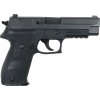 -28%
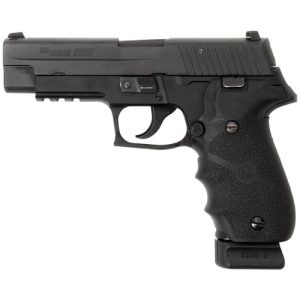
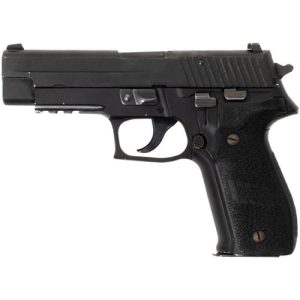
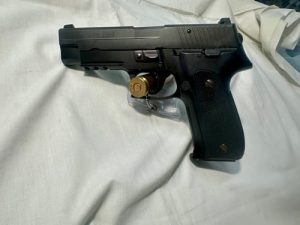
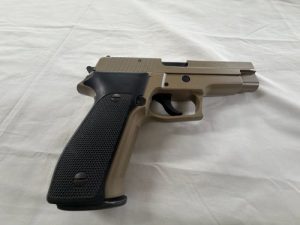
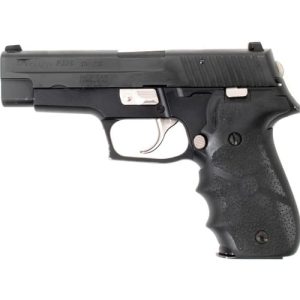
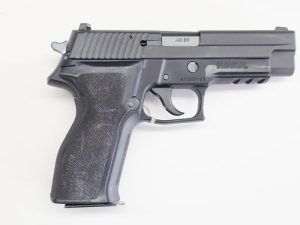
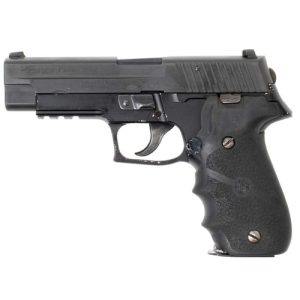
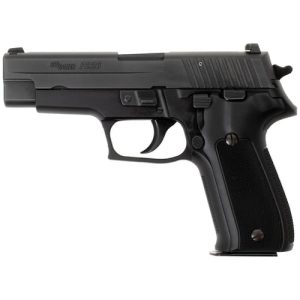
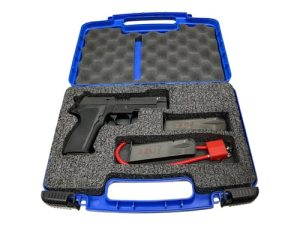
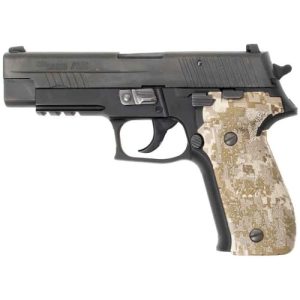
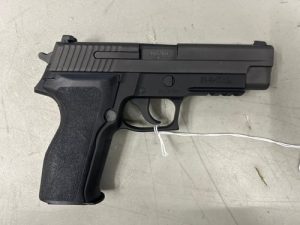
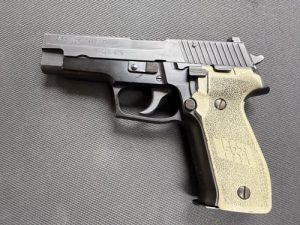
-28%Sig Sauer - P226 - Semi-Automatic Pistol - 4.4" Barrel - .40 S&W - (1) 12 Round Magazine - DA/SA - LEO Trade-In - Surplus Good to Very Good Condition
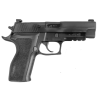
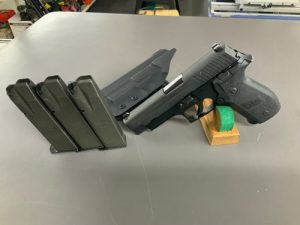
Sig Sauer P226 .40 S&W 4.4" Barrel 10rd Semi-Auto Pistol, DA/SA, E2 Grips, SIGLITE Night Sights W/ 3 Magazines - Surplus Very Good Condition
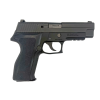 -17%
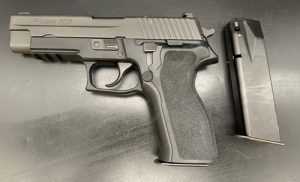
-17%USED Sig Sauer P226R, DAK Trigger, 9mm Pistol Used L.E.O Trade Ins, Semi-Auto, 4.4" Barrel, (1) 15rd Magazine - Surplus Good To Very Good Condition
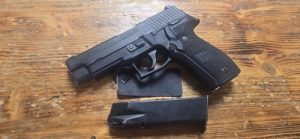
 -15%
-15% -15%
-15%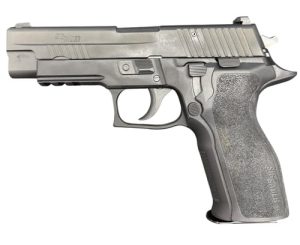

Should You Buy a Used P229 Instead?
The P229 is the compact-frame sibling to the full-size P226. Same DA/SA action, same hammer-forged barrel, same decocker, packed into a slightly shorter slide and grip. ICE and the DEA carried the P229 in .357 SIG through the 2000s, which is why the .357 SIG variant dominates the used trade-in market.
For carry, the P229 is the better choice. The grip is shorter by half an inch and the slide is shorter by half an inch. For range work and home defense, the P226 wins because the longer sight radius and added grip area produce tighter groups and easier reloads. Used P229 pricing tracks within 10-15% of equivalent P226 listings, so the choice is genuinely use-case driven.
The P228 is the discontinued original compact (replaced by the P229 in production). Used P228s are collector territory at $700-$1,100 because parts support is becoming harder and the M11 contract variant (US military designation for the P228) has a premium. For most buyers, a used P229 is the better compact Sig than a used P228.
Who Should NOT Buy a Used Sig P226
The P226 is heavy, big, and built around an old-school manual of arms. Four buyer profiles should walk away.
- Concealed carriers with smaller frames. The P226 weighs 34 ounces unloaded and rides 8.1 inches long. For everyday concealed carry, a Sig P365 or Glock 19 (see our used Glock 19 guide) is a better-balanced choice. The P226 is a duty pistol, not a CCW.
- New shooters intimidated by DA/SA transitions. The double-action-to-single-action trigger transition (heavy first pull, lighter follow-ups) requires deliberate practice. New shooters often shoot the first round low and the follow-ups high. A striker-fired Glock 19 or Smith & Wesson M&P delivers a consistent trigger pull every round and is easier to learn on.
- Optic-cut requirement out of the box. Standard used P226s do not have factory optic cuts. Aftermarket optic milling runs $200-$300. If you want a red dot ready pistol off the shelf, look at the Glock 19 Gen 5 MOS, the M&P 2.0 Optic Ready, or the current Sig P320 X-Series instead.
- Buyers wanting cheap aftermarket parts ecosystem. The Glock and M&P platforms have $30 sights, $50 trigger kits, and $200 fully optic-ready slide swaps. The Sig P226 aftermarket is real but more expensive: $150 sights, $200 trigger jobs from Gray Guns (founded by former Sig master gunsmith Bruce Gray) or Matrix Precision Arms, $400 custom action work from Andy Langlois. The P226 rewards investment but doesn’t cheap out gracefully.
Used Sig P226 Buyer Glossary
- DA/SA (Double-Action / Single-Action): The standard Sig P226 trigger system. First trigger pull cocks and releases the hammer (long, heavy double-action pull, typically 10-12 lbs). Subsequent shots fire from a cocked hammer (short, light single-action pull, typically 4.5-5.5 lbs). The mode transition is the platform’s defining manual-of-arms.
- DAK (Double Action Kellerman): A double-action-only trigger system offered as a factory option on P226/P228/P229/P239 through the 2000s and 2010s. Named for designer Klaus Kellerman. 6.5-pound consistent pull, no second-strike capability, unusual mid-trigger reset.
- Decocker: The lever on the left side of the frame above the trigger that drops the hammer to the safety half-cock position without firing. The signature manual-of-arms feature of the P226. Allows hammer-down carry with a chambered round.
- Mk25 (Navy SEAL contract): The P226 variant currently produced under contract for Naval Special Warfare Command. Phosphate-coated internals, anchor logo on slide, UID barcode plate. Commands a $100-$200 used premium over standard P226.
- Legion: Sig’s premium P226 trim level launched 2016. Enhanced SRT trigger, X-Ray3 sights, G10 grips, beavertail frame, PVD finish. Commands a $200-$300 used premium over standard P226.
- Tacops: Tactical Operations variant. Stainless slide, threaded barrel option, accessory rail, four 20-round magazines as standard. Marketed to military/law enforcement; production discontinued.
- Stainless Elite: Full stainless construction (slide and frame) variant. SRT trigger and beavertail frame as standard. Production discontinued around 2017.
- West German proof code: Two-letter alphabetical date stamp on Eckernförde-production P226s. Decodes to month-and-year of manufacture using Sig’s published proof chart. “Made in W. Germany” stamping (pre-1990 reunification) commands a $200-$400 premium over “Made in Germany” (post-reunification).
- Eckernförde: The German manufacturing plant in Schleswig-Holstein where Sig produced P-series pistols from 1984 through approximately 2012. Source of all “Made in W. Germany” and early “Made in Germany” stamped guns.
- Exeter NH: Current Sig Sauer US manufacturing facility in New Hampshire. All current production P226s, including Mk25, Legion, and standard Nitron variants, come from Exeter.
- X-Ray3 sights: Sig factory day-and-night sight system. Tritium-illuminated front sight with fiber-optic green dot insert; tritium-illuminated rear sight with black serrations. Standard on Legion variants. $170 aftermarket installed.
- SRT (Short Reset Trigger): Sig’s accelerated-reset trigger upgrade. Reduces the trigger reset distance compared to standard P226. Standard on Legion variants and available as $150-$200 aftermarket upgrade.
Related Reading
- Used Handguns Sub-Hub: Police Trade-Ins, Pre-Owned & Surplus Pistols
- Used Guns Pillar: Surplus, Police Trade-Ins, and the Full Used Market
- Used Remington 870 Buying Guide · Used Glock 19 Buying Guide: Generations, Prices & Inspection
- Used AR-15 Buying Guide · used 1911 buyer guide: Prices, Brands & Inspection
- Used vs New Guns: When to Buy Each
- Best Online Gun Stores: Where to Buy
- Best Home Defense Handguns
- Best Gun for Women’s Self Defense
New to the platform? Start with our full SIG P226 review covering the current Nitron, MK25 and Legion models.
Frequently Asked Questions
Related: Deciding between SIG’s classic metal-frame gun and its modern modular pistol? Read our full Sig P226 vs Sig P320 comparison.
Is a used Sig P226 worth buying?
Yes. The P226's alloy frame, hammer-forged barrel, and proven trigger group survive police-duty round counts that would retire most polymer pistols. A clean used example at $600-$800 outperforms most new $700 9mms on dwell, recoil management, and trigger feel out of the box. Look for clean rails, undamaged locking block, and original magazines.
How much is a used Sig P226 worth?
A used Sig P226 ranges from $450 (worn .40 S&W police trade-in or DAK variant) to $1,400 (low-round-count West German Made-in-Germany stamped collectible). Standard used 9mm runs $600-$800; Legion used runs $900-$1,100; Mk25 used runs $700-$900 depending on contract markings; Tacops runs $700-$900 with original four 20-round magazines.
What is the difference between a German and US-made Sig P226?
German P226s (pre-2012, Eckernförde plant in Schleswig-Holstein) used stamped slides, hand-fit tolerances, and carry three German proof marks. US Exeter NH P226s use CNC-milled slides and external extractors. Performance is statistically equivalent; the German premium is collector-driven, not mechanical. "Made in W. Germany" stamped pre-1990 reunification commands a $200-$400 premium over "Made in Germany" (no W.) post-reunification production.
How do I tell what year my Sig P226 was made?
Find the two-letter date code stamped on the front of the slide chin (older production) or the left side of the barrel hood (newer production). The first letter encodes month (A=January through M=December, skipping I); the second letter encodes year on a 26-year rotating cycle. Match the code against Sig's published proof-code chart. If the code is illegible, Sig customer service will cross-reference your serial number.
Is the Sig P226 still being made?
Yes. Sig Sauer's Exeter, NH facility produces current P226 variants including the standard Nitron, Mk25, Legion, XCarry Legion, and Tacops configurations. The classic German Eckernförde production line ended in approximately 2012; everything sold new since runs out of New Hampshire. Used Eckernförde German production is now exclusively a collector market.
What is the difference between a Sig P226 and a P226 Legion?
The Legion adds an enhanced Legion-grade Short Reset Trigger (SRT), X-Ray3 day-and-night sights, G10 Hogue grips, a beavertail frame insert, and a Legion-only PVD or stainless finish. Used Legion commands a $200-$300 premium over standard used P226. Buy Legion if you would otherwise pay $400+ to upgrade trigger + sights + grips on a standard P226; otherwise buy standard.
What does DAK mean on a Sig P226?
DAK stands for Double Action Kellerman, named for designer Klaus Kellerman. It is a double-action-only trigger system with a 6.5-pound consistent pull, no second-strike single-action reset, and an unusual partial-reset feature that allows a lighter mid-trigger break. Many buyers convert DAK back to DA/SA for approximately $200 in parts via Matrix Precision Arms or Revenant Arms conversion kits.
Are police trade-in Sig P226s reliable?
Yes. Police trade-in P226s typically have low actual round counts (cops shoot 100-200 rounds per year in qualification, not weekend range sessions), cosmetic holster wear on the dust cover, and fully serviceable internal lockup. The frame rails, locking block, hammer-forged barrel, and DA/SA action mechanism almost always pass full inspection. The Sig P226 is mechanically rated for 100,000+ rounds, so a 1,000-2,000 round LE trade-in is 1-2% used.
4,659+ Gun & Ammo Deals
Updated daily from 200+ top retailers. Filter by category, caliber, action type, and price.