

- Treat every gun as loaded
- Point the muzzle in a safe direction
- Keep your finger off the trigger until you’re ready to shoot
- Know your target and what’s beyond
The short version: the Ruger 5.7 is the gun that finally made 5.7x28mm make sense for normal people. It does almost everything the legendary FN Five-seveN does, with a better trigger out of the box, for less than half the money. I put a little over 700 rounds through one across a couple of months, and I came away thinking it is one of the most flat-shooting, soft-recoiling, easy-to-hit-with handguns I have ever fired. It holds 20 rounds, it is optic-ready, and it points like a laser. The catch, as always with this round, is the ammo.
I’m Nick Hall. If we haven’t shot it, we don’t recommend it, and I shot this one until the brass bin was full. Here’s the whole picture.
Table of Contents
How we tested: Every pick here is ranked against our testing methodology. Minimum round counts, accuracy and reliability protocols, the failures that disqualify a gun.
Quick Take: Who the Ruger 5.7 Is For
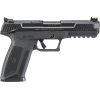
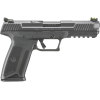
The Ruger 5.7 is a full-size, polymer-framed pistol chambered in 5.7x28mm, the same little high-velocity round that feeds the FN P90 and the Five-seveN. It carries 20+1 and ships with two 20-round magazines. The whole appeal of the platform is speed and capacity with almost no recoil. The bullet leaves the muzzle north of 1,900 feet per second, shoots flat as a string out past 50 yards, and barely moves the gun when it goes off. New shooters hit with it immediately, and experienced shooters can run it fast.
What makes the Ruger special is the price and the trigger. FN wants well over a grand for a Five-seveN. Ruger built a gun that does the same job, added a genuinely excellent trigger, made it optic-ready, and put it on the shelf for around five hundred bucks. That changed the math on this cartridge for a lot of people.
Best for: shooters who want a soft-recoiling range gun that is pure fun, anyone recoil-sensitive who still wants serious capacity, home defenders who value 21 rounds of flat-shooting velocity, and people who have always wanted into the 5.7 world but could not stomach the FN tax.
Ruger 5.7 Specs
- Chambering: 5.7x28mm
- Action: Secure Action, internal hammer-fired, single action
- Capacity: 20+1, ships with two 20-round magazines
- Barrel: 4.94 inches, alloy steel, black nitride, 1:9 RH twist
- Overall length: 8.65 inches
- Height: 5.60 inches
- Weight: 24.5 ounces unloaded
- Slide: through-hardened billet steel, black oxide, optic-ready
- Sights: fiber-optic front, adjustable rear
- Safety: manual thumb safety plus a bladed trigger safety
- Maker: Ruger, Prescott, Arizona
- MSRP: $549; street price often closer to $395-460
Firearm Scorecard
Overall: 8.4 / 10
| Shootability & Recoil | 9.5/10 |
| Trigger | 9.0/10 |
| Accuracy | 9.0/10 |
| Capacity | 9.5/10 |
| Value vs the FN | 9.0/10 |
| Ammo Cost & Terminal Debate | 6.5/10 |
Design Intent: A Cartridge Built to Beat Armor
To understand the Ruger 5.7, you have to understand the round, and the round has a job most people forget. FN designed the 5.7x28mm in the late 1980s as the heart of a Personal Defense Weapon system, the P90 and the Five-seveN pistol. The goal was blunt: build a small, light, controllable cartridge that could punch through Soviet body armor and helmets at distances a 9mm could not touch. The military loading, the SS190, did exactly that. It was an armor defeater first and a pistol round second.
Here’s the honest part for American buyers. That true armor-piercing SS190 is restricted to military and law enforcement. The 5.7 ammo you and I can buy, loads like the FN SS197SR, American Eagle, and Speer Gold Dot, is not armor-piercing by law. What you get on the civilian side is the rest of the package: blistering velocity, a flat trajectory, almost no recoil, and 20 rounds in the grip. The Ruger 5.7 takes that whole package and finally sells it at a price that is not insulting.
Ruger’s contribution is the Secure Action fire control. It is an internal hammer system that gives you a light, crisp, single-action-feeling trigger with a clean break, paired with a bladed trigger safety and a real thumb safety up top. It’s the best trigger on any factory 5.7 pistol, and it’s a big part of why the gun shoots as well as it does.
It’s worth remembering how close this cartridge came to dying. For years the only games in town were FN’s expensive Five-seveN and the P90, ammo was scarce and pricey, and the round had a cult following but no mainstream foothold. Then in 2020 Ruger dropped the 5.7 at half the FN’s price, the floodgates opened, and Smith and Palmetto piled in right behind. Ammo makers responded to the sudden demand, loads multiplied, and prices came down off the ceiling. The Ruger did not just give us a cheaper 5.7 pistol. It dragged the whole cartridge back from the edge of irrelevance and made it a real, supported option again.
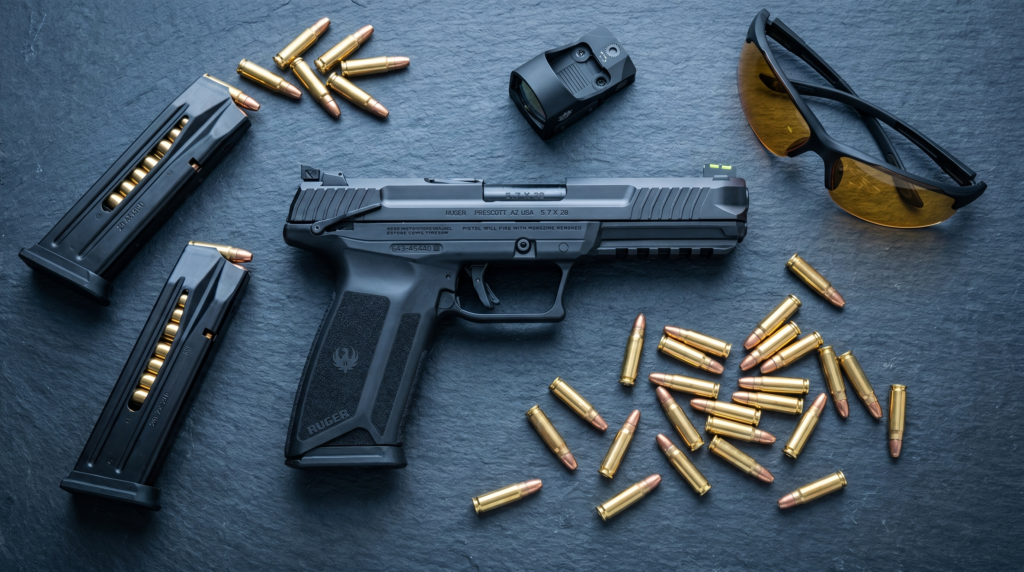
Variants and the 5.7 Field
Ruger keeps it simple. The 5.7 ships in essentially one configuration, the optic-ready, fiber-optic-sighted gun reviewed here. There is no dizzying lineup to sort through. The real decision is not which Ruger 5.7 to buy, it is which 5.7 pistol to buy at all, so here is how the field stacks up against it.
How the Ruger 5.7 Compares to the Competition
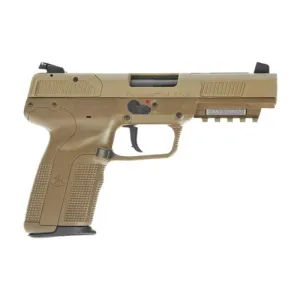
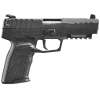
FN Five-seveN ($819.99-$1,500)
The FN is the original and the gun every other 5.7 gets measured against. It’s superbly built, it has decades of duty history, and the newer MRD version is optic-ready out of the box. It’s also more than double the price of the Ruger. Side by side at the range, the Ruger’s trigger is better and the accuracy is a wash. You’re paying the FN premium for the name, the heritage, and the fit. If money is no object, the FN is a beautiful thing. For everyone else, the Ruger does 95 percent of it for less than half the cash.
S&W M&P 5.7 ($586-$670)
The Smith is the Ruger’s closest rival on price and the most interesting gun in the class. It uses a gas-delayed Tempo barrel system that tames the round a touch differently, it is optic-ready, and the ergonomics are excellent. It costs a bit more than the Ruger and the trigger is good but not quite as crisp as Ruger’s Secure Action. This is the matchup most buyers actually agonize over. I’d give the Ruger the trigger and the price, the Smith the grip feel and the optic cut. You will not be unhappy with either.
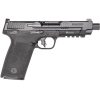
PSA 5.7 Rock ($400-$500)
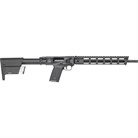
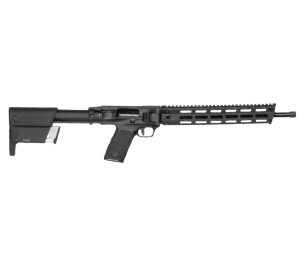
The Rock is the budget door into 5.7, and Palmetto undercut everyone to get there. It’s a lot of gun for the money and there is a growing aftermarket around it. The trade is in refinement. The slide and trigger do not feel as polished as the Ruger, and the long-term track record is shorter. If the absolute lowest buy-in is the goal, the Rock gets you shooting 5.7 for the least money. If you want the gun you will still love in five years, spend the extra hundred and get the Ruger.
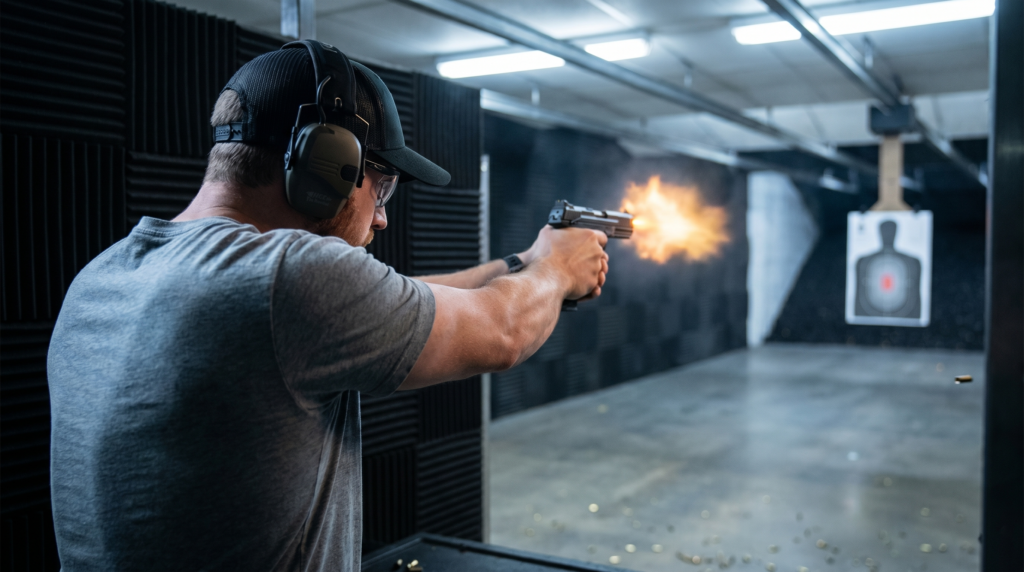
Testing Protocol: How I Ran the Ruger 5.7
I ran a little over 700 rounds through this pistol across about eight range sessions, indoor and outdoor, in everything from cold mornings to hot afternoons. I shot it with irons for the first half, then mounted a red dot for the second half to see how it did as an optic gun. I cleaned it twice in that span and otherwise let it run dirty.
Break-In
There was none to speak of. The gun ran clean from the first magazine. The only early quirk was the magazines, which are stiff to load to a full 20 by hand. A cheap mag loader fixed that in about five seconds and I never thought about it again.
Reliability
Zero malfunctions across the whole 700-plus rounds. No failures to feed, no failures to eject, no light strikes, nothing. I fed it FN SS197SR, American Eagle 40-grain, Speer Gold Dot, and a couple boxes of Federal. The gun did not care what brand it was eating. For a cartridge that has a reputation for being finicky in some platforms, the Ruger was boringly reliable, which is exactly what you want.
Accuracy
This is where the gun shows off. With the red dot and a rest, I was printing 1.5-inch groups at 25 yards with the SS197SR, and even my offhand groups stayed tight because the gun barely moves. The flat trajectory is the real party trick. Holds that would need a big drop adjustment with a 9mm are basically point-and-shoot out to 50 yards. I rang a 100-yard steel plate repeatedly off a bench, which is not something I say casually about a handgun.
Ammo Log
- FN SS197SR 40gr V-Max, 250 rounds, zero issues, 1.5″ at 25 (red dot)
- American Eagle 40gr TMJ, 250 rounds, zero issues, 2.0″ at 25
- Speer Gold Dot 40gr, 100 rounds, zero issues, 1.75″ at 25
- Federal 40gr FMJ, 120 rounds, zero issues, 2.1″ at 25
Performance Results
The headline is how shootable this thing is. The 5.7 round produces a sharp little muzzle report but almost no rearward push, so follow-up shots are stupidly fast. I could run controlled pairs into one ragged hole and barely lose the dot between shots. New shooters I handed it to were grinning by the end of the magazine, because there is no flinch to fight. It’s the single best gun I own for getting a nervous first-timer comfortable behind a centerfire pistol.
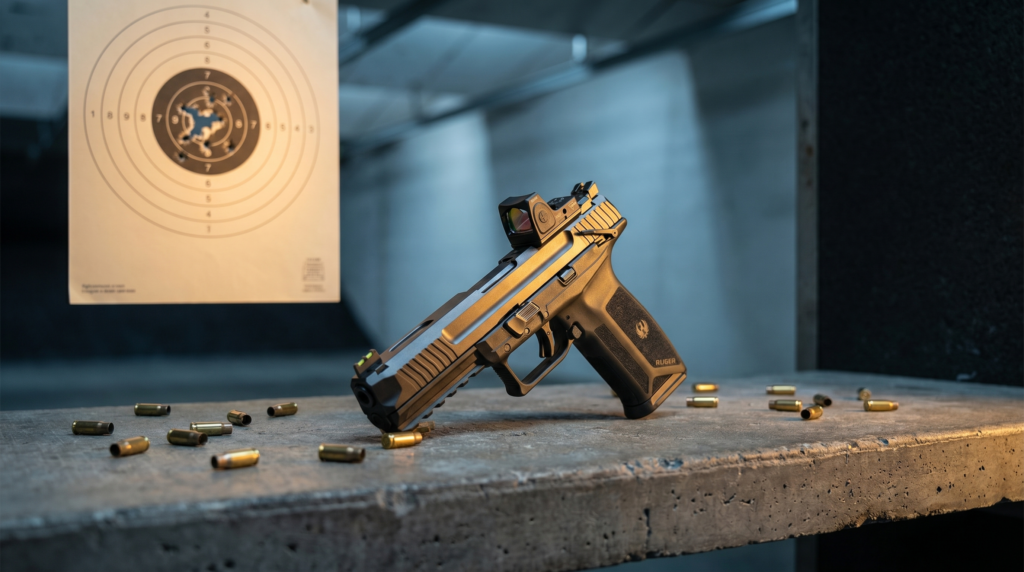
The 20-round capacity changes how the gun feels too. You stop counting and just shoot. For a home-defense role, having 21 flat-shooting rounds on tap with recoil this mild is a genuinely compelling argument, whatever you think of the terminal-ballistics debate. After 700 rounds the gun looked and ran like new, and the trigger never lost its crisp break. This is a well-built pistol, not a novelty.
The red dot turned it into something special. With a dot mounted, the flat trajectory and the lack of recoil let me hold the optic dead still through a string of fire, and the gun rewarded it with hits most shooters would expect from a carbine. I spent one afternoon working a 50-yard steel array and was hitting an 8-inch plate on demand, standing, unsupported, with the same hold I’d use at 15 yards. There is no other handgun I own that lets a regular shooter do that without a lot of practice. That reach, combined with the capacity and the soft shooting, is the whole argument for the platform in one range trip.
Technical Deep Dive
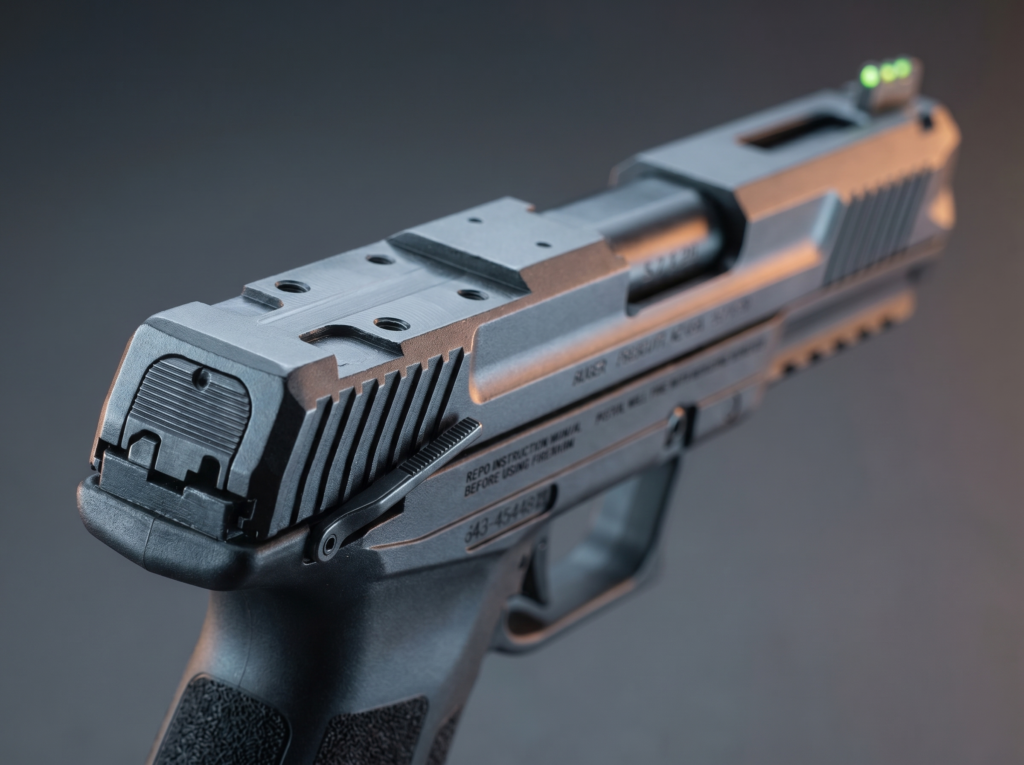
The Ruger 5.7 uses an internal hammer and a delayed-blowback-style locked action tuned for the 5.7 round’s pressure curve. The through-hardened billet steel slide is lighter than it looks and cycles fast, which is part of why recoil feels so flat. The slide is milled and ready for an optic with Ruger’s adapter plate, so adding a red dot is a five-minute job with no gunsmithing.
| Component | Detail |
|---|---|
| Fire control | Secure Action, internal hammer, single-action feel |
| Slide | Through-hardened billet steel, black oxide, optic-ready |
| Barrel | 4.94″ alloy steel, black nitride, 1:9 RH twist |
| Magazine | 20-round steel, ships with two |
| Trigger pull | ~5 lbs as measured, crisp single-action break |
| Safeties | Manual thumb safety plus bladed trigger safety |
One thing worth knowing is how the gun handles the round’s pressure. The 5.7x28mm runs at rifle-like pressures for a handgun cartridge, and Ruger engineered the action to bleed that energy off smoothly. The result is a pistol that feels mild despite firing a very fast round. It’s clever engineering hiding behind a simple-looking gun.
Parts and Accessories Worth Buying
| Upgrade | Why | Rough Cost |
|---|---|---|
| Ruger optic adapter plate | Required to mount most red dots | $30-50 |
| Compact red dot | The gun is built to wear one, and it shines with one | $150-400 |
| Magazine loader | Saves your thumbs loading to 20 | $15-25 |
| Speer Gold Dot 5.7 ammo | The best-regarded defensive load for the round | $30-40/box |
| Extra 20-round magazines | Cheap insurance for a 20-round gun | $30-40 each |
Common Problems and Solutions
- Ammo cost and availability. The biggest knock on any 5.7. It runs anywhere from 50 cents to a dollar a round, well above 9mm. Buy in bulk when you see it priced right, and budget for it before you buy the gun.
- Stiff magazines. Loading to a full 20 by hand is tough on the thumbs when the mags are new. A cheap loader solves it, and the springs ease slightly with use.
- Terminal performance debate. The 5.7 fires a small, fast bullet, and people argue endlessly about its stopping power versus a 9mm. Run a quality expanding load like Gold Dot and judge it for what it is: a high-velocity, high-capacity, low-recoil option, not a 10mm.
- Optic plate confusion. The gun needs Ruger’s adapter plate for most red dots, and buyers sometimes order the wrong footprint. Check your dot’s pattern against the plate options before you buy.
Who Should NOT Buy the Ruger 5.7
- High-volume budget shooters. If you want to shoot a lot for cheap, 5.7 ammo will bleed your wallet. Buy a 9mm like a Glock 17 or an M&P and shoot four times as much for the money.
- Deep concealment carriers. At 8.65 inches long this is a full-size pistol. If you want something to vanish inside a waistband, look at a Sig P365 or a Hellcat instead.
- Big-bore believers. If you trust heavy, slow bullets and want maximum terminal mass, the 5.7 will never satisfy you. Get a 10mm or a .45 and be happy.
- Anyone who hates a manual safety. The thumb safety is part of the design. If you want a striker gun with no external safety, this platform will annoy you.
Final Verdict
The Ruger 5.7 earns an 8.4 out of 10 and a permanent spot in my range bag. It democratized a cartridge that used to cost a fortune to get into, and it did it without cutting the corners that matter. The trigger is the best in the class, it ran flawlessly through everything I fed it, and it’s so flat and soft to shoot that it makes everyone behind it look good. The only real marks against it are the price of feeding it and the endless terminal-ballistics argument, neither of which is the gun’s fault.
If the 5.7 round appeals to you at all, this is where I’d start. It sits right at the top of our guide to the best 5.7 pistols, and it makes the FN look overpriced rather than aspirational. For a closer look at the budget end of the class, our PSA 5.7 Rock review covers the cheapest way into the cartridge. But for the gun that gets the balance right, the Ruger is the one I keep coming back to. And Mike’s right about one thing: when the problem is armor, this is the family of guns that was actually built to answer it.
Ruger 5.7 Review FAQ
Is the Ruger 5.7 a good gun?
Yes. It is one of the most shootable handguns on the market, with a flat trajectory, very mild recoil, a 20+1 capacity, and the best trigger in the 5.7 class. It does nearly everything the FN Five-seveN does for around half the price.
What caliber is the Ruger 5.7?
The Ruger 5.7 is chambered in 5.7x28mm, the same high-velocity cartridge used by the FN Five-seveN pistol and the FN P90. It fires a small, fast bullet that shoots very flat with little recoil.
How many rounds does the Ruger 5.7 hold?
Twenty plus one. The pistol uses 20-round magazines and ships with two of them, giving you 21 rounds on tap from a full load.
Can the Ruger 5.7 shoot through body armor?
The 5.7x28mm cartridge was originally designed to defeat soft body armor, but the true armor-piercing military load, the SS190, is restricted to military and law enforcement. The 5.7 ammunition civilians can legally buy in the US is not armor-piercing.
Is the Ruger 5.7 good for home defense?
It makes a strong case. You get 21 flat-shooting rounds with very mild recoil and an excellent trigger, which is easy to shoot fast and accurately under stress. Run a quality expanding defensive load such as Speer Gold Dot.
Ruger 5.7 vs FN Five-seveN, which is better?
The FN is beautifully built and has decades of duty heritage, but it costs more than double the Ruger. The Ruger has a better factory trigger and matches the FN on practical accuracy. For most buyers, the Ruger is the smarter purchase.
3,979+ Gun & Ammo Deals
Updated daily from 200+ top retailers. Filter by category, caliber, action type, and price.
Related Guides