
Last updated March 10th 2026
I clean and maintain my own firearms — rifles, handguns, and shotguns — after every range session and have done so for over a decade. This guide covers the same process I use personally, based on manufacturer recommendations and professional armorer training. Some links are affiliate links that support our independent testing. Read our editorial policy.

Quick Answer: Gun Cleaning Essentials
- How often: After every range session for defensive firearms. Every 500-1,000 rounds for range-only guns. Every 3-6 months for stored guns (light oil wipe-down).
- Basic supplies: CLP (Break Free or Ballistol), bore brush and jag, cleaning patches, nylon brush, microfiber cloth — total cost $30-$50
- Time required: 10-15 minutes for a basic cleaning, 30-45 minutes for a thorough deep clean
- Cardinal rule: Always verify the firearm is unloaded before cleaning. Remove the magazine, lock the slide/bolt open, and visually and physically inspect the chamber.
Why Gun Cleaning Matters
A dirty firearm is an unreliable firearm. Carbon fouling, copper buildup, and dried lubricant create friction that causes malfunctions — failures to feed, failures to extract, and failures to fire. In a defensive scenario, a malfunction can cost your life. In competition, it costs you the match. On a hunt, it costs you the animal.
Beyond reliability, regular cleaning prevents:
- Rust and corrosion. Metal surfaces exposed to moisture, sweat, and humidity corrode. A thin film of oil prevents oxidation. Neglected guns develop pitting — permanent damage that reduces accuracy and value.
- Accuracy degradation. Copper fouling in the bore changes the bullet’s path. A rifle that shoots 1 MOA when clean may shoot 2-3 MOA after 500 rounds of copper buildup. Match shooters clean between stages for this reason.
- Premature wear. Carbon acts as an abrasive. Gritty residue between moving parts accelerates wear on rails, locking lugs, and extractors. Proper lubrication reduces friction and extends the service life of every component.
- Reduced resale value. A well-maintained firearm holds its value significantly better than a neglected one. Pitting, rust, and excessive wear are immediately visible to buyers.
Essential Cleaning Supplies

You do not need a wall of products to keep your guns clean. Here is what actually matters:
Cleaning Solvents and Lubricants
CLP (Cleaner, Lubricant, Protectant) is the all-in-one solution that handles 90% of gun cleaning needs. One product cleans carbon, lubricates moving parts, and protects against corrosion. My top picks:
- Break Free CLP ($8-$12) — The military standard. Used by the US military for decades. Works in every climate and on every firearm type. If you buy one cleaning product, buy this.
- Ballistol ($10-$15) — A biodegradable, non-toxic alternative that works on metal, wood, leather, and plastic. Excellent for older guns with wood furniture. Smells like licorice.
- Lucas Gun Oil ($8-$12) — Superior lubricant for high-round-count guns. Better long-term lubrication than CLP alone. I use CLP to clean and Lucas Oil to lubricate as a two-step process on my defensive firearms.
For heavy carbon removal: Hoppe’s No. 9 solvent ($7-$10) is the classic — the smell is iconic. It dissolves carbon and powder fouling more aggressively than CLP alone.
For copper fouling: Bore Tech Eliminator ($12-$15) or Hoppe’s Copper Solvent removes copper jacket fouling from rifle bores that CLP alone cannot touch. Essential for precision rifle maintenance.
Bore Cleaning Tools
- Bore brush (bronze or nylon): Scrubs the inside of the barrel. Bronze brushes are more aggressive for heavy fouling; nylon brushes are gentler for routine cleaning. Match the brush to your caliber (.22, .30, 9mm, 12-gauge, etc.).
- Jag and patches: A jag is a pointed tip that holds a cotton patch. You push solvent-soaked patches through the bore to remove loosened fouling. Use properly sized patches — too small and they do not contact the rifling, too large and they jam.
- Cleaning rod: A one-piece cleaning rod (Dewey, Tipton, Pro-Shot) is better than a multi-piece rod because it is straighter and less likely to damage the bore crown. Carbon fiber or coated steel rods are best — uncoated steel rods can scratch the bore.
- Bore snake: A pull-through cleaning cord with an integrated brush. Perfect for quick field cleaning and post-range cleaning when you do not want to break out the full kit. Hoppe’s BoreSnake ($12-$18) is the standard. Not a replacement for a proper rod cleaning, but excellent for routine maintenance.
Other Essentials
- Nylon utility brush (old toothbrush works) — for scrubbing carbon off external surfaces, slide rails, and hard-to-reach areas
- Microfiber cloth — for wiping down external surfaces and removing excess oil
- Cleaning mat — protects your table and gives you a padded, non-slip surface. TekMat ($15-$25) makes gun-specific mats with disassembly diagrams printed on them
- Cotton swabs (Q-tips) — for detailing small areas, extractors, and firing pin channels
- Pick set — dental picks or purpose-built gun picks for scraping carbon from tight spots (bolt face, extractor claw, gas rings)
Recommended starter kit: The Real Avid Gun Boss Pro Universal Cleaning Kit ($30-$40) includes rods, jags, brushes, and a carrying case for all common calibers. Pair it with a bottle of Break Free CLP and a bore snake in your primary caliber, and you have everything you need for under $60.
How to Clean a Handgun (Semi-Automatic)

This process applies to most striker-fired and DA/SA semi-automatic pistols (Glock, Sig, S&W, CZ, etc.). Always consult your owner’s manual for model-specific instructions.
Step 1: Make Safe
This is the most important step. Remove the magazine. Lock the slide back. Visually and physically verify the chamber is empty — look into the chamber and stick your finger in to confirm. Set the magazine aside in a different location. Point the gun in a safe direction during the entire cleaning process. Every year, people are injured or killed by “unloaded” guns during cleaning. Do not become a statistic.
Step 2: Field Strip
Field stripping breaks the gun into its main components without requiring tools. For most semi-auto pistols, this means separating the slide assembly, barrel, recoil spring/guide rod, and frame. For a Glock: lock the slide slightly back, pull down both takedown tabs, release the slide forward off the frame, then remove the recoil spring and barrel from the slide. It takes 10 seconds once you know how.
Do not detail-strip (remove small pins, springs, and internal parts) during routine cleaning. Field stripping is sufficient for 95% of maintenance. Detail stripping is for deep cleaning every 2,000-5,000 rounds or troubleshooting specific issues.
Step 3: Clean the Barrel
Apply CLP or solvent to a bore brush and run it through the barrel 5-10 times. The brush scrubs carbon and lead/copper fouling from the rifling. Then attach a jag with a solvent-soaked patch and push it through. Repeat with clean patches until the patch comes out without significant black or green residue. A bore snake can replace this entire step for routine cleaning — run it through 3-4 times with CLP applied.
Direction matters: Ideally, push the brush from the breech (chamber) end toward the muzzle to avoid damaging the crown. With a bore snake, pull from breech to muzzle.
Step 4: Clean the Slide and Frame
Use a nylon brush and CLP to scrub carbon from the slide rails (inside the slide), the breech face (where the cartridge sits), the extractor, and the area around the firing pin hole. For the frame, clean the rail grooves, trigger bar area, and the feed ramp (the polished ramp that guides cartridges into the chamber). Cotton swabs are excellent for detailing small areas.
Wipe everything down with a clean microfiber cloth to remove excess solvent and carbon residue.
Step 5: Lubricate
Less is more. Over-lubrication attracts dirt and carbon, creating a gritty paste that accelerates wear. You want a thin film of oil — not puddles. Apply one small drop of CLP or gun oil to each of these contact points:
- Slide rails (4 contact surfaces where the slide meets the frame) — one drop per rail, spread with your finger
- Barrel exterior — light coat on the barrel hood and locking lug area
- Barrel bore — a very light pass with an oiled patch (for storage protection; some shooters prefer to run the first round through a dry bore)
- Recoil spring — light oil on the spring and guide rod where they contact the barrel
- Any other metal-on-metal contact point visible during field strip
Step 6: Reassemble and Function Check
Reassemble in reverse order. Once reassembled, perform a function check: rack the slide to confirm it moves smoothly, dry-fire to test the trigger (point in a safe direction), and cycle the slide again to confirm the trigger resets. If everything functions normally, your handgun is clean and ready. For detailed handgun selection, see our handgun buyer’s guide.
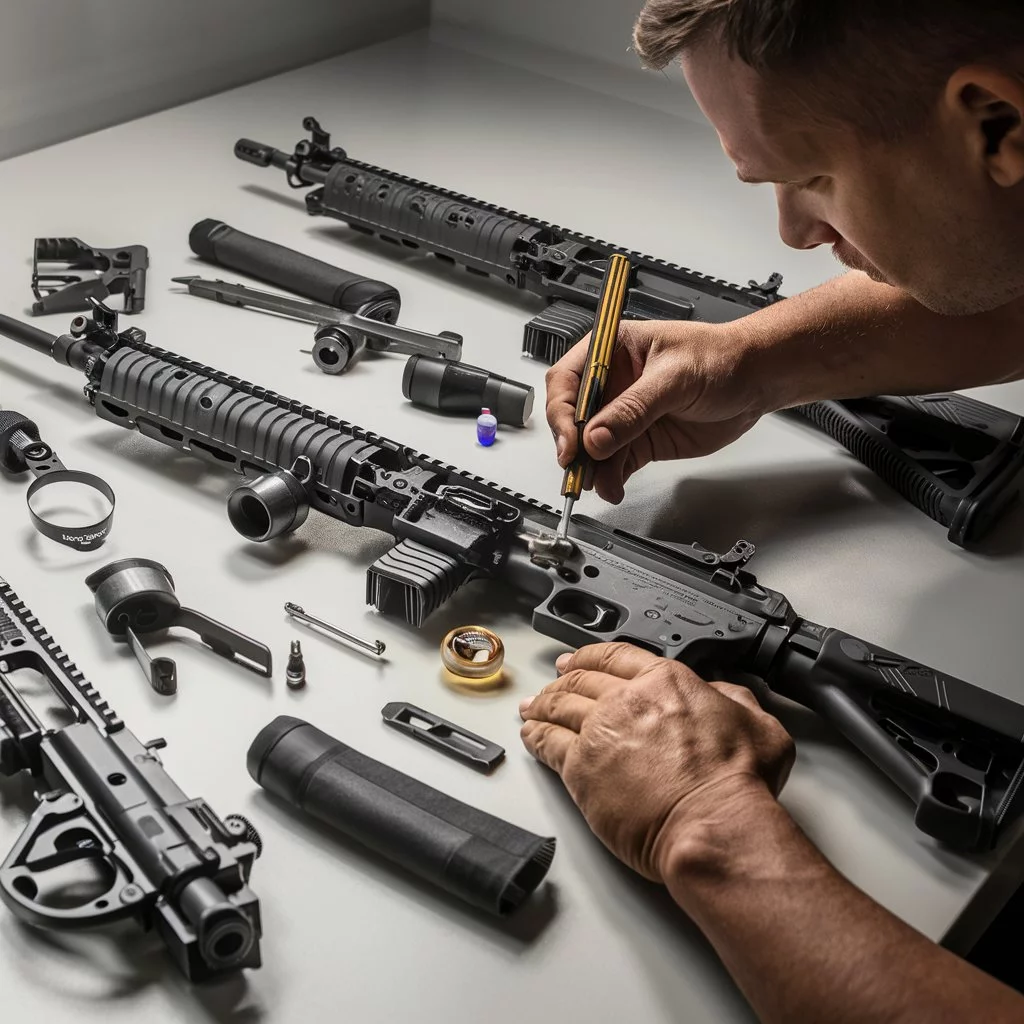
How to Clean an AR-15 Rifle
The AR-15 is a direct-impingement system that vents hot gas directly into the bolt carrier group — which means the BCG gets filthy. AR-15 cleaning focuses heavily on the BCG and bore.
Step 1: Make Safe and Separate Upper from Lower
Remove the magazine. Lock the bolt back. Visually and physically verify the chamber is empty. Push out the takedown pins and separate the upper receiver from the lower. Pull the charging handle and bolt carrier group out of the upper receiver.
Step 2: Clean the Bolt Carrier Group
This is where the AR-15 gets dirty. The BCG will be coated in black carbon. Disassemble the BCG: remove the firing pin retaining pin, pull out the firing pin, rotate and remove the cam pin, then pull the bolt out of the carrier.
- Bolt: Scrub carbon from the bolt face, extractor, and the area behind the gas rings. Use a pick to clean the bolt face’s firing pin hole and the extractor claw. Check the gas rings — they should overlap (not have all three gaps aligned) and the bolt should not slide freely out of the carrier under its own weight when held vertically.
- Carrier: Scrub the interior of the carrier (where gas enters) with a brush and CLP. Clean the carrier key (the piece bolted on top) — ensure the screws are still staked and tight. Wipe the exterior clean.
- Firing pin and cam pin: Wipe clean with a cloth. Do NOT oil the firing pin — oil in the firing pin channel can cause light primer strikes in cold weather.
Step 3: Clean the Bore
Same process as the handgun bore cleaning. Run a bore brush with CLP 10-15 times from the chamber end. Follow with solvent-soaked patches until they come out clean. For AR-15 precision use, follow with a copper solvent (Bore Tech Eliminator) and patches to remove copper fouling.
The chamber and extension: Use a chamber brush (larger than a bore brush, designed to scrub the chamber and locking lug recesses) with CLP. The locking lug recesses trap carbon and can cause extraction issues if neglected. A chamber flag or AR-15 specific chamber brush tool makes this easy.
Step 4: Clean the Upper and Lower Receivers
Upper: Wipe the interior with CLP and a cloth. Clean the charging handle channel. Wipe the feed ramps (the polished ramps at the bottom of the barrel extension that guide rounds into the chamber).
Lower: Brush out the fire control group (trigger, hammer, disconnector) with a nylon brush and CLP. Clean the buffer tube interior if carbon has accumulated. Wipe the magazine well.
Step 5: Lubricate and Reassemble
The AR-15 runs best when lubricated generously — unlike a handgun, the AR actually prefers to be wet. Apply oil to:
- Bolt carrier group: Coat the exterior of the carrier and bolt with a thin film of oil. Apply oil to the cam pin hole, the gas rings, and the carrier key. This is where most of the friction occurs.
- Charging handle: Light oil on the latch and the rails.
- Trigger group: One drop on the trigger pin, hammer pin, and disconnector.
- Buffer spring: Light oil on the spring to reduce the “twang” sound during cycling.
Reassemble the BCG (bolt, cam pin, firing pin, retaining pin), insert into the upper, and close the upper onto the lower. Function check. For the complete AR-15 platform guide, see our AR-15 buyer’s guide.
How to Clean a Shotgun

Shotgun cleaning is simpler than rifle or pistol cleaning because shotgun bores are smooth (no rifling to trap copper) and the action design is typically less carbon-intensive.
Pump-Action Shotguns (Mossberg 500/590, Remington 870)
- Make safe: Unload completely. Pump the action open and verify the chamber and magazine tube are empty.
- Remove the barrel: Most pump shotguns allow barrel removal by unscrewing the magazine tube cap and sliding the barrel forward off the receiver.
- Clean the bore: Run a 12-gauge bore brush (or 20-gauge for 20-gauge guns) with CLP through the barrel 5-10 times. Follow with patches until clean. Shotgun bores clean up fast because there is no rifling to trap fouling.
- Clean the action: Wipe down the bolt face, action bars, and the interior of the receiver with CLP and a brush. Pump-action shotguns are mechanically simple — the action bars, elevator, and bolt are the primary areas to clean.
- Lubricate: Oil the action bars where they slide through the receiver, the bolt face, and the hinge point of the elevator. Light oil on the magazine tube where the forend slides.
- Choke tubes: If your shotgun uses removable choke tubes, unscrew them and clean the threads with a brush and CLP. Apply anti-seize compound (not gun oil) to the threads before reinstalling. Neglected choke tubes can seize in the barrel — a frustrating and potentially expensive problem.
For shotgun selection, see our best home defense shotguns and the shotgun section of our home defense firearms guide.
Semi-Automatic Shotguns
Semi-auto shotguns (Mossberg 940, Beretta 1301, Benelli M4) require additional attention to the gas system or inertia system. Gas-operated shotguns (940, 1301) accumulate carbon in the gas ports and piston — clean these every 250-500 rounds with a brush and solvent. Inertia-driven shotguns (Benelli M4, M2) have simpler internals with fewer parts to clean. Consult your owner’s manual for model-specific disassembly.
Cleaning Schedule: How Often Is Enough?
There are two schools of thought on cleaning frequency, and both have merit:
The “clean after every session” approach: Clean your firearms after every range trip. This ensures maximum reliability and prevents carbon buildup from hardening. I follow this approach for my defensive firearms — the guns I would stake my life on get cleaned every time, no exceptions.
The “clean when needed” approach: Many modern firearms — especially quality AR-15s and Glocks — will run thousands of rounds without cleaning. I have intentionally run a BCM AR-15 to 2,000 rounds without cleaning as a test — it never malfunctioned. The “clean when needed” approach is fine for range-only guns, but I would never apply it to a defensive firearm.
My recommended schedule:
- Defensive firearms (home defense, carry guns): Clean after every range session. Lubricate monthly even if not fired.
- Range and competition guns: Clean every 500-1,000 rounds or when accuracy degrades.
- Hunting rifles: Clean before and after each hunting season. Clean immediately if exposed to rain, snow, or mud.
- Stored firearms: Wipe down with oil every 3-6 months. Check for rust or moisture damage. Ensure your gun safe has a dehumidifier running.
Long-Term Storage and Rust Prevention
Firearms in long-term storage face one primary enemy: moisture. Even inside a safe, humidity fluctuations cause condensation that leads to rust. Here is how to prevent it:
- Dehumidifier in your safe: A GoldenRod electric dehumidifier ($25-$40) or Eva-Dry rechargeable silica gel unit ($20-$30) keeps humidity below 50% — the threshold where rust begins. This is mandatory for any gun safe. See our gun safe buyer’s guide for details.
- Silicone-treated gun socks: Individual fabric sleeves treated with silicone that wick moisture away from the firearm’s surface. Allen, Remington, and Bore Stores all make them ($5-$8 each). Better than bare contact with safe foam.
- VCI (Vapor Corrosion Inhibitor) products: Zerust capsules, VCI paper wraps, and VCI bags emit invisible vapor that forms a protective molecular layer on metal surfaces. Place Zerust capsules ($5 for a 2-pack) in your safe for passive rust prevention.
- Heavy-duty preservation: For guns stored for months or years, apply a heavier preservative like Birchwood Casey Barricade or Eezox. These create a thicker protective film than standard CLP. Wipe off excess before shooting — heavy preservatives can affect ignition reliability.
Common Cleaning Mistakes
- Over-lubricating. Excess oil collects dust, dirt, and unburned powder, creating an abrasive paste. A thin film of oil is all you need. If you can see oil pooling or dripping, you have used too much. Wipe off the excess.
- Using WD-40 as a gun lubricant. WD-40 is a water displacement solvent, not a lubricant. It evaporates, leaving no protective film, and can penetrate primer pockets and deactivate ammunition. Use products designed for firearms.
- Neglecting the bore crown. The muzzle crown is the most accuracy-sensitive part of the barrel. Damage from a cleaning rod banging against the crown can destroy accuracy. Use a bore guide (for rifles) and always clean from the breech end when possible.
- Not cleaning the magazines. Magazines accumulate dirt, lint, and debris that cause feeding issues. Disassemble your magazines every 6-12 months, wipe the follower and spring with a dry cloth, and reassemble. Do not oil magazine internals — oil attracts debris.
- Cleaning in an unventilated area. Gun cleaning solvents produce fumes. Work in a well-ventilated area or wear nitrile gloves and open a window. Lead residue is also a concern — wash your hands after cleaning.
- Using a steel brush on aluminum. Never use a steel wire brush on aluminum receivers (AR-15 lowers and uppers are aluminum). Steel scratches and damages aluminum. Use brass, bronze, or nylon brushes only.
When to See a Gunsmith
Basic cleaning and maintenance is a skill every gun owner should have. But some problems require professional attention:
- Persistent malfunctions after cleaning — If your firearm continues to malfunction after a thorough cleaning and proper lubrication, the issue is mechanical, not maintenance-related.
- Rust or pitting in the bore — Light surface rust can be cleaned, but pitting (small craters in the metal surface) is permanent damage that requires professional evaluation.
- Broken or worn parts — Extractors, firing pins, recoil springs, and other small parts wear out over time. If you notice a broken or excessively worn component, replace it or have a gunsmith do so.
- Accuracy loss that cleaning does not fix — If a rifle’s accuracy has degraded significantly and bore cleaning does not restore it, the barrel may be shot out (worn rifling). A gunsmith can inspect and advise on re-barreling.
- Stuck choke tubes, seized screws, or stripped threads — Forcing these risks permanent damage. A gunsmith has the tools and experience to remove them safely.
Frequently Asked Questions
Can I use household products to clean my gun?
No. Automotive cleaners, kitchen degreasers, and household solvents can damage finishes, dissolve polymers, and leave residues that affect firearm function. Use products designed for firearms. A bottle of CLP costs $8-$12 and lasts for months — there is no reason to improvise.
How do I clean a gun I just bought?
Always clean a new firearm before shooting it for the first time. Factory guns are packed with heavy preservative oils that must be removed and replaced with proper lubricant. Field strip, wipe everything down, clean the bore, apply fresh CLP or gun oil to all contact points, and function check. This also familiarizes you with the gun’s disassembly/reassembly process.
Do I need to clean my gun if I did not fire it?
If you handled the gun, wipe it down with an oiled cloth — fingerprint oils contain salts that cause rust. If you carried the gun (concealed carry), clean and re-oil it monthly — sweat, lint, and body oils accelerate corrosion. Guns stored in a climate-controlled safe with a dehumidifier need a wipe-down every 3-6 months.
What is the best gun cleaning solvent?
Break Free CLP for all-purpose cleaning, lubrication, and protection. Hoppe’s No. 9 for aggressive carbon removal. Bore Tech Eliminator for copper fouling in rifle bores. CLP alone handles 90% of cleaning needs — add dedicated solvents only if you shoot precision rifles or high round counts.
How do I remove rust from a gun?
Light surface rust can be removed with fine bronze wool (0000 grade) and gun oil. Apply oil, gently rub the rusted area with the bronze wool in the direction of the metal grain, and wipe clean. For more severe rust, Evapo-Rust or naval jelly can dissolve it, but test on an inconspicuous area first. Deep pitting cannot be reversed — prevent it with proper storage and maintenance.
Final Thoughts
Gun cleaning is not complicated and does not take long — but it does require consistency. Fifteen minutes after each range session keeps your firearms running reliably for decades. The process is the same whether you own a $300 pistol or a $3,000 rifle: make safe, field strip, clean the bore, scrub the carbon, lubricate lightly, reassemble, function check.
The best time to clean your gun is right after you shoot it — before carbon hardens and before you forget. Make it part of your range routine, and it becomes second nature.
For help choosing firearms worth maintaining, see our handgun buyer’s guide, AR-15 buyer’s guide, and best home defense shotguns. For proper storage, our gun safe buyer’s guide covers the best options at every price point. And for the ammunition that keeps your guns running, check our ammo buying guide and daily ammo deals.