
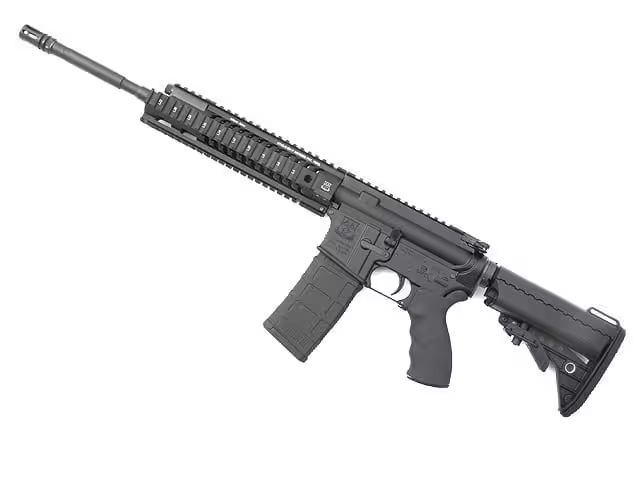
How we tested: Every pick here is ranked against our testing methodology. Minimum round counts, accuracy and reliability protocols, the failures that disqualify a gun. Where we have not shot a specific variant ourselves, we say so in that section.
How to Build an AR-15: Complete Step-by-Step Guide (2026)
Last updated July 2026 · By Nick Hall, AR-15 builder who has assembled dozens of rifles from stripped lowers through complete builds
- Treat every gun as loaded
- Point the muzzle in a safe direction
- Keep your finger off the trigger until you’re ready to shoot
- Know your target and what’s beyond
This post contains affiliate links. If you click and purchase, we may earn a small commission at no extra cost to you. We only recommend products we trust.
- Treat every gun as loaded
- Point the muzzle in a safe direction
- Keep your finger off the trigger until you’re ready to shoot
- Know your target and what’s beyond
Table of Contents
Introduction: Build vs Buy
Before you commit to building your own AR-15, it’s worth asking the honest question: should you build or buy?
Building makes sense when:
- You want exact control over every component, barrel profile, trigger, gas system, handguard, stock
- You want to learn the platform inside and out (there’s no better way than assembling one yourself)
- You’re building a specialized rifle, precision, lightweight, suppressed, or a specific caliber, that isn’t available off the shelf
- You enjoy the process and consider it part of the hobby
Buying makes more sense when:
- You want a basic, reliable AR-15 at the lowest possible price, factory rifles like the S&W M&P15 Sport II or PSA PA-15 are often cheaper than building from equivalent-quality parts
- You want a manufacturer warranty covering the complete rifle
- You’re not mechanically inclined and don’t want to risk assembly errors
Here’s the truth most build guides won’t tell you: building an AR-15 doesn’t necessarily save money. A budget factory AR-15 can be had for $400-500 and it’ll work out of the box. Building from individual parts at that price point often means cutting corners. Where building shines is the mid-range and up, a $900 build with hand-selected components will outperform a $900 factory rifle almost every time.
If you’re still in the “should I buy?” camp, check our AR-15 buyer’s guide for factory recommendations. If you’re ready to build, let’s get into it.
Tools You’ll Need
You don’t need a machine shop, but you do need some specific tools. Trying to build an AR-15 with general-purpose tools is a recipe for scratched finishes, damaged parts, and a lot of frustration.
Essential tools:
- AR-15 armorer’s wrench, A multi-purpose wrench designed specifically for the AR platform. It’ll tighten your castle nut, barrel nut, and muzzle device. Expect to spend $20-50 for a good one.
- Upper receiver vise block, Clamps into the magazine well and holds the upper receiver in a bench vise. You need this for torquing the barrel nut. Do not try to hold the receiver by hand or clamp directly on the aluminum, you will damage it.
- Lower receiver vise block, Holds the lower for assembly work. A reaction rod (which inserts through the upper receiver and clamps on the barrel extension) is even better if you can afford one.
- Roll pin punch set, AR-15 lower assembly uses several roll pins (bolt catch, trigger guard, forward assist). You need punches sized for 5/32″ and 3/32″ roll pins. A roll pin starter punch is worth every penny, it holds the pin in alignment so you can start it straight without it flying across the room.
- Torque wrench, The barrel nut must be torqued to 30-80 ft-lbs (depending on manufacturer specs). A 1/2″ drive torque wrench with the appropriate range is essential. This is not optional, under-torquing causes accuracy problems, over-torquing can strip threads.
- Bench vise, Bolted to a sturdy workbench. You need a vise that won’t move when you’re applying 60 ft-lbs of torque to a barrel nut.
- Pivot pin installation tool, The front pivot pin detent and spring are the most commonly launched parts during AR builds. A $5 installation tool or a simple clevis pin saves an hour of searching the floor.
Helpful but not strictly necessary:
- Headspace gauges (go/no-go), critical if assembling a barrel to an upper, less so with factory-assembled uppers
- Anti-seize compound for the barrel nut threads
- Blue Loctite (242) for grip screw and various other screws
- Aeroshell 33MS grease for the barrel nut
- Masking tape to protect the receiver finish during assembly
Step 1: Choose Your Lower Receiver
The lower receiver is the serialized, legally-regulated part of the AR-15. Under federal law, the lower receiver is the firearm, everything else is just parts. This means:
- You must purchase it through a Federal Firearms Licensee (FFL) and complete a Form 4473 background check
- You cannot have it shipped directly to your door (it must go to an FFL)
- All federal, state, and local age/eligibility requirements apply
Not sure how the FFL transfer process works? We’ve got a complete FFL transfer guide that walks through the whole thing.
Stripped vs. complete lower:
A stripped lower is just the raw receiver, no parts installed. You’ll install the trigger group, buffer tube assembly, pistol grip, magazine release, bolt catch, and safety selector yourself. This is the “full build” approach and gives you maximum control over component selection. Stripped lowers run from $40 (Poverty Pony / Anderson) to $400+ (ADM, LMT, Radian).
A complete lower comes with everything already assembled, trigger, stock, grip, buffer assembly, all small parts. You just pin it to an upper receiver and you’re done. This is faster but limits your customization options (though you can always swap parts later). Complete lowers run $150-600+ depending on quality and components.
Material choices: The vast majority of lowers are forged 7075-T6 aluminum, which is the mil-spec standard. Billet lowers are machined from a solid block of aluminum and offer tighter tolerances and more aesthetic options but weigh slightly more. Polymer lowers exist but aren’t recommended for serious use, they can crack at the buffer tube threads or the pivot pin holes under stress.
For most builders, an Aero Precision M4E1 stripped lower ($80-100) hits the sweet spot of quality, features, and value. The threaded roll pin holes and integrated trigger guard eliminate two of the most annoying parts of lower assembly.
Step 2: Assemble the Lower
Lower assembly is where first-time builders spend most of their time. It’s not difficult, but there are small springs and detents that require patience. Here’s the order that works best:
1. Magazine catch. Drop the magazine catch button into the left side of the receiver, thread the magazine catch through from the right side, and screw it into the button. Depress the button from the left and tighten until about 3 threads show, then test with a magazine.
2. Trigger guard. If your lower has an integrated trigger guard (like the Aero M4E1), skip this step. Otherwise, align the trigger guard with the ears on the lower and drive in the roll pin. Use a roll pin starter punch and support the receiver ear from below, these ears are thin and can crack if you’re ham-fisted.
3. Bolt catch. Install the bolt catch spring and plunger, then drive in the bolt catch roll pin from left to right. This is the single most annoying step of the entire build. The roll pin is small, the spring is under tension, and the hole alignment has to be perfect. A bolt catch installation tool or even a pair of slave pins makes this dramatically easier.
4. Trigger group. Install the hammer and trigger with their respective springs and pins. If you’re using a mil-spec trigger, the hammer spring legs go over the trigger pin (not under, this is the most common assembly error). If you’re using a drop-in trigger (like a CMC, Larue MBT-2S, or Timney), follow the manufacturer’s instructions, they’re self-contained units that typically just pin right in.
5. Safety selector. Insert the safety selector detent and spring into the hole in the lower (above the grip area), then install the selector from the left side. The detent should click into the notches on the selector when you rotate it between safe and fire.
6. Pistol grip. The grip screw captures the safety detent spring, so you need to hold the spring in place with a finger or a small tool while threading the grip on. Apply a drop of blue Loctite to the grip screw. Tighten firmly but don’t gorilla it, you’re threading into aluminum.
7. Buffer tube assembly. This is where you need to understand mil-spec vs. commercial buffer tubes:
- Mil-spec: 1.148″ diameter, straight tube. Uses mil-spec stocks. This is the standard, buy mil-spec unless you have a specific reason not to.
- Commercial: 1.168″ diameter, slightly tapered at the rear. Uses commercial stocks. Slightly cheaper to manufacture but increasingly rare. Stocks are not interchangeable between specs.
Install the buffer retainer and spring in the hole in front of the buffer tube threads. Thread the buffer tube onto the receiver extension, making sure the buffer retainer is captured beneath the tube’s lip. Slide on the castle nut and end plate (the end plate goes between the nut and receiver), then stake or torque the castle nut to 38-42 ft-lbs. Install the buffer spring and buffer.
8. Stock. Slide your stock onto the buffer tube until it clicks into position. Adjust for length of pull. Done.
Step 3: Choose Your Upper Receiver
At this point, you have a choice: build the upper from scratch or buy a complete upper assembly. Honestly? For a first build, buying a complete upper is the smarter move.
Here’s why: the upper assembly requires proper headspacing between the bolt and barrel extension. If headspace is incorrect, you get dangerous situations, either the bolt won’t lock properly, or excessive pressure can damage the rifle (and you). A factory-assembled upper has been headspaced and test-fired. A home-assembled upper requires go/no-go gauges and the knowledge to use them.
That said, building your own upper isn’t rocket science, thousands of people do it successfully. You just need to check headspace with proper gauges before firing.
Stripped upper receiver: The forging itself, without barrel, handguard, or any components installed. Most stripped uppers include the forward assist and dust cover already installed (or the hardware to install them). Aero Precision, BCM, and Anderson all make quality stripped uppers.
Complete upper: Barrel installed and torqued, handguard mounted, gas system assembled, muzzle device installed. Typically comes with BCG and charging handle, though some are sold without. This is a plug-and-play solution, pin it to your completed lower and you’re ready to function check.
Step 4: Barrel and Gas System
The barrel is the single most important component for accuracy. Don’t cheap out here, you can save money on furniture and aesthetics, but the barrel is where it counts.
Barrel profiles:
- Government/M4 profile: Thin under the handguard, steps up to a thicker diameter at the gas block and forward. It’s a compromise profile that’s lighter than a heavy barrel but heavier than a pencil barrel. This is what you’ll find on most factory rifles.
- Lightweight/pencil: Thin throughout. Saves weight (sometimes a full pound vs. heavy barrels) but heats up faster during rapid fire and can exhibit point-of-impact shift as the barrel warms. Great for lightweight builds where sustained fire isn’t the priority.
- Heavy/bull/HBAR: Thick throughout. More resistant to heat-induced accuracy degradation. Heavier but more accurate during sustained fire. Preferred for precision builds and bench shooting.
- Hybrid/Faxon Gunner/BA Hanson: Modern profiles that optimize weight distribution by removing material where it’s not structurally necessary. These are arguably the best all-around choice for a general-purpose build.
Barrel length: 16″ is the minimum legal length for a rifle without an NFA tax stamp. This is the standard for most builds. 14.5″ with a permanently pinned/welded muzzle device (bringing overall length to 16″+) is also popular. 18″ and 20″ barrels extract more velocity from the 5.56mm cartridge and are preferred for precision or longer-range work.
Gas system lengths:
This is one of the most important and most overlooked aspects of an AR build. The gas system length determines where the gas port is located on the barrel, which directly affects how much dwell time the bullet has after passing the gas port. More dwell time means more gas pushed back to cycle the action, which means more felt recoil and more carbon fouling.
- Carbine length (7″): Standard on 14.5-16″ barrels. Higher port pressure creates a snappier recoil impulse and more gas blowback. Runs reliably but can be over-gassed on 16″ barrels.
- Mid-length (9″): The sweet spot for 16″ barrels. Lower port pressure than carbine, softer recoil, less gas in the face, longer parts life. If you’re building a 16″ rifle, go mid-length unless you have a specific reason not to.
- Rifle-length (12″): Standard on 18-20″ barrels. Lowest port pressure, softest shooting, gentlest on parts. The original AR-15/M16 gas system length.
For a deep dive into how AR gas systems work and the debate between direct impingement and gas piston systems, read our DI vs gas piston guide.
Barrel material: 4140 chrome-moly steel (CMV) is standard. 4150 CMV is slightly harder and is the true mil-spec material. 416R stainless steel is preferred for precision barrels, it’s easier to machine to tight tolerances. Chrome-lining the bore and chamber improves corrosion resistance and extends barrel life but can slightly reduce accuracy compared to an unlined bore. Nitride (melonite/QPQ) treatment is an alternative to chrome lining that provides excellent corrosion protection without filling the bore.
Step 5: Handguard Selection
The handguard is where your support hand goes, where you mount accessories (lights, lasers, grips, bipods), and it protects your hand from the hot barrel. There are two major categories:
Drop-in handguards use the delta ring assembly and standard barrel nut. They’re cheap ($20-60), easy to install, and perfectly functional. The downside: they contact the barrel at two points (the delta ring and the front handguard cap), which means they can transmit barrel harmonics to your optic if you mount one on the handguard. They also offer limited accessory mounting.
Free-float handguards attach only to the barrel nut and do not contact the barrel at any point. This eliminates external pressure on the barrel, which improves accuracy, especially with lighter barrel profiles. Free-float handguards also provide full-length accessory mounting and look better (if we’re being honest). The downside: they cost more ($100-300+) and require removing the delta ring assembly and installing a proprietary barrel nut.
Attachment systems:
- M-LOK: Developed by Magpul. Uses slots machined into the handguard with T-nuts that lock accessories in place. Lighter than Picatinny, lower profile when not in use. This is the current industry standard, most manufacturers have converged on M-LOK.
- Picatinny (MIL-STD-1913): The traditional rail system with cross-slots. Still the standard for top rails (where optics mount) and available in full-quad-rail handguard configurations. Heavy when rails cover all four sides, but provides the most rigid accessory mounting.
- KeyMod: An open-source alternative to M-LOK that uses keyhole-shaped slots. It lost the industry adoption war to M-LOK and is now largely discontinued. Avoid for new builds.
Our recommendation: a mid-length or longer M-LOK free-float handguard from Aero Precision, Midwest Industries, or BCM. The Aero ATLAS S-ONE is an excellent value at around $120-150.
Step 6: BCG and Charging Handle
The bolt carrier group (BCG) is the heart of the AR-15. It strips a round from the magazine, chambers it, locks into battery, fires, extracts the spent case, and ejects it. A quality BCG is non-negotiable.
What to look for in a BCG:
- Carpenter 158 bolt: This is the mil-spec bolt steel. It’s a 9310-class steel that’s been the standard since the M16’s adoption. Some premium manufacturers use 9310 steel instead, both are excellent.
- MPI/HPT tested: Magnetic Particle Inspection (MPI) checks for microscopic cracks in the bolt. High Pressure Test (HPT) fires a proof load through the barrel to verify the bolt handles overpressure. Both tests should be standard on any BCG you buy.
- Properly staked gas key: The gas key sits on top of the bolt carrier and directs gas into the carrier to cycle the action. It’s held in place by two screws that must be properly staked (deformed) to prevent them from backing out. Improperly staked gas keys cause intermittent failures to cycle, it’s one of the most common reasons for AR malfunctions.
- Coating: Phosphate (parkerized) is standard mil-spec. Nickel boron (NiB) is slicker and easier to clean. Nitride is durable and affordable. DLC (Diamond-Like Carbon) is premium. Any of these work, pick your price point.
Good BCGs for the money: Toolcraft ($70-90), BCM ($130-160), Daniel Defense ($180-200). The Toolcraft is arguably the best value in the entire AR industry, it’s made from the same materials and to the same specs as BCGs costing twice as much.
Charging handle: The mil-spec charging handle works, but it’s small and doesn’t offer enough purchase for aggressive manipulation. An ambidextrous charging handle with extended latches makes the rifle much more user-friendly. The Radian Raptor ($60-80) and BCM Gunfighter ($45-55) are the most popular upgrades. Aero Precision’s Breach charging handle is another excellent mid-range option.
For a complete breakdown of parts and accessories worth upgrading, see our best AR-15 parts and accessories guide.
Step 7: Muzzle Device
The muzzle device threads onto the end of the barrel and serves different purposes depending on the type:
Flash hider: Disperses the burning propellant gases exiting the muzzle, reducing the visible flash signature. The A2 “birdcage” flash hider is the mil-spec standard and comes included with most barrels. It works well, there’s no shame in keeping it. The Surefire Warcomp and BCM Mod 0 are popular upgrades that combine flash hiding with mild compensating effects.
Muzzle brake: Redirects propellant gases through ports to counteract rearward recoil. Muzzle brakes dramatically reduce felt recoil, some reduce it by 50% or more. The trade-off: they’re loud. Brutally loud. The concussion blast directed to the sides is punishing for anyone standing next to you. Brakes are ideal for competition shooting where you need fast follow-up shots, but they’ll make you unpopular at an indoor range.
Compensator: Redirects gases upward through top-facing ports to counteract muzzle rise. Similar to a brake but focused on keeping the muzzle flat rather than reducing overall recoil. The VG6 Gamma is one of the most effective compensators on the market.
Suppressor mount: If you own or plan to own a suppressor, choose a muzzle device that’s compatible with your suppressor’s mounting system (SureFire, Dead Air, SilencerCo, etc.). Planning ahead saves you from having to change your muzzle device later.
For most general-purpose builds, a flash hider is the right choice. For competition or range-only rifles, a brake or comp makes more sense.
Step 8: Final Assembly and Function Check
With both the upper and lower assembled, final assembly is the easiest part:
1. Join upper and lower. Push the takedown pin (rear) to the right. Hinge the upper onto the lower, aligning the front pivot pin holes. Push the pivot pin from left to right through both receivers. Close the upper onto the lower and push the takedown pin from left to right. The rifle should feel solid with zero wobble between receivers.
2. Insert the BCG and charging handle. Pull the charging handle partially back, align the BCG’s gas key with the channel in the charging handle, and slide both into the upper receiver together. Push forward until the bolt locks into battery. Release the charging handle.
3. Function check (with an EMPTY rifle, no magazine, no ammunition in the room):
- Place the selector on SAFE. Pull the trigger. The hammer should NOT fall. If it does, there’s a problem with the safety selector or trigger group.
- Place the selector on FIRE. Pull the trigger. The hammer should fall (you’ll hear a click). Keep the trigger held back.
- While holding the trigger, pull the charging handle fully to the rear and release. This resets the hammer.
- Slowly release the trigger. You should feel and hear a distinct click, that’s the disconnector releasing the hammer to the trigger sear. The hammer should NOT follow the bolt forward. If it does (called “hammer follow”), stop immediately, there’s a trigger assembly problem.
- Pull the trigger again. The hammer should fall cleanly. Repeat 3-4 times.
4. Headspace verification. If you assembled the upper yourself (barrel to receiver), you absolutely must check headspace before firing. Insert a GO gauge into the chamber and close the bolt. The bolt should close fully. Insert a NO-GO gauge. The bolt should NOT close. If the bolt closes on a no-go gauge, the headspace is excessive and the barrel/bolt combination is unsafe, do not fire.
5. First range trip. Start with factory-loaded brass-cased ammunition. Fire a single round and inspect the case for any signs of excessive pressure (flattened primers, case head expansion, cracked cases). Fire 5 rounds and check function. Then proceed with normal shooting. Break-in procedures (shoot-one-clean-one) are generally unnecessary with modern barrel manufacturing, but it doesn’t hurt to clean after the first 50 rounds.
Build Cost Breakdown
Here’s what realistic builds cost in 2026, broken down by tier. Prices reflect typical street prices, not MSRP.
Budget Build ($450-600):
- Anderson or PSA stripped lower: $40-60
- Lower parts kit with mil-spec trigger: $30-45
- Mil-spec buffer tube kit and stock: $35-50
- PSA or Bear Creek complete upper (16″, mid-length, M-LOK): $250-350
- Toolcraft BCG: $70-85
- Mil-spec charging handle: $15-20
- Magpul PMAG (x2): $20
- Total: $460-630
This gets you a reliable, functional rifle that’ll shoot 2-3 MOA. It won’t have premium features, but it’ll go bang every time you pull the trigger.
Mid-Range Build ($700-1,000):
- Aero Precision M4E1 stripped lower: $85-100
- Larue MBT-2S trigger: $90-100
- BCM or Aero buffer tube kit: $50-60
- B5 SOPMOD stock: $55-65
- Aero/BA 16″ mid-length barrel (Hanson profile): $150-180
- Aero ATLAS S-ONE handguard: $120-140
- Aero upper receiver: $70-85
- Toolcraft NiB BCG: $85-100
- Radian Raptor charging handle: $60-75
- Gas block and tube: $30-40
- A2 flash hider: $5-8
- Total: $800-953
This is the sweet spot. The Larue trigger alone transforms the shooting experience, and the Ballistic Advantage barrel will shoot 1-1.5 MOA with quality ammo. This build outperforms most factory rifles under $1,200.
Premium Build ($1,200+):
- ADM UIC stripped lower: $250-300
- Geissele SSA-E trigger: $180-210
- Vltor A5 buffer system: $100-120
- B5 Enhanced SOPMOD stock: $85-100
- Criterion CORE 16″ mid-length barrel: $250-280
- Geissele Mk16 handguard: $250-300
- BCM upper receiver: $90-110
- BCM BCG: $140-160
- Geissele ACH charging handle: $80-95
- Superlative Arms adjustable gas block: $80-100
- SureFire Warcomp: $130-150
- Total: $1,635-1,925
This is an extremely high-quality rifle that competes with factory rifles costing $2,500+. The Criterion barrel will likely shoot sub-MOA, the Geissele trigger is world-class, and every component is selected for performance.
Common Mistakes to Avoid
After years of seeing AR builds, both successful and disastrous, here are the mistakes that come up over and over:
1. Not checking headspace. If you assemble your own upper (barrel into receiver), you must check headspace with go/no-go gauges. This is a safety issue, not optional. Complete factory uppers are already headspaced, you only need to check if you assemble the barrel yourself.
2. Improperly staked gas key. If you buy a cheap BCG without proper staking, the gas key screws can back out over time. This causes intermittent cycling failures that are maddening to diagnose. Check the staking on any BCG you buy, you should see clear deformation of the carrier material around each screw head.
3. Over-tightening the castle nut without staking. The castle nut should be torqued to spec and then staked with a punch so it can’t rotate. An unstaked castle nut will back off over time, and your stock will wobble. Buy a castle nut staking tool or use a punch and hammer.
4. Wrong gas system length for barrel length. Don’t put a carbine gas system on an 18″ barrel or a rifle gas system on a 14.5″ barrel. Match them correctly: carbine for 14.5″, mid-length for 16″, rifle-length for 18-20″. Using the wrong length causes over-gassing or under-gassing issues.
5. Skipping the function check. Always do a thorough function check with an empty rifle before heading to the range. Check safety engagement, trigger reset, and hammer follow. Finding these issues at the workbench is much better than finding them at the range.
6. Buying the cheapest possible barrel. This is the one component where spending more makes a measurable difference in performance. A $60 barrel will work, but a $150-250 barrel from Ballistic Advantage, Faxon, or Criterion will shoot significantly better. Save money elsewhere, the barrel is where accuracy lives.
Related AR-15 Guides
- AR-15 Buyer’s Guide
- Best AR-15 Parts & Accessories
- Buy Cheap AR-15 Parts
- DI vs Gas Piston
- AR-15 Optics Guide
- Best Cheap AR-15 Rifles
AR-15 Build Questions That Come Up After the First Trigger Pull
Why does my new build have a stuck case or short-stroking on the first range trip?
The two most common causes are an undersized gas port and an unbroken-in extractor spring. A new barrel often runs slightly under-gassed for the first 100 to 200 rounds as the bore polishes and the gas port carbon profile establishes. Short-stroking that disappears around round 150 is normal break-in. A stuck case at round 50 suggests either a sharp chamber that needs polishing or an ammunition mismatch with the barrel’s gas-port geometry.
Should I torque my barrel nut to 30, 40, or 80 foot-pounds?
The mil-spec range is 30 to 80 foot-pounds, with the upper torque applied only if needed for gas-tube alignment. The cleanest practice is to start at 30, check alignment, and step up in 5-pound increments until the gas tube clears the upper without binding. Over-torquing past 80 risks damaging the upper receiver threads. Under-torquing below 30 risks the barrel walking loose under sustained fire.
When does the headspace gauge actually matter for a hobby builder?
Headspace gauges matter when you assemble a barrel and bolt from different sources. A barrel and bolt sold as a matched set typically gauge fine without independent checking. A barrel from one vendor with a bolt from another, or a used bolt swapped into a new barrel, should be gauged with a Go gauge at minimum and a No-Go gauge for confirmation. Skipping the gauge on mismatched parts is one of the few build shortcuts that genuinely risks catastrophic failure.
What torque sequence works best for the upper receiver to lower assembly?
Snap the takedown pin first, then the rear pivot pin. The receivers should mate flush with no gap at the front pivot point. If you feel resistance, do not force the pins, check the lower receiver’s magazine well alignment with the upper’s feed ramps. A misaligned receiver pair under forced assembly creates feed-ramp damage that shows up only after several hundred rounds when failure-to-feed malfunctions begin.
Frequently Asked Questions
How much does it cost to build an AR-15?
A basic AR-15 build costs 400 to 600 dollars using budget parts. Mid-range builds run 800 to 1,200 with quality components. Premium builds with match barrels and upgraded triggers can exceed 2,000 dollars.
Is it legal to build your own AR-15?
Yes, in most states. Federal law allows individuals to manufacture firearms for personal use without a license. Some states restrict home builds or require serial numbers. Check your state laws before starting.
What tools do I need to build an AR-15?
Essential tools include an armorer wrench, punch set, vise block, torque wrench, and roll pin starter punches. A bench vise is strongly recommended. Total tool investment runs about 50 to 100 dollars for quality sets.
Is it cheaper to build or buy an AR-15?
At the budget level, buying a complete rifle from PSA or Ruger is usually cheaper. Mid-range and above, building lets you pick exactly the components you want and often saves money versus an equivalent factory rifle.
How long does it take to build an AR-15?
A first build takes 2 to 4 hours with instructions. Experienced builders can assemble an AR-15 in under an hour. The lower receiver takes longer due to small pins and springs. The upper is faster.
What is the hardest part of building an AR-15?
Installing the front pivot pin detent spring and the bolt catch roll pin are the most frustrating steps for beginners. Work in a contained area so small parts do not fly across the room. A roll pin starter punch helps.
Do I need a stripped or complete lower to build an AR?
A stripped lower gives you full control over every component choice. A complete lower saves time and assembly effort. For a first build, a stripped lower is more educational. For a quick project, go complete.
What barrel length should I choose for my AR-15 build?
16 inches is the standard legal minimum for a rifle without NFA registration. 14.5 inches with a pinned muzzle device is another popular option. For an AR pistol, 10.5 to 11.5 inches is common in 5.56.
6,216+ Gun & Ammo Deals
Updated daily from 200+ top retailers. Filter by category, caliber, action type, and price.