

Last updated March 30, 2026. This post contains affiliate links. If you buy something through a link, I may earn a commission at no extra cost to you.
- Treat every gun as loaded
- Point the muzzle in a safe direction
- Keep your finger off the trigger until you’re ready to shoot
- Know your target and what’s beyond
Why a Gun Alone Is Not a Home Defense Plan
The FBI reports roughly 780,000 burglaries per year in the US. That is one every 40 seconds. Most happen during the day when nobody is home, but roughly 28% occur with someone inside. Those are the ones that turn dangerous.
I’ve had this conversation with dozens of people at the range. They just bought their first handgun for home defense, feel really good about it, and when I ask what their plan is if someone breaks in at 2am, they get a look on their face like I asked them to explain quantum physics. The gun is the last line. Everything before it matters more.
A home defense plan is a pre-thought-out set of actions your entire household knows and can execute under stress, in the dark, half-asleep. It covers what you do when you hear glass break, where everyone goes, who calls 911, what you say to an intruder, and when you are actually justified in using lethal force. The gun is just one component of that system.
Most home invasions happen fast. You will not have time to think through your options in real time. That’s why you build the home defense plan now, walk through it with your family, and make it automatic. This guide gives you everything you need to do that.
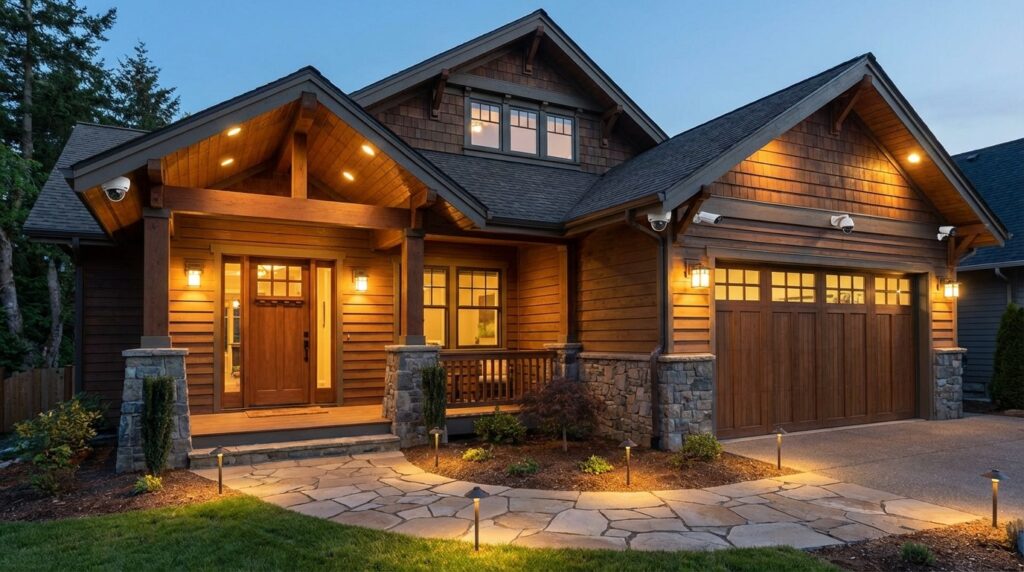
Layered Security: Think Like a Professional
Military and law enforcement think in layers. The idea is that each layer slows or stops a threat before it reaches the next one. If something gets through layer one, layer two engages. This is how you should think about your home. An intruder should face multiple obstacles before they ever get near you or your family.
Layer 1: Exterior Deterrence
Most burglars are not professionals. They want an easy target. Make your house look like work and they’ll move on to the neighbor’s place. Exterior lighting is your first tool. Motion-activated lights on all entry points eliminate the darkness criminals rely on. You want the lights bright enough to be uncomfortable, not decorative.
Cameras serve two purposes: deterrence and evidence. A visible Ring or Arlo camera on the front door significantly reduces the chance your house gets targeted. Burglars talk to each other. A house with cameras and lights is getting skipped. Cameras also give you footage for law enforcement and your insurance claim if the worst happens.
Landscaping matters more than people think. Dense shrubs under windows give a burglar a place to work unseen. Keep shrubs trimmed to 3 feet or less. Clear sight lines from the street to your front door. A burglar who can be seen from the street is a burglar who moves on. A fence is a double-edged sword: it slows you from seeing threats, but also slows the threat from leaving quickly.
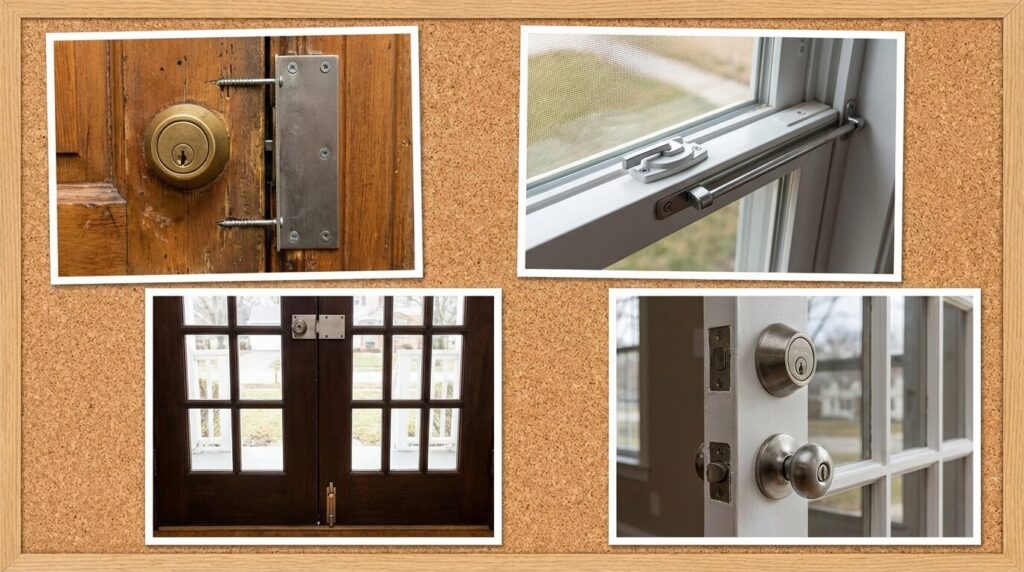
Layer 2: Perimeter Hardening
Most residential doors are laughably easy to kick in. The deadbolt looks solid but it’s only as good as the door frame it’s mounted in, and most door frames are hollow pine that splits on the first kick. Install a door reinforcement kit like the Door Armor MAX or a Strikemaster II. These reinforce the strike plate with steel and extend the screws deep into the stud. A reinforced door can take 10 to 20 kicks instead of one.
Sliding glass doors are a weak point. They can be lifted off their tracks or forced open easily. A simple piece of cut-down wooden dowel in the track stops this. For more security, add a pin lock that goes through both frames. French doors are similarly weak at the center seam. A surface bolt at the top and bottom of the inactive door closes this gap.
Windows on the ground floor should have window locks beyond the standard latch, which is essentially decorative. Window pins, keyed locks, or window security film all add time and noise to a break-in attempt. Noise is a massive deterrent. A burglar who makes noise is a burglar who leaves.
A monitored alarm system is worth the monthly fee. Not because the monitoring center will stop anything in real time, but because the audible alarm drives most intruders out immediately, and the police response gives you documentation. If you cannot afford monitoring, a standalone siren alarm. According to a University of North Carolina study, 83% of burglars check for an alarm before breaking in, and 60% move to an easier target if they find one still works as a deterrent. The noise itself is the deterrent. Most burglars are out within 90 seconds of an alarm activating.
Layer 3: Interior Response
This is where your home defense plan kicks in. The perimeter has been breached. Someone is in your house. Everything from here forward is about putting distance and barriers between your family and the threat while you get to your firearm and communicate with 911.
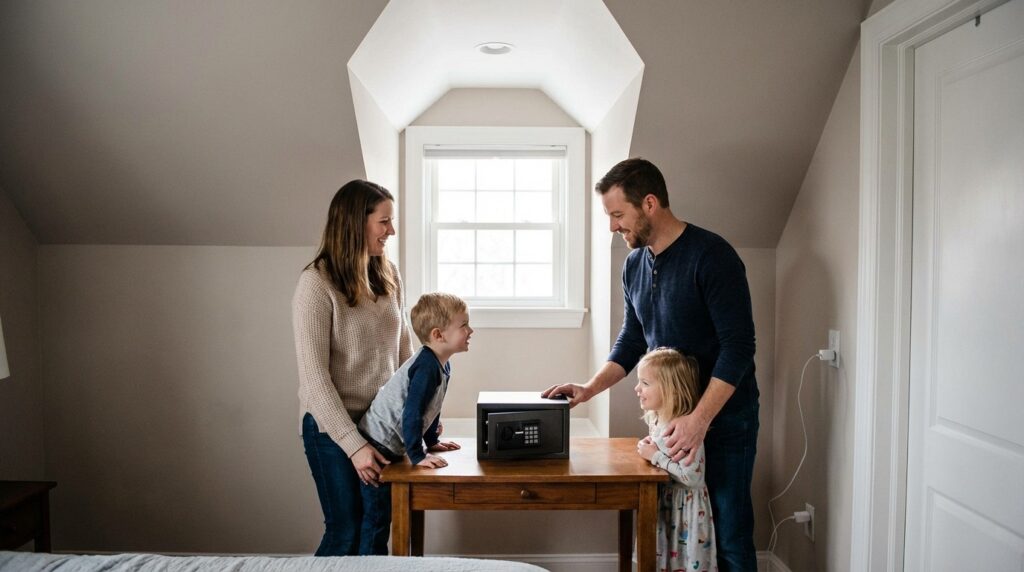
Setting Up a Safe Room
A safe room is the centerpiece of any serious home defense plan. It does not need to be a reinforced bunker. In most homes the primary bedroom is the natural safe room because it has a door with a lock, and that’s where your gun is stored. The goal is to make that room a place where you can shelter, arm yourself, communicate with 911, and wait for police from a position of strength.
Door Reinforcement
Interior doors are hollow core. One kick and they’re done. If your bedroom is your safe room, add a solid core door or at minimum a door barricade bar like the Master Lock 265DCCSEN. A barricade bar braced against the floor can resist hundreds of pounds of force. This is not overkill. If an intruder has made it into your house and is trying to get through your bedroom door, the thirty seconds it takes them to break through that door is thirty seconds for police to arrive.
What Belongs in Your Safe Room
Your firearm, obviously. But also a dedicated phone or charger so your cell phone is always there and charged. A flashlight or two. A first aid kit including a tourniquet and Israeli bandage. The idea is that you can sustain yourself in that room for at least 30 to 60 minutes if you have to. A safe with quick-access biometric lock keeps the gun secure from kids while remaining accessible to you under stress.
A weapon-mounted light on your firearm is non-negotiable in my opinion. You need to identify your target before you shoot. Shooting an unknown silhouette in your own hallway is how tragedies happen. The Streamlight TLR-1 HL or Cloud Defensive REIN are excellent options depending on your platform. In a dark house under stress, positive target identification is everything.
Safe Room Communication
You should be able to communicate with the rest of the house from your safe room. If you have kids in separate rooms, a two-way radio or a simple intercom system solves this. Cell phones work too, but having a dedicated channel helps. The goal is to know whether everyone is in the safe room or whether someone still needs to get there before you barricade.
Family Communication Plan
Everyone in your household needs to know the home defense plan. That means your spouse or partner, your teenagers, and in age-appropriate ways your younger kids. A plan that only lives in your head is not a plan. It’s a fantasy.
The Code Word
Establish a family code word or phrase that means “this is real, execute the home defense plan now.” Something simple and easy to remember. Some families use a sports team, others use something neutral. The point is that when they hear that word, everyone knows it is not a drill. This matters because in the middle of the night, a shout of “get to the room!” might be confusing. A pre-established code is unambiguous.
Rally Point
Everyone needs to know where to go. If the safe room is the master bedroom, the home defense plan is: every family member goes to the master bedroom. If a family member cannot make it there safely, they shelter in place in their own room and communicate via phone or radio. Nobody moves through the house to find each other. Moving through a dark house toward an unknown threat is exactly how you get shot by a family member or get between the threat and an exit.
Who Calls 911
One person calls 911. That is usually whoever does not have the firearm. The 911 call is critical. Tell the dispatcher your address, that there is an intruder in your home, that you are armed and sheltering in place in your bedroom, and describe what you are wearing. That last part matters. When police arrive, they do not know who is the homeowner and who is the intruder. If you are a guy in a dark t-shirt and boxers holding a rifle, make sure dispatch knows that so responding officers are briefed.
Stay on the line with 911. Let them know everything that is happening. If the intruder is leaving, tell them. If they are coming toward you, tell them. The dispatcher is relaying your information to responding units in real time.
What to Do When Someone Breaks In
This is the core of the home defense plan. And the answer is simpler than most people expect.
Barricade and Call 911
Get to your safe room. Lock the door. Barricade it if you can. Get your firearm. Call 911. Yell loudly that you have called the police, you are armed, and they need to leave. Do not go looking for the intruder. Do not try to clear your own house. Wait for police to arrive.
This strategy wins almost every time. The intruder typically wants to steal stuff, not fight an armed homeowner waiting behind a barricaded door. Most will leave the moment they hear you. Those who don’t leave are demonstrating an intent to harm you, which significantly strengthens any legal justification for force you may later need to articulate.
Do Not Clear Rooms
I want to say this as plainly as I can: do not try to clear your own house. Room clearing is a team skill that police and military train extensively for, with people covering each other’s blind spots. Alone, moving through a dark house, you are at a massive tactical disadvantage. Every doorway is a fatal funnel. Every corner is a place something could be hiding that you cannot see until you’ve already walked past it.
The only exception to this rule is if a family member is in another part of the house and you have to go to them. That is a rescue mission, not a clearance. You move directly to that person, get them, and get back to the safe room. You are not hunting the intruder. You are recovering a family member.
Use of Force Decisions
If an intruder breaches your safe room door after you have announced yourself and called 911, you are now in a situation where lethal force is likely justified in most states. But the legal justification depends heavily on your state’s laws regarding castle doctrine and duty to retreat. Know your state’s laws before you are in this situation. After the threat is stopped, immediately call 911 if you have not already, secure your firearm, and cooperate with responding officers.
Kids Protocol
Talking to your kids about home defense is uncomfortable, but it is a parental responsibility. You do not need to scare them. Frame it the same way you frame a fire drill: this is what we do if something scary happens, so we are not scared, we are ready.
Young Children (5-12)
Keep it simple. If you hear the code word or a loud bang, go to Mom and Dad’s room right away and close the door. Do not open the door for anyone except Mom or Dad or a police officer in uniform. Practice this. Make it a game at first so they are not terrified. Kids who have practiced a response are far calmer in an actual event than kids who have never thought about it.
Be honest with your kids about firearms in the age-appropriate way. The Eddie Eagle program from the NRA has a simple message for young kids: Stop. Don’t touch. Run away. Tell a grown-up. If a kid knows what a firearm is, knows not to touch it, and knows to get an adult, you have dramatically reduced the risk of a tragedy while also keeping the tool accessible for actual defense.
Teenagers
Teenagers can and should be part of the actual plan. They can operate a phone, they can barricade a door, and in some states they can legally use a firearm in self-defense. Consider whether your teenager should know how to access and safely handle the home defense firearm. This is a family decision, but a teenager who knows what to do is a teenager who survives.
Have a real conversation with your teens about the home defense plan. Walk through it with them. Ask them what questions they have. Teenagers who feel included in the home defense plan rather than talked at tend to actually follow it.
Kids Who Are in Their Own Rooms
If you can get to your kids safely, do it as part of the rally-to-safe-room plan. If you cannot, they should know to shelter in place in their own room, lock or barricade their door, call 911 on their own phone if they have one, and stay quiet. Have them text you their status so you know whether anyone is missing before you barricade your own door.
Practice Drills
A plan you’ve never practiced is a plan that will fall apart under stress. The good news is that home defense drills are quick and easy to run. You do not need a full weekend exercise. A 15-minute walkthrough every few months keeps the home defense plan fresh.
The Basic Walkthrough
Walk every family member through the home defense plan step by step. Start at each bedroom. Where do you go? What’s the code word? Who calls 911? What do you say? Walk physically to the safe room. Lock and barricade the door. Time yourself. If it takes more than 90 seconds to get everyone to the safe room and get the door locked, figure out why and fix it.
Night Drill
Run a drill at night with lights off. This is a different experience. Hallways you walk every day look different in complete darkness under stress. Make sure every family member knows the path to the safe room without lights. Consider glow-in-the-dark tape on the floor if needed. Night vision of any kind is a major advantage; even cheap night vision monoculars can help you navigate your own home without turning on lights and silhouetting yourself.
Communication Drill
Practice calling 911 without actually calling 911. Have family members practice what they would say, including your address, the nature of the emergency, and your physical description. Also practice communicating between rooms via your chosen method (phone, radio). Make sure the two-way radios are charged and everyone knows how to use them.
Firearm Accessibility
Practice accessing your home defense firearm from your quick-access safe under simulated stress conditions: in the dark, tired, heart pounding. Biometric safes can fail under stress (sweaty fingers, wrong angle). Make sure you can access your gun quickly and reliably. If you cannot, consider a different safe or a different access method. A combination you can dial in the dark is often more reliable than biometrics under stress.
The Complete Home Defense Plan Checklist
Here is everything in one place. Print this out and work through it with your family.
- Exterior: motion lights, visible cameras, trimmed landscaping, reinforced entry doors
- Perimeter: door reinforcement kits on all exterior doors, window locks/pins, alarm system
- Safe room: solid core door or barricade bar, quick-access safe, charged phone, flashlight, first aid kit
- Firearm: weapon-mounted light, ready ammunition, practiced access under stress
- Communication plan: code word, rally point, designated 911 caller, physical description for dispatch
- Kids protocol: age-appropriate briefing, shelter-in-place instructions, communication method
- Drills: quarterly walkthrough, annual night drill, communication drill
- Legal: know your state’s castle doctrine and duty to retreat laws
Need to build your home defense setup? Check our gun deals page for current discounts on home defense firearms from 15+ retailers. Our price comparison tool shows every retailer side by side. And for specific recommendations, see our best home defense handgun and best shotgun ammo for home defense guides.
Frequently Asked Questions
How do I create a home defense plan for my family?
Start by designating a safe room, establishing rally points for family members, and assigning roles. Practice the plan regularly with drills. Include communication protocols, emergency numbers, and ensure everyone knows to call 911 first.
What should a family home defense plan include?
A complete plan covers safe room selection, rally points, communication methods, firearm access protocols, children instructions, 911 procedures, exterior lighting, alarm systems, and regular practice drills. Write it down and review quarterly.
What is the best safe room for home defense?
The master bedroom is typically ideal. It should have a solid-core door, a reinforced lock, a phone for 911, a flashlight, and your home defense firearm. Upstairs bedrooms add the advantage of controlling a single stairway approach.
Should I clear my house during a home invasion?
No. Room clearing is extremely dangerous even for trained professionals. Barricade in your safe room, call 911, arm yourself, and wait. The only exception is if you must move to retrieve children who cannot reach you.
How do I keep my kids safe during a home invasion?
Teach children a code word that means go to the designated safe room immediately. Practice this regularly. Young children should know to hide under beds or in closets. Never let children investigate noises on their own.
How often should I practice my home defense plan?
Run through your home defense plan every 3-4 months, similar to fire drills. Walk through scenarios at night with the lights off. Include all family members and adjust the plan as children age or your living situation changes.
What should I do after a home defense shooting?
Call 911 immediately. State your name, address, that you were attacked, and request police and ambulance. Do not touch anything at the scene. When police arrive, comply with all commands and invoke your right to an attorney before giving statements.
Do I need a home security system as part of my defense plan?
A security system with door and window sensors provides critical early warning that gives you time to execute your plan. Even a basic system with loud alarms deters most intruders and buys precious seconds to arm yourself and reach your safe room.
Related Guides
Want to go deeper on specific parts of the home defense plan? Check these out:
- Home Security Layers: Cameras, Alarms, Lights and Firearms
- Home Defense Room Clearing: What Civilians Need to Know
- Home Defense Caliber Guide: 9mm vs .45 vs 12 Gauge vs 5.56
- Castle Doctrine vs Stand Your Ground: Every State Explained
- Home Defense Training: Courses, Drills and Practice Plans
Author

14,517+ Gun & Ammo Deals
Updated daily from 10+ top retailers. Filter by category, caliber, action type, and price.
Related Guides