

Last updated April 12th 2026 · By Nick Hall, concealed carry instructor who has helped dozens of women choose and train with their first gun
Affiliate disclosure: Some of the links below are affiliate links, meaning at no additional cost to you, we may earn a commission if you click through and make a purchase.
- Treat every gun as loaded
- Point the muzzle in a safe direction
- Keep your finger off the trigger until you’re ready to shoot
- Know your target and what’s beyond
Table of Contents
The Gun Counter Problem
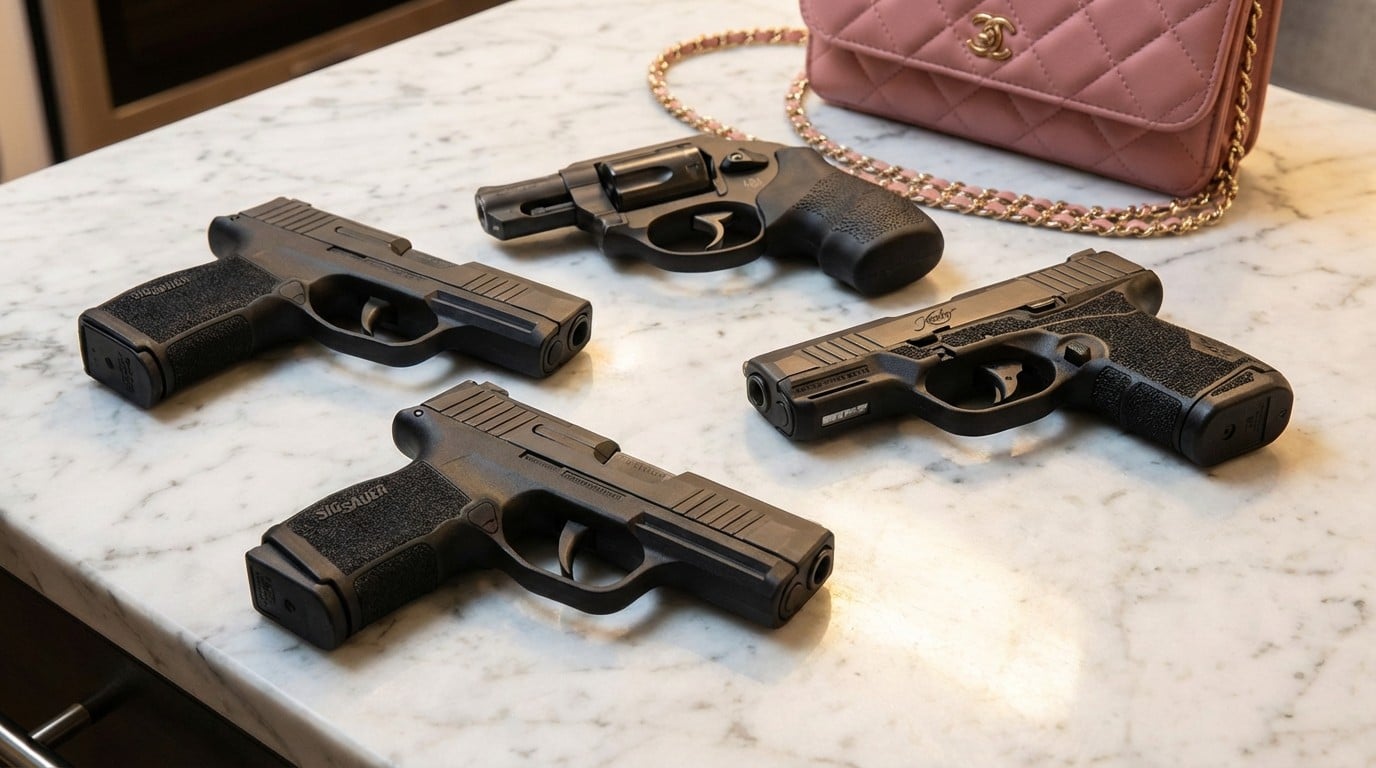
Here’s a scene that plays out constantly at gun shops across the country. A woman walks in, tells the guy behind the counter she wants to buy her first gun, and he hands her a pink .38 revolver. She didn’t ask for pink. She didn’t ask for a revolver. He just decided that’s what she needs.
Sometimes it’s a .22. Sometimes it’s a subcompact 9mm that’s snappy as hell and miserable to shoot. The logic is usually “it’s small so it must be good for a woman” or “revolvers are simple so it must be right for a beginner.” Neither of those is how you choose a gun that actually fits.
Your right gun is the one that fits your hand, works for your intended use, and that you’ll actually practice with. That’s it. The process to get there is less complicated than gun store guys make it seem. The NSSF women’s programs are proof that the industry is finally starting to take women shooters seriously, and it has nothing to do with the color of the frame.
I’ve watched too many women walk out of a gun shop with the wrong gun because nobody asked them the right questions. This guide on how to choose a gun as a woman is those questions, plus the answers you need to make a smart choice on your own terms. The NSSF reports that women are the fastest-growing demographic of new firearm owners, and the industry is still catching up to how to serve that market honestly.
“What’s It For?” Pick Your Primary Use First
Before you choose a gun or even look at one, answer this: what are you actually buying it for? That question shapes every other decision you’ll make. The best concealed carry gun isn’t the best home defense gun. The best range gun isn’t the best carry gun. Pick your primary use first.
Concealed Carry
A women concealed carry gun needs to be something you’ll actually carry every day. That means it has to be small enough to conceal, comfortable enough to wear for 8+ hours, and reliable enough to trust your life to. Size and weight matter a lot here. So does holster compatibility, because the wrong holster will make you stop carrying faster than the wrong gun will. Pay attention to printing (the outline of the gun showing through your clothes), especially with appendix carry (AIWB), where a good holster with a claw attachment pulls the grip into your body.
Home Defense
You don’t have to conceal it, so size matters less. A full-size pistol or even a short shotgun gives you more to hold onto, better capacity, and easier operation under stress. Weight is less of an issue when it’s sitting in a bedside safe.
Range Shooting and Practice
Bigger and heavier is often better here. A full-size gun absorbs recoil better, is easier to shoot accurately, and doesn’t beat up your hands. A dedicated range gun is often different from a carry gun, and that’s fine.
Competition
Totally different animal. You’ll want something with a great trigger, high capacity, and possibly a red dot optic. Get into the sport first, then let what you shoot in matches guide your purchase.
Most people buying their first gun are buying it for either carry or home defense. Those two use cases will point you toward different guns, so be honest about which one is your real priority. You can always buy a second gun later for the other purpose.
Hand Fit Matters More Than Caliber
The single most important factor in choosing a handgun is whether it fits your hand. Not the caliber. Not the brand. Not what’s on sale. If the gun doesn’t fit, you won’t shoot it well, and you won’t enjoy practicing with it, and then it sits in a drawer. That’s the worst outcome.
Trigger reach is the key measurement: the distance from the back of the grip to the face of the trigger. If your finger can’t reach the trigger without shifting your grip, that gun is too big for your hand. If your finger is way past the trigger and you’re pulling with the joint instead of the pad, the grip is too small.
You want the pad of your index finger (the fleshy part between the tip and the first joint) to contact the trigger. That gives you the most control. When you hold the gun with a proper grip, check that without any adjustment.
What to do in the store: Pick up every gun that interests you. Grip it properly, point it at a safe spot, and see where your trigger finger lands. You’re looking for natural reach with the pad of your finger. Also note whether the grip feels like it fills your hand or swallows it. Too thin can be as problematic as too fat.
Many modern pistols have interchangeable backstraps that let you size the grip. The Glock 43X, Smith & Wesson M&P series, Walther PDP, and others all offer this. If a gun feels almost right, ask if there’s a different backstrap to try. A medium backstrap on a Glock might fit your hand better than a small on a different gun.
Grip circumference also matters. Pistols with double-stack magazines are wider than single-stack guns. If you have small hands, a single-stack or slim-profile pistol like the Sig P365, Glock 43X, or S&W Shield Plus might fit better than a full-size double-stack. But try both before deciding. Some women with small hands shoot full-size pistols better because the extra weight manages recoil.
Check out our roundup of best gun for small hands woman shoppers for specific models that tend to work well when hand size is a limiting factor.
The Slide Question
Racking the slide is the number one thing people bring up when talking about women and pistols. “Can she rack that slide?” It’s usually asked in a way that implies the answer is probably no. That framing is wrong.
Racking a slide isn’t about strength. It’s about technique. Most people who struggle with it are doing it wrong. The weak method is trying to pull the slide back with your shooting-hand thumb and first two fingers while the gun is already in your shooting grip. You get almost no mechanical advantage that way.
The strong method is to grip the slide with your support hand using an overhand grip (palm on top, four fingers curled over the serrations), then push the frame forward with your shooting hand while simultaneously pulling the slide backward with your support hand. Push-pull. You’re using both hands working against each other, and it works dramatically better. We cover this in detail in our guide to how to rack a slide with small or weak hands.
That said, some slides genuinely are easier than others. The Smith & Wesson M&P EZ series (.380 and 9mm) was specifically designed with a lighter recoil spring for easier slide operation. It’s a real solution, not a consolation prize. Plenty of experienced shooters choose the EZ because it’s comfortable to shoot and reliable.
The Walther CCP uses a gas-delayed blowback system that makes the slide significantly easier to rack. The Beretta tip-up barrel pistols (Tomcat, Bobcat) don’t require slide racking at all to chamber the first round. You just tip the barrel up and drop a round in. Revolvers obviously have no slide at all.
If you try the proper technique and still can’t rack a specific slide reliably, that gun isn’t for you. There are plenty of good options that don’t require hand strength most people don’t have. No shame in choosing based on what you can operate confidently under stress.
Caliber: Stop Overthinking It
Ask three gun guys what caliber a woman should shoot and you’ll get five arguments. Ignore all of them. The caliber debate has been mostly settled by modern ballistics research: .380 ACP, 9mm.38 Special.40 S&W, and .45 ACP all work as defensive rounds when loaded with quality hollow points. The differences between them are smaller than internet arguments make them seem.
For most new shooters, 9mm is the answer. It has manageable recoil, it’s widely available, it’s cheap enough to practice with, and modern 9mm defensive loads are genuinely excellent. Every major gun manufacturer makes great 9mm pistols in every size. Start there unless you have a specific reason not to.
.380 ACP is a legitimate defensive round. It has less recoil than 9mm, and the guns chambered in it tend to be smaller and lighter. The Smith & Wesson M&P 380 Shield EZ is one of the most recommended guns for new shooters for a reason. If .380 is what lets you practice regularly without dreading the range.380 is the right answer for you.
.38 Special in a revolver is another solid option. Revolvers are simpler to operate in some ways (no slide, no manual safety on most), and .38 Special is effective and shootable. The downside is lower capacity (typically 5-6 rounds) and slower reloading. That might matter; it might not, depending on your use case.
What matters isn’t the caliber on paper. It’s what you’ll actually practice with. A .380 you shoot twice a month is better protection than a .45 you’re afraid to shoot because it hurts your hands. Pick what you’ll train with consistently. See our best .380 handguns for women and best 9mm pistols for women roundups for specific recommendations.
Recoil: What Actually Matters
Recoil is real, and it matters. But most people’s understanding of it’s backwards. Lighter guns don’t necessarily mean less felt recoil (the kick you actually feel, as opposed to “free recoil” which is the raw physics number on a spec sheet). A lightweight gun in a powerful caliber often kicks harder than a heavier gun in the same caliber, because there’s less mass to absorb the energy. A 16-ounce .38 snub-nose kicks harder than a 28-ounce .38 service revolver.
There are two types of recoil you’ll encounter: push and snap. Push recoil moves the gun backward into your hands in a longer, rolling motion. It’s common in larger caliber, heavier guns. Snap recoil is a sharper, more abrupt flip. It’s common in lightweight small-caliber guns. Most people find push recoil more manageable and less fatiguing.
Grip matters enormously here. A high, firm two-handed grip that locks out the support hand wrist and pushes the shooting hand thumb forward does more to manage recoil than any gun choice. Good technique with a snappy gun beats bad technique with a soft one. Get some training before you decide a gun has too much recoil.
That said, if a gun genuinely hurts your hands after 50 rounds, that’s a problem. You won’t practice enough. Consider a heavier full-size version of the same caliber, a lower-recoil caliber, or a gun with a better recoil-management system. The Walther PDP and Springfield Hellcat have excellent recoil management for their size. The M&P EZ series was built for low recoil by design.
Your goal is a gun you can shoot 100-200 rounds in a range session without your hands hurting or flinching. If you can do that, you’ll practice enough to be competent. That’s the standard.
Try Before You Buy
Don’t buy a gun you haven’t shot. This is the rule. There are too many good options available and too much money involved to guess. You need to pull the trigger on it first.
Rental Ranges
Rental ranges are the best option. Many gun ranges have rental programs where you pay a lane fee and a small rental charge to shoot a specific gun. This is the single best way to test guns. Bring a list of 3-4 candidates, rent them all, and shoot 15-20 rounds through each. Pay attention to how each one feels in your hand, how the trigger feels, and whether you can manage the recoil and sight it naturally.
Classes and Courses
Classes are another great option. Many beginner courses, especially women-focused ones, provide guns for students to use. You’ll try several guns over the course of the class, get hands-on training with proper technique, and have an instructor help you evaluate fit. USCCA and NRA both run women’s programs, and many ranges have their own.
Borrowing From Friends
Borrowing from friends works too. If someone you trust owns the model you’re considering, ask to shoot it. Bring your own ammo, be safe about it, and spend enough time with it to get a real feel. A few cylinders or a single magazine isn’t enough. Shoot 50 rounds.
Gun Shows and Shops
Even if you can’t shoot it first, handle every gun you’re considering at the counter. Grip it, point it, run the slide, dry fire it if they allow. You can tell a lot about fit just from handling, even if you can’t confirm recoil management until you shoot.
What to Ignore
Ignore the Color
Pink guns are a marketing decision, not a quality signal. A Taurus in pink is still a Taurus. A Sig in black is still a Sig. Buy based on fit, reliability, and performance. If you happen to like the pink, fine. But don’t buy or avoid a gun because of the color.
Ignore What Your Boyfriend, Husband, or Dad Says
They may mean well. They are often wrong. Their hand isn’t your hand. Their use case isn’t your use case. Listen politely, nod, then go shoot what you actually want to shoot and make your own call.
Ignore Internet Forums
Gun forums are dominated by people who’ve been shooting for decades and have strong opinions formed around their own preferences and experiences. They’re not shopping for a first gun with your hands, your budget, and your lifestyle. Use forums to identify options to research, not to get a definitive answer.
Ignore “Just Get a Revolver” Advice
Revolvers are fine guns. But “just get a revolver because they’re simpler” is patronizing advice that ignores the real tradeoffs: limited capacity, slower reloads, and often stiffer triggers than a quality semi-auto. If a revolver fits your needs and you shoot it well, great. But it shouldn’t be a default recommendation any more than any other gun.
Ignore What Looks Good on Social Media
Guns that photograph well for Instagram aren’t necessarily the best guns to carry or shoot. Choose a gun that does the job, not the aesthetic.
Our Top Picks by Use Case
I’m not going to bury you in a massive list here. These are honest starting points based on what tends to work for women across a range of hand sizes and experience levels. Read our full roundups for detailed comparisons.
Best overall handguns for women: The best handguns for women roundup covers our top picks across categories. Short version: Smith & Wesson M&P EZ series (380 or 9mm), Sig Sauer P365, Walther PDP F (designed specifically with women’s feedback), Glock 43X, and Springfield Hellcat Pro are consistently at the top.
For concealed carry: Slim, reliable, and shootable. The best CCW guns for women post goes deep on this. The Sig P365, Glock 43X, and Smith & Wesson Shield Plus are the most popular for a reason. The Walther PDP F-Series is worth considering if you shoot full-size better.
For self-defense (home or carry): Reliability above everything. The best women self defense gun is the one that goes bang every time, regardless of brand. Our best guns for women’s self-defense guide prioritizes proven, reliable platforms. The M&P EZ for those who need easy operation. The Sig P365 or Hellcat for those who want high capacity in a small package.
For women who have never shot: Start simple. The best gun for a woman who’s never shot guide is built specifically for this situation. The M&P EZ is often the right answer. Soft shooting, easy to operate, forgiving for beginners.
For buying your first gun: Looking for the best first gun for a woman? Our first gun buying guide for women covers the full purchase process from choosing to buying to first range trip. If this is your first gun, read that too.
Ready to start shopping? Our gun deals page tracks prices from 200+ retailers daily, and our price comparison tool shows you every retailer side by side.
About This Guide
I’ve taught women’s concealed carry classes for over a decade, and the number one complaint I hear from new students is “nobody at the gun store listened to me.” This guide exists because of those conversations. Every recommendation and opinion in here comes from working directly with women at the range, watching what works and what doesn’t, and listening to what actually matters to the person who’s going to carry the gun every day.
I’m a man writing a guide for women, and I’m aware of the irony. But the advice here isn’t gendered. It’s about hand fit, recoil tolerance, intended use, and honest evaluation. Those are universal. The reason this guide is specifically addressed to women is that women get worse advice at gun counters than men do, and that needs to stop. If anything in here doesn’t match your experience, I want to hear about it.
First-Gun Selection Questions Specific to Women Buyers
Should I let the gun-store salesperson recommend a specific gun for me?
Use the salesperson’s recommendation as a starting point for range testing, not as the final answer. The default salesperson advice for women buyers has historically defaulted to compact revolvers and small .380s, which sometimes fit and sometimes do not. The right protocol is to test multiple options at a range that rents firearms before purchase, and to evaluate based on your actual shooting accuracy and manipulation comfort rather than the salesperson’s assumptions.
What is the best caliber for a woman’s first defensive handgun?
9mm for nearly all first-handgun buyers. The 9mm cartridge offers the best balance of recoil, terminal effectiveness, ammunition availability, and pricing of any common defensive caliber. The historical advice to default women buyers to .380 or .38 special is partially outdated, many women carriers run 9mm pistols as well as any other shooter, and the marginal recoil difference is often less than the salesperson predicts. Test multiple options before committing.
How important is the slide rack effort for a first handgun?
Critical. A handgun whose slide you cannot rack reliably under stress is a defensive liability regardless of how well the gun fits in other ways. Test rack the slide ten times in succession from a defensive grip. A gun that fatigues your hand on rack tests will fatigue under genuine defensive stress. Smith & Wesson EZ-series pistols specifically address this with reduced-effort slides; many other modern handguns have softer recoil springs than older designs.
Do I need to start with a smaller gun and “work up”?
No. The conventional advice to start with a smaller gun and work up to a service-size handgun is partially inverted. A larger, heavier handgun produces less felt recoil and is easier to shoot accurately for new shooters of any sex. The small-gun-first path often produces frustration with felt recoil that drives shooters away from regular practice. The cleanest first-gun path is a full-size or compact handgun at the range, with a smaller backup added later if concealment becomes a constraint.
FAQ: How to Choose a Gun as a Woman
How do I know if a gun fits my hand?
Pick the gun up in a proper shooting grip and see where your index finger lands on the trigger. You want the pad of your finger (between the tip and first joint) to contact the trigger naturally, without stretching or cramping your hand. If you're fishing for the trigger or your finger is way past it, the grip is the wrong size. Many guns have interchangeable backstraps so you can fine-tune the fit.
Should I listen to the gun store salesman?
Take their suggestions as starting points, not gospel. A good gun store employee will ask you questions about your use case and hand size. A bad one will hand you whatever they have too much of in inventory, or assume you want something pink and simple. If they're not asking what you need it for, take their advice with serious skepticism. Come in knowing what questions to ask.
Is 9mm too much recoil for a woman?
No. 9mm is manageable for virtually anyone with proper technique and the right gun. The key is using a gun that fits your hand and learning a proper high, firm grip. A full-size or mid-size 9mm is typically softer shooting than a tiny subcompact in the same caliber because the weight absorbs more recoil. If you're genuinely recoil-sensitive, the Smith & Wesson M&P 9 EZ was designed to be especially soft-shooting.
Revolver or semi-automatic pistol?
Both are valid. Revolvers have no slide to rack for the first round, simpler manual of arms, and are reliable. Semi-autos have higher capacity, faster reloads, and are often easier to shoot accurately due to lighter triggers. The "just get a revolver" advice women often hear is well-meaning but oversimplified. Try both, see what you shoot better, and pick that. Don't let anyone else make that call for you.
How much should I spend on my first gun?
Budget $400-600 for a reliable first handgun from a reputable manufacturer. You can find solid guns below that (Taurus G3, Ruger Security-9), but be wary of going below $300. The guns that matter for self-defense are the ones that go bang every single time. Reliability is not worth compromising on. Also budget for ammo, a holster if you're carrying, and at least one training class.
Do I need to take a class before buying a gun?
You don't have to, but it's genuinely useful to take a beginner class before or shortly after buying. A basic pistol course will teach you safe handling, proper grip, stance, and trigger control. Many beginner courses let you use range guns, which is a great way to try different platforms before committing. The USCCA and NRA both run women's courses, and most ranges have beginner classes on a regular schedule.
What if I have small hands?
Small hands aren't a disqualifier for most guns, but grip fit matters more for you than for someone with average hands. Look for single-stack or slim-profile pistols like the Sig Sauer P365, Glock 43X, S&W Shield Plus, or Smith & Wesson M&P EZ. Many full-size pistols also offer small backstrap options that reduce grip circumference. The key is handling every gun you're considering at the counter and checking trigger reach before buying.
Should I buy a gun online or in a store?
If you're buying your first gun, buy from a local gun store if you can. The ability to handle it, ask questions, and potentially shoot it at an attached range is worth more than online price savings. If you're buying a gun you've already tested and know you like, online through a licensed dealer (FFL transfer) can save real money. But for a first purchase, prioritize a retailer who can help you test and confirm fit.
4,715+ Gun & Ammo Deals
Updated daily from 200+ top retailers. Filter by category, caliber, action type, and price.