
Affiliate disclosure: This Kel-Tec KSG review contains affiliate links. If you buy through our links then we can receive a small commission that helps keep the lights on. You don’t pay anything more.
- Treat every gun as loaded
- Point the muzzle in a safe direction
- Keep your finger off the trigger until you’re ready to shoot
- Know your target and what’s beyond
Review: Kel-Tec KSG – 15 Rounds of Bullpup Madness
Our Rating: 7.5/10
- RRP: $899
- Street Price: $750-$899 (Check our live pricing for the best current deal)
- Gauge: 12 Gauge (2.75″ and 3″ shells)
- Action: Pump-action (dual tube magazine)
- Configuration: Bullpup
- Barrel Length: 18.5″
- Overall Length: 26.1″
- Weight (unloaded): 6.9 lbs
- Capacity: 14+1 (7+7+1 with 2.75″ shells), 12+1 with 3″ shells
- Receiver Material: Glass-reinforced nylon (Zytel)
- Barrel Material: Steel, phosphate coated
- Rail: Full-length Picatinny top rail, short bottom rail
- Sights: None (rail equipped)
- Safety: Cross-bolt behind trigger guard
- Made in: USA (Cocoa, Florida)
Pros
- 14+1 capacity in a package shorter than most SBRs
- Dual tube magazines let you load different shell types and switch on the fly
- Full-length Picatinny rail gives you unlimited optic and accessory options
- Incredibly compact at 26.1 inches overall, perfect for tight spaces
- Lightweight at 6.9 lbs unloaded for a 15-round shotgun
Cons
- Short-stroking is a real issue if you don’t pump it with authority
- Bullpup pump ergonomics feel weird and take serious practice to master
- Loading 14 rounds one shell at a time is painfully slow
- Early production models had reliability issues (mostly fixed in current production)
Current Kel-Tec KSG Prices
Quick Take
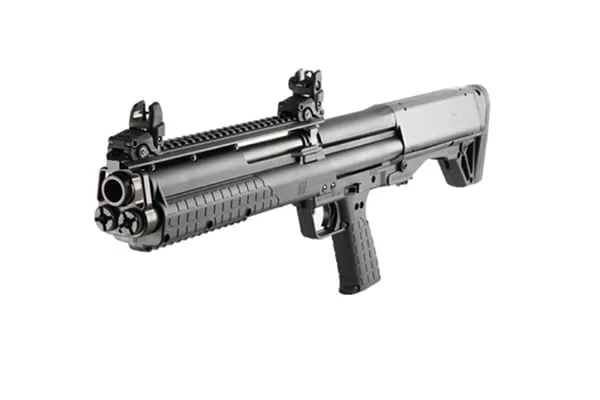
The Kel-Tec KSG is one of those guns that makes you do a double take at the gun counter. It looks like something out of a video game. Then you pick it up and realize it’s barely longer than two rulers laid end to end, it weighs less than seven pounds, and it holds fifteen rounds of 12 gauge. At that point you either love it or you think it’s a gimmick. I’ve been shooting one for a while now and I can tell you it’s both brilliant and frustrating in roughly equal measure.
Here’s the deal. Kel-Tec crammed 14+1 rounds of 12 gauge into a package that measures just 26.1 inches overall. That’s shorter than most AR pistols. They pulled this off with a bullpup layout and dual tube magazines that sit underneath the barrel, feeding the same chamber through a selector you toggle with your thumb. It’s clever engineering that actually works.
But the KSG demands commitment. You can’t baby the pump action or you’ll short-stroke it. The bullpup layout means the ejection port is right next to your face, loading is slow (14 shells, one at a time, into the bottom), and the ergonomics are genuinely strange if you’re coming from a traditional shotgun. Give it 200 rounds of practice and it starts to click. Give it 50 and you’ll hate it.
Best For: Shooters who want maximum 12 gauge capacity in the most compact package possible. Ideal for home defense in tight spaces, truck guns, or anyone who just wants something genuinely different in their safe. Not ideal for pump-action beginners.
Why Kel-Tec Built the KSG This Way
When Kel-Tec unveiled the KSG at SHOT Show 2011, the internet lost its collective mind. A 15-round bullpup pump shotgun? From the company that made the tiny .380 pocket pistol? People didn’t know whether to be excited or skeptical. Most were both.
The design brief was straightforward: maximum shotgun capacity in the shortest possible package. Traditional tube-fed shotguns run into a physics problem. The longer the magazine tube, the longer the gun. An 8+1 Mossberg 590 is already pushing 40 inches overall. To get 14+1, you’d need a magazine tube so long the gun would be unwieldy.
Kel-Tec’s solution was elegant. Run two magazine tubes side by side under the barrel, each holding seven rounds of 2.75″ shells. Then wrap the whole thing in a bullpup layout so the action sits behind the trigger, eliminating the wasted space of a traditional buttstock. The result is 14+1 rounds in 26.1 inches. That’s physically remarkable. No other production shotgun comes close to that capacity-to-length ratio.
The dual-tube design also has a tactical advantage that doesn’t get enough attention. You can load different shell types in each tube and switch between them with a flick of the selector behind the trigger guard. Buckshot in the left tube, slugs in the right. Or less-lethal in one and lethal in the other. It’s a genuinely useful feature, not just a marketing bullet point.
George Kellgren (Kel-Tec’s founder and chief designer) has a long history of unconventional firearms design. The KSG fits perfectly into that lineage. It’s not trying to be a better Remington 870. It’s trying to be something that didn’t exist before. Whether that appeals to you depends entirely on what you want from a shotgun.
Competitor Comparison
Mossberg 590A1 (~$550)
If you want a proven, battle-tested pump shotgun and don’t care about size, the 590A1 is the obvious alternative. It’s about $350 cheaper than the KSG, feeds from a single tube you can load in your sleep, and has a decades-long track record with military and law enforcement. The tradeoff is it’s 40+ inches long and holds 8+1 rounds. That’s almost half the capacity in a gun that’s 14 inches longer.
The 590A1 wins on simplicity, reliability, and price. The KSG wins on capacity and compactness. For a bedside home defense gun where space is tight, the KSG’s advantage is real. For general-purpose use where you want zero learning curve, the 590A1 is the safer bet.
Current Mossberg 590A1 Prices
Benelli M4 (~$1,800)
The Benelli M4 is the gold standard of combat shotguns. It’s a semi-auto, which means no short-stroking, no pump to worry about, just pull the trigger and it cycles. The ARGO gas system is legendarily reliable. But it holds 7+1 rounds in a 40-inch package and costs twice what the KSG does.
These are fundamentally different shotguns for different buyers. The M4 is a fighting shotgun used by militaries around the world. The KSG is a space-age capacity monster for people who want maximum firepower in minimum length. If budget allows and you want the most reliable combat shotgun ever made, get the M4. If you want 15 rounds in 26 inches, there’s only one option.
Current Benelli M4 Prices
IWI Tavor TS12 (~$1,400)
The Tavor TS12 is the KSG’s most direct competitor. It’s a bullpup shotgun with a rotating triple-tube magazine that holds 15+1 rounds. It’s semi-automatic, which eliminates the short-stroking problem entirely. Sounds like it wins across the board, right? Not so fast.
The TS12 costs about $500 more than the KSG, weighs over 8 pounds empty, and is 28.3 inches long. It’s also considerably more complex mechanically. The KSG is actually lighter, shorter, and cheaper. The TS12’s semi-auto action and extra round of capacity are real advantages, but you pay for them in dollars and ounces. If you want a bullpup shotgun and budget isn’t the primary concern, the TS12 is worth a hard look. If you want the most compact option or you prefer the simplicity of a pump, the KSG still holds its own.
Current IWI Tavor TS12 Prices
Standard Mfg DP-12 (~$1,400)
The DP-12 takes the “more is more” approach to bullpup shotguns. It’s a double-barreled pump-action bullpup that fires two rounds with each trigger pull, holding 16 rounds total (14 in the tubes, 2 in the chambers). It’s a conversation starter. It’s also nearly 10 pounds empty and 29.5 inches long.
The DP-12 is an absolute beast to shoot. Recoil from firing two 12 gauge shells simultaneously is not for the faint of heart. It’s heavier and longer than the KSG, costs about $500 more, and the double-barrel pump mechanism is more complex. The KSG is the more practical choice for actual defensive use. The DP-12 is for people who want the most ridiculous shotgun at the range. Both are valid reasons to buy a gun.
Current Standard Mfg DP-12 Prices
Features and Quirks
The Dual Tube Magazine System
The heart of the KSG is its dual tube magazine system. Two parallel tubes run beneath the barrel, each holding 7 rounds of 2.75″ shells (or 6 rounds of 3″ shells). A manual selector switch behind the trigger guard lets you choose which tube feeds the chamber. Push it left, you’re feeding from the left tube. Push it right, right tube. It’s intuitive once you practice it a few times.
The tactical applications are interesting. You can load buckshot in one tube and slugs in the other, switching between them as the situation demands. Or load one tube with less-lethal rounds and the other with standard defensive loads. Some competition shooters load birdshot in one tube and slugs in the other to handle different stages without reloading.
There’s one quirk to be aware of: the tubes don’t automatically switch when one empties. When you run tube one dry, the pump will cycle on an empty chamber. You have to manually flip the selector to tube two. This is by design (accidental switching would be worse), but it means you need to track your round count or be ready to switch quickly when you hear that telltale click.
Construction and Build Quality
The KSG’s receiver is glass-reinforced nylon (Zytel), the same material Glock uses for their frames. It’s tough, lightweight, and impervious to corrosion. The barrel, bolt, and internal components are steel with a phosphate finish. At 6.9 pounds unloaded, it’s remarkably light for what it is. A fully loaded KSG (15 rounds of 00 buckshot) is still lighter than an empty Benelli M4.
Fit and finish is good, not great. This is a Kel-Tec, so you’re not getting Benelli-level polish. The polymer has visible mold lines in a few places, and the overall aesthetic is more “functional tool” than “showroom piece.” But everything fits together tightly with no wobble or rattle. The pump action is smooth (if a bit stiff when new), and the cross-bolt safety is positive and easy to manipulate.
The Bullpup Layout
If you’ve never handled a bullpup shotgun, the KSG will feel alien. The action sits behind the pistol grip, which means the ejection port is roughly where your cheek meets the stock on a traditional shotgun. The trigger has a longer pull than a conventional pump because it connects to the sear through a transfer bar. It’s not bad, but it’s noticeably mushier than a Mossberg or Remington trigger.
The upside of the bullpup layout is obvious: you get an 18.5-inch barrel (the legal minimum for a non-NFA shotgun) in an overall length of just 26.1 inches. A Remington 870 with an 18-inch barrel is 38.5 inches long. That’s 12.4 inches of difference, which is enormous when you’re navigating hallways or storing the gun in a vehicle.
The downside is ergonomics. Loading the KSG requires flipping it over and feeding shells into ports on the bottom of the stock area, behind your support hand. It’s slower than loading a traditional pump. Racking the action requires a longer stroke because the pump handle travels further on the bullpup layout. And getting a good cheek weld feels different than anything else in your safe. None of these are dealbreakers, but they all require practice.
Rail Space and Accessories
The full-length Picatinny rail on top of the KSG is genuinely useful. There’s enough rail real estate to mount a red dot, backup iron sights, and still have room left over. The rail is integral to the receiver, so it’s rock solid. I ran a Holosun 510C on mine and it held zero beautifully through hundreds of rounds of 12 gauge punishment.
There’s also a short Picatinny rail section on the bottom of the pump handle for a vertical grip or light. I’d strongly recommend a vertical foregrip on the KSG. It gives you more leverage for racking the pump and reduces the chance of short-stroking. A Magpul RVG from Brownells is a popular and affordable option.
800 Rounds at the Range: Testing the KSG
Break-In Period
I’m going to be honest. The first 50 rounds through the KSG were rough. I short-stroked it three times in the first two magazines. If you’re used to the short, snappy pump stroke of a Mossberg 500, the KSG’s longer travel will trip you up. The pump needs to go all the way back and all the way forward, and you need to do it with conviction. Tentative, halfway strokes will leave a shell stuck between the magazine and the chamber.
By round 100, I had the rhythm down. Full stroke back, full stroke forward, don’t be gentle. Once that muscle memory clicked, the short-stroking issue disappeared almost entirely. I had one more short-stroke around round 400 when I was tired and got lazy. That was entirely my fault, not the gun’s.
Reliability Testing
Over 800 rounds, the KSG ate everything I fed it without a single malfunction that wasn’t operator-induced. The four short-strokes were all on me. Zero failures to feed from the magazine tubes. Zero failures to eject. Zero failures to fire. The tube selector worked flawlessly every time I switched it. I was genuinely impressed by the mechanical reliability, especially given the KSG’s early reputation for feeding issues.
It’s worth noting that current production KSGs (mine was manufactured in 2024) are significantly better than the first-generation guns from 2012-2013. Kel-Tec made multiple revisions to the shell catches, feed ramp geometry, and pump rail tolerances. If you’ve heard horror stories about KSG reliability, they were probably about early production models. The current guns are solid.
Accuracy and Patterning
Accuracy testing with a shotgun is different than with a rifle, but the KSG performed well. With Federal FliteControl 00 buckshot at 15 yards, I was getting patterns about the size of a fist. That’s excellent. At 25 yards, patterns opened up to about 8-10 inches depending on the load. Standard non-FliteControl buckshot patterned in the 12-15 inch range at 25 yards.
Slugs were the bigger surprise. Using Remington Slugger 1 oz rifled slugs, I was ringing an 8-inch steel plate at 50 yards consistently with a red dot. The KSG’s 18.5-inch barrel gives slugs plenty of velocity, and the Picatinny rail makes mounting an optic easy. It’s not a slug gun by design, but it’s more than capable at reasonable distances.
Ammo Log
- Federal FliteControl 00 Buck (9 pellet): 200 rounds, zero malfunctions, tightest patterns
- Winchester Super-X 00 Buck: 150 rounds, zero malfunctions
- Remington Express 00 Buck: 100 rounds, zero malfunctions
- Federal Power-Shok #4 Buck: 100 rounds, zero malfunctions
- Remington Slugger 1 oz Rifled Slugs: 100 rounds, zero malfunctions
- Winchester Super-X #7.5 Birdshot: 100 rounds, zero malfunctions (great for practice)
- Rio Royal Buck 00: 50 rounds, zero malfunctions (budget option that worked fine)
Everything cycled. I deliberately mixed shell brands and types within the same tube to test reliability under less-than-ideal conditions. No issues. I also tested with both 2.75″ and 3″ shells. The 3″ magnums are brutal out of a 6.9-pound gun, but they fed and ejected without complaint.
Performance Testing Results
Reliability: 7/10
The mechanical reliability is actually excellent. Every malfunction I experienced in 800 rounds was a short-stroke caused by operator error. The caveat is that the KSG makes short-stroking easier than a traditional pump because of the longer pump travel and bullpup geometry. A Mossberg 590 is more forgiving in this regard. The gun itself works perfectly, but it demands correct technique, which is why it gets a 7 instead of an 8 or 9.
If you commit to learning the pump stroke and practice regularly, you can treat this as a 9/10 reliability gun. If you’re a casual shooter who picks it up twice a year, the short-stroking issue will bite you.
Accuracy: 7/10
Buckshot patterns are competitive with any other 18.5-inch cylinder bore shotgun. The KSG’s short sight radius isn’t ideal for precision, but that’s what the Picatinny rail is for. Throw a red dot on it and the accuracy picture changes dramatically. Slugs at 50 yards were surprisingly good. I’m not docking points for being a shotgun. The 7/10 reflects solid, expected performance for the platform.
Ergonomics and Recoil: 6/10
This is where the KSG polarizes people. The bullpup pump layout is genuinely awkward at first. The pump stroke is longer than you expect. Loading from the bottom is slow and fumble-prone until you build muscle memory. The trigger is adequate but not crisp. The length of pull is fixed and may not suit all body types.
Recoil is stout but manageable. At 6.9 pounds, 12 gauge buckshot loads give you a solid thump. The 3-inch magnums are genuinely punishing. The inline bullpup design helps with felt recoil compared to a traditional stock, pushing the recoil straight back into your shoulder rather than torquing the gun upward. A good rubber buttpad (the KSG comes with one) makes a real difference. I wouldn’t call it comfortable for extended shooting sessions with full-power loads, but it’s no worse than any other lightweight 12 gauge.
Fit, Finish, and QC: 7/10
The KSG is well-built for a polymer-receiver gun. No rattles, no loose parts, no cosmetic issues beyond the expected mold lines on the polymer. The metal components are properly finished with a uniform phosphate coating. The pump action was stiff out of the box but smoothed out nicely after about 100 rounds. The Picatinny rail is properly machined with crisp edges.
It’s not going to win any beauty contests next to a Benelli, but it’s solid, functional, and clearly built to a standard rather than to a price point. For a sub-$900 shotgun with this level of engineering complexity, the quality is respectable.
Known Issues and Common Problems
Short-Stroking
This is the number one complaint about the KSG and it’s legitimate. The pump has a longer travel than a traditional shotgun, and if you don’t cycle it completely in both directions, you’ll jam it. New KSG owners short-stroke constantly until they learn to run the pump with authority. The fix is practice. Grip it hard, rack it all the way back, slam it all the way forward. Treat it like you mean it. A vertical foregrip on the bottom rail helps enormously.
Early Production Feeding Issues
First-generation KSGs (roughly 2012-2014) had well-documented issues with shells not feeding reliably from the magazine tubes. Kel-Tec revised the shell catches and feed geometry multiple times. If you’re buying a new KSG today, this is largely a non-issue. If you’re buying used, try to find one manufactured after 2016. You can check the serial number with Kel-Tec’s customer service to confirm the production date.
Slow Loading
There’s no way around this one. Loading 14 rounds into the KSG takes time. Each shell goes in one at a time through the loading ports on the bottom, and you have to load seven into each tube separately. It’s not a quick process, especially with cold or wet hands. In a defensive scenario, you’re starting with 15 rounds and that should be more than enough. But if you need to reload mid-fight, the KSG is at a disadvantage compared to a traditional pump that can be topped off quickly.
Bullpup Ergonomics Learning Curve
Some shooters never fully acclimate to the bullpup pump layout. The ejection port location, the trigger feel, the loading process, and the overall handling are all different enough from a traditional shotgun to frustrate experienced shotgunners who have thousands of rounds of muscle memory on conventional pumps. Budget at least 200 rounds of dedicated practice before you form a final opinion.
Parts, Accessories, and Upgrades
| Upgrade Category | Recommended Component | Why It Matters | Cost Estimate |
|---|---|---|---|
| Vertical Foregrip | Magpul RVG or BCM Gunfighter | Better pump leverage, reduces short-stroking dramatically | $20-$35 |
| Red Dot Sight | Holosun 510C or Vortex Crossfire | The KSG needs an optic to realize its accuracy potential | $150-$300 |
| Flashlight | Streamlight TLR-1 HL (on pump rail) | Essential for a defensive shotgun, integrated mount | $125-$150 |
| Side Saddle | Esstac KSG Card or Velcro Shell Card | Extra shells on the receiver for emergency reloads | $20-$40 |
| Buttpad | Kel-Tec Factory Thick Recoil Pad | Tames recoil during extended range sessions | $25-$40 |
| Sling | Magpul MS4 QD Sling | You need a sling on a 26-inch gun, trust me | $45-$65 |
You can find most of these at Palmetto State Armory or Brownells. I’d prioritize a vertical foregrip and a red dot above everything else. Those two upgrades transform the KSG from a fun curiosity into a genuinely capable defensive tool.
The Verdict
The Kel-Tec KSG is one of the most polarizing firearms you can buy, and I think that’s part of its charm. It crams 15 rounds of 12 gauge into a package that fits in a large backpack. It lets you switch between two different shell types on the fly. It looks like nothing else at the range and handles like nothing else in your safe. It also short-strokes if you baby it, takes forever to load, and has ergonomics that confuse experienced shotgunners. That’s the whole picture.
After 800 rounds, I genuinely like the KSG. I don’t love it the way I love a good 870 or a Benelli M4, because those guns just work without demanding anything from you. The KSG asks you to learn its quirks and respect its requirements. When you do, it rewards you with a level of compact firepower that literally nothing else on the market can match. 14+1 rounds of 12 gauge in 26.1 inches. That’s still wild, even after years of shooting it.
Is the KSG the best shotgun for everyone? Absolutely not. Is it the best shotgun for certain people and certain applications? Without question. If you want maximum capacity in minimum space for home defense, if you enjoy mastering unconventional platforms, or if you just want something in your collection that makes people stop and stare at the range, the KSG delivers.
Final Score: 7.5/10
Best For: Home defense in tight spaces, truck/vehicle guns, shooters who want maximum 12 gauge capacity in the shortest possible package, and anyone who enjoys owning guns that spark conversations. Pair it with a good bullpup shotgun comparison to see how it stacks up against the rest of the field.
Best Kel-Tec KSG Prices
FAQ: Kel-Tec KSG
Is the Kel-Tec KSG a good shotgun?
The KSG is a good shotgun for people who value compactness and capacity above all else. 14+1 rounds of 12 gauge in a 26-inch package is unmatched. The pump action can short-stroke if you are tentative, and the bullpup layout takes practice. After you learn it, it is a capable home defense and range shotgun.
How many rounds does the Kel-Tec KSG hold?
14+1 rounds of 2-3/4 inch shells (7 rounds per tube plus one in the chamber). With 3-inch shells, capacity drops to 12+1 (6 per tube). You can switch between the two magazine tubes via a selector behind the trigger guard.
Does the Kel-Tec KSG jam?
The KSG can short-stroke if you do not pump it with authority. This is user error, not a mechanical flaw. Early models (pre-2014) had occasional feeding issues that were addressed in later production. Run the pump hard and fast, and the KSG cycles reliably.
Is the Kel-Tec KSG good for home defense?
Yes, with caveats. The 26-inch overall length makes it very maneuverable in hallways and rooms. 14+1 capacity is more than enough. However, the bullpup pump takes practice to run under stress, and loading 14 rounds one at a time is slow. A Mossberg 590A1 is simpler to operate but much longer.
How much does a Kel-Tec KSG cost?
The Kel-Tec KSG typically sells for $800 to $1,000 depending on the variant and retailer. The standard KSG is at the lower end. The KSG25 (longer barrel, 24+1 capacity) costs more.

How can I purchase this shotgun. I live in the state of Pennsylvania. Are there dealers in the Southeastern part of Pennsylvania.
If you have no problems with local gun laws, and I’ll always say it like that so basically it’s on you to check every single time, then you can order your gun online and have it delivered to your local FFL dealer. That can be a gun store or a pawn shop. Getting anything in stock right now is a bit of a nightmare, but that will change post Covid!