
Last updated March 13th 2026
Some of the links below are affiliate links, meaning at no additional cost to you, we may earn a commission if you click through and make a purchase.
- Treat every gun as loaded
- Point the muzzle in a safe direction
- Keep your finger off the trigger until you’re ready to shoot
- Know your target and what’s beyond
Mossberg 590 vs 590A1: Is the Mil-Spec Upgrade Worth It?
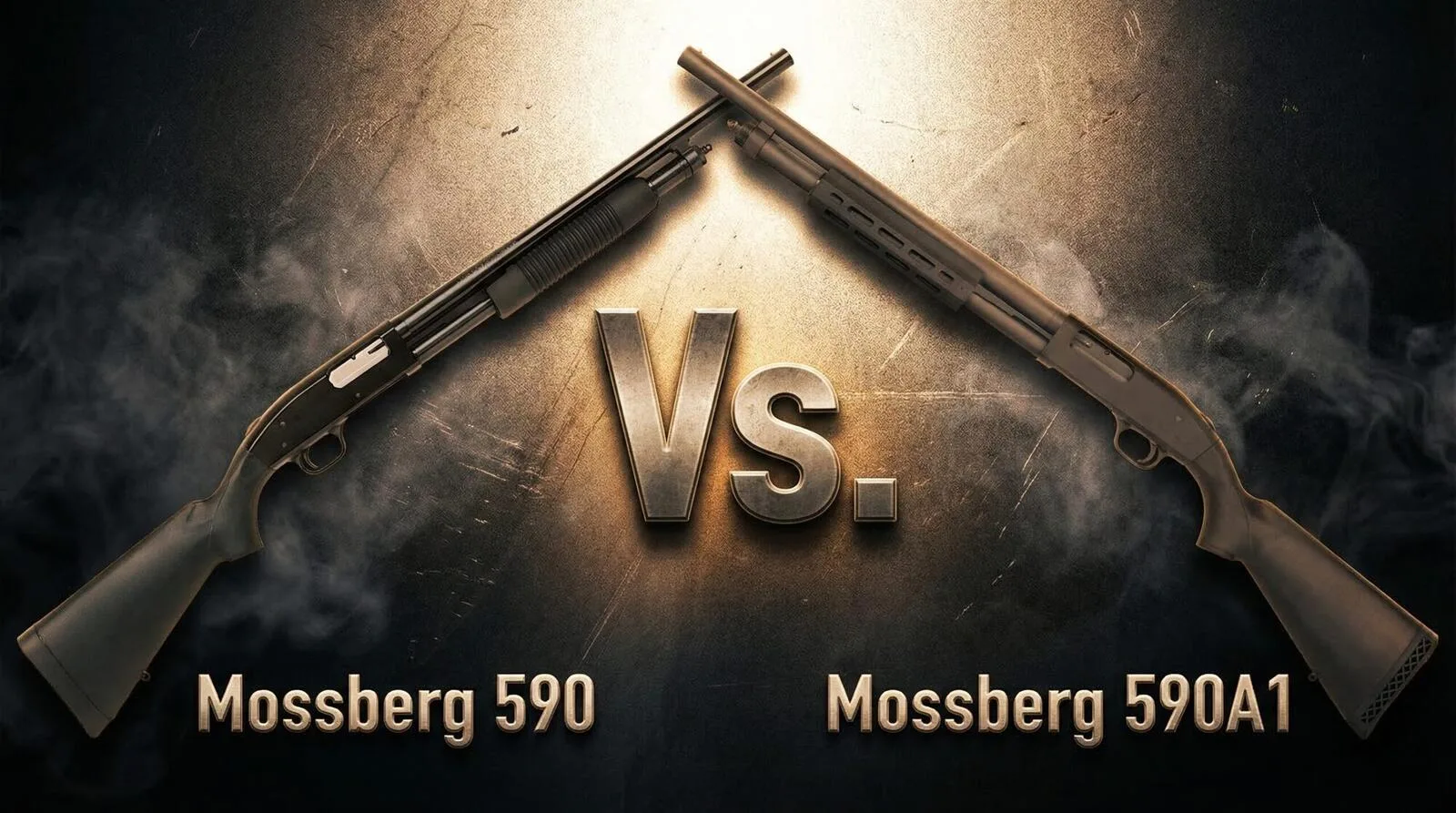
The Mossberg 590 and 590A1 are two of the most popular pump-action shotguns in America, and they share about 90% of their DNA. They look almost identical on the rack. But that remaining 10% is what separates a solid tactical shotgun from one that passed the most punishing military torture test ever designed for a scattergun.
I’ve shot both of these shotguns extensively over the years, running everything from birdshot to full-power slugs and buckshot through them. The 590A1 has been my dedicated home defense gun for a long time, but I’ll be the first to admit it’s not the right choice for everyone. The standard 590 is a seriously capable shotgun in its own right.
So what exactly do you get for the extra money? Let’s break down every meaningful difference between these two shotguns and figure out which one deserves a spot in your safe.
Mossberg 590 vs 590A1 Specs Comparison
For a fair head-to-head, I’m comparing the 9-shot versions of each shotgun since they share the same 20-inch barrel length and magazine capacity. This is the most apples-to-apples comparison you can make between the two platforms.
| Spec | Mossberg 590 (9-Shot) | Mossberg 590A1 (9-Shot) |
|---|---|---|
| Gauge | 12 Gauge, 3″ Chamber | 12 Gauge, 3″ Chamber |
| Barrel Length | 20″ | 20″ |
| Barrel Type | Standard wall | Heavy-walled |
| Barrel Finish | Matte blued | Parkerized |
| Overall Length | 41″ | 41″ |
| Weight | 7 lbs | 7.25 lbs |
| Capacity | 8+1 | 8+1 |
| Trigger Guard | Polymer | Metal (aluminum) |
| Safety | Polymer, top-tang | Metal, top-tang |
| Sights | Bead front | Ghost ring (rear) + blade front |
| Bayonet Lug | No | Yes |
| Mil-Spec Rated | No | MIL-SPEC 3443G |
| MSRP | ~$647 | ~$910 |
On paper, the differences look small. Same capacity, same barrel length, same overall length. But those highlighted upgrades on the 590A1 add up to a meaningfully tougher shotgun. Let’s dig into each one.
Barrel: Standard vs Heavy-Walled
This is the single biggest difference between the 590 and 590A1, and it’s the one that matters most for durability. The 590A1’s heavy-walled barrel is noticeably thicker than the standard 590 barrel. The story behind it is actually pretty interesting: the U.S. Navy requested the upgrade because standard barrels were getting dented and deformed when caught in heavy steel ship doors during boarding operations.
For most civilian shooters, a standard barrel works just fine. You’re not going to deform it during a range session or while storing it in your closet. But if you’re running this shotgun in training courses, tossing it around in a patrol vehicle, or just want the peace of mind that your barrel can take a serious impact without losing zero, the heavy wall is worth every penny.
I’ve seen standard 590 barrels survive years of hard use without any issues. But I’ve also watched shooters bang their barrels on barricades and doorframes during force-on-force training. That’s where the A1 barrel earns its keep. If you’re a “train hard” kind of shooter, the heavy barrel is a real functional upgrade, not just a marketing gimmick.
Mossberg 590
Trigger Guard: Polymer vs Metal
The standard 590 uses a polymer trigger guard, while the 590A1 gets a metal (aluminum) trigger guard. This is one of those differences that sounds minor until you’ve cracked a polymer trigger guard by dropping a shotgun on a hard surface. It happens more often than people think, especially in cold weather when plastics get brittle.
The 590A1 also upgrades the top-tang safety button from polymer to metal. Again, this is a durability play. Under normal use, the polymer components on the standard 590 are perfectly adequate. Mossberg has been using them for decades without widespread complaints.
But if you’re issuing this shotgun to officers, deploying it overseas, or otherwise subjecting it to conditions where failure isn’t an option, the metal components inspire a lot more confidence. For a range toy or home defense gun that lives in a closet, the polymer is fine. For a working gun that gets tossed around, the metal upgrade matters.
Mossberg 590A1
Sights: Bead vs Ghost Ring
The standard 590 ships with a simple bead front sight. It’s the same type of sight you’ll find on most hunting shotguns, and it works well enough for close-range defensive use. Point it at the target, put the bead on center mass, and press the trigger. Simple and effective inside typical home defense distances.
The 590A1 comes equipped with ghost ring sights: a protected blade front sight paired with a fully adjustable ghost ring rear aperture. This is a significant upgrade for anyone who needs to make precise shots, especially with slugs. At 50 yards and beyond, the ghost ring setup makes slug accuracy dramatically better than trying to aim with a bead.
In my experience, the ghost ring sights on the 590A1 are fast to acquire and intuitive to use. Your eye naturally centers the front post in the rear ring. For home defense at across-the-room distances, either sight works. But if you ever want to stretch the legs of your shotgun with slugs or need to make a precise shot past 25 yards, the ghost rings are vastly superior.
Bayonet Lug
The 590A1 9-shot models come with a bayonet lug. The standard 590 does not. Let’s be honest here: you will almost certainly never need to mount a bayonet on your home defense shotgun. This is not a practical feature for 99.9% of shotgun owners.
That said, there’s something undeniably cool about owning a shotgun that can accept a bayonet. It’s part of the 590A1’s military heritage and one of the visual cues that immediately identifies it as the mil-spec variant. Some shooters also use the bayonet lug as a mounting point for breaching tools or other accessories, which gives it at least some niche practical value.
If the bayonet lug is your primary reason for picking the 590A1 over the standard 590, I’d encourage you to rethink your priorities. But as one piece of a larger package of mil-spec upgrades, it’s a nice bonus.
Weight and Handling
The 590A1 tips the scales at roughly 7.25 pounds compared to the standard 590’s 7 pounds (both in 9-shot configuration). That quarter-pound difference comes almost entirely from the heavy-walled barrel and the metal trigger guard and safety. It’s not a huge weight penalty, but you can feel it during extended range sessions, especially when you’re running drills and mounting the gun repeatedly.
The heavier barrel does have one upside: it shifts the balance point slightly forward, which some shooters prefer. A front-heavy shotgun tends to swing more smoothly and can help reduce felt muzzle rise between shots. It’s a subtle difference, but it’s there if you’re paying attention.
For home defense, either weight is perfectly manageable. If you’re carrying this shotgun on long patrols or hikes, every ounce counts, and the lighter 590 has a small edge. For most recreational and defensive shooters, the weight difference is a non-issue.
Reliability
Both of these shotguns are extremely reliable. The Mossberg 500/590 platform has been around since 1960, and the design has been refined over six decades. The dual extractors, anti-jam elevator, and top-tang safety are all proven features shared by both models. I’ve never had a malfunction with either gun that wasn’t caused by limp-wristing the pump stroke.
Where the 590A1 separates itself is in the military torture testing. It passed MIL-SPEC 3443G, which requires firing 3,000 rounds of full-power buckshot with no more than three malfunctions and zero parts failures. The standard 590 has not been submitted for this testing, but that doesn’t mean it would fail. It simply hasn’t been put through the formal evaluation.
The Parkerized finish on the 590A1 also offers better corrosion resistance than the matte blued finish on the standard 590. If your shotgun will be exposed to moisture, salt air, or sweat on a regular basis, the Parkerized finish will hold up better over time. For a gun that lives in a climate-controlled home, this advantage is less meaningful.
Value and Price
The Mossberg 590 9-shot carries an MSRP around $647, while the 590A1 9-shot lists at roughly $910. That’s a $263 difference at retail, though street prices tend to close the gap somewhat. You can typically find the 590 in the $450 to $550 range and the 590A1 between $650 and $800 at most retailers.
For that extra money, you’re getting: a heavy-walled barrel, metal trigger guard, metal safety button, ghost ring sights, a Parkerized finish, a bayonet lug, and the peace of mind that comes with mil-spec certification. When you break it down per feature, it’s actually a pretty reasonable premium. Ghost ring sights alone would cost you $80 to $120 to add aftermarket.
The standard 590 represents excellent value if you want a reliable, no-frills tactical pump shotgun. The 590A1 is the better buy if you plan to train hard with your shotgun, want the best sights out of the box, or simply want to buy once and never worry about durability. Neither is a bad choice. It really comes down to how you plan to use the gun.
Current Prices: Mossberg 590 Tactical
Mossberg 590 Tactical
Current Prices: Mossberg 590A1
Mossberg 590A1
Can’t find what you’re looking for above? Check inventory at Palmetto State Armory or Guns.com for both models.
The Verdict: Which Mossberg Should You Buy?
Buy the Mossberg 590 if: You want a proven, reliable tactical pump shotgun without paying the mil-spec premium. The standard 590 is an outstanding home defense gun, a solid range shotgun, and a platform with decades of proven performance behind it. If your shotgun will primarily live in a safe or closet and come out for range trips and the occasional training class, save your money and go with the 590.
Buy the Mossberg 590A1 if: You want the toughest pump shotgun money can buy. The heavy-walled barrel, metal components, ghost ring sights, and Parkerized finish make the 590A1 the clear choice for hard-use applications. If you’re a first responder, a serious tactical training enthusiast, or you simply believe in buying the best version of something the first time around, the A1 is worth the extra investment.
Personally, I’d steer most people toward the 590A1. The ghost ring sights alone make it a more capable shotgun, and the durability upgrades give you a gun you’ll never outgrow. But I would never tell someone they made a bad choice by picking the standard 590. It’s a legendary shotgun for good reason. For a deeper look at the A1 variant, check out our full Mossberg 590A1 review.
FAQ: Mossberg 590 vs 590A1
Related Guides
- Best Pump-Action Shotguns
- Mossberg 590A1 Review
- Mossberg 500 Review
- Remington 870 Shotgun Review
- Best Shotguns for Home Defense
What is the main difference between the Mossberg 590 and 590A1?
The biggest difference is the barrel. The 590A1 uses a heavy-walled barrel designed to resist dents and deformation under hard use. The 590A1 also upgrades the trigger guard and safety from polymer to metal, adds ghost ring sights, includes a Parkerized finish for better corrosion resistance, and features a bayonet lug on 9-shot models.
Is the Mossberg 590A1 worth the extra money?
For most shooters, yes. The ghost ring sights, heavy-walled barrel, and metal components make the 590A1 a more capable and durable shotgun. The price difference is typically $150 to $250 at street prices. If you plan to train regularly or use the shotgun in a professional capacity, the A1 is the better investment.
Can you swap parts between the Mossberg 590 and 590A1?
Many parts are interchangeable since both guns are built on the same Mossberg 500/590 platform. Stocks, forends, and most internal components are compatible. However, the heavy-walled barrel from the 590A1 is not a direct swap onto a standard 590 receiver without potential fitting issues. The metal trigger guard assembly can be purchased separately and installed on a standard 590.
Did the Mossberg 590A1 really pass military testing?
Yes. The Mossberg 590 and 590A1 are the only pump-action shotguns to have passed the U.S. military's MIL-SPEC 3443 torture test. This test requires firing 3,000 rounds of full-power buckshot with no more than three malfunctions and zero parts failures. It is one of the most demanding reliability tests for any firearm.
Which is better for home defense, the Mossberg 590 or 590A1?
Both are excellent home defense shotguns. The standard 590 is lighter, less expensive, and perfectly reliable for defensive use. The 590A1 offers better sights and more durable construction. For a shotgun that will primarily serve as a home defense tool, the standard 590 is a great value. If you want the absolute best, go with the 590A1.
Author

Related Guides