

Last updated September 2026 · By Nick Hall, shooter who carried both the Glock 19 Gen 6 and M&P 2.0 head-to-head for a month each
Some of the links below are affiliate links, meaning at no additional cost to you, we may earn a commission if you click through and make a purchase.
- Treat every gun as loaded
- Point the muzzle in a safe direction
- Keep your finger off the trigger until you’re ready to shoot
- Know your target and what’s beyond
Quick Answer: The Glock 19 Gen 6 wins overall in 2026 for the deepest holster, sight, and red-dot ecosystem on the planet, plus the Gen 6 upgrade package (optic cut, flared mag well, improved trigger). The Smith & Wesson M&P 2.0 wins for ergonomics, interchangeable backstraps, more aggressive grip texture, and a better feel for shooters with larger hands.
Both guns share the compact 9mm category, similar weight (around 24 oz), and both run reliably across mixed brass and steel-cased ammo. The G19 Gen 6 has the gold-standard reliability record and the deepest aftermarket; the M&P 2.0 has the better factory trigger and the more accommodating ergonomics out of the box. Both are excellent.
The biggest mistake choosing between the G19 Gen 6 and M&P 2.0 is buying based on the spec sheet without handling both. Hand fit and grip preference vary significantly between shooters; the right gun is the one your hand prefers, not the one with the longer Wikipedia article. Shoot both at the range before committing.
Also see our head-to-head comparison: Sig P320 vs S&W M&P 2.0.
How we tested: Every pick here is ranked against our testing methodology. Minimum round counts, accuracy and reliability protocols, the failures that disqualify a gun. Where we have not shot a specific variant ourselves, we say so in that section.
Glock 19 Gen 6 vs Smith & Wesson M&P 2.0: America’s Two Best Polymer Pistols Compared
If you’re shopping for a polymer-framed striker-fired pistol in 2026, the conversation always comes back to two names: Glock and Smith & Wesson M&P. These are the two most popular handgun lines in America, carried by law enforcement, used for home defense, and trusted by millions of concealed carriers from coast to coast.
Glock started the polymer revolution back in 1982 with the Glock 17. It was ugly, unconventional, and better than anything else on the market. Smith & Wesson answered in 2005 with the original M&P (Military & Police) line, which has since evolved into the M&P 2.0 series. With Glock’s Gen 6 now on shelves, the comparison has shifted in some significant ways.
I’ve owned both platforms for years. My Glock 19 Gen 5 was a nightstand gun and carry gun before I upgraded to the Gen 6. My M&P 2.0 Compact has done the same duty rotation. Both have thousands of rounds through them. I’m not here to declare one the “winner” across the board because these pistols excel in different areas.
What I will do is break down every category that matters and tell you which one comes out ahead in each. The Gen 6 has closed some gaps that used to favor the M&P, and opened new ones. By the end, you’ll know exactly which platform fits your needs, your hands, and your budget.
Table of Contents
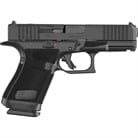
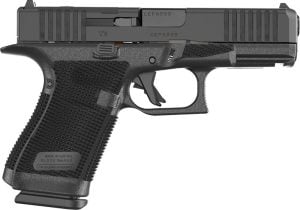
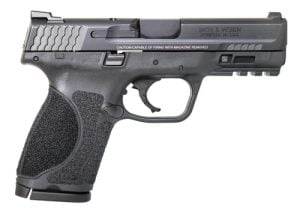
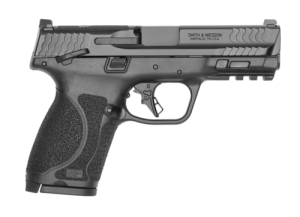

Specs Comparison
Figures below come from the makers: Glock’s G19 Gen 6 technical data and Smith & Wesson. Prices are live from the retailers we track and move daily.
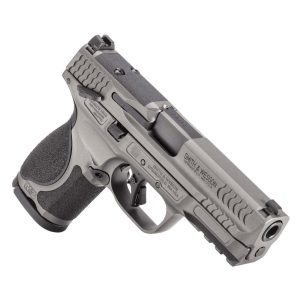
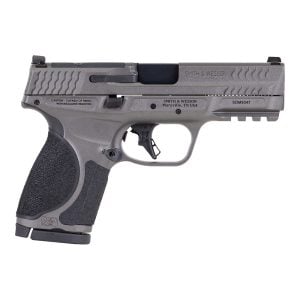
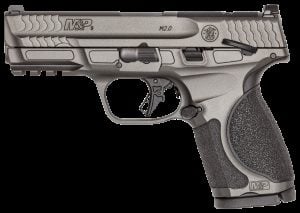
Before we get into the nuances, let’s look at the raw numbers. I’m comparing the Glock 19 Gen 6 against the S&W M&P 2.0 Compact since these are the most directly comparable models in each lineup. Both are compact 9mm pistols designed for duty, carry, and general use.
| Specification | Glock 19 Gen 6 | S&W M&P 2.0 Compact |
|---|---|---|
| Caliber | 9mm Luger | 9mm Luger |
| Barrel Length | 4.02″ | 4.0″ |
| Overall Length | 7.28″ | 7.3″ |
| Height | 5.04″ | 4.97″ |
| Width | 1.34″ | 1.3″ |
| Weight (Unloaded) | 20.11 oz | 22.0 oz |
| Magazine Capacity | 15+1 | 15+1 |
| Trigger Pull | ~5.8 lbs (flat-face) | ~5.0 lbs |
| Sights | Steel front, adjustable rear | Steel white-dot |
| Optics | ORS (direct-milled, 3 plates) | Not optics-ready (base model) |
| MSRP | $745 | $553 |
The Gen 6 has changed the spec sheet in meaningful ways. The Glock 19 is now the lighter gun at 20.11 oz versus the M&P’s 22 oz. That’s a flip from the Gen 5 era. Glock finally ships with steel sights, closing a complaint that lasted two decades. And the ORS (Optics Ready System) makes the Gen 6 factory-ready for a red dot without buying a separate MOS model.
The trade-off is price, though less of one than the sticker suggests. The Gen 6 lists $192 above the M&P 2.0 Compact, but street prices put them anywhere from $40 apart to level. Whether the upgrades justify that depends on whether you want a red dot, because the optics-ready versions land the other way round.

Ergonomics & Grip
This is where the M&P 2.0 still pulls ahead for most shooters. The M&P uses an 18-degree grip angle that’s closer to the 1911 and feels more natural when you present the pistol. The Glock’s 22-degree grip angle is steeper, which some people love and others can never get comfortable with. The Gen 6 didn’t change this.
Pick up a Glock and a M&P, close your eyes, and point them at a target. Most shooters find the M&P lines up more naturally with their arm. That’s the grip angle at work. It’s not better or worse in an absolute sense, but it does matter for instinctive shooting.
The Gen 6 did improve its grip texturing over the Gen 5, and it’s now closer to the M&P’s aggressive texture. But the M&P 2.0 still ships with four interchangeable palm swell inserts (S, M, ML, L) so you can customize the grip circumference to fit your hand. Glock still offers no equivalent on the Gen 6.
I have medium-sized hands and the M&P just fits better. The trigger reach is comfortable without any insert, and the medium insert locks everything in. If ergonomics are your priority, the M&P remains the clear choice.
Winner: S&W M&P 2.0. The palm swell inserts, better texturing, and more natural grip angle still give it a decisive edge here. The Gen 6 narrowed the gap slightly, but didn’t close it.

Trigger
This is the category that changed the most with the Gen 6. Glock replaced the hinged Safe Action trigger with a flat-face design that has a cleaner, more consistent pull. The break is noticeably improved over the Gen 5’s spongy wall. At around 5.8 lbs, it’s slightly heavier than both the Gen 5 (5.5 lbs) and the M&P 2.0 (5.0 lbs), but the quality of the pull more than compensates.
The M&P 2.0 trigger is still good. Smith & Wesson fixed the mushy original M&P trigger years ago, and the 2.0 version offers a lighter pull with a crisp break. But the Gen 6’s flat-face trigger feels more modern and precise. Glock’s reset is still short and tactile, and it’s genuinely satisfying to shoot.
In side-by-side shooting, the Gen 6 trigger is the best factory Glock trigger ever made. It’s competitive with triggers from Walther, CZ, and Sig that used to embarrass Glock in this category. The M&P 2.0 trigger is lighter, but the Gen 6 breaks cleaner. Both have excellent aftermarket options from Apex Tactical, Overwatch, ZEV, and Timney.
Winner: Tie. The Gen 6 flat-face trigger closes the gap that used to favor the M&P. The M&P has a lighter pull, the Glock has a cleaner break and better reset. Personal preference decides this one now.
Accuracy
Both pistols are more accurate than most shooters. The Gen 6 carries over the Glock Marksman Barrel (GMB) with improved polygonal rifling that debuted in Gen 5. The M&P 2.0 uses conventional rifling with a 1:10 twist rate that handles a wide range of bullet weights well.
In my experience benching these two side by side at 25 yards, the M&P 2.0 Compact consistently prints groups about half an inch tighter with 124gr Federal HST and 115gr Blazer Brass. At practical distances (7 to 15 yards), the accuracy difference is negligible. Both will put rounds into a 3-inch circle all day long if you do your part.
Where the Gen 6 gains an edge is with a red dot mounted. The ORS system provides a rock-solid optics mount, and a red dot on the Glock makes precision shooting significantly easier. The base M&P 2.0 Compact isn’t optics-ready without buying the optics-ready variant, which adds to the cost.
Winner: Tie. Iron sights to iron sights, both are mechanically accurate. The Gen 6’s factory optics readiness gives it a practical accuracy advantage if you run a red dot.
Reliability
Glock’s reputation for reliability is legendary, and it’s well-earned. Military and police forces in over 40 countries trust the platform. The Glock 19 specifically has been torture-tested by everyone from the U.S. military to random YouTubers burying them in mud, and it just keeps running. The Gen 6 maintains full backward compatibility with all Gen 3/4/5 double-stack 9mm magazines.
The M&P 2.0 is no slouch in this department. The platform has been in service since 2005, and the 2.0 revision addressed the few durability concerns of the original. Agencies like the Charlotte-Mecklenburg Police Department and numerous state agencies run M&P pistols. The gun eats everything I feed it without complaint.
I’ve never had a malfunction with either gun using quality ammunition. Both have digested cheap steel-case, premium hollow points, and everything in between. The Gen 6 is newer so the long-term track record is still being established, but Glock’s manufacturing consistency gives me zero concern.
Winner: Tie. Both are among the most reliable handguns ever made. You can trust your life to either platform without hesitation.
Optics & Sights
This is the biggest change from the Gen 5 era and it deserves its own section. The Glock 19 Gen 6 ships with the ORS (Optics Ready System), a direct-milled optics cut in the slide with three adapter plates covering the most popular footprints: Trijicon RMR, Leupold DeltaPoint, and C-More. No more buying a separate MOS model or sending your slide out for milling.
The base M&P 2.0 Compact is not optics-ready. Smith & Wesson sells optics-ready variants, but they cost more and don’t always include the adapter plates. If you want to run a red dot on the M&P, you’re either buying the OR model ($58 more at the time of writing) or paying for slide milling ($100-200).
Glock also finally upgraded to steel sights on the Gen 6. For over 20 years, the stock Glock plastic sights were the first thing every owner replaced. The Gen 6’s steel front sight and adjustable rear sight are perfectly adequate. They’re not night sights, but they’re a massive improvement over the old plastic units. The M&P’s steel white-dot sights are still good, but the sights advantage that S&W held for years has evaporated.
Winner: Glock 19 Gen 6. Factory optics readiness with adapter plates included is a major advantage. The sights upgrade closes the last gap. If you plan to run a red dot, the Gen 6 is the clear choice.
Aftermarket & Customization
This is Glock’s strongest category and it’s not even close. The Glock aftermarket ecosystem is the largest in the firearms industry. You can build a Glock from scratch using nothing but aftermarket parts. Slides, barrels, trigger groups, sights, frames, magazine extensions, compensators, stippling services: if you can imagine it, someone makes it for a Glock.
The Gen 6 maintains full backward compatibility with Gen 3/4/5 magazines, most holsters, and the majority of aftermarket parts. The ORS optics system uses a slightly different mounting pattern than the Gen 5 MOS, so some MOS-specific accessories won’t carry over. But the core ecosystem remains intact.
The M&P 2.0 has a healthy aftermarket, but it’s a fraction of what Glock offers. Apex Tactical is the go-to for M&P triggers. You can find aftermarket sights, holsters, and some barrel options. Holster availability also favors Glock, with nearly every manufacturer offering Glock models first.
Winner: Glock. The aftermarket ecosystem is the deepest and most diverse of any handgun platform in history. Gen 6 backward compatibility means your existing Glock accessories carry over.
Concealed Carry
Here’s another area where the Gen 6 has flipped the script. The Glock 19 Gen 6 weighs just 20.11 oz unloaded, nearly 2 oz lighter than the M&P 2.0 Compact at 22 oz. That’s a noticeable difference over a full day of carry. The Gen 5 used to lose this comparison, but the Gen 6 is now the lighter gun.
Dimensions are virtually identical between the two. Either one carries well in a quality IWB holster. Both hold 15 rounds of 9mm. The Glock’s weight advantage makes it slightly more comfortable for all-day carry, but we’re talking ounces, not pounds.
Where it gets interesting is the subcompact and micro-compact segment. The S&W Shield Plus is one of the best micro-compact 9mm pistols on the market with its 13+1 capacity in a tiny package. The Glock 43X and 48 answer with a slimline design and 10-round flush-fit magazines (or 15 with Shield Arms S15 mags). The Shield Plus is thinner and holds more rounds out of the box.
Winner: Tie. The Gen 6’s weight reduction gives Glock the edge in the compact segment, but S&W’s Shield Plus still leads in the micro-compact segment. Overall, this category is now dead even.
Duty Use
Glock dominates American law enforcement. An estimated 65% of U.S. police agencies issue Glock pistols. The Glock 17 and Glock 19 are the most widely carried duty pistols in the country. Federal agencies including the FBI, DEA, and U.S. Marshals all issue Glock handguns. The Gen 6’s factory optics readiness will likely accelerate agency adoption as departments transition to red dot sights.
Smith & Wesson holds a solid share of the duty market with the M&P line. The LAPD adopted the M&P as an approved duty weapon. The Colorado State Patrol, numerous sheriff’s departments, and military police units carry M&P pistols. S&W has been in the law enforcement business for over 170 years and that relationship runs deep.
Both pistols are offered in dedicated duty configurations. The Gen 6’s ORS system and improved trigger give it an even stronger position for agency evaluations going forward. Glock’s dominance in this space continues to grow.
Winner: Glock. The sheer volume of agency adoptions gives Glock the nod, and the Gen 6’s factory optics readiness strengthens that lead.
Value & Price
On paper this is where the M&P pulls ahead: the Gen 6 lists at $745 against $553 for the M&P 2.0 Compact, a $192 gap. At the register it is much closer than that. Our price feed has the Glock 19 Gen 6 at $620.00, the same $620 from four separate retailers. The M&P 2.0 Compact moves around a lot more: $578.99 at the cheapest retailer we track, $619.99 at the big chains most people actually buy from. So the saving is somewhere between nothing and about $40 depending on where you shop, not the $200 the MSRPs imply.
The Gen 6 does give you more for the money than the Gen 5 did. Steel sights and factory optics readiness are included, which used to cost $100-200 in aftermarket upgrades. But the M&P 2.0 still ships with four palm swell inserts, steel sights, and two magazines. Dollar for dollar, the M&P gives you a ready-to-go pistol for significantly less money.
If you plan to mount a red dot, the comparison flips outright. The optics-ready M&P 2.0 Compact runs $636.99, which is $17 MORE than the Gen 6 at $620, and the Gen 6 is optics-ready as standard with three adapter plates in the box. Buying the M&P for a red dot setup costs you more and gives you less. Running iron sights, the M&P is still the cheaper gun, but by up to about $40 rather than the couple of hundred its MSRP suggests, and at some retailers by nothing at all.
Winner: S&W M&P 2.0, narrowly. It is up to about $40 cheaper on the base gun depending where you buy, and throws in four palm swell inserts. That verdict flips the moment you want a red dot, because the optics-ready M&P costs more than the optics-ready Gen 6.
Live Pricing
The Verdict
Buy the Glock 19 Gen 6 if: You want factory optics readiness with a rock-solid mounting system. You value the largest aftermarket ecosystem in the industry. You plan to run a red dot. You want the lightest compact 9mm in this comparison. You already own Glocks and want full magazine and holster compatibility. The Gen 6 is the best factory Glock ever made, and its flat-face trigger and ORS system finally put it ahead of the competition in features.
Buy the M&P 2.0 if: You want the best out-of-the-box value. The ergonomics matter to you and the M&P’s grip angle fits your hand better. You’re budget-conscious, and shopping around gets you up to about $40 off the base gun without sacrificing reliability. The M&P 2.0 is the better pistol for someone who wants to buy it, load it and trust it, and who has no interest in mounting an optic.
Here’s the honest truth: you will not go wrong with either pistol. I trust both with my life. The Gen 6 has closed several gaps that used to favor the M&P (trigger, sights, weight) and opened a new advantage with factory optics. But it did so at a higher price point. The best advice I can give is to rent both at a range, shoot a box of ammo through each, and buy the one that feels right in your hand.
If you put a gun to my head (pun intended), the M&P 2.0 is still the better value for a budget-conscious first-time buyer. The Glock 19 Gen 6 is the better platform for someone who wants the most feature-rich, customizable compact 9mm on the market and is willing to pay for it. Neither choice is wrong.
| Category | Winner |
|---|---|
| Ergonomics & Grip | S&W M&P 2.0 |
| Trigger | Tie |
| Accuracy | Tie |
| Reliability | Tie |
| Optics & Sights | Glock 19 Gen 6 |
| Aftermarket | Glock |
| Concealed Carry | Tie |
| Duty Use | Glock |
| Value & Price | S&W M&P 2.0 |
Related Guides
Looking for more on these platforms? Check out these guides:
- Glock 19 Gen 6 Review: 1,200 Round Test
- Best Glock Pistols: Every Model Ranked
- Glock 45 Gen 6 Review
- Glock vs SIG P320
- Glock 43X vs SIG P365
- Best Glock Holsters
- Best Glock Sights & Upgrades
- Best Full Size 9mm Pistols
Frequently Asked Questions
Is the M&P 2.0 as reliable as a Glock?
Yes. The M&P 2.0 has proven itself to be every bit as reliable as a Glock. Both platforms regularly pass 2,000+ round torture tests without malfunction. Law enforcement agencies across the country trust M&P pistols for duty use, and the platform has over 20 years of real-world service. You can trust either gun with your life.
What changed in the Glock 19 Gen 6 trigger?
The Gen 6 replaced the traditional hinged Safe Action trigger with a flat-face design. It has a slightly heavier pull (around 5.8 lbs vs the Gen 5s 5.5 lbs) but the break is significantly cleaner and more consistent. It is widely considered the best factory Glock trigger ever made. The reset remains short and tactile.
Do police use Glock or Smith & Wesson?
Police use both. Glock dominates with roughly 65% of U.S. law enforcement agencies issuing Glock pistols, including the FBI, DEA, and U.S. Marshals. Smith & Wesson holds a significant share as well, with agencies like the LAPD and Colorado State Patrol carrying M&P pistols. Both are proven duty weapons.
Is the Glock 19 Gen 6 optics ready?
Yes. The Gen 6 features the ORS (Optics Ready System), a direct-milled optics cut in the slide that ships with three adapter plates covering the most popular red dot footprints: Trijicon RMR, Leupold DeltaPoint, and C-More. You no longer need to buy a separate MOS model or pay for aftermarket slide milling.
Which is better for a first gun, Glock 19 Gen 6 or M&P 2.0?
For a budget-conscious first-time buyer the M&P 2.0 is the better choice, though by less than the sticker price suggests. It lists $192 under the Gen 6, but at street prices the gap is anywhere from about $40 down to nothing ($578.99 to $619.99 against $620.00). It comes with palm swell inserts for hand-size customization and ergonomics most new shooters get on with faster. If you want to mount a red dot, buy the Gen 6 instead: it is optics-ready as standard and the optics-ready M&P actually costs more.
Can Glock magazines fit in an M&P?
No. Glock and M&P magazines are not interchangeable. They use completely different magazine designs and dimensions. You will need platform-specific magazines for each gun. The Glock 19 Gen 6 is fully backward compatible with all Gen 3, Gen 4, and Gen 5 double-stack 9mm Glock magazines.
Is Glock or Smith & Wesson M&P better?
Both are excellent, reliable striker-fired pistols, and the choice comes down to feel. Glock has the larger aftermarket and longer track record; the M&P often wins on grip ergonomics and an interchangeable backstrap fit, plus a slightly better stock trigger to some. Handle both, because the better gun is the one that fits your hand.
What is the main difference between Glock and M&P?
The biggest differences are grip and ergonomics. The M&P has a more contoured grip with swappable backstraps and a higher beavertail, while the Glock has its blockier, universally supported frame. They are mechanically similar and equally reliable, so most buyers decide on grip feel, trigger preference and aftermarket support.
6,216+ Gun & Ammo Deals
Updated daily from 200+ top retailers. Filter by category, caliber, action type, and price.
Related Guides