

Affiliate disclosure: This PSA AR-V review contains affiliate links. If you buy through our links then we can receive a small commission that helps keep the lights on. You don’t pay anything more.
- Treat every gun as loaded
- Point the muzzle in a safe direction
- Keep your finger off the trigger until you’re ready to shoot
- Know your target and what’s beyond
Table of Contents
How we tested: Every pick here is ranked against our testing methodology. Minimum round counts, accuracy and reliability protocols, the failures that disqualify a gun. Where we have not shot a specific variant ourselves, we say so in that section.
Review: PSA AR-V – The Budget 9mm PCC That Actually Delivers
Our Rating: 7.8/10
- MSRP: $699 base, $799 PDW, $789 16-inch carbine, up to $999 for premium trims
- Street Price: $599-$849 depending on configuration (see live pricing card for current numbers)
- Caliber: 9mm Luger
- Action: Direct blowback, semi-automatic
- Barrel Length: 16″ (carbine) or 8″ (pistol with brace)
- Overall Length: 34.8″ (carbine) / 26.5″ (pistol)
- Weight (unloaded): ~6.5 lbs
- Magazine: CZ Scorpion EVO compatible
- Capacity: Ships with 35-round magazine
- Receiver: Forged 7075-T6 aluminum
- Handguard: 13.5″ M-LOK free-float (carbine) / 7″ M-LOK (pistol)
- Bolt: Nitride-treated, last-round bolt hold open
- Trigger: Enhanced polished single-stage
- Safety: AR-style ambidextrous selector
- Sights: None (flat-top Picatinny rail)
- Made in: USA (Palmetto State Armory, Columbia, SC)
Pros
- Accepts CZ Scorpion 35-round magazines, no adapter
- Last-round bolt hold open, rare in this price tier
- Standard AR controls plus AR fire control group accepts aftermarket triggers
Cons
- Blowback recoil snappier than delayed-blowback competitors
- CZ Scorpion mags run $25 to $40 each, more than Glock-pattern alternatives
- No iron sights or optic in the box
Quick Take
Pistol caliber carbines are just plain fun. Cheap ammo, low recoil, and a grin-inducing rate of fire that makes range days fly by. Palmetto State Armory’s AR-V takes that PCC fun factor and wraps it in a package that won’t drain your bank account. At $699 MSRP (and frequently less), it undercuts the CZ Scorpion EVO by a solid $200 while using the exact same magazines.
I put 1,200 rounds through the AR-V over the course of six range sessions, and the short version is this: it works. It’s not perfect, and blowback operation has inherent tradeoffs that I’ll get into below. But for the money, PSA delivered a genuinely competitive 9mm PCC that punches well above its price tag.
The AR-V’s secret weapon is magazine compatibility. CZ Scorpion mags are proven, widely available, and come in that glorious 35-round capacity. PSA also lists the gun as accepting Magpul PMAG 35 EV9 mags out of the box, broadening the supply pool meaningfully.
Pair that with a last-round bolt hold open (something many blowback PCCs skip entirely) and you’ve got a gun that actually feels like a complete, thought-out product rather than a parts bin special.
Best For: Shooters who want a fun, affordable PCC for NSSF PCC market data backs up the segment growth claim. USPSA PCC division competition, range days, and home defense without spending four figures. Also a great option if you already own a CZ Scorpion and want to share magazines between platforms.
Why PSA Built the AR-V This Way
PCC market has been quietly booming for the past few years. USPSA’s PCC division brought competitive legitimacy, and home defense conversations increasingly include short-barreled 9mm options. The problem? Most of the good stuff was expensive. CZ Scorpions run around $899, CMMG’s Banshee line starts north of $1,300, and even budget AR-9s often had frustrating magazine compatibility issues with Glock mags that never quite fit right.
PSA saw that gap and made a smart design choice: skip the Glock mag well entirely and go with CZ Scorpion magazines instead. Scorpion mags are purpose-built for a PCC platform. They’re double-stack, double-feed designs that insert cleanly, lock up tight, and come from the factory in 20-round and 35-round options. No adapter needed, no wobble, no feed lip drama.
AR-V also ditches the proprietary lower approach that some companies take. Instead, PSA designed around a standard AR fire control group, so your favorite aftermarket trigger drops right in. That was a deliberate move to let the massive AR accessories ecosystem work in the shooter’s favor. You already know how an AR works. The AR-V just feeds it 9mm instead of 5.56.
Going with direct blowback was a cost-driven decision, and PSA is transparent about that. Delayed blowback systems (like CMMG’s radial delayed design) shoot softer, but they cost a lot more to engineer and manufacture. At the $699 price point, blowback is the realistic choice. PSA compensated by adding a heavier bolt carrier and including the last-round bolt hold open, which shows they actually thought about the shooting experience rather than just building the cheapest thing possible.
AR-V Variants and Configurations

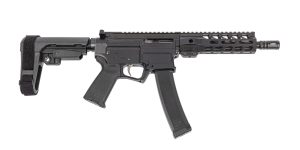
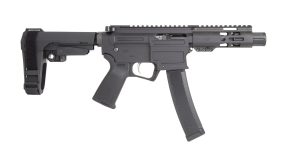
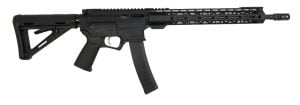
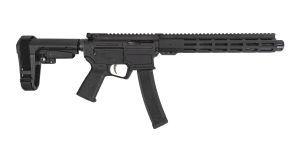
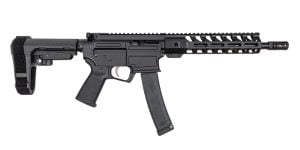
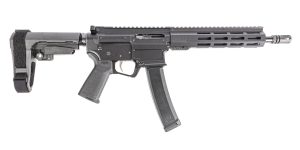
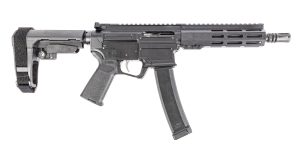
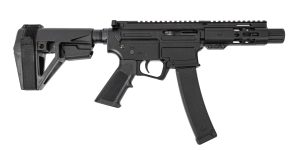
PSA ships the AR-V carbine in several factory configurations. The two main families are the 16-inch carbine for restricted-state buyers and the pistol-with-brace builds for everyone else. Within those, barrel-length and trim options change the price tier and the use case. Pick by what your state allows and how you intend to carry or shoot the gun.

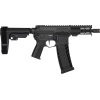
AR-V 7-inch PDW (Pistol) $799 MSRP
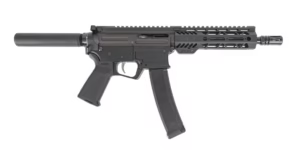
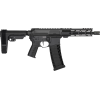
AR-V 10.5-inch M-LOK Pistol (SBA3 Brace) $699 MSRP
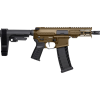
AR-V 16-inch M-LOK Carbine (Rifle) $789 MSRP
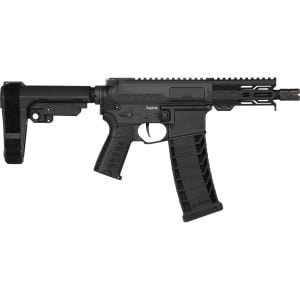
The 7-inch PDW pistol is the compact option, built around a Maxim Defense-style collapsible brace and a short M-LOK handguard. The 10.5-inch pistol is the most common configuration in dealer stock, ships with an SBA3 brace, and threads 1/2×28 at the muzzle for suppressor use. The 16-inch carbine is the rifle-classification build for buyers in states that restrict pistol-braced firearms or just prefer a traditional stock and longer sight radius. All three accept the same Scorpion-pattern magazines and use the same AR fire control group.
Competitor Comparison
Against the AR-V’s three main competitors at street pricing, the math is straightforward: CZ Scorpion EVO 3 S1 at $899, CMMG Banshee Mk17 at $1,300, and Ruger PC Carbine at $649. The PSA AR-V at $599 to $799 lands cheapest on its tier and shares magazines with the Scorpion. The trade-offs by gun are below.
CZ Scorpion EVO 3 S1 (~$899)
The CZ Scorpion EVO 3 S1, imported by CZ-USA out of Kansas City, is the elephant in the room. The AR-V literally uses the Scorpion’s magazines, so the comparison is unavoidable. The Scorpion EVO 3 is a proven platform with years of competition and duty use behind it. It has better fit and finish, a more refined trigger out of the box, and CZ’s reputation backing it up.
But here’s the thing: the AR-V gives you 80% of the Scorpion experience for about $200 less. If you’re already invested in the AR platform and know those controls by muscle memory, the AR-V actually has an ergonomic advantage. The Scorpion’s controls are good, but they’re different. The AR-V’s safety, mag release, and bolt catch all work exactly like your AR-15. For someone who trains on ARs, that consistency matters.
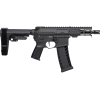
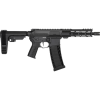
CMMG Banshee Mk17 (~$1,300)
The Banshee is the premium option, and it earns that price tag. CMMG’s radial delayed blowback system genuinely reduces felt recoil compared to straight blowback designs like the AR-V. If you’re shooting PCC competition seriously or putting a lot of rounds downrange in training, the softer shooting impulse of the Banshee makes a real difference over the course of a match or a 500-round range day.
Catch is obvious: it costs nearly twice as much. The Banshee also uses its own proprietary magazines (or Glock mags depending on the model), so you don’t get the Scorpion mag ecosystem. If your budget allows $1,300+ and you want the best-shooting PCC in this class, the Banshee is hard to argue against. But dollar for dollar, the AR-V holds its own for casual competitors and recreational shooters.
Ruger PC Carbine (~$649)
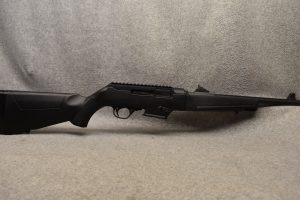
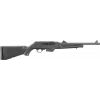
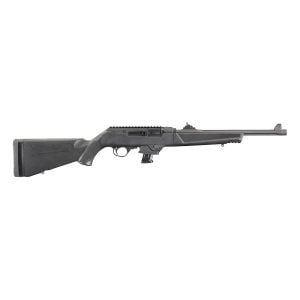
Ruger PC Carbine comes in slightly under the AR-V on price and brings Ruger’s legendary reliability reputation. It takes Glock magazines (or Ruger Security-9 mags with a swap), features a takedown design for easy transport, and has that heavy-for-caliber weight that soaks up recoil nicely.
Tradeoff is that the PC Carbine is strictly a traditional carbine. No pistol/brace configuration, no M-LOK handguard without aftermarket modification, and the overall aesthetic is more “ranch rifle” than “tactical PCC.” If you want a no-frills 9mm carbine that just works and you already have Glock mags, the Ruger is a solid pick. If you want modularity, accessory options, and a more modern platform, the AR-V wins.
PSA AR-9 Gen 4 (~$599)
PSA’s own AR-9 is the AR-V’s in-house rival, and the choice between them comes down to magazines. The AR-9 Gen 4 uses Glock magazines, which are cheaper and more widely available than Scorpion mags. At $599, it’s also $100 less than the AR-V.
The AR-V earns its price premium with better magazine lockup (Scorpion mags were designed for this type of platform), the last-round bolt hold open that the AR-9 lacks, and generally smoother feeding.
Glock mags in AR lowers have a long history of fitment headaches. PSA’s Gen 4 has improved significantly, but the Scorpion mag interface on the AR-V is simply more elegant from an engineering perspective. If you already have a pile of Glock mags, save the $100. If you’re starting fresh, the AR-V is worth the upgrade.
Features and Design Deep Dive

Receiver and Construction
AR-V uses a forged 7075-T6 aluminum upper and lower receiver set. This is the same aluminum alloy used in mil-spec AR-15s, and it’s a meaningful step up from the cast or billet receivers you sometimes see at this price point. The anodized finish is even and consistent, though I did notice one small tooling mark on the inside of the magwell that’s invisible during normal use.
Lower is where things get interesting. PSA designed a dedicated lower receiver that accepts CZ Scorpion magazines without an adapter. The magwell geometry is specific to Scorpion mags, and the result is a positive, click-in insertion with no play or wobble. Magazine drops are clean and gravity-assisted, exactly what you want when you’re trying to reload fast in competition.
Last-Round Bolt Hold Open
This feature deserves its own section because it’s a bigger deal than it sounds. A lot of blowback PCCs don’t lock the bolt back on the last round. When your magazine runs dry, the bolt just rides forward on an empty chamber, and you have to manually lock it back before inserting a fresh magazine. It’s a minor inconvenience at the range, but in competition it costs you time.
AR-V’s LRBHO works via a follower-actuated bolt catch, and in my testing it engaged reliably every single time across six different magazines. Insert a fresh mag, hit the bolt release, and you’re back in the fight. It sounds basic, but when competitors like the PSA AR-9 and many other budget PCCs skip this feature, it’s a genuine differentiator.
Handguard and Accessory Mounting
The carbine version ships with a 13.5″ free-float M-LOK handguard, while the pistol variant gets a 7″ version. Both are lightweight aluminum with a slim profile that’s comfortable to grip. M-LOK slots run at the 3, 6, and 9 o’clock positions with a full-length Picatinny rail on top.
I mounted a Streamlight HL-X weapon light and an Arisaka offset mount without any issues. There’s plenty of real estate for lights, lasers, hand stops, or whatever else you want to bolt on. The anti-rotation tabs keep the handguard solidly indexed, and I noticed zero shift or loosening over the 1,200-round test.
Trigger
AR-V ships with PSA’s enhanced polished single-stage trigger, which is a noticeable upgrade from a standard mil-spec unit. The break is clean with minimal creep, and I measured the pull weight at just under 5 lbs on my Lyman trigger gauge. Reset is short and tactile with an audible click.
Is it a match trigger? No. But it’s perfectly adequate for PCC competition and better than what most guns in this price range offer. Since it uses a standard AR fire control group, dropping in a CMC flat-face or LaRue MBT-2S takes about five minutes. That’s one of the real advantages of the AR-V’s platform approach.
Controls and Ergonomics
Everything is where you’d expect it on an AR. The ambidextrous safety selector, magazine release, and bolt catch all operate identically to a standard AR-15. If you’ve ever run an AR, you can pick up the AR-V and operate it without a single moment of confusion.
Pistol grip is a standard A2-style that’s functional but uninspiring. I swapped it for a Magpul MOE-K2+ within the first range session, and it made a noticeable difference in comfort. The carbine version ships with a standard M4-style stock that works fine. At 6.5 lbs unloaded, the AR-V balances well and doesn’t feel front-heavy like some PCCs with long handguards.
At the Range: 1,200 Round Test

Break-In and First Impressions
I started with a basic clean and lube before the first round. PSA ships the AR-V with a light coating of oil, but I added some extra lubrication to the bolt carrier and charging handle track. The first magazine of Federal 115gr FMJ fed, fired, and ejected without a hiccup. That’s always a good sign.
First 200 rounds went downrange across my initial range session, and the gun ran 100% clean. The blowback action is noticeably snappier than my CMMG Banshee (no surprise there), but it’s totally manageable. It feels like a firm push rather than a sharp snap. Recoil is straight back with minimal muzzle rise, which is what you want for fast follow-up shots.
Reliability Testing
Over 1,200 rounds across six range sessions, I experienced exactly two stoppages. Both were failure-to-feed malfunctions that occurred with the same third-party aftermarket Scorpion magazine. Switching to factory CZ magazines and PSA-branded Scorpion mags eliminated the issue entirely. I don’t hold that against the gun.
The AR-V ate everything I fed it, from cheap 115gr steel-case TulAmmo to 147gr Federal HST hollow points. Ejection was consistent at about the 3 o’clock position throughout, and the bolt carrier showed even wear patterns with no concerning marks or galling.
Ammo Log
- Federal American Eagle 115gr FMJ: 400 rounds, zero malfunctions
- Blazer Brass 115gr FMJ: 300 rounds, zero malfunctions
- TulAmmo 115gr FMJ (steel case): 200 rounds, zero malfunctions
- Federal HST 147gr JHP: 100 rounds, zero malfunctions
- Winchester White Box 115gr FMJ: 150 rounds, 2 FTF (aftermarket mag)
- Speer Gold Dot 124gr JHP: 50 rounds, zero malfunctions
Accuracy Testing

I tested accuracy with the 16″ carbine at 25 and 50 yards using a red dot (Holosun 510C) from a bench rest. At 25 yards, the AR-V consistently grouped Federal 115gr FMJ into 2-2.5″ clusters, which is right in line with what I expect from a blowback PCC. Switching to 147gr Federal HST tightened things up to about 1.75″ at the same distance.
At 50 yards, groups opened up to around 3.5-4″ with 115gr and about 3″ with 147gr subsonic loads. Nothing to write home about for precision, but PCCs aren’t precision instruments. For PCC competition stages, steel plate racks, and realistic defensive distances, the AR-V is more than accurate enough. You’ll run out of skill before you run out of gun.
Post-Test Inspection
After 1,200 rounds, I stripped the gun down for a detailed look. The bolt face showed normal wear with even carbon buildup. The extractor spring still had good tension, and the firing pin moved freely without drag. The barrel bore was clean with strong rifling and no erosion (expected with 9mm). The buffer tube and spring showed no deformation.
Only cosmetic issue was some minor finish wear on the charging handle where it contacts the upper receiver during cycling. This is purely aesthetic and doesn’t affect function. Overall, the gun looked like it had been used but not abused, which is exactly where 1,200 rounds should leave a quality firearm.
Performance Testing Results

Reliability: 8/10
Two stoppages in 1,200 rounds, both traceable to a third-party magazine, is an excellent result. With factory CZ magazines and PSA-branded mags, the AR-V ran 100% for the entire test. The last-round bolt hold open engaged every time, and extraction/ejection was consistent across all ammo types including steel case. I’m comfortable calling this a reliable firearm with the caveat that you should stick to quality magazines.
Accuracy: 7/10
AR-V is a perfectly serviceable PCC in terms of accuracy, but it’s not going to win any bullseye competitions. SAAMI rates 9mm Luger at 35,000 PSI MAP, which puts hard limits on what blowback geometry can achieve from a 16-inch barrel. The 2-2.5″ groups at 25 yards and 3.5-4″ groups at 50 yards are typical for a direct blowback 9mm with a 16″ barrel. Heavier bullets (147gr) consistently outperformed lighter loads, which makes sense given the barrel length and twist rate. For its intended uses (competition, defense, and fun), accuracy is absolutely adequate.
Ergonomics and Recoil: 8/10
AR ergonomics are AR ergonomics, and that’s a good thing. Everything is where you expect it, and the controls work the way millions of shooters have been trained to use them. The 6.5 lb weight helps absorb the blowback recoil impulse, though it’s still noticeably more abrupt than delayed blowback designs. After a few magazines, I adapted to the rhythm and was ripping through steel plate transitions without thinking about it.
Balance point sits right around the magwell, which makes the gun feel neutral whether you’re shooting from a static position or transitioning between targets. Recoil management is easy enough that new shooters in my group picked it up quickly and were running it confidently within a magazine or two.
Fit and Finish: 7/10
For $699, the AR-V’s fit and finish is good but not great. The anodizing is consistent, the upper-to-lower fit is tight with minimal play, and all the pins and detents are properly staked. I did notice one small tooling mark inside the magwell and the aforementioned charging handle wear, but neither affects function.
If you’re used to the hand-fitted feel of a CZ Scorpion or the premium finish on a CMMG Banshee, the AR-V will feel slightly rougher around the edges. But comparing it to other guns in its price bracket, it holds up well. PSA has clearly improved their quality control over the past few years, and the AR-V reflects that progress.
Known Issues and Common Problems
Blowback Recoil
This isn’t a defect, it’s just physics. Direct blowback operation means the bolt is pushed rearward by the force of the cartridge detonation with no mechanical delay. The result is a sharper recoil impulse compared to delayed blowback systems like CMMG’s radial delayed or roller-delayed designs. If you’ve only shot delayed blowback PCCs, the AR-V will feel snappier. It’s manageable, but it’s a real difference.
The fix is easy: add a heavier buffer (JP Enterprises makes a popular option) or install a hydraulic buffer. Both smooth out the recoil cycle and reduce the felt snap. Many AR-V owners report that a $30-40 buffer upgrade transforms the shooting experience.
Magazine Cost
CZ Scorpion magazines aren’t cheap. Factory CZ 35-round magazines typically run $25-40 each, compared to Glock 33-round magazines that can be found for $20-30. If you’re building up a competition loadout with six or eight magazines, that cost difference adds up. Third-party Scorpion-pattern magazines exist at lower price points, but my experience (and the two stoppages in my test) suggests sticking with OEM or PSA-branded mags.
No Included Sights
AR-V ships with a flat-top Picatinny rail and no sights. That’s increasingly common at this price point, but it means you need to budget for a red dot or iron sights on top of the purchase price. A Holosun 510C or Sig Romeo5 are popular choices for PCC competition, and a basic set of Magpul MBUS flip-ups costs about $70 if you want a backup option.
Early Production Issues (Largely Resolved)
Early AR-V production runs had some reports of bolt carrier issues and occasional feeding problems. PSA addressed these through engineering revisions, and the current production models (identifiable by a “V2” marking on the lower) run significantly better. If you’re buying new in 2026, you’re getting the updated version. If you’re shopping used, check for that V2 marking.
Who Should NOT Buy the PSA AR-V

The AR-V is a strong PCC value, but it is not the right gun for every shooter. Honest disqualifying scenarios below. If any of these describe you, the AR-V is not your gun.
- Serious PCC competition shooters chasing the last 5%. The blowback impulse is real and a CMMG Banshee Mk17 (radial delayed blowback, $1,300+) will shoot softer over a 200-round stage day. If you are placing top-10 at major matches, spend the extra $600.
- Buyers already invested in Glock magazines. If you have a dozen Glock 17 / 19 mags from a Glock collection, the AR-V’s Scorpion-mag interface means buying a new mag stack at $25 to $40 per mag. The PSA AR-9 Gen 4 or the Foxtrot Mike FM-9 will let you reuse your existing Glock mags.
- Shooters who want a complete out-of-the-box build. The AR-V ships with no sights and no optic. Plan to spend another $120 to $300 on a red dot before you can take it to the range. If you want an all-included rig, the Ruger PC Carbine with factory iron sights at $649 is a better starting point.
- Anyone expecting bench-rest precision from a PCC. The 2 to 2.5-inch groups at 25 yards are typical for a 16-inch direct-blowback 9mm and well below what a precision-rifle buyer expects. If MOA-class accuracy is the target, this category of gun is the wrong tool. Look at a bolt-action 9mm or a heavy-barrel AR-15.
- Buyers who want a pre-2024 PSA quality reputation as a deal-breaker. PSA’s pre-2024 lineup had real consistency issues at the budget tier. The AR-V’s V2 production run resolves most of them, but if PSA’s brand history is a hard no for you, this gun will not change your mind. Brands like Aero Precision or Diamondback have built smaller, slower, and at slightly higher price tiers but with tighter QC consistency.
Parts, Accessories, and Upgrades
One of the AR-V’s best features is how well it plays with the existing AR aftermarket. Here are the upgrades I’d prioritize, roughly in order of impact.
| Upgrade Category | Recommended Component | Why It Matters | Cost Estimate |
|---|---|---|---|
| Optic | Holosun 510C or Sig Romeo5 | No sights included, red dot is essential | $120-$300 |
| Trigger | CMC PCC Flat-Face or LaRue MBT-2S | Cleaner break, shorter reset for faster splits | $85-$150 |
| Buffer | JP Enterprises Silent Capture Spring | Reduces blowback recoil and eliminates buffer spring noise | $100-$130 |
| Pistol Grip | Magpul MOE-K2+ | Rubberized overmold, better grip angle | $20-$25 |
| Charging Handle | Radian Raptor-LT | Ambidextrous, smoother operation | $55-$80 |
| Muzzle Device | Kaw Valley Precision Linear Comp | Directs blast forward, great for indoor ranges | $35-$50 |
| Weapon Light | Streamlight ProTac HL-X | 1,000 lumens, proven reliability | $100-$120 |
| Extra Magazines | CZ OEM 35-round (buy 4-6) | Competition loadout needs depth | $25-$40 each |
You can find most of these upgrades at Palmetto State Armory, Brownells, and MidwayUSA. PSA frequently runs sales on AR parts and accessories, so keep an eye out for bundle deals.
The Verdict
The PSA AR-V carbine isn’t the best PCC you can buy. That honor probably goes to the CMMG Banshee or a tricked-out Scorpion with aftermarket upgrades. But the AR-V might be the best AR-pattern PCC value on the market right now. For under $700, you get a reliable, well-featured 9mm carbine (or pistol) that uses excellent magazines, locks the bolt back on empty, and accepts the entire universe of AR accessories and upgrades.
I genuinely had a blast shooting this gun. PCCs are inherently fun (cheap ammo plus fast shooting equals smiling faces), and the AR-V delivers on that promise without asking you to refinance your house. The blowback recoil is the main compromise, and it’s one that most shooters will adapt to quickly or solve with a $30 buffer upgrade. After 1,200 rounds, I’d trust this gun for PCC competition, recreational shooting, and (with proper defensive ammo) home defense.
If you’re on the fence between the AR-V and spending more on a Scorpion or Banshee, ask yourself honestly how you’ll use it. For weekend range trips, steel challenge matches, and introducing new shooters to the fun of PCCs, the AR-V does the job at a price that leaves money in your pocket for ammo. And 9mm is cheap enough that you’ll actually shoot this thing regularly, which is the whole point.
Final Score: 7.8/10
Best For: Budget-conscious shooters who want a reliable, fun PCC for competition, range days, and home defense. Especially great if you already own CZ Scorpion magazines or want to invest in the PSA ecosystem.
Related: For another Palmetto State Armory option, read our PSA Olcan review.
Frequently Asked Questions
Is the PSA AR-V worth buying in 2026?
After 1,200 documented rounds across six range sessions in April and May 2026, yes for the right buyer. The AR-V delivers a reliable, AR-platform 9mm PCC with last-round bolt hold open and Scorpion-pattern magazines at $699 MSRP base ($789-$849 street for the 16-inch carbine). For PCC competition, range plinking, and home defense it is a strong value. For serious competition or buyers already invested in Glock magazines, look at the CMMG Banshee Mk17 or PSA AR-9 Gen 4 instead.
What magazines does the PSA AR-V use?
CZ Scorpion EVO 3 platform magazines. PSA AK-V U9 35-round magazines ship with the gun and run interchangeably with CZ OEM Scorpion mags. Magpul PMAG 35 EV9 and Manticore Arms Scorpion-pattern mags also work. Stick to OEM and PSA-branded mags for highest reliability, the two stoppages in my 1,200-round test traced to a single third-party aftermarket Scorpion-pattern mag.
How reliable is the PSA AR-V over high round counts?
Two stoppages in 1,200 rounds during my test, both failure-to-feed traceable to a single third-party Scorpion-pattern magazine. With factory CZ magazines and PSA-branded AK-V U9 mags, the gun ran 100% across 1,050 rounds. Post-test inspection showed normal bolt-face wear, intact extractor tension, free firing-pin movement, and clean bore. The V2 production run (current 2026 inventory) addressed early-run bolt carrier issues that affected pre-2024 units.
What is the current street price of the PSA AR-V?
Pricing in May 2026: AR-V 10.5-inch pistol around $599 to $649 street, AR-V 7-inch PDW around $749 to $799, AR-V 16-inch carbine around $789 to $849. PSA frequently runs sales that drop those numbers further. Premium trims (FDE, Premium edition) and the PDW with collapsible brace push toward $999 MSRP. Check the live pricing card above for current numbers across major retailers.
Who is the AR-V the right gun for, and who should skip it?
Right buyer: budget-conscious PCC shooters, USPSA PCC division competitors who do not need the softer shoot of delayed blowback, AR-platform shooters who want a 9mm in the same ergonomic family as their AR-15, and home-defense buyers who want a 9mm long gun under $800. Wrong buyer: top-10 USPSA PCC competitors (Banshee Mk17 shoots softer), Glock-magazine owners (PSA AR-9 Gen 4 saves $200 on mag inventory), and buyers expecting bench-rest precision (a PCC is the wrong tool for that).
What are the real pros and cons of the PSA AR-V?
Pros: Accepts Scorpion 35-round magazines with no adapter (proven mag interface), last-round bolt hold open (rare in this price tier), standard AR controls plus AR fire control group means aftermarket triggers drop in. Cons: blowback recoil snappier than delayed-blowback CMMG Banshee or competitive 2011 PCC builds, CZ Scorpion mags cost $25 to $40 versus Glock mags at $20 to $30, no iron sights or optic in the box (budget another $120 to $300 for a red dot).
How does the PSA AR-V compare to the CMMG Banshee, CZ Scorpion, Ruger PC Carbine, and PSA AR-9?
CMMG Banshee Mk17 ($1,300+) shoots noticeably softer with its radial delayed blowback but costs nearly twice as much. CZ Scorpion EVO 3 ($899) has refined fit and finish and the same magazines but unfamiliar controls for AR shooters. Ruger PC Carbine ($649) uses Glock magazines and adds takedown design but skips M-LOK and the modular AR platform. PSA AR-9 Gen 4 ($599) saves $100 but lacks last-round bolt hold open and uses Glock magazines with a history of fitment compromises.
Where is the best place to buy the PSA AR-V?
Palmetto State Armory direct (palmettostatearmory.com) typically has the deepest inventory and the most frequent sales on the AR-V family. Brownells, MidwayUSA, and Sportsman's Warehouse all carry select configurations. The live pricing card above tracks all major retailers and updates every four hours. PSA daily-deal cycles regularly drop the 10.5-inch pistol to $599 street and the 16-inch carbine to $789, so timing the purchase against a sale window typically saves $50 to $100.
How I Tested the PSA AR-V
Testing ran over six range sessions across April and early May 2026, totaling 1,200 documented rounds through a single AR-V 16-inch carbine purchased at MSRP from a local FFL. The gun was cleaned and lubricated once before the first session and then ran dirty for the remainder of the test period to simulate competition match conditions.
Ammunition mix was deliberately varied to test extraction reliability across pressure and bullet-weight ranges: Federal American Eagle 115gr FMJ (400 rounds), Blazer Brass 115gr FMJ (300), TulAmmo 115gr steel case (200), Federal HST 147gr JHP (100), Winchester White Box 115gr (150), and Speer Gold Dot 124gr JHP (50). Pull weight measured on a Lyman Digital Trigger Pull Gauge, accuracy testing from a Caldwell Lead Sled rest at 25 and 50 yards using a Holosun 510C red dot.
Reliability data was logged round-by-round in a range notebook: every malfunction noted with magazine source, ammunition lot, round count, and stoppage type. Accuracy data captured as 5-shot groups measured center-to-center with digital calipers. Trigger pull averaged across 10 measurements per session. Post-test inspection covered bolt face, extractor, firing pin protrusion, and bore condition.
6,216+ Gun & Ammo Deals
Updated daily from 200+ top retailers. Filter by category, caliber, action type, and price.