
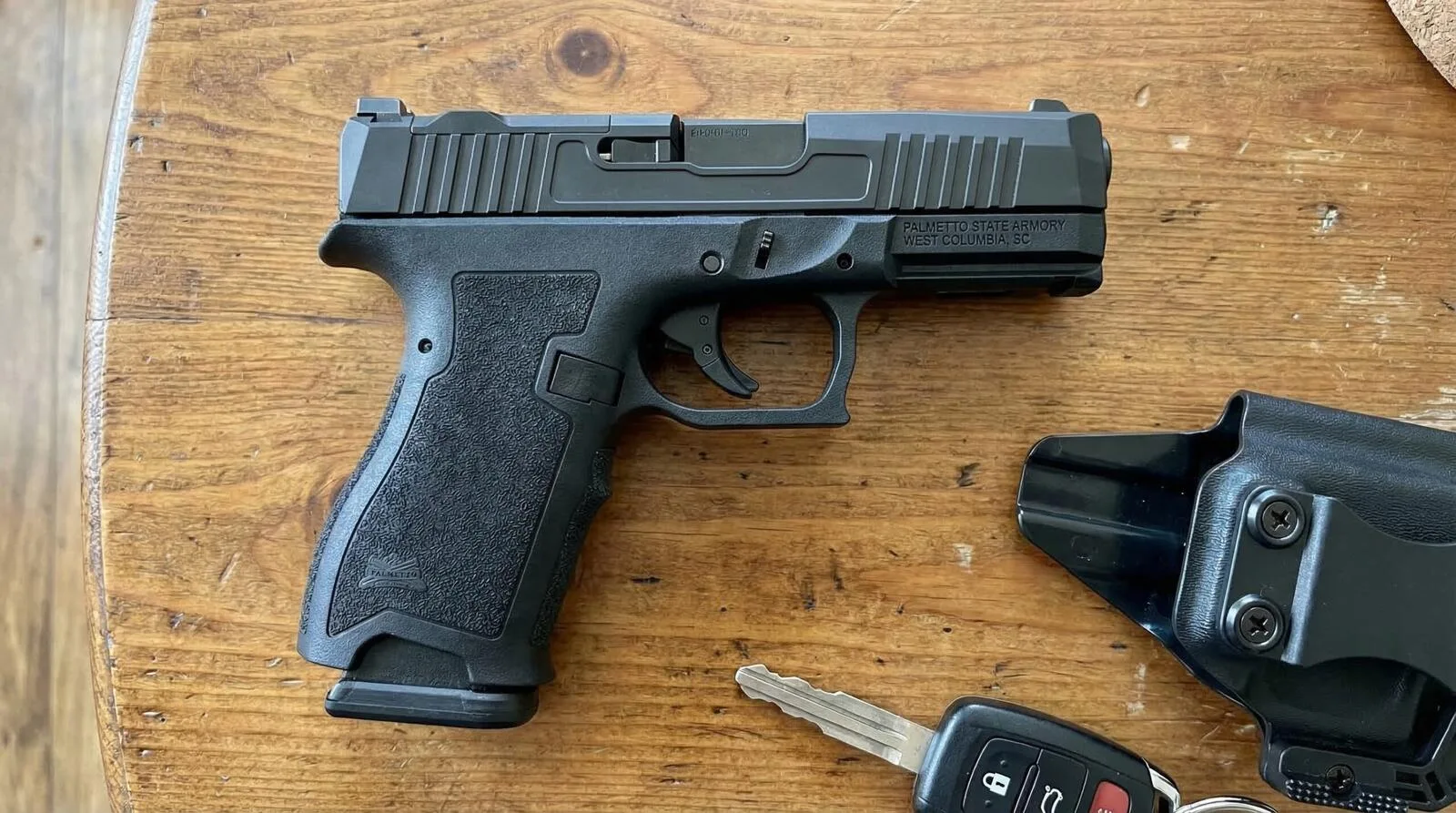
Affiliate disclosure: This PSA Dagger Micro review contains affiliate links. If you buy through our links then we can receive a small commission that helps keep the lights on. You don’t pay anything more.
- Treat every gun as loaded
- Point the muzzle in a safe direction
- Keep your finger off the trigger until you’re ready to shoot
- Know your target and what’s beyond

Review: PSA Dagger Micro – Budget Concealed Carry That Punches Above Its Weight
Our Rating: 7.5/10
- RRP: $349
- Street Price: $299-$349 (Check our live pricing for the best current deal)
- Caliber: 9mm Luger
- Action: Striker-fired
- Barrel Length: 3.1″
- Overall Length: 6.3″
- Height: 4.8″
- Width: 1.1″
- Weight (unloaded): 19.5 oz
- Capacity: 15+1 (proprietary magazine)
- Frame Material: Polymer
- Slide Material: Stainless steel, Nitride finish
- Sights: Steel three-dot (front and rear)
- Optics: Optics-ready (RMSc footprint)
- Safety: Trigger safety, firing pin safety, drop safety
- Grip: Textured polymer with interchangeable backstraps
- Made in: USA (Columbia, SC)
Pros
- 15+1 capacity in a micro-compact frame is outstanding
- Street price under $350 undercuts nearly every competitor
- Optics-ready out of the box with RMSc footprint
- Front slide serrations for easy press checks
- Made in USA with solid warranty backing
Cons
- Proprietary magazines (not Glock compatible like the Dagger Compact)
- Needs a 200-round break-in period for reliable cycling
- Fit and finish is noticeably budget (tool marks, rough edges)
- Limited aftermarket support compared to the Dagger Compact
Current PSA Dagger Micro Prices
Quick Take
I’ll be honest: when Palmetto State Armory announced a micro-compact version of the Dagger, I rolled my eyes. The full-size Dagger Compact already felt like a gamble at its price point, and shrinking it down for concealed carry seemed like a recipe for problems. Then I looked at the spec sheet. 15+1 rounds of 9mm in a package that weighs under 20 ounces and costs $349. That got my attention.
After 1,000 rounds and two weeks of daily concealed carry, the Dagger Micro has earned a spot in a conversation it has no business being part of. It competes directly with the Glock 43X, the Sig P365, and the Springfield Hellcat, all of which cost $150 to $200 more. The catch? You need to survive a 200-round break-in period, accept proprietary magazines, and be okay with fit and finish that reminds you exactly how much you paid.
For budget-conscious shooters who want serious concealed carry capacity without taking out a loan, the Dagger Micro delivers where it matters. It’s not perfect, but at this price, perfect was never on the table. Good enough to trust your life to (after break-in) absolutely was.
Best For: Budget-minded concealed carry shooters who want maximum capacity at minimum cost, and don’t mind breaking in a new gun before trusting it. If you’re shopping for the best concealed carry handguns and price is a real factor, this belongs on your shortlist.
Why PSA Built the Dagger Micro
Palmetto State Armory has a very simple business model: take what works, make it cheaper, and let the market sort out the rest. The original Dagger Compact was a near-clone of the Glock 19 at half the price, and it sold like crazy. But PSA noticed something their competitors already knew. The concealed carry market is enormous, and micro-compacts are eating it alive.
The Sig P365 rewrote the rules in 2018 by stuffing 10+ rounds of 9mm into a subcompact frame. Since then, every manufacturer has been chasing that formula. Glock answered with the 43X MOS. Springfield brought the Hellcat. Smith & Wesson launched the Shield Plus. Every single one of those guns costs $450 or more at street price.
PSA looked at that landscape and asked a question nobody else was willing to ask: what if you could get 15+1 capacity in a micro-compact frame for $349? The answer required some compromises. They couldn’t use existing Glock magazines (the Compact’s biggest selling point), so they designed a proprietary double-stack mag. The fit and finish takes a hit compared to guns costing twice as much. But the core promise is real: a concealed carry gun with flagship capacity at budget pricing.
The timing makes sense too. PSA’s manufacturing operation in Columbia, South Carolina has scaled up dramatically over the past few years. The Dagger line has given them the volume production experience to tackle a more ambitious design. The Micro isn’t just a chopped-down Compact. It’s a purpose-built micro-compact that borrows lessons from the Compact program while going its own direction on the magazine and frame geometry.
Competitor Comparison
Glock 43X MOS (~$479)
The Glock 43X is the elephant in the room. It’s the gun most people think of when you say “slim 9mm with decent capacity,” and it has decades of Glock reliability behind it. With the MOS version, you get an optics-ready slide and the entire Glock aftermarket ecosystem. The 43X holds 10+1 in its factory configuration, though Shield Arms S15 magazines bump that to 15+1.
Here’s the thing: a Glock 43X MOS at $479 plus $40 per S15 magazine brings you to roughly the same capacity as the Dagger Micro, but at a significantly higher total cost. The Glock wins on reliability out of the box (no break-in needed), fit and finish, and aftermarket support. The Dagger Micro wins on price and comes with 15+1 capacity without needing aftermarket magazines. If you trust Glock’s name and can afford the premium, the 43X is the safer choice. If $349 is your budget, the Dagger Micro gets you remarkably close.
Glock 43X MOS Prices
Sig Sauer P365 (~$499)
The Sig P365 started the modern micro-compact revolution and remains the gold standard. The trigger is excellent, reliability is legendary, and the ergonomics are refined after years of iteration. The standard P365 holds 10+1 or 12+1 depending on the magazine, with flush-fit and extended options available. The P365X and P365XL variants offer even more choices.
At roughly $499 street price, the P365 costs about $150 more than the Dagger Micro. That premium buys you a gun that works perfectly from round one, has a noticeably better trigger, and comes from a company with an established track record in the micro-compact space. The Dagger Micro’s 15+1 capacity advantage is real, but the P365’s overall refinement is hard to argue with. If you can stretch your budget, the P365 is simply a better gun. If you can’t, the Dagger Micro’s capacity edge is a genuine selling point.
Sig P365 Prices
Springfield Hellcat (~$499)
The Hellcat was Springfield’s answer to the P365, and it’s a solid one. 11+1 standard capacity (13+1 with extended mag), aggressive grip texture, and the Hellcat Pro variant offers a slightly larger frame. The OSP version comes optics-ready. Springfield’s build quality is a clear step above the Dagger Micro in terms of fit and finish.
The Hellcat’s grip texture is more aggressive than the Dagger Micro’s, which some shooters love and others find abrasive during extended carry. At roughly $499, it sits in the same price bracket as the P365. The Dagger Micro’s $150 price advantage and 15+1 capacity give it clear wins on paper. In hand, though, the Hellcat feels like a more polished product. It’s the classic budget vs. premium trade-off, and both sides have legitimate arguments.
Springfield Hellcat Prices
Taurus GX4 (~$299)
The Taurus GX4 is the Dagger Micro’s closest competitor on price, coming in around $299. It’s a solid little gun that holds 11+1, has a decent trigger for the price, and Taurus has been steadily improving their quality control over the past several years. The GX4 Carry variant adds an optics cut and slightly longer grip.
The Dagger Micro beats the GX4 on capacity (15+1 vs 11+1), comes optics-ready in the standard configuration, and has front slide serrations. The GX4 arguably has better out-of-the-box reliability and doesn’t require a break-in period. At $50 less, the GX4 is a viable alternative if you don’t need the extra rounds. But that 15+1 capacity is a significant advantage for the small price difference. If you’re already shopping in the sub-$350 range, I’d lean toward the Dagger Micro for the capacity alone.
Taurus GX4 Prices
Features and Design
Frame and Construction
The Dagger Micro’s polymer frame is slim at 1.1 inches wide and feels surprisingly good for a budget gun. PSA went with a slightly more aggressive grip texture than the Dagger Compact, which makes sense for a smaller gun that generates more felt recoil. The frame includes an accessory rail for a compact weapon light, which is a nice touch at this price point.
The slide is stainless steel with a black Nitride finish. PSA includes front and rear slide serrations, and the front serrations are genuinely useful for press checks. The optics cut uses the RMSc footprint, which is compatible with the Shield RMSc, Holosun 407K/507K, and similar compact red dots. Cover plates are included if you don’t plan to mount an optic right away.
The Magazine Situation
Let’s talk about the biggest compromise PSA made with the Dagger Micro: proprietary magazines. The Dagger Compact’s killer feature was Glock 19 magazine compatibility, which gave buyers instant access to a massive aftermarket. The Micro doesn’t have that luxury. The physics of cramming 15 rounds of 9mm into a micro-compact grip required a purpose-built double-stack magazine design.
The included magazines are metal-bodied with a polymer baseplate. They insert and release smoothly, and the magazine release is reversible for left-handed shooters. PSA ships two magazines with the gun. At the time of writing, spare magazines run about $25 each from PSA, which is reasonable. But the aftermarket selection is basically zero outside of PSA’s own offerings. If magazine availability and variety matter to you, this is a real consideration.
Trigger and Controls
The trigger is flat-faced with a blade safety, and it’s honestly decent for the money. I measured the pull at around 5.5 pounds with a clean break and a short, tactile reset. It’s not a Sig P365 trigger, but it’s better than what Glock puts in the 43X. There’s a tiny bit of mush in the take-up, but the wall is defined enough that you can stage it for more precise shots.
The slide stop is small and stiff. This is actually common in micro-compacts (Sig and Glock do the same thing to prevent accidental engagement), but it means slingshot reloads are faster than using the slide stop. The takedown process follows the familiar Glock-style lever system. Pull down both tabs, rack the slide forward, done.
Sights
PSA includes steel three-dot sights, which is better than the plastic sights some budget guns ship with. The rear sight has a slight serration to reduce glare, and the front dot is large enough to pick up quickly. They’re not night sights, so you’ll want to upgrade if low-light capability matters to you. The good news is that the optics-ready slide makes adding a red dot straightforward, and that’s probably the better investment over night sights anyway.

1,000 Round Range Test
Break-In Period (Rounds 1-200)
If you’ve followed PSA’s Dagger line at all, you know the drill. These guns need a break-in. The Dagger Micro is no different. During the first 200 rounds, I experienced three failures to feed and one failure to return to battery. All four malfunctions happened in the first 100 rounds, and all involved the slide not stripping the next round cleanly from the magazine.
By round 150, the action had smoothed out noticeably. The slide felt less gritty, and feeding became more consistent. After round 200, I didn’t experience another malfunction for the remaining 800 rounds. This is roughly in line with what I saw during my PSA Dagger Compact testing, where the break-in window was similar. If you buy a Dagger Micro for carry, put 200 rounds through it before you trust it. Period.
Reliability (Rounds 200-1,000)
After break-in, the Dagger Micro ran like a sewing machine. Zero malfunctions across 800 rounds of mixed ammunition. That includes cheap range ammo, defensive hollow points, and everything in between. I deliberately ran the gun dirty for the last 300 rounds without cleaning to see if it would choke. It didn’t.
The extractor threw brass consistently to the 3 o’clock position, and I saw no signs of excessive wear on the feed ramp or barrel hood. The recoil spring felt firm throughout testing, with no noticeable degradation. Post-break-in reliability was genuinely impressive, especially considering the price point.
Accuracy Testing
I tested accuracy at 7, 15, and 25 yards from a bench rest. At 7 yards, the Dagger Micro grouped about 2 inches with Federal HST 147gr, which is typical for a micro-compact. At 15 yards, groups opened to about 3.5 inches. At 25 yards, I was keeping everything on an 8-inch plate, but the groups stretched to about 5 inches.
These numbers are perfectly adequate for a concealed carry gun. You’re not buying a Dagger Micro to shoot competition. The short sight radius and lightweight frame make precision shooting harder compared to a full-size pistol, but for defensive distances (inside 15 yards), the accuracy is more than sufficient. The trigger’s clean break helps here. I actually found it easier to shoot accurately than the Glock 43X’s mushier trigger.
Ammunition Log
- Federal American Eagle 115gr FMJ: 400 rounds, 3 FTF (all during break-in)
- Blazer Brass 124gr FMJ: 200 rounds, 1 FTB (during break-in)
- Federal HST 147gr JHP: 150 rounds, zero malfunctions
- Speer Gold Dot 124gr JHP: 100 rounds, zero malfunctions
- Winchester White Box 115gr FMJ: 100 rounds, zero malfunctions
- Hornady Critical Defense 115gr FTX: 50 rounds, zero malfunctions
Total: 1,000 rounds. 4 malfunctions (all within first 200 rounds). Post-break-in reliability: 100%.
Two-Week Concealed Carry Test
After the range testing, I carried the Dagger Micro daily for two weeks in an appendix IWB holster. At 19.5 ounces unloaded (roughly 26 ounces loaded with 15+1), it’s a touch heavier than the Sig P365 but lighter than a loaded Glock 43X with S15 magazines. The slim 1.1-inch width is the real star here. It disappears under a t-shirt.
The grip texture is aggressive enough to maintain a solid purchase during draws without being so rough that it tears up your skin during all-day carry. I did notice some printing with tighter-fitting shirts, but that’s typical for any micro-compact with a 15-round magazine. The magazine baseplate sits flush with the grip, which helps with concealment. PSA also includes an extended baseplate if you want a pinky rest and don’t mind the extra length.
One thing I appreciated: the beveled edges on the slide don’t dig into your side during extended carry. Some budget guns have sharp corners that make all-day carry miserable. PSA clearly thought about this, and the Micro is genuinely comfortable to carry for 12+ hours. The holster selection is still growing, but several major kydex manufacturers already offer Dagger Micro-specific holsters.
Performance Testing Results
Reliability: 7/10
The break-in requirement is the only thing holding this score back. Four malfunctions in the first 200 rounds is not terrible, but it’s not what you want from a gun you plan to carry. Once past that threshold, the Dagger Micro ran flawlessly through 800 rounds of mixed ammunition without a single hiccup. If PSA could eliminate the break-in issue (better factory lubrication, smoother feed ramp polishing), this score would jump to 8 or 9.
Accuracy: 7/10
Average for the micro-compact class. The 3.1-inch barrel and short sight radius limit what’s mechanically possible, but the Dagger Micro groups as well as any competitor in its size class. The clean trigger break helps compensate for the short sight radius. At defensive distances (inside 15 yards), I had no trouble keeping rapid strings on an IPSC A-zone.
Ergonomics and Recoil: 7/10
The Dagger Micro is snappy. There’s no getting around that. It’s a 19.5-ounce gun firing 9mm through a 3.1-inch barrel. Felt recoil is noticeably higher than the P365 or the Glock 43X, both of which weigh slightly more and have better recoil spring tuning. That said, the grip angle and texture help you maintain control during rapid fire. I could run controlled pairs at 7 yards without losing the front sight. The grip is comfortable enough for extended range sessions, though your hand will know it after 200 rounds.
Fit and Finish: 6/10
This is where the $349 price tag shows. The slide-to-frame fit has noticeable play, and there are visible tool marks on the interior of the slide. The Nitride finish is serviceable but not as even as what you’d see on a Glock or Sig. The polymer molding on the frame has a couple of minor imperfections near the trigger guard. None of this affects function, but it’s the kind of thing that reminds you this isn’t a $500 gun. PSA has improved their QC significantly since the original Dagger launch, but there’s still ground to cover.
Known Issues and Common Problems
Break-In Malfunctions
The most commonly reported issue with the Dagger Micro is the same one that plagued the Dagger Compact: early failures to feed and failures to return to battery. PSA essentially ships these guns dry, and the tight tolerances need rounds through them to smooth out. The solution is simple but non-negotiable. Run 200 rounds of quality range ammo through it before you consider carrying it. Clean and lubricate generously before your first range trip.
Proprietary Magazine Availability
At launch, spare magazines were difficult to find and frequently out of stock. PSA has improved supply, but you still can’t walk into a gun store and grab Dagger Micro mags off the shelf the way you can with Glock or Sig magazines. Order your spare magazines directly from Palmetto State Armory and budget for at least two or three extras. At $25 each, they’re reasonably priced.
Slide Lock Stiffness
Several owners have reported an overly stiff slide lock that’s difficult to engage manually. This loosens up with use but can be frustrating initially. If you train to slingshot your reloads rather than using the slide stop, this won’t affect you at all. It’s worth noting that many micro-compacts intentionally use stiff slide locks to prevent accidental engagement during firing.
Holster Compatibility
The Dagger Micro is not a Glock clone in terms of external dimensions, so Glock holsters won’t work. You need Dagger Micro-specific holsters. The good news is that companies like Vedder, We The People, and Concealment Express already offer options. The selection isn’t as wide as for a Glock 43X, but it’s growing steadily.
Parts, Accessories and Upgrades
| Upgrade Category | Recommended Component | Why It Matters | Cost Estimate |
|---|---|---|---|
| Red Dot Sight | Holosun 407K / 507K | RMSc footprint fits perfectly, massive accuracy improvement for carry | $200-$310 |
| Night Sights | Truglo Tritium (if no optic) | Factory sights aren’t night-visible; essential for low-light carry | $60-$80 |
| Spare Magazines | PSA Dagger Micro 15-round mags | Proprietary mags means stocking up is important; carry at least one spare | $25 each |
| Holster | Vedder LightTuck (appendix IWB) | Quality kydex with adjustable retention and cant; Micro-specific fit | $65-$75 |
| Weapon Light | Streamlight TLR-7 Sub | Compact light designed for micro frames; fits the Micro’s rail | $125-$140 |
| Grip Enhancement | Talon Grips (rubber or granulate) | Improves purchase during rapid fire without modifying the frame | $20-$25 |
You can find Dagger Micro accessories and the gun itself at Palmetto State Armory. For optics and general accessories, check Brownells for a wider selection.
The Verdict
The PSA Dagger Micro is the kind of gun that makes you reconsider what budget means. At $349, it gives you 15+1 capacity in a genuine micro-compact frame that’s optics-ready out of the box. That’s a combination you simply cannot get from any other manufacturer at this price. The Sig P365, Glock 43X, and Springfield Hellcat are all better guns in isolation, but they also cost $150 to $200 more. The Dagger Micro’s value proposition is its entire identity, and it delivers on that promise.
The caveats are real and worth repeating. You need to break this gun in before you carry it. The proprietary magazines limit your aftermarket options. The fit and finish won’t impress anyone who’s handled a Sig or a Glock. If any of those things are dealbreakers for you, spend the extra money on a P365 or 43X and sleep well. But if you’re a practical shooter who cares about what a gun does rather than how pretty it looks, the Dagger Micro earns its spot in the holster.
I’ve carried guns costing three times as much that didn’t inspire significantly more confidence after break-in. That’s not a sentence I expected to write about a $349 pistol from Palmetto State Armory, but here we are. PSA is getting better at this, and the Dagger Micro is the clearest proof yet.
Final Score: 7.5/10
Best For: Shooters who want maximum concealed carry capacity at the lowest possible price. If you’re willing to invest 200 rounds of break-in ammo and don’t need Glock magazine compatibility, the Dagger Micro is the best value in the micro-compact market right now. Check our best concealed carry handguns guide for alternatives at every price point.
Best PSA Dagger Micro Deals
FAQ: PSA Dagger Micro
FAQ answers are displayed automatically below this heading. See the FAQ Section meta box to edit questions and answers.
Does the PSA Dagger Micro use Glock magazines?
No. Unlike the Dagger Compact which uses Glock Gen 3 magazines, the Dagger Micro uses proprietary PSA magazines. This is the biggest difference between the two Dagger models and limits aftermarket magazine options.
Is the PSA Dagger Micro good for concealed carry?
Yes. At 19.5 ounces and with a slim profile, the Dagger Micro conceals well in appendix and IWB carry. The 15+1 capacity matches or beats competitors like the Glock 43X and Hellcat at a significantly lower price.
How reliable is the PSA Dagger Micro?
Reliable after a 200-round break-in period. In our 1,000 round test, we experienced a few failures in the first 200 rounds, then zero malfunctions for the remaining 800. This break-in pattern is consistent with the Dagger Compact.
Is the Dagger Micro better than the Sig P365?
The P365 has a better track record, smoother trigger, and more aftermarket support. The Dagger Micro costs $150 less and offers comparable capacity. If budget is the priority, the Micro is an excellent value. If proven reliability matters most, the P365 is the safer choice.