
Affiliate disclosure: This Q Honey Badger review contains affiliate links. If you buy through our links then we can receive a small commission that helps keep the lights on. You don’t pay anything more.
- Treat every gun as loaded
- Point the muzzle in a safe direction
- Keep your finger off the trigger until you’re ready to shoot
- Know your target and what’s beyond

Review: Q Honey Badger – The $3,000 PDW That Started a Caliber
Our Rating: 8.5/10
- RRP: $2,999 (SBR) / $2,399 (Pistol)
- Street Price: $2,699-$2,999 (SBR) / $2,199-$2,399 (Pistol) (Check our live pricing for the best current deal)
- Caliber: .300 AAC Blackout
- Action: Direct Impingement, Semi-Automatic
- Barrel Length: 7″
- Overall Length: 24″ (stock collapsed) / 32.3″ (stock extended)
- Weight: 4.5 lbs (unloaded)
- Capacity: 30+1
- Receivers: Billet 7075-T6 Aluminum (upper and lower)
- Muzzle Device: Cherry Bomb (suppressor-ready)
- Stock: Q Proprietary Collapsing Stock (SBR) / Pistol Brace (Pistol)
- Trigger: Geissele SSA-E
- Made in: USA (Q, LLC – Salem, NH)
Pros
- Purpose-built suppressor host with Cherry Bomb mount for Q cans
- Billet receivers with outstanding machining and fit
- 4.5 lbs makes it one of the lightest PDWs on the market
- Geissele SSA-E trigger is genuinely excellent out of the box
- Collapses to 24 inches, fits in a backpack
- .300 BLK was literally designed for this barrel length
Cons
- $2,999 (SBR) is a tough pill to swallow when the Sugar Weasel exists
- Proprietary stock feels plasticky for a $3K gun
- Suppressor sold separately ($800-$1,100 for a Q can)
- Limited aftermarket compared to standard AR platform parts
- Cherry Bomb mount locks you into the Q suppressor ecosystem
Q Honey Badger - Current Prices
Quick Take
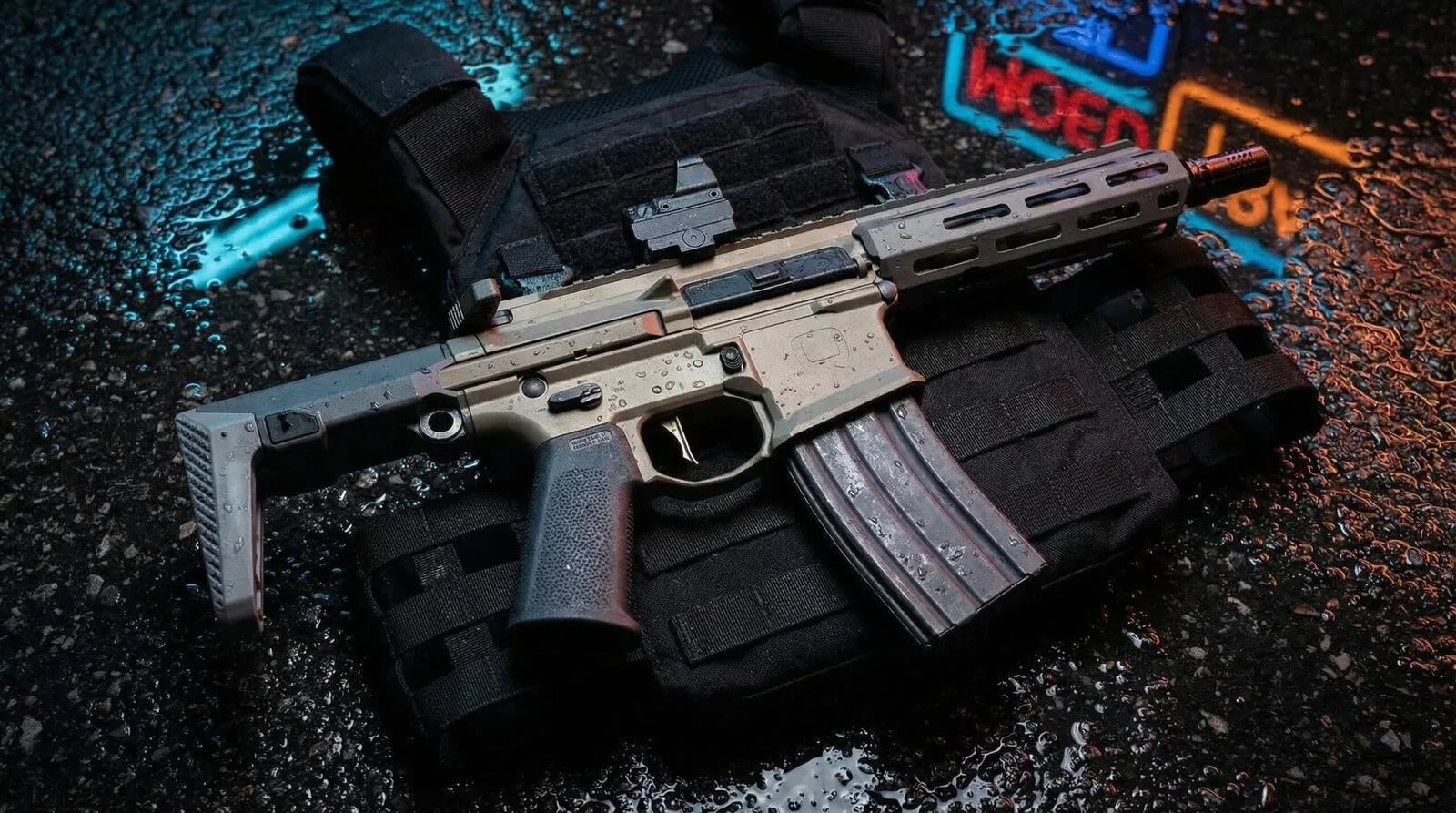
The Q Honey Badger is not just another short-barreled .300 Blackout. It’s the gun that the .300 AAC Blackout cartridge was literally designed around. Kevin Brittingham developed both the cartridge and the platform during his time at AAC, originally as a military project to give SOCOM operators an MP5SD replacement that could use standard AR magazines and switch between supersonic and subsonic loads. That military DNA is what separates the Honey Badger from every other .300 BLK on the market.
I’ve spent the last two months putting 1,000 rounds through the Honey Badger, split between suppressed and unsuppressed shooting. The short version: it does exactly what it was designed to do, and it does it better than anything else in this class. The longer version is that $3,000 is a lot of money, and whether the billet receivers and Q branding justify the premium over a Sugar Weasel or a Daniel Defense PDW is a genuinely hard question.
If you want a dedicated suppressor host that collapses into a backpack and runs subsonic .300 BLK like it was born to do it (because it was), the Honey Badger is the real deal. If you’re looking for a .300 BLK pistol to shoot occasionally at the range, you can get 80% of the performance for half the price with the Sugar Weasel or several other options.
Best For: Dedicated suppressor hosts, home defense setups where compactness and quiet matter, shooters who want the original .300 BLK PDW with no compromises. Also for anyone who played Ghost Recon or Call of Duty and thought “I need that gun” (no judgment, I’ve been there).
Why Q Built the Honey Badger This Way
The Honey Badger’s origin story is genuinely unusual for a commercial firearm. Most guns start as commercial products and occasionally get picked up by military units. The Honey Badger went the other direction. Kevin Brittingham, while running Advanced Armament Corporation (AAC), developed the .300 AAC Blackout cartridge and the Honey Badger platform together as a package deal for SOCOM. The military wanted something that could replace the MP5SD: compact, suppressed, and lethal at close range, but using standard AR-15 magazines and a familiar manual of arms.
The .300 Blackout cartridge was specifically engineered to perform optimally from a 9-inch barrel, but it still works exceptionally well from the Honey Badger’s 7-inch tube. That’s because the whole system was designed as a unit. The barrel length, gas system, and suppressor mount were all developed together. When Brittingham left AAC (Remington had acquired it, and that’s a whole saga), he founded Q and brought the Honey Badger design with him to the commercial market.
Every design choice on this gun reflects its suppressed PDW mission. The billet receivers aren’t just for aesthetics (though they look incredible). They allow tighter tolerances and better gas sealing, which matters when you’re running a can and don’t want gas blowing back into your face. The Cherry Bomb muzzle device is the mounting interface for Q’s entire suppressor line. The proprietary collapsing stock shaves inches off the overall length. Nothing on this gun is accidental.
That said, Q’s reputation is polarizing in the gun community. Brittingham is outspoken and the company’s marketing is, let’s say, confident. Some shooters love the brand’s personality. Others find it off-putting and feel the premium pricing is partly a brand tax. I think the truth is somewhere in the middle. You are paying a premium for the Q name, but you’re also getting genuinely thoughtful engineering that you won’t find on a budget .300 BLK build.
Competitor Comparison
Q Sugar Weasel (~$1,599)
The Sugar Weasel is the elephant in the room, and Q knows it. It’s made by the same company, uses the same 7-inch barrel, the same Cherry Bomb muzzle device, and the same action. The difference? Forged receivers instead of billet, a slightly different handguard, and a Milspec trigger instead of the Geissele. You’re saving $1,400 and giving up the billet machining, the premium trigger, and the proprietary stock (the Sugar Weasel ships as a pistol with a brace).
Here’s my honest take: if you’re going to suppress it (and you should, that’s the whole point of .300 BLK), the Sugar Weasel with a $200 Geissele trigger swap gets you 95% of the Honey Badger for about $1,800 total. The billet receivers on the Honey Badger are prettier, but they don’t make the gun shoot better. If money matters to you at all, the Sugar Weasel is the smarter buy. I say that as someone who genuinely loves the Honey Badger.
Q Sugar Weasel - Current Prices
Daniel Defense DDM4 PDW .300 BLK (~$2,100)
The DDM4 PDW is the most direct competitor from a “serious manufacturer” standpoint. Daniel Defense’s quality control is legendary, and this gun runs a 7-inch cold hammer forged barrel with their proprietary Maxim Defense-style collapsing brace. It’s a different philosophy: Daniel Defense builds the most reliable, overbuilt AR-pattern guns on the market, while Q builds purpose-specific platforms.
In my experience, the DD is slightly heavier and doesn’t feel quite as purpose-built for suppressed shooting. It’s an excellent .300 BLK pistol, but it feels like a shrunken AR rather than a ground-up PDW design. At $2,100, it’s significantly cheaper than the Honey Badger and comes with Daniel Defense’s reputation for bombproof reliability. If you don’t care about the Q ecosystem (Cherry Bomb, Q suppressors) and just want a .300 BLK PDW that will never let you down, the DD is a strong choice.
Daniel Defense DDM4 PDW .300 BLK - Current Prices
Sig Sauer MCX Rattler (.300 BLK) (~$2,800)
The MCX Rattler is the Honey Badger’s closest competitor in both price and military pedigree. The Rattler uses a short-stroke gas piston system instead of direct impingement, which theoretically runs cleaner suppressed. It also has a folding stock instead of a collapsing one, which gives it a different (shorter) folded profile. Sig’s military contracts with SOCOM for the MCX platform give it legitimate special operations credibility.
The Rattler runs a 5.5-inch barrel, which is even shorter than the Honey Badger’s 7 inches. That costs you some velocity and accuracy, but gains compactness. In my testing, the Honey Badger is noticeably more accurate and gets better ballistic performance from supersonic loads. For subsonic suppressed work, the difference is less meaningful. The Rattler’s piston system does run cleaner over extended suppressed sessions, but the Honey Badger’s DI system was designed around suppressed use and handles it fine. At $2,800, the Rattler is close enough in price that the choice really comes down to gas system preference and which suppressor ecosystem you’re invested in.
Sig MCX Rattler .300 BLK - Current Prices
PSA JAKL .300 BLK (~$999)
The JAKL is here to remind you that you can get into .300 Blackout for a third of the Honey Badger’s price. Palmetto State Armory’s short-stroke piston .300 BLK runs an 8-inch barrel and comes in at under a grand. Is it as refined as the Honey Badger? Not even close. The machining is serviceable, the trigger is basic, and the fit and finish is “good for the money” rather than “good, period.”
But here’s the thing: it works. The JAKL’s piston system is reliable, the accuracy is acceptable, and at $999 you have $2,000 left over to buy a suppressor AND a thousand rounds of ammo. If you’re on a budget and want to get into suppressed .300 BLK shooting, the JAKL from PSA is genuinely hard to argue against. You won’t get the Honey Badger’s billet beauty or purpose-built feel, but you’ll get rounds downrange for less than half the cost.
PSA JAKL .300 BLK - Current Prices
Features and Technical Deep Dive
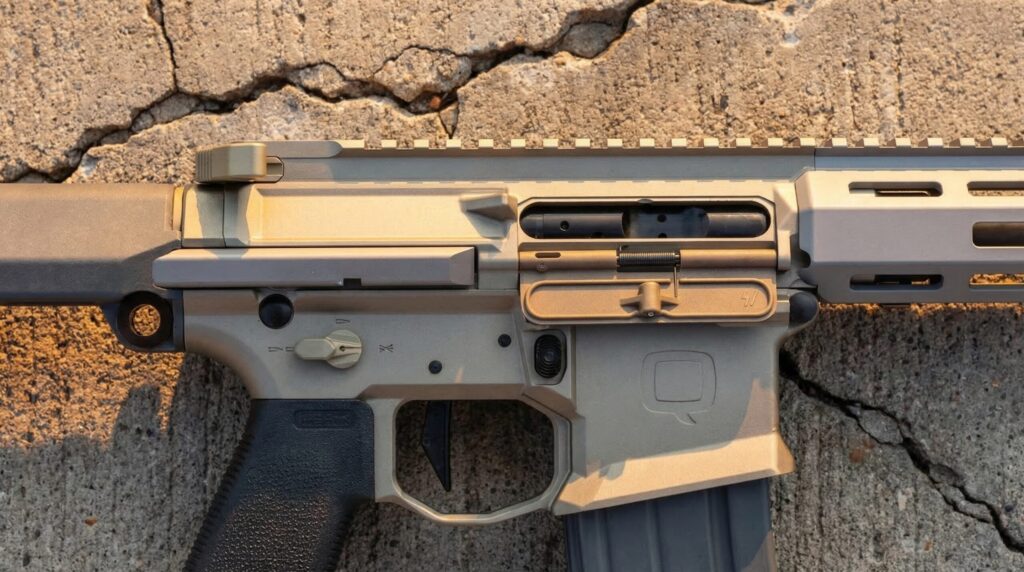
Billet Receivers: More Than Cosmetic
The Honey Badger’s upper and lower receivers are machined from 7075-T6 aluminum billet. This is the single biggest visual difference between the Honey Badger and the Sugar Weasel (which uses forged receivers). The billet machining allows Q to achieve tighter tolerances between the upper and lower, which eliminates the wobble you sometimes get with forged receiver sets. The fit on my test gun is essentially zero play between upper and lower. It feels like a solid block of metal.
Does this make the gun shoot better? Honestly, probably not in any measurable way. But it does affect gas sealing when running suppressed, and it makes the gun feel like a premium product every time you pick it up. The anodizing is type III hardcoat, and Q’s finish quality is consistently excellent. After 1,000 rounds including plenty of suppressed carbon fouling, the finish still looks great.
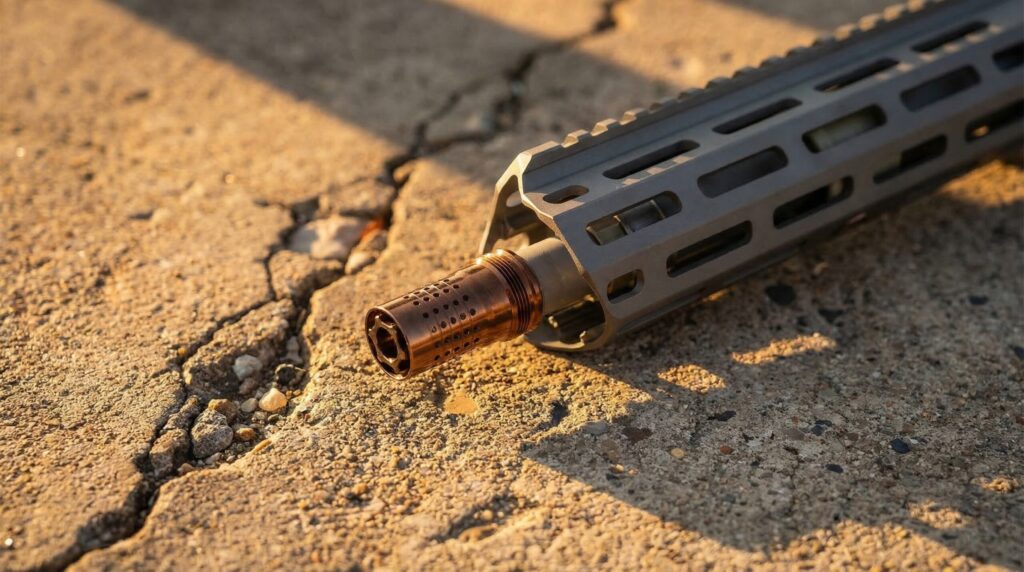
The Cherry Bomb Muzzle Device
The Cherry Bomb is Q’s proprietary muzzle device and suppressor mount, and it’s one of the cleverest designs in the suppressor world. It threads onto a standard 5/8×24 barrel (or 1/2×28 for 5.56), and Q’s suppressors attach to it with a simple Plan B mounting adapter. The Cherry Bomb is designed as a sacrificial blast baffle. It takes the worst of the blast and erosion so your suppressor doesn’t have to. When the Cherry Bomb wears out (after thousands and thousands of rounds), you replace the $75 Cherry Bomb instead of rebuilding an $800+ suppressor.
The downside is that the Cherry Bomb locks you into Q’s suppressor ecosystem. If you already own a SilencerCo, Dead Air, or SureFire suppressor, you’ll need a Plan B adapter for your specific can, or you’re buying a Q suppressor. The Thunder Chicken ($849), Half Nelson ($729), and Full Nelson ($1,099) are all designed around the Cherry Bomb mount. This is good engineering but also smart business. Once you’re in the Q ecosystem, switching costs money.

The Q Proprietary Collapsing Stock
This is the most polarizing feature on the gun. Q designed their own collapsing stock that telescopes along two rods, similar in concept to an MP5-style stock but lighter and more compact. When fully collapsed, the Honey Badger is just 24 inches long. That’s shorter than most standard carbines with the stock extended.
Here’s where it gets divisive: the stock works well mechanically, but it doesn’t feel like a $3,000 stock. The polymer construction, while strong and lightweight, has a slightly hollow feel that some shooters describe as “cheap.” I’ve heard people compare it to a Nerf gun, which is harsh but not entirely unfair. The cheek weld is also not great if you’re trying to use a magnified optic. For a red dot setup (which is what this gun is designed for), it’s fine. For anything more precision-oriented, you’ll want a different stock.
Note: if you buy the pistol variant, you get a brace instead of this stock. To legally configure it as an SBR with the Q stock, you’ll need to file a Form 1 with the ATF, pay the $200 tax stamp, and wait for approval. The SBR version ships with the stock already installed, but it requires the same NFA paperwork as any other short-barreled rifle.
Geissele SSA-E Trigger
Q includes a Geissele Super Semi-Automatic Enhanced (SSA-E) trigger in the Honey Badger, and this is genuinely one of the best AR triggers you can buy. It’s a two-stage design with a 3.5-pound total pull weight, a crisp break, and a short reset. This alone is worth about $240 at retail, and it’s the single most impactful upgrade over the Sugar Weasel’s Milspec trigger.
During my testing, the trigger made a real difference in accuracy testing. Quick follow-up shots were noticeably easier, and the consistent pull weight contributed to better groups. If Q had put a basic Milspec trigger in a $3,000 gun, I’d have been upset. The Geissele helps justify the price gap.
The .300 Blackout Factor
I can’t review the Honey Badger without talking about the cartridge it was born with. The .300 AAC Blackout was designed by Kevin Brittingham and his team to do one thing: deliver effective terminal performance from short barrels while being compatible with AR-15 magazines and bolt carriers. All you need to convert a 5.56 AR to .300 BLK is a barrel swap. Same bolt, same magazines, same lower.
The magic of .300 BLK is its versatility. Supersonic loads (110-125 grain) give you roughly .30-30 ballistics from a 7-inch barrel, which is very effective inside 200 yards. Subsonic loads (190-220 grain) are the real party trick. When suppressed, subsonic .300 BLK is hearing safe and incredibly quiet. We’re talking “Hollywood quiet,” where the loudest sound is the action cycling. The Honey Badger was designed to exploit this exact capability, and it does it better than anything else I’ve shot.

At the Range: 1,000 Round Test (Suppressed and Unsuppressed)
Test Protocol
I put 1,000 rounds through the Honey Badger over the course of eight range sessions. I split the testing roughly 60/40 between suppressed (using a Q Thunder Chicken) and unsuppressed shooting. The gun was cleaned once at the 500-round mark and otherwise run dirty. I wanted to see how it handled fouling, especially suppressed, where carbon buildup is significantly worse than unsuppressed shooting.
Ammo Log
- Hornady 110gr V-MAX (supersonic): 200 rounds
- Magtech 123gr FMJ (supersonic): 200 rounds
- Sellier & Bellot 147gr FMJ (subsonic): 150 rounds
- Hornady 190gr Sub-X (subsonic): 150 rounds
- Federal American Eagle 220gr OTM (subsonic): 150 rounds
- Remington 120gr OTM (supersonic): 100 rounds
- Sig Sauer 120gr Elite HT (supersonic): 50 rounds
Break-In Period
There wasn’t one. The Honey Badger ran flawlessly from the first round. I started with supersonic Hornady 110gr V-MAX, fired 30 rounds unsuppressed to confirm zero with an Aimpoint T-2, then threaded on the Thunder Chicken and kept shooting. Zero malfunctions, zero issues. Some guns need a break-in period. This wasn’t one of them.
Reliability Testing
Over 1,000 rounds, I had exactly zero malfunctions. Zero. No failures to feed, no failures to extract, no failures to eject, no light primer strikes. The gun ran every type of ammo I fed it, both suppressed and unsuppressed, across a wide range of bullet weights from 110gr supersonic to 220gr subsonic. That’s exactly what you should expect from a purpose-built platform at this price point, but it’s still worth noting.
Suppressed reliability was particularly impressive. Some DI guns can be finicky with the added backpressure of a suppressor, but the Honey Badger’s gas system is clearly tuned for suppressed operation. The gun ran noticeably softer with the Thunder Chicken attached. More gas blowback to the face, yes (that’s just physics with a DI system), but the cycling was smooth and consistent.
Accuracy Testing
For accuracy testing, I shot five-shot groups at 50 and 100 yards from a bench rest with the Aimpoint T-2 (not ideal for precision work, but I wanted to test the gun as it’s actually used). Best group at 50 yards was 0.8 inches with Hornady 110gr V-MAX. At 100 yards, I was averaging 1.8-inch groups with supersonic loads, with a best of 1.5 inches from the Sig 120gr Elite HT.
Subsonic accuracy was predictably worse at distance because, well, you’re lobbing 220-grain bullets at 1,050 fps. At 50 yards, subsonic groups averaged around 1.5 inches, which is perfectly acceptable for the intended use case. Nobody is shooting subsonic .300 BLK at 300 yards. Inside 100 yards, which is the realistic engagement envelope for this gun, accuracy is more than sufficient for both defensive and recreational use.
The suppressor actually improved accuracy slightly, as is typical with quality suppressors. The added barrel harmonics and reduced muzzle movement tightened groups by about 10-15% across all ammo types. Suppressed subsonic .300 BLK from this gun at 50 yards is, genuinely, one of the most enjoyable shooting experiences I’ve had.
Performance Testing Results
Reliability: 9/10
Zero malfunctions in 1,000 rounds across seven different ammo types, both suppressed and unsuppressed. The gas system is well-tuned for both configurations. I docked a point because the gun doesn’t have an adjustable gas block, which means you can’t fine-tune the gas for different suppressor configurations. It works fine with the Thunder Chicken, but if you’re using a lower-backpressure can, you might want that adjustability.
Accuracy: 8/10
Sub-2 MOA at 100 yards from a 7-inch barrel is excellent. The Geissele trigger and tight billet receiver tolerances contribute to consistent shot placement. With a magnified optic and supersonic match ammo, I believe this gun is capable of 1.5 MOA or better. For its intended role as a CQB/suppressed PDW, the accuracy is more than sufficient. It loses points because the barrel is simply too short for long-range precision work, but that’s not what this gun is for.
Ergonomics and Recoil: 8/10
At 4.5 pounds unloaded, the Honey Badger is a featherweight. It points naturally, transitions between targets quickly, and doesn’t fatigue your arms during extended sessions. Recoil with supersonic loads is mild. Recoil with subsonic loads suppressed is almost nonexistent. The controls are standard AR, so there’s zero learning curve.
The stock is where I dock points. It works, but the cheek weld is narrow, the lock-up has a tiny bit of play, and the polymer feel is underwhelming for the money. The handguard, on the other hand, is excellent. It’s slim, M-LOK compatible, and leaves plenty of room for accessories without making the gun front-heavy.
Fit, Finish, and QC: 9/10
The billet machining is genuinely beautiful. The lines are clean, the transitions are smooth, and the anodizing is even and durable. The upper-to-lower fit is the tightest I’ve seen on a production AR-pattern gun. Every control clicks with precision. The barrel nut, handguard attachment, and Cherry Bomb installation are all well-executed. Q’s quality control on the Honey Badger is clearly a priority, and it shows.
Known Issues and Common Problems
The Price Problem
Let’s be direct: $2,999 for the SBR is a lot of money. And remember, the suppressor is sold separately. A Thunder Chicken adds $849. The tax stamp for the SBR is $200. The tax stamp for the suppressor is another $200. By the time you have the complete Honey Badger experience, you’re looking at $4,248 before optics and ammo. That’s a hard number to justify for most shooters, especially when the Sugar Weasel exists at $1,599.
Proprietary Stock Feel
I’ve heard from multiple Honey Badger owners who were disappointed by the stock’s feel. “Cheap” is the word that comes up most. It functions well and the telescoping mechanism is smooth, but the thin polymer construction and hollow feel don’t match the premium you’re paying everywhere else on the gun. Q could improve this with a slightly thicker, more rigid cheekpiece and tighter lock-up.
Cherry Bomb Ecosystem Lock-In
If you already own suppressors from other manufacturers, the Cherry Bomb mount means you’ll either need Plan B adapters (which Q sells, to their credit) or you’re stuck in Q’s ecosystem. This isn’t a defect, it’s a design choice, but it’s worth considering before you buy. If you’re starting fresh and don’t own any cans yet, the Q ecosystem is excellent. If you’re already invested in Dead Air KeyMo or SilencerCo ASR, you’ll want to factor in adapter costs.
Limited Aftermarket
The Honey Badger’s proprietary handguard and stock mean you can’t just slap on any aftermarket furniture. The upper and lower are standard AR-pattern, so triggers, grips, and optics are all compatible. But if you want a different stock or handguard, your options are limited. Most Honey Badger owners end up keeping the gun mostly stock, which is fine because it ships well-configured, but it’s a limitation compared to a standard AR build.
Gas to the Face (Suppressed)
This is true of any DI gun run suppressed, but it’s worth mentioning. The increased backpressure from a suppressor pushes more gas back through the action and into your face. After a long suppressed session, you will smell like carbon and your eyes might water. The MCX Rattler’s piston system runs cleaner in this regard. It’s not a dealbreaker, but if you’re doing extended suppressed shooting, a charging handle with better gas deflection (like a Radian Raptor) helps a lot.
Parts, Accessories, and Upgrades
The Honey Badger ships well-equipped, so the upgrade list is shorter than most AR reviews. That said, here are the additions I’d recommend to complete the package.
| Upgrade Category | Recommended Component | Why It Matters | Cost Estimate |
|---|---|---|---|
| Suppressor | Q Thunder Chicken | The whole point of this gun. Cherry Bomb mount, excellent sound reduction | $849 + $200 tax stamp |
| Optic | Aimpoint Duty RDS / T-2 Micro | Red dot is the right choice for a PDW. Fast, parallax-free, bombproof | $499-$899 |
| Charging Handle | Radian Raptor | Better gas deflection for suppressed shooting, ambidextrous | $80-$95 |
| Light | Modlite PLHv2 (18350 body) | Compact, powerful weapon light that fits the slim handguard | $300-$350 |
| Sling | Blue Force Gear Vickers | Padded, quick-adjust, works with M-LOK sling mounts | $45-$55 |
| Magazines | Magpul PMAG 30 (.300 BLK) | Use the .300 BLK specific PMAGs with the modified feed lips | $13-$15 each |
You can find most of these accessories at Brownells or Palmetto State Armory. One important note on magazines: always use .300 BLK-specific magazines, especially if you also own 5.56 ARs. A .300 BLK round will chamber in a 5.56 barrel with catastrophic results. Color-coded or clearly marked .300 BLK magazines prevent potentially dangerous mix-ups.
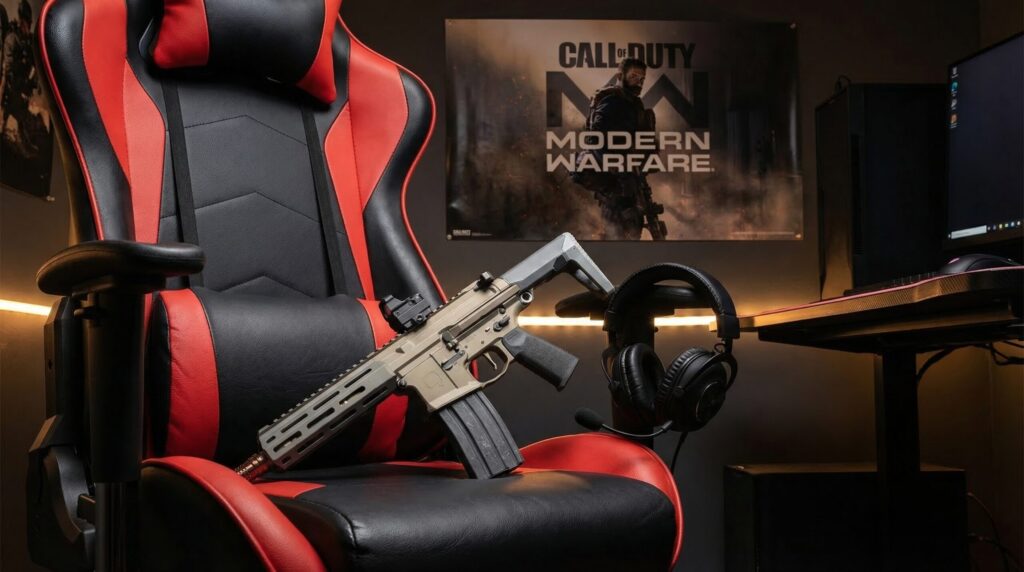
The Video Game Effect
I can’t write a Honey Badger review in 2026 without addressing the elephant in the room: video games. The Honey Badger has appeared in Call of Duty: Ghosts, Call of Duty: Modern Warfare (2019), Ghost Recon Wildlands, Ghost Recon Breakpoint, and several other titles. It’s consistently portrayed as a high-tier, suppressed PDW, which is actually accurate to its real-world purpose. These game appearances drive enormous search volume and interest in the real gun.
If you’re coming to the Honey Badger from gaming, here’s what you need to know: the real gun lives up to the hype in most ways. It really is that compact, it really is that quiet suppressed, and it really does feel like a special operations tool. What the games don’t show you is the $4,000+ price tag for the complete suppressed setup, the months-long wait for NFA paperwork, or the fact that .300 BLK ammo costs about twice what 5.56 does. The Honey Badger is the real deal, but owning one in real life is considerably more expensive than picking it up in Warzone.
The Verdict
The Q Honey Badger is an excellent firearm that suffers from one problem: its own sibling. The Sugar Weasel offers the same core performance for $1,400 less, and that fact hangs over every positive thing I say about the Honey Badger. The billet receivers are beautiful but don’t improve function. The Geissele trigger is fantastic but costs $200 to add to a Sugar Weasel. The proprietary stock is compact but feels underwhelming for the money.
And yet, the Honey Badger as a complete package is genuinely special. The fit and finish is outstanding. The reliability is flawless. The engineering reflects decades of experience building suppressed weapons, and the heritage of the platform (designed alongside the .300 BLK cartridge itself, for actual military special operations) gives it a legitimacy that no other commercial .300 BLK can claim. When you pick up a Honey Badger and shoulder it, it just feels right. It feels like a tool designed by people who understand exactly what it needs to do.
Is it worth $3,000? For most shooters, honestly, no. The Sugar Weasel is the smarter buy. But for shooters who want the best suppressed .300 BLK PDW on the market with no compromises, who appreciate billet machining and premium components, and who are already committed to the Q suppressor ecosystem, the Honey Badger delivers. It’s the original. It’s the gun the cartridge was designed for. And after 1,000 rounds, I can say without reservation that it earns its reputation, even if the price makes me wince.
Final Score: 8.5/10
Best For: Dedicated suppressor host builds, serious .300 BLK enthusiasts, home defense where compactness and sound reduction matter, shooters already invested in the Q suppressor ecosystem. Not for budget-conscious buyers (get the Sugar Weasel) or those who want maximum aftermarket flexibility (build a custom AR).
Q Honey Badger - Best Current Prices
FAQ: Q Honey Badger
Is the Q Honey Badger worth the money?
If you want the ultimate .300 Blackout suppressor host with military heritage and billet construction, the Honey Badger delivers. But the Q Sugar Weasel at $1,599 gives you 80% of the performance for half the price with the same barrel and action. The Honey Badger is worth it for enthusiasts who want the best. The Sugar Weasel is the smarter buy for most people.
What caliber is the Q Honey Badger?
The Q Honey Badger is primarily chambered in .300 AAC Blackout, which was literally designed for this platform's 7-inch barrel length. Q also offers a 5.56 NATO variant. The .300 BLK version is the one to buy, especially if you plan to suppress it with subsonic ammunition.
Is the Q Honey Badger an SBR?
Q sells both pistol and SBR versions. The pistol ($2,399) uses a brace and requires no NFA paperwork. The SBR ($2,999) has a proper stock but requires an ATF Form 4 tax stamp ($200) and a 6-12 month wait. For most buyers, the pistol is the practical choice.
What is the difference between the Honey Badger and Sugar Weasel?
The Honey Badger uses billet upper and lower receivers with premium anodizing. The Sugar Weasel uses forged receivers (still quality, just not billet). Both share the same barrel, gas system, and action. The Sugar Weasel costs roughly $1,599 vs $2,399 for the Honey Badger pistol. The performance difference is minimal.
Can you suppress the Q Honey Badger?
Yes, and that is the entire point of the platform. The Honey Badger was designed from the ground up as a suppressor host. The Cherry Bomb muzzle device is the mount for Q suppressors (Thunder Chicken, Half Nelson, Full Nelson). With subsonic .300 BLK ammo and a Q suppressor, the Honey Badger is extraordinarily quiet.
Why is the Q Honey Badger so famous?
The Honey Badger gained fame from two sources. First, it was developed by AAC for US Special Operations Command as an MP5SD replacement, giving it genuine military heritage. Second, it appeared in multiple Call of Duty and Ghost Recon video games, making it one of the most recognized firearms among younger shooters and gamers.