
Affiliate disclosure: This Glock 19 Gen 6 review contains affiliate links. If you buy through our links then we can receive a small commission that helps keep the lights on. You don’t pay anything more.
- Treat every gun as loaded
- Point the muzzle in a safe direction
- Keep your finger off the trigger until you’re ready to shoot
- Know your target and what’s beyond

Review: Rock Island Armory 1911 GI Standard – The American Classic, From the Philippines
Our Rating: 8.2/10
- RRP: $420
- Street Price: $380–$450 (Check our live pricing for the best current deal)
- Caliber: .45 ACP
- Action: Single-action, recoil-operated
- Barrel Length: 5 inches
- Overall Length: 8.54 inches
- Height: 5.51 inches
- Width: 1.3 inches
- Weight (unloaded): 39.52 oz (2.47 lbs)
- Capacity: 8+1 (Ships with one 8-round ACT-MAG)
- Frame Material: 4140 Ordnance steel (Cast)
- Slide Material: 4140 Ordnance steel (Forged), Parkerized finish
- Sights: Fixed, low-profile GI-style (Front blade, dovetail rear)
- Optics: None (Traditional GI slide)
- Safety: Manual thumb safety, grip safety
- Grip: Smooth tropical walnut wood panels
- Made in: Marikina, Philippines (Armscor)
Pros
- Incredibly affordable—often found for under $400.
- High-quality 4140 steel construction feels indestructible.
- Authentic “Series 70” design with no firing pin safety mush.
- Outstanding customer service and lifetime warranty.
- Rock-solid reliability with standard 230gr ball ammo.
Cons
- GI sights are tiny and very difficult to see in low light.
- Cast frame isn’t as prestigious as forged alternatives.
- Parkerized finish is thin and prone to showing wear quickly.
- Small grip safety and spur hammer will cause “hammer bite.”
RIA 1911 GI Standard
Quick Take
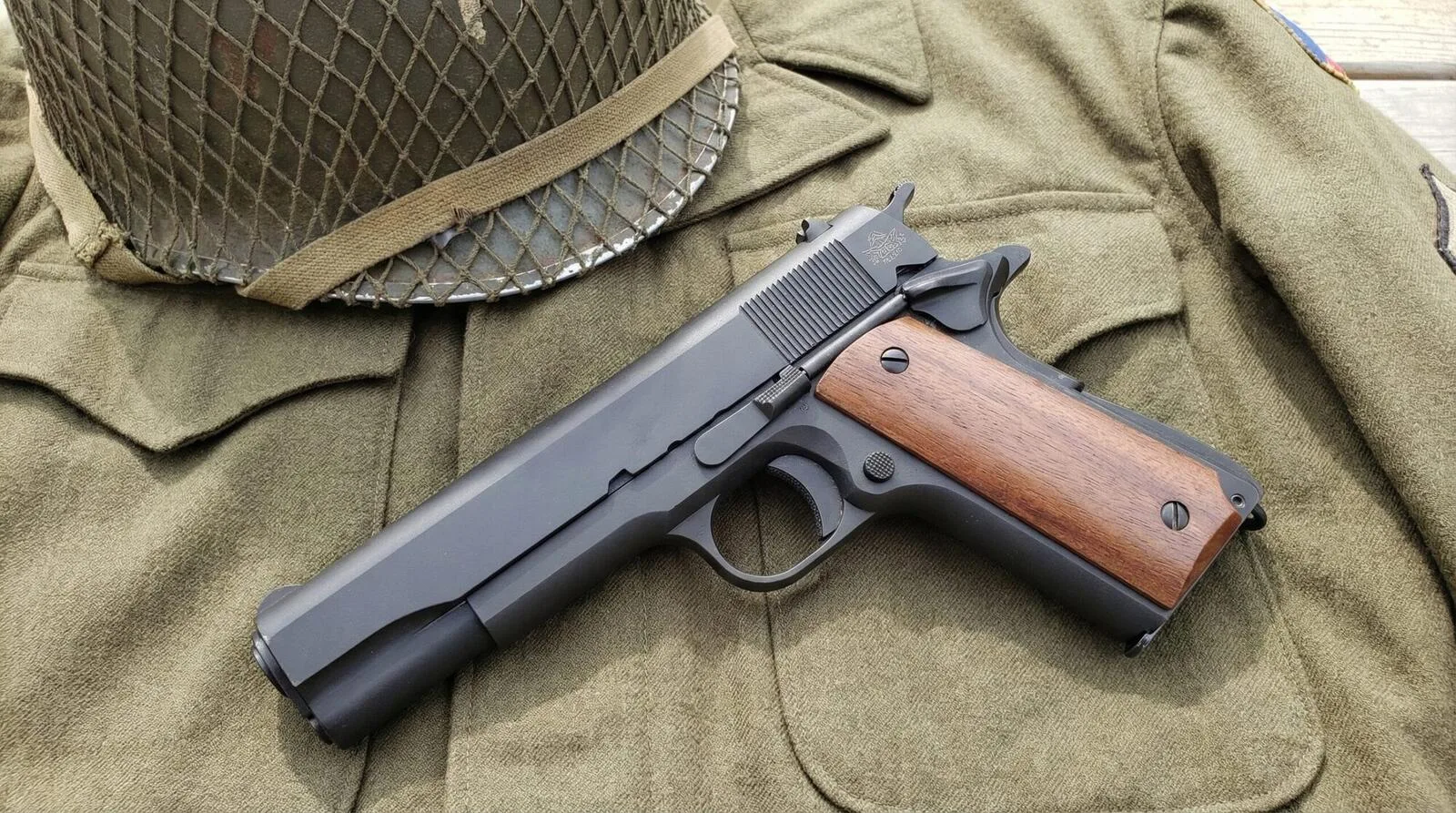
The RIA GI Standard is a “bare-bones” beast and about as pure a recreation of the World War II military spec 1911 as you’re likely to find without some kind of perverse designer price tag.
It foregoes every modern creature comfort to provide a functional, reliable firearm at a price that often beats out polymer striker-fired guns. If you want a 1911 that you aren’t afraid to get dirty, this is it.
This pistol is as American pie and Hulk Hogan waving the flag, but it’s made in the Philippines by industry giant Armscor. Honestly that doesn’t matter, Rock Island Armory has an American base, a massive American following and they seem to get the American vibe.
Is it perfect? It’s a sub-$400 1911, of course it’s not perfect. But is it the best cheap 1911 on the market in 2026? Yes, I think it is.
Why Armscor Built the Rock Island 1911 GI Standard This Way
Rock Island Armory had a very different problem than the modern giants. While companies like Glock are forced to innovate to stay ahead of high-tech rivals, RIA found their success by standing perfectly still.
For decades, the budget 1911 market was a wasteland of unreliable parts and questionable metallurgy. Rock Island realized that there was a massive, underserved audience of shooters who didn’t want a tactical race gun or a $2,000 1911 heirloom.
They just wanted a 1911 that looked like the one their grandfather carried and actually went bang every time they pulled the trigger.
The GI Standard addresses the three pillars of the budget market in order. First, the Heritage: by sticking to the Series 70 design, RIA keeps the trigger pull crisp and the internal mechanics simple, avoiding the mushy safeties found in more modern clones.
Second, the Price: by utilizing an investment cast 4140 steel frame rather than a forged one, they can keep the street price around $400 while maintaining a level of durability that has been proven over millions of rounds.
Third, the Customizer: they built this gun as a blank canvas. Because it follows standard Government Model dimensions, it acts as the ultimate base for DIY enthusiasts who want to swap out grips, magazines, or internals without worrying about proprietary parts.
Rock Island didn’t try to reinvent the wheel; they just made sure the wheel was made of solid steel and everyone could buy one.
Competitor Comparison
Springfield Armory Defender (Approx. $550-600)
The Springfield is the Rock Island’s biggest rival. While the RIA uses a cast frame, the Springfield is forged. The Springfield also has slightly better high-profile sights. However, you are paying a $250 premium for that forged steel and the “Made in USA” rollmark.
Springfield Armory Defender
Tisas 1911 A1 US Army (Approx. $400)
Tisas is the new kid on the block from Turkey. Their GI clone actually uses a forged frame and slide, which technically beats the RIA’s cast frame on paper. However, RIA has a much longer track record in the US and a superior warranty department in Nevada.
Tisas 1911 A1 45
Armscor Citadel M-1911 (Approx $370)
Basically this is the same gun as the Rock Island Armory, with a different brand and some minor cosmetic differences. It’s made at the same factory in the Philippines, by parent company Armscor, and you can find it cheaper. It really comes down to the cost on the day as to what is the better deal, but the foundations of this gun are exactly the same.
Armscor 1911 45
Colt Government Model (Approx. $900)
Comparing these two is like comparing a Jeep Wrangler to a classic Willys. The Colt is the real deal with the heritage and the pony, but the Rock Island will do 90% of the same work at half the price.
Colt Government Model
Who Should Not Buy This Gun?
If you have vision issues or aging eyes, stay away. The GI sights are essentially two tiny slivers of metal that are nearly impossible to pick up quickly. You will spend more time hunting for your front sight than actually aiming, and upgrading them is no small thing.
Modern tactical shooters will also hate this gun. There is no accessory rail for a light, no optic cut, and the thumb safety is so small that it’s easy to miss under stress. If you need a tacticool 1911, the RIA Rock series is a better fit than this GI model and the Tisas Duty comes with Novak sights.
Variants & Models
- GI Standard FS (Full Size): The classic 5-inch barrel model reviewed here.
- GI Standard MS (Midsize): A Commander-style 1911 with a 4.25-inch barrel for easier carry.
- GI Standard CS (Compact): An Officer-sized 1911 with a 3.5-inch barrel and 7-round capacity.
- GI Standard 10mm: A beefed-up version for those who want the Big Ten power in a classic frame.
Features & Quirks
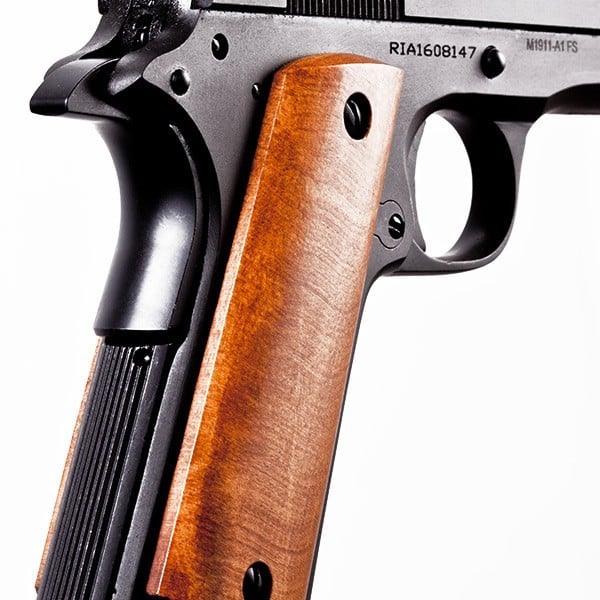
The RIA GI Standard is a Series 70 design, which means it lacks the firing pin safety found in more modern Series 80 1911s. This is a major selling point for trigger snobs.
Cast Frame & Forged Slide
Rock Island uses a cast 4140 steel frame, while the slide is forged. Some purists turn their noses up at cast frames, but RIA has proven over decades that their casting process is incredibly durable. The gun feels like a solid brick of steel in the hand, weighing nearly 40 ounces empty.
Ergonomics & Controls
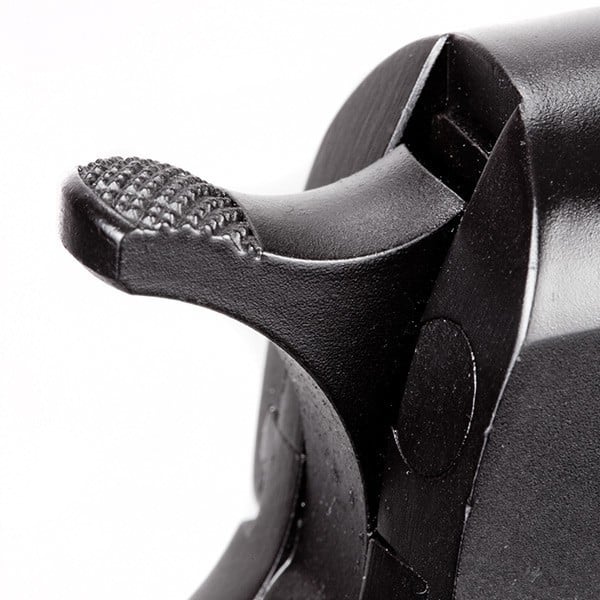
The controls are GI to the core. The thumb safety is a small, single-sided lever that clicks with a metallic thwack. The grip safety is the old-school narrow variety. Because there is no extended beavertail, the spurred hammer sits very close to the web of your hand. If you have a high grip, prepare for some range rash after a long session.
Sights & Trigger
The sights are low profile, which is code for tiny. They are non-adjustable and fixed to the slide. The trigger, however, is the saving grace. Even on this budget model, the single-action break is usually between 4 and 6 lbs with very little creep. It is a much better trigger than you’ll find on almost any $400 striker-fired pistol.
RIA 1911 GI Standard
At the Range: 1,500 Round Test
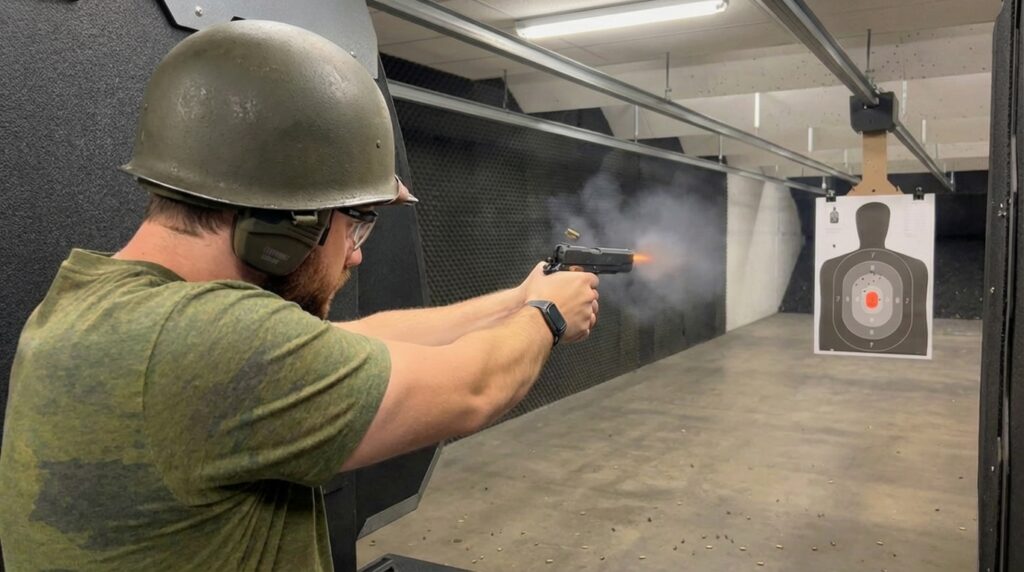
To see if the “cheap” 1911 could actually go the distance, I ran 1,500 rounds through a box-stock GI Standard over the course of three months.
The Break-In Period
Rock Island explicitly recommends a 500-round break-in. They aren’t kidding. During the first 150 rounds, I had several “stovepipes” and failure-to-feeds. The gun was extremely tight from the factory. I doused the rails in Slip 2000 and kept shooting. By round 400, the malfunctions stopped entirely, and the gun started running like a sewing machine.
Ammo Performance & Reliability
I fed the RIA a steady diet of:
- 1,100 Rounds: Armscor 230gr FMJ (Factory matched)
- 200 Rounds: Winchester White Box 230gr FMJ
- 200 Rounds: Speer Gold Dot 230gr JHP
The gun loved the 230gr ball ammo. It ate the Armscor and Winchester rounds without a single hitch after the break-in. It was surprisingly decent with the Speer Gold Dot hollow points, though I did have one failure to feed where the blunt nose of the hollow point hit the feed ramp and stopped.
Internal Inspection: Post-1,500 Rounds
I detail-stripped the gun after the test to check the internals.
- Slide Rails: Surprisingly little wear. The Parkerizing had worn down to silver in the high-friction areas, but the surfaces were smooth.
- Barrel Lugs: No signs of peening or rounding. The lock-up remained as tight as it was on day one.
- MIM Parts: Like most budget guns, the RIA uses some Metal Injection Molded (MIM) parts (like the sear and hammer). I looked for stress cracks or chips, but found none.
- The Feed Ramp: I noticed some light brass marking on the ramp, but no deep gouges. A quick polish would likely make this gun even more reliable with hollow points.
Performance Testing Results
Reliability (8/10)
The RIA GI Standard is a rugged workhorse, but it demands respect for the break-in process. During the first 150 rounds of a 1,500-round test, the gun suffered several stovepipes and failure-to-feeds because the factory fit was incredibly tight.
However, after dousing the rails in Slip 2000 and crossing the 400-round mark, the malfunctions vanished. From that point on, it ran like a sewing machine, eating a steady diet of 230gr ball ammo without a single hitch. It even handled Speer Gold Dot hollow points with only one minor failure to feed, proving that while it’s a budget gun, it’s dependable once the metal surfaces have been properly mated.
Accuracy (7/10)
This gun is mechanically accurate, but your performance is strictly limited by the sights. At the range, the single-action trigger is the saving grace, offering a crisp break between 4 and 6 lbs with very little creep. However, the GI-style sights are essentially two tiny slivers of metal that are nearly impossible to pick up quickly or in low light.
You will likely spend more time hunting for that front blade than actually aiming. It is more than capable of putting lead where you want it at standard engagement distances, but don’t expect to win any precision bullseye matches without some serious concentration.
Ergonomics & Recoil (6/10)
The ergonomics are a throwback to 1911, for better or worse. The 40-ounce steel construction does a great job of soaking up the push of the .45 ACP, making it feel like a solid, controllable brick in the hand.
That said, the “GI” controls feel dated; the thumb safety is a tiny, single-sided lever, and the factory wood grips are thick and can get slick when your hands start to sweat. Because there is no extended beavertail, shooters with a high grip should prepare for range rash as the spurred hammer sits dangerously close to the web of the hand.
Fit, Finish, and Quality Control (6/10)
You can see exactly where Rock Island saved money to keep the price under $450. Inside the slide, machining marks are clearly visible, and the Parkerized finish is thin and prone to showing wear or freckling quickly if not kept heavily oiled.
While the 4140 steel construction feels indestructible, the use of Metal Injection Molded (MIM) parts for the sear and hammer reflects its budget nature. It isn’t a museum piece, but for a tool designed for pure utility, the fit is functional where it counts, such as the barrel lockup which remained tight even after 1,500 rounds.
Known Issues & Problems
The Rock Island GI Standard is a legendary budget workhorse, but you don’t get this price tag without some rough edges. Most problems with this gun are actually just the reality of 1911 maintenance that modern striker-fired shooters aren’t used to.
The Magazine Bottleneck
The single biggest point of failure is the factory ACT-MAG. While they are decent range mags, the feed lips are notorious for spreading over time, leading to nose-dive jams where the round slams into the bottom of the feed ramp. If your RIA is choking, 99% of the time a Wilson Combat 47D or a Mec-Gar magazine will solve the problem instantly.
Extractor Tension & Stovepipes
Because these are mass-produced, the extractor tension can be hit-or-miss out of the box. If you experience stovepipe malfunctions (where the spent casing gets stuck in the ejection port), your extractor is likely too loose. Conversely, if it’s too tight, the gun won’t go fully into battery. Learning to tune a 1911 extractor is a rite of passage for RIA owners, but most local gunsmiths can fix it in five minutes for a few bucks.
Parkerized Freckling
The Parkerized finish is a porous phosphate coating. It is designed to soak up oil to protect the metal. If you carry this gun against your skin or leave it in a humid safe without a heavy coat of oil, it will develop surface rust, often called freckling, within days. This isn’t a bad finish; it’s just a high-maintenance one. Keep a silicon cloth handy and wipe it down every time you touch it.
The 500-Round Break-In
RIA explicitly tells you the gun needs a 500-round break-in period. During this time, the cast frame and forged slide are essentially sanding each other into a perfect fit. You will have malfunctions during the first few boxes of ammo. Don’t call the warranty department until you’ve hit the 500-round mark and performed a deep clean.
Slide Stop & Soft Metal Myths
There is a persistent rumor on forums about soft metal on the slide stop notch. While RIA uses quality 4140 steel, the slide stop itself is a high-wear part. If you consistently slingshot the slide using the slide release as a lever, you may see some peening of the notch over several years. This is a common 1911 trait, not a defect unique to Rock Island.
Parts, Accessories & Upgrades
- Magazines: Get two Wilson Combat 47D magazines immediately.
- Grips: Swap the smooth wood for Pachmayr Signature Grips if you want better control.
- Sights: If you can’t see the tiny sights, a drop of neon orange nail polish on the front blade makes a world of difference.
One of the best things about the Rock Island Armory GI Standard is that it uses the classic Government Model blueprint, meaning it has access to a massive universe of 1911 parts. Because this is a bare-bones gun, a few strategic upgrades can significantly improve the shooting experience. Here are the parts I recommend to turn this budget workhorse into a more refined shooter.
Recommended Upgrades
| Upgrade Category | Recommended Component | Why It Matters | Cost Estimate |
| Magazines | Wilson Combat 47D | Replaces the inconsistent factory ACT-MAG to solve 99% of feeding issues. | $35 – $45 |
| Grips | Pachmayr Signature Grips | Provides a secure, rubberized hold to replace the “slick” factory wood. | $30 – $45 |
| Sights (Low Cost) | Neon Orange Nail Polish | A simple drop on the front blade makes the tiny GI sights actually visible. | $5 – $10 |
| Sights (Gunsmith) | Fiber Optic/Novak (Milling required) | Professional installation is needed because the GI sights are staked and fixed. | $150 – $250 |
| Maintenance | Slip 2000 Lubricant | Essential for getting through the heavy 500-round break-in period. | $15 – $20 |
| Protection | Silicon Wipe-Down Cloth | Prevents “freckling” and surface rust on the porous Parkerized finish. | $5 – $10 |
When it comes to where to buy parts and accessories for your 1911, we’ve got a few solid options.
- Palmetto State Armory – Our first port of call for parts for more or less anything.
- Brownells – Great 1911 parts bin
- Optics Planet – Slow delivery sometimes, but an epic selection of parts, upgrades and add-ons.
The Verdict
The Rock Island Armory 1911 GI Standard is a 9/10 for value. It is the perfect entry-level 1911 for someone who wants to learn the platform without spending a month’s rent. It requires a bit of a break-in and some basic maintenance, but it is a rugged, dependable firearm that honors the original design faithfully.
Final Score: 8.2/10
Best For: Budget-conscious shooters and 1911 purists who want a simple, effective .45 ACP.
RIA 1911 GI Standard
FAQ – Rock Island Armory GI Standard 45 ACP
Is the Rock Island 1911 GI made in America?
No. It is manufactured by Armscor in the Philippines. However, they have a major US headquarters in Pahrump, Nevada, which handles all US sales and warranty work.
Can I change the sights on the GI model?
It’s difficult. The front sight is staked and the rear is a GI-style dovetail. You cannot simply swap them for modern sights without significant gunsmithing or slide milling.
What is the best ammo for the Rock Island 1911?
Stick to 230-grain Full Metal Jacket (FMJ) ball ammo. This is what the gun was designed for. If you carry it for defense, test at least 100 rounds of your chosen hollow point first.
Does it come with a lifetime warranty?
Yes. Rock Island Armory offers a limited lifetime warranty on their firearms. Their customer service is widely regarded as some of the best in the industry.
Is it safe to dry fire?
Generally, yes, but with any 1911, it is a good idea to use snap caps to protect the firing pin and breech face over long periods of dry fire practice.
Will this gun fit standard 1911 holsters?
Absolutely. It follows the standard Government Model dimensions, so any holster made for a 5-inch 1911 will fit like a glove.
Is the frame cast or forged?
The frame on the GI Standard is investment cast, while the slide is forged. This is how they keep the price so low while maintaining strength where it matters most.
How do I stop hammer bite?
The easiest way is to wear a shooting glove. If you want a permanent fix, you’ll need to have a gunsmith install a wide beavertail grip safety, which usually requires modifying the frame. If you know you're going to do that, look at the Springfield Armory Defender or Magnum Research Desert Eagle G Series instead. Or the Tisas.
Author

Related Guides