

Last updated March 24th 2026
Some of the links below are affiliate links, meaning at no additional cost to you, we may earn a commission if you click through and make a purchase.
- Treat every gun as loaded
- Point the muzzle in a safe direction
- Keep your finger off the trigger until you’re ready to shoot
- Know your target and what’s beyond
Quick Verdict
I’ll save you 3,000 words of suspense. The Sig P365 wins this fight for most people, but it’s closer than the internet wants you to believe. The P365 has a better trigger, slightly more refined ergonomics, and the XL upgrade path is genuinely compelling. If you blindfolded me and told me I had to carry one micro compact for the rest of my life, I’d grab the P365. Not because the Hellcat is bad. It’s legitimately excellent. The P365 just edges it out where it matters most to me.
That said, the Springfield Hellcat is the smarter buy if you’re on a budget. It streets for $50-75 less, gives you an extra round in the flush-fit mag, and the OSP model has a better optics mounting ecosystem than Sig’s proprietary footprint. You genuinely can’t go wrong with either gun. I’ve carried both extensively and trust both with my life. But if we’re splitting hairs, and that’s exactly what we’re doing here, the P365 takes it.
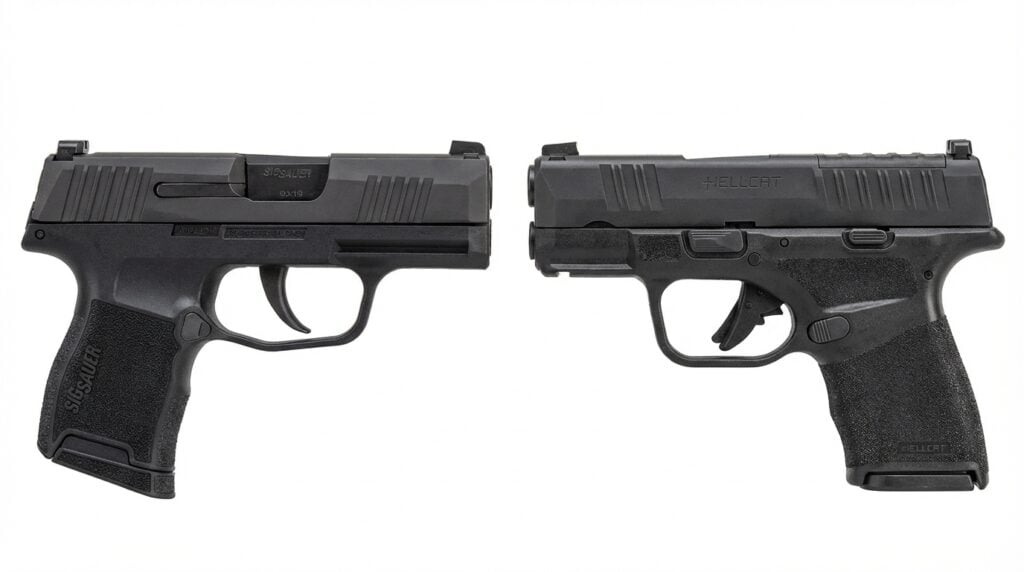
Specs Comparison
Let’s get the numbers out of the way. These two guns are absurdly close on paper, which is why this comparison gets so heated online. Here’s the side-by-side breakdown.
| Spec | Sig Sauer P365 | Springfield Hellcat |
|---|---|---|
| Caliber | 9mm Luger | 9mm Luger |
| Capacity | 10+1 / 12+1 / 15+1 | 11+1 / 13+1 / 15+1 |
| Barrel Length | 3.1″ | 3.0″ |
| Overall Length | 5.8″ | 6.0″ |
| Height | 4.3″ | 4.0″ |
| Width | 1.06″ | 1.0″ |
| Weight (empty) | 17.8 oz | 17.9 oz |
| Trigger | Flat, ~5.5 lb pull | Curved, ~5.5 lb pull |
| MSRP | ~$599 | ~$569 |
| Street Price | ~$450-500 | ~$400-450 |
Almost identical. We’re talking fractions of an inch and fractions of an ounce. The biggest real-world differences are capacity (Hellcat wins by one round at base), trigger style (flat vs. curved), and price. Everything else is a rounding error. So let’s talk about what actually matters when these guns are in your hands.
Size and Ergonomics
On paper, the Hellcat is technically shorter in grip height and narrower. In your hand? You’d never know it. These guns feel remarkably similar in size, and both disappear inside a quality concealed carry holster whether you’re running AIWB or strong-side hip. I’ve carried both in the same holster shell and couldn’t tell the difference under a t-shirt. Neither prints. Neither digs into your side. They’re both just… small.
Where the P365 pulls ahead is feel. The grip texture on the Sig is more refined. It’s aggressive enough to lock in during recoil but doesn’t shred your skin during a full day of appendix carry. The Hellcat’s texture is a bit more abrasive. Fine for range work, slightly less pleasant against bare skin all day. It’s a minor gripe, but when both guns are this close, the small stuff matters.
The P365’s grip also fills the hand slightly better for me. My pinky gets a solid purchase on the flush-fit 10-round mag, whereas the Hellcat’s 11-round flush mag leaves me hanging just a bit. Extended mags solve this on both guns, obviously. But if you’re running the smallest possible configuration, the P365 feels better in medium to large hands.
Controls are a wash. Both have reversible mag releases and serviceable slide stops. The P365’s slide is slightly easier to rack in my experience, which matters if you’re recommending one of these to a newer shooter or someone with smaller hands. The Hellcat’s slide serrations are deep and grippy, though, so it’s not like you’ll struggle with either one. Winner: P365, by a nose.
Trigger
This is where the P365 starts building a real lead. The flat-faced trigger on the Sig is genuinely one of the best triggers in any production micro compact. Period. The take-up is smooth, the wall is distinct, and the break is clean and predictable. It feels like it belongs in a gun that costs $200 more. I’ve shot P365s with well north of 2,000 rounds on them and the trigger only gets better as it breaks in.
The Hellcat’s trigger isn’t bad. Let me be clear about that. The curved trigger has a decent break and a fairly short reset. But it’s mushier than the Sig’s, with more creep before the wall and a less defined break. You notice it most during slow-fire accuracy work at distance. For defensive shooting at 7 yards? Honestly, both triggers are fine. You’ll never notice the difference under stress.
The reset is another area where the P365 shines. It’s short and tactile. You can feel and hear the click as the trigger resets, which makes fast follow-up shots more intuitive. The Hellcat’s reset is longer and less pronounced. For competition-style shooting or rapid drills, that P365 reset makes a noticeable difference in split times. For defensive use? Again, probably won’t matter. But we’re comparing, so let’s compare.
If you shoot these guns back to back at the range, the P365 trigger puts a smile on your face. The Hellcat trigger is just… there. It works. That’s the difference between good and great. Winner: P365, decisively.
Capacity
Springfield pulled off something genuinely impressive when they stuffed 11+1 into the Hellcat’s flush-fit magazine. That extra round over the P365’s 10+1 doesn’t sound like much, but in a gun this small, it’s an engineering flex. Both guns offer extended magazine options that bring capacity up to 13 and 15 rounds, so the gap narrows with bigger mags. But that base capacity edge goes to Springfield.
Is one round worth switching platforms over? No. Absolutely not. But if you’re starting from scratch and capacity is your primary concern, the Hellcat gives you more ammo in a virtually identical package. For most of us who carry with a spare mag anyway, this advantage is more theoretical than practical. Still, a win is a win.
Worth noting that the Hellcat’s 13-round extended mag is a sweet spot for a lot of carriers. It adds minimal length to the grip and gives you serious capacity for a gun this size. The P365’s 12-round mag fills a similar role but gives you one fewer round. At the 15-round level, they’re dead even, and both mags extend the grip enough that you’re basically holding a compact-sized gun. Winner: Hellcat.
Accuracy
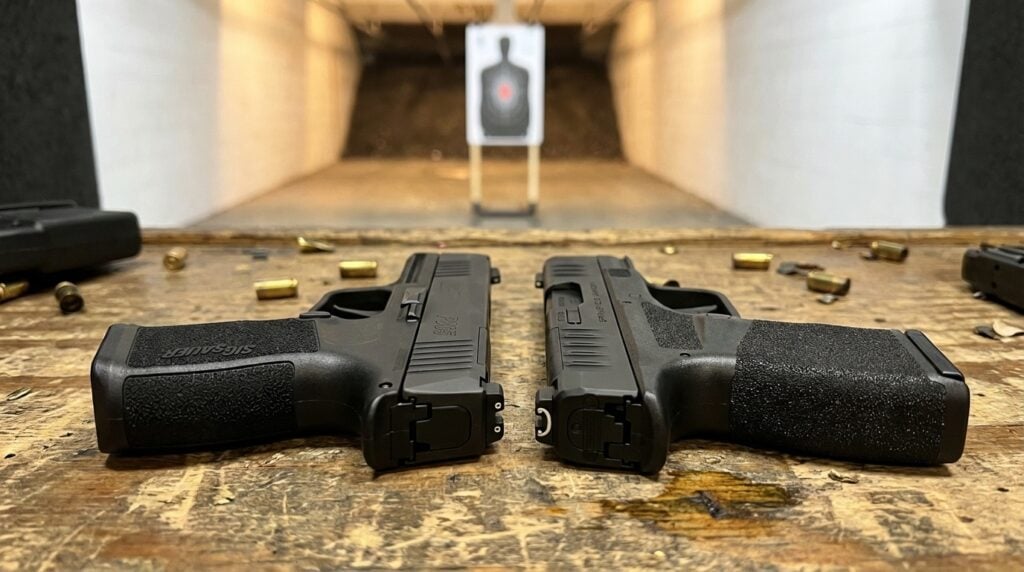
Here’s a dirty little secret about micro compact accuracy comparisons: both of these guns are more accurate than 95% of the people shooting them. From a bench rest at 15 yards, I can keep both inside 2.5 inches consistently with quality ammo like Federal HST or Speer Gold Dot. The mechanical accuracy is there with both platforms. Your fundamentals matter infinitely more than which gun you’re holding.
That said, the P365’s superior trigger does translate to tighter groups for me at 15 yards and beyond. Not dramatically tighter. Maybe half an inch on a good day. The cleaner break lets me call my shots better and avoid pulling groups low-left (the universal right-handed flinch pattern). At 7 yards and in, where most defensive encounters happen, I can’t tell any difference. Both guns stack rounds where I point them.
So who wins? Nobody, really. If you’re shooting sub-2-inch groups from a micro compact, you’re not buying the right size gun. These are defensive tools, and both are combat-accurate well beyond any realistic engagement distance. Winner: Tie.
Reliability
Both of these guns have been on the market since 2018-2019. Millions of each have been sold. The early P365 had some striker drag and primer issues that Sig resolved within the first year. The Hellcat launched cleaner and hasn’t had any widespread reliability concerns. In 2026, both guns are mature, proven platforms that run like sewing machines.
I’ve personally put over 1,500 rounds through my P365 and around 1,200 through a Hellcat OSP. Zero malfunctions with either gun using factory brass-cased ammo from Federal, Winchester, Fiocchi, and Blazer. I’ve run them dirty. I’ve run them dry. I’ve fed them cheap range ammo and premium defensive hollow points. Both just work.
The one thing I’ll mention is break-in. Some P365 owners report the gun runs a bit stiff for the first 100 rounds before everything smooths out. The Hellcat tends to run smoothly right out of the box. Neither gun needs a specific break-in protocol, but don’t panic if your new P365 feels a little tight on the first range trip. Run 200 rounds through it and it’ll loosen up nicely.
Anyone telling you one is significantly more reliable than the other is selling you something. Or they got a lemon, which happens with literally every manufacturer. Winner: Tie. Both are stone-cold reliable.
Sights and Optics
Both guns come with usable iron sights out of the box. The P365 ships with Sig’s X-Ray3 tritium night sights, which are genuinely good. The Hellcat comes with a U-Dot sight system that’s quick to pick up but not tritium. Edge to Sig on irons. But let’s be honest, most people reading this comparison are probably thinking about mounting a red dot.
And that’s where it gets interesting. The Hellcat OSP uses the Shield RMSc footprint, which is essentially the industry standard for micro red dots. You can mount a Holosun 407K, 507K, Shield RMSc, Swampfox Sentinel, and a growing list of others. Direct mount. No adapter plates. No drama. The P365 uses Sig’s proprietary footprint on the X and XL models, which limits you to the Sig Romeo Zero, the new Romeo Zero Elite, or specific optics cut for the Sig pattern.
Sig has been expanding compatibility, and the Romeo Zero Elite is a genuinely good optic. But Springfield wins this round simply because of options. More choices means more price competition, easier replacement if something breaks, and a better chance of finding exactly the optic you want. Winner: Hellcat OSP, clearly.
Aftermarket and Accessories
The P365 has been around slightly longer and sells in massive volume, which means the aftermarket is just enormous. Every holster maker on the planet offers P365 options. Magazines are everywhere. Aftermarket triggers, grip modules, barrels, and slide cuts are abundant. Companies like Wilson Combat even make a premium grip module for the P365 that transforms the ergonomics. The ecosystem is mature and deep.
The Hellcat isn’t far behind. Holster support is excellent, and you’ll find plenty of magazines and accessories. But the P365’s head start and slightly higher sales volume give it the edge in sheer variety. If you’re someone who likes to customize and tinker, the P365 platform gives you more to work with.
One thing that doesn’t get enough attention: the P365 family shares magazines across models. Your flush-fit 10-rounder works in the standard P365, the X, and the XL. Same with the 15-round extended mags. That interchangeability is a real advantage if you end up owning multiple P365 variants, which a lot of Sig fans do. Springfield’s Hellcat and Hellcat Pro don’t share magazines as seamlessly, though the Pro does accept standard Hellcat mags with a sleeve adapter. Winner: P365, slightly.
Price and Value
Let’s talk money. The Hellcat consistently streets for $400-450, while the P365 sits around $450-500. That $50-75 difference is real money, especially if you’re also budgeting for a holster, ammo, training, and maybe an optic. Springfield frequently runs rebates and dealer promotions too, so I’ve seen Hellcats dip below $380 during sales.
The P365 isn’t overpriced. It’s genuinely worth what they’re charging. But the Hellcat gives you 90-95% of the experience for less money. If you’re buying your first concealed carry gun and every dollar counts, the Hellcat is the better value play. If you’ve got the budget and want the best possible trigger and ergonomics, the P365 is worth the premium.
Either way, both guns are insane value compared to what micro compacts cost just five years ago. We’re living in the golden age of micro compact 9mm pistols, and the price war between these two has been great for consumers. Five years ago, you’d pay $550+ for either of these at a gun shop. Now you can regularly find them under $450. That’s wild for this level of quality.
One more thing on value: factor in the long-term cost of ownership. Magazines, holsters, and accessories are all slightly cheaper for the Hellcat across the board. OEM Hellcat magazines run about $30-35 versus $40-45 for P365 mags. Over time, those differences add up if you’re buying spare mags for training and carry rotation. Winner: Hellcat, on price.
Sig Sauer P365 Current Prices
Springfield Hellcat Current Prices
Which Should You Buy?
Buy the Sig P365 if the trigger matters to you. If you’re a shooter who notices the difference between a good trigger and a great one, the P365 will make you happy every time you go to the range. It’s also the better choice if you’re eyeing the XL or X Macro as a future upgrade, since magazines and holsters cross over within the P365 family. And if you want the Wilson Combat grip module option, that’s a P365-only upgrade that’s worth every penny.
Buy the Springfield Hellcat if budget is a real consideration. That $50-75 you save can go toward ammo and training, which will make you more dangerous than any trigger upgrade ever will. The Hellcat is also the move if you want to mount a red dot, thanks to the universal RMSc footprint on the OSP model. Pair it with a Holosun 507K and you’ve got one of the best concealed carry setups available at any price.
If you’re brand new to concealed carry, honestly, go handle both at your local gun shop. Whichever one feels better in your hand is the right answer. The performance gap between these two guns is so small that personal preference should be the tiebreaker. Grip angle, trigger feel, how the sights look to your eyes. These things are subjective, and they matter more than any spec sheet comparison.
What about the upgraded models? If you can conceal a slightly larger gun, the P365 XL gives you a longer sight radius and a 12-round flush mag in a package that’s still very concealable. The Hellcat Pro does the same thing with a 15-round flush mag and a 3.7-inch barrel. Both are outstanding options for people who find the standard models just a hair too small. I’d take the XL over the Pro personally, but it’s genuinely close.
Either way, you’re buying one of the two best micro compact pistols ever made. Full stop. You can carry either one every single day with complete confidence. The “loser” of this comparison is still a phenomenal firearm that millions of people trust with their lives. Don’t let analysis paralysis keep you from getting trained and getting armed. Pick one, buy a quality holster, and go send rounds downrange.
Final Thoughts
The Sig P365 vs Springfield Hellcat debate isn’t going away anytime soon, and honestly, that’s a good thing. Competition between these two platforms has driven prices down and quality up for everyone. Both guns get incremental improvements every year. Both have spawned entire families of variants (the P365 X, XL, X Macro, and AXG lines; the Hellcat Pro and RDP). And both continue to set the standard that every new micro compact gets measured against. When Smith and Wesson launched the Shield Plus, when Glock finally released the 43X MOS, when Ruger brought out the Max-9, they were all gunning for these two. That tells you everything.
My P365 lives in my daily carry rotation and has for years. I’ve recommended the Hellcat to friends and family members without hesitation. You really can’t lose here. Just pick the one that speaks to you, invest in good defensive ammo, find a holster that works for your body, and train. That last part matters more than anything in this article. Stay safe out there.
FAQ: Sig P365 vs Springfield Hellcat
Is the Sig P365 better than the Springfield Hellcat?
For most shooters, yes. The P365 has a superior flat-faced trigger, slightly better ergonomics, and a more mature aftermarket ecosystem. But the Hellcat wins on base capacity and price, so it depends on your priorities.
Which is more reliable, P365 or Hellcat?
Both are equally reliable in 2026. The early P365 had minor striker drag issues that Sig resolved quickly. Both guns have millions of rounds through them collectively with no systemic problems. You can trust either one.
Is the P365 or Hellcat easier to shoot?
The P365 is slightly easier to shoot well thanks to its superior trigger and marginally better grip ergonomics. The difference is most noticeable during slow-fire accuracy drills at 15 yards and beyond. At typical defensive distances, both shoot equally well.
Can you put a red dot on both the P365 and Hellcat?
Yes. The P365 X and XL models accept optics via Sig s proprietary mounting system. The Hellcat OSP uses the industry-standard Shield RMSc footprint, which gives you more optic choices including the popular Holosun 407K and 507K.
Which has better capacity, P365 or Hellcat?
The Hellcat wins base capacity with 11+1 rounds in the flush-fit magazine versus the P365 s 10+1. Both offer 15-round extended magazines. That one extra round in the smallest configuration gives Springfield the edge here.
Is the Hellcat cheaper than the P365?
Yes, typically by 50 to 75 dollars. The Hellcat streets for around 400 to 450 dollars while the P365 runs 450 to 500. Springfield also runs frequent rebates that can push the Hellcat below 380 dollars during sales.
What holsters work for both the P365 and Hellcat?
Both guns have excellent holster support from every major manufacturer. However, they are different sizes and shapes, so holsters are not interchangeable between them. Companies like Tier 1, Tenicor, and Vedder make dedicated models for each.
Should I get the P365 XL or Hellcat Pro instead?
If you want a slightly larger micro compact with a longer grip and barrel, both the P365 XL and Hellcat Pro are excellent upgrades. The XL has better trigger feel and the Pro has better optic compatibility. Both are fantastic concealed carry options for people who can conceal a slightly bigger gun.
Author

14,511+ Gun & Ammo Deals
Updated daily from 10+ top retailers. Filter by category, caliber, action type, and price.