
Affiliate disclosure: This Smith & Wesson Model 500 review contains affiliate links. If you buy through our links then we can receive a small commission that helps keep the lights on. You don’t pay anything more.
- Treat every gun as loaded
- Point the muzzle in a safe direction
- Keep your finger off the trigger until you’re ready to shoot
- Know your target and what’s beyond
Review: Smith & Wesson Model 500 – The Most Powerful Production Revolver Ever Made
Our Rating: 7.0/10
- RRP: ~$1,500
- Street Price: $1,350-$1,600 (Check our live pricing for the best current deal)
- Caliber: .500 S&W Magnum
- Action: Double-action / Single-action
- Barrel Length: 8.375″ (also available in 4″, 6.5″, 10.5″)
- Overall Length: 15″
- Weight (Unloaded): 72.5 oz (8.375″ barrel)
- Capacity: 5 rounds
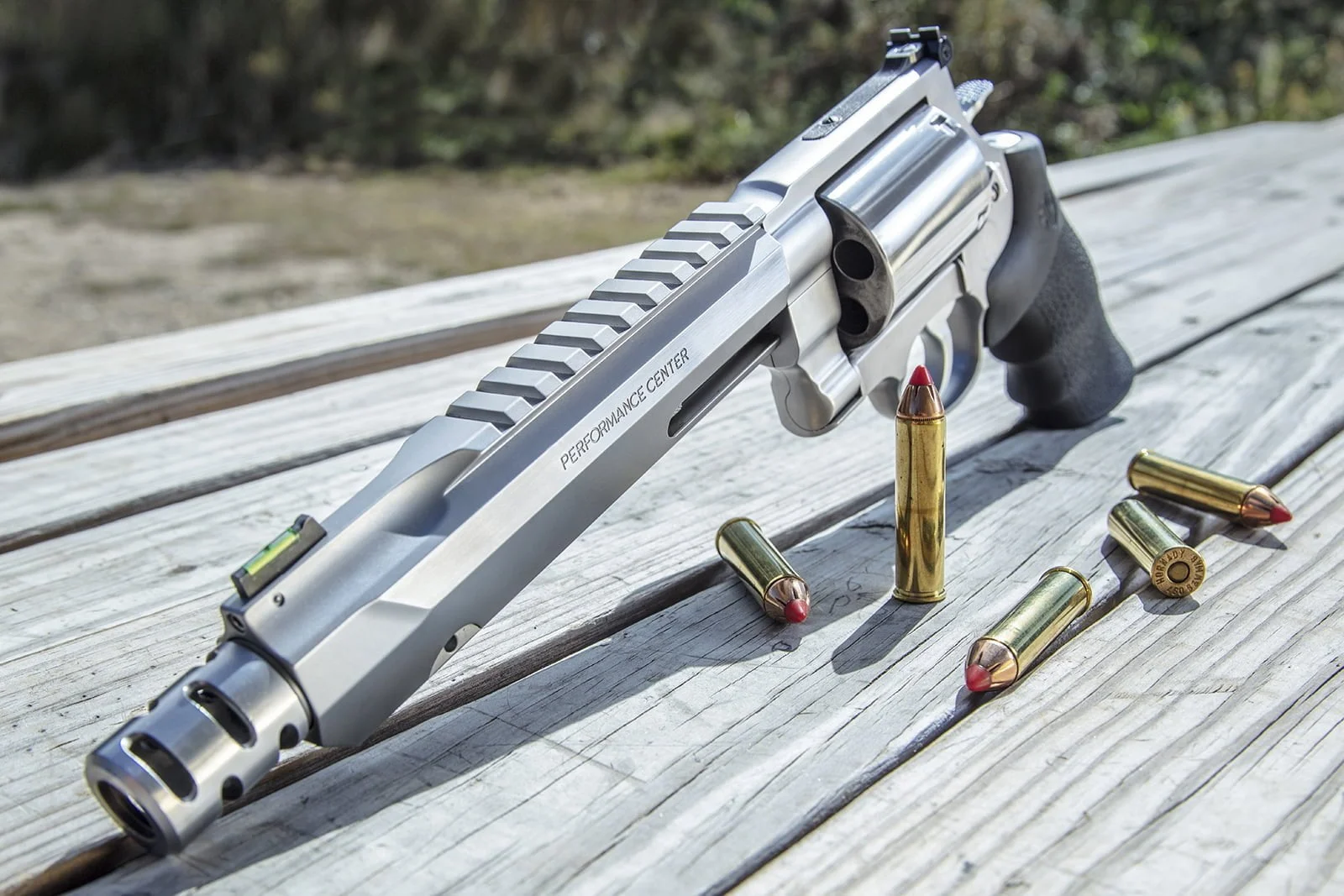
- Frame: X-Frame (stainless steel)
- Barrel: Compensated
- Sights: Front orange ramp, adjustable rear
- Optics: Picatinny top rail
- Grip: Hogue rubber monogrip
- Made in: USA (Springfield, MA)
Pros
- The most powerful production revolver ever made, period
- Over 2,600 ft-lbs of muzzle energy capable of taking any game in North America
- Excellent S&W build quality and stainless steel construction
- Compensated barrel tames recoil as much as physics will allow
- Picatinny rail makes optics mounting simple for hunters
Cons
- Ammo costs $2-4 per round, and you will burn through it
- Recoil is genuinely painful for most shooters after a few cylinders
- At 72.5 oz unloaded, extended carry is exhausting
- Ammo availability can be spotty at local shops
- Holster options are extremely limited
Current Smith & Wesson Model 500 Prices
Quick Take
There’s no polite way to say this: the Smith & Wesson Model 500 is completely ridiculous. It fires a .500 S&W Magnum cartridge that produces over 2,600 ft-lbs of muzzle energy. That’s more than most rifle cartridges. It weighs four and a half pounds empty. And none of that matters, because this gun exists for one reason: because Smith & Wesson proved they could build it.
I spent time with the 8.375″ barrel version, which is the most common configuration. After 500 rounds (yes, at $2-4 per round, I’m aware of the math), I can tell you this revolver does exactly what it promises. It puts absolutely enormous amounts of energy downrange with the kind of reliability you expect from a well-built wheelgun.
Is it practical? Not really. Is it the best choice for self-defense? Absolutely not. Can it take down any game animal on the North American continent? Without question. But the real reason people buy the Model 500 is simpler than all of that. They buy it because holding 2,600 ft-lbs of energy in your hands makes you grin like an idiot. And honestly, that’s reason enough.
Best For: Handgun hunters pursuing dangerous or large game, shooters who want the most powerful production revolver ever made, and anyone who believes “because I can” is a perfectly valid reason to own a firearm. Also pairs well with our guides on the most powerful handguns and big game hunting handguns.
Why Smith & Wesson Built the Model 500 This Way
In 2003, Smith & Wesson partnered with Cor-Bon to create the .500 S&W Magnum cartridge. The goal was straightforward: build the most powerful production handgun in the world. Not the most practical. Not the most comfortable. The most powerful. Full stop.
To handle the enormous chamber pressures (60,000 PSI), S&W had to design an entirely new frame. The existing N-frame that housed the .44 Magnum wasn’t even close to sufficient. The result was the X-frame, the largest revolver frame S&W has ever produced. Everything about it is overbuilt by design because it has to be.
The compensated barrel isn’t just a nice touch. It’s a necessity. Without it, the .500 S&W Magnum’s recoil would be genuinely unmanageable for most shooters. The ports redirect muzzle gases upward to counteract barrel rise, and they make a meaningful difference. The gun is still brutal to shoot, but the compensator keeps it on the right side of controllable.
S&W also made the smart decision to include a Picatinny rail on top. The Model 500’s primary real-world application is handgun hunting, and mounting a red dot or pistol scope transforms it from a range novelty into a legitimate hunting tool. At distances where you can manage the recoil well enough to shoot accurately, this revolver can ethically take elk, moose, and even brown bear.
The 8.375″ barrel is the sweet spot in the lineup. The 4″ snub version (yes, it exists) is borderline comical to shoot and sacrifices significant velocity. The 10.5″ barrel squeezes out extra performance but makes an already unwieldy gun even harder to handle in the field. The 8.375″ balances ballistic performance with something approaching manageability.
Competitor Comparison
The Model 500 doesn’t have a lot of direct competitors because not many manufacturers want to play in this space. But there are a handful of big-bore revolvers worth considering if you’re shopping for maximum handgun power.
Magnum Research BFR .45-70 (~$1,200)
The BFR (Biggest Finest Revolver) in .45-70 Government is the most interesting alternative to the Model 500. The .45-70 cartridge doesn’t match the .500 S&W Magnum’s raw energy numbers, but it’s been dropping large game since the 1870s and has vastly better ammo availability. You can walk into almost any gun shop and find .45-70 on the shelf. Try that with .500 S&W Magnum.
The BFR also costs roughly $300 less, and the ammo runs about $1-2 per round instead of $2-4. If your goal is hunting big game with a revolver and you value practicality at all, the BFR in .45-70 deserves serious consideration. The Model 500 wins on raw power and brand cachet, but the BFR wins on cost of ownership.
Magnum Research BFR .45-70 Prices
Smith & Wesson 460 XVR (~$1,500)
The 460 XVR is the Model 500’s sibling from the same X-frame family. It fires the .460 S&W Magnum, which produces slightly less energy than the .500 but has one huge advantage: versatility. The 460 XVR can also fire .454 Casull and .45 Colt, giving you three cartridges in one gun. That means you can practice with cheaper .45 Colt loads and save the full-power .460 rounds for hunting.
The .460 S&W Magnum also holds the record for highest velocity in a production handgun. If I were choosing between the 500 and the 460 XVR for actual hunting use, the 460 XVR’s ammo flexibility makes it the more practical choice. The Model 500 is for people who want the title of “most powerful,” not “most versatile.”
Smith & Wesson 460 XVR Prices
Ruger Super Redhawk .454 Casull (~$1,100)
The Super Redhawk in .454 Casull is the sensible choice in the big-bore revolver world, if “sensible” is a word that applies here at all. It produces around 1,600-1,900 ft-lbs of energy depending on the load. That’s significantly less than the Model 500’s 2,600+ ft-lbs, but it’s still more than enough for any North American game animal.
The Ruger costs $400 less than the S&W, the ammo is cheaper and easier to find, and the recoil is stout but manageable with practice. It also fires .45 Colt for affordable practice sessions. For handgun hunting, the Super Redhawk in .454 Casull is arguably the better tool. But nobody buys a Model 500 because they want “arguably better.” They buy it because they want the biggest.
Ruger Super Redhawk .454 Casull Prices
Taurus Raging Hunter .44 Magnum (~$900)
If you’re thinking about a big-bore hunting revolver but the Model 500’s price tag and ammo cost make you wince, the Taurus Raging Hunter in .44 Magnum is worth a look. The .44 Mag produces around 900-1,200 ft-lbs depending on the load. That’s less than half the Model 500’s output, but it’s been taking deer, hogs, and black bear for decades.
The Raging Hunter costs $600 less than the Model 500, and .44 Magnum ammo runs under $1 per round. You can also find it at literally any store that sells ammunition. Taurus quality has improved significantly in recent years, and the Raging Hunter’s factory compensator and cushioned grip make it comfortable enough for extended range sessions. It’s a completely different class of gun, but it may actually be the right answer for most buyers who think they want a Model 500.
Taurus Raging Hunter .44 Mag Prices
Features and Technical Details
The X-Frame
The X-frame is the heart of what makes the Model 500 possible. S&W designed it from scratch specifically for the .500 S&W Magnum cartridge. The cylinder alone is massive, with walls thick enough to safely contain chamber pressures that would crack an N-frame. The entire frame is stainless steel, which adds weight but provides excellent corrosion resistance for a gun that may see field use in all conditions.
The frame’s size is something you have to see in person to fully appreciate. Setting a Model 500 next to a Model 629 (.44 Magnum) makes the 629 look like a compact carry gun. The X-frame cylinder diameter is significantly larger, and the overall proportions are simply in a different category. This is not a gun that hides in any holster.
Compensated Barrel
The compensator on the 8.375″ model is integral to the barrel, not an add-on. It vents gases through ports machined into the top of the barrel near the muzzle. The effect is noticeable. Without compensation, the .500 S&W Magnum would produce barrel rise so severe that follow-up shots would be measured in “eventually” rather than seconds.
With the compensator, the recoil impulse is more of a straight-back push into your palm rather than a violent upward rotation. Don’t misunderstand: it still kicks harder than anything else you’ve ever fired from a handgun. But the compensator keeps it in the realm of “controllable with proper technique” rather than “physically dangerous to the shooter.”
Trigger
The double-action trigger pull is heavy, as you’d expect from a large revolver. It’s smooth but long, and honestly, you’ll want to shoot this gun in single-action mode for accuracy. The single-action pull breaks cleanly with minimal overtravel. It’s a good trigger by big-bore revolver standards.
For hunting applications, single-action is the only realistic option anyway. You’re not doing speed drills with a Model 500. You’re taking one carefully aimed shot at a time. The trigger supports that use case well.
Sights and Optics Rail
The factory sights are a bright orange ramp front with a fully adjustable rear. They’re perfectly adequate for range use and short-range hunting. The orange ramp picks up well against most backgrounds, and the rear adjustments are precise enough to zero the gun for your preferred load.
The real story here is the Picatinny rail on top of the barrel. This is what transforms the Model 500 from a range toy into a hunting revolver. A quality pistol scope or red dot sight makes this gun effective at distances where iron sights become challenging. For serious handgun hunters, the optics rail is arguably the Model 500’s best feature. I’d recommend a Leupold DeltaPoint Pro or a Burris FastFire for those who want to mount a red dot. Check Brownells for optics options.
Grip and Ergonomics
The Hogue rubber monogrip is the right choice for this gun. It absorbs as much recoil as a grip reasonably can, and the rubber texture provides a secure hold even with sweaty hands. S&W could have gone with wood grips for aesthetics, but function matters more here than looks.
That said, the ergonomics score a 5/10 for a reason. The gun is simply too large and too heavy for comfortable extended use. Your hand will fatigue from gripping it. Your wrists will ache from the recoil. Your forearms will feel it the next day. This is the reality of a handgun that weighs 72.5 ounces empty and fires a cartridge that produces over a ton of muzzle energy. Physics doesn’t negotiate.
At the Range: 500 Round Test
Let’s address the elephant in the room. Putting 500 rounds through a Model 500 at $2-4 per round means spending somewhere between $1,000 and $2,000 on ammunition alone. That’s potentially more than the gun costs. I spread this testing over multiple sessions because my hands, wrists, and wallet all required recovery time between outings.
Ammo Log
- Hornady 300gr FTX: 200 rounds (primary hunting load)
- Federal 325gr Swift A-Frame: 100 rounds
- Hornady 500gr XTP: 100 rounds (maximum weight subsonic)
- Winchester 350gr JHP: 100 rounds
Break-In and Initial Impressions
The first five rounds told me everything I needed to know about what I was dealing with. The concussive blast from the compensator is startling even with ear protection. The recoil is unlike any other handgun I’ve fired. It doesn’t snap or flip like a .44 Magnum. It shoves. The entire gun pushes straight back with tremendous force, and the compensator redirects the muzzle blast upward in a visible fireball.
People at neighboring lanes stopped shooting to watch. This happens every single time you bring a Model 500 to an indoor range. Get used to being the center of attention, or bring it to an outdoor range where you’re less likely to disturb other shooters with the concussion.
Reliability
Zero malfunctions across 500 rounds. Not a single one. This is one of the fundamental advantages of a revolver: the mechanism is mechanically simple and extraordinarily reliable. The cylinder locked up tight every time. Extraction was smooth. The ejector rod cleared all five cases cleanly with one push.
I did check cylinder timing and lockup at 100, 250, and 500 rounds. No measurable change. The X-frame is built like a bank vault, and 500 rounds of .500 S&W Magnum didn’t faze it. S&W’s metallurgy and heat treatment on these guns is excellent.
Accuracy Testing
At 25 yards, shooting single-action from a rest, the Model 500 is mechanically very accurate. I managed consistent 2-3 inch groups with the Hornady 300gr FTX load, which was the most accurate ammunition I tested. The Federal 325gr Swift A-Frame ran close behind at around 3 inches. The heavy 500gr Hornady loads opened up to about 4 inches, but those rounds are designed for maximum penetration at close range, not precision at distance.
At 50 yards with iron sights, groups opened to 4-5 inches with the best loads. That’s still minute-of-vitals on any large game animal. With a mounted optic, I’d expect those groups to tighten considerably. The limiting factor on accuracy with the Model 500 isn’t the gun. It’s the shooter’s ability to manage the recoil and maintain a consistent grip through the trigger press.
Standing unsupported? My groups roughly doubled. The gun’s weight actually helps here, as it dampens some of the wobble, but the anticipation of recoil is a real accuracy killer. If you flinch (and you will, at least initially), your shots will go low and left for right-handed shooters.
Recoil Management
I’ll be honest: I could comfortably shoot about 25 rounds per session before my hands started protesting. By 50 rounds, I was done for the day. Some shooters have higher tolerances, but the .500 S&W Magnum’s recoil is cumulative. It doesn’t matter how tough you think you are. Your body has limits, and this cartridge will find them.
Proper grip technique is critical. A high, firm, two-handed hold with your support hand wrapped tightly over the dominant hand is essential. Lock your wrists. Lean slightly forward. And let the gun roll upward in recoil rather than fighting it. Trying to muscle the gun back down immediately will beat up your wrists faster than anything else.
Performance Testing Results
Reliability: 9/10
500 rounds, zero malfunctions. The revolver mechanism is inherently reliable, and S&W’s execution on the X-frame is flawless. Cylinder lockup remained tight throughout testing. Extraction was positive with all ammunition tested. The only reason this isn’t a 10/10 is that no mechanical device is truly perfect, but in my testing, this gun was.
Accuracy: 7/10
The Model 500 is capable of better accuracy than most shooters can extract from it. From a bench rest at 25 yards, 2-3 inch groups prove the mechanical accuracy is there. The challenge is that the recoil makes it genuinely difficult to shoot to the gun’s potential. With an optic and practice, a skilled shooter can make this gun perform at impressive distances. For the average shooter, the recoil will be the limiting factor on accuracy, not the hardware.
Ergonomics and Recoil: 5/10
There’s simply no way to make a 72.5-ounce revolver firing 2,600+ ft-lbs of energy comfortable. The Hogue grip does its best, the compensator helps significantly, and the gun’s weight absorbs some of the impulse. But firing the Model 500 is a physically demanding experience. Most shooters will be sore after a range session. The grip circumference is also very large, which can be an issue for shooters with smaller hands.
Fit, Finish, and QC: 8/10
Smith & Wesson’s fit and finish on the Model 500 is excellent. The stainless steel frame has a consistent satin finish with no machining marks or tool chatter. The cylinder rotates smoothly with no perceptible play when locked. The barrel-to-frame fit is precise, and the compensator ports are cleanly machined. This gun feels like a quality product, which it should at $1,500.
Known Issues and Common Problems
Ammunition Cost and Availability
This is the single biggest issue with the Model 500. At $2-4 per round, range time adds up faster than almost any other firearm. A box of 20 rounds costs $40-80. That’s enough for four cylinders. The cost alone limits how much practice most owners will realistically get with this gun.
Availability is also a concern. Major retailers don’t always stock .500 S&W Magnum. You may need to order online and plan ahead. Reloading is an option if you’re set up for it, but the components (especially brass and bullets) are also more expensive than common calibers.
Follow-Up Shot Speed
The recoil makes fast follow-up shots essentially impossible for most shooters. After each shot, you need to reacquire the target, reset your grip, and manage the adrenaline from the previous round’s recoil. In a hunting scenario, this means your first shot needs to count. For dangerous game, that’s a serious consideration.
Weight and Carry Fatigue
At 72.5 ounces (over 4.5 pounds) unloaded, the Model 500 is exhausting to carry for extended periods. Add five loaded rounds and you’re well over 5 pounds of handgun hanging off your hip. For hunters who spend all day in the field, this weight becomes a real factor. A quality chest rig helps distribute the weight better than a belt holster, but there’s no way to make a 5-pound handgun feel light.
Holster Availability
Finding a holster for the Model 500 is genuinely difficult. The X-frame’s dimensions put it outside the range of most standard holster molds. Custom Kydex makers can build one for you, and a few leather holster manufacturers offer X-frame options, but you won’t walk into a store and find one on the rack. Budget an extra $75-150 for a custom holster and expect to wait for it.
Parts, Accessories, and Upgrades
The Model 500 doesn’t need many upgrades out of the box. S&W got the important things right from the factory. But there are a few additions that make sense, especially for hunting use.
| Upgrade Category | Recommended Component | Why It Matters | Cost Estimate |
|---|---|---|---|
| Optic | Leupold DeltaPoint Pro / Burris FastFire III | Transforms hunting accuracy at distance | $350-$500 |
| Holster | Custom Kydex chest rig | Best carry method for field use, distributes weight | $100-$175 |
| Ammo Carrier | Speed strip or belt slide | .500 S&W speedloaders barely exist, strips work | $15-$30 |
| Grip | Hogue rubber (factory) or wood target grips | Factory Hogue is best for recoil, wood for aesthetics | $30-$70 |
| Trigger Job | Professional action job (S&W Performance Center) | Smooths DA pull, lightens SA for hunting accuracy | $150-$250 |
For optics, grips, and accessories, check current availability at Brownells, which typically has the best selection of S&W compatible parts.
The Verdict
The Smith & Wesson Model 500 is not a practical firearm. It’s expensive to buy, wildly expensive to feed, painful to shoot in quantity, and so heavy that carrying it all day is an endurance event. The ammo is hard to find, holster options are limited, and follow-up shots require a level of patience that most shooters don’t possess. By every rational metric, there are better options for almost any application.
And yet, it’s the most powerful production revolver ever made. It produces over 2,600 ft-lbs of muzzle energy from a handgun. It can ethically take any game animal on the North American continent. When you pull the trigger, it produces a sound and a sensation that no other production handgun can match. For handgun hunters who pursue large and dangerous game, it is a genuinely capable tool that delivers terminal performance no other revolver can equal.
I gave it a 7.0/10 because the practical limitations are real and significant. But I’ll also tell you this: every single person I handed this gun to at the range came back grinning. There is something deeply, unreasonably satisfying about firing the most powerful handgun in the world. The Model 500 exists because it can. If that sentence excites you, you already know you want one. If you’re looking for a great all-around revolver or a .44 Magnum for more practical big-bore shooting, there are better choices. But for the title? Nothing else comes close.
Final Score: 7.0/10
Best For: Dedicated handgun hunters pursuing large or dangerous game, collectors and enthusiasts who want the most powerful production revolver ever built, and anyone who understands that “because it’s the biggest” is a perfectly valid reason to own a gun.
Find the Best Price on the Smith & Wesson Model 500
FAQ: Smith & Wesson Model 500
How powerful is the Smith & Wesson 500?
The S&W 500 fires the .500 S&W Magnum cartridge, generating over 2,600 ft-lbs of muzzle energy with full-power loads. This is roughly 6 times the energy of a 9mm and nearly 3 times a .44 Magnum. It is the most powerful production revolver in the world.
How much does the S&W 500 cost?
The S&W Model 500 typically sells for $1,300 to $1,700 depending on barrel length and configuration. The 8.375-inch barrel version is the most common. Shorter barrel models are slightly cheaper but harder to shoot well.
Is the S&W 500 practical?
Not for most purposes. It is too heavy (72+ ounces), too expensive to shoot ($2-4/round), and too powerful for self-defense (extreme overpenetration risk). It is practical for hunting dangerous game and for shooters who simply want the most powerful handgun experience available. It exists because it can.
Can you hunt with a S&W 500?
Yes. The .500 S&W Magnum is capable of taking any game animal in North America, including grizzly bear, moose, and bison. It is legal for handgun hunting in all states that allow it. The 8.375-inch barrel version with a scope is the best hunting configuration.
How bad is the recoil on the S&W 500?
The recoil is severe. Even with the compensated barrel and rubber grip, full-power .500 S&W loads produce a sharp, violent recoil impulse that most shooters find punishing after a few rounds. Lighter loads (350-grain at moderate velocity) are more manageable. Extended shooting sessions are not enjoyable for most people.
Author

14,752+ Gun & Ammo Deals
Updated daily from 10+ top retailers. Filter by category, caliber, action type, and price.
Related Guides
Take layaway payments on the 500/Smith and Wesson
How to buy this in Pakistan