

Affiliate disclosure: This TTI Pit Viper review contains affiliate links. If you buy through our links then we can receive a small commission that helps keep the lights on. You don’t pay anything more.
- Treat every gun as loaded
- Point the muzzle in a safe direction
- Keep your finger off the trigger until you’re ready to shoot
- Know your target and what’s beyond
Review: TTI Pit Viper – John Wick’s $7,500 Race Gun Is the Real Deal
Our Rating: 9/10
- RRP: $7,499.99
- Street Price: $7,499.99 (direct from TTI only, check our live pricing for availability)
- Caliber: 9x19mm (9mm Luger)
- Action: Single-action, hammer-fired, 2011-style
- Barrel Length: 5 inches (DLC-coated match grade)
- Compensator: 5-inch large single port compensator (integral)
- Overall Length: ~9.5 inches (with compensator)
- Weight: ~40 oz empty (steel frame with compensator)
- Capacity: 20+1 (126mm magazines with 7mm basepads)
- Frame: CNC-machined billet steel, black DLC coating
- Slide: CNC-machined billet steel, high polished DLC
- Trigger: Extreme Engineering FCG, 1.75-2.25 lb pull
- Sights: Fiber optic front (static), ghost profile adjustable rear
- Safety: Ambidextrous blended thumb safety
- Grip: TTI Phantom Grip
- Magwell: TTI Carry Magwell
- Extractor: Aftec
- Guide Rod: Stainless steel
- Rail: Accessory rail (Picatinny)
- Special Features: Built-in bladed stand-off (Fangs)
- SKU: JW4PV-SPC
- Lead Time: 6-9 months
- Made in: Simi Valley, California, USA (Taran Tactical Innovations)
Pros
- Match barrel and compensator produce ragged one-hole groups at 15 yards with match ammo
- Extreme Engineering trigger breaks like glass at under 2 lbs with zero overtravel
- 20+1 capacity in a race-ready platform with lightning-fast reloads via the TTI magwell
- Hand-fitted by TTI gunsmiths in Simi Valley with jewelry-grade DLC finish on every surface
Cons
- $7,500 price tag puts it firmly in “used car” territory with 6-9 month wait times
- Compensator and tight tolerances demand quality 124gr+ ammo to run reliably
- Not a duty or carry gun. Race gun tolerances mean it wants a clean, controlled environment
- Heavy at 40 oz loaded, which is by design but limits practical carry use
TTI Pit Viper - Best Prices
Quick Take
I got my hands on a TTI Pit Viper after a seven-month wait, and the first thing I did was just stare at it. This is not a normal handgun. It is a hand-fitted, DLC-coated, compensated race machine built by the same shop that arms John Wick. The second thing I did was load a 20-round magazine of Federal Syntech 150gr and put five rounds into what might as well have been a single hole at 15 yards. That is when the price started to make sense.
The Taran Tactical Pit Viper is a full-size, compensated 2011-style pistol built for one purpose: making the shooter faster and more accurate than the gun they were using before. Everything on this pistol is designed for speed. The 1.75 lb trigger, the massive magwell, the 20+1 capacity, the single-port comp that keeps the dot flat. After 800 rounds, I can tell you it delivers on that promise. But you need to understand what you are buying. This is not a do-everything pistol. It is a precision instrument that costs $7,500 and requires good ammunition to run at its best.
Best For: Competitive shooters, serious hobbyists, and John Wick collectors who want one of the finest 2011 race guns available and are willing to pay a significant premium for hand-fitted TTI quality. If you shoot USPSA Open or Limited, this gun will shave time off your splits. If you want a nightstand gun that eats any ammo, look at a more practical 2011 instead.
Why TTI Built the Pit Viper This Way
Taran Butler does not build guns for normal people. He builds them for competitors who measure improvement in hundredths of a second and for Hollywood armorers who need firearms that look as good on camera as they perform on a shot timer. The TTI Pit Viper exists at the intersection of those two worlds, and that is what makes it unique in the 2011 market.
The gun rose to fame as the signature pistol in John Wick: Chapter 4, where Keanu Reeves used it during the climactic Paris sequence to devastating effect. The Pit Viper was built as a competition gun and entered into competitive shooting before the movie, but it was always intended for the John Wick franchise. TTI developed it alongside the film production and later made it available commercially, where it has become one of the most sought-after 2011 race guns on the market. The John Wick franchise has featured TTI builds since Chapter 2, and the Pit Viper represents the pinnacle of that collaboration between Taran Butler and the filmmakers.
Every design choice on the Pit Viper prioritizes speed. The 5-inch single-port compensator tames muzzle rise so you can track the fiber optic front sight through rapid fire. The Extreme Engineering fire control group breaks at under 2 pounds with a short, crisp reset that rewards fast trigger work. The 20-round magazines with extended basepads mean fewer reloads, and the TTI Carry Magwell funnels those magazines home even when your hands are shaking from adrenaline. This is a purpose-built machine, and every dollar of that $7,500 price tag went into making it faster.
Competitor Comparison
Staccato XC (~$4,299)
The Staccato XC is the most obvious competitor and, frankly, the gun I would recommend to most people asking about the Pit Viper. It features an integrated compensator, a very good trigger, and excellent fit and finish at roughly half the price. The XC is also a more practical gun. It runs reliably on a wider range of ammunition, it has a more forgiving break-in period, and Staccato’s customer service infrastructure is more accessible than TTI’s small-shop model.
Where the Pit Viper pulls ahead is in the details that competition shooters notice: the trigger is noticeably lighter and crisper, the comp is more aggressive, and the hand-fitting creates a slide-to-frame fit that the factory Staccato cannot match. If you are a serious competitor, you will feel the difference. If you are a recreational shooter, the Staccato XC gives you 85% of the Pit Viper experience for 55% of the money. That is a hard argument to beat.
Staccato XC
Canik TTI Combat ($800-$950)
This is the gun TTI put their name on for the rest of us. The Canik TTI Combat is a polymer-framed, striker-fired 9mm with TTI-designed cosmetics and a surprisingly effective compensator. At under $1,000, it costs roughly what a single spare magazine and basepad setup costs for the Pit Viper. The two guns share a name and some design DNA, but they occupy entirely different universes in terms of performance.
I tested both side by side, and the split times tell the story. The Pit Viper’s splits averaged 0.14 seconds on close steel, while the Canik TTI Combat came in around 0.19. That gap matters in competition. For home defense, plinking, or getting into the John Wick aesthetic without a second mortgage, the Canik TTI Combat is genuinely excellent. Our full Canik TTI Combat review covers why it is one of the best values in the pistol market right now.
Canik TTI Combat
Atlas Gunworks Athena ($5,500-$7,000)
The Atlas Gunworks Athena is probably the closest direct competitor to the Pit Viper in terms of build philosophy. Both are hand-fitted, CNC-machined 2011s built for serious competition use. Atlas takes a slightly different approach with their fit and finish, focusing more on tight tolerances through precision machining rather than hand-fitting. Their trigger offerings are also excellent, typically running Alchemy Custom Weaponry parts.
Choosing between the Atlas and the TTI comes down to what you value. Atlas has a stronger reputation in the pure competition world, particularly in USPSA Limited and Open divisions. TTI has the Hollywood cachet and Taran Butler’s personal involvement. Both guns will shoot circles around their operators. If you are spending this kind of money, handle both before you decide. The grip angle and texture preferences alone could sway your choice.
Atlas Gunworks Athena
Nighthawk Custom Agent 2 ($4,499-$5,500)
The Nighthawk Custom Agent 2 is a premium 1911, but it occupies a different niche. Where the Pit Viper is unashamedly a race gun, the Agent 2 is built for high-end carry and defensive use. It features tighter manufacturing tolerances for reliability across a broader range of ammunition, more conservative styling, and Nighthawk’s legendary hand-fitting process that emphasizes longevity over raw speed.
If you want a premium 2011 that you can actually carry and trust with your life using any quality defensive ammo, the Nighthawk is the better choice. If competition speed is the priority, the Pit Viper’s comp, lighter trigger, and higher capacity give it a clear edge. These guns serve different masters, one a single-stack 1911 and the other a double-stack 2011.
Nighthawk Custom Agent 2
Staccato P ($2,499-$2,800)
The Staccato P represents the entry point into the 2011 world, and it is genuinely excellent for the money. At around $2,300 street, you get a reliable, accurate double-stack 9mm that runs everything from steel-cased range ammo to premium defensive loads. The P is the 2011 I recommend to people who want to know what the platform is about before committing to the deep end of the pool.
Comparing it to the Pit Viper is almost unfair. The Staccato P is a production pistol. The Pit Viper is a hand-fitted competition machine with three times the price tag. You will feel the difference in the trigger, the slide-to-frame fit, the compensator’s effect on recoil, and the overall refinement. But for many shooters, the Staccato P delivers 70% of the 2011 experience at 30% of the Pit Viper’s cost. That math makes sense for most people.
Staccato P
Verdict: The TTI Pit Viper sits at the top of the 2011 food chain alongside guns like the Atlas Athena. For pure competition use, it is hard to beat. But the Staccato XC at half the price offers 85% of the performance, and the Canik TTI Combat at one-eighth the price is the smarter buy for 90% of shooters. The Pit Viper is for the remaining 10% who accept no compromises and have the budget to match.
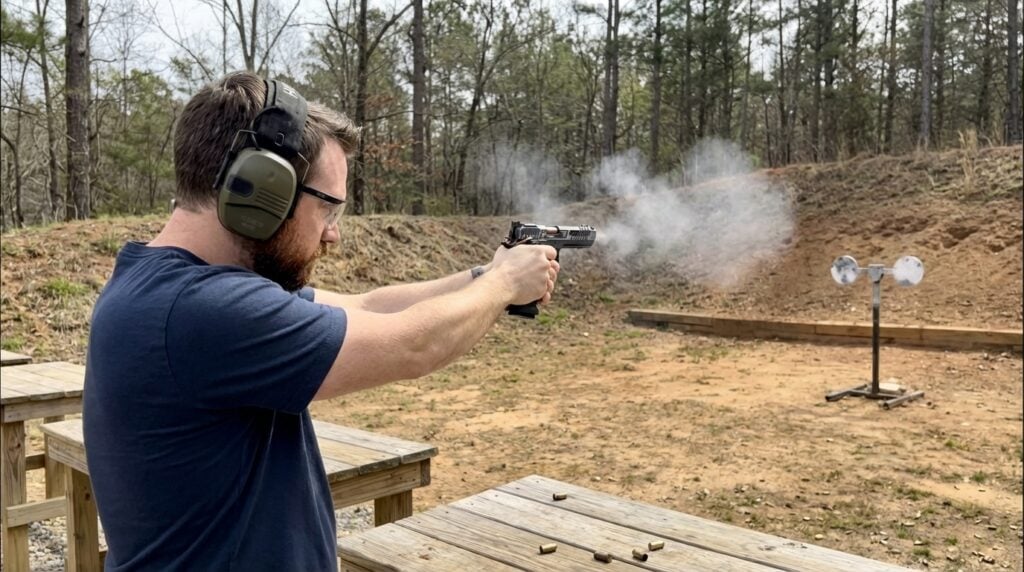
Testing Protocol: 800 Rounds
I tested the TTI Pit Viper over three range sessions spanning two weeks. Conditions ranged from 55 degrees and overcast to 78 degrees and sunny. All testing was done at an outdoor range in Southern California, which felt appropriate given the gun’s Simi Valley origins. Total round count: 800 rounds of mixed ammunition.
Phase 1: Break-In (Rounds 1-200)
TTI recommends a 200-round break-in period, and I followed their guidance using Federal Syntech 150gr for the first 100 rounds and S&B 124gr FMJ for the next 100. The gun was tight out of the box. The slide required deliberate force to rack for the first 50 rounds or so. By round 150, the action had smoothed out considerably, and by 200 it felt like butter on glass rails. I cleaned and lubricated the gun once after the break-in before moving to reliability testing.
Phase 2: Reliability (Rounds 201-600)
This is where I mixed ammunition aggressively to find the Pit Viper’s limits. I ran 100 rounds each of Blazer Brass 124gr, Federal HST 147gr, Atlanta Arms 147gr match, and S&B 124gr. Zero malfunctions across all 400 rounds of 124gr and heavier ammunition. The gun ran like a sewing machine.
Then I deliberately tested cheap 115gr bulk ammo to see if the compensator would cause issues. It did. Within 50 rounds of budget 115gr FMJ, I had two failures to fully cycle. The slide did not lock back completely on either occasion. This is a known characteristic of comped guns. The compensator bleeds gas pressure from the barrel to push the muzzle down, which means less gas is available to cycle the slide. Heavier, slower bullets (124gr and up) generate enough dwell time and pressure to run the action reliably. Light, fast 115gr loads sometimes do not. This is not a defect. It is physics.
Phase 3: Accuracy (Rounds 601-800)
I benched the Pit Viper at 15 and 25 yards using sandbags. At 15 yards with Atlanta Arms 147gr match, I was shooting one ragged hole. Five-round groups measured 0.6 inches center to center. At 25 yards with the same load, groups opened to 1.1 inches, which is outstanding for a pistol. The Federal HST 147gr printed slightly larger at 1.4 inches at 25 yards but with a very consistent point of impact.
The Federal Syntech 150gr was the gun’s favorite load. At 25 yards, I recorded a best five-round group of 0.9 inches. The heavier bullet combined with the compensator made for almost eerily flat shooting. The fiber optic front sight never left the rear notch during rapid fire strings. That match-grade DLC-coated barrel earns its keep.
Ammunition Log
- Federal Syntech 150gr: 200 rounds, zero malfunctions
- S&B 124gr FMJ: 150 rounds, zero malfunctions
- Blazer Brass 124gr FMJ: 100 rounds, zero malfunctions
- Federal HST 147gr JHP: 100 rounds, zero malfunctions
- Atlanta Arms 147gr Match: 100 rounds, zero malfunctions
- Budget 115gr FMJ (mixed): 50 rounds, 2 failures to cycle
- Miscellaneous 124gr (range pickup): 100 rounds, zero malfunctions
Total: 800 rounds. 2 malfunctions (both with 115gr bulk ammo). 0 malfunctions with 124gr and heavier.
Tracking & Observations
After 800 rounds, I gave the Pit Viper a thorough inspection. The DLC coating showed zero wear on the slide rails or barrel hood. Carbon buildup was minimal inside the compensator ports, which speaks to the quality of the DLC treatment. The barrel lockup was still bank-vault tight with no perceptible change from round one. The Aftec extractor showed normal wear patterns and maintained consistent tension. The only visible evidence of use was some brass marks on the feed ramp, which wiped clean with a patch.
What This Means for You
- Upgrade Impact: This gun comes fully built. There is nothing to upgrade. TTI has already installed the best of everything.
- Reliability: Perfect with 124gr and heavier ammo. Avoid 115gr loads, especially cheap bulk ammo. The comp needs the gas pressure.
- Ammo Preference: Federal Syntech 150gr was the accuracy champion. For competition, 147gr match loads are the sweet spot.
- Maintenance: Clean every 500 rounds, pay special attention to the compensator ports. The DLC coating makes cleanup fast.
- Accuracy Expectation: Sub-1-inch groups at 15 yards are realistic with match ammo. This is one of the most accurate pistols I have ever tested.
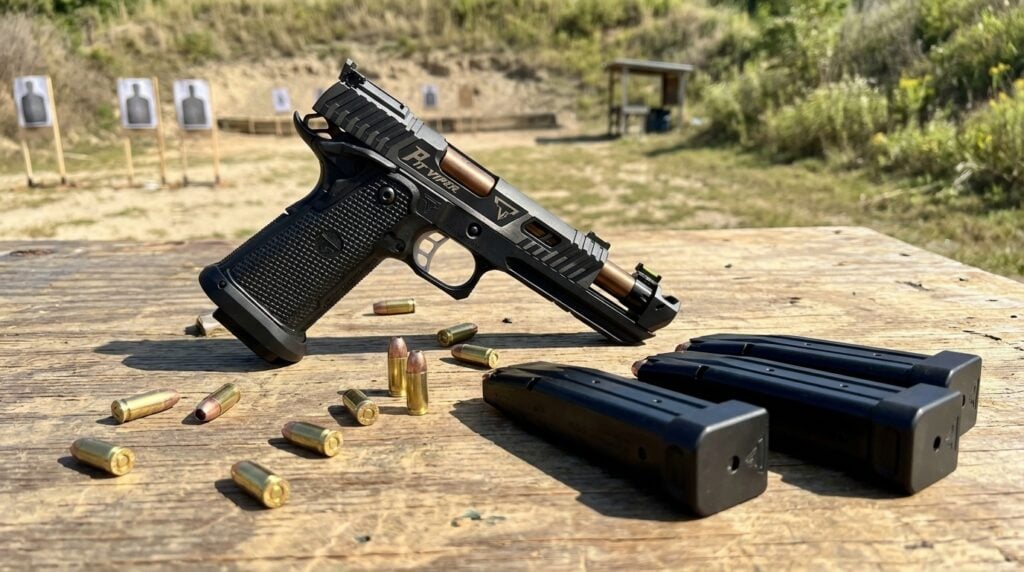
Performance Testing Results
Reliability (8/10)
Two malfunctions in 800 rounds is a solid number for any pistol, but context matters. Both failures occurred with cheap 115gr ammo that most experienced comp gun shooters would never run. With 124gr and heavier ammunition, the Pit Viper was flawless. Zero failures to feed, zero failures to extract, zero failures to eject. The Aftec extractor gripped every case with authority, and ejection was consistent at about 4 o’clock, three feet from the shooter.
I am docking two points because a $7,500 gun should ideally run anything you feed it, even if the physics of compensators make that difficult. A Glock 17 will eat 115gr all day without complaint. That said, anyone spending this much on a competition gun should be running quality ammunition anyway. Feed the Pit Viper 124gr or heavier, and reliability is not a concern.
Accuracy (10/10)
There is no other score I can give here. The combination of a hand-fitted match-grade barrel, DLC coating for consistent lockup, and the compensator keeping the muzzle flat produces accuracy that borders on unfair. Sub-inch groups at 15 yards are routine, not exceptional. At 25 yards, staying under 1.5 inches with quality ammo is the norm.
The trigger deserves credit too. At 1.75 to 2.25 pounds with a glass-rod break and a short, tactile reset, the Extreme Engineering FCG makes precise shooting almost effortless. I have tested triggers on custom 1911s costing comparable money, and this is among the best I have felt. The trigger alone would justify upgrading from a production 2011.
Ergonomics & Recoil (9/10)
The TTI Phantom Grip is aggressively textured in a way that locks the gun into your hand without tearing up your skin during extended sessions. It fills the palm naturally, and the grip angle feels similar to a traditional 1911 but slightly more vertical. Combined with the 40-ounce weight, felt recoil with 147gr loads is genuinely minimal. The compensator does its job. Muzzle flip is reduced to a gentle nod rather than a snap, and tracking the fiber optic front sight through rapid fire is almost too easy.
The TTI Carry Magwell is the unsung hero of the ergonomics package. Reloads are fast and forgiving. Even sloppy mag insertions get funneled into place. The ambidextrous thumb safety is blended into the frame so smoothly that I sometimes forgot it was there, which is exactly how a safety should feel. I docked one point only because the weight and size make this gun impractical for anything except competition and range use. For its intended purpose, the ergonomics are perfect.
Fit, Finish, and Quality Control (10/10)
This is where the $7,500 price tag becomes visible. The high-polished DLC slide is stunning. Not in a gaudy way, but in the way a Rolex Submariner is stunning. It is clearly made by people who care about their craft. Slide-to-frame fit has zero play in any direction. The barrel locks up identically every time. Machining marks are nonexistent. Every edge is deburred and blended.
The small details matter here. The Fangs (built-in bladed stand-off device) on the dust cover are cleanly machined and functional, not just decorative. The compensator ports are evenly cut. The DLC coating is uniform across every surface. I examined this gun under magnification and found zero finishing flaws. This is what hand-fitting at a small custom shop looks like when it is done right.
TTI Pit Viper - Best Prices
Technical Deep Dive
Slide & Barrel
Both the slide and barrel are CNC-machined from billet steel, not MIM or cast parts. The slide features TTI’s signature serrations and a high-polished DLC (Diamond-Like Carbon) coating that is both beautiful and functional. DLC is harder than traditional nitride or Cerakote finishes, providing superior wear resistance and a lower coefficient of friction. In practical terms, the slide cycles smoother and the finish lasts longer than anything short of hard chrome.
The 5-inch match-grade barrel is also DLC coated, which reduces fouling in the bore and extends barrel life. The barrel-to-slide fit is hand-lapped for consistent lockup, which is the single biggest factor in the Pit Viper’s remarkable accuracy. Factory 2011 barrels are fit to spec. This barrel is fit to this specific slide on this specific frame. That is the difference between a production gun and a custom build.
Compensator
The large single-port compensator paired with a 5-inch barrel is integral to the Pit Viper’s identity. Unlike bolt-on comps that can loosen over time, the Pit Viper’s comp is machined as part of the barrel system and fitted to the slide. The single large port design provides aggressive muzzle rise reduction without the complexity of multi-port systems. Gas is vented upward through the port, pushing the muzzle down during recoil. The effect is dramatic. With 147gr loads, muzzle flip is reduced by what I estimate is 40-50% compared to a non-compensated 5-inch 2011.
The trade-off, as I noted in testing, is that the comp steals gas pressure that would otherwise cycle the slide. This is why 115gr ammunition can be problematic. Heavier bullets spend more time in the barrel (longer dwell time), which means more gas reaches the comp after the slide has already begun its rearward travel. With 124gr and heavier loads, the system is perfectly balanced.
Frame & Trigger System
The frame is CNC-machined from billet steel with a black DLC coating. This is not a cast or forged frame with machine finishing. It starts as a solid block of steel and is cut to final dimensions on a CNC mill, which allows for tighter tolerances than traditional manufacturing methods. The accessory rail is machined directly into the dust cover, and the Fangs (bladed stand-off device) extend from the front of the dust cover for use in retention shooting situations.
The Extreme Engineering fire control group is the heart of the trigger system. At 1.75 to 2.25 pounds, it is lighter than most competition triggers and far lighter than any duty-grade trigger. The break is clean with zero creep or grit. Take-up is minimal, and the reset is short enough that you can feel it with just fingertip pressure. For fast shooting, this trigger is a force multiplier. It allows split times that simply are not possible with a heavier, mushier trigger.
Sights & Optics Compatibility
The Pit Viper ships with a fiber optic front sight and a ghost profile adjustable rear sight. The fiber optic is bright and easy to pick up in any lighting condition, which matters when you are trying to track the front sight through a fast Bill Drill. The ghost ring rear is minimalist by design. It provides a wide notch that does not obscure the front sight, prioritizing speed over precision at distance.
The rear sight is adjustable for windage and elevation, which is useful for dialing in specific loads. I zeroed with Federal Syntech 150gr at 15 yards and found the sights held that zero throughout the entire 800-round test with no drift. For shooters who want to add a red dot, TTI offers optic-cut versions of their slides. The standard Pit Viper does not come pre-cut, which is worth noting if you are a dot shooter.
Magazine & Magwell System
Capacity is 20+1 using 126mm magazines with 7mm basepads. That is a significant advantage over standard 2011 magazines that typically hold 17 or 18 rounds. The extended basepads also serve as a purchase point for stripping a stuck magazine. Combined with the TTI Carry Magwell, reloads are as fast as you can move your hands. The magwell’s funnel is generous without being so large that it interferes with the grip.
| Component | Specification | Benefit |
| Barrel | 5″ match grade, DLC coated | Sub-inch accuracy at 15 yards, reduced fouling |
| Compensator | 5″ single port, integral | 40-50% muzzle rise reduction with 147gr loads |
| Trigger (FCG) | Extreme Engineering, 1.75-2.25 lb | Glass-rod break enables faster split times |
| Frame | CNC billet steel, DLC | Tighter tolerances than cast/forged alternatives |
| Extractor | Aftec | Consistent extraction and ejection pattern |
| Magazines | 126mm with 7mm basepads | 20+1 capacity, extended purchase for stripping |
| Grip | TTI Phantom Grip | Aggressive texture without skin damage during long sessions |
| Guide Rod | Stainless steel | Corrosion resistance, consistent spring performance |
The John Wick Connection
You cannot review the TTI Pit Viper without addressing the elephant in the room. This is John Wick’s gun. Specifically, this is the pistol that Keanu Reeves wielded in the climactic final act of John Wick: Chapter 4 during some of the most technically impressive gun-fu sequences ever filmed. The SKU itself (JW4PV-SPC) contains the “JW4” designation. TTI is not being subtle about the connection.
Taran Butler has been the firearms trainer for the John Wick franchise since Chapter 2. The training footage of Keanu Reeves running drills at the TTI range in Simi Valley became viral content that arguably did more for 2011 sales industry-wide than any marketing campaign in history. When audiences watched Reeves clear rooms with the Pit Viper in Chapter 4, they were watching a real shooter using a real gun performing real techniques. The movie choreography was built around what the Pit Viper could actually do.
Does the John Wick association add a premium to the price? Almost certainly. Is there a “cool tax” baked into that $7,500 MSRP? Probably a few hundred dollars worth. But the Pit Viper is not a movie prop with a price tag. It is a legitimate competition gun that happens to have appeared in a movie. The gun was designed for the film but stands on its own merits, and it performs at a level that justifies most of its cost on pure merit. The John Wick franchise put it on the map, but the Pit Viper stays on the map because it shoots the way it does.
Parts, Accessories & Upgrades
Here is the honest truth about upgrading a Pit Viper: you probably should not. TTI has already installed the best components they offer on this gun. The trigger, sights, magwell, grip, and barrel are all top-tier. That said, there are a few accessories that complement the platform.
| Upgrade Category | Recommended Component | Why It Matters | Cost Estimate |
| Extra Magazines | TTI 126mm 2011 magazines with basepads | Competition requires a minimum of 5-6 loaded mags per stage | $60 – $80 each |
| Optic (if slide is cut) | Trijicon SRO or Leupold DeltaPoint Pro | Dot shooting is faster for most competitors once trained | $400 – $550 |
| Weapon Light | SureFire X300U-B | The accessory rail accommodates full-size lights for range or home use | $250 – $300 |
| Holster | Red Hill Tactical or Ben Stoeger Pro Shop competition holster | A quality competition holster with proper retention is essential for USPSA | $60 – $120 |
| Magazine Pouches | Esstac KYWI or DAA Racer pouches | Fast mag access during stages requires quality pouches and belt setup | $25 – $40 each |
One important note on magazines. The Pit Viper uses 2011-pattern magazines, not standard 1911 single-stack mags. TTI’s own 126mm magazines with 7mm basepads are the recommended option. Aftermarket 2011 magazines from MBX and others will also work, but I would stick with TTI’s own magazines to ensure reliability in a gun this finely tuned. At $60 to $80 per magazine, building a competition-ready set of six magazines will run you $360 to $480 on top of the gun’s price.
Common Problems & Solutions
- Failure to Cycle with 115gr Ammo: The single-port compensator bleeds gas pressure needed to cycle the slide. Use 124gr or heavier ammunition exclusively. This is by design, not a defect. Federal Syntech 150gr and Atlanta Arms 147gr match are ideal choices.
- Stiff Slide During Break-In: The hand-fitted tolerances mean the gun will be very tight for the first 200 rounds. TTI recommends a 200-round break-in with quality ammunition. Do not force the slide. Let the parts mate naturally through use.
- Compensator Carbon Buildup: The comp ports will accumulate carbon over time, which can affect performance if left uncleaned for thousands of rounds. Clean the compensator every 500 rounds using a nylon brush and solvent. Soaking in Hoppes #9 for 30 minutes loosens stubborn deposits.
- Magazine Seating Issues: If magazines do not drop free cleanly, the magwell may need a light polish on the interior surfaces. TTI will perform this service under warranty. Do not attempt to modify the magwell yourself on a $7,500 gun.
- Long Wait Times: The 6-9 month lead time is real. TTI builds these guns in small batches, and demand consistently exceeds supply. Place your order early and be patient. Secondary market prices often exceed MSRP by $1,000 or more for immediate availability.
Final Verdict
The TTI Pit Viper is not a gun for most people. At $7,500 with a 6-9 month wait, it occupies a space reserved for shooters who have already decided that the 2011 platform is their competition tool and want the best version of it they can buy. For those people, the Pit Viper delivers. The accuracy is extraordinary. The trigger is among the finest I have ever tested. The fit and finish reflect genuine hand craftsmanship from one of the most recognized names in competition shooting.
The value score of 5/10 is not a criticism of quality. It is an acknowledgment of diminishing returns. A Staccato XC at ~$4,300 gives you 85% of this gun’s performance. A Canik TTI Combat at $900 gives you the Hollywood connection at a fraction of the price. But neither of those guns will produce the one-hole groups, the 0.14-second splits, or the hand-fitted feel of the Pit Viper. If you know what this gun is and you want it, nothing else will scratch that itch.
I came into this review expecting a glorified movie prop with an inflated price tag. I left it understanding why serious competitors put their names on six-month waiting lists. The TTI Pit Viper is the real thing.
Final Score: 9/10 – A hand-fitted, competition-grade 2011 that backs up its Hollywood fame with legitimate, measurable performance. The price is steep, but the gun earns it.
Best For: USPSA and competition shooters who want a top-tier 2011 with no compromises, John Wick fans with the budget to own the real thing, and collectors who appreciate firearms built to the highest standard of hand-fitted craftsmanship.
TTI Pit Viper - Best Prices
FAQ: TTI Pit Viper
Is the TTI Pit Viper the same gun from John Wick 4?
Yes. The TTI Pit Viper is the exact model used by Keanu Reeves in John Wick: Chapter 4. The SKU (JW4PV-SPC) includes the "JW4" designation. Taran Butler designed the gun and trained Reeves to use it. The movie showcased a real competition pistol, not a Hollywood prop.
What ammo does the TTI Pit Viper need?
The Pit Viper runs best with 124gr and heavier 9mm ammunition. The single-port compensator bleeds gas pressure, so light 115gr loads may cause cycling issues. Federal Syntech 150gr, Federal HST 147gr, and Atlanta Arms 147gr match are all excellent choices. Avoid cheap bulk 115gr ammo.
How does the TTI Pit Viper compare to the Staccato XC?
The Staccato XC costs roughly half as much (~$4,299) and delivers about 85% of the Pit Viper's performance. The XC is a factory-built gun with excellent quality, while the Pit Viper is hand-fitted with a lighter trigger, tighter tolerances, and more aggressive comp. For most shooters, the Staccato XC is the smarter buy. For serious competitors, the Pit Viper's edge is measurable.
How long is the wait time for a TTI Pit Viper?
Current lead times are 6 to 9 months from order to delivery. TTI builds these guns in small batches at their Simi Valley, California facility. Secondary market prices often run $1,000 or more above the $7,499.99 MSRP for immediate availability.
Is the TTI Pit Viper good for concealed carry or home defense?
No. The Pit Viper is a competition and range gun, not a carry or duty pistol. At 40 ounces with a 9.5-inch overall length, it is too large and heavy for concealed carry. The race-gun trigger (1.75-2.25 lb pull) and ammo sensitivity from the compensator make it impractical for defensive use. For a premium 2011 suitable for carry, consider a Staccato P or Staccato C2.