

Last updated March 15th 2026
Some of the links below are affiliate links, meaning at no additional cost to you, we may earn a commission if you click through and make a purchase.
- Treat every gun as loaded
- Point the muzzle in a safe direction
- Keep your finger off the trigger until you’re ready to shoot
- Know your target and what’s beyond
10mm for Bear Defense: Does It Actually Work?
The 10mm Auto has become the most popular semi-automatic cartridge for bear defense, and for good reason. It offers serious power in a high-capacity, fast-shooting platform. But can it actually stop a charging bear? The data says yes, with some important caveats.
I spend a lot of time in bear country, primarily in the northern Rockies and Pacific Northwest. I’ve carried revolvers, bear spray, and 10mm pistols on various trips. This guide is based on research, conversations with wildlife biologists and experienced outdoorsmen, and the available data on handgun use against bears.
Let’s look at what the science says, which ammo and guns give you the best chance, and how to carry your 10mm in the backcountry.
Can 10mm Stop a Bear? What the Data Shows
The most frequently cited study on this topic comes from a USGS-affiliated analysis of handgun defense against bears in Alaska, covering incidents from 1883 to 2009. The study found that handguns were effective at stopping bear attacks approximately 84% of the time, regardless of caliber. That number held relatively consistent across 9mm, .357 Magnum, .44 Magnum, and other cartridges.
The key takeaway is that shot placement and the number of rounds fired mattered more than caliber. Bears were stopped more reliably when the shooter was able to put multiple rounds on target quickly. This is where the 10mm’s semi-automatic platform provides a genuine advantage over revolvers: faster follow-up shots and higher capacity.
A Glock 20 gives you 16 rounds of 10mm (15+1) that you can deliver as fast as you can pull the trigger. A .44 Magnum revolver gives you 6 shots with significantly more recoil between each one. In a high-stress encounter with a charging grizzly, that capacity and speed advantage is meaningful.
The 10mm Auto with full-power ammunition generates 600 to 700+ ft-lbs of muzzle energy with deep-penetrating bullets. That’s enough energy and penetration to reach the vitals of a large bear through the heavy bone and muscle of the skull or shoulder area. It’s not as powerful as a .44 Magnum, but it’s in the same conversation.
10mm vs .44 Magnum for Bear Defense
| Factor | 10mm Auto | .44 Magnum |
|---|---|---|
| Muzzle Energy (typical) | 600-700 ft-lbs | 900-1,200 ft-lbs |
| Capacity | 15+1 (Glock 20) | 5-6 rounds |
| Follow-up Shot Speed | Fast | Slow |
| Recoil | Moderate-Heavy | Heavy-Severe |
| Weight (typical gun) | 30.7 oz (Glock 20) | 46-52 oz (S&W 629) |
| Penetration (hard cast) | 24-30″+ in gel | 30-36″+ in gel |
On raw power, the .44 Magnum wins decisively. A 300-grain hard cast .44 Magnum at 1,200 fps generates over 1,000 ft-lbs of energy and penetrates through just about anything. The 10mm can’t match that level of single-shot authority.
But bear defense isn’t a benchrest competition. It’s a high-speed, high-stress event where you need to get rounds on target fast. The 10mm platform (especially the Glock 20) is lighter, holds nearly three times as many rounds, and allows significantly faster follow-up shots. For most shooters, those advantages offset the .44 Magnum’s power advantage.
I’ve talked to Alaskan guides who carry .44 Magnum revolvers and swear by them. I’ve also talked to guides who switched to 10mm Glocks and won’t go back. Both camps have valid points. The best bear defense gun is the one you can shoot accurately under extreme stress, and for many people, that’s a 10mm semi-auto.
Best 10mm Ammo for Bear Defense
Not all 10mm ammo is appropriate for bear defense. Standard hollow points designed for self-defense against humans will expand too quickly and not penetrate deeply enough to reach a bear’s vitals through heavy bone. You need hard-hitting loads designed for maximum penetration.
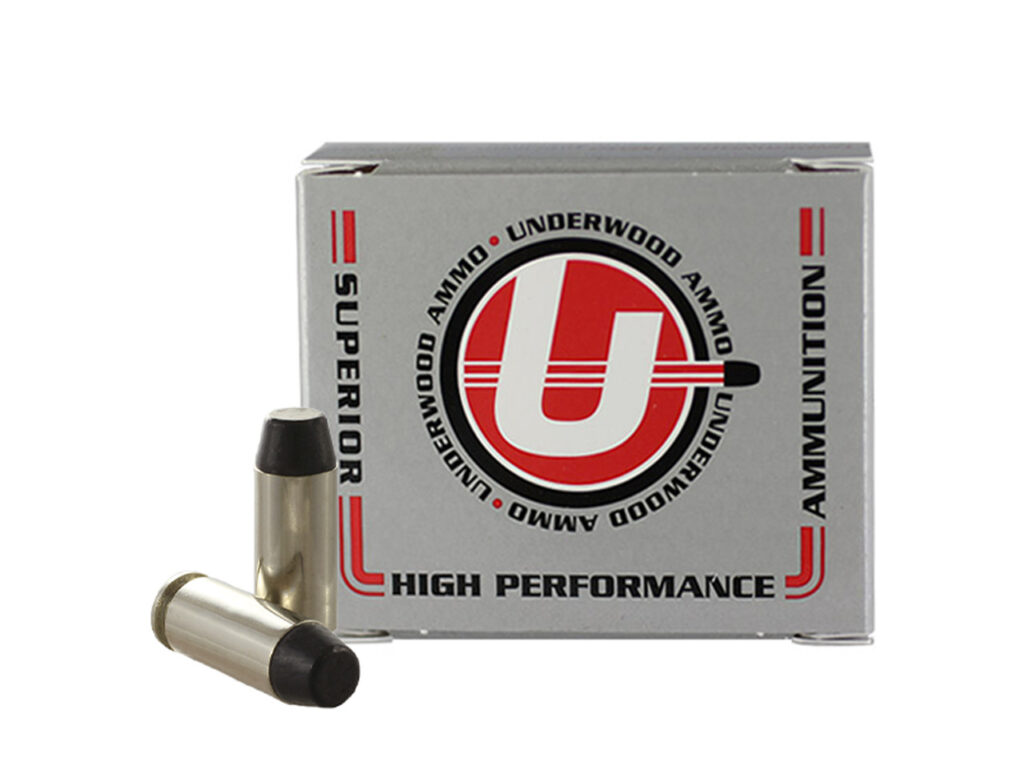
1. Underwood 200gr Hard Cast Flat Nose
- Bullet Weight: 200 grain
- Bullet Type: Hard Cast Lead Flat Nose
- Muzzle Velocity: 1,300 fps
- Muzzle Energy: 750 ft-lbs
Underwood 200gr Hard Cast 10mm
Underwood’s 200-grain hard cast is one of the most recommended 10mm bear defense loads in the community. At 1,300 fps, it hits harder than most 10mm factory ammo and the hard cast lead construction punches through bone without deforming. The flat nose design creates a wide wound channel while maintaining straight-line penetration.
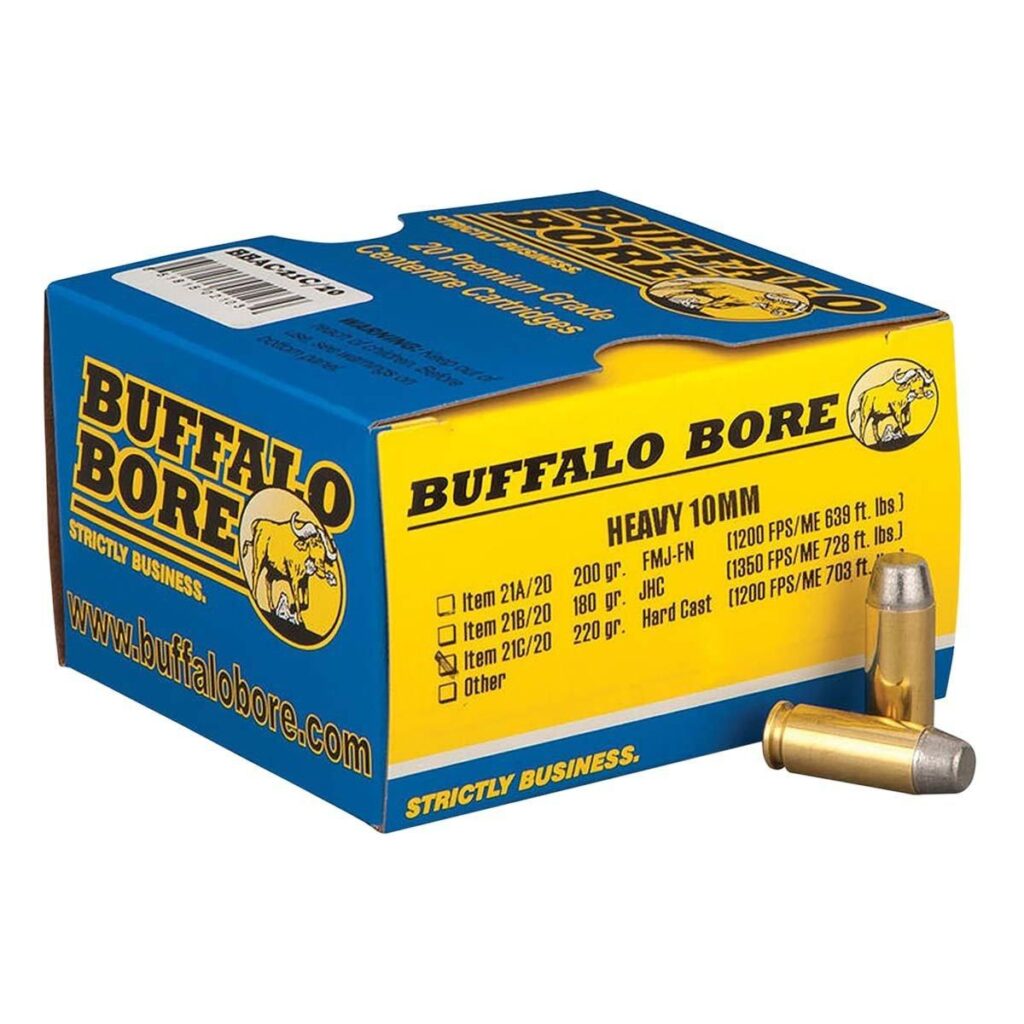
2. Buffalo Bore 220gr Hard Cast
- Bullet Weight: 220 grain
- Bullet Type: Hard Cast Lead Flat Nose
- Muzzle Velocity: 1,200 fps
- Muzzle Energy: 703 ft-lbs
Buffalo Bore 220gr Hard Cast 10mm
Buffalo Bore’s 220-grain load is the heaviest factory 10mm option available. The extra 20 grains of bullet weight over the Underwood means more momentum and deeper penetration through large animal anatomy. Buffalo Bore has a strong reputation among wilderness carry enthusiasts, and this load is one of the main reasons why.
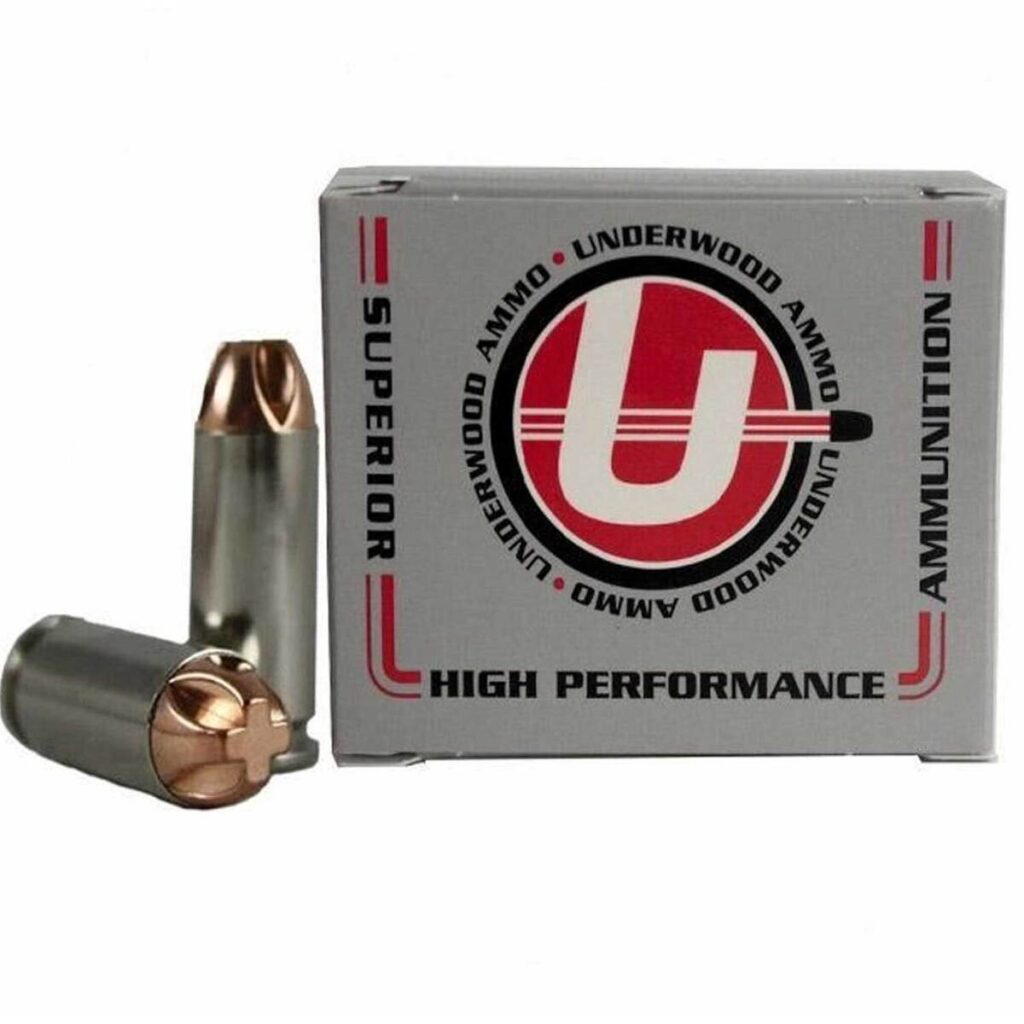
3. Underwood Xtreme Penetrator 140gr
- Bullet Weight: 140 grain
- Bullet Type: Lehigh Xtreme Penetrator (solid copper)
- Muzzle Velocity: 1,500 fps
- Muzzle Energy: 700 ft-lbs
Underwood Xtreme Penetrator 140gr 10mm
The Xtreme Penetrator takes a different approach. Instead of a heavy, slow bullet, it uses a lightweight 140-grain solid copper projectile at 1,500 fps. The fluted nose design creates a wound channel wider than the bullet diameter without relying on expansion. The solid copper construction means it won’t deform on bone, and the high velocity means exceptional penetration.
Some experienced bear country carriers prefer this load because the lighter bullet produces less recoil, allowing faster follow-up shots. When you’re trying to stop a 600-pound grizzly at 15 yards, getting more rounds on target faster can be more important than maximum single-shot power.
Best 10mm Pistols for Bear Defense
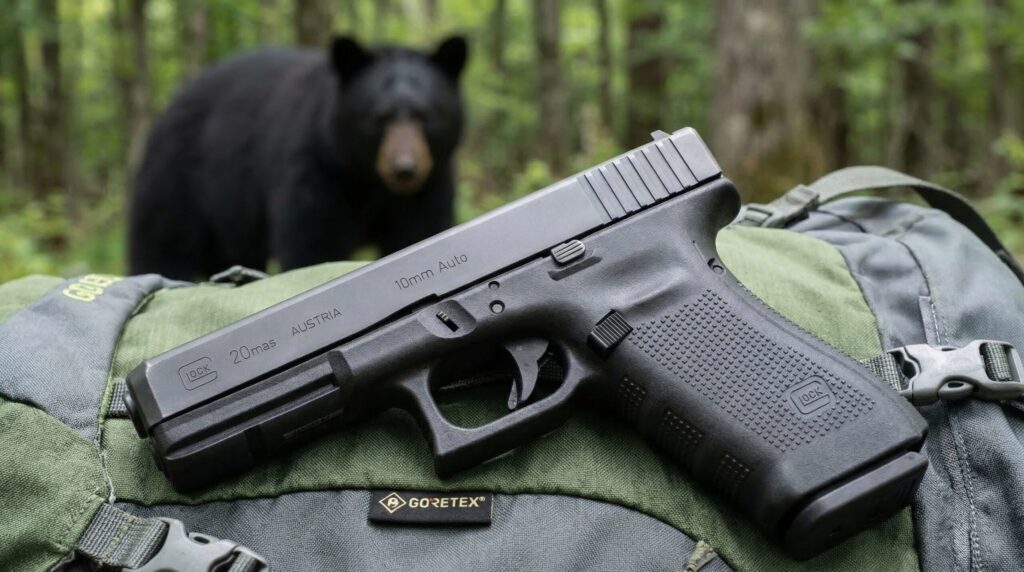
Glock 20 Gen5 MOS
Pros
- 15+1 capacity is unmatched for bear defense
- Lightweight and easy to carry on a chest rig
- Extremely reliable in harsh conditions
- Massive aftermarket support
Cons
- Factory barrel may not be ideal for hard cast lead
- Not the most accurate 10mm out of the box
- Grip angle takes some getting used to
Glock 20 Gen5 MOS
The Glock 20 is the default recommendation for bear defense with 10mm, and it deserves that status. You get 15+1 rounds of 10mm in a package that weighs just over 30 ounces unloaded. It’s reliable in extreme cold, wet conditions, and dirt. It doesn’t need to be babied.
The Gen5 MOS version lets you mount a red dot optic, which can help with target acquisition under stress. Many backcountry carriers add an aftermarket barrel (like a KKM or Lone Wolf) for better accuracy with hard cast loads, though the factory barrel works fine with jacketed and plated ammunition.
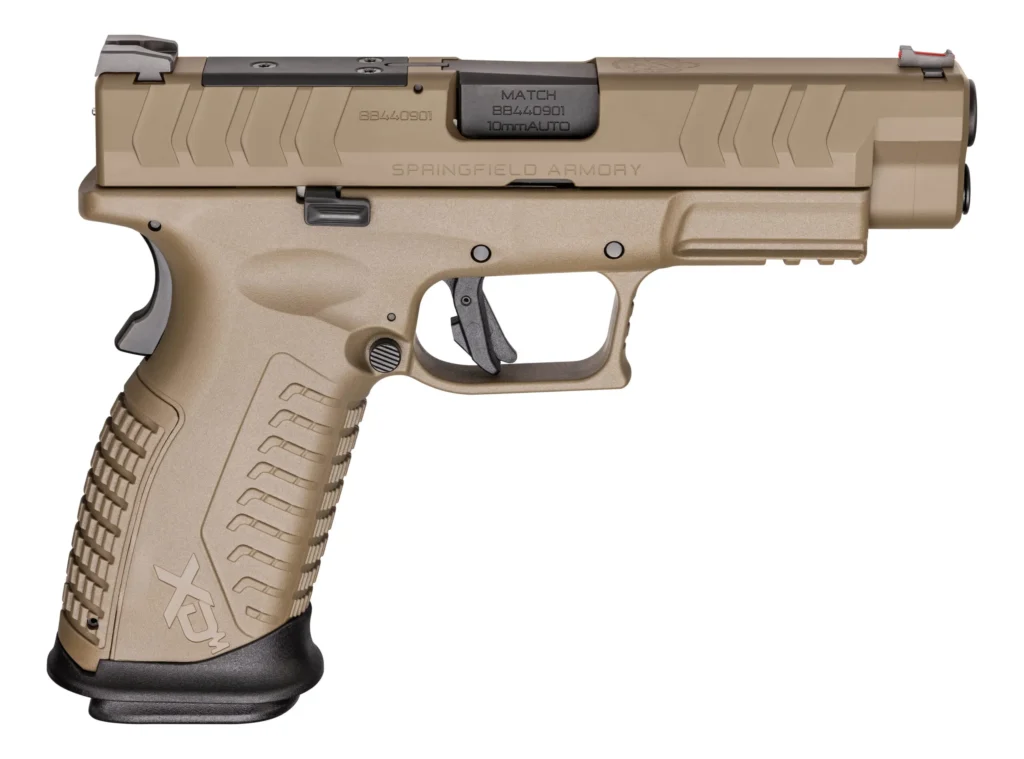
Springfield XDM Elite 10mm
Pros
- 16+1 capacity (one more than the Glock 20)
- Excellent trigger out of the box
- Very comfortable grip ergonomics
Cons
- Heavier than the Glock 20
- Less aftermarket support
- Grip safety may not appeal to everyone
Springfield XDM Elite 10mm
The Springfield XDM Elite offers a 16+1 capacity with a slightly longer barrel (4.5 inches vs the Glock’s 4.6 inches, though some XDM variants come with 5.25-inch barrels). The grip ergonomics are excellent, and many shooters find it more comfortable and naturally pointing than the Glock.
Springfield’s Match Enhanced Trigger Assembly (META) gives you a noticeably better trigger than the Glock out of the box. For bear defense, where you need accurate shot placement under extreme stress, a better trigger can make a difference. The XDM also has a grip safety, which some backcountry carriers prefer as an added layer of security during active hiking.
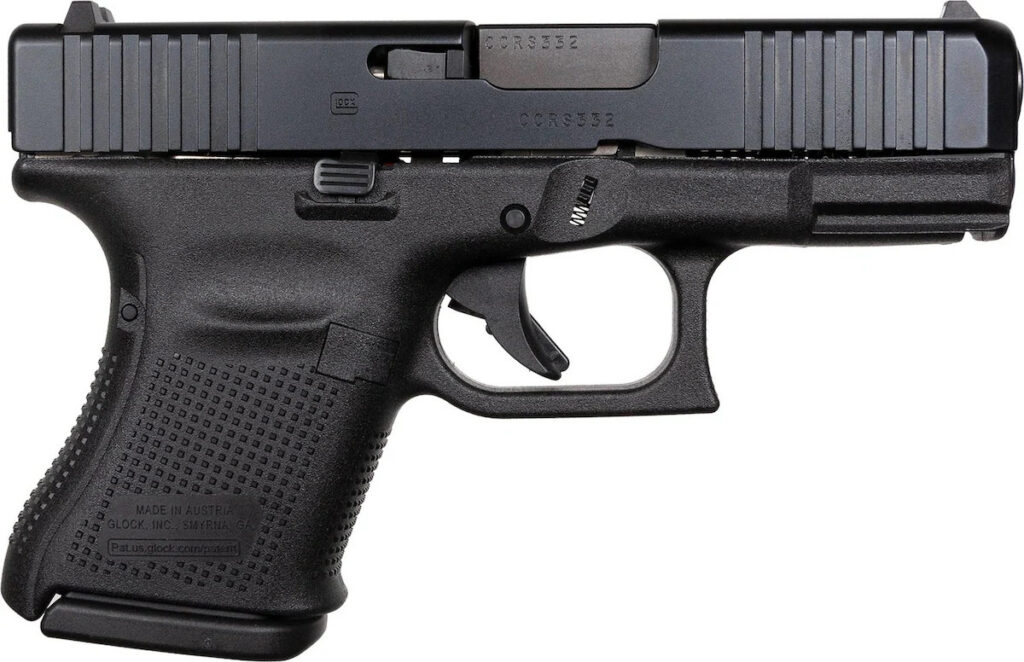
Glock 29 Gen5
The Glock 29 is the compact version of the Glock 20, and it fills a specific niche for bear defense. If you need a 10mm that you can comfortably conceal under a jacket or carry in a smaller chest rig, the Glock 29 delivers 10+1 rounds in a significantly smaller package.
Pros
- Most compact 10mm option available
- Accepts Glock 20 magazines for extended capacity
- Easy to carry in all conditions
Cons
- Shorter barrel reduces velocity
- Sharper recoil than the full-size Glock 20
- 10+1 standard capacity (vs 15+1)
Glock 29 Gen5
The trade-off is a shorter 3.78-inch barrel, which means you’ll lose some velocity (typically 50 to 100 fps compared to the Glock 20). Recoil is also sharper in the lighter, smaller frame. But you still have 10mm power and the ability to accept Glock 20 magazines as backups, which gives you 15-round extended capacity when you need it.
How to Carry a 10mm in Bear Country
How you carry your 10mm is almost as important as which gun and ammo you choose. In a bear encounter, you may have only 2 to 3 seconds to draw and fire. Your holster setup needs to allow fast access even when you’re wearing a backpack, wading through a stream, or scrambling over rocks.
Chest Rigs: The Best Option
A chest-mounted holster is the gold standard for bear country carry. Companies like Kenai Chest Holster, Hill People Gear, and Gunfighters Inc. make purpose-built chest rigs that keep your pistol accessible regardless of what you’re wearing or carrying on your back.
The Kenai Chest Holster is my personal favorite. It positions the gun high on the chest where it doesn’t interfere with backpack straps, and the retention is secure enough for vigorous hiking without being slow to draw. The Glock 20 fits perfectly in their Kydex shell.
Hip Holsters
A strong-side hip holster works if you’re not wearing a backpack with a hip belt. The problem is that most backpacking hip belts sit right over your holster, making the gun inaccessible when you need it most. If you go the hip route, make sure your holster sits above or below your pack’s belt line and practice drawing with your full pack on.
Drop Leg Holsters
Drop leg holsters are sometimes used by anglers and hunters who need the gun below their waders or other gear. They work but tend to bounce around during vigorous activity. If you go this route, choose one with a solid thigh strap system and practice drawing while moving.
Bear Spray vs 10mm: Do You Need Both?
This is one of the most debated topics in the outdoor community. Studies from the US Fish and Wildlife Service have shown that bear spray is effective at stopping aggressive bears about 92% of the time, compared to the approximately 84% effectiveness rate for handguns. Bear spray also requires less precision to deploy, it creates a cloud rather than requiring you to hit a moving target.
However, bear spray has significant limitations. It’s ineffective in heavy wind, rain can dilute it, extreme cold can reduce canister pressure, and it has a maximum range of about 20 to 30 feet. A 10mm pistol works in all weather conditions and is effective at greater distances.
My recommendation is to carry both. Bear spray should be your first response in most situations because it’s effective, doesn’t require precision, and doesn’t result in a dead bear (which creates its own set of problems with wildlife agencies and your conscience). The 10mm is your backup for when bear spray isn’t an option or has failed to stop the threat.
Carrying both isn’t cumbersome with the right setup. Bear spray clips to a shoulder strap or hip belt, and the 10mm rides in a chest holster. You can access either in seconds. Think of bear spray as your primary deterrent and the 10mm as your last resort.
Tips for Bear Defense Shooting Practice
Owning a 10mm and loading it with the right ammo is only half the equation. You need to practice drawing and shooting under stress conditions that simulate (as much as possible) a real bear encounter.
Practice drawing from your chest rig while wearing your full backpack setup. Time yourself. You should be able to go from holstered to first shot on target in under 2 seconds. A charging grizzly covers about 15 yards per second, so every tenth of a second matters.
Shoot your bear defense ammo at the range. Do not just load up with Buffalo Bore or Underwood and head into the backcountry without knowing how that ammo feels and where it hits in your specific gun. Full-power 10mm loads can have a significantly different point of impact than the mild range ammo you might practice with normally.
Practice shooting at targets from unconventional positions: seated, on the ground, moving backward. A bear encounter probably won’t happen while you’re standing at a shooting bench with perfect posture. Train for reality.
Final Thoughts: Is 10mm Enough for Bears?
Yes, 10mm is enough for bear defense when loaded with the right ammunition and deployed by a shooter who has practiced for the scenario. It’s not the most powerful option available, but the combination of adequate power, high capacity, fast follow-up shots, and lightweight carry makes it arguably the best overall package for backcountry bear defense.
The ideal 10mm bear defense setup, in my opinion, is a Glock 20 loaded with Underwood 200-grain hard cast or Buffalo Bore 220-grain hard cast, carried in a Kenai-style chest holster with bear spray on the opposite side. That gives you both deterrent and lethal options, fast access to both, and 16 rounds of ammunition that can penetrate the toughest parts of a bear’s anatomy.
No handgun is a guarantee against a large bear. But the 10mm gives you better odds than almost any other semi-automatic option, and it does so in a package that’s practical to carry every day you’re in the backcountry.
FAQ: 10mm for Bear Defense
Is 10mm enough for grizzly bears?
Yes, with proper ammunition. Hard-cast 200-220gr loads penetrate 24-30 inches in gel. The USGS study found handguns stopped aggressive bears in 84% of incidents.
What is the best 10mm ammo for bears?
Underwood 200gr Hard Cast (1,250 fps, 694 ft-lbs) is top choice. Buffalo Bore 220gr Hard Cast and Underwood Xtreme Penetrator are also excellent.
Is 10mm better than .44 Magnum for bears?
10mm offers more rounds (15+1 vs 6), lighter weight, and faster follow-ups. .44 Magnum delivers more energy per shot. For most users, 10mm is more practical.
Should I carry bear spray or a 10mm?
Carry both. Bear spray stops bears in 92% of incidents. The 10mm serves as backup when spray fails or is not viable.
What holster for 10mm in bear country?
A chest-mounted holster is best. It keeps the pistol accessible regardless of backpack hip belts or clothing layers. Kenai Chest Holster and Hill People Gear Kit Bag are proven choices.
Author

Related Guides