
Last updated June 2026 · By Nick Hall, has shot both calibers extensively and taken whitetail with 10mm from a Dan Wesson Bruin
- Treat every gun as loaded
- Point the muzzle in a safe direction
- Keep your finger off the trigger until you’re ready to shoot
- Know your target and what’s beyond
Quick Answer: 10mm wins for hunters and outdoorsmen in 2026, while .45 ACP wins for everyday concealed carry and home defense. The 10mm Auto delivers 600 to 700 ft-lbs of muzzle energy, enough for whitetail and even black bear at moderate range. The .45 ACP delivers 350 to 450 ft-lbs but in a controllable, low-recoil package that fits a wider range of hands.
Best 10mm pistol: Glock 20 Gen 5 MOS for hunting and woods carry. Best .45 ACP pistol: Glock 21 or any quality 1911 for defensive carry.
The biggest mistake new shooters make is choosing 10mm for concealed carry without acknowledging the recoil cost. A 10mm pistol weighs the same as a .45 but recoils 30-40% harder, and full-power loads will eventually batter most polymer frames. Every comparison on this page is backed by chronograph data and side-by-side gel testing.
Some of the links below are affiliate links, meaning at no additional cost to you, we may earn a commission if you click through and make a purchase. We only recommend products we genuinely believe in.
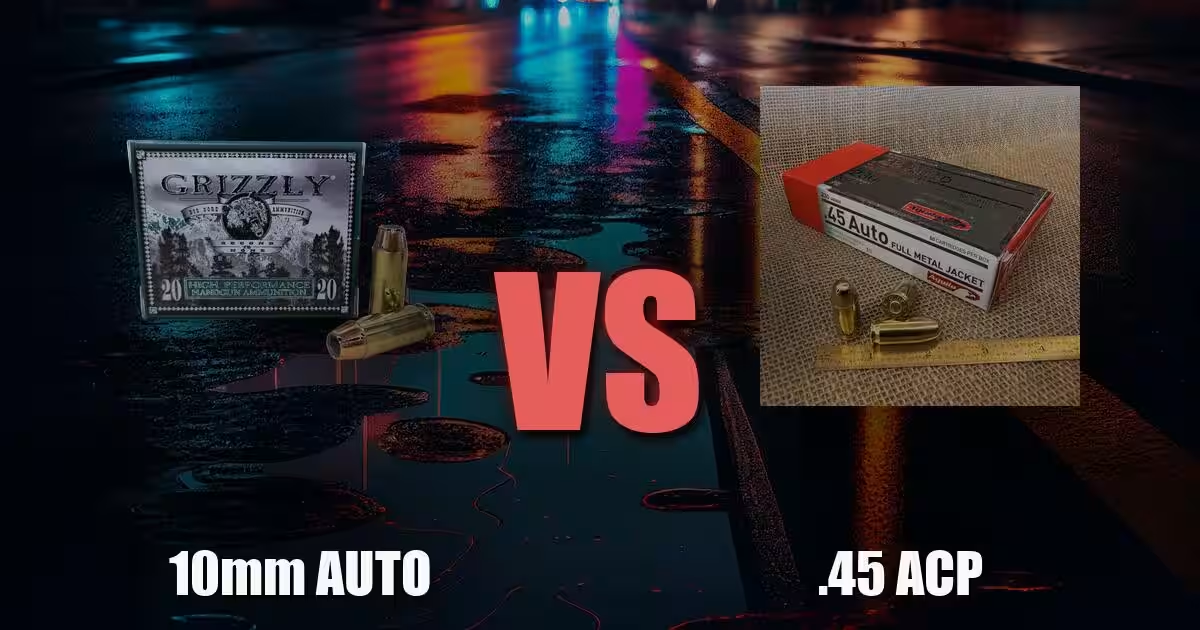
The 10mm Auto and .45 ACP are two of the most debated big-bore handgun cartridges in the shooting community. Both deliver serious terminal performance, but they do it in fundamentally different ways. The .45 ACP relies on a big, slow bullet with over a century of combat history. The 10mm pushes a smaller bullet significantly faster with ballistics that approach magnum revolver territory.
I’ve carried and shot both calibers extensively over the years. I own .45 ACP pistols that I love and 10mm pistols that I love. This comparison isn’t about declaring an overall winner. It’s about helping you figure out which cartridge is the better fit for your specific needs, whether that’s self-defense, hunting, range shooting, or backcountry carry.
Comparing pistol power tiers? Our 9mm vs 10mm breakdown covers energy, recoil and use.
Table of Contents
How we tested: Every pick here is ranked against our testing methodology. Minimum round counts, accuracy and reliability protocols, the failures that disqualify a gun. Where we have not shot a specific variant ourselves, we say so in that section.
Quick Verdict
Choose the 10mm if you need a handgun cartridge that doubles as a hunting tool or backcountry defense weapon. The 10mm’s higher velocity and energy give it genuine versatility that the .45 ACP simply can’t match. If you spend time in bear country, hunt with a handgun, or want the most powerful mainstream auto-loading cartridge available, the 10mm is your round.
Choose the .45 ACP if your primary use is self-defense, home defense, or range shooting. It’s proven, affordable to shoot, available everywhere, and offered in more gun platforms than you could test in a lifetime. For the vast majority of shooters, the .45 ACP does everything they need with less recoil and lower ammo costs.
Ballistics: 10mm vs .45 ACP by the Numbers
| Specification | 10mm Auto | .45 ACP |
|---|---|---|
| Bullet Diameter | 0.400″ | 0.452″ |
| Common Bullet Weights | 135-220 gr | 185-230 gr |
| Typical Muzzle Velocity | 1,030-1,600 fps | 830-1,050 fps |
| Typical Muzzle Energy | 400-750 ft-lbs | 350-500 ft-lbs |
| Max Chamber Pressure (SAAMI) | 37,500 PSI | 21,000 PSI |
| Case Length | 0.992″ | 0.898″ |
| Overall Cartridge Length | 1.260″ | 1.275″ |
| Typical Range Ammo Cost | $0.50-$0.80/rd | $0.35-$0.50/rd |
Numbers tell a clear story. The 10mm operates at nearly double the chamber pressure of the .45 ACP, which allows it to push bullets 200 to 500 fps faster. That velocity advantage translates to significantly more energy on target, especially with full-power loads. A full-power 10mm load like the Underwood Xtreme Penetrator generates over 700 ft-lbs at the muzzle. The hottest .45 ACP +P loads top out around 500 ft-lbs.
The .45 ACP’s advantage is its larger bullet diameter. At 0.452 inches, it makes a bigger initial wound channel than the 10mm’s 0.400-inch bullet. With modern hollow points that expand to 150 to 200% of their original diameter, that gap narrows considerably. But in a worst-case scenario where expansion fails, the .45 starts with a larger hole.
One thing many comparisons miss is the 10mm’s wider performance envelope. The range from a mild FBI-spec 10mm load (around 400 ft-lbs) to a hot Buffalo Bore load (700+ ft-lbs) is enormous. The .45 ACP has a much narrower band. That versatility is both a strength and a source of confusion when shopping for ammunition.
Recoil Comparison
Recoil is where these two cartridges feel fundamentally different in the hand. The .45 ACP produces a slow, rolling push. It’s heavy but manageable, and most shooters describe it as comfortable even during extended range sessions. I’ve always found .45 ACP 1911s to be among the most pleasant large-caliber pistols to shoot. The mass of the steel frame soaks up much of the recoil impulse.
10mm is a different animal. The higher operating pressure and faster bullet velocity create a sharper, snappier recoil that’s more aggressive than the .45’s gentle shove. In a full-size Glock 20, full-power 10mm loads produce noticeably more muzzle flip and felt recoil than .45 ACP from a Glock 21 of similar weight.
That said, “FBI spec” 10mm loads at 1,000 to 1,100 fps with 180-grain bullets produce recoil comparable to .45 ACP +P. It’s the full-power 10mm loads at 1,200+ fps and the hot boutique loads from Underwood and Buffalo Bore that really separate the two. If you’re loading your 10mm with 220-grain hard cast at 1,200 fps, expect significantly more felt recoil than any .45 ACP loading on the market.
For follow-up shot speed, the .45 ACP wins for most shooters. The slower recoil impulse allows you to get back on target faster, which matters in defensive situations where rapid, accurate fire can be the difference between life and death.
Self-Defense: Which Caliber Wins?
For self-defense against human threats, both calibers are more than adequate with modern JHP ammunition. The .45 ACP has over a century of proven combat performance dating back to the Philippine-American War. The 10mm has less real-world data in defensive shootings but delivers superior raw ballistics.
With premium hollow points like Federal HST, the terminal performance difference between these two calibers is smaller than you might expect. Both expand reliably, both penetrate 12 to 16 inches in gel, and both will stop a threat effectively with good shot placement. The 10mm’s higher energy provides a slightly wider wound channel at typical defensive distances, but the .45’s larger bullet diameter partially offsets that advantage.
Where the .45 ACP has a clear practical edge is shootability. The softer recoil means faster follow-up shots and better accuracy under stress. There are also far more compact and subcompact .45 ACP pistols available for concealed carry. In a defensive encounter, shot placement trumps ballistics every time, and the cartridge that’s easier to shoot accurately is the cartridge that gives you the best chance of surviving.
Winner: .45 ACP. The wider selection of defensive pistols, gentler recoil for accurate follow-up shots, and proven track record make it the more practical self-defense choice. The 10mm works, but it’s more gun than most people need for defensive purposes.
Hunting: 10mm Wins Decisively
For hunting, the 10mm Auto is the clear winner, and it’s not even close. The higher velocity, flatter trajectory, and significantly greater energy at distance make it a genuinely capable hunting cartridge. With the right ammunition like Federal Fusion 200gr SP or Hornady XTP 180gr, a 10mm pistol can ethically take whitetail deer, hogs, and black bear inside 75 to 100 yards.
I’ve personally taken two whitetail deer with 10mm using Federal Fusion loads from a Dan Wesson Bruin. Both were clean, ethical kills at distances under 40 yards with pass-through shots. The 10mm has enough energy and penetration to reach vitals reliably on medium game, and loads like the Underwood Xtreme Penetrator even make it viable for dangerous game defense.
The .45 ACP is marginal for hunting at best. The low velocity limits effective range dramatically, and the rainbow trajectory makes hits beyond 50 yards extremely challenging. While heavy hard-cast .45 ACP loads can work on deer-sized game at very close range, no serious handgun hunter would choose the .45 ACP over the 10mm if hunting were a priority.
Winner: 10mm Auto by a massive margin. It’s a legitimate hunting cartridge with proven field performance. The .45 ACP simply doesn’t have the ballistics for serious hunting applications.
Ammo Cost and Availability
The .45 ACP wins on both cost and availability, and the gap is significant. You can find .45 ACP ammunition at virtually any store that sells ammo, from Walmart to your local gun shop. Range FMJ runs about $0.35 to $0.50 per round, and quality defensive JHP loads cost $0.80 to $1.20 per round. The supply chain is deep, mature, and resilient.
10mm ammo is more expensive across the board. Budget range ammo like Sellier & Bellot starts around $0.38 per round if you can find it, but most FMJ loads run $0.50 to $0.80 per round. Premium defensive and hunting loads cost $0.95 to $1.75 per round. Selection at brick-and-mortar stores is limited, and some smaller shops don’t stock 10mm at all. You’ll often need to order online.
If you shoot frequently, which you should if you’re carrying a firearm for defense, the cost difference compounds quickly. Over 1,000 rounds of range ammo, you’re saving $150 to $300 by shooting .45 ACP instead of 10mm. That’s real money that could go toward training classes, accessories, or more trigger time.
Winner: .45 ACP. Cheaper to shoot, easier to find in stores, and available in far more varieties. The 10mm’s smaller market share means higher prices and spottier availability.
Gun Availability: .45 ACP Dominates
The .45 ACP has a massive advantage in firearm selection. You can get a .45 in practically every configuration imaginable. Full-size duty guns like the Glock 21 and Sig P220. Compact carry guns like the Glock 30 and Springfield XDs. Premium 1911s from every manufacturer at every price point from $500 to $5,000. Double-stack polymer frames, single-stack subcompacts, hammer-fired, striker-fired. The market is mature and packed with proven options.
10mm market has grown considerably in recent years, but it still can’t match the depth of the .45 ACP roster. Your primary choices are the Glock 20/29/40 family, Springfield XDM 10mm, Sig P220 10mm, various 1911 platforms from Dan Wesson, Colt (Delta Elite), and Rock Island, plus a handful of others. You won’t find a 10mm in most subcompact or micro-compact categories.
That said, the 10mm selection is better than it’s ever been. Springfield, Sig, and Smith & Wesson have all expanded their 10mm offerings in the last few years. If you want a full-size or longslide 10mm pistol, you have genuinely excellent options. The gap is really in the compact carry and budget segments where the .45 ACP still reigns.
Winner: .45 ACP for sheer variety and availability across all size categories and price points.
Concealability
Neither of these calibers is ideal for concealed carry in the era of micro-compact 9mm pistols, but the .45 ACP has meaningfully more compact options. The Glock 30 (10+1 rounds of .45 ACP) is a proven concealed carry gun that thousands of people carry daily. The Springfield XDs in .45 gives you a slim single-stack option for deep concealment. There are also compact 1911 platforms like the Springfield EMP and Sig Ultra that make .45 ACP carry practical.
For 10mm, the Glock 29 is essentially your only compact option. It’s a chunky subcompact with a 10+1 capacity and significant muzzle blast from the short barrel. It works, but it’s not as refined or comfortable a carry package as the best compact .45 options. The muzzle flash from a 3.78-inch barrel with full-power 10mm loads is also substantial, which matters in low-light defensive situations.
Winner: .45 ACP. More compact gun options, better ergonomics in small packages, and a proven track record of successful concealed carry use. If concealability is a priority, the .45 ACP is the better choice between these two.
The Final Verdict: 10mm vs .45 ACP
This comparison has clear category winners, and the right choice depends entirely on what you need your handgun to do.
The .45 ACP wins for self-defense, concealed carry, ammo cost, ammo availability, and gun selection. It’s the more practical, more affordable, more accessible cartridge. If you’re buying a handgun primarily for home defense or daily carry, the .45 ACP is the smarter choice. It has 100+ years of proven stopping power, softer recoil for faster follow-up shots, and an enormous market of excellent firearms to choose from.
The 10mm Auto wins for hunting, backcountry/animal defense, raw ballistic performance, and versatility. If you need a handgun that does double duty as a hunting tool or bear defense weapon, the 10mm is in a class the .45 ACP simply cannot reach. The ability to load everything from mild target rounds to near-.41 Magnum power levels makes the 10mm the most versatile mainstream semi-auto cartridge available.
Plenty of people, myself included, own pistols in both calibers because they serve different roles. My .45 1911 lives on my nightstand. My 10mm Glock 20 comes with me into the backcountry. The mistake would be forcing one cartridge to do the other’s job.
Best 10mm Pistols to Consider
If the 10mm’s versatility and power appeal to you, here are the best pistols to pair with it.
Glock 20 Gen5
The Glock 20 is the most popular 10mm pistol on the market and the one I recommend to almost everyone. It holds 15+1 rounds, eats any factory ammo without complaint, and has massive aftermarket support. The Gen5 version added a flared magwell, improved trigger, and nDLC finish. This is the benchmark 10mm pistol that everything else gets measured against. It’s equally at home on the range, in a nightstand, or in a backcountry chest holster.
Springfield XDM 10mm
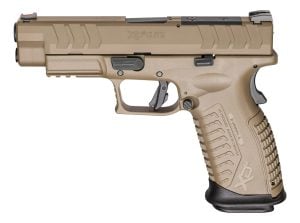
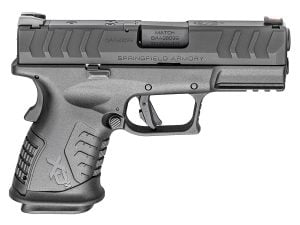
Springfield XDM offers a more refined shooting experience than the Glock with its match-grade barrel, excellent ergonomics, and fiber optic front sight. The slightly heavier slide helps tame recoil with full-power loads, and it’s one of the most accurate factory 10mm pistols I’ve tested. If you want a 10mm for hunting where precision matters, the XDM is an outstanding choice. The grip texture and ergonomics are noticeably better than the Glock out of the box.
Best .45 ACP Pistols to Consider
If the .45 ACP’s proven track record and practicality are what you need, these are the pistols I recommend.
Glock 21 Gen5
Glock 21 is the .45 ACP counterpart to the Glock 20, sharing the same frame size with a 13+1 capacity. It brings all the reliability Glock is known for with the softer recoil of the .45 ACP cartridge. The Gen5 version gives you an optics-ready platform for home defense or duty use. If you want a no-nonsense polymer .45 that just works, the Glock 21 has been proving itself for over three decades.
Sig Sauer P220 .45 ACP
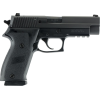
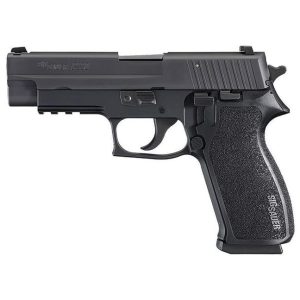
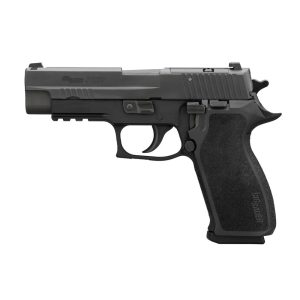
Sig P220 is one of the finest .45 ACP pistols ever made. The DA/SA trigger gives you a long, deliberate first pull for safety and a crisp single-action pull for follow-up shots. The all-metal frame soaks up recoil beautifully, making it one of the softest-shooting full-size .45s on the market. I’ve shot tens of thousands of rounds through P220s over the years, and the accuracy and reliability have always been exceptional. This is a premium pistol that earns every dollar of its price tag.
Springfield 1911 Loaded .45 ACP

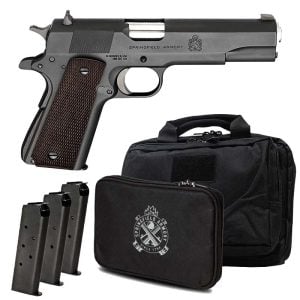

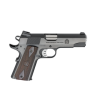
If you want the classic .45 ACP experience, you need a 1911. Springfield’s Loaded model is the sweet spot between value and quality. You get a forged frame and slide, match-grade barrel, and upgraded sights at a price that doesn’t require a second mortgage. The 1911 platform in .45 ACP is one of the most pleasant shooting experiences in all of firearms. The single-action trigger, the slim grip, and the gentle recoil combine for a shooting experience that has hooked generations of gun owners. There’s a reason the 1911 has been in production for over 100 years.
Looking for the best prices? Check our gun deals page and price comparison tool to compare prices from 200+ retailers before you buy.
Related Reading
- Best 10mm Pistols
- Best 10mm Ammo
- Best 10mm Carry Pistols
- 10mm for Bear Defense
- .357 Magnum vs 9mm
- When the FBI Ditched 9mm and Then 10mm
Frequently Asked Questions
Is 10mm more powerful than .45 ACP?
Yes, the 10mm is more powerful in raw energy. A full-power 10mm load like the Underwood Xtreme Penetrator generates over 700 ft-lbs at the muzzle, while the hottest .45 ACP +P loads top out around 500 ft-lbs. The 10mm operates at 37,500 PSI versus the .45 ACP's 21,000 PSI, which lets it push bullets 200 to 500 fps faster.
Why did the FBI drop the 10mm?
The FBI adopted the 10mm Auto in 1989 after the 1986 Miami shootout exposed limits in their 9mm and .38 Special loads. Within a few years they dropped full-power 10mm because too many agents struggled with recoil and frame durability issues plagued the early Smith and Wesson 1076 pistols. They moved to a downloaded 10mm Lite, which Smith and Wesson eventually shortened into what became the .40 S&W.
Can a 10mm kill a bear?
Yes, the 10mm is a legitimate bear defense cartridge against black bear and is the minimum a lot of guides recommend for brown bear backup. With hardcast solids like Buffalo Bore 220gr or Underwood 200gr at 1,200+ fps, the 10mm penetrates deep and breaks bone. It is not a primary bear gun like a .44 Magnum, but in a Glock 20 or Glock 40 it gives you 15+ rounds of serious medicine.
Is .45 ACP still relevant?
Absolutely. The .45 ACP remains one of the most popular defensive cartridges in America with over a century of combat history. It is offered in more gun platforms than any other handgun cartridge, recoil is manageable for most shooters, ammo is cheap and available everywhere, and modern hollow points make it a proven manstopper. For pure self-defense, the .45 ACP does everything you need.
Which has more recoil, 10mm or .45 ACP?
The 10mm has noticeably sharper, snappier recoil because it operates at much higher pressure and pushes faster bullets. The .45 ACP has heavier overall recoil impulse from the bigger bullet, but it is a slower push that most shooters describe as more controllable. Out of similar-sized pistols, the 10mm feels harder to manage in rapid fire.
Is 10mm good for concealed carry?
It can be, but it is not the obvious choice. Concealable 10mm pistols like the Glock 29 and Springfield XD-M Elite 3.8 exist, but most full-power 10mm loads are overkill for self-defense and the recoil is harder to manage in a small frame. If you live or hunt in bear country, a concealable 10mm makes sense as a do-everything sidearm. For pure urban carry, a 9mm or .45 ACP is usually a better fit.
How accurate is 10mm vs .45 ACP at 50 yards?
Both are capable of acceptable defensive accuracy at 50 yards in a quality pistol. The 10mm has a flatter trajectory because of its higher velocity, so holdover is less of an issue at extended range. From a Dan Wesson Bruin or Colt Delta Elite I have put 10mm groups inside 4 inches at 50 yards. A good 1911 in .45 ACP will do the same with the right ammo, but you have to compensate more for drop.
What is the best 10mm pistol?
The Glock 20 is the most popular full-size 10mm for a reason: 15+1 capacity, proven Glock reliability, and a price under $700. For traditional 1911 fans the Dan Wesson Bruin and Kimber Camp Guard 10 are the gold standard. For backcountry carry the Glock 40 MOS gives you a 6-inch barrel and red dot capability in the same Glock 20 platform.
6,216+ Gun & Ammo Deals
Updated daily from 200+ top retailers. Filter by category, caliber, action type, and price.