
Last updated March 12th 2026
Some of the links below are affiliate links, meaning at no additional cost to you, we may earn a commission if you click through and make a purchase.
- Treat every gun as loaded
- Point the muzzle in a safe direction
- Keep your finger off the trigger until you’re ready to shoot
- Know your target and what’s beyond
357 Magnum vs 38 Special: Which Is Right for You?
The 357 Magnum vs 38 Special debate is one of the oldest in the revolver world. These two cartridges are so closely related that they share the same bullet diameter, and a 357 Magnum revolver can actually chamber and fire 38 Special rounds. Yet the performance gap between them is significant, and picking the wrong one for your needs can lead to real frustration.
If you are shopping for your first revolver or trying to pick the right caliber for a specific purpose, this comparison will give you the facts you need. I have spent years shooting both calibers across dozens of revolvers, and the “right” choice depends entirely on what you plan to do with it.
The 38 Special is mild, affordable, and easy to shoot well. The 357 Magnum hits harder, reaches farther, and opens up hunting as a real possibility. Both are proven self-defense rounds with decades of street data behind them.
Let’s break down the differences across every category that matters: ballistics, recoil, self defense, home defense, hunting, cost, and the critical versatility factor that often tips the scales. By the end, you will know exactly which cartridge fits your situation.
Before we get into the details, here is the quick answer for anyone in a hurry. If you can only own one revolver and want maximum flexibility, get a 357 Magnum. If you know your gun will only ever be used for self defense or range practice and you prioritize ease of shooting above all else, the 38 Special is a perfectly solid choice. Now let’s dig into the reasons why.
A Brief History
Understanding where these cartridges came from helps explain why they work the way they do today. The 38 Special and 357 Magnum are not just related by dimensions. They are a direct parent-child lineage, with the younger cartridge built specifically to overcome the limitations of the older one.
The 38 Special came first by more than three decades. Smith & Wesson introduced it in 1898 as an improvement over the anemic 38 Long Colt, which had failed badly during the Philippine-American War. Soldiers reported emptying their revolvers into charging Moro warriors with little effect, and the Army needed something better.
By 1902 the 38 Special was in widespread production and quickly became the standard sidearm cartridge for American law enforcement. Police departments across the country adopted it, and it would remain the dominant police caliber for the better part of 80 years. The round earned its reputation through sheer volume of use.
For over 30 years the 38 Special served well, but shooters and ballisticians wanted more power from the same platform. Enter Elmer Keith, the legendary Idaho handgunner who spent years pushing 38 Special cases to their limits with heavy handloads. His experiments, along with work by Phil Sharpe and D.B. Wesson, laid the groundwork for something bigger.
In 1934, Smith & Wesson and Winchester collaborated to create the 357 Magnum. The case was intentionally made 0.135 inches longer than the 38 Special so it could not be chambered in older, weaker 38 Special revolvers. This was a deliberate safety measure to prevent dangerous pressure levels in guns not built for the new cartridge.
The first production revolver, the S&W Registered Magnum, shipped in 1935 and the cartridge was an instant sensation. Early adopters included J. Edgar Hoover, General George Patton, and law enforcement agencies that wanted maximum handgun power. The 357 Magnum quickly earned a reputation as the most powerful production handgun cartridge of its era.
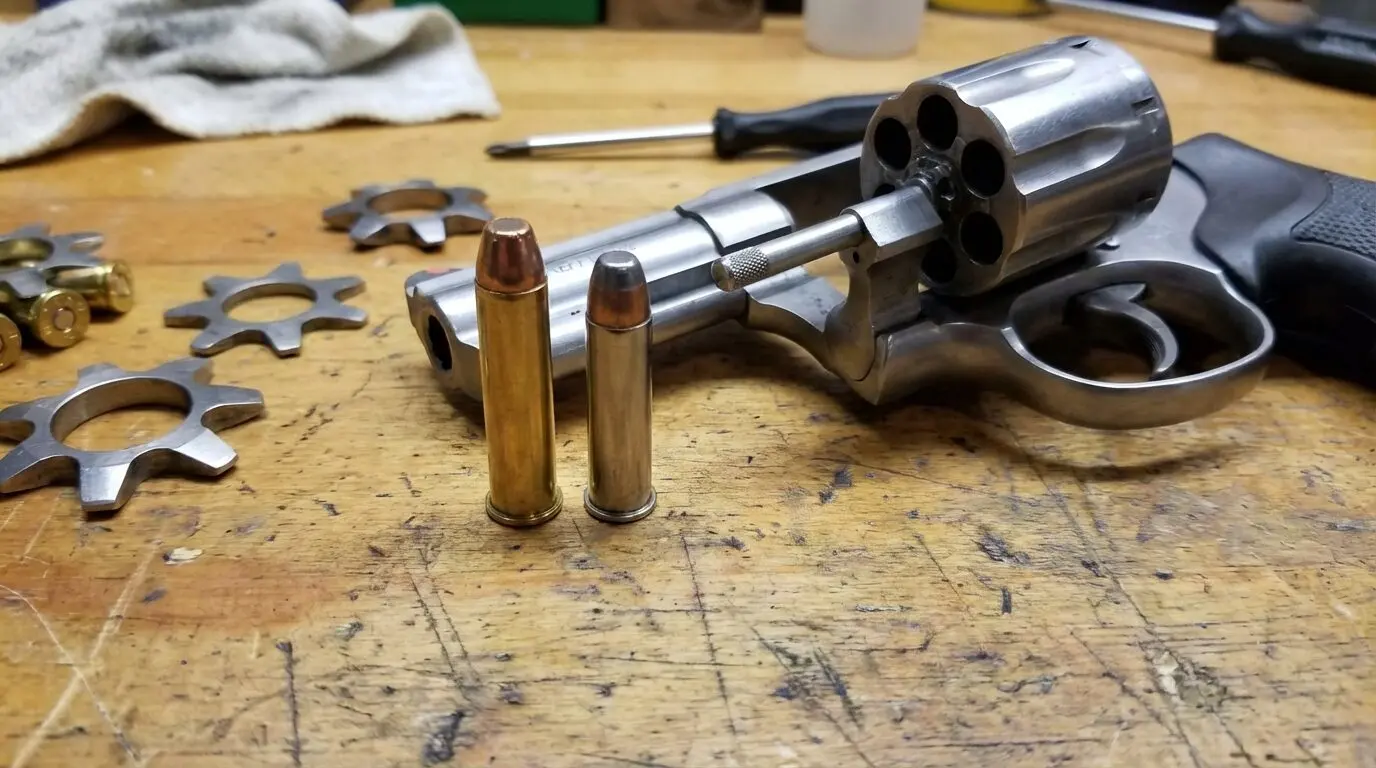
That length difference is the key to the relationship between these two rounds. A 357 Magnum cylinder is long enough to accept the shorter 38 Special case. But a 38 Special cylinder is too short for the 357 Magnum cartridge. This one-way compatibility has defined how shooters think about these calibers ever since.
Today, both cartridges are among the most popular revolver rounds in the world. The 38 Special remains a top choice for concealed carry and recreational shooting. The 357 Magnum holds its place as the gold standard for revolver power and versatility. Between the two of them, they account for the vast majority of revolver ammunition sold in the United States each year.
Ballistics Comparison
Numbers tell the story better than anything else here. The table below compares common factory loads for both calibers, measured from a 4-inch revolver barrel. These are representative averages across major manufacturers, and your specific gun may shoot slightly faster or slower depending on barrel length and chamber tolerances.
If you are trying to pick the right ammo for either caliber, check out our guide to the best 357 Magnum ammo for tested recommendations.
| Load | Bullet Weight | Muzzle Velocity | Muzzle Energy |
|---|---|---|---|
| 38 Special (Standard) | 158 gr | ~770 fps | ~208 ft-lbs |
| 38 Special +P | 158 gr | ~890 fps | ~278 ft-lbs |
| 357 Magnum | 158 gr | ~1,235 fps | ~535 ft-lbs |
| 357 Magnum | 125 gr | ~1,450 fps | ~583 ft-lbs |
The energy gap is dramatic. A standard 38 Special produces roughly 208 ft-lbs of muzzle energy. A full-power 357 Magnum with the same 158-grain bullet weight nearly triples that to 535 ft-lbs. Even the hotter 38 Special +P only reaches about half the energy of a standard 357 Magnum load.
Velocity differences are just as stark. The 357 Magnum pushes that same 158-grain bullet about 460 fps faster than a standard 38 Special. With lighter 125-grain bullets, 357 Magnum velocities climb past 1,400 fps, which is approaching rifle territory for a handgun cartridge.
What does this mean in practical terms? The 357 Magnum’s higher velocity translates directly into greater bullet expansion with hollow point ammunition. A hollow point needs a minimum velocity threshold to reliably open up, and the 357 Magnum exceeds that threshold by a wide margin. The 38 Special, especially from short-barreled snub-nose revolvers, can sometimes fall below expansion thresholds with certain bullet designs.
At distance, the 357 Magnum holds its advantages. It shoots flatter and retains more energy at 50 and 100 yards. For most revolver shooting scenarios inside 25 yards, both calibers will hit where you aim them. But the 357 Magnum’s extra velocity gives it a real edge for longer-range work, particularly in lever-action rifles where barrel lengths of 18 to 20 inches can push 357 Magnum velocities past 1,800 fps.
Barrel length plays a significant role with both cartridges but affects the 357 Magnum more. A 2-inch snub-nose barrel cuts 357 Magnum velocity by 200 to 300 fps compared to a 4-inch barrel. That lost velocity reduces the 357 Magnum’s advantage over 38 Special +P considerably. From a snub-nose, the two calibers are closer in performance than the table above suggests. From a 6-inch barrel or a rifle, the gap widens in the 357 Magnum’s favor.
It is also worth noting that the 357 Magnum’s higher velocity creates a distinctly different wound profile with expanding ammunition. Hollow point bullets driven at 357 Magnum speeds tend to expand more aggressively and create larger wound channels. This is a real advantage for self defense and hunting applications where terminal performance matters most.
Recoil and Shootability
This is where the 38 Special really shines. Standard 38 Special loads produce a gentle push that most new shooters handle comfortably from the first cylinder. It is one of the best calibers available for learning proper trigger control and sight alignment on a revolver. The mild recoil lets you focus on fundamentals instead of flinching in anticipation of the kick.
Even 38 Special +P loads remain manageable in most revolvers. The step up from standard pressure to +P adds a noticeable bump in recoil, but nothing that should intimidate a moderately experienced shooter. In a steel-frame revolver with a 3-inch or longer barrel, 38 Special +P feels very controlled.
The 357 Magnum is a different animal entirely. In a full-size, steel-frame revolver like a Smith & Wesson 686 or Ruger GP100, the recoil is firm but manageable for experienced shooters. The weight of these guns (typically 35 to 40 ounces) absorbs a good portion of the recoil impulse. In a lightweight snub-nose revolver, full-power 357 Magnum loads can be genuinely punishing.
I have seen plenty of range sessions cut short by sore hands after running hot 357 through a lightweight carry gun. Guns like the Smith & Wesson 340PD (under 12 ounces) are borderline painful with full-power 357 Magnum ammunition. Many owners of these lightweight 357 revolvers end up loading them with 38 Special +P anyway, which raises the question of why they paid for the magnum chambering.
The felt recoil difference comes down to simple physics. The 357 Magnum generates roughly twice the chamber pressure of a standard 38 Special (35,000 psi vs 17,000 psi). That pressure creates more blast, more noise, and more muzzle flip. In low-light conditions the 357 Magnum also produces a significant muzzle flash that can be temporarily blinding.
For new shooters, recoil-sensitive individuals, or anyone who wants to practice frequently without fatigue, the 38 Special is the better choice. If you can handle the kick and want maximum performance, the 357 Magnum delivers. But it demands more from the shooter to place rounds accurately under stress, and that is a factor worth considering honestly.
One practical tip: if you buy a 357 Magnum revolver and find the recoil too harsh, you can always load it with 38 Special. You have not wasted your money. You have simply bought a heavier, more stable platform for shooting 38 Special, and that extra weight actually helps tame recoil further. Many shooters who buy a 357 Magnum end up shooting 38 Special through it 90% of the time, and there is nothing wrong with that approach.
Self Defense: Which Is Better?
Both calibers have long track records as defensive cartridges. The 38 Special served as the primary law enforcement round in America for most of the 20th century, and modern +P hollow points have only improved its effectiveness. A 38 Special +P with a quality hollow point like the Speer Gold Dot or Federal HST expands reliably and penetrates to FBI-standard depths of 12 to 18 inches in calibrated ballistic gelatin.
The 357 Magnum has an undeniable edge in raw stopping power. The 125-grain semi-jacketed hollow point load earned a legendary reputation in the 1970s and 1980s for one-shot stops. During that era, multiple law enforcement studies ranked the 357 Magnum 125-grain JHP as the single most effective handgun cartridge in real-world shootings. Modern defensive 357 Magnum loads from Hornady, Federal, and Speer continue that tradition with consistent expansion and deep penetration.
Here is the practical consideration most people overlook: shot placement matters more than caliber. A 38 Special hit to center mass will always outperform a 357 Magnum miss. If you shoot the 38 Special more accurately (and most people do, thanks to lighter recoil), that accuracy advantage may cancel out the 357’s power advantage in a real defensive encounter.
Follow up Shots
There is also the follow-up shot factor. With a revolver’s typical 5 or 6 round capacity, every shot counts. Faster and more accurate follow-up shots with the 38 Special mean you are more likely to place multiple effective hits. The 357 Magnum’s heavier recoil slows your split times between shots, which could matter in a dynamic defensive situation.
For concealed carry specifically, the 38 Special in a lightweight snub-nose remains one of the most popular choices in America. If you prefer to carry a 357 Magnum, take a look at our list of the best 357 Magnum carry pistols. For those leaning toward the milder option, our roundup of the best 38 revolvers covers the top picks on the market.
Bottom line for self defense: both calibers work. The 38 Special +P is “good enough” for the vast majority of defensive scenarios. The 357 Magnum provides a measurable edge in terminal performance if you can shoot it accurately. Choose the one you will actually practice with regularly, because the best defensive caliber is the one you can put on target under pressure.
Home Defense
Home defense introduces a factor that changes the equation: walls. Full-power 357 Magnum rounds carry enough velocity and energy to punch through multiple layers of drywall and still pose a lethal threat on the other side. In a home with family members in adjacent rooms, that overpenetration risk is a serious concern that you cannot afford to ignore.
The 38 Special +P with a proper hollow point is arguably the better home defense choice for this reason. It delivers enough energy to stop a threat effectively while reducing (not eliminating) the risk of dangerous overpenetration. The lower muzzle flash and reduced blast are also real advantages when firing indoors without ear protection, which is the reality of most home defense scenarios.
If you insist on using a 357 Magnum for home defense, consider loading it with 38 Special +P defensive rounds instead. You get the benefit of the heavier, more controllable 357 Magnum revolver platform while using ammunition better suited to an indoor environment. This is actually what many experienced shooters do with their bedside revolvers. The extra weight of a full-size 357 Magnum revolver makes it more pleasant to shoot than a lightweight 38 Special, even when loaded with identical ammunition.
Another option is to use purpose-built 357 Magnum defensive loads designed to minimize overpenetration. Hornady Critical Defense in 357 Magnum uses the FTX bullet, which is designed to expand quickly and dump energy fast. These loads reduce the overpenetration problem compared to traditional JHP or hard-cast bullets, though they still hit harder than 38 Special +P.
Watch Your Ears with 357
One more practical note: the concussive blast from a 357 Magnum fired indoors without hearing protection can cause permanent hearing damage in a single shot. The 38 Special is still loud (around 150 decibels from a revolver), but the 357 Magnum can exceed 165 decibels. That difference is meaningful when your ears are unprotected, and the disorientation from the blast could affect your ability to engage a second threat or communicate with family members.
Capacity is identical for home defense purposes. Both calibers are available in 5-shot snub-nose and 6 or 7-shot medium-frame configurations. The Ruger GP100 and Smith & Wesson 686 Plus both offer 7-round cylinders in 357 Magnum, which gives you two extra rounds over a traditional 5-shot snub-nose. For a nightstand gun where concealment does not matter, that extra capacity is worth considering.
If you live in an apartment or a home with thin walls and neighbors nearby, the 38 Special +P is the more responsible choice. In a rural setting with thick walls and no adjacent homes, the 357 Magnum’s overpenetration risk is less of a concern, and its superior stopping power becomes the more relevant factor.
Hunting
This category is not close. The 357 Magnum is a legitimate hunting cartridge for deer-sized game at reasonable distances. With heavy 158 or 180-grain hard-cast or bonded bullets, it will cleanly take whitetail deer inside 50 yards from a revolver (and farther from a lever-action rifle). Many states allow 357 Magnum for deer hunting during handgun seasons.
From a lever-action carbine with an 18-inch barrel, the 357 Magnum becomes even more capable. Velocity gains of 300 to 400 fps over revolver numbers push the effective range out to 100 yards or more on deer. The Marlin 1894 and Henry Big Boy in 357 Magnum have become extremely popular for exactly this reason, offering a lightweight, low-recoil deer rifle that shares ammunition with your revolver.
The 38 Special simply does not have the energy for ethical big game hunting. At typical engagement distances it falls well below the 500 ft-lb threshold that most experienced hunters consider the minimum for deer. You could use it for small game or pest control, but even there the 22 LR is a more practical and economical choice.
If hunting is part of your plan, the 357 Magnum is the only real option between these two. Pair it with the right ammunition and you have a capable woods gun. For ammo selection, our best 357 Magnum ammo guide covers hunting loads alongside defensive options.
Bear Defense, and Lions Too
The 357 Magnum also makes an excellent trail gun for protection against wild animals. Loaded with heavy hard-cast bullets at 180 grains, it provides meaningful protection against black bears and mountain lions. The 38 Special cannot reliably claim the same level of protection against large predators, and that matters if you spend time in bear country.
For handgun hunters, the 357 Magnum opens up a world of possibilities that the 38 Special simply cannot touch. Silhouette shooting, small game, medium game, and even feral hogs are all on the table with the right load. It is one of the most versatile hunting handgun cartridges ever created, with a century of field results to back up the claims.
If you are specifically interested in the hunting side, a revolver with a 6-inch barrel will squeeze the most velocity and accuracy out of the 357 Magnum cartridge. Models like the Ruger GP100 with the 6-inch barrel or the Smith & Wesson 686 Plus are popular choices among handgun hunters for exactly this reason.
Cost Comparison
The 38 Special has a clear advantage at the cash register. Standard 38 Special range ammo typically runs $0.30 to $0.45 per round for brass-cased FMJ. The 357 Magnum in comparable quality starts around $0.45 and often lands between $0.55 and $0.75 per round. Over a year of regular practice at 100 rounds per month, that difference can add up to $200 or more.
Defensive ammunition prices are closer together. A box of 20 premium hollow points runs $20 to $30 for either caliber. Since you only need a box or two of defensive ammo (one to carry and one to verify function and point of aim in your gun), this cost difference is negligible.
On the gun side, prices are roughly equivalent. A Ruger SP101 in 357 Magnum costs about the same as one in 38 Special. The same is true across the Smith & Wesson, Taurus, and Kimber lineups. You are not paying a premium for the 357 Magnum chambering in most cases, which makes the versatility argument even stronger.
Availability Can be an Issue
Ammunition availability is worth mentioning too. Both calibers are widely stocked at every gun store and major retailer. During ammo shortages (which seem to happen every few years), the 38 Special tends to be slightly easier to find on shelves because production volumes are higher. The 357 Magnum is not rare by any means, but it can be the first to sell out during panic buying periods.
For handloaders, both cartridges are simple and economical to reload. The 38 Special is especially cheap to reload since it uses less powder and operates at lower pressures, meaning brass lasts longer. Many 357 Magnum owners reload their own 38 Special practice ammo to keep range costs down while buying factory 357 Magnum for serious use. This is one of the smartest ways to enjoy the best of both worlds.
One cost factor people often forget is long-term practice expenses. Revolvers are not high-volume guns compared to semi-automatic pistols, but consistent practice still adds up. If you plan to shoot 200 rounds per month (a modest amount for someone who takes training seriously), the difference between 38 Special and 357 Magnum could mean $50 to $60 per month, or $600 to $700 per year. That is real money for most shooters.
The good news is that owning a 357 Magnum revolver does not lock you into buying expensive magnum ammo. You can train with 38 Special all week and load 357 Magnum for carry or field use. Your actual 357 Magnum consumption might only be a box or two per month for function checks and occasional full-power practice. That makes the cost comparison much closer in practice than it looks on paper.
The Versatility Factor
This is the single most important consideration in the entire debate, and the reason most experienced revolver shooters lean toward the 357 Magnum. A revolver chambered in 357 Magnum can fire both 357 Magnum and 38 Special ammunition interchangeably. A 38 Special revolver can only fire 38 Special. That distinction changes everything.
That one-way compatibility gives the 357 Magnum owner two guns in one. Load it with 38 Special for affordable practice, reduced recoil training, or mild home defense loads. Switch to 357 Magnum for hunting, woods carry, or maximum defensive power. You get to match your ammunition to the task at hand without buying a second revolver.
Think about it from a practical standpoint. If you buy a 38 Special revolver and later decide you want more power, your only option is to buy another gun. If you buy a 357 Magnum and decide you prefer lighter loads, you just buy different ammunition. One path costs hundreds of dollars. The other costs $20 for a box of 38 Special.
This versatility is not just theoretical. I keep my 4-inch 357 loaded with 38 Special +P for nightstand duty and swap to full-power 357 Magnum when I take it into the woods. At the range, I shoot mostly 38 Special for practice because it is cheaper and easier on the hands. One gun covers three completely different use cases without compromise.
The training benefits are substantial too. New shooters can start with light 38 Special wadcutter loads (extremely mild recoil) and gradually work up through standard 38 Special, then 38 Special +P, and finally 357 Magnum as their skills develop. That progression happens all within the same gun, so the trigger feel, grip angle, and sight picture stay consistent throughout the learning process.
The only scenario where a dedicated 38 Special revolver makes more sense is when you want the lightest, smallest possible package and you know you will never need 357 Magnum power. Some ultralight 38 Special snub-nose revolvers weigh under 12 ounces, which makes them noticeably easier to carry every day compared to even the lightest 357 Magnum options.
But even then, you are giving up the option of ever stepping up to magnum power in that gun. If your needs change down the road, you will need to buy a new revolver. With a 357 Magnum, you already have the capability waiting whenever you want it.
Lever-action rifles extend the versatility even further. A 357 Magnum lever gun like the Henry Big Boy or Marlin 1894 can shoot 38 Special as a plinking round and 357 Magnum as a deer-capable hunting load. Pair a 357 revolver with a 357 lever gun and you have a two-gun setup that shares one ammunition supply. That kind of logistical simplicity is hard to beat for camping trips, ranch work, or general backcountry preparedness.
Which Should You Choose?
The right answer depends on your intended use. Here is how I would break it down by situation after years of shooting both calibers.
Keep in mind that there is no universally wrong answer here. Both are time-tested, reliable cartridges with enormous aftermarket support, wide ammunition selection, and excellent gun options at every price point. The question is not which one is “better” in absolute terms. It is which one is better for your specific needs, budget, and shooting experience.
Choose the 38 Special if: You are a new shooter who wants the easiest path to good marksmanship. You want a lightweight carry gun and know you will only ever need it for self defense at close range. You are on a tight ammunition budget and plan to shoot frequently. You are recoil-sensitive or have hand or wrist issues that make heavy recoil uncomfortable.
Choose the 357 Magnum if: You want maximum versatility in a single revolver. You plan to hunt with a handgun or want a trail gun for the backcountry. You are comfortable managing heavier recoil or plan to work up to it gradually. You like the idea of practicing with affordable 38 Special ammo and carrying 357 Magnum for serious purposes.
For most people, I recommend the 357 Magnum. The ability to shoot both calibers is simply too valuable to pass up, especially since the guns cost the same. Buy a quality 357 Magnum revolver, stock up on 38 Special for practice, and load it with your preferred 357 Magnum defensive or hunting round when it matters.
Check out our picks for the best 357 Magnum revolvers and the 357 Magnum buyer’s guide to find the right one for your needs. Both guides cover options at every price point and barrel length.
The only exception is the dedicated pocket carry gun. If you need something ultra-compact and ultra-light for everyday concealed carry, a purpose-built 38 Special snub-nose like the Smith & Wesson 642 or Ruger LCR in 38 Special is hard to beat. It does one thing and does it very well. For that specific role, saving a few ounces of carry weight matters more than the option of loading magnum rounds you would never actually use in that gun anyway.
If you are buying specifically for home defense, get a 357 Magnum with a 4-inch barrel and load it with 38 Special +P hollow points. You get the shootability of the 38 Special, the stability of a medium-frame magnum revolver, and the option to load magnum rounds if you ever move to a rural property where overpenetration is less of a concern.
For the hunter or outdoorsman, the 357 Magnum is not even a question. It is the only cartridge between these two that earns a place in the field. Pair it with a lever-action rifle in the same caliber and you have covered everything from plinking to putting venison in the freezer.
No matter which caliber you choose, the revolver platform itself remains one of the most reliable firearms designs ever created. Both the 38 Special and 357 Magnum benefit from the simplicity, durability, and “pick it up and it works” nature of a quality wheelgun. You are making a good choice either way.
Frequently Asked Questions
Can I shoot 38 Special in a 357 Magnum revolver?
Yes, this is completely safe and one of the biggest advantages of owning a 357 Magnum. The 38 Special case is shorter than the 357 Magnum case but shares the same bullet diameter (.357 inches). Every 357 Magnum revolver on the market is designed to accept and fire 38 Special ammunition without any modifications. You can freely mix and match between range sessions or even load both into the cylinder at the same time if you want to practice with varying recoil levels.
Can I shoot 357 Magnum in a 38 Special revolver?
No, and you should never attempt this. The 357 Magnum cartridge is physically longer than the 38 Special chamber, so it will not fit in most cases. Even if you somehow forced it, the much higher pressure of the 357 Magnum (35,000 psi vs 17,000 psi) could cause a catastrophic failure in a gun not built to handle it. This is exactly why Winchester and Smith & Wesson made the 357 case longer in the first place.
Is 38 Special enough for self defense?
Yes. Modern 38 Special +P hollow point ammunition from top manufacturers like Speer, Federal, and Hornady is effective for personal defense. The round has decades of real-world data supporting its effectiveness. It was the standard law enforcement cartridge in America for most of the 20th century. With quality ammunition and good shot placement, the 38 Special is a proven defensive caliber that continues to be carried by thousands of people every day.
Does 357 Magnum kick too hard for a beginner?
In a full-size, steel-frame revolver, most beginners can handle 357 Magnum after a few cylinders of 38 Special to warm up. In a lightweight snub-nose, full-power 357 Magnum loads can be uncomfortable even for experienced shooters. The beauty of buying a 357 Magnum is that beginners can start with 38 Special and work their way up to magnum loads at their own pace. There is no rush to shoot full-power ammunition.
Which is better for a first revolver?
A 357 Magnum revolver is the better first revolver for most people. You can load it with mild 38 Special rounds while you learn, then step up to 357 Magnum as your skills and confidence grow. You get two calibers for the price of one gun. A medium-frame revolver like the Ruger GP100 or Smith & Wesson 686 with a 4-inch barrel is the classic recommendation for a first revolver, and for good reason.
Will shooting 38 Special in a 357 Magnum damage the cylinder?
It will not damage the cylinder, but it can cause a carbon ring to build up at the front of each chamber where the shorter 38 Special case ends. This carbon ring can occasionally make it difficult to chamber 357 Magnum rounds afterward. The fix is simple: clean the cylinders with a bronze brush and solvent after extended 38 Special shooting sessions. It is a minor maintenance issue, not a damage concern. Some shooters prevent this entirely by running a cylinder or two of 357 Magnum at the end of each range session to burn off the carbon deposits.
What is the difference between 38 Special and 38 Special +P?
The “+P” designation means the ammunition is loaded to higher pressure than standard 38 Special. Standard 38 Special operates at a maximum pressure of 17,000 psi, while 38 Special +P is rated to 20,000 psi. That extra pressure produces higher velocity and more energy, which improves terminal performance for self defense. Most modern revolvers are rated for +P ammunition, but check your owner’s manual to be sure. Older or lightweight-frame revolvers may not be rated for sustained +P use.
Is the 357 Magnum too loud?
The 357 Magnum is noticeably louder than the 38 Special. From a revolver, a 357 Magnum typically registers around 164 decibels, while a 38 Special comes in around 150 decibels. Both require hearing protection at the range, but the 357 Magnum’s sharper report and concussive blast are more fatiguing over extended shooting sessions. If noise sensitivity is a concern, start with 38 Special loads and work up. Always wear quality hearing protection regardless of which caliber you are shooting.
Can I use a 357 Magnum lever-action rifle for deer hunting?
Absolutely. A 357 Magnum lever-action rifle with an 18 to 20-inch barrel pushes bullet velocities 300 to 400 fps higher than a revolver. That bumps muzzle energy into the 700 to 800 ft-lb range with common loads, which is more than enough for whitetail deer inside 100 to 125 yards. Popular options include the Henry Big Boy, Marlin 1894, and Rossi R92. The added benefit is that the rifle can also shoot 38 Special for inexpensive target practice.