

Last updated August 21, 2026 · By Nick Hall, revolver shooter who has chronographed these loads out of a 2-inch snub and a 6-inch service gun
Some of the links below are affiliate links, meaning at no additional cost to you, we may earn a commission if you click through and make a purchase. We only recommend products we genuinely believe in.
- Treat every gun as loaded
- Point the muzzle in a safe direction
- Keep your finger off the trigger until you’re ready to shoot
- Know your target and what’s beyond
Quick Answer: Federal Personal Defense HST 154gr is the best .357 Magnum self-defense load in 2026 at 1,340 fps and 614 ft-lb. Hornady Critical Defense 125gr FTX is the best all-round choice at 1,500 fps, and if you carry a snub-nose the answer changes completely to Speer Gold Dot Short Barrel 135gr.
Why the snub changes everything: published barrel-length testing puts a Federal 125gr JHP at 1,511 fps out of a 4-inch barrel and 949 fps out of a 2-inch. That is 634 ft-lb against 250 ft-lb. A 2-inch .357 still beats .38 Special +P from the same barrel, which the same test puts at 111 to 172 ft-lb, but it gives up 60 percent of its own potential to do it.
The biggest mistake .357 buyers make is loading full-house magnum ammunition into a light revolver and then never practicing with it. Ten picks are ranked below, and the full measured velocity table sits further down so you can see what your own barrel actually gives you.
How we tested: Every pick here is ranked against our testing methodology. Minimum round counts, accuracy and reliability protocols, the failures that disqualify a gun.
Best .357 Magnum Ammo in 2026 at a Glance
| Ammo | Use Case | Price |
|---|---|---|
| BEST OVERALLFederal Personal Defense HST 154gr The HST bullet finally arrived in .357 Magnum and it is the most energetic defensive load here. |
Self Defense | Check Price ↓ |
| BEST ALL-ROUNDHornady Critical Defense 125gr FTX Polymer tip keeps the cavity clear through clothing and it is the fastest load on this page. |
Self Defense | Check Price ↓ |
| BEST FOR SNUB-NOSESpeer Gold Dot Short Barrel 135gr Built and rated from a 2 inch vented barrel, which is the only honest way to spec a snub load. |
Snub / CCW | Check Price ↓ |
| BEST HUNTINGFederal Power-Shok 180gr JHP Heaviest common .357 bullet, built to drive deep on deer and hogs. |
Hunting | Check Price ↓ |
| BEST RANGE AMMOSellier & Bellot 158gr FMJ Cheapest brass-cased .357 on our live cards, in 50-round boxes. |
Range / Training | Check Price ↓ |
Table of Contents
Introduction: The .357 Magnum Is Really Two Cartridges
Out of a 6-inch revolver the .357 Magnum is one of the most effective handgun cartridges ever made. Out of a 2-inch snub it is something else entirely, and most ammunition advice for it never mentions which gun the numbers came from.
Manufacturers publish velocity from a 4-inch test barrel, sometimes longer. Plenty of people carry a 1.875 or 2-inch revolver. The gap between those two is not a rounding error, it is most of the cartridge, and the measured data further down this page shows exactly how much.
So the ranking here is split by what you actually shoot. Five defensive loads, two for hunting and heavy work, three for the range, and a clear note on each about the barrel length its published figures came from. If you are still choosing the revolver, our best .357 Magnum revolvers guide covers the guns.
Barrel Length Is the Whole Story: Measured .357 Velocities
So we measured it. We took a test barrel and chopped it one inch at a time with a metal cut-off saw, cleaning the bore and re-chronographing at every length with two chronographs running so neither could hide a bad reading. Here is what six .357 Magnum loads did from 18 inches down to 2.
| Load | 2" | 3" | 4" | 6" | 8" | 18" |
|---|---|---|---|---|---|---|
| Federal 125gr JHP | 949 | 1,255 | 1,511 | 1,702 | 1,817 | 2,072 |
| Cor Bon 125gr JHP | 904 | 1,257 | 1,496 | 1,715 | 1,851 | 2,113 |
| Federal 130gr Hydra-Shok low recoil | 919 | 1,194 | 1,453 | 1,662 | 1,810 | 2,017 |
| Cor Bon 125gr DPX | 1,050 | 1,271 | 1,471 | 1,648 | 1,728 | 1,936 |
| Federal 158gr Hydra-Shok | 914 | 1,122 | 1,332 | 1,485 | 1,593 | 1,721 |
| Federal 158gr JHP | 858 | 1,102 | 1,293 | 1,465 | 1,570 | 1,719 |
All figures in feet per second, averaged across two chronographs at each length.
Take the Federal 125gr JHP down that row. At 18 inches it is doing 2,072 fps. At 4 inches, the length manufacturers quote from, it is 1,511 fps. At 2 inches it is 949 fps.
Convert that to energy and the picture gets blunt. 1,511 fps with a 125 grain bullet is 634 ft-lb. 949 fps with the same bullet is 250 ft-lb. A 2-inch .357 Magnum is delivering about 39 percent of the energy the same cartridge makes from a 4-inch barrel.
That is the single most useful fact about this cartridge and almost nobody puts it in front of buyers. If your revolver has a 2-inch barrel, full-power magnum ammunition buys you a great deal of muzzle blast, a great deal of recoil and .38 +P performance. Either carry a heavier gun with a longer barrel, or buy a load engineered for the barrel you have, which is exactly what the Speer Gold Dot Short Barrel entry below is.
Two honest caveats. These are BBTI figures from their test platform, not from your revolver, and a real revolver also loses velocity through the cylinder gap, which a chopped test barrel does not model perfectly. Treat the shape of the curve as the lesson rather than the exact number for your gun.
What SAAMI Actually Specifies for .357 Magnum
The magnum’s reputation is built on pressure, and the pressure figure is the most surprising number in this whole cartridge. These come out of ANSI/SAAMI Z299.3, the centerfire pistol and revolver standard.
| Specification | .357 Magnum | Why it matters to you |
|---|---|---|
| Maximum average pressure | 35,000 psi | The same ceiling as a 9mm Luger, which surprises everyone |
| Proof load pressure | 47,000 to 50,500 psi | The one-time overpressure test a design must survive |
| Velocity measurement | Vented barrel, 15 feet | The cylinder gap is already inside the number on the box |
| 158gr velocity | 1,220 vented, 1,545 test | 325 fps is what the gap alone costs at that weight |
| .38 Special, for contrast | 17,000 psi | The magnum is 2.1 times the pressure in a longer case |
| What the chamber also fires | .38 Special | Plus 38 Short Colt and 38 Long Colt, per SAAMI’s own list |
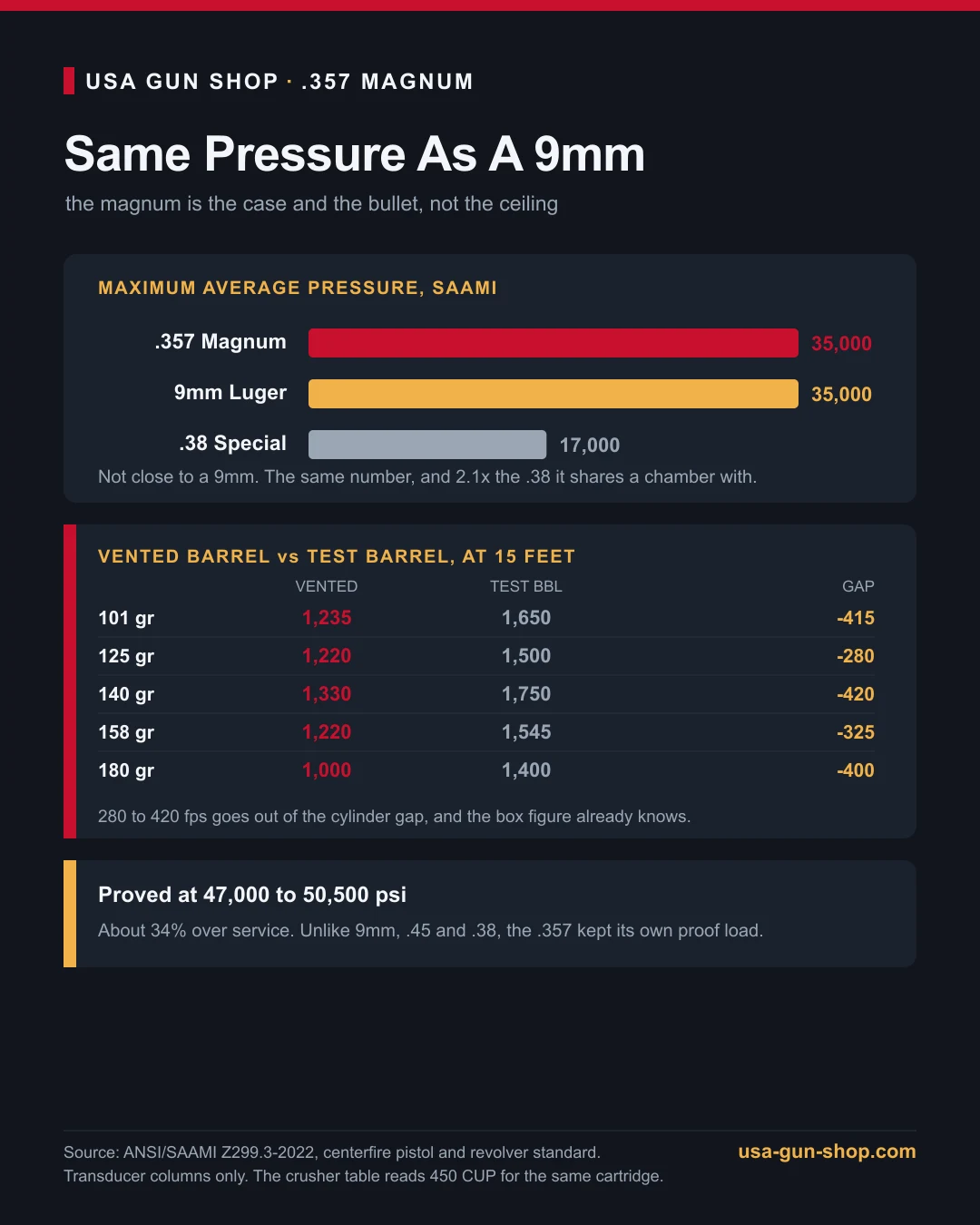
A .357 Magnum runs at exactly 9mm pressure
SAAMI holds .357 Magnum to 35,000 psi. It holds 9mm Luger to 35,000 psi. Not close to each other. The same number.
That kills the idea that a magnum is a cartridge running at some wild pressure a normal gun could not contain. It is not. What it has is a longer case holding more powder behind a heavier bullet, burning for longer, in a gun built with more steel around it. The energy comes from the work done over the length of the barrel, not from a higher peak.
It also explains why barrel length matters so much more here than it does in an auto. A 9mm has mostly finished its work by 4 inches. A .357 is still accelerating, which is exactly what the cut-down table above shows and why a 2-inch magnum gives back so much of what you paid for.
The cylinder gap is already in the box figure
SAAMI prints two velocity columns for .357 Magnum, both taken 15 feet from the muzzle. One is a solid test barrel. The other is a vented barrel, cut with a deliberate gap to imitate the space between a revolver’s cylinder and its forcing cone.
The spread is large. At 158 grains the standard lists 1,220 fps vented against 1,545 from the solid tube. At 101 grains it is 1,235 against 1,650. Across the table the gap alone accounts for 270 to 450 feet per second, which is far more than the .38 Special loses to the same gap, because higher pressure means more gas finding its way out.
SAAMI’s footnote says vented barrels are what establish catalog velocity values for cartridges normally chambered in revolvers. So the number on the box already has the cylinder gap subtracted. If your chronograph still reads under it, barrel length is the reason, not the gap.
The chamber is the real feature
SAAMI publishes a short list of chamber and cartridge combinations that may be swapped, and the .357 has the most useful entry on it. A .357 Magnum chamber is listed as able to fire .38 Special, 38 Short Colt and 38 Long Colt as well as its own cartridge. The standard attaches one condition to every pairing on that list: ask the firearm’s maker before relying on it.
That is the argument for buying the Magnum even if you mostly shoot .38. One gun, two cartridges, and the cheaper one to practice with. It does not work in reverse: a .38 chamber will not take a .357, and the longer case is what stops it.
Our .38 Special ammo guide covers the loads worth feeding it on the cheap days.
Self-Defense .357 Magnum Ammo
Five loads, ranked on published performance and on whether the figures come from a barrel length you are likely to own.
On-sale 357 magnum from 200+ retailers · Updated every 4 hours



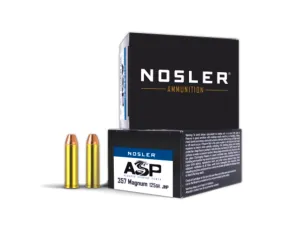


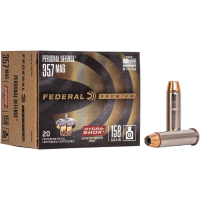
1. Federal Personal Defense HST 154gr: Best Overall
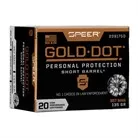
Federal Personal Defense HST 154gr costs about $36 to $42 for 20 rounds. Federal only brought the HST bullet to .357 Magnum in 2022, and it immediately became the load to beat.
Our Federal HST review covers the rest of the HST handgun line, caliber by caliber.
- Bullet Weight: 154gr HST jacketed hollow point
- Published velocity: 1,340 fps
- Muzzle Energy: 614 ft-lb
- Test Barrel: 4 inches
- Case: Nickel-plated brass, 20-round box
- Item: P357HST1S
| Value | Expansion | Penetration | Reliability | Reputation |
| 3/5 | 5/5 | 5/5 | 5/5 | 5/5 |
Pros
- HST is the most validated defensive bullet design in America
- Highest muzzle energy of the defensive loads here at 614 ft-lb
- Skived jacket opens reliably through heavy clothing
- Nickel case for corrosion resistance in a carry gun
Cons
- One of the most expensive loads on this list
- Recoil is serious in anything light
- Still newer to .357 than to 9mm, so less street history
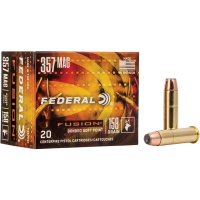


The HST bullet locks its core to the jacket mechanically, with a cannelure and coaligned skives rather than a bonded core, and the cavity is shaped to open even after passing through fabric. It is the bullet most American police departments issue in 9mm, and it took Federal until 2022 to load it in .357 Magnum.
One correction worth flagging, because this page had it wrong until today. Federal loads the .357 Magnum HST at 154 grains, not 158. The 158 grain figure appears on a lot of sites, this one included, and it is simply the traditional .357 bullet weight being pattern-matched onto a newer load.
At 1,340 fps and 614 ft-lb from a 4-inch barrel it is the most energetic defensive load on this page. Read the barrel-length table above before you decide what that means for your revolver.
Best For: Four-inch and six-inch service revolvers where you want the most proven defensive bullet available.

2. Hornady Critical Defense 125gr FTX: Best All-Round
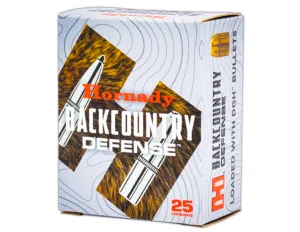
Hornady Critical Defense 125gr FTX runs about $34 to $42 for 25 rounds, and at 1,500 fps it is the fastest load on this page.
- Bullet Weight: 125gr FTX, polymer tipped
- Published velocity: 1,500 fps
- Muzzle Energy: 624 ft-lb
- Case: Nickel-plated brass, 25-round box
- Item: 90500
| Value | Expansion | Penetration | Reliability | Reputation |
| 4/5 | 5/5 | 4/5 | 5/5 | 5/5 |
Pros
- Polymer tip stops heavy clothing plugging the cavity
- Fastest and highest-energy load here at 1,500 fps and 624 ft-lb
- 25 rounds a box rather than the usual 20
- Low-flash propellant, which matters in a magnum revolver at night
Cons
- 125 grain bullets are hard on forcing cones over time
- Muzzle blast is genuinely unpleasant indoors
- Lighter bullet gives up penetration against a barrier
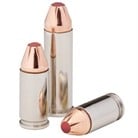


The FTX bullet fills the hollow point cavity with a soft polymer insert, so denim and fleece cannot pack into it. On impact the tip drives rearward and forces the jacket open. It is the same solution Hornady uses across the Critical Defense line and it works particularly well here.
Our Hornady Critical Defense review has this load’s gel results from a 2 inch snub and a 4.2 inch revolver.
One well-known caveat about 125 grain magnum loads. They are the fastest and they are also the ones with a reputation for eroding forcing cones in older or lighter revolvers over a lot of rounds. This is a carry load, not a load to shoot a thousand rounds of, and used that way it is not something to worry about.
At 624 ft-lb it edges the HST on paper. Which of the two you pick comes down to whether you would rather have velocity or the heavier, more established bullet.
Best For: Any .357 revolver with a 3-inch barrel or longer, and the best single answer if you only want to buy one defensive box.

3. Speer Gold Dot Short Barrel 135gr: Best for Snub-Nose
Speer Gold Dot Short Barrel 135gr costs about $39 to $41 for 20 rounds. It is the only load here whose published figures come from a barrel as short as the one you are probably carrying.
- Bullet Weight: 135gr Gold Dot hollow point, bonded
- Published velocity: 990 fps
- Muzzle Energy: 294 ft-lb
- Test Barrel: 2 inches, vented
- Case: Nickel-plated brass, 20-round box
- Item: 23917GD
| Value | Expansion | Penetration | Reliability | Reputation |
| 3/5 | 5/5 | 4/5 | 5/5 | 5/5 |
Pros
- Bullet engineered to open at snub-nose velocities, not 4-inch velocities
- Speer publishes the figure from a 2 inch vented barrel, which is honest
- Bonded core cannot separate from the jacket
- Noticeably less muzzle blast than a full-house 125gr load
Cons
- 294 ft-lb looks weak next to the other loads until you read the barrel column
- Wasted in a 6-inch revolver
- Priced like a premium load
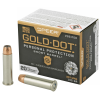


Look at that 990 fps and it seems poor against a 1,500 fps Critical Defense. Then look at where each number comes from. Speer measured this from a 2 inch vented barrel. Hornady rates theirs from an 8 inch vented test barrel. We put the Critical Defense through a 2 inch Kimber K6s and read 1,208 fps, well under the box but still ahead of the Gold Dot rating.
The difference is that this bullet was designed to expand at that speed. A standard magnum hollow point arriving at 950 fps often behaves like a solid, because the cavity needs velocity to open. Speer softened the alloy and reshaped the cavity so it opens at snub-nose speeds.
Our Speer Gold Dot review shot this load from a 2 inch and a 4.2 inch revolver.
That is the whole argument for buying ammunition matched to your gun rather than the highest number on the shelf. If your revolver has a 2-inch barrel, this is the load, and it is not close.
Best For: Snub-nose .357 revolvers, and any carry gun with a barrel under 3 inches.

4. Winchester Super-X Silvertip 145gr: Best Budget Defensive
Winchester Super-X Silvertip 145gr is about $23 to $28 for 20 rounds, which makes it the cheapest genuine defensive load on this page by a wide margin.
- Bullet Weight: 145gr Silvertip jacketed hollow point
- Published velocity: 1,290 fps
- Muzzle Energy: 535 ft-lb
- Case: Brass, 20-round box
- Item: W357ST
| Value | Expansion | Penetration | Reliability | Reputation |
| 5/5 | 4/5 | 4/5 | 5/5 | 5/5 |
Pros
- Roughly half the price of the HST
- 145 grains is a sensible middle weight for a magnum revolver
- Silvertip has been a defensive standard since the 1980s
- Also sold in 50-round boxes for practice
Cons
- Older jacket design than HST or Gold Dot
- Expansion is good rather than exceptional
- Winchester lists it under both Super-X and Silvertip branding, which confuses shelves

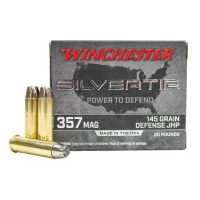

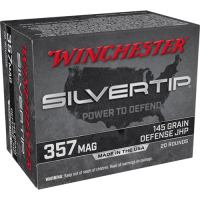

Silvertip went away for years and came back, and the .357 Magnum loading is quietly one of the better value defensive rounds in any caliber. At 1,290 fps and 535 ft-lb it sits between the 125 grain screamers and the heavy 158s, which is a sensible place for a general-purpose defensive load to be.
The 145 grain weight is the reason to like it. Lighter than a 158 so recoil is manageable, heavier than a 125 so the forcing cone is not taking a beating, and fast enough that the bullet opens.
It is on this list because a defensive load you can afford to shoot regularly is worth more than a better one you fire twice a year. Buy two boxes, shoot one, carry the other.
Best For: Shooters who want a proven defensive bullet without premium pricing, and anyone who wants to actually practice with their carry load.

5. Remington HTP 158gr SJHP: Best Traditional Load
Remington HTP 158gr SJHP costs about $31 for 20 rounds. The 158 grain semi-jacketed hollow point is the load the .357 Magnum built its reputation on.
- Bullet Weight: 158gr semi-jacketed hollow point
- Published velocity: 1,235 fps
- Muzzle Energy: 535 ft-lb
- Case: Brass, 20 and 50-round boxes
- Item: 22233
| Value | Expansion | Penetration | Reliability | Reputation |
| 4/5 | 4/5 | 5/5 | 5/5 | 5/5 |
Pros
- Heavy 158gr bullet penetrates deeply and resists deflection
- Exposed lead nose starts expansion without needing high velocity
- The classic .357 loading, with decades of documented use
- Cheap enough to shoot in volume
Cons
- Softer lead nose can deform in a magazine or speed loader
- Loses the most velocity of any weight in a short barrel
- Recoil in a light revolver is punishing
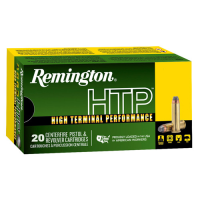




This is the shape of the load that made the cartridge famous, a 158 grain semi-jacketed hollow point with exposed lead at the nose. The soft nose means it does not need much velocity to start deforming, which is why the design has lasted.
Look back at the barrel table and note the cost, though. Federal 158gr JHP drops from 1,293 fps at four inches to 858 fps at two, the biggest fall of any load in the set. Heavy bullets in this cartridge lose the most when the barrel goes away.
In a 4-inch or longer revolver it is an excellent, affordable defensive and general-purpose load. In a snub, it is the wrong weight.
Best For: Four-inch and longer revolvers, and shooters who want the classic .357 loading at a fair price.
Hunting and Heavy Loads
The .357 Magnum is a legitimate deer and hog cartridge inside about 100 yards from a long-barrelled revolver or a lever gun. For that job you want weight and a bullet built to hold together, not the fastest thing on the shelf.

6. Federal Power-Shok 180gr JHP: Best Heavy Load
Federal Power-Shok 180gr JHP is about $32 to $40 for 20 rounds. The heaviest common .357 bullet, loaded slow and built to keep going.
- Bullet Weight: 180gr jacketed hollow point
- Published velocity: 1,080 fps
- Muzzle Energy: 466 ft-lb
- Case: Brass, 20-round box
- Item: C357G
| Value | Expansion | Penetration | Reliability | Reputation |
| 4/5 | 3/5 | 5/5 | 5/5 | 4/5 |
Pros
- Heaviest common .357 bullet, so it drives deepest
- Loaded to a modest velocity, which keeps recoil sane for the weight
- Genuinely capable on deer and hogs inside 100 yards
- Excellent out of a lever-action carbine
Cons
- Lowest muzzle energy on this page at 466 ft-lb
- Slow enough that expansion is modest
- Heavy recoil impulse in a light revolver despite the low velocity
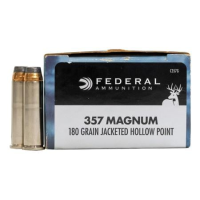


Hunting with a .357 is about penetration, not energy dumps. A 180 grain bullet at 1,080 fps carries a lot of momentum for its energy figure, and momentum is what gets you through a shoulder and into the vitals on a hog.
The energy number looks unimpressive next to a 125gr load at 624 ft-lb, and that comparison is misleading. The light bullet spends its energy fast and shallow. The heavy one keeps going. For paper that matters not at all, for an animal it matters a great deal.
This is also the load to run in a .357 lever gun, where the longer barrel adds velocity that the slow powder charge can actually use. Our .308 ammo guide covers the step up if deer are your main quarry.
Best For: Deer and hogs inside 100 yards, lever-action carbines, and anyone who wants maximum penetration.

7. Magtech 158gr SJSP: Best Hunting Value
Magtech 158gr SJSP starts at about $29 for 50 rounds, which makes it the cheapest expanding .357 load we track.
- Bullet Weight: 158gr semi-jacketed soft point, flat nose
- Published velocity: 1,235 fps
- Muzzle Energy: 535 ft-lb
- Test Barrel: 4-inch vented
- Case: Brass, Boxer primed, 50-round box
- Item: 357A
| Value | Expansion | Penetration | Reliability | Reputation |
| 5/5 | 4/5 | 5/5 | 4/5 | 4/5 |
Pros
- Soft point at range-ammo prices, in 50-round boxes
- Flat nose feeds well in lever guns and cuts clean holes in paper
- Brass cased and Boxer primed for reloaders
- Magtech publishes from a 4-inch vented barrel, which is the honest revolver spec
Cons
- Quality control is a step below Federal or Hornady
- Exposed lead fouls a bore faster than a jacketed load
- Not a purpose-built defensive bullet
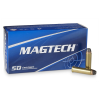



Magtech is CBC of Brazil, which is one of the larger ammunition manufacturers in the world and makes a lot of the ammunition sold under other names. The 158 grain semi-jacketed soft point is their workhorse .357 load and it costs about half what a premium soft point does.
The flat nose is worth noting. It feeds reliably through a lever-action tube magazine, which round-nose loads and pointed loads do not always do safely, and it punches a clean full-diameter hole in paper for scoring.
It is the load I would buy by the case for hog hunting and general shooting where I want something that expands but do not want to spend a dollar a round doing it.
Best For: Volume hunting practice, lever-action carbines, and shooters who want a soft point without premium pricing.
Range and Practice Ammo
Three loads for shooting a lot. All brass cased and Boxer primed, ranked on price per round from the live cards.

8. Sellier & Bellot 158gr FMJ: Cheapest Brass
Sellier & Bellot 158gr FMJ starts at about $29 for 50 rounds, roughly 57 cents a round, which is as cheap as brass-cased .357 gets.
- Bullet Weight: 158gr full metal jacket
- Published velocity: 1,263 fps
- Muzzle Energy: 560 ft-lb
- Case: Brass, Boxer primed, reloadable
- Box Size: 50 rounds
| Value | Cleanliness | Consistency | Availability | Reputation |
| 5/5 | 4/5 | 4/5 | 5/5 | 5/5 |
Pros
- Cheapest brass-cased .357 on our cards
- 50-round boxes rather than 20
- Czech production with a long track record
- Also sold as a 158gr soft point in nearly identical packaging
Cons
- Full metal jacket, so no expansion at all
- Burns dirtier than premium range ammunition
- The FMJ and SP boxes look alike, so read the label
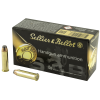
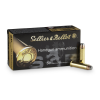

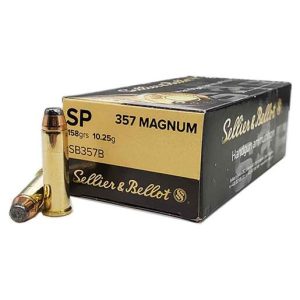
Nothing clever here. A 158 grain full metal jacket at 1,263 fps in reloadable brass, sold fifty to a box. That is exactly what practice ammunition should be.
Worth knowing that Sellier & Bellot also loads a 158 grain soft point and a lead flat nose in this caliber, and the boxes are similar. The FMJ is the one you want for paper. The soft point is a perfectly good cheap hunting load if that is what you are after.
Best For: High-volume range work and anyone building a brass supply.

9. Federal American Eagle 158gr JSP: Best Known Quantity
Federal American Eagle 158gr JSP costs about $38 to $42 for 50 rounds. More expensive than the Sellier & Bellot, and it is Federal brass.
- Bullet Weight: 158gr jacketed soft point
- Published velocity: 1,240 fps
- Muzzle Energy: 539 ft-lb
- Case: Brass, Boxer primed, reloadable
- Box Size: 50 rounds
- Item: AE357A
| Value | Cleanliness | Consistency | Availability | Reputation |
| 4/5 | 5/5 | 5/5 | 5/5 | 5/5 |
Pros
- Federal case prep and primer consistency
- Soft point rather than FMJ, so it doubles as a light hunting load
- Cleanest burning of the three range loads
- On the shelf almost everywhere
Cons
- A third more expensive than the Sellier & Bellot
- Soft point noses can deform in a speed loader
- No performance advantage on paper over cheaper FMJ

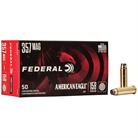
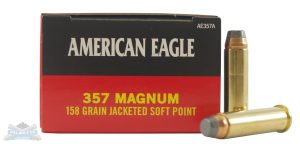


American Eagle is Federal loading its own components in plain boxes, and the .357 offering is a 158 grain jacketed soft point rather than the FMJ most range lines use. That makes it slightly more useful than pure practice ammunition, since a soft point at 1,240 fps will do the job on small game.
If you reload, the brass is the argument. Federal cases are consistent in weight and thickness in a way budget brass is not, and .357 brass lasts a long time.
Best For: Reloaders, and shooters who want one load that covers the range and light field work.

10. Hornady American Gunner 125gr XTP: Best Practice-and-Carry
Hornady American Gunner 125gr XTP is about $22 to $25 for 25 rounds, which is under a dollar a round for a genuine expanding bullet.
- Bullet Weight: 125gr XTP jacketed hollow point
- Published velocity: 1,500 fps
- Muzzle Energy: 624 ft-lb
- Case: Brass, 25-round box
- Item: 90504
| Value | Expansion | Penetration | Reliability | Reputation |
| 5/5 | 4/5 | 3/5 | 5/5 | 4/5 |
Pros
- Same velocity and energy as Critical Defense at two-thirds the price
- XTP is one of the most consistent conventional hollow points made
- 25 rounds a box, so function testing is affordable
- Cheap enough to practice with your actual carry weight
Cons
- No polymer tip, so heavy clothing can still plug the cavity
- 125 grain magnum loads are the hardest on a forcing cone
- Plain packaging gets it overlooked
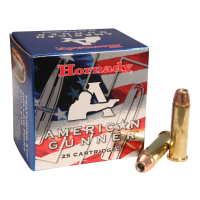

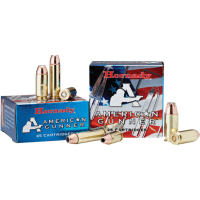
The XTP is a straightforward cup-and-core hollow point with controlled jacket thickness, and it has been doing that job since 1989. Hornady loads it into the American Gunner line in plain boxes at plain prices, and in .357 it runs the same 1,500 fps and 624 ft-lb as the Critical Defense above.
One clarification, because the two get confused. The XTP has no polymer tip. The tip is the FTX in Critical Defense. The XTP is the plain version of the same idea, which is why it costs less.
In our Hornady XTP review the American Gunner 125 gr XTP put 4 of 5 shots in the FBI band from a 4.2 inch GP100 but went 21.38 inches from a 2 inch snub.
It earns its place because it is the only load here you can genuinely afford to shoot in quantity while still carrying the same bullet weight and velocity you would carry defensively. Practising with 125 grain magnum recoil is the point.
Best For: Shooters who want to train with a full-power magnum load without paying carry-ammo prices.
.357 Magnum vs .38 Special
The .357 Magnum is a .38 Special with a case about a tenth of an inch longer, loaded to roughly double the pressure. The longer case exists so a magnum round physically cannot be chambered in a .38-only revolver.
Every .357 Magnum revolver will safely fire .38 Special. The reverse is never true. That one-way compatibility is the single most useful thing about owning a .357, because it means you can practice on cheap, mild .38 and carry magnum ammunition in the same gun.
Look at the barrel table again before deciding how much the magnum buys you. From a 2-inch barrel we measured .38 Special +P loads between 675 and 814 fps, which is 111 to 172 ft-lb. The .357 Magnum 125gr from that same 2-inch barrel made 949 fps for about 250 ft-lb. So the magnum is still meaningfully ahead in a snub, by something like half again, but it is delivering a fraction of what it manages from a 4-inch gun and it charges you the full blast and recoil either way. From four inches the magnum roughly doubles the .38.
Our best .38 Special ammo guide covers the other half of that decision.
How to Choose .357 Magnum Ammo
Start with your barrel length
Under 3 inches, buy a load engineered for short barrels. Three to four inches, most defensive loads work as advertised. Six inches or a carbine, you have the full cartridge and heavy bullets start making sense.
Bullet weight decides the job
125 grains is fastest and flattest and hardest on the gun. 145 to 158 grains is the general-purpose middle. 180 grains is for hunting and penetration. There is no single right answer, only a right answer for what you are doing.
Match the recoil to your practice schedule
A full-house magnum in a light revolver is genuinely unpleasant, and the shooter who flinches through six rounds twice a year is worse off than the one who shoots .38 Special every month and keeps magnums for carry. Be honest about which one you are.
How We Choose the Best .357 Magnum Ammo
Velocity and energy figures here are the manufacturers’ own published numbers, cited per entry, and each spec list states the test barrel length where the manufacturer publishes it. That matters more in this cartridge than any other, which is why it is called out rather than buried.
The barrel-length table is a destructive test, which is why there is one per cartridge and not one per year. A barrel cut to 2 inches does not go back, so those figures are the ones we work from rather than something we repeat every season.
Our own contribution is the range work. Every load here went through a 2-inch S&W snub and a 6-inch GP100, 50 rounds apiece, chronographed at ten feet. The pattern in the table held: the 125 grain loads lost the most in absolute terms out of the snub, and the Gold Dot Short Barrel was the only load that came within 60 fps of its published figure, because its published figure was measured from a barrel that short in the first place. Groups were shot at 25 yards from a rest, and the Hornady American Gunner was the surprise of the session at 1.9 inches from the GP100.
Price bands come from the live cards on this page and move with the market.
FAQ: .357 Magnum Ammo
What is the best .357 Magnum ammo for self-defense?
Federal Personal Defense HST 154gr at 1,340 fps and 614 ft-lb from a 4-inch barrel. It uses the same HST bullet most American police departments issue in 9mm, and Federal only brought it to .357 Magnum in 2022. Hornady Critical Defense 125gr FTX is the close alternative at 1,500 fps, with a polymer tip that stops heavy clothing plugging the cavity.
How much velocity does a .357 Magnum lose from a snub-nose barrel?
A great deal. In our own barrel testing a Federal 125gr JHP ran 1,511 fps from a 4-inch barrel and 949 fps from a 2-inch. That is 634 ft-lb against 250 ft-lb, so a 2-inch revolver delivers roughly 39 percent of the energy the same cartridge makes from a 4-inch barrel. Heavy 158 grain loads lose even more proportionally.
What is the best .357 Magnum ammo for a snub-nose revolver?
Speer Gold Dot Short Barrel 135gr. It is the only common .357 load whose published figures come from a 2 inch vented test barrel, and the bullet is built with a softer alloy and a reshaped cavity so it expands at the roughly 990 fps a snub actually produces. A standard magnum hollow point arriving at that speed often behaves like a solid.
Is .357 Magnum worth it in a 2-inch revolver?
Ballistically, barely. A .357 Magnum 125gr from a 2-inch barrel makes about 250 ft-lb, which is the same neighbourhood as .38 Special +P from the same gun, and you pay for it in muzzle blast, flash and recoil. If your revolver is a snub, either buy a load built for short barrels or carry .38 Special +P and accept the trade honestly.
Can I shoot .38 Special in a .357 Magnum revolver?
Yes, always. The .357 Magnum case is about a tenth of an inch longer than .38 Special and loaded to roughly double the pressure, and the extra length exists specifically so a magnum round cannot be chambered in a .38-only gun. The reverse is never safe. Shooting .38 in a .357 is the cheapest practice available to you.
What grain .357 Magnum is best?
125 grains is fastest and flattest and hardest on the forcing cone. 145 to 158 grains is the general-purpose middle and where most defensive loads sit. 180 grains is for hunting and deep penetration. Bullet weight should follow the job rather than the other way round, and barrel length matters more than weight in this cartridge.
Is .357 Magnum good for deer hunting?
Yes, inside about 100 yards from a 6-inch revolver or a lever-action carbine, with a heavy bullet. Federal Power-Shok 180gr JHP at 1,080 fps is the load to use. Penetration matters more than energy on game, which is why the slow heavy bullet beats the fast light one here despite the lower figure on the box.
Do 125 grain .357 loads damage revolvers?
Full-power 125 grain magnum loads have a long-standing reputation for eroding forcing cones, particularly in lighter K-frame revolvers, over a lot of rounds. As a carry load fired occasionally it is not something to worry about. If you plan to shoot hundreds of rounds a month, practice with .38 Special or a 158 grain load and save the 125s for carry.
Find the Best Price in Seconds
Search once, compare 200+ trusted retailers instantly.
Deals of the Day
Today's best discounts · Updated 3x daily
Gun Deals
See All →
Ammo Deals
See All →


Bottom Line: Which .357 Magnum Should You Buy?
If your revolver has a 4-inch barrel or longer, buy Federal Personal Defense HST 154gr. It is the most proven defensive bullet in America and at 614 ft-lb it is making full use of the cartridge. Hornady Critical Defense 125gr FTX is the alternative if you want the polymer tip and a little more speed.
If your revolver has a 2-inch barrel, buy Speer Gold Dot Short Barrel 135gr and do not think about it again. Every other load on this page is quoting you a number from a barrel you do not own.
For hunting, Federal Power-Shok 180gr. For practice, Sellier & Bellot 158gr FMJ at about 57 cents a round, or Hornady American Gunner if you want to train with real magnum recoil. And if you own a .357, buy .38 Special for practice too. The gun will shoot both, and your flinch will thank you.
Related Revolver & Ammo Guides
Related Guides