

Last updated September 2026 · By Nick Hall. Reviewed against Massad Ayoob’s Deadly Force (2014), the FBI Uniform Crime Reports on residential intrusion, and the published training curricula at Gunsite Academy, Thunder Ranch, and Massad Ayoob Group.
Some of the links below are affiliate links, meaning at no additional cost to you, we may earn a commission if you click through and make a purchase.
Table of Contents
Home Defense Strategies with Firearms: A Layered Approach
The most common American home-defense failure is the same one as the most common American concealed-carry failure: someone bought a gun, considered the problem solved, and skipped every other layer of the defense. The result is a household where the firearm is the entire defensive plan, expected to resolve a problem that should have been resolved at the perimeter, the alarm panel, the locked door, the family communication plan, or the decision to retreat to a safe room. The gun is the last line of defense, not the only one, and treating it as the entire plan is the design pattern that produces the bad outcomes.
This guide walks through a layered home-defense strategy in the order the layers actually function: perimeter and structural hardening (which resolves most threats before they ever reach the door), the firearm choice and staging that handles threats that do penetrate, the family plan that coordinates everyone in the house, the low-light tactical dimension that distinguishes serious home defense from range marksmanship, and the legal framework that governs every use of force inside your home. None of these layers is independent of the others. The household that has thought through all five is the household whose firearm probably never has to come out of the safe. The household that has thought through only the firearm is the household where the gun ends up being the only thing the situation depends on, and the situation is usually too complicated for that to work cleanly.
Sources cited throughout: Massad Ayoob’s Deadly Force: Understanding Your Right to Self Defense (Gun Digest Books, 2014); FBI Uniform Crime Reports and Bureau of Justice Statistics data on residential intrusion patterns; the published curricula of Gunsite Academy, Thunder Ranch, Massad Ayoob Group, and Tom Givens’s Rangemaster home-defense modules; and the working observations of instructors who teach home-defense courses to hundreds of armed citizens per year.
The Home Defense Layers at a Glance
The table below maps the major home-defense layers to what each one actually does, what it costs, and the failure mode it addresses. A serious home-defense posture invests across all five layers, not just the most exciting one.
| Layer | What it does | Cost | Failure mode it addresses |
|---|---|---|---|
| Perimeter (lighting, sight lines, fence) | Deters opportunistic intrusion; eliminates concealment | $200-$2,000 | Stops the attempt before it starts |
| Structural (locks, reinforced strike plates, doors) | Makes forced entry slow and loud | $300-$1,500 | Buys time and produces noise that alerts occupants |
| Alarm + monitoring | Triggers law-enforcement response; deters once active | $200 install + $20-50/mo | Brings third parties into the response loop |
| Family communication plan | Coordinates household response; avoids family-on-family mistakes | $0 | Prevents the most preventable mid-incident tragedies |
| Firearm + training | Resolves the threat if all prior layers fail | $500-$2,000 + training cost | Last-resort lethal capability |
Hardening Your Home First
The cheapest and most effective home-defense investments happen before the bedroom door, not behind it. Exterior lighting eliminates the concealment that opportunistic burglars rely on; motion-activated LED floodlights at $40-80 per unit pay back the investment in deterrence within months. Trimmed shrubs around windows close sight lines that an intruder could use to monitor the house. A six-foot privacy fence with a self-locking gate raises the entry difficulty enough that opportunistic intruders will move to a softer target. A doorbell camera at the front entry produces video evidence that prosecutors find compelling and that pre-empts much of the “he just knocked” narrative that hostile witnesses sometimes offer.
The structural layer is where the marginal-dollar return is highest. The single biggest upgrade in residential security is the reinforced strike plate: a $20 four-screw plate that replaces the two-screw factory strike plate on every exterior door, anchoring the deadbolt into the wall stud rather than the soft pine of the door frame. The factory strike plate fails to a forceful kick; the reinforced plate does not. Pair this with three-inch screws (also $5) replacing the standard 3/4-inch screws in the door hinges, and any exterior door becomes dramatically harder to kick in. Add a deadbolt-quality lock from Schlage, Kwikset, or Medeco ($60-200 per door), reinforce sliding glass doors with a bar or lockable pin ($20), and you have hardened the structure for under $400 per door.
The alarm-and-monitoring layer is the next-most-effective dollar invested. A monitored alarm system (SimpliSafe, Ring Alarm Pro, ADT) at $20-50 per month triggers law-enforcement response on confirmed intrusion. The deterrent effect is real: FBI data consistently shows alarmed homes are intruded at roughly one-third the rate of unalarmed homes in the same neighborhoods. The monitoring contract also creates a documented timeline of the incident, which matters for both criminal prosecution of the intruder and any post-incident civil claim. The full coverage of secure storage that complements the hardening sits in best gun safes and rapid-access options in best biometric gun safes.
Choosing the Right Home Defense Firearm
Three platforms cover essentially every American home-defense use case: the full-size 9mm pistol, the 12-gauge pump-action shotgun, and the AR-15 in 5.56 NATO. Each has trade-offs, and the right answer for any specific household depends on the layout, the inhabitants, and the realistic threat model. The 9mm pistol is the most universally accessible: it requires the least training to use competently, takes the least space to store, and can move with the defender through the house. The 12-gauge delivers the most decisive single-shot terminal effect and produces an intimidation factor that is documented to end roughly half of home-defense encounters without a shot fired. The AR-15 in 5.56 offers significant capacity and follow-up advantages, with the counterintuitive benefit of less over-penetration through interior walls than typical pistol ammunition (5.56 fragments rapidly in soft tissue and drywall).
The decision between these platforms is structural. A small apartment with a single-person occupancy and adult-only residents may be optimally served by a single 9mm pistol; the maneuverability advantages of a pistol matter in tight quarters. A two-story home with multiple bedrooms and children whose safe room is the parents’ bedroom is well-served by either a shotgun or an AR-15, both of which deliver capability the pistol cannot match. A rural property with potentially multiple-attacker scenarios may justify the AR-15’s capacity outright. The trade-off analysis between the two long-gun options lives in shotgun vs AR-15 for home defense; the broader home-defense firearm catalog in best guns for home defense and the shotgun-specific picks in best shotguns for home defense and best pump-action shotguns. The ammunition discussion is in home defense shotgun: slugs vs buckshot, best defensive ammo, and best 9mm ammo.
What matters more than caliber or platform is reliability and familiarity. The home-defense firearm must be a platform the defender has function-tested with their chosen ammunition (at least 200 rounds without a malfunction) and trains with regularly enough to operate it under stress without conscious thought. The shooter who has 1,000 rounds through a Glock 19 will be more effective with the Glock at 2 a.m. than the same shooter would be with a Mossberg 590 they shot 20 times five years ago. Familiarity trumps platform optimization. The cluster on choosing the platform that fits your specific situation sits in choosing a firearm for self-defense; the broader caliber question in why does everybody use 9mm.
Staging Your Firearm: Accessibility vs Safety
The home-defense firearm has to be accessible in the situation that demands it and secure in all other situations. These two requirements conflict directly, and the household that resolves the tension well is the one that has thought through the staging carefully. A pistol locked in a thumbprint-keyed gun safe in the master closet is secure but two minutes away. A pistol on the nightstand is one second away but accessible to children, guests, and an intruder who has reached the bedroom before the defender wakes up. The right answer for most households is a biometric rapid-access safe within arm’s reach of the bed, with the firearm loaded and ready and the safe locked against unauthorized access.
The biometric safe market has matured. Vaultek, SecureIt, GunBox, Hornady, and Stack-On make rapid-access biometric safes that open in roughly one second to a registered fingerprint and offer multiple backup access methods (PIN code, mechanical key). The price range for a competent unit is $200-450. The unit needs to be mounted to a structure (bedside table, wall stud), not free-standing, because a free-standing safe walks away with the intruder. The detailed coverage is in best biometric gun safes.
For long guns, the staging question is different. A shotgun or AR-15 is too large to stage in a bedside safe; the practical staging options are a vertical rifle safe in the master bedroom, a closet-mounted quick-access vault, or for households where the rifle is the primary home-defense weapon, a Trigger Safe / SecureIt model that holds the rifle ready-to-grab behind a biometric lock. Whatever the choice, the long gun should be staged with a magazine inserted but chamber empty, the standard “Cruiser Ready” condition police use for vehicle-mounted long guns, where racking the slide both chambers a round and announces intent. The cluster on storage options sits in best gun safes.
Developing a Home Defense Plan
The household defense plan is the dimension most armed gun owners have not seriously thought through, and it is where serious home-defense training produces the largest practical improvement. The plan answers the questions that the household will not have time to discuss during an actual incident: who calls 911, who retrieves the firearm, who goes to the children, where everyone retreats to, what the verbal commands to an intruder are, what the “all clear” signal is among family members, and what the response is if separation occurs.
The safe-room concept is the cleanest core of any household plan. Identify the room in the house where the family will retreat in an intrusion (usually the master bedroom if it is on the same floor as the children, otherwise a defensive-position fallback that everyone can reach). Equip the safe room with a charged cell phone, a working landline if available, a flashlight, the defensive firearm, and a written reminder of the household’s 911 protocol. The defender fortifies into the safe room, calls 911, announces “I am armed and the police are on the way” loudly enough for an intruder to hear, and waits. The doctrine of retreat-and-hold beats the doctrine of clear-the-house in nearly every documented home-defense incident analyzed by the training community. Tom Givens, Massad Ayoob, and the FBI’s research on residential intrusions all converge on this conclusion.
What you do not do is “clear the house” looking for intruders. Room-clearing is a four-person SWAT discipline that takes years to learn well and is not safe for a single armed homeowner. The intruder has the tactical advantage of knowing where they are; you do not. The right response is to deny ground, retreat to the safe room, fortify, call for help, hold the position. The deeper coverage of the room-clearing question and the household coordination dimension lives in home defense room clearing and situational awareness. For households with children specifically, see self-defense for senior citizens for the more general at-risk-population framework.
Low-Light Considerations
The overwhelming majority of home-defense encounters occur at night or in low-light interior conditions. This is the single most under-trained dimension of civilian home defense. The square-range shooter who is excellent in daylight at 7 yards may be incapable of identifying their target, indexing their sights, or making accurate hits in the darkened hallway where the actual encounter happens. The fix is twofold: a weapon-mounted light, and training that includes low-light shooting.
The weapon-mounted light has become standard equipment on serious home-defense pistols and is essentially mandatory on home-defense long guns. Streamlight TLR-1 HL, TLR-7 series, Surefire X300 Ultra, and Inforce APL are the standard pistol options at the 800-1,000 lumen output that current doctrine requires. For long guns, the SureFire Scout, Modlite PLHv2, and Streamlight ProTac HL-X are the standard options. The output level matters: 800-1,000 lumens at the muzzle is the threshold for positively identifying a person 15-25 feet away in interior darkness. Lower outputs are inadequate for serious home defense; higher outputs introduce diminishing returns and risk reflective glare in close quarters.
The handheld flashlight (separate from the weapon light) is the searching tool. The weapon light is for engaging targets; pointing the muzzle at every shadow in the house in order to see is a violation of the four basic rules of gun safety. The serious household will carry a handheld light to search and use the weapon light only when the threat is identified and the muzzle is being pointed at the threat intentionally. The cluster on the underlying safety doctrine sits in the 6 basic rules of gun safety.
Training and Practice
Home-defense competence requires training that goes beyond the square-range work most casual shooters do. The minimum competent home-defense training cadence: a multi-day defensive pistol course every twelve to eighteen months from a serious instructor; a low-light shooting class at least once (Surefire Institute, Gunsite Low Light, the various traveling instructors who offer the curriculum); dry-fire practice that includes drawing from your bedside-safe staging position; and live-fire practice that includes shooting under simulated stress (a shot timer is the cheapest stress simulator available). The full ongoing-training argument lives in firearms training: why you must get better; the dry-fire-program details in high-tech firearms training systems.
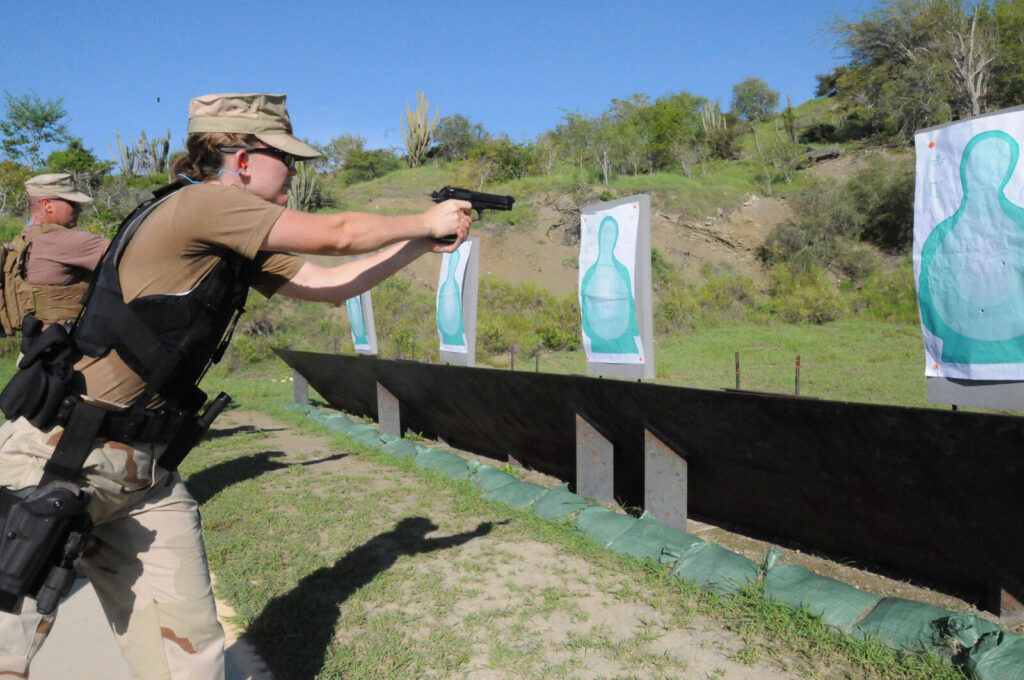
The household training dimension, rehearsing the safe-room plan, the family-to-family verbal commands, the 911 protocol, the “all clear” signal, is the part most armed citizens skip entirely. A quarterly family drill in which everyone walks through the home-defense plan (without firearms in the drill itself; the drill is about the household coordination, not the trigger pull) is the cheapest single home-defense investment a household can make. It costs nothing. It catches the failure points before the failure point matters. The household whose family has rehearsed the plan three times in the previous year is the household whose plan actually executes when the situation arises.
Legal Considerations
The legal framework for using deadly force inside the home is more favorable than the framework outside it in essentially every American jurisdiction, but the difference varies materially. Castle doctrine, in some form, exists in every American state. The phrase traces to Sir Edward Coke’s 1604 declaration that “the house of every one is to him as his castle and fortress.” American law codifies this in two ways: as an exception to any duty to retreat (you do not have to flee your own home) and as a presumption of reasonable fear (the law presumes you reasonably feared death or serious injury when someone unlawfully entered your home, particularly by force).
The boundaries of “castle” vary by state. Florida and Texas extend the doctrine to the home, the occupied vehicle, and (in Texas) the workplace. California extends it to the home only, with significant limits on the presumption. New York extends it to the home but requires a showing of reasonable fear rather than presuming it. Colorado’s “Make My Day” doctrine (1985) is one of the broadest in the country, granting immunity from both criminal prosecution and civil suit for the use of force against an unlawful intruder. The full state-by-state matrix is in castle doctrine explained, with broader state coverage in US gun laws by state and the substantive legal test in what is self-defense with a gun.
The aftermath dimension matters as much as the substantive law. Even in the most defender-favorable jurisdictions, a home-defense shooting triggers a criminal investigation, possible grand jury review, and in non-immunity states a likely civil suit by the intruder’s family. The financial reality of post-incident defense, even with a clean shooting in a castle-doctrine state, runs $50,000-$250,000 in attorney fees. The deeper coverage of the legal aftermath lives in legal issues after a defensive shooting and the financial-hedge case in why you need concealed carry insurance now. The moral framework that should precede every use of lethal force is in the ethics of lethal force in self-defense.
The Bottom Line
The serious American home-defense posture invests across five layers: perimeter and structural hardening that resolves most threats before they reach the door, an alarm-and-monitoring system that brings law-enforcement response into the loop, a family communication plan that prevents the most preventable mid-incident tragedies, a defensive firearm staged for rapid access by adults and secure access from children, and ongoing training that produces competence under stress. The household that has invested in all five layers is the household whose firearm probably never has to come out of the safe. The household that has invested only in the firearm is the household where the gun ends up being the only thing the situation depends on, and the situation is usually too complicated for that to work cleanly.
The practical takeaway: do not skip the cheaper, lower-stress layers. A $400 perimeter-and-structural-hardening upgrade prevents more residential intrusions than a $1,500 pistol-and-training investment, and the two are not interchangeable; they are sequential. Harden the structure first, install the alarm second, develop the family plan third, choose and stage the firearm fourth, train continuously fifth. The order matters, and the household that takes them in the right order is the one whose defense actually holds when the situation arrives.
Related Guides
- Best Guns for Home Defense, the platform survey.
- Best Shotguns for Home Defense, the 12-gauge market.
- Shotgun vs AR-15 for Home Defense, the long-gun trade-off analysis.
- Home Defense Shotgun: Slugs vs Buckshot, ammunition selection.
- Best Biometric Gun Safes, rapid-access storage market.
- Best Gun Safes, the broader safe market.
- Choosing a Firearm for Self-Defense, gun-selection decision framework.
- Firearms Training: Why You Must Get Better, the ongoing-training argument.
- Legal Issues After a Defensive Shooting, the post-incident framework.
- Castle Doctrine Explained, the state-by-state matrix.
- The Ethics of Lethal Force, the moral framework.
- Home Defense Room Clearing, the case against clearing alone.
Sources and Further Reading
- Massad Ayoob, Deadly Force: Understanding Your Right to Self Defense (Gun Digest Books, 2014).
- Massad Ayoob, In the Gravest Extreme (Police Bookshelf, 1980).
- Tom Givens, Concealed Carry Class: The ABCs of Self-Defense Tools and Tactics (Gun Digest Books, 2019).
- U.S. Federal Bureau of Investigation, Uniform Crime Reports, residential intrusion data.
- U.S. Bureau of Justice Statistics, residential victimization patterns.
- Gunsite Academy Defensive Pistol curriculum, Low Light module.
- Massad Ayoob Group MAG-40 and home-defense curriculum.
- Surefire Institute Low Light Shooting course materials.
- State castle-doctrine statutes for the jurisdiction in which the household resides.
Home-Defense Strategy Questions Most Tactics Articles Skip
Where should the defensive gun actually live in the house?
Within reach of the master bedroom is the standard answer. The cleaner version: within reach of wherever you sleep, with a quick-access safe that the unauthorized cannot open and you can open in under three seconds in the dark with your weak hand. A gun two rooms away is a gun that exists for theoretical scenarios. The bedroom safe is the gun for the actual statistical home-invasion timeline.
Should I sweep the house if I hear something at night?
No, in nearly every scenario. The standard defensive doctrine is to stay put, secure the bedroom, call 911 on speakerphone, and stage the gun pointed at the door. Clearing rooms is a training-intensive skill that police teams practice for hundreds of hours; a sleep-deprived homeowner doing it for the first time at 2am is at high risk of catastrophic outcome. Stay in the secured room and let the threat come to you.
Where should family members go if the alarm goes off at night?
The standard plan: every family member shelters in place, in their bedroom, behind a closed door. Children old enough to follow instructions practice the “stay in your room, lock the door, get on the floor” sequence twice a year. The defender does not move to gather family members during an active intrusion, every move increases the risk. The 911 call provides the dispatched location of all family members in their rooms, and law enforcement does the consolidation after arrival.
What is the right answer to “shoot through the door if someone breaks in”?
Never, in nearly all jurisdictions and scenarios. Shooting through a closed door without visual identification is treated as use of deadly force against an unverified threat. The defender cannot articulate a reasonable belief of imminent danger from a target they have not seen. Verify the threat visually before firing, even in the worst-case scenarios. The “shoot through the door” instinct is the most common cause of accidental shootings of family members who returned home unexpectedly.
Frequently Asked Questions
What is the best gun for home defense?
The best home defense gun depends on your living situation. A 12-gauge or 20-gauge shotgun is devastating at close range with limited over-penetration risk using proper loads. An AR-15 offers 30-round capacity, low recoil, and excellent accuracy. A full-size 9mm pistol is the most maneuverable option and can be operated with one hand. Choose the platform you are most trained and comfortable with.
Should I have a home defense plan?
Yes. A home defense plan should include a designated safe room with a reinforced door and phone, a specific rallying point for family members, clear rules about who moves where during an intrusion, the location of your firearm and flashlight, and a decision not to clear your house (let police do that). Practice the plan with your family so everyone knows their role.
Should I clear my house during a break-in?
No. Unless a family member is in another part of the house and cannot get to safety, do not attempt to clear your home. Room clearing is an extremely dangerous skill that requires extensive training and is typically done by teams of trained operators. Retreat to a safe room, call 911, arm yourself, and wait for police. Moving through your house in the dark exposes you to ambush.
What is the best shotgun load for home defense?
Number 1 buckshot and 00 buckshot are the most recommended home defense shotgun loads. 00 buck delivers eight to nine .33-caliber pellets per shell and is devastating at home defense distances. Number 1 buck offers slightly more pellets with slightly less individual pellet energy. Avoid birdshot for home defense as it lacks penetration to reliably stop a threat.
Do I need a weapon-mounted light for home defense?
Yes. A weapon-mounted light is essential for any home defense firearm. You must positively identify your target before you shoot, and most home invasions occur at night. A weapon-mounted light keeps both hands on the gun while illuminating the threat. The Streamlight TLR-1 HL and SureFire X300U are top choices for pistols and rifles.
How should I store my home defense gun?
A bedside biometric gun safe provides the best balance of quick access and security. Your home defense gun should be accessible in seconds but secured from unauthorized users, especially children. Consider placing smaller quick-access safes in multiple locations so you are never far from a firearm regardless of where an intruder enters your home.
Should I clear my house if I hear an intruder?
No. Room-clearing is a four-person SWAT discipline that takes years to learn well and is not safe for a single armed homeowner. The intruder has the tactical advantage of knowing where they are; you do not. The right response is to deny ground, retreat to the designated safe room (usually the master bedroom), fortify, call 911, announce "I am armed and the police are on the way" loudly enough for an intruder to hear, and hold the position. The doctrine of retreat-and-hold beats the doctrine of clear-the-house in nearly every documented home-defense incident analyzed by the training community.
What is the best home defense gun?
There is no single best home-defense gun. Three platforms cover essentially every American home-defense use case: the full-size 9mm pistol (most universally accessible, requires least training, takes least space), the 12-gauge pump-action shotgun (most decisive single-shot terminal effect, strong intimidation factor), and the AR-15 in 5.56 NATO (high capacity, fast follow-up, counterintuitively less wall-penetration than typical pistol ammunition). The right choice depends on the household layout, the occupants, and the realistic threat model. What matters more than caliber or platform is reliability and familiarity: the firearm you have function-tested with 200 rounds of your chosen load and train with regularly is more effective than any "optimal" platform you barely know.
Do I need a weapon-mounted light?
For serious home defense, yes. The overwhelming majority of home-defense encounters occur at night or in low-light interior conditions, and the square-range shooter who is excellent in daylight may be incapable of identifying their target, indexing their sights, or making accurate hits in the darkened hallway where the actual encounter happens. Streamlight TLR-1 HL, TLR-7 series, Surefire X300 Ultra, and Inforce APL are the standard pistol options at 800-1,000 lumens. Pair with a separate handheld flashlight for searching (the weapon light is for engaging identified threats, not for pointing the muzzle at every shadow in the house).
4,644+ Gun & Ammo Deals
Updated daily from 200+ top retailers. Filter by category, caliber, action type, and price.
Related Guides