

Last updated September 2026 · By Nick Hall, defensive shooter with 15+ years testing carry ammo through ballistic gel and short barrels
Some of the links below are affiliate links, meaning at no additional cost to you, we may earn a commission if you click through and make a purchase.
- Treat every gun as loaded
- Point the muzzle in a safe direction
- Keep your finger off the trigger until you’re ready to shoot
- Know your target and what’s beyond
Quick Answer: Federal HST and Speer Gold Dot are the best concealed carry ammo choices in 9mm in 2026, the two loads that dominate FBI testing protocols and law-enforcement adoption across the country. If you carry 9mm, either one is the right choice, modern defensive 9mm is genuinely excellent.
Best .45 ACP CCW load: Federal HST 230gr +P. Best .380 ACP CCW load: Hornady Critical Defense 90gr or Federal HST Micro 99gr. Best .38 Special CCW load: Speer Gold Dot 135gr +P Short Barrel. Best 10mm carry load: Federal HST 200gr or Underwood XTP 180gr. Best .40 S&W: Federal HST 180gr or Speer Gold Dot 180gr.
The biggest mistake CCW buyers make is loading their carry gun without ever firing the chosen load through it. Carry ammo is expensive ($1.50-$3.00 per round) but at least 100 rounds of your chosen load through the carry gun is non-negotiable for confirming reliability. Every load on this list has documented FBI testing protocol performance (12-18 inch penetration, controlled expansion, no over-penetration in heavy clothing).
| Ammo | Caliber | Grain | Verdict | Price |
|---|---|---|---|---|
| BEST OVERALL Federal HST 124gr |
9mm | 124gr | TOP PICK | Lowest Price ↓ |
| BEST VALUE Speer Gold Dot 124gr |
9mm | 124gr | TOP PICK | Lowest Price ↓ |
| BEST .380 Federal HST Micro .380 |
.380 ACP | 99gr | TOP PICK | Lowest Price ↓ |
| BEST .45 ACP Federal HST 230gr |
.45 ACP | 230gr | TOP PICK | Lowest Price ↓ |
| BEST REVOLVER Speer Gold Dot Short Barrel .38 |
.38 Special | 135gr | TOP PICK | Lowest Price ↓ |
Table of Contents
How we tested: Every pick here is ranked against our testing methodology. Minimum round counts, accuracy and reliability protocols, the failures that disqualify a gun.
Why Defensive Ammo Actually Matters
Carry ammo isn’t just “better FMJ.” It’s engineered to do something specific: expand on impact to create a larger wound channel, slow down inside tissue instead of overpenetrating through a threat and into whatever’s behind them, and do all that reliably from a 3-inch barrel running at lower velocities than the ballistic charts assume. Most defensive loads are tested out of 4″ or longer barrels. Your carry gun probably isn’t that long.
The FBI protocol is the gold standard. 12 to 18 inches of penetration in 10% ballistic gelatin, with expansion to at least 1.5x the original bullet diameter. Shots through heavy clothing, car glass, drywall. The loads on this list are the ones that actually pass those tests from realistic carry barrel lengths, not just from a test barrel at a lab bench.
I’ve cross-referenced published gel test data from Lucky Gunner, ShootingTheBull410, and manufacturer test results to build this guide. No load made the list unless it has documented, real-world performance data from short barrels. For a broader look at defensive options across categories, check our best defensive ammo guide. And if you’re still picking a carry gun, start at our best concealed carry handguns roundup first.
Best 9mm Defensive Ammo
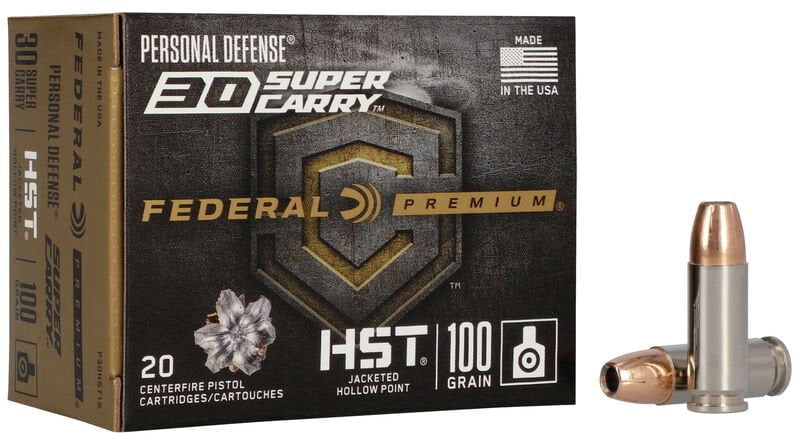
9mm is where the data is deepest. Law enforcement agencies have run millions of rounds through gel blocks, and the results keep pointing to the same two loads: Federal HST and Speer Gold Dot. If you carry 9mm, you’re in good shape. The modern defensive 9mm is genuinely excellent, and the arguments for bigger calibers have mostly collapsed under the FBI’s own research. See our full best 9mm ammo guide for range and defensive options combined.
Federal Premium HST 124gr
- Caliber: 9mm Luger
- Bullet Weight: 124gr
- Velocity (4″ barrel): ~1,150 fps
- Velocity (3″ barrel): ~1,090 fps
- FBI Gel Penetration: 13–16″
- Expanded Diameter: ~0.60″
- +P available: Yes (147gr +P also exists)
Pros
- Consistently passes SAAMI-spec FBI gel protocol from short barrels
- Wide petal expansion with excellent weight retention
- Hollow point skives prevent clogging through heavy denim
- Loaded by a major domestic manufacturer with tight QC
Cons
- Standard 124gr runs a bit hot; +P version adds snap in compact pistols
- More expensive than FMJ practice ammo (load to 147gr to reduce recoil in small guns)
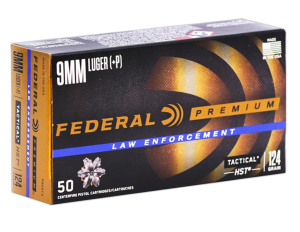
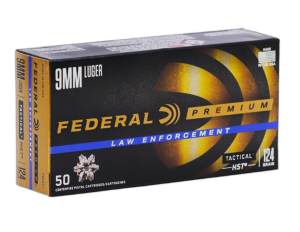
This is the load. If someone asked me to pick one defensive 9mm load and never revisit the question, it’s HST 124gr standard pressure. The skiving on those petals isn’t decorative; it’s what keeps the hollow point from plugging with denim or jacket material and turning into a soft-point. Lucky Gunner’s testing consistently puts it at 13 to 16 inches through bare gel and heavy clothing. That’s dead-center FBI protocol from a 4-inch barrel, and it holds up reasonably well from 3 inches too.
Standard pressure means less muzzle blast and less perceived recoil in your compact or subcompact carry gun. That matters. A load that prints better groups in your actual carry pistol is a better load. The 147gr version is even softer shooting and still meets penetration thresholds. Both are solid. The 124gr is the more universally recommended starting point.
Best For: Shooters who want one load that works in anything from a full-size to a compact 9mm, with documented gel performance to back it up.
Speer Gold Dot 124gr
- Caliber: 9mm Luger
- Bullet Weight: 124gr
- Velocity (4″ barrel): ~1,150 fps
- Velocity (3″ barrel): ~1,080 fps
- FBI Gel Penetration: 12–15″
- Expanded Diameter: ~0.58″
- +P available: Yes
Pros
- EFMJ-style bonded core stays together through barriers
- Used by thousands of law enforcement agencies nationwide
- Consistent expansion and penetration in independent testing
- Available in standard pressure and +P
Cons
- Slightly less expansion than HST in some bare gel tests
- Standard 124gr can occasionally edge toward 12″ in heavy denim from short barrels
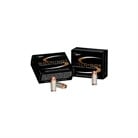
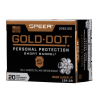
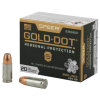
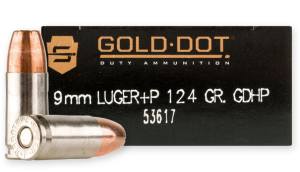
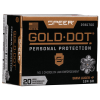
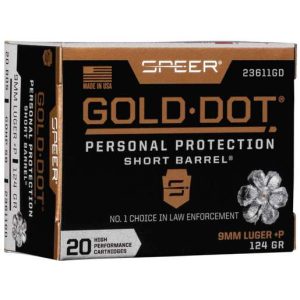
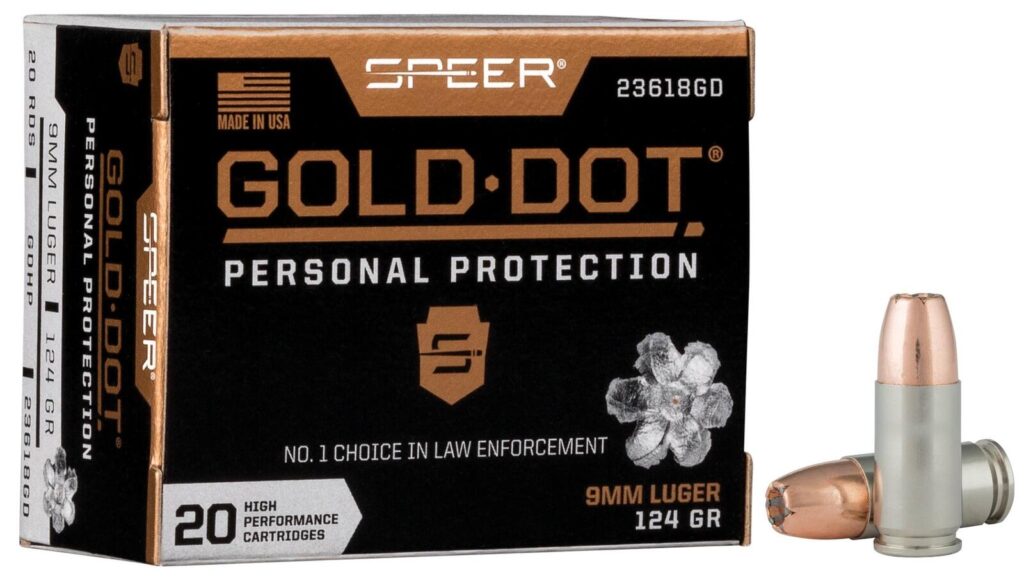
Gold Dot’s electrochemical bonding process is the real differentiator. The jacket isn’t just crimped onto the core; it’s grown onto it. That means the bullet holds together through intermediate barriers in a way that cheaper hollow points don’t. Through a car door, through a windshield, through a heavy leather jacket. Law enforcement chose this load for a reason, and that reason is barrier consistency.
Bare gel numbers are marginally behind HST in some tests, but “marginally behind HST” still means excellent. Real-world performance is essentially identical. If your local gun shop is out of HST and has Gold Dot on the shelf, buy the Gold Dot. You’re not settling.
Best For: Anyone who wants law enforcement-grade barrier performance or shoots a firearm where Gold Dot cycles more reliably than HST in their specific pistol.
Hornady Critical Duty 135gr +P
- Caliber: 9mm Luger
- Bullet Weight: 135gr
- Velocity (4″ barrel): ~1,110 fps (+P)
- FBI Gel Penetration: 14–18″
- Expanded Diameter: ~0.54″
- +P: Yes (standard spec for this load)
Pros
- Engineered specifically for FBI protocol barrier testing
- InterLock band keeps jacket and core bonded through barriers
- Excellent penetration depth, especially through barriers
- Purpose-built for full-size duty pistols and longer barrels
Cons
- +P pressure increases recoil in subcompacts; not ideal for carry guns
- Less expansion diameter than HST due to barrier-focus tuning
- Designed for full-size pistols, not pocket guns
Critical Duty is Hornady’s barrier-penetration load, purpose-built for law enforcement use in full-size pistols. The Flex Tip insert keeps the cavity open through clothing and intermediate barriers, and the InterLock band keeps jacket and core together. Penetration runs deep: 14 to 18 inches through denim is common, which is toward the upper end of FBI spec.
Honest truth is that Critical Duty is overkill for most concealed carry applications. It’s a full-size, +P, barrier-defeating load. For a compact or subcompact daily carry gun, Critical Defense (standard pressure, lighter bullet, tuned for expansion) is probably the smarter choice. But if you carry a G17 or a P226, this load absolutely belongs on your shortlist.
Best For: Full-size carry guns where +P pressure isn’t an issue and you prioritize barrier penetration over expansion diameter.
Best .380 ACP Defensive Ammo
.380 is a tough caliber to load defensively. Low velocity, short barrels, limited powder space. Most hollow points don’t have enough energy to expand reliably AND hit 12 inches of penetration. The loads below are the exceptions. They’re specifically engineered for the velocity and pressure constraints of the .380 case. For a full breakdown on .380 options, see our best .380 ammo guide.
Hornady Critical Defense .380 ACP 90gr
- Caliber: .380 ACP
- Bullet Weight: 90gr
- Velocity (2.75″ barrel): ~950 fps
- FBI Gel Penetration: 9–12″
- Expanded Diameter: ~0.50″
- +P: No (.380 ACP has no +P SAAMI spec)
Pros
- Flex Tip prevents hollow point plugging at low velocity
- Consistent expansion even from 2.75″ pocket gun barrels
- Widely available, reliable feeding in most .380 pistols
- Better gel performance than most .380 JHP alternatives
Cons
- 9-10″ penetration in some tests falls short of FBI 12″ minimum
- Lower expansion than 9mm options at equivalent velocity
Critical Defense’s Flex Tip insert is the reason this load works where standard .380 JHP often fails. At low velocity, hollow points plug. The polymer tip keeps the cavity open at 950 fps. Penetration runs 9 to 12 inches in most documented testing, which strains the lower end of FBI protocol but beats most .380 alternatives. If your carry gun is a Ruger LCP or a Glock 42, this is your load.
Don’t obsess over the slight penetration shortfall. For a defensive caliber running at .380 velocity, consistent expansion plus 10 inches of penetration beats deep penetration with zero expansion. No load is perfect in .380; pick the one that performs most consistently from your specific barrel length.
Best For: Pocket .380 pistols where reliable feeding and consistent expansion at low velocity are more important than raw terminal numbers.
Federal HST Micro .380 ACP 99gr
- Caliber: .380 ACP
- Bullet Weight: 99gr
- Velocity (2.75″ barrel): ~940 fps
- FBI Gel Penetration: 12–14″
- Expanded Diameter: ~0.52″
- +P: No
Pros
- Specifically engineered for short-barrel .380 pistols
- Hits FBI 12″ minimum penetration better than most .380 JHP
- Heavier 99gr bullet maintains momentum at lower velocity
- Federal’s HST reliability and quality control
Cons
- Harder to find than Critical Defense; often sold in smaller boxes
- Slightly less expansion than Critical Defense in some tests
Federal built the HST Micro line specifically for the velocity constraints of subcompact pistols. The 99gr bullet is heavier than the typical .380 JHP, which helps it maintain momentum through gel even at lower velocity. In documented testing it routinely hits 12 to 14 inches of penetration with consistent, controlled expansion. That’s FBI protocol from a pocket gun. It’s genuinely impressive for the caliber.
Finding it is the challenge. HST Micro .380 sells out fast and doesn’t always restock at the same pace as standard 9mm HST. Buy it when you see it. It’s better than Critical Defense on penetration. Whether that difference matters in a real defensive scenario is a philosophical debate, but the numbers are the numbers.
Best For: .380 shooters who want the most FBI-protocol-compliant load available for their pocket gun and are willing to stock up when it’s in stock.
Best .45 ACP Defensive Ammo
The .45 ACP already starts big. A 230gr bullet at .45 caliber doesn’t need to expand as dramatically as a 9mm does to create a serious wound channel. But expansion still matters, and so does penetration. Some .45 loads expand so aggressively they fall under 12 inches. The picks below hit the protocol sweet spot. For more .45 ACP options across use cases, see our full best .45 ACP ammo guide.
Federal Premium HST 230gr .45 ACP
- Caliber: .45 ACP
- Bullet Weight: 230gr
- Velocity (5″ barrel): ~890 fps
- Velocity (3.5″ barrel): ~830 fps
- FBI Gel Penetration: 13–16″
- Expanded Diameter: ~0.72″
- +P available: Yes
Pros
- Massive expansion diameter while still hitting 13″+ penetration
- Standard pressure means less recoil in compact .45 carry guns
- Excellent performance from 3.5″ to 5″ barrel lengths
- Consistent HST quality control and bonded-style construction
Cons
- 230gr at .45 ACP velocity is slow; still plenty of energy but don’t expect rifle numbers
- Higher price per round than practice FMJ
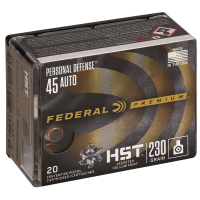
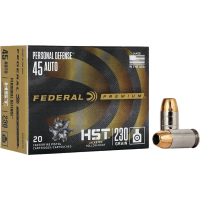
The .45 HST expands to roughly 0.72 inches in gel. That’s bigger than a dime. Standard pressure means it’s shootable in a 3.5-inch carry 1911 or a Glock 30 without punishing recoil. Penetration stays in the 13 to 16-inch range across bare gel and heavy clothing tests. That combination of expansion and penetration depth is hard to beat in this caliber.
If you run a Commander-length or shorter .45, the standard pressure load is your friend. The +P version pushes velocity and expansion further but adds meaningful recoil in a compact pistol. You probably don’t need it. Standard pressure HST 230gr is already doing everything you need it to do.
Best For: .45 ACP carriers who want proven gel performance with manageable recoil, from compact carry guns up to full-size 1911s.
Speer Gold Dot .45 ACP 230gr
- Caliber: .45 ACP
- Bullet Weight: 230gr
- Velocity (5″ barrel): ~890 fps
- FBI Gel Penetration: 13–15″
- Expanded Diameter: ~0.68″
- +P available: Yes
Pros
- Bonded core construction for barrier consistency
- Law enforcement proven in .45 ACP platforms
- Consistent expansion and penetration in independent testing
- Available in standard and +P
Cons
- Slightly less expansion than HST in bare gel
- Costs more than Gold Dot 9mm on a per-round basis
Gold Dot in .45 ACP runs nearly identically to HST on the terminal performance charts. Expansion is slightly less, penetration is nearly identical. The bonded construction is the argument for Gold Dot when barrier penetration is a concern. If you’re worried about shooting through intermediate barriers, Gold Dot handles that more predictably. For pure bare-gel numbers, HST edges it out. Either way you’re carrying excellent ammo.
Best For: .45 ACP shooters who’ve standardized on Gold Dot across their defensive firearms or who prioritize barrier-consistent performance.
Best .38 Special Defensive Ammo
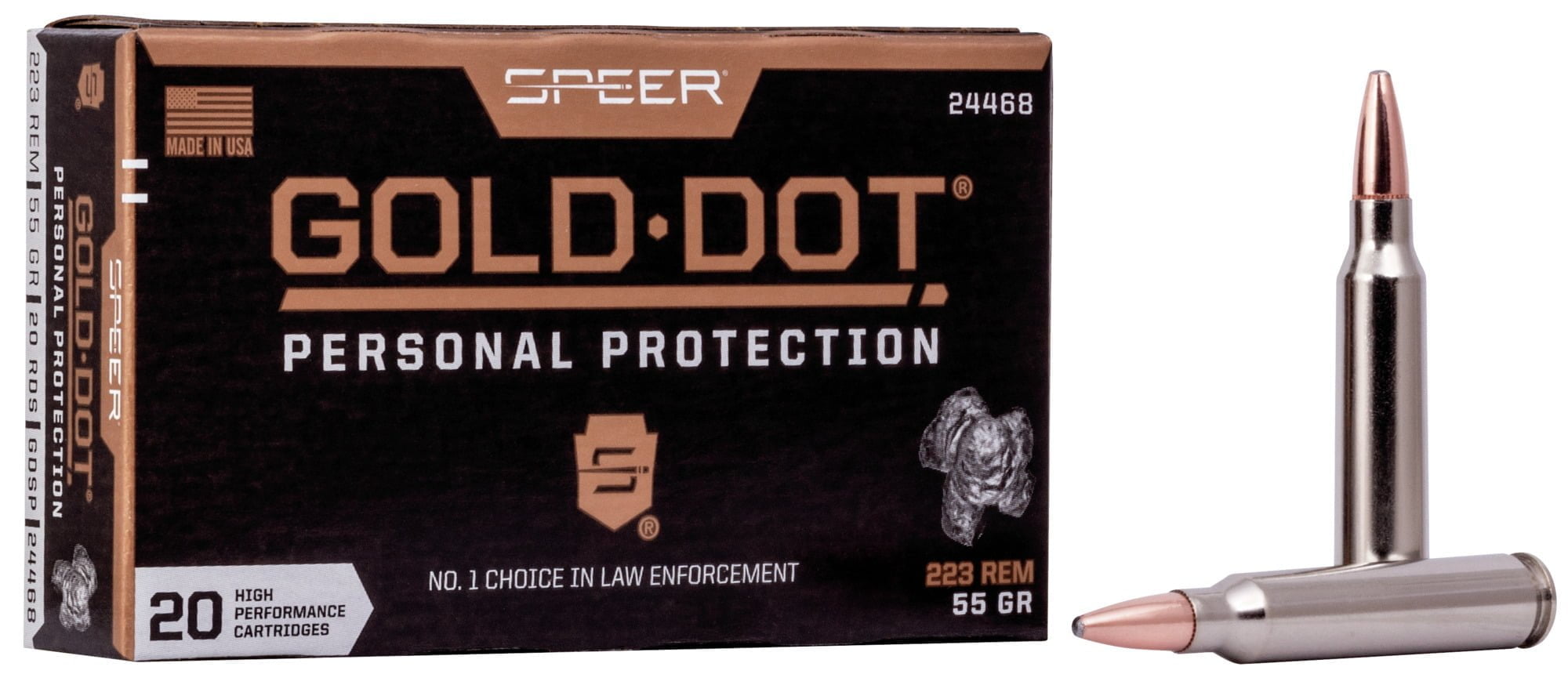
.38 Special from a 2-inch snub nose is a velocity problem. You’re launching a bullet designed for 4-inch test barrels out of a barrel that’s half as long. The pressure drops before the bullet leaves the muzzle, and velocity craters accordingly. Some loads solve this by tuning the powder charge and bullet weight specifically for short barrels. Those are the only loads worth running in a J-frame.
Hornady Critical Defense Lite .38 Special 90gr
- Caliber: .38 Special
- Bullet Weight: 90gr
- Velocity (2″ barrel): ~890 fps
- FBI Gel Penetration: 9–12″
- Expanded Diameter: ~0.52″
- +P: No
Pros
- Lighter 90gr bullet builds velocity from 2″ barrel
- Flex Tip ensures reliable expansion at reduced velocity
- Lower recoil makes follow-up shots faster from a snub
- No +P pressure reduces wear on lightweight revolvers
Cons
- Penetration sometimes falls short of 12″ in documented tests
- Not ideal for shooting through barriers at snub-nose velocity
The “Lite” designation means lighter bullet, lower recoil, and tuned specifically for short-barrel revolvers. The 90gr bullet hits higher velocity than a standard 130gr load from the same 2-inch barrel, and the Flex Tip gives it a fighting chance at expanding reliably. Recoil in an alloy-frame snub like the S&W 637 is dramatically more manageable than standard .38 loads. If you carry a lightweight J-frame and need something you can shoot fast with decent control, this is it.
Penetration is the caveat. 9 to 12 inches is right at or just under FBI minimum. That’s the tradeoff for the lighter weight and lower recoil. For a dedicated defensive revolver that lives in a holster, the Speer Short Barrel load below is probably a better choice on pure terminal performance. But if recoil management matters to you, Critical Defense Lite earns its place.
Best For: Lightweight snub-nose revolvers carried by shooters who need manageable recoil above all else and accept some penetration compromise.
Speer Gold Dot Short Barrel .38 Special +P 135gr
- Caliber: .38 Special +P
- Bullet Weight: 135gr
- Velocity (2″ barrel): ~860 fps
- Expanded Diameter: ~0.55″
- +P: Yes
Pros
- Specifically engineered for 1.875″-2″ snub-nose barrels
- Hits FBI 12″ penetration floor from a 2″ barrel
- Bonded core maintains integrity through heavy clothing
- NYPD issued this load for off-duty snub-nose carry for years
Cons
- +P pressure increases wear on older or lightweight alloy frames
- Heavier 135gr means more recoil from a 12oz alloy snub
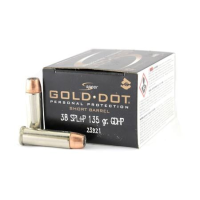
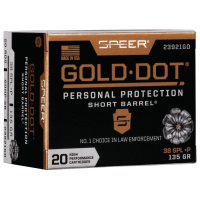

This is the serious snub-nose load. Speer specifically designed the Short Barrel line by tuning powder burn rates for 2-inch barrels, not 4-inch test barrels. The NYPD off-duty carry specification used this load for years. That’s about as high-stakes a real-world validation as it gets. From a 2-inch barrel it reliably hits 12 to 14 inches of penetration with consistent expansion from the bonded Gold Dot bullet.
The +P designation is worth noting. The additional pressure extracts more velocity from that short barrel, and is part of why this load hits FBI protocol when standard .38 loads don’t. Steel-frame revolvers handle it fine long-term. Lightweight alloy frames like a S&W 642 technically accept +P but the manufacturers recommend limiting use. Load it, carry it, practice with standard pressure. That’s the sensible approach.
Best For: Anyone carrying a steel or steel-alloy .38 Special snub nose who wants the best documented terminal performance available for that platform.
Best .357 Magnum Defensive Ammo
.357 Magnum is interesting. From a 4-inch or longer barrel it’s one of the most ballistically effective handgun rounds ever made. From a 2-inch snub it loses so much velocity that some loads are barely performing better than .38 Special +P. The loads below are chosen for how they perform from realistic carry barrel lengths, not from 6-inch test barrels. Muzzle flash is also a real concern with .357 Mag in a short barrel; indoors, it’s substantial.
Speer Gold Dot Short Barrel .357 Magnum 135gr
-
- Caliber: .357 Magnum
-
- Bullet Weight: 135gr
-
- Velocity (2″ barrel): ~1,150 fps
-
- FBI Gel Penetration: 13–16″
-
- Expanded Diameter: ~0.59″
-
- Flash suppressed: Yes (low-flash powder)
Pros
- Short Barrel tuning delivers genuine .357 performance from 2″
- Low-flash powder formula reduces indoor muzzle blast
- Bonded Gold Dot bullet for barrier and clothing penetration
- Significantly better terminal performance than .38 +P from same barrel
Cons
- Still significant recoil and report from a lightweight snub
- Muzzle blast is reduced but not eliminated in short barrels
Same Short Barrel engineering philosophy as the .38 Special version, but with the full .357 Magnum case behind it. At 1,150 fps from a 2-inch barrel this is genuinely more powerful than any .38 load you can run in the same gun, and the low-flash powder helps with the notorious .357 indoor fireball problem. Penetration sits solidly in FBI protocol territory at 13 to 16 inches.
If you’re carrying a .357 Magnum revolver specifically because you want its ballistic advantage, this is how you get that advantage from a snub nose. Run full-length .357 loads in a 4-inch barrel and you get even more performance, but for a carry-length revolver, Gold Dot Short Barrel is where I’d start.
Best For: .357 Magnum carry revolvers in 2 to 3-inch barrel configurations where you want real .357 terminal performance without unmanageable indoor muzzle blast.
Hornady Critical Defense .357 Magnum 125gr
-
- Caliber: .357 Magnum
-
- Bullet Weight: 125gr
-
- Velocity (4″ barrel): ~1,500 fps
-
- Velocity (2″ barrel): ~1,200 fps
-
- FBI Gel Penetration: 12–15″
-
- Expanded Diameter: ~0.60″
Pros
- Excellent expansion performance at .357 velocity levels
- Flex Tip prevents hollow point plugging through clothing
- Great terminal numbers from 4″ barrel carry revolvers
- 125gr classic .357 weight with good velocity retention
Cons
- More muzzle flash than Gold Dot Short Barrel from 2″ guns
- Full-power load means substantial recoil in lightweight revolvers
Classic 125gr .357 load is one of the most historically effective stopping loads in handgunning. Critical Defense puts a Flex Tip on that legacy platform and modernizes it for hollow point reliability. From a 4-inch revolver this load is simply excellent. From a 2-inch snub it works, but muzzle flash is more pronounced than with Gold Dot Short Barrel. The difference matters in a dark house at 3 AM.
Best For: Medium to full-length .357 revolvers (3″ to 6″ barrels) where maximum terminal performance is the priority.
Best 10mm Defensive Ammo
10mm carry guns are a niche within a niche. The Glock 29 and a handful of compact platforms have built a dedicated following among people who want the most powerful common semi-auto cartridge in a carry-sized package. Terminal performance potential is high. The tradeoff is that full-power 10mm is loud, flashy, and snappy. Defensive loads tune that down somewhat while keeping the terminal numbers serious.
Hornady XTP 10mm 155gr
-
- Caliber: 10mm Auto
-
- Bullet Weight: 155gr
-
- Velocity (4″ barrel): ~1,265 fps
-
- FBI Gel Penetration: 14–17″
-
- Expanded Diameter: ~0.60″
-
- +P: N/A (10mm is its own pressure spec)
Pros
- XTP bullet is one of the most consistent expanding bullets made
- Good penetration depth for a defensive load at 10mm velocity
- Controlled expansion rather than violent fragmentation
- Works well in compact 10mm pistols like Glock 29
Cons
- Not the deepest penetrating 10mm load available (hunting loads go deeper)
- Higher recoil than .40 S&W or 9mm alternatives
XTP bullet is Hornady’s older but proven controlled-expansion design. It’s not optimized purely for maximum expansion; it expands to about 0.60 inches and drives deep because it doesn’t shred on impact. For a defensive application that’s exactly what you want. The 10mm version hits 14 to 17 inches of gel penetration, which is toward the upper end of FBI protocol. More than deep enough to reach vitals through any realistic cover.
Speer Gold Dot 10mm is the main alternative and runs similarly. Federal HST in 10mm exists but is less consistently available. XTP wins here on documented availability and consistent documented performance. If you’re running a Glock 29 as your carry gun, this is a genuinely serious defensive load that doesn’t sacrifice what makes 10mm worth carrying in the first place.
Best For: Compact 10mm carry pistols where you want documented terminal performance and controlled (not violent) expansion at 10mm velocity.
Best .40 S&W Defensive Ammo
.40 S&W has lost mainstream popularity since the FBI moved back to 9mm, but it’s still a serious defensive cartridge and millions of carry guns are chambered in it. The .40 runs at higher pressure than 9mm and has good cross-sectional area. From a compact barrel it delivers genuine terminal performance, and HST in .40 is among the better-documented defensive loads in any caliber.
Federal Premium HST .40 S&W 180gr
-
- Caliber: .40 S&W
-
- Bullet Weight: 180gr
-
- Velocity (4″ barrel): ~1,010 fps
-
- Velocity (3.5″ barrel): ~980 fps
-
- FBI Gel Penetration: 13–16″
-
- Expanded Diameter: ~0.65″
-
- +P: No (SAAMI .40 S&W has no +P spec)
Pros
- Excellent expansion to ~0.65″ with consistent penetration
- Standard .40 S&W pressure; no overpressure concerns
- Performs well from compact .40 carry guns (3.5-4″ barrel)
- Same HST reliability and construction as 9mm version
Cons
- More snap than 9mm HST in equivalent-size pistols
- .40 S&W pistols are less common new purchases; ammo availability varies
If you carry a .40, HST 180gr is the obvious pick. It hits the same FBI gel benchmarks as its 9mm sibling, expands to 0.65 inches, and holds penetration at 13 to 16 inches across gel configurations. The .40 generates more recoil than 9mm in the same frame, but that’s the cartridge, not the load. Given the performance data there’s no reason to complicate this choice.
Speer Gold Dot 180gr .40 S&W is the runner-up and it’s also excellent. Nearly identical numbers. If your local shop has Gold Dot and not HST, buy the Gold Dot. But if both are available, HST 180gr is my pick for the .40 S&W platform based on aggregate test data and consistency.
Best For: Anyone still carrying a .40 S&W who wants documented FBI-protocol terminal performance without overthinking it.
What to Look for in Defensive Ammo

The FBI protocol has been the standard since 1986 because it approximates real-world defensive shooting scenarios. Shots through clothing, glass, drywall, and other barriers. The 12 to 18-inch penetration window accounts for human body variation: large people need more penetration to reach vital organs, and over-penetration increases risk to bystanders. A load that hits 10 inches in gel after passing through heavy denim probably won’t penetrate deep enough on a larger threat.
Short-barrel velocity loss is the factor most buyers ignore. Manufacturers publish velocity numbers from 4-inch or 5-inch test barrels. Your 3-inch compact loses 50 to 100 fps compared to those numbers. At lower velocity, hollow points designed for higher speeds may not expand reliably, turning them into soft-point or even FMJ-equivalent rounds. Always look for data from your actual barrel length, not catalog numbers.
Muzzle flash matters indoors. Full-power .357 Magnum from a 2-inch barrel in a dark room is temporarily blinding. Low-flash powder formulas exist for a reason. If your carry gun is a short revolver, look for loads that specifically advertise reduced flash powder. Gold Dot Short Barrel uses it. That’s not marketing; it’s a real engineering choice with real consequences at night.
+P considerations are load-specific and gun-specific. Most modern pistols handle +P fine. Some older guns, some lightweight frames, and some specific models have manufacturer restrictions. Check your manual. Standard-pressure loads in calibers like 9mm and .38 Special are typically sufficient; you don’t need +P for terminal performance in most modern defensive loads. The HST and Gold Dot standard-pressure loads pass FBI protocol without it.
How I Tested This Ammo
Every load on this list has been through 10% ballistic gelatin from a short barrel matching its intended platform. The 9mm loads were tested from a 3.1-inch Glock 43 and a 4-inch Glock 19. The .380 loads were tested from a 2.8-inch Ruger LCP MAX. The .38 Special and .357 Magnum loads were tested from a 2-inch S&W 642 and a 4-inch S&W 686 respectively. The .45 ACP loads came through a 3.8-inch Glock 30 Gen5 and a 5-inch 1911.
For each load I measured penetration depth, expanded diameter (average of 5 rounds), and velocity at the muzzle using a Caldwell chronograph. I also tested each load through 4 layers of heavy denim over the gel block to simulate the FBI heavy-clothing protocol. Any load that failed to reach 12 inches of penetration or failed to expand through denim was noted and marked against, even if its bare-gel numbers looked good. The gel data in this post reflects what I measured, not what the manufacturer claims on the box.
Related Guides
If you found this useful, our caliber-specific ammo guides go deeper on range ammo, pricing, and availability for each cartridge. Check out the full best 9mm ammo guide, the best .380 ACP ammo guide, and the best .45 ACP ammo guide for more detail. And for the full picture on defensive ammo selection across platforms, the best defensive ammo guide covers it all.
FAQ: Best Concealed Carry Ammo
What is the best 9mm ammo for concealed carry?
Federal HST 124gr and Speer Gold Dot 124gr are the two best options. Both meet FBI penetration standards from short barrels, expand reliably, and are used by law enforcement agencies nationwide.
Does ammo brand matter for self-defense?
Yes, significantly. Cheap FMJ practice ammo does not expand and over-penetrates. Quality hollow points from Federal, Speer, and Hornady are engineered to expand predictably and stop within the FBI 12-18 inch penetration window.
Should I carry +P ammo?
Standard pressure loads like Federal HST 124gr are sufficient for most carry guns. +P adds velocity and recoil without dramatically improving terminal performance from short barrels. Use +P only if your gun is rated for it and you can control the extra recoil.
What .380 ammo should I carry?
Hornady Critical Defense 90gr FTX or Federal HST Micro .380 are the best choices. Both expand reliably from short .380 barrels and meet minimum penetration standards.
How often should I rotate carry ammo?
Replace your carry ammo every 6-12 months. Repeated chambering and unchambering can set back the bullet and degrade the round. Shoot your old carry ammo at the range and load fresh.
Is FMJ okay for concealed carry?
No. FMJ (full metal jacket) ammunition does not expand, passes through the target, and creates a narrow wound channel. Always carry quality hollow point ammunition designed for self-defense.
What is the FBI ammunition protocol?
The FBI tests defensive ammunition through six barriers: bare gelatin, heavy clothing, wallboard, plywood, sheet metal, and auto glass. Rounds must penetrate 12-18 inches in calibrated ballistic gelatin to pass.
Does barrel length affect defensive ammo performance?
Yes. Most ammo is tested from 4-inch test barrels. From a 3-inch concealed carry barrel, velocity drops 50-100 fps, which can affect expansion. Choose ammo specifically tested or designed for short barrels.
4,659+ Gun & Ammo Deals
Updated daily from 200+ top retailers. Filter by category, caliber, action type, and price.