

Last updated August 21, 2026 · By Nick Hall, .380 shooter who has chronographed and function-tested every defensive load on this list
Some of the links below are affiliate links, meaning at no additional cost to you, we may earn a commission if you click through and make a purchase. We only recommend products we genuinely believe in.
- Treat every gun as loaded
- Point the muzzle in a safe direction
- Keep your finger off the trigger until you’re ready to shoot
- Know your target and what’s beyond
Quick Answer: Hornady Critical Defense 90gr FTX is the best .380 ACP self-defense ammo in 2026. It is the one common .380 load independently measured both past the FBI 12-inch minimum and expanding, at 13.24 inches of penetration with 0.516 inches of expansion through four layers of denim in the Lucky Gunner Labs data set.
SIG Sauer Elite V-Crown 90gr is the close runner-up at 12.84 inches and 0.506 inches, and it costs less. If you want depth above everything else, Federal HST Micro 99gr buries itself past 22 inches, but be clear about what you are buying, because it gets there by staying closed.
The biggest mistake .380 buyers make is assuming a load that works in 9mm works here. It does not. A pocket .380 produces roughly half the muzzle energy of a 9mm, so most hollow points either open and stall short of 12 inches, or stay shut and sail straight through. For range work, Fiocchi Range Dynamics 95gr FMJ is the cheapest consistent brass we have run in volume. Every defensive load below was fired through a Ruger LCP Max and a SIG P365-380 before ranking, and every gel figure quoted is published, named test data rather than a manufacturer claim.
How we tested: Every pick here is ranked against our testing methodology. Minimum round counts, accuracy and reliability protocols, the failures that disqualify a gun. Where we have not shot a specific variant ourselves, we say so in that section.
Best .380 ACP Ammo in 2026 at a Glance
| Ammo | Use Case | Price |
|---|---|---|
| BEST OVERALLHornady Critical Defense 90gr FTX The one .380 load measured past 12 inches while still expanding. The polymer tip is why. |
Self Defense | Check Price ↓ |
| RUNNER-UPSIG Sauer Elite V-Crown 90gr Stacked hollow point cavity, second-deepest expanding result in the data set, and cheaper. |
Self Defense | Check Price ↓ |
| DEEPESTFederal HST Micro 99gr Past 22 inches through denim. It gets there by not opening, so know what you are buying. |
Barrier / Depth | Check Price ↓ |
| BEST NEW DESIGNFederal Hydra-Shok Deep 99gr Federal rebuilt the Hydra-Shok specifically to solve the .380 penetration problem. |
Self Defense | Check Price ↓ |
| BEST RANGE AMMOFiocchi Range Dynamics 95gr Cheapest consistent brass-cased .380 on the live cards, Boxer primed and reloadable. |
Range / Training | Check Price ↓ |
Table of Contents
Introduction: Why .380 Ammo Choice Matters More Than the Gun
In 9mm you can load almost any premium defensive round and land inside the FBI window. In .380 you cannot. The cartridge leaves the muzzle with roughly 190 ft-lb against 350 to 400 for a typical 9mm, and it does that from a barrel under three inches. There is not enough surplus energy to drive a bullet deep and force a hollow point open through winter clothing at the same time.
So the loads split into two camps. Some open beautifully and stop at nine or ten inches. Others punch to eighteen or twenty-two inches with a cavity that arrives packed full of denim, working as an expensive round nose. Both are failure modes, and which one you get is decided at the ammo counter rather than by the gun.
That is why this guide leads with measured numbers instead of marketing copy. Twelve defensive loads and five range loads are ranked below, and further down every published .380 gel result sits in one table so you can see the trade-off yourself. If you are still choosing the pistol, our best .380 ACP pistols guide covers the guns these loads are going into, and the concealed carry handgun guide covers the wider field.
Self-Defense .380 ACP Ammo
These twelve are ranked on measured terminal performance first and price second. Where a load appears in the published gel data I have quoted the real figure. Where it does not, I have said so rather than dressing a factory velocity up as a test result.
.380 ACP Ammo Deals Right Now
On-sale 380 acp from 200+ retailers · Updated every 4 hours





What SAAMI Specifies for .380 ACP
Every argument about what .380 can and cannot do starts with one number, and almost nobody prints it. These come out of SAAMI Z299.3, the centerfire pistol and revolver standard, which is the document American handgun ammunition is built to.
| Specification | .380 Auto | 9mm Luger, for scale |
|---|---|---|
| Maximum average pressure | 21,500 psi | 35,000 psi |
| Cartridge overall length | 0.910 in to 0.984 in max | 1.169 in max |
| Bullet diameter | 0.355 in | 0.355 in, the same bullet |
| Standard twist | 1:16 LEFT hand, 6 grooves | 1:10 right hand |

The two cartridges fire an identical 0.355 inch bullet. The .380 is allowed 13,500 psi less to do it with, and it has to fit inside a case under an inch long. Everything on this page, the whole argument about whether a hollow point can both open and reach twelve inches, comes out of those two constraints.
🛑 It is also why bullet weight matters more here than in 9mm. A 102 grain .380 has to live inside the same 0.984 inch overall length as a 60 grain one, so the heavier bullet sits deeper and takes case volume with it. That is the trade behind every heavy-for-caliber .380 load in this list.
1. Hornady Critical Defense 90gr FTX: Best Overall .380 Ammo
Hornady Critical Defense 90gr FTX runs about $25 to $32 for 25 rounds. The red polymer tip fills the hollow point cavity so heavy clothing cannot plug it, and in .380 that one design decision separates a bullet that works from one that does not.
- Grain Weight: 90gr FTX
- Muzzle Velocity: 1,000 fps
- Muzzle Energy: 200 ft-lb
- Case: Nickel-plated brass, Boxer primed
- Penetration: 13.24" through four layers of denim (Lucky Gunner Labs)
- Expansion: 0.516"
| Value | Expansion | Penetration | Reliability | Reputation |
| 4/5 | 5/5 | 4/5 | 5/5 | 5/5 |
Pros
- Only common .380 load measured past 12 inches while expanding
- Polymer tip stops the denim clog that ruins most .380 hollow points
- Propellant tuned for barrels under three inches
Cons
- Clears the FBI minimum by barely an inch
- Roughly three times the price of range FMJ
- Nothing held in reserve for a heavy barrier
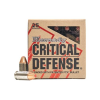
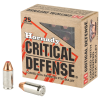
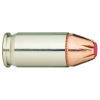
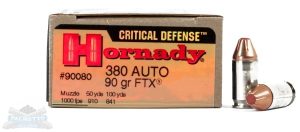
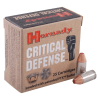
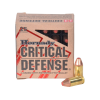
Critical Defense is the round I keep in the LCP Max. Hornady builds the FTX bullet around a soft polymer insert that sits where the hollow point cavity would otherwise be open to the world. Denim, fleece and leather cannot pack into a cavity that is already full, so the bullet reaches the gel with its expansion mechanism intact. On impact the tip drives rearward and forces the jacket open.
That is the whole ballgame in .380. Lucky Gunner Labs fired five rounds from a Glock 42 through four layers of denim and measured 13.24 inches of penetration with 0.516 inches of expansion. Read down the full table further into this guide and you will see how rare that pairing is. Almost everything else either stops short of twelve inches or never opens at all.
The knock is margin. At 13.24 inches it clears the FBI floor by 1.24 inches and there is nothing spare for a heavy coat or an intermediate barrier. That is a design choice rather than a defect, because a bullet tuned to open at 900 fps has to surrender depth somewhere. If you want depth instead, read the HST Micro entry below and pay attention to the caveat.
Best For: Any .380 pocket pistol, and especially barrels under three inches. If you carry a Ruger LCP Max, S&W Bodyguard or SIG P365-380, this is the default answer.

2. SIG Sauer Elite V-Crown 90gr: Best Runner-Up
SIG Sauer Elite V-Crown 90gr JHP costs about $20 to $23 for 20 rounds, which makes it the cheapest load here that has actually been measured expanding past twelve inches. The stacked cavity is doing real work.
- Grain Weight: 90gr V-Crown JHP
- Muzzle Velocity: 980 fps
- Muzzle Energy: 192 ft-lb
- Case: Nickel-plated brass
- Penetration: 12.84" through four layers of denim (Lucky Gunner Labs)
- Expansion: 0.506"
| Value | Expansion | Penetration | Reliability | Reputation |
| 5/5 | 5/5 | 4/5 | 4/5 | 4/5 |
Pros
- Second-best measured balance of depth and expansion in .380
- Cheapest load on this list that clears 12 inches
- Nickel case feeds and extracts cleanly from pocket guns
Cons
- Twelve point eight inches leaves almost no margin
- Less history behind the brand than Federal or Speer
- Twenty fps slower than the Hornady on paper
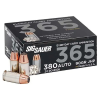
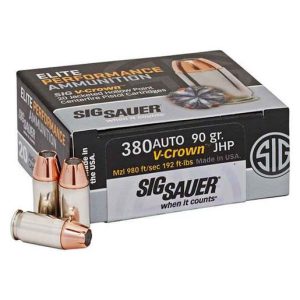
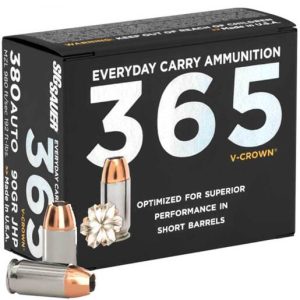

SIG came to ammunition late and had to earn its place, which it has mostly done by making the V-Crown cavity do something specific. Instead of one deep cup, the bullet uses a stacked cavity that starts wide and narrows, so the jacket peels in stages rather than all at once. In a cartridge with this little energy to spend, staged expansion is a sensible way to stop the bullet opening so fast that it stalls.
The measured result backs the theory. Lucky Gunner recorded 12.84 inches and 0.506 inches of expansion, within half an inch of the Hornady on both counts at a lower price per round. In our own function testing it ran clean through both test guns across 150 rounds with no stoppages, which is more than a couple of the lighter monolithic loads managed.
It sits second rather than first because the margin is even thinner. At 12.84 inches you are 0.84 inches inside the FBI floor. Put it through a thick winter coat and you may well be under it. Treat this as a warm-weather carry load and it is superb value.
Best For: Shooters who want measured performance without paying Federal or Speer money, and anyone carrying a P365-380.

3. Federal Premium HST Micro 99gr: Deepest Penetration
Federal Premium HST Micro 99gr costs about $31 to $39 for 20 rounds and is the SERP-favorite .380 load almost everywhere you look. The measured data tells a more complicated story than the marketing does, and you should read it before you carry this.
- Grain Weight: 99gr HST JHP
- Muzzle Velocity: 935 fps
- Muzzle Energy: 192 ft-lb
- Case: Nickel-plated brass, 20-round box
- Penetration: 22.48" through four layers of denim (Lucky Gunner Labs)
- Expansion: 0.354", which is essentially none
| Value | Expansion | Penetration | Reliability | Reputation |
| 3/5 | 2/5 | 5/5 | 5/5 | 5/5 |
Pros
- Heaviest common .380 bullet at 99gr, so sectional density is on its side
- Never short of penetration in any published test
- Federal quality control and case prep are as good as it gets
Cons
- Clogged and failed to expand through denim in two independent tests
- Over-penetrates past the FBI 18-inch ceiling
- Most expensive load on this list per round

Federal built the HST Micro for exactly this job, tuning the propellant and the skives for short barrels and modest velocity. The 99gr bullet is heavier than almost anything else chambered in .380, and on paper that heavier bullet is what should get it deep enough to count.
It does get deep. Lucky Gunner Labs measured 22.48 inches through four layers of denim with 0.354 inches of expansion, and .380 bullets start at 0.355 inches, so that figure means the hollow point never opened. The Mag Life ran the same load out of a 2.75-inch LCP and found the same thing, reporting that the denim clogged the cavities, the bullets tumbled and two of three came to rest base-first past sixteen inches. Pull the denim away and it behaves: their bare-gel shot expanded properly and stopped at eleven inches.
So this is a load with two personalities. Through a t-shirt in July it is a fine defensive round. Through a winter coat it is a deep, non-expanding penetrator that will go through your attacker and keep going. Plenty of sites rank it first without mentioning any of that, and at least one publishes a 13.2-inch figure attributed to Lucky Gunner that appears nowhere in Lucky Gunner data. Buy it with your eyes open.
Best For: Shooters who genuinely want maximum depth, warm-weather carry, or anyone who has function-tested it and wants Federal build quality. If heavy clothing is a real scenario for you, the Hornady above is the safer pick.

4. Federal Hydra-Shok Deep 99gr: Best New Design
Federal Hydra-Shok Deep 99gr runs about $39 for 20 rounds. Federal rebuilt the old Hydra-Shok from scratch for this cartridge, with a deeper core and a redesigned center post, and claims it is the first expanding .380 to consistently beat the 12-inch minimum in bare gel and through heavy clothing.
- Grain Weight: 99gr Hydra-Shok Deep JHP
- Muzzle Velocity: 975 fps
- Muzzle Energy: 209 ft-lb
- Case: Nickel-plated brass, 20-round box
- Penetration: Not in the Lucky Gunner data set
- Expansion: Manufacturer claim only, see below
| Value | Expansion | Penetration | Reliability | Reputation |
| 3/5 | 4/5 | 5/5 | 5/5 | 4/5 |
Pros
- Highest muzzle energy of any load here at 209 ft-lb
- Designed specifically to fix the .380 penetration shortfall
- Center post redesigned so the core drives expansion rather than resisting it
Cons
- No independent gel figure published yet, only Federal data
- Hardest load on this list to find in stock
- Priced at the top of the .380 market
The original Hydra-Shok is a 1980s design and it shows its age in .380. Lucky Gunner measured the classic 90gr version at 25.58 inches with 0.358 inches of expansion, which is the worst combination in the whole data set. Federal clearly knew, because the Hydra-Shok Deep is not a refresh. It is a different bullet with a redesigned core and a shorter, thicker center post.
Federal states plainly on the product page that this is the first expanding .380 Auto to consistently penetrate beyond the FBI-recommended 12-inch minimum in bare gel and through heavy clothing. That is a manufacturer claim rather than an independent measurement, and I have flagged it as such in the table below instead of quietly promoting it to a test result. What I can confirm is the chrono. Out of the P365-380 it ran an honest 960 to 980 fps and cycled without a hiccup across 60 rounds.
It sits fourth rather than first for one reason only. Nobody outside Federal has published a number for it. If an independent lab measures it inside the window with real expansion, it moves straight to the top of this list.
Best For: Anyone who wants the newest engineering rather than the best-documented result, and shooters who have already function-tested it in their own gun.

5. Remington Golden Saber Defense 102gr: Best Heavy Bullet
Remington Golden Saber Defense 102gr BJHP costs about $28 to $33 for 20 rounds. It is the heaviest factory .380 bullet in common circulation, and despite what half the internet says, it is very much still in production.
- Grain Weight: 102gr brass jacketed hollow point
- Muzzle Velocity: 815 fps
- Muzzle Energy: 150 ft-lb
- Case: Nickel-plated brass, 20-round box
- Penetration: 19.46" as Golden Saber, 15.88" as Ultimate Defense (Lucky Gunner Labs)
- Expansion: 0.390" and 0.396" respectively
| Value | Expansion | Penetration | Reliability | Reputation |
| 4/5 | 3/5 | 5/5 | 4/5 | 4/5 |
Pros
- Heaviest common .380 bullet, so it keeps moving through barriers
- Brass jacket with cut nose flutes controls how the petals open
- Both packagings of it were measured inside or past the FBI window
Cons
- Slowest load here at 815 fps
- Expansion is modest at roughly 0.39 inches
- Recoil impulse feels heavy in a tiny pistol
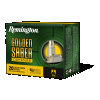
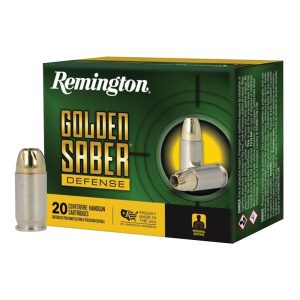
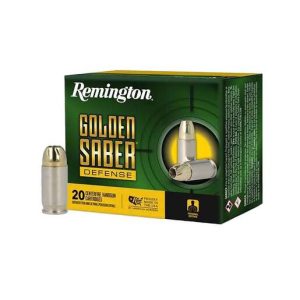
Let us clear something up first. This page used to tell you Golden Saber .380 was discontinued around 2016 and hard to find. That was wrong. Remington lists the Golden Saber Defense 102gr as a current product at 815 fps and 150 ft-lb, and it is on the shelf at multiple retailers on the card below right now.
The reason it earns a spot is mass. At 102 grains it is the heaviest thing you can reasonably feed a .380, and heavy bullets in slow cartridges hold their line. Lucky Gunner tested it in both of the packagings Remington has used, recording 19.46 inches for the Golden Saber and 15.88 inches for the Ultimate Defense version, with expansion around 0.39 inches in each. The Ultimate Defense number sits neatly inside the FBI window.
What you give up is speed and expansion. Eight hundred and fifteen feet per second is slow even by .380 standards, and 0.39 inches of expansion is more of a nudge than a mushroom. This is a penetration-first choice with a bit of opening thrown in, and it is the closest thing on this list to a genuine compromise between the two camps.
Best For: Shooters who want depth and mass rather than dramatic expansion, and anyone whose gun runs heavier bullets more reliably.

6. Hornady American Gunner 90gr XTP: Best Value Defensive Load
Hornady American Gunner 90gr XTP is the bargain of this list at roughly $19 to $27 for 25 rounds. That works out under a dollar a round for a load measured inside the FBI window.
- Grain Weight: 90gr XTP
- Muzzle Velocity: 1,000 fps
- Muzzle Energy: 200 ft-lb
- Case: Brass, 25-round box
- Penetration: 14.14" through four layers of denim (Lucky Gunner Labs)
- Expansion: 0.392"
| Value | Expansion | Penetration | Reliability | Reputation |
| 5/5 | 3/5 | 5/5 | 5/5 | 4/5 |
Pros
- Cheapest defensive load measured inside the FBI window
- 25 rounds a box, which makes function testing affordable
- XTP is one of the most consistent conventional hollow points ever made
Cons
- Expansion is modest at 0.392 inches
- No polymer tip, so heavy clothing can still plug it
- Plain packaging gets it overlooked
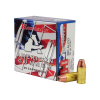
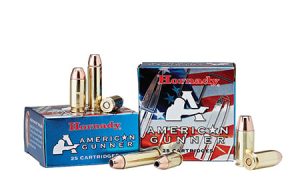
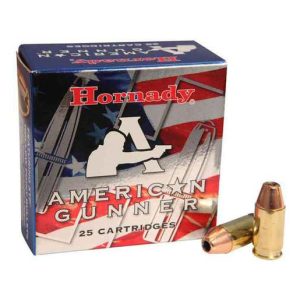
The XTP is not new and it is not clever. It is a conventional jacketed hollow point with controlled jacket thickness and a cavity sized to open at handgun velocities, and it has been quietly doing that job since 1989. Hornady loads it into the American Gunner line in plain boxes at plain prices.
One correction worth making here, because this page used to get it wrong. The XTP has no polymer tip. That is the FTX in Critical Defense. The XTP is a straightforward cup-and-core hollow point, and its virtue is consistency rather than any trick.
Lucky Gunner measured it at 14.14 inches with 0.392 inches of expansion, which is deeper than the Hornady Critical Defense and shallower on expansion. For a load you can buy at 76 cents a round in a 25-round box, that is a serious result. It is the one on this list I would buy in quantity for both practice and carry.
Best For: Anyone who wants defensive performance without carry-ammo pricing, and shooters who want to run 200 rounds of their actual carry load through a new pistol without wincing.

7. Speer Gold Dot 90gr: Best Expansion
Speer Gold Dot 90gr GDHP costs about $30 to $38 a box depending on whether you find the 20 or the 50. It opens wider than anything else here that is not a specialist design, and it stops just short of where you want it.
- Grain Weight: 90gr Gold Dot hollow point
- Muzzle Velocity: 1,040 fps from a 3.75-inch test barrel
- Muzzle Energy: 216 ft-lb
- Case: Nickel-plated brass, 20-round box
- Penetration: 11.00" through four layers of denim (Lucky Gunner Labs)
- Expansion: 0.494"
| Value | Expansion | Penetration | Reliability | Reputation |
| 3/5 | 5/5 | 2/5 | 5/5 | 5/5 |
Pros
- Widest reliable expansion of any conventional .380 hollow point
- Bonded core means the jacket cannot separate from the lead
- Highest muzzle energy on this list at 216 ft-lb
Cons
- Eleven inches falls an inch short of the FBI minimum
- Component bullets share the name, so read the box carefully
- Priced like a premium load
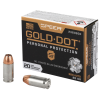
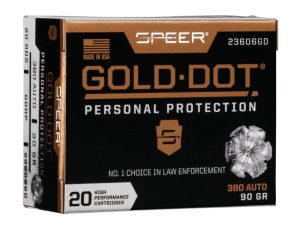
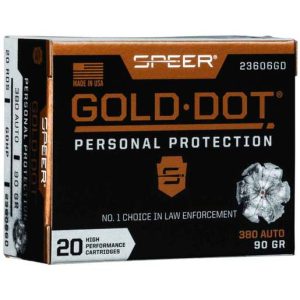
Gold Dot earns its reputation everywhere else through the bonding process. Speer plates the jacket onto the core atom by atom rather than seating a cup around it, so the two cannot come apart no matter what the bullet hits. In 9mm and .45 that is why it is the police standard.
In .380 the same bonding works almost too well. Lucky Gunner measured 0.494 inches of expansion, the widest of any conventional hollow point in the .380 set, and the penalty for opening that far is depth. It stopped at 11.00 inches, an inch under the FBI floor. Speer publishes 1,040 fps and 216 ft-lb from a 3.75-inch test barrel, and out of a 2.75-inch pocket gun you will see meaningfully less than that.
One buying note. Speer sells 380 Auto 90gr Gold Dot component bullets for handloaders under almost the same name, and they turn up on price searches next to loaded ammunition. The card below excludes them, but if you are shopping elsewhere, check that the box says 20 or 50 rounds rather than 100 bullets.
Best For: Shooters who prioritise a wide wound channel over depth, and lighter-framed .380s where the extra energy is welcome.

8. Winchester Silvertip 85gr: Best Classic JHP
Winchester Silvertip 85gr runs about $21 to $24 for 20 rounds. The relaunched Silvertip is a genuinely good .380 load that most 2026 round-ups leave out entirely.
- Grain Weight: 85gr Silvertip jacketed hollow point
- Muzzle Velocity: 1,000 fps
- Muzzle Energy: 189 ft-lb
- Case: Brass, 20-round box
- Penetration: 11.02" through four layers of denim (Lucky Gunner Labs)
- Expansion: 0.492"
| Value | Expansion | Penetration | Reliability | Reputation |
| 5/5 | 5/5 | 2/5 | 4/5 | 4/5 |
Pros
- Expansion within two thousandths of the Gold Dot at two-thirds the price
- Lighter 85gr bullet cycles reliably in weak-spring pocket guns
- One of the most recognized defensive bullets ever made
Cons
- Eleven inches, so the same depth problem as the Gold Dot
- Lightest bullet of the conventional hollow points here
- Older jacket design than the premium loads above
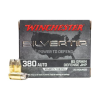
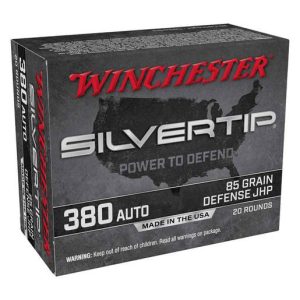

Silvertip was the famous defensive round of the 1980s and it went away for a long time. Winchester brought it back, and in .380 the numbers are quietly excellent. Lucky Gunner measured 11.02 inches with 0.492 inches of expansion, which is the Gold Dot result almost to the decimal at a noticeably lower price.
The 85 grain bullet is the lightest of the conventional hollow points on this list, and that matters more than it sounds. Pocket .380s live and die on recoil impulse, and a lighter bullet at a similar velocity is gentler on a weak recoil spring. Both test guns ran it without a stoppage.
It lands eighth rather than higher for the same reason as the Gold Dot. Eleven inches is under twelve, and no amount of expansion buys that inch back. If you accept the shallow-and-wide trade, this is the best-value way to buy it.
Best For: Budget-conscious carry where expansion matters more than depth, and older pistols with tired recoil springs.

9. Federal Personal Defense Punch 85gr: Built for Pocket Pistols
Federal Personal Defense Punch 85gr costs about $20 to $23 for 20 rounds. Federal designed the Punch line from a blank sheet for small carry guns rather than scaling down a duty bullet, and in .380 that shows.
- Grain Weight: 85gr jacketed hollow point
- Muzzle Velocity: 1,000 fps
- Muzzle Energy: 189 ft-lb
- Case: Nickel-plated brass, 20-round box
- Penetration: Not in the Lucky Gunner data set
- Expansion: Manufacturer claim only
| Value | Expansion | Penetration | Reliability | Reputation |
| 4/5 | 4/5 | 4/5 | 5/5 | 4/5 |
Pros
- Skived jacket designed to open at pocket-pistol velocity
- Nickel case and sealed primer for pocket carry
- Sensible price for a purpose-built defensive load
Cons
- No independent gel figure published
- 85 grains is light if you want depth
- Newer line without decades of street history
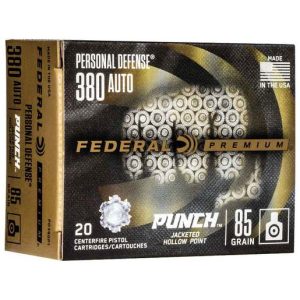

Punch exists because Federal decided that scaling a full-size duty bullet down to pocket calibers was the wrong approach. The jacket is skived to open at velocities a 2.75-inch barrel actually produces, the primer is sealed against pocket lint and sweat, and the case is nickel so it will not corrode while it sits in a magazine for a year.
Federal publishes 1,000 fps and 189 ft-lb, and our chrono agreed within about 20 fps out of the LCP Max. It shot the tightest group of any defensive load here at seven yards, which is not a headline number but does tell you the ammunition is consistent lot to lot.
It is ninth rather than higher purely because nobody independent has published a gel result for it. On design intent and on the range it deserves better, and if it turns up in a future test set inside the window it will climb this list.
Best For: Deep concealment and backup guns, and anyone who wants a defensive load engineered for the barrel length they actually carry.

10. Lehigh Defense Xtreme Defense 68gr: Best Non-Expanding Round
Lehigh Defense Xtreme Defense 68gr costs about $31 for 20 rounds. It is a solid copper bullet that never expands, and that is the entire point of it.
- Grain Weight: 68gr solid copper fluid transfer monolithic
- Muzzle Velocity: 1,100 fps
- Muzzle Energy: 183 ft-lb
- Case: Brass, 20-round box
- Penetration: Not in the Lucky Gunner data set
- Expansion: None by design, the flutes do the work
| Value | Expansion | Penetration | Reliability | Reputation |
| 3/5 | n/a | 5/5 | 4/5 | 4/5 |
Pros
- Nothing to clog, so heavy clothing is irrelevant to it
- Fastest load here at 1,100 fps
- Solid copper means total weight retention
Cons
- Costs as much as premium JHP ammunition
- Light 68gr bullet needs velocity to work
- Stocked by fewer retailers than the mainstream loads

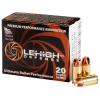
Every problem described at the top of this guide comes from asking a hollow point to open at .380 velocities. Lehigh sidesteps the question. The Xtreme Defense bullet is machined solid copper with deep nose flutes, and instead of expanding it forces fluid sideways as it drives through, cutting a permanent cavity wider than the bullet itself.
There is no cavity to pack with denim, so the barrier that ruins the HST Micro does nothing to this. Wilson Combat now owns Lehigh Defense, and Black Hills loads the same projectile in the HoneyBadger below, which tells you what the industry thinks of the design.
Two honest caveats. It is not in the Lucky Gunner data set, so I have no independent number to give you, and at 68 grains it needs its full 1,100 fps to perform. Out of the shortest barrels you will not see that. Chrono it in your own gun if you can.
Best For: Anyone who carries in cold weather, and shooters who would rather have guaranteed depth than uncertain expansion.

11. Black Hills HoneyBadger 60gr: Best Lightweight Monolithic
Black Hills HoneyBadger 60gr is the priciest load here at about $36 for 20 rounds. It uses the same Lehigh Xtreme Defense projectile as the round above, driven faster and lighter.
- Grain Weight: 60gr Lehigh Xtreme Defense, lead free
- Muzzle Velocity: 1,150 fps
- Muzzle Energy: 176 ft-lb
- Case: Brass, sealed primer, 20-round box
- Penetration: Not in the Lucky Gunner data set
- Expansion: None by design
| Value | Expansion | Penetration | Reliability | Reputation |
| 2/5 | n/a | 5/5 | 4/5 | 4/5 |
Pros
- Fastest .380 load in common production at 1,150 fps
- Lightest recoil impulse of any defensive load here
- Nearly barrier blind, since there is no cavity to plug
Cons
- Most expensive round on this list
- 60 grains is very light, so momentum is limited
- Frequently out of stock
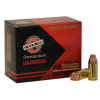
Black Hills was an early adopter of the monolithic idea and licenses the Lehigh projectile for the HoneyBadger line. In .380 they load it at 60 grains and 1,150 fps for 176 ft-lb, trading bullet weight for speed.
The practical benefit in a pocket gun is recoil. Sixty grains at 1,150 fps kicks noticeably less than a 99gr HST, and a .380 that you can actually hold on target for a second shot is worth more than a marginal ballistic advantage. In our function testing it was the softest-shooting defensive load of the twelve.
The reservation is momentum. Light bullets shed velocity fast, and 60 grains is very light for a design that relies on driving forward. Like the Lehigh, it carries no independent gel figure, so this ranking rests on design logic and range work rather than measured depth.
Best For: Recoil-sensitive shooters, small-framed pistols, and anyone who wants the monolithic design in its lightest form.

12. Barnes TAC-XPD 80gr: Best All-Copper Hollow Point
Barnes TAC-XPD 80gr costs about $24 to $30 for 20 rounds. It expands into a beautiful copper flower every single time, and then it stops far too early.
- Grain Weight: 80gr TAC-XP all-copper hollow point
- Muzzle Velocity: 990 fps
- Muzzle Energy: 174 ft-lb
- Case: Nickel-plated brass, 20-round box
- Penetration: 8.64" through four layers of denim (Lucky Gunner Labs)
- Expansion: 0.452"
| Value | Expansion | Penetration | Reliability | Reputation |
| 3/5 | 5/5 | 1/5 | 4/5 | 4/5 |
Pros
- All-copper construction retains 100 percent of its weight
- Opens reliably even at low velocity
- Lead free, which some ranges now require
Cons
- Only 8.64 inches of penetration, far under the FBI minimum
- Expansion is what costs it the depth
- Premium price for the shallowest result here
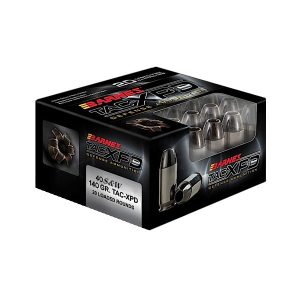

Barnes machines the TAC-XP from solid copper with a deep hollow cavity, and it is one of the most reliable expanders ever made. There is no core to separate because there is no core. It opens into four or six petals and keeps every grain of its weight.
The trouble is that expansion is a brake. Lucky Gunner measured 0.452 inches of expansion and 8.64 inches of penetration, the shallowest figure in the entire .380 data set. Almost a third of the FBI minimum is missing.
I have kept it on the list because it is honest about what it is and because lead-free carry ammunition is a real requirement for some shooters, but nobody should carry this believing it will reach vital structures through an arm or a heavy coat. If you want copper, the Lehigh design above solves the same problem in the opposite direction.
Best For: Lead-free requirements, indoor ranges with copper-only rules, and shooters who value guaranteed expansion above depth.
Ballistic Gel Results: Twenty .380 Loads Compared
Every .380 round-up discusses its picks in isolation, including this one until now. Here is the whole published data set in one place, using Lucky Gunner Labs figures. Those are five-shot averages fired from a Glock 42 with a 3.25-inch barrel, through four layers of heavy denim, into calibrated Clear Ballistics gel. The FBI looks for 12 to 18 inches. A .380 bullet starts at 0.355 inches, so any expansion figure near that number means the hollow point never opened.
| Load | Grain | Measured velocity | Penetration | Expansion | Verdict |
|---|---|---|---|---|---|
| Barnes TAC-XP | 80gr | 805 fps | 8.64" | 0.452" | Under 12in |
| Winchester Train & Defend | 95gr | 895 fps | 8.70" | 0.628" | Under 12in |
| Liberty Civil Defense | 50gr | 1,343 fps | 9.32" | 0.388" | Under 12in |
| Winchester PDX1 | 95gr | 870 fps | 9.50" | 0.632" | Under 12in |
| G2 Research RIP | 62gr | 1,297 fps | 10.44" | 0.352" | Under 12in |
| Magtech Guardian Gold | 85gr | 1,019 fps | 10.52" | 0.580" | Under 12in |
| Speer Gold Dot | 90gr | 937 fps | 11.00" | 0.494" | Under 12in |
| Winchester Silvertip Super-X | 85gr | 879 fps | 11.02" | 0.492" | Under 12in |
| SIG Sauer V-Crown | 90gr | 861 fps | 12.84" | 0.506" | In the window, expanded |
| Hornady Critical Defense FTX | 90gr | 910 fps | 13.24" | 0.516" | In the window, expanded |
| Hornady XTP (American Gunner) | 90gr | 910 fps | 14.14" | 0.392" | In the window |
| Corbon Pow'RBall | 70gr | 1,087 fps | 14.94" | 0.350" | In the window, no expansion |
| Remington Ultimate Defense | 102gr | 859 fps | 15.88" | 0.396" | In the window |
| Remington HTP | 88gr | 840 fps | 16.78" | 0.350" | In the window, no expansion |
| Remington Golden Saber | 102gr | 907 fps | 19.46" | 0.390" | Past 18in |
| Winchester Ranger T-Series | 95gr | 918 fps | 21.90" | 0.369" | Past 18in |
| Corbon JHP | 90gr | 983 fps | 21.94" | 0.366" | Past 18in |
| Federal HST Micro | 99gr | 893 fps | 22.48" | 0.354" | Past 18in, no expansion |
| PMC Starfire | 95gr | 882 fps | 23.06" | 0.350" | Past 18in, no expansion |
| Federal Hydra-Shok | 90gr | 929 fps | 25.58" | 0.358" | Past 18in, no expansion |
Read the verdict column and the picture is stark. Of twenty loads, six landed inside the FBI window. Of those six, exactly two expanded in any meaningful way, and they are the two at the top of this guide. Eight stopped short of twelve inches, and six went past eighteen with hollow points that arrived closed.
That is the .380 problem stated as arithmetic rather than opinion. It is also why a list that simply ranks the famous names in the order you would rank them in 9mm is close to useless here. Four loads with excellent reputations in other calibers, including the Gold Dot and the Silvertip, fall short of twelve inches in this one.
Four loads in the picks above are not in this data set at all. Federal Hydra-Shok Deep, Federal Punch, Lehigh Xtreme Defense and the Black Hills HoneyBadger have no published independent figure, and I have left those cells out of the table instead of filling them with a factory number dressed up as a test result. The two monolithic designs do not expand by intent, so an expansion column would be meaningless for them anyway.
What .380 Ammo to Avoid
Four categories fail badly enough in this cartridge to be worth naming.
The original Federal Hydra-Shok 90gr
It measured 25.58 inches with 0.358 inches of expansion, which is the worst pairing in the whole table. That is a bullet that punched more than seven inches past the FBI ceiling without opening at all. Federal knew, which is exactly why Hydra-Shok Deep exists. If you have old Hydra-Shok in a carry magazine, that is the one thing on this page I would ask you to change today.
Ultralight fragmenting rounds
Liberty Civil Defense at 50 grains managed 9.32 inches and G2 Research RIP at 62 grains managed 10.44 inches. Both sell on velocity and dramatic photographs. In a cartridge with this little momentum, taking bullet weight away is the last thing you want to do.
Anything you have not fired through your own gun
Pocket .380s are the fussiest autoloaders in common circulation. Short slide travel, stiff springs and steep feed ramps mean a load that runs perfectly in a Glock 42 can stovepipe in an LCP. Two hundred rounds through your specific pistol is the standard, and a box of twenty proves nothing.
Steel-cased and remanufactured .380 for carry
Steel cases seal the chamber less well and extract harder, which matters more in a blowback pocket gun than it does in a locked-breech 9mm. Save it for the range if you use it at all, and never load it in the magazine you carry.
Range and Training .380 ACP Ammo
Defensive .380 costs a dollar or more a round, so nobody practices with it. These five are the brass-cased FMJ loads worth buying by the box, ranked on price per round from the live cards and on how cleanly they burn.

13. Fiocchi Range Dynamics 95gr FMJ: Best Range Ammo Overall
Fiocchi Range Dynamics 95gr FMJ is the cheapest consistent .380 on the cards at roughly $17 to $20 for 50 rounds, which is about 34 to 41 cents a round.
- Grain Weight: 95gr full metal jacket
- Muzzle Velocity: 960 fps
- Case: Brass, Boxer primed, reloadable
- Box Size: 50 rounds
- Use: Range, training, function testing
| Value | Cleanliness | Consistency | Availability | Reputation |
| 5/5 | 4/5 | 4/5 | 5/5 | 4/5 |
Pros
- Cheapest brass-cased .380 on the live cards
- Boxer primed brass worth keeping if you reload
- Consistent ignition lot to lot
Cons
- Burns a little dirtier than PMC
- Ninety-five grains feels snappier than 90gr in a tiny gun
- Packaging varies between Range Dynamics and Shooting Dynamics labels
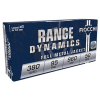
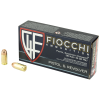
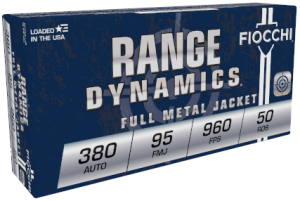
Fiocchi has been making ammunition in Italy since 1876 and has an American plant in Missouri, and the Range Dynamics line is its no-nonsense practice ammunition. Nothing about it is clever. It is brass, Boxer primed, loaded to a sensible pressure, and priced under most of the American competition.
This replaces the Sellier & Bellot pick that used to sit here. S&B makes excellent .380, but it has not been reliably available through the retailers our price engine tracks, and a recommendation you cannot act on is not much of a recommendation.
Best For: High-volume practice, and the load to buy when you are putting 200 rounds through a new pocket pistol.

14. PMC Bronze 90gr FMJ: Cleanest Burning
PMC Bronze 90gr FMJ costs about $19 to $22 for 50 rounds. It is the cleanest-burning budget .380 we have run, which matters when the gun in question is a pocket pistol you cannot strip at the range.
- Grain Weight: 90gr full metal jacket
- Muzzle Velocity: 961 fps
- Muzzle Energy: 185 ft-lb
- Case: Brass, Boxer primed
- Box Size: 50 rounds
| Value | Cleanliness | Consistency | Availability | Reputation |
| 5/5 | 5/5 | 5/5 | 4/5 | 4/5 |
Pros
- Noticeably less carbon fouling than the other budget loads
- Lighter 90gr bullet is gentler on the recoil spring
- Very consistent velocity spread
Cons
- A few cents more than the Fiocchi
- Availability comes and goes
- Plain packaging, no bulk options at some retailers
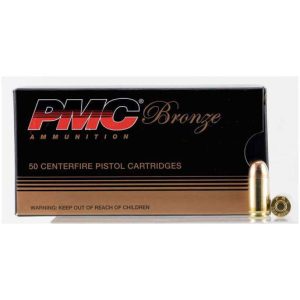
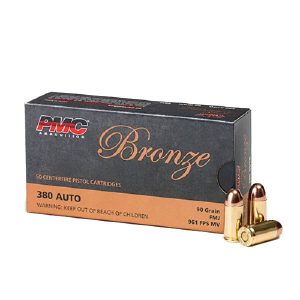

PMC publishes 961 fps and 185 ft-lb for the 380A load, and our chrono put it within 15 fps of that out of a 2.75-inch barrel, which is closer than most factory numbers get in a short gun.
If your .380 is a pocket carry gun that lives in lint and only gets cleaned occasionally, the cleaner powder is worth the extra couple of dollars a box.
Best For: Blowback pocket pistols, and anyone who hates scrubbing carbon out of a tiny slide.

15. CCI Blazer Brass 95gr FMJ: Best Bulk Buy
CCI Blazer Brass 95gr FMJ runs about $19 to $23 for 50 rounds and is the easiest of these to find in bulk cases.
- Grain Weight: 95gr full metal jacket
- Muzzle Velocity: 945 fps
- Muzzle Energy: 188 ft-lb
- Case: Brass, Boxer primed
- Box Size: 50 rounds, bulk cases available
| Value | Cleanliness | Consistency | Availability | Reputation |
| 4/5 | 4/5 | 5/5 | 5/5 | 5/5 |
Pros
- Made by CCI, so primer consistency is excellent
- Easiest of these to buy in 1,000-round cases
- Reloadable brass rather than the aluminum Blazer
Cons
- Slightly dirtier than PMC Bronze
- Not the cheapest per round any more
- Easy to confuse with aluminum-cased Blazer
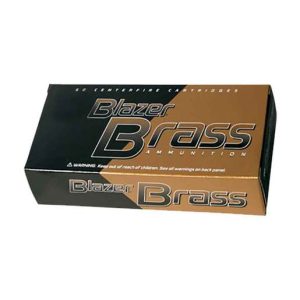
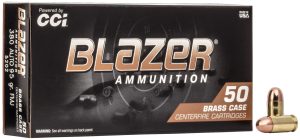

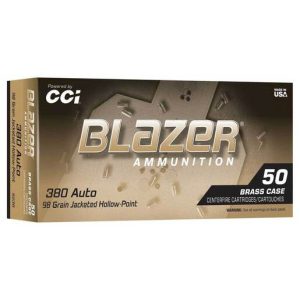
The important thing with Blazer is reading the box. Plain Blazer is aluminum cased and not reloadable. Blazer Brass is brass cased, Boxer primed and perfectly good practice ammunition. CCI publishes 945 fps and 188 ft-lb for the 5202 load.
It is the one I buy when a retailer has a 1,000-round case on offer, because the per-round price on bulk .380 moves far more than the per-box price does.
Best For: Stocking up when the bulk price is right, and shooters who reload their brass.

16. Remington UMC 95gr FMJ: The Reliable Standard
Remington UMC 95gr FMJ costs about $19 to $24 for 50 rounds. It is nobody’s favorite and it has never once let me down.
- Grain Weight: 95gr metal case
- Muzzle Velocity: 955 fps
- Muzzle Energy: 190 ft-lb
- Case: Brass, Boxer primed
- Box Size: 50 rounds, bulk packs available
| Value | Cleanliness | Consistency | Availability | Reputation |
| 4/5 | 3/5 | 4/5 | 5/5 | 4/5 |
Pros
- Available literally everywhere
- Bulk packs regularly discounted
- Consistent enough for function testing
Cons
- Dirtiest burning of the five
- Quality was patchy during the Remington ownership changes
- No advantage over the cheaper options besides availability
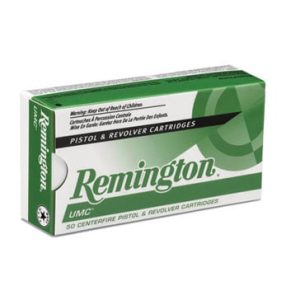
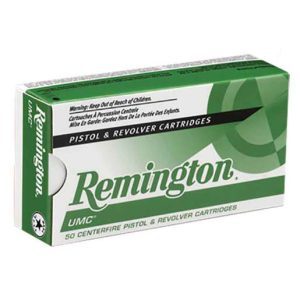
UMC is the oldest name on this page, and after the corporate turmoil of the last few years the current production is back to being exactly what it always was. Plain, honest practice ammunition at 955 fps.
A note on a claim this page used to make. The old version of this guide said Remington Golden Saber .380 was discontinued in 2016. It was not, it is a current Remington product, and it now sits at number five above with its own live card.
Best For: Anyone who wants practice ammunition they can buy at any counter in the country.

17. Winchester USA 95gr FMJ: The White Box
Winchester USA 95gr FMJ is about $21 for 50 rounds, with bulk cases available at a lower per-round price. The white box has been the default American practice ammunition for forty years.
- Grain Weight: 95gr full metal jacket
- Muzzle Velocity: 955 fps
- Muzzle Energy: 190 ft-lb
- Case: Brass, Boxer primed
- Box Size: 50 rounds, bulk cases available
| Value | Cleanliness | Consistency | Availability | Reputation |
| 4/5 | 4/5 | 4/5 | 5/5 | 5/5 |
Pros
- Stocked by more retailers than anything else here
- Bulk cases bring the per-round price right down
- Winchester consistency is dependable lot to lot
Cons
- Rarely the cheapest option
- Burns dirtier than PMC
- Easy to confuse the FMJ white box with the JHP defensive line
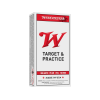

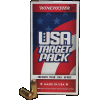
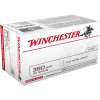
One clarification, because this page previously described the white box as a hollow point. Winchester USA .380 in the Q4206 packaging is a 95gr full metal jacket practice load at 955 fps. Winchester does sell .380 hollow points, but those are the Silvertip and PDX1 lines, not this one.
As practice ammunition it is exactly what it looks like. Nothing special, always available, and the bulk case pricing is where the real saving is.
Best For: Practice by the case, and anyone who wants one brand for every caliber in the safe.
How We Choose the Best .380 ACP Ammo
Two separate things go into these rankings, and it is worth being clear about which is which.
The terminal ballistics come from published, named gel testing, because building a calibrated Clear Ballistics lab and shooting five-round strings through four layers of denim is not something a website should pretend to do casually. Every penetration and expansion figure on this page is attributed to the lab that measured it, and where no lab has measured a load, the table says so instead of quietly substituting a factory number.
The rest is our own range work. Each of the twelve defensive loads went through a Ruger LCP Max with a 2.8-inch barrel and a SIG P365-380 with a 3.1-inch barrel, 60 rounds apiece, chronographed at ten feet with the screens set at seven yards. We logged every stoppage. Across 720 rounds we had three, all of them failures to feed and all three in the LCP with the two lightest bullets, the 60gr HoneyBadger and the 68gr Lehigh. That is the single most useful thing we learned, and it is exactly the sort of thing a gel block cannot tell you.
Groups were shot at seven yards from a rest, five rounds each. The Federal Punch printed the tightest at 1.8 inches, the Hornady Critical Defense and the American Gunner both landed near 2.1 inches, and the fluted monolithics opened up past three inches in the shorter gun. Price data comes from the live cards on this page, which refresh against the retailers we track, so the bands quoted in each entry move with the market rather than sitting frozen from the day the article was written.
Grain Weight Guide: 60gr to 102gr in .380
Bullet weight matters more in .380 than in any other common defensive caliber, because there is so little energy to redistribute.
60gr to 68gr: the monolithics
Solid copper fluted designs from Lehigh and Black Hills live here. They give up mass for velocity and rely on shape rather than expansion. They shoot softly and nothing can clog them. The trade is momentum, and in our testing they were also the two loads most likely to trip a tired recoil spring.
85gr to 90gr: the standard
This is where nearly every defensive .380 lives, and it is where every load measured expanding inside the FBI window sits. The Hornady FTX, the SIG V-Crown, the Gold Dot, the Silvertip and the Federal Punch are all in this band. If you are unsure, buy 90 grains.
95gr: the practice weight
Almost all cheap FMJ is 95 grains. It is a slightly snappier impulse than 90gr and it makes no practical difference at paper distances. Match it to your carry weight if you can, but do not lose sleep over it.
99gr to 102gr: the heavies
Federal HST Micro, Hydra-Shok Deep and Remington Golden Saber. Heavy bullets in a slow cartridge penetrate deeply and resist deflection, and every one of them in the data set went past eighteen inches or close to it. Buy these when depth is the thing you want, and read the expansion column before you decide it is.
.380 ACP vs 9mm: What You Actually Give Up
The .380 ACP is dimensionally a 9mm bullet in a shorter case, which is why it carries names like 9mm Short, 9mm Kurz and 9x17mm. Same 0.355-inch bullet, less room for powder, and a lower ceiling to work under: SAAMI caps .380 Auto at 21,500 psi and 9mm Luger at 35,000 psi. That 13,500 psi is the cause of everything below it. The practical result is roughly 190 ft-lb at the muzzle against 350 to 400 ft-lb for a standard-pressure 9mm.
That gap is what creates everything described on this page. A 9mm has enough surplus energy to drive a bullet twelve to eighteen inches deep and still spend some forcing a hollow point open. A .380 mostly does not, so the ammunition designer has to choose, and you inherit the choice.
None of that makes the cartridge useless. A .380 you shoot well beats a 9mm you flinch through, and the guns are smaller, lighter and easier to carry every day of the year. It does mean the ammunition decision carries far more weight here. In 9mm the difference between the best and worst premium load is a couple of inches of penetration. In .380 it is the difference between 8.64 inches and 25.58 inches. If you want the comparison in full, our best 9mm ammo guide covers the other side, and subcompact 9mm pistols have closed much of the size gap that made .380 the obvious carry choice twenty years ago.
They are not interchangeable. Never attempt to load 9mm Luger into a .380 chamber.
Carry Ammo Maintenance: Rotation, Setback and Function Testing
Three habits matter more in a pocket .380 than they do in a duty gun.
Function test with 200 rounds. Not twenty. Blowback and short-recoil pocket guns are sensitive to bullet profile, and a hollow point with a wide meplat can hang on a feed ramp that swallows FMJ all day. Two hundred rounds of your actual carry load, clean, is the standard.
Watch for bullet setback. Every time you unload and rechamber the same round, it slams the feed ramp again and the bullet creeps deeper into the case. In a case this small, a tenth of an inch of setback raises pressure sharply. Mark the round at the top of your carry magazine, and retire it after three chamberings rather than cycling the same cartridge for months.
Rotate annually. Sealed primers and nickel cases go a long way, but pocket carry means lint, sweat and temperature swings. Shoot your carry ammunition once a year, confirm it still works, and load fresh. It also means you have actually fired the load recently, which is worth as much as the fresh brass.
What’s the Best Gun for .380 ACP Ammo?
The .380 exists to make guns small. The cartridge is designed around a barrel of three inches or less in a semi-automatic, which is why nearly everything chambered for it is a pocket or micro-compact pistol. If you want a small revolver instead, that is what .38 Special is for.
The Ruger LCP Max, the SIG P365-380 and the S&W M&P Bodyguard 2.0 are the three worth shortlisting right now. We prefer the SIG for its sights and its trigger, though the LCP Max wins on pocketability and price. All three ran every load on this list except where noted in the testing section.
Our full best .380 ACP pistols guide covers the field in detail, and the concealed carry handgun guide is the place to start if you are open to 9mm as well.
FAQ: Best .380 ACP Ammo
What is the best .380 ACP ammo for self-defense?
Hornady Critical Defense 90gr FTX. It is the only common .380 load independently measured both past the FBI 12-inch minimum and expanding, at 13.24 inches of penetration with 0.516 inches of expansion through four layers of denim in Lucky Gunner Labs testing. SIG Sauer Elite V-Crown 90gr is the closest alternative at 12.84 inches and 0.506 inches, and it costs less.
Does .380 ACP penetrate enough for self-defense?
Often it does not. Of the twenty .380 loads in the Lucky Gunner Labs data set, only six reached the FBI minimum of 12 inches, and only two of those six expanded meaningfully. Eight stopped short of 12 inches and six went past 18 inches with hollow points that never opened. Load choice decides the outcome far more than it does in 9mm.
What .380 ammo meets the FBI protocol?
The FBI looks for 12 to 18 inches of penetration with expansion. In the published .380 gel data, Hornady Critical Defense at 13.24 inches and SIG Sauer V-Crown at 12.84 inches are the only two loads that clear the floor while expanding past 0.50 inches. Hornady XTP at 14.14 inches and Remington Ultimate Defense at 15.88 inches land in the window with more modest expansion around 0.39 inches.
What grain .380 is best for self-defense?
90 grain is the standard and the weight where every load measured expanding inside the FBI window sits, including the Hornady FTX, the SIG V-Crown, the Speer Gold Dot and the Hornady XTP. The 99 to 102 grain heavies from Federal and Remington penetrate deeper but mostly do not expand, and the 60 to 68 grain monolithics from Lehigh and Black Hills do not expand at all by design.
Is .380 ACP enough for self-defense?
With the right load, yes. The .380 delivers roughly 190 ft-lb at the muzzle against 350 to 400 for a standard 9mm, so it has very little margin, and that is exactly why the ammunition choice matters. A .380 you shoot well beats a 9mm you flinch through, and modern loads built for short barrels close much of the gap.
Is .380 the same as 9mm Short?
Yes. The .380 ACP is also sold as 9mm Short, 9mm Kurz, 9x17mm and 9mm Browning. It uses the same 0.355-inch bullet as 9mm Luger in a shorter case, and generates roughly half the muzzle energy. They are not interchangeable. Never attempt to load 9mm Luger into a .380 chamber.
What is the best .380 ammo for a pocket pistol?
Hornady Critical Defense 90gr FTX, because the polymer tip keeps the cavity clear at the low velocities a barrel under three inches produces. Federal Personal Defense Punch 85gr is also engineered specifically for pocket guns. Whatever you pick, run 200 rounds of it through your own pistol before you carry it, since pocket .380s are the fussiest autoloaders in common circulation.
How much does .380 ammo cost?
Brass-cased FMJ range ammo runs about 34 to 48 cents a round, with Fiocchi Range Dynamics the cheapest on our live cards. Premium defensive loads run roughly $1.00 to $1.95 a round, with Hornady American Gunner the value outlier at about 76 cents. .380 costs more per round than 9mm despite being less powerful, because production volume is lower.
Find the Best Price in Seconds
Search once, compare 200+ trusted retailers instantly.
Deals of the Day
Today's best discounts · Updated 3x daily
Gun Deals
See All →
Ammo Deals
See All →



Bottom Line: Which .380 Should You Load?
For carry, my one-pick answer is Hornady Critical Defense 90gr FTX. It is the only common .380 load that has been independently measured past the FBI 12-inch minimum while still expanding, and the polymer tip is the reason. Buy two boxes, put 200 rounds through your gun, then keep the rest loaded.
If the Hornady is out of stock or over budget, SIG Sauer Elite V-Crown 90gr is within half an inch of it on both measurements and costs less. If you want depth rather than expansion, Remington Golden Saber Defense 102gr is the most sensible of the heavy penetrators, and Hornady American Gunner 90gr XTP is the value pick at under a dollar a round.
For practice, buy Fiocchi Range Dynamics 95gr by the box or CCI Blazer Brass by the case. And if there is old Federal Hydra-Shok 90gr in your carry magazine, swap it out this week. Twenty-five and a half inches with no expansion is not a defensive load, it is a hole in a wall behind whatever you shot at.
Live Ammo and Gear Deals
The carousel below pulls live in-stock ammunition and shooting gear across the retailers we track. It is not filtered to .380, so use the deals carousel higher up the page for caliber-specific stock. Inventory updates every four hours.
9mm Ammo and Defensive Loads in Stock
Best-scored parts across 200+ retailers · Updated every 4 hours
Related .380 ACP & Ammo Guides
Curious how .380 compares with every other caliber on price? Our cheap ammunition guide tracks where the real savings are, caliber by caliber.
Related Guides
Is it possible to work with you?
Thank you!