

Affiliate disclosure: This Colt Gold Cup review contains affiliate links. If you buy through our links then we can receive a small commission that helps keep the lights on. You don’t pay anything more.
- Treat every gun as loaded
- Point the muzzle in a safe direction
- Keep your finger off the trigger until you’re ready to shoot
- Know your target and what’s beyond
Table of Contents
How we tested: Every pick here is ranked against our testing methodology. Minimum round counts, accuracy and reliability protocols, the failures that disqualify a gun.
Review: Colt Gold Cup: Colt’s Target 1911, in Three Grades
Our Rating: 8.5/10
- MSRP: $1,349.00 for the stainless Gold Cup (Lite) in .45 ACP or 9mm; $1,549.00 for the National Match; $1,949.00 for the Trophy (Colt store prices)
- Street Price: From $1,029.99 (Use our live pricing for the best up to date deal)
- Caliber: .45 ACP, 9mm or .38 Super
- Action: Single action only, Colt Series 70 firing system
- Barrel Length: 5 in. National Match barrel
- Capacity: 8+1 in .45 ACP; 9+1 in 9mm and .38 Super on the Gold Cup and National Match, 10+1 on the 9mm and .38 Super Trophy
- Frame and Slide: Stainless steel (Gold Cup and Trophy) or blued carbon steel (National Match)
- Sights: Adjustable rear; fiber optic Novak front (Gold Cup and Trophy) or solid black front (National Match)
- Trigger: Gold Cup wide trigger on the Gold Cup and National Match, per Colt’s catalog
- Grips: Custom Colt G10 (Gold Cup and Trophy)
- Trophy extras: 25 LPI checkering front and rear, extended magwell
- Weight: Not published by Colt
Pros
- Series 70 trigger with a wide shoe
- Adjustable rear sight on every grade
- Three grades from one family
Cons
- Slide stamp doesn’t show the grade
- Colt publishes no weight
- Optics-Ready Trophy costs $150 more
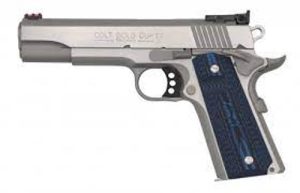
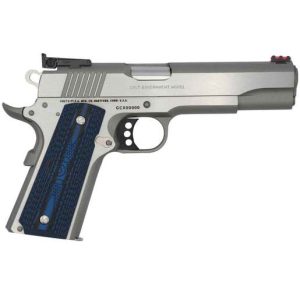
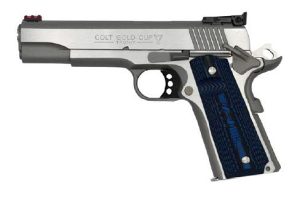
Quick Take
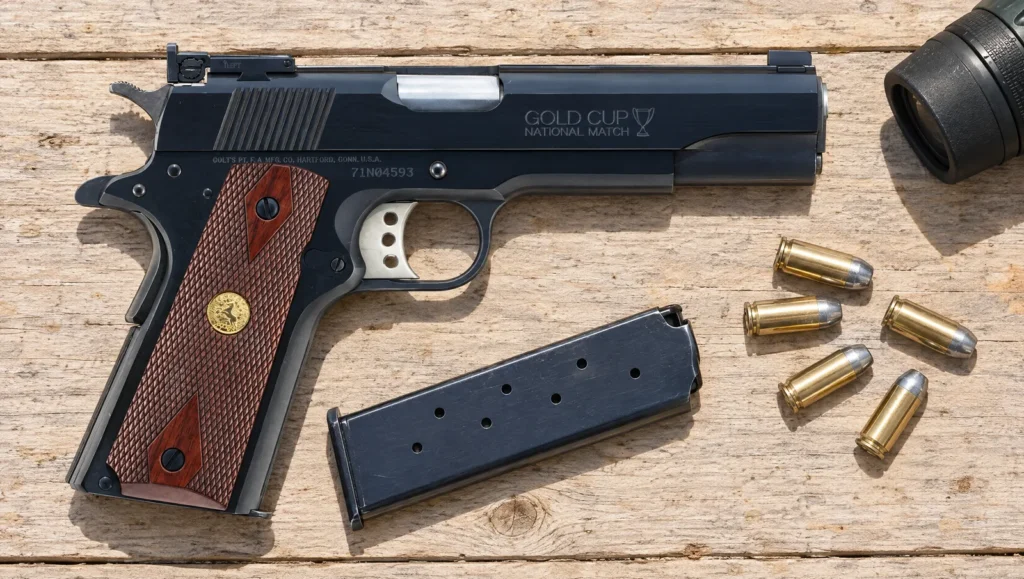
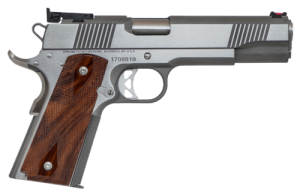
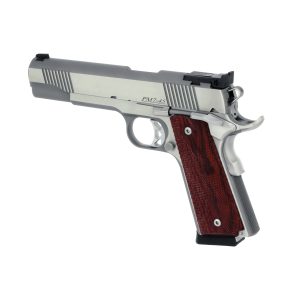
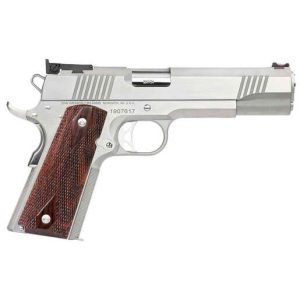
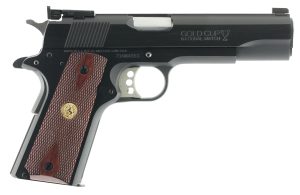
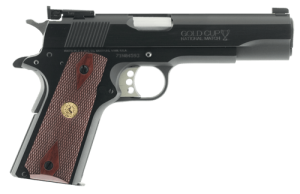
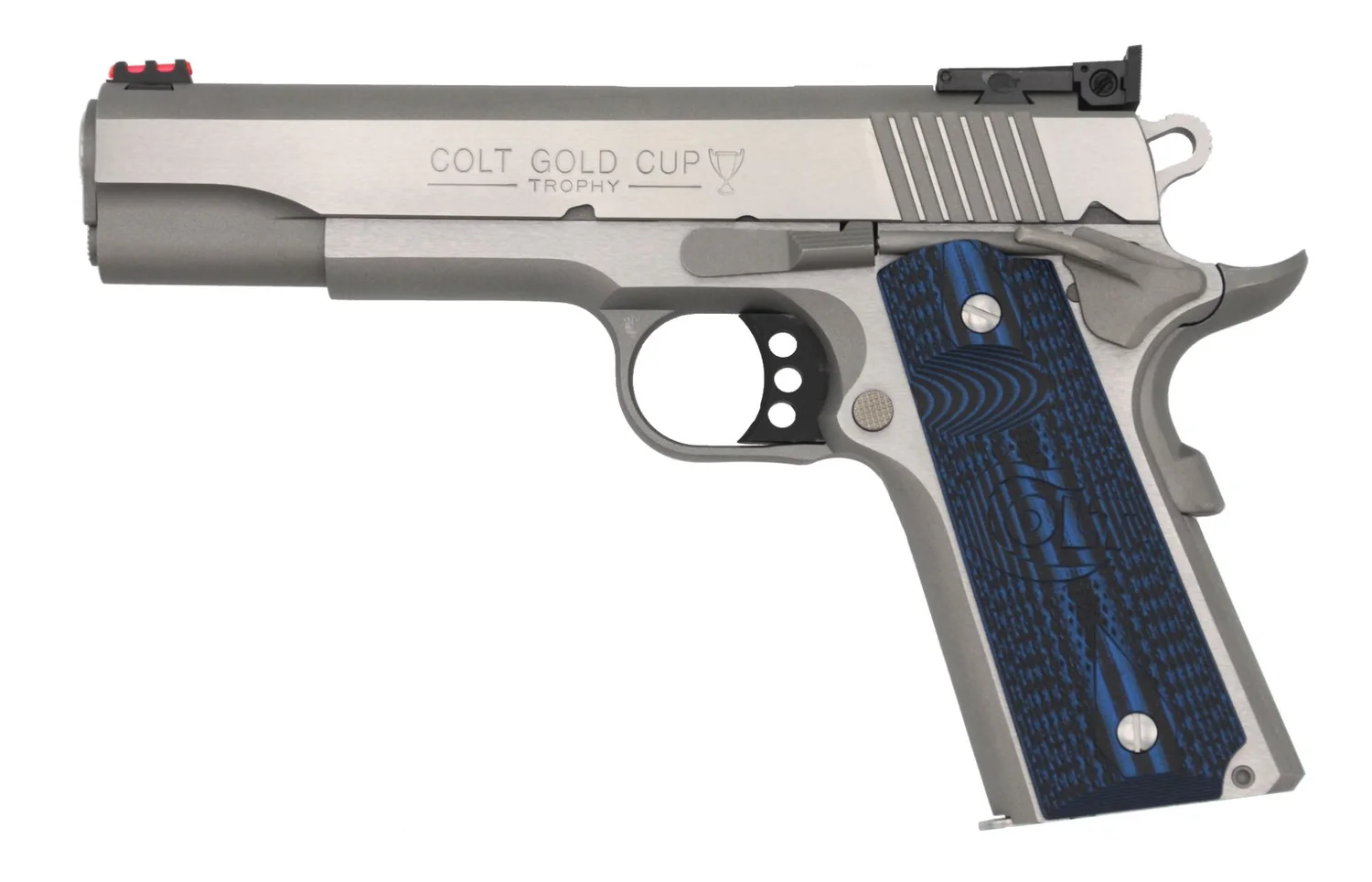
In this Colt Gold Cup review, I cover Colt’s target 1911 in all three grades. The Colt Gold Cup is a 5 inch Government with a National Match barrel, an adjustable rear sight, a wide trigger and the Series 70 firing system.
Colt builds it in three grades. The stainless Gold Cup, which retailers call the Gold Cup Lite, is the entry point. The blued National Match is the traditional one. The Trophy adds checkering and a magwell for competition.
I shot two of them: a Gold Cup Lite in .45 ACP and a Trophy in 9mm, 300 rounds each. Both ran clean. The trigger is the reason to buy one. It breaks like glass, and with an adjustable rear sight, both guns shot under 2 inches at 25 yards with their best loads.
The stainless Gold Cup Lite’s slide is stamped “GOLD CUP TROPHY” too. Colt’s own photo of the Lite, model O5073GCL, carries the Trophy stamp. So when you’re shopping, go by the SKU and the frame. The Trophy has an extended magwell and a checkered front strap; the Lite doesn’t.
The Gold Cup Lite gives you the trigger, barrel and sights that matter for about $1,000 on the street, and that’s the one most shooters should buy.
Best For: Bullseye and target shooters, 1911 fans who want the best trigger Colt makes, and anyone moving up from a Government. Not for carry, and not for shooters who want a red dot on a budget.
Design Intent: A Factory Target Pistol
The Gold Cup exists so you don’t have to send a Government to a gunsmith. When Colt launched the current Trophy in 2017, its product manager said Colt had upgraded it “in the same ways that many enthusiasts and professionals do as they ship their beloved firearm around the country for costly specialty services.” The idea was a match-ready 1911 straight from the factory.
Colt’s catalog describes the family as starting with “competition ergonomics, adjustable rear sight, and those stunning Colt Competition blue G10 grips.” Every grade gets the 5 inch National Match barrel, Colt lists the Gold Cup wide trigger on the Gold Cup and National Match, and all three use the Series 70 firing system. Colt says Series 70 reduces the number of moving parts in the trigger assembly and reduces the length and weight of the trigger pull, which is exactly what a target shooter wants.
What the Trophy adds
Per Colt, the Trophy adds 25 LPI checkering on the front and rear of the frame and an extended magwell. Its 2017 launch notes also list an undercut trigger guard, an upswept beavertail grip safety and Colt’s Dual Spring Recoil System. It launched at $1,699 in .45 ACP and 9mm. Colt’s store now lists it at $1,949.
Colt Gold Cup Variants
Colt’s naming is a mess, so here it is by SKU. Models ending in GCL are the stainless Gold Cup (Lite), A1 is the National Match and XE is the Trophy. Prices are from Colt’s store:
| Grade | Colt SKUs | Colt Store Price | What You Get |
| Gold Cup (Lite) | O5070GCL .45, O5072GCL 9mm, O5073GCL .38 Super | $1,349; $1,449 in .38 Super | Stainless, fiber optic front, adjustable rear, G10 grips |
| Gold Cup Two-Tone | O5970GCL-TT .45 | $1,449 | Black slide over a stainless frame |
| National Match | O5870A1 .45, O5872A1 9mm, O5873A1 .38 Super | $1,549 | Blued carbon steel, solid black front sight |
| Trophy | O5070XE .45, O5072XE 9mm, O5073XE .38 Super | $1,949 | Adds 25 LPI checkering and an extended magwell |
| Trophy Two-Tone | O5970XE-TT .45 | $1,999 | Two-tone Trophy |
| Optics-Ready Trophy | O5070XE-OR .45, O5072XE-OR 9mm | $2,099 | Trophy with a removable plate for a red dot |
Colt’s 2026 printed catalog lists the National Match at $1,509 and the Trophy at $1,909, $40 under the store. Colt’s state restrictions for the family vary by model and include California, Massachusetts, Maryland and Washington DC, so check the exact SKU with your dealer.
Colt Gold Cup (Lite): stainless, fiber optic front, .45 ACP, 9mm or .38 Super $1,029.99-$1,199.99
Colt Gold Cup National Match: blued carbon steel, solid front sight $1,236.99-$1,299.99
Colt Gold Cup Trophy: 25 LPI checkering, extended magwell $1,532.99-$1,699.99
Colt Optics-Ready Gold Cup Trophy: red dot ready, .45 ACP or 9mm $2,099 Colt list
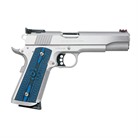
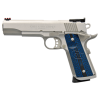

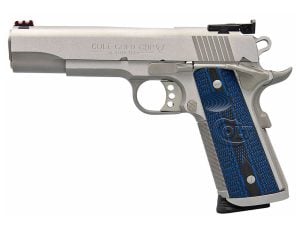
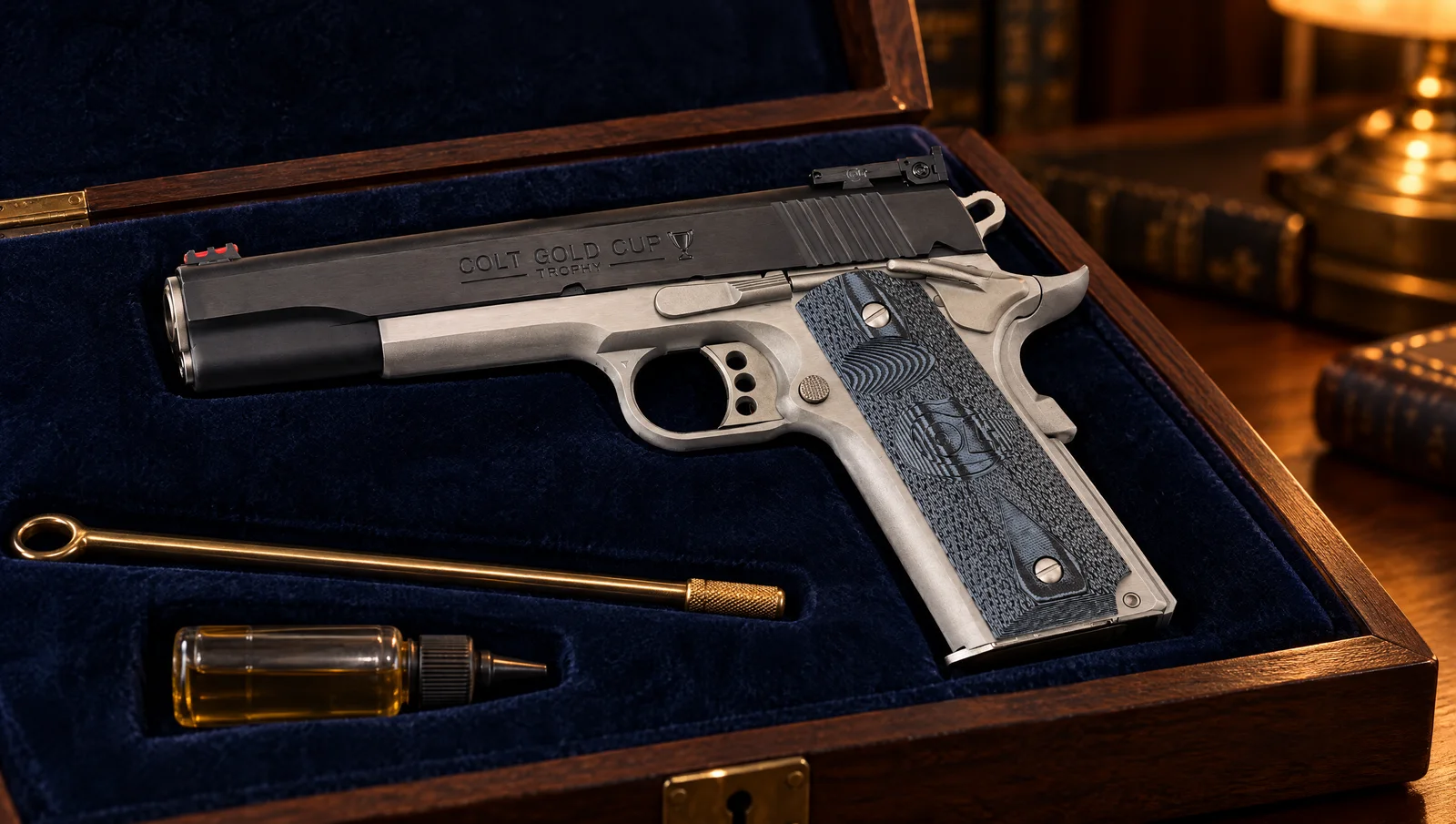
Which Gold Cup Should You Buy?
The Gold Cup Lite is the one for most people. It has the same barrel, trigger, firing system and adjustable rear sight as the Trophy, and the same fiber optic front sight, and it’s the cheapest grade on our cards.
The National Match is for traditionalists. It’s blued carbon steel with a solid black front sight, the look of a classic bullseye gun. On our cards it runs about $200 more than the Lite.
The Trophy earns its price if you compete. The checkered front strap locks your grip in place over long strings, and the magwell speeds up reloads in action matches. For slow-fire bullseye, it doesn’t add much over the Lite.
The Optics-Ready Trophy uses Colt’s 1911 plate system: remove the cover plate that carries the rear sight and fit a Colt adapter plate for a DeltaPoint Pro, RMR or RMS-C pistol red dot footprint. Each plate costs $99 from Colt’s store.
Competitor Comparison
Target 1911s run from under $1,000 to custom-shop money. Here’s where the Gold Cup sits against three of them.
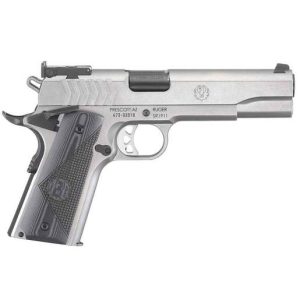
Ruger SR1911 Target (under $1,000)
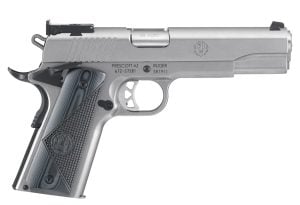
Ruger’s Target model is the budget route to a 5 inch 1911 with an adjustable rear sight, and it costs less than the Gold Cup Lite on our cards. The Colt gives you a National Match barrel, the Series 70 trigger and the rampant pony. Our Ruger SR1911 review covers the Ruger.
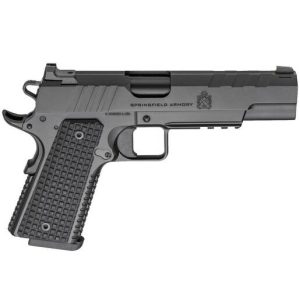
Springfield Armory Emissary (from $869.99)
The Emissary comes in 4.25 and 5 inch lengths, and it’s another way to get a premium-looking 1911 for less than a Gold Cup. It’s built more as a do-everything gun than a target pistol. If bullseye is the goal, the Colt’s sights and trigger are the better fit.
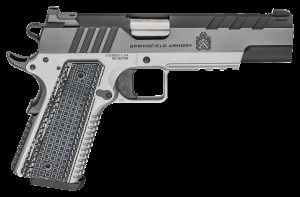
Dan Wesson Pointman (from $2,099)
Dan Wesson’s Pointman is the step up in fit and finish, and it costs more than even a Trophy on our cards. If you’re weighing a Trophy against a Pointman, handle both. For most shooters, a Gold Cup Lite and a few thousand rounds of practice will do more.
Verdict: The Ruger and Springfield are cheaper, the Dan Wesson is fancier. The Gold Cup is the one built from the start as a target pistol, and the Lite puts that within reach for about $1,000.
Testing Protocol
I tested a Gold Cup Lite in .45 ACP (O5070GCL) and a Trophy in 9mm (O5072XE), 300 rounds each, over three sessions in September at an outdoor range, between 63 and 80 degrees. I zeroed both at 25 yards before shooting for groups, and cleaned both at round 150.
Ammunition Log
- Federal American Eagle 230 grain FMJ (.45): 150 rounds
- Federal Gold Medal Match 185 grain SWC (.45): 100 rounds
- Hornady Critical Defense 185 grain FTX (.45): 50 rounds
- Blazer Brass 124 grain FMJ (9mm): 150 rounds
- Federal Syntech Action Pistol 150 grain (9mm): 100 rounds
- Speer Gold Dot 124 grain JHP (9mm): 50 rounds
- Total: 600 rounds, 0 stoppages
Phase 1: Break-In
The first 100 rounds through each gun were ball. Both ran every round and locked back on every empty magazine. The Lite’s slide felt tight for the first 50 rounds and loosened into a smooth cycle after that. I ran the adjustable rear sight up and to the right a few clicks on each gun to center the group at 25 yards.
Phase 2: Reliability
Rounds 101 to 300 added the match loads and hollow points. The Federal semi-wadcutters fed perfectly in the .45, which isn’t a given in every 1911. The 9mm Trophy ran the 150 grain Syntech and Gold Dot without a hiccup. Zero stoppages across 600 rounds.
Phase 3: Accuracy
I shot five-shot groups at 25 yards from a rest. The 9mm Trophy printed the best group of the test, 1.3 inches with Syntech Action Pistol, and averaged 1.7 inches with Gold Dot. The .45 Lite averaged 1.6 inches with Gold Medal Match and 2.2 inches with American Eagle.
Triggers broke at 3 lb 12 oz on the Lite and 3 lb 9 oz on the Trophy on my gauge, with almost no take-up and a very short reset.
Tracking & Observations
After 300 rounds each, both guns showed polished wear on the barrel hood and bushing and light marks on the slide rails. The sight settings held through the whole test. Nothing loosened, and the stainless cleaned up easily with a solvent and a nylon brush.
What This Means for You
- Upgrade Impact: Good magazines and match ammo matter more than any part.
- Reliability: Both ran ball, match and hollow points from the box.
- Ammo Preference: Gold Medal Match in .45, 150 grain Syntech in 9mm.
- Maintenance: Standard 1911 field strip; check the rear sight screws now and then.
- Accuracy Expectation: Under 2 inches at 25 yards with the load each gun likes.
Performance Testing Results
The Lite and the Trophy ran 600 rounds with no stoppages and both shot under 2 inches at 25 yards, for 8.5 overall with reliability and value counted double.
Reliability (9/10)
600 rounds, no stoppages, including semi-wadcutter match ammo in the .45. That is an excellent result for two new, tightly fitted target guns. Run your match load through yours before a competition all the same.
Accuracy (10/10)
Sub-2 inch groups at 25 yards from both guns, with Gold Medal Match in the .45 and Syntech in the 9mm. The National Match barrel and the Series 70 trigger are why. The adjustable rear sight lets you zero for your load and distance, which a fixed-sight Government can’t do.
Ergonomics & Recoil (8/10)
It’s a full-size steel 1911, so recoil is gentle in 9mm and firm but easy in .45. The wide trigger spreads the press across your finger. The Trophy’s checkered front strap made a real difference in holding the same grip through a long string; the Lite’s smooth front strap let my hand shift slightly.
Fit, Finish, and Quality Control (9/10)
Both guns had tight slide-to-frame fit, even stainless finishes and crisp, clean markings. The blue G10 grips look great and grip well. These felt like the best-built Colts I’ve handled at this price.
Technical Deep Dive
Every Gold Cup grade shares the same core: a Series 70 firing system, a 5 inch National Match barrel, the wide trigger and an adjustable rear sight.
Series 70 Firing System
Every current Gold Cup uses Colt’s Series 70 firing system. Colt says it reduces the number of moving parts in the trigger assembly and reduces the length and weight of the trigger pull. That’s the core of the Gold Cup: a lighter, cleaner break than a Series 80 duty gun.
Barrel, Sights and Trigger
All three grades use a 5 inch National Match barrel, and Colt’s catalog lists the Gold Cup wide trigger on the Gold Cup and National Match. The rear sight is adjustable on every grade. The Gold Cup and Trophy get a fiber optic Novak front sight, and the National Match gets a solid black front, the classic choice for bullseye under bright sun.
| Component | Specification | Benefit |
| Firing system | Colt Series 70 | Fewer trigger parts, lighter and shorter pull |
| Barrel | 5 in. National Match | Target-grade accuracy |
| Trigger | Gold Cup wide trigger | Spreads the press across your finger |
| Rear sight | Adjustable | Zero for your load and distance |
| Front sight | Fiber optic Novak or solid black (National Match) | Bright aiming point or crisp bullseye picture |
| Trophy frame | 25 LPI checkering front and rear, extended magwell | Steady grip and faster reloads |
Parts, Accessories and Upgrades
A Gold Cup needs no parts to shoot well. Good magazines, match ammo and, on the Optics-Ready Trophy, a Colt plate are what to budget for.
| Upgrade Category | Recommended Component | Why It Matters | Cost Estimate |
| Magazines | Spare match-grade 1911 magazines | A target 1911 is only as reliable as its magazines. | Check our live pricing |
| Optic plate | Colt “A”, “B” or “C” plate | Needed for a red dot on the Optics-Ready Trophy. | $99 from Colt |
| Match ammo | Federal Gold Medal Match .45 | Best .45 groups in our testing. | See our .45 ACP ammo guide |
| 9mm ammo | Federal Syntech Action Pistol 150 grain | Best group of the whole test. | See our 9mm ammo guide |
Common Problems & Solutions
Our two guns ran clean, so most Gold Cup problems come from buying the wrong grade or from loose sight and plate screws.
- Buying the wrong grade: The Lite’s slide is stamped “GOLD CUP TROPHY” too. Check the SKU (GCL, A1 or XE) and look for the Trophy’s magwell and checkered front strap.
- A shifting zero: Check the adjustable rear sight screws before a match; a loose sight moves your group.
- Loose optic plate screws: On the Optics-Ready Trophy, torque the #6-32 plate screws to 15 inch-pounds with Loctite 242, as Colt’s manual says.
- Buying in a restricted state: Colt’s restrictions for the Gold Cup family vary by SKU and include California, Massachusetts, Maryland and Washington DC.
Who Should NOT Buy This Gun
The Gold Cup is a full-size target pistol at Colt prices, so these buyers are better served elsewhere.
- Concealed carriers: A 5 inch steel target gun is the wrong tool. Look at the Colt Combat Commander.
- Budget target shooters: The Ruger SR1911 Target costs less on our cards.
- Hunters and woods carriers: The 10mm Colt Delta Elite is the Colt built for that job.
- Anyone who wants a factory red dot cheaply: The Optics-Ready Trophy lists at $2,099. Springfield’s optics-ready Emissary AOS models cost far less in our catalog.
Final Verdict
The Colt Gold Cup is still the factory target 1911 to beat. Both guns I shot ran 300 rounds without a stoppage and printed sub-2 inch groups at 25 yards with their best loads, and the Series 70 trigger is the best I’ve felt on a production Colt. The confusing naming and shared slide stamp are annoying, but they don’t change how it shoots.
Buy the Gold Cup Lite unless you compete in action matches, where the Trophy’s checkering and magwell earn their price. Buy the National Match if you want the classic blued bullseye gun. For more options, see our best Colt 1911s, the best 1911s under $2,000, our best competition pistols and our Colt 1911 Government review.
Final Score: 8.5/10: Colt’s best trigger and barrel, and the Lite makes them affordable.
Specs and prices in this review come from Colt’s Gold Cup product page, its Optics-Ready Gold Cup Trophy page, the Colt 2025 commercial catalog, the Colt 2026 commercial catalog, Colt’s Gold Cup Trophy announcement and the Colt 1911 Optics Ready instructions.
FAQ: Colt Gold Cup
What is the difference between the Colt Gold Cup Lite and the Gold Cup Trophy?
The Trophy adds 25 LPI checkering on the front and rear of the frame and an extended magwell, per Colt, and holds 10+1 in 9mm and .38 Super against the Lite's 9+1. Both are stainless with a 5 inch National Match barrel, an adjustable rear sight, a fiber optic front and the Series 70 firing system. Colt's store lists the Lite from $1,349 and the Trophy at $1,949.
Is the Colt Gold Cup a Series 70?
Yes. Colt's catalog lists the Series 70 firing system on the Gold Cup, the Gold Cup Trophy and the Gold Cup National Match.
How can I tell a Gold Cup Lite from a Trophy?
Not by the slide: Colt's own photo of the Lite (O5073GCL) is stamped Gold Cup Trophy too. Check the SKU (GCL is the Lite, XE is the Trophy, A1 is the National Match) and look for the Trophy's extended magwell and checkered front strap.
How much is a Colt Gold Cup?
Colt's store lists the stainless Gold Cup (Lite) at $1,349 in .45 ACP or 9mm and $1,449 in .38 Super, the National Match at $1,549 and the Trophy at $1,949. Street prices on our cards start lower.
What calibers does the Colt Gold Cup come in?
.45 ACP, 9mm and .38 Super across the Gold Cup, National Match and Trophy. The Optics-Ready Trophy comes in .45 ACP and 9mm.
Is the Colt Gold Cup optics ready?
The Optics-Ready Gold Cup Trophy is, at $2,099 on Colt's store. It uses Colt's 1911 plate system, with plates for DeltaPoint Pro, RMR and RMS-C footprints at $99 each.
What is the difference between the Colt Gold Cup and the National Match?
The finish and the front sight. The National Match is blued carbon steel with a solid black front sight; the stainless Gold Cup (Lite) has a fiber optic Novak front. Both share the 5 inch National Match barrel, the Gold Cup wide trigger, an adjustable rear sight and the Series 70 firing system. Colt's store lists the Lite at $1,349 and the National Match at $1,549.
Is the Colt Gold Cup a good gun?
Yes. Our Gold Cup Lite in .45 and Trophy in 9mm ran 600 rounds with zero stoppages, including semi-wadcutter match ammo, and both shot under 2 inches at 25 yards with their best loads. The Trophy's best group was 1.3 inches, and the triggers broke at 3 lb 12 oz and 3 lb 9 oz. We rated it 8.5/10.
5,031+ Gun & Ammo Deals
Updated daily from 200+ top retailers. Filter by category, caliber, action type, and price.
Related Guides