

Affiliate disclosure: This Colt Combat Commander review contains affiliate links. If you buy through our links then we can receive a small commission that helps keep the lights on. You don’t pay anything more.
- Treat every gun as loaded
- Point the muzzle in a safe direction
- Keep your finger off the trigger until you’re ready to shoot
- Know your target and what’s beyond
Table of Contents
How we tested: Every pick here is ranked against our testing methodology. Minimum round counts, accuracy and reliability protocols, the failures that disqualify a gun.
Review: Colt Combat Commander: The 1911 Built to Be Carried
Our Rating: 8.3/10
- MSRP: $1,249.00 on Colt’s store for the Combat Commander and Lightweight Commander; $1,349.00 for the Night Commander
- Street Price: Under $1,000 (Use our live pricing for the best up to date deal)
- Caliber: .45 ACP, 9mm or .38 Super (Combat Commander); .45 ACP or 9mm (Lightweight Commander)
- Action: Single action only, semi-automatic
- Barrel Length: 4.25 in., three quarters of an inch shorter than a Government Model
- Capacity: 8+1 in .45 ACP, 9+1 in 9mm
- Frame: Carbon steel (Combat Commander) or lightweight alloy (Lightweight Commander)
- Slide: Carbon steel, blued, with wide angled cocking serrations
- Sights: Novak LoMount, per Colt’s launch notes
- Grips: Colt G10
- Weight: Not published by Colt
- State Restrictions: Colt lists California, Massachusetts and Washington DC
Pros
- Carry length with a full-size grip
- Three calibers, including .38 Super
- Steel or alloy frame, same price
Cons
- Colt publishes no weight
- Optics-Ready version costs $150 more
- Not sold in California or Massachusetts
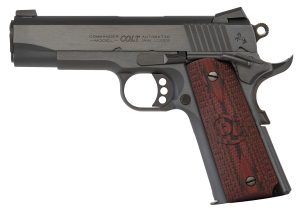
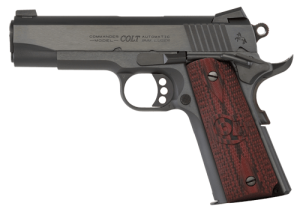
Quick Take
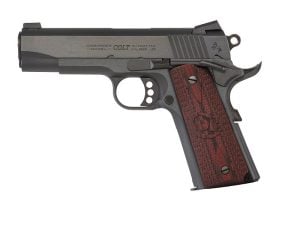
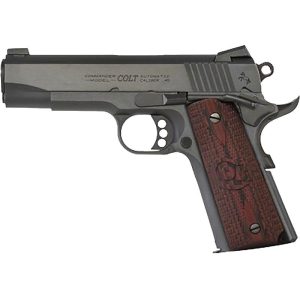
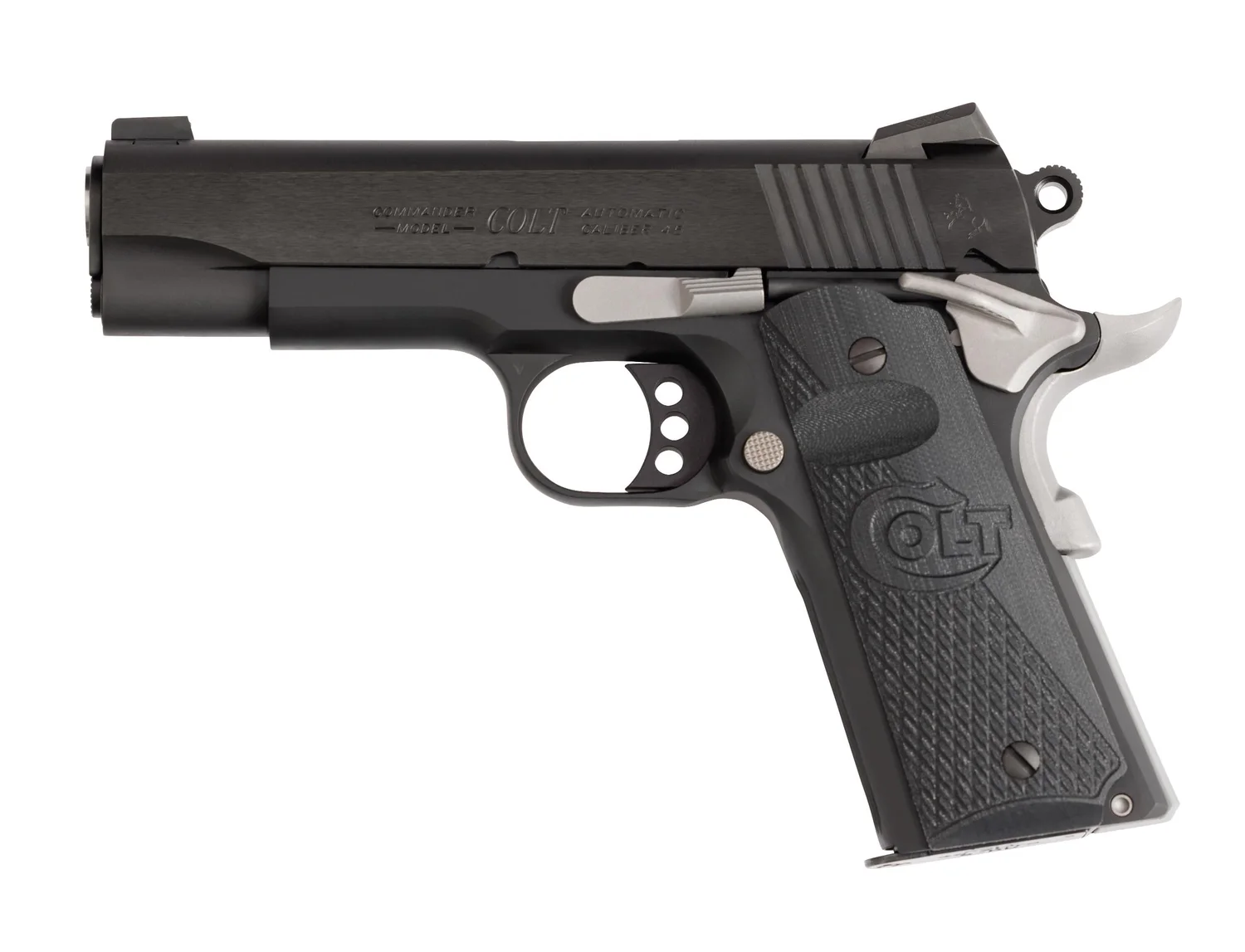
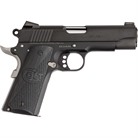
The Colt Combat Commander is a Government Model with the slide and barrel cut down to 4.25 inches. The grip stays full size, so you still get eight rounds of .45 ACP or nine of 9mm and a proper hold, but the gun is shorter to carry. Colt sells it in two builds at the same price: the Combat Commander with a carbon steel frame, and the Lightweight Commander with an alloy frame.
For this Colt Combat Commander review, I shot both. A steel Combat Commander in .45 and a Lightweight Commander in 9mm got 400 rounds each over four sessions.
The .45 ran every round. The 9mm had two stoppages in its first hundred and none after. Both are classic Colts to shoot: a crisp single action trigger, Novak sights you can find fast, and G10 grips that stay put in a sweaty hand.
Colt’s price list makes the choice simple. The steel and alloy guns both list at $1,249, so you’re choosing on weight and recoil, not money. The Optics-Ready versions list at $1,399, which is $150 more, even though Colt charges nothing extra for the optics cut on its 10mm Delta Elite.
If you want a Colt 1911 to carry every day, this is the one, and street prices often land under $1,000.
Best For: 1911 shooters who want to carry on the belt, and anyone who finds a 5 inch Government too long. Pick the steel frame for the range and the alloy frame for all-day carry. Not for pocket carry or for anyone who wants double-stack capacity.
Design Intent: A Government You Can Carry
When Colt updated the Combat Commander, it said the gun was “Designed for the 1911 enthusiast who wants something more compact for concealed carry.” Colt took three quarters of an inch off the Government’s slide and barrel and kept the full-size grip, which gives you a 1911 that rides better on the belt without giving up capacity or control.
Colt’s launch notes list what the updated gun got: an upswept beavertail grip safety and undercut trigger guard so you can grip it high, Colt G10 grips, wide angled cocking serrations, Novak LoMount sights and Colt’s Dual Spring Recoil System, which Colt says lessens felt recoil. That 2017 update launched in 9mm and .45 ACP at $949. Colt’s store now lists it at $1,249, and a .38 Super version has joined the line.
Steel or alloy: the one real choice
Colt’s 2026 catalog lists the two guns together with one spec line: a lightweight alloy or carbon steel frame under a blued carbon steel slide. The steel frame soaks up more recoil and suits a range gun that also gets carried.
The alloy frame is the one to wear all day. Colt doesn’t publish a weight for either, so hold both at the counter. The difference is obvious the moment you pick them up.
Colt Commander Variants
Colt’s store lists these Commanders, all with a 4.25 inch barrel:
| Model | Colt SKU | Colt Store Price | Frame / Difference |
| Combat Commander .45 ACP | O4940XE | $1,249 | Carbon steel, 8+1 |
| Combat Commander 9mm | O4942XE | $1,249 | Carbon steel, 9+1 |
| Combat Commander .38 Super | O4943XE | $1,249 | Carbon steel; the only Commander in .38 Super |
| Lightweight Commander .45 ACP | O4840XE | $1,249 | Alloy, 8+1 |
| Lightweight Commander 9mm | O4842XE | $1,249 | Alloy, 9+1 |
| Night Commander .45 ACP | O4840NC | $1,349 | Lightweight aluminum frame, matte black Cerakote |
| Optics-Ready Combat or Lightweight Commander .45 | O4940XE-OR / O4840XE-OR | $1,399 | Removable slide plate for a red dot |
| Optics-Ready Night Commander | O4840NC-OR | $1,499 | Night Commander with the optics cut |
Two notes on those numbers. Colt’s 2026 printed catalog lists the Combat and Lightweight Commander at $1,229 and the Night Commander at $1,339, so the store runs $10 to $20 higher. And Colt’s store lists the Optics-Ready Commanders in .45 ACP only, though retailers also carry 9mm and .38 Super optics-ready SKUs. Colt’s Combat Elite and CCU Commanders are separate premium lines, and our cards leave them out.
Colt Combat Commander: carbon steel frame, .45 ACP, 9mm or .38 Super $989.99-$1,049.99
Colt Lightweight Commander: alloy frame, .45 ACP or 9mm $939.56-$1,087.99
Colt Night Commander O4840NC: aluminum frame, black Cerakote, .45 ACP $1,055.99-$1,149.00
Colt Optics-Ready Commander: red dot ready, .45 ACP $1,399 Colt list
The Optics-Ready Commander
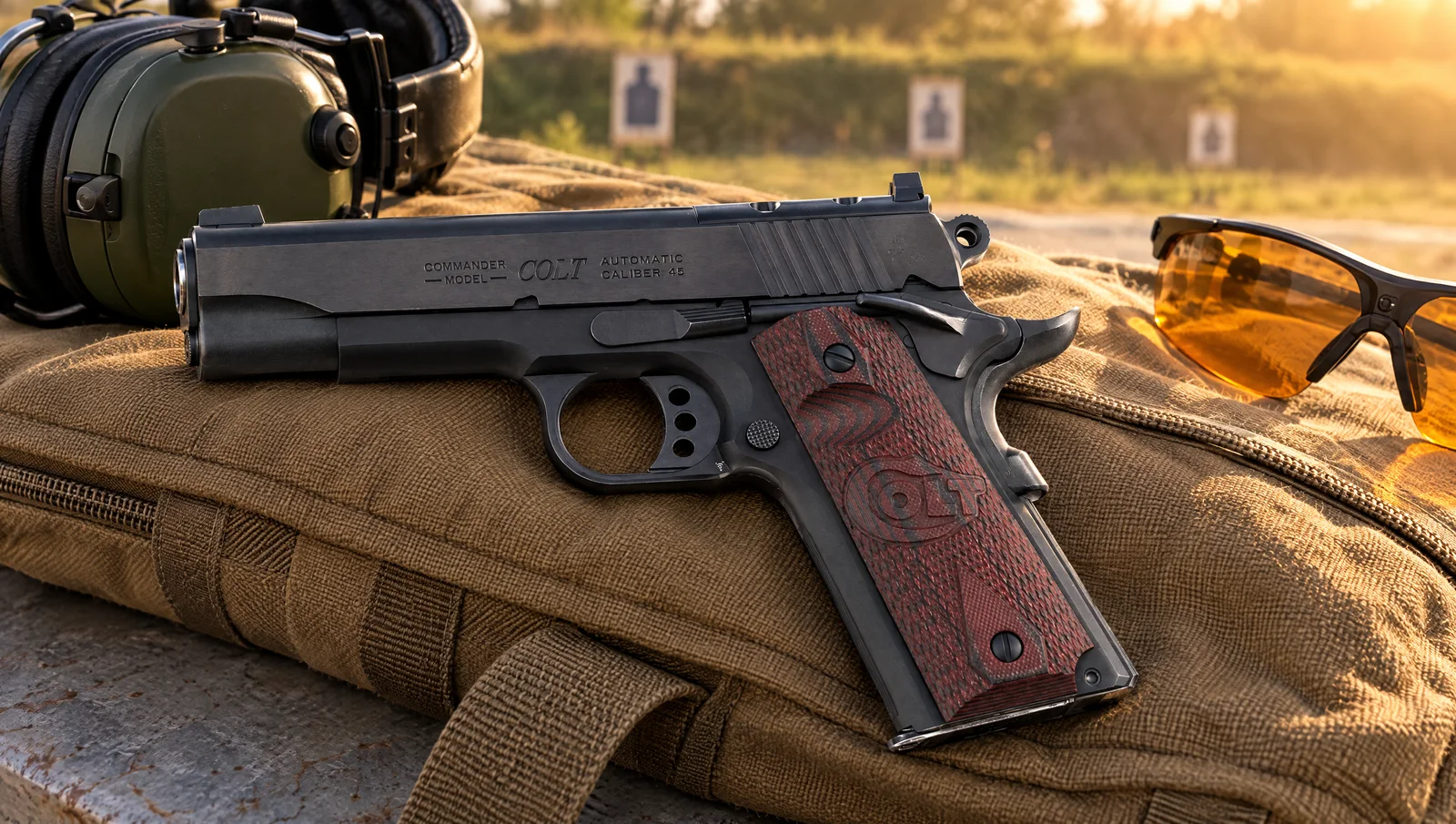
The Optics-Ready Commanders use Colt’s 1911 plate system. According to Colt’s instructions, the gun ships with a cover plate that carries the rear sight. To fit a red dot, remove the four cover plate screws with a 5/64 inch hex key and bolt on the Colt adapter plate for your optic: plate “A” for the DeltaPoint Pro footprint, “B” for the RMR, or “C” for the RMS-C and K series footprint, as Colt words it.
Colt’s store sells each plate for $99, and the instructions don’t say one comes in the box. The manual calls for the #6-32 plate screws to be torqued to 15 inch-pounds with a medium thread locker like Loctite 242. So on a Commander, a red dot costs $150 for the optics-ready gun plus $99 for the plate, before you buy the optic.
Competitor Comparison
Every rival here costs less than the Colt. These three Commander-size 1911s are the ones it meets most often at the counter.
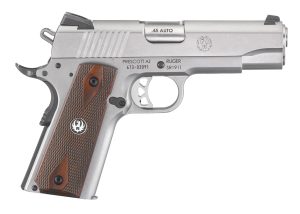
Ruger SR1911 Commander (under $900)
Ruger’s SR1911 comes in Commander-size versions, including a lightweight model, and it costs less than the Colt on our cards. It’s the value pick among the big names. The Colt gives you the rampant pony and a .38 Super option. Our Ruger SR1911 review covers the Ruger in depth.
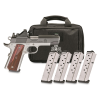
Springfield Armory Ronin 4.25 inch (under $900)
Springfield’s Ronin comes in a 4.25 inch Commander length, including an optics-ready version, and undercuts the Colt on our cards. It’s a strong alternative if you want a red dot without paying Colt’s optics premium. See our Springfield Ronin review.


Kimber Pro Carry II (from $780.99)
Kimber’s Pro Carry II uses a 4 inch barrel, a quarter inch shorter than the Commander, and it’s the cheapest of the three on our cards. If you want the shortest slide with a full grip, look at it. The Colt is the one with the name and the resale value.
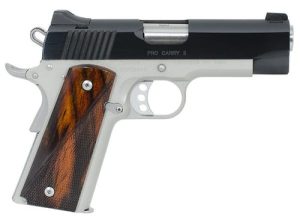
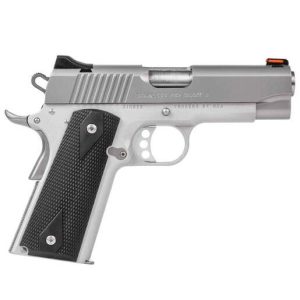
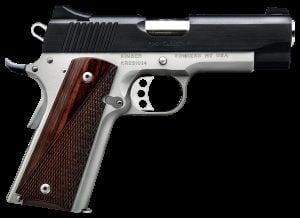
Verdict: Every rival here costs less. The Colt earns its premium with the steel or alloy choice at one price, a .38 Super version, and the Colt name on the slide.
Testing Protocol
I tested two new guns side by side: a steel Combat Commander in .45 ACP (O4940XE) and a Lightweight Commander in 9mm (O4842XE). Each got 400 rounds over four sessions in September at an outdoor range, between 61 and 79 degrees, using the factory magazines. I cleaned and lubricated both before the first shot and at round 200.
Ammunition Log
- Federal American Eagle 230 grain FMJ (.45): 250 rounds
- Federal HST 230 grain JHP (.45): 75 rounds
- Hornady Critical Defense 185 grain FTX (.45): 75 rounds
- Blazer Brass 115 grain FMJ (9mm): 250 rounds
- Speer Gold Dot 124 grain JHP (9mm): 75 rounds
- Federal HST 124 grain JHP (9mm): 75 rounds
- Total: 800 rounds, 2 stoppages
Phase 1: Break-In
The first 100 rounds through each gun were ball. The steel .45 ran every one.
The Lightweight 9mm had two failures to go fully into battery with Blazer Brass, at rounds 31 and 64, both cleared with a push on the back of the slide. After that, nothing. A tight new 1911 in 9mm often wants a box or two to settle in, and this one did.
Phase 2: Reliability
Rounds 101 to 400 on each gun mixed ball and both hollow points. Neither gun stopped again. Both locked back on every empty magazine, and brass went consistently to the right and slightly back. The 9mm magazines were easier to load to full capacity than the .45 ones, which were stiff for the first few sessions.
Phase 3: Accuracy
I shot five-shot groups at 15 yards from a rest. The steel .45 printed the best group, 1.9 inches with Federal HST, and averaged 2.3 inches with American Eagle. The Lightweight 9mm averaged 2.4 inches with Gold Dot and 2.8 inches with Blazer. Triggers broke at 4 lb 9 oz on the Combat Commander and 4 lb 14 oz on the Lightweight, both clean with very little creep.
Tracking & Observations
After 400 rounds each, both guns showed light wear at the muzzle and on the slide rails, and the bluing had rubbed slightly at the front of the dust cover. Nothing loosened, including the grip screws. The alloy frame showed no marks where the slide stop sits, which is where you’d look first on a lightweight 1911.
What This Means for You
- Upgrade Impact: A good gun belt and holster matter more than any part.
- Reliability: Run 100 to 200 rounds of ball through a new 9mm before you carry it.
- Ammo Preference: Federal HST in .45 and Speer Gold Dot in 9mm for carry.
- Maintenance: Standard 1911 field strip; keep the rails lubricated.
- Accuracy Expectation: 2 to 3 inches at 15 yards.
Performance Testing Results
Across 800 rounds the two Commanders had two break-in stoppages, both on the 9mm, and a 1.9 inch best group at 15 yards, for 8.3 overall with reliability and value counted double.
Reliability (8/10)
The steel .45 went 400 for 400. The Lightweight 9mm had two break-in stoppages in its first 64 rounds, then 336 clean. Together, that’s a good record, but it’s why I’d shoot any new 9mm 1911 for a while before trusting it.
Accuracy (8/10)
Groups of 2 to 3 inches at 15 yards are right where a carry-length 1911 should be, and the best of them came in under 2. The single action trigger does most of the work. The steel .45 shot the tighter groups of the two, though it was also the heavier gun.
Ergonomics & Recoil (9/10)
This is the Commander’s case. You get the full Government grip, so the gun fills your hand, but the shorter slide clears a holster faster and digs in less when you sit down. The high beavertail and undercut trigger guard let you grip it high. The steel .45 was a firm, controllable push, and the alloy 9mm was easy to shoot. A steel frame puts more weight behind a .45, so pick steel if you want the softest .45.
Fit, Finish, and Quality Control (9/10)
Both guns had tight slide-to-frame fit with no rattle, even bluing and cleanly cut serrations. The G10 grips have an aggressive texture that holds well without chewing up a shirt. They feel like Colts, which is what you’re paying for.
Technical Deep Dive
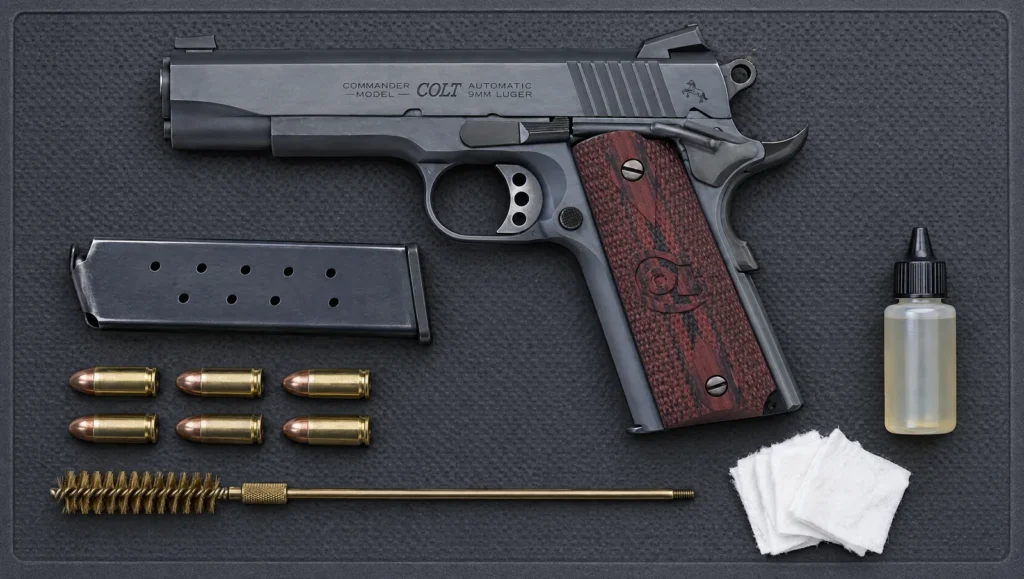
The Commander is a Government Model with a 4.25 inch slide and barrel, a full-size grip and a choice of steel or alloy frame.
Slide, Barrel and Recoil System
The Commander’s 4.25 inch barrel is three quarters of an inch shorter than a Government’s, per Colt. Colt fits its Dual Spring Recoil System, which it says lessens felt recoil and aids shot recovery. The slide is blued carbon steel with wide angled cocking serrations at the rear.
Frames and Calibers
The Combat Commander uses a carbon steel frame and comes in .45 ACP, 9mm and .38 Super. The Lightweight Commander uses a lightweight alloy frame and comes in .45 ACP and 9mm. The Night Commander is a Lightweight with a matte black Cerakote finish. Capacity is 8+1 in .45 and 9+1 in 9mm, per Colt’s catalog.
| Component | Specification | Benefit |
| Barrel | 4.25 in. | Shorter draw and easier carry |
| Frame | Carbon steel (Combat) or alloy (Lightweight) | Pick recoil control or low weight |
| Slide | Blued carbon steel, wide angled serrations | Easy to rack and press check |
| Recoil system | Colt Dual Spring Recoil System | Softer felt recoil |
| Sights | Novak LoMount | Snag-free on the draw |
| Grip | Upswept beavertail, undercut trigger guard, G10 grips | A high, secure hold |
Parts, Accessories and Upgrades
The Commander needs nothing to run. A proper holster and belt matter more than any part you could add.
| Upgrade Category | Recommended Component | Why It Matters | Cost Estimate |
| Holster | A holster made for a 4.25 inch Commander | Government holsters leave the muzzle loose. | Varies |
| Gun belt | A stiff, purpose-made gun belt | A steel 1911 sags on a dress belt. | Varies |
| Optic plate | Colt “A”, “B” or “C” plate | Needed for a red dot on the Optics-Ready model. | $99 from Colt |
| Ammo | Federal HST (.45) or Speer Gold Dot (9mm) | The best defensive groups from each gun in our testing. | See our .45 ACP ammo and 9mm ammo guides |
Common Problems & Solutions
Most Commander problems are break-in on a new 9mm, the wrong holster, or where you live.
- Break-in stoppages on a new 9mm: Clean off the factory oil, lubricate the rails and shoot a couple of boxes of ball before carrying it.
- Buying a Government holster: It fits, but the shorter Commander slide leaves the muzzle loose. Get a Commander-length holster.
- Loose optic plate screws: Torque the #6-32 plate screws to 15 inch-pounds with Loctite 242, as Colt’s manual says, and check them regularly.
- Buying in a restricted state: Colt lists California, Massachusetts and Washington DC as restricted for the Commander family. Check with your dealer first.
Who Should NOT Buy This Gun
The Commander is a single-stack Colt at Colt prices, so these buyers are better served elsewhere.
- Buyers in California, Massachusetts or DC: Colt lists all three as restricted.
- Anyone who wants the most rounds: A Springfield Prodigy holds far more 9mm in a 1911-style gun.
- Budget buyers: The Ruger SR1911 Commander and Kimber Pro Carry II both cost less on our cards.
- Range-only shooters: If it never leaves the range bag, the full-size Colt Government gives you a longer sight radius and more weight to soak up recoil.

Final Verdict
The Colt Combat Commander is the 1911 I’d carry. It keeps everything good about a Government, the grip, the trigger and the capacity, and cuts the slide down to a length that works on a belt. Both guns I tested shot well and ran after a short break-in on the 9mm. It costs more than a Ruger or Kimber, and the optics-ready version carries a $150 premium, but you are buying a Colt.
Pick the steel Combat Commander if you shoot .45 and want the softest recoil, or the Lightweight Commander if it’s going on your hip every day. For more options, see our best Colt 1911s, the best 1911s under $1,000 and the best .45 ACP carry pistols.
Final Score: 8.3/10: the Colt 1911 built for carry, in steel or alloy for the same price.
Specs and prices in this review come from Colt’s Commander product page, its Night Commander page, its Optics-Ready Combat Commander page, the Colt 2026 commercial catalog, the Colt 1911 Optics Ready instructions and Colt’s updated Combat Commander announcement.
FAQ: Colt Combat Commander
What is the difference between the Colt Combat Commander and Lightweight Commander?
The frame. The Combat Commander has a carbon steel frame and the Lightweight Commander has a lightweight alloy frame, per Colt. Both have a 4.25 inch barrel and a blued carbon steel slide, and Colt's store lists both at $1,249.
How many rounds does the Colt Combat Commander hold?
8+1 in .45 ACP and 9+1 in 9mm, per Colt's 2026 catalog. The Lightweight Commander holds the same.
What calibers does the Colt Combat Commander come in?
The steel Combat Commander comes in .45 ACP, 9mm and .38 Super. The Lightweight Commander comes in .45 ACP and 9mm.
How much is a Colt Combat Commander?
Colt's store lists the Combat Commander and Lightweight Commander at $1,249, the Night Commander at $1,349 and the Optics-Ready Commanders at $1,399. Street prices on our cards often land under $1,000.
Is the Colt Combat Commander good for concealed carry?
Yes, on the belt. Colt designed it for 1911 shooters who want something more compact for concealed carry. The Lightweight Commander's alloy frame is the better choice if you carry all day.
Can I buy a Colt Commander in California?
Not new from Colt. Colt lists California, Massachusetts and Washington DC as state restrictions for the Commander family. Check with a dealer in your state before you plan around one.
What is the difference between the Colt Combat Commander and the Government?
The length. The Commander's barrel and slide are 4.25 inches, three quarters of an inch shorter than the 5 inch Government's, per Colt. The grip stays full size, so capacity is the same: 8+1 in .45 ACP and 9+1 in 9mm. The Government suits range shooters; the Commander is the one to carry.
Is the Colt Combat Commander 9mm reliable?
In our test, yes after break-in. Our Lightweight Commander 9mm had two failures to go fully into battery with Blazer Brass, at rounds 31 and 64, then ran 336 rounds clean. The steel .45 Combat Commander went 400 for 400. Run 100 to 200 rounds of ball through a new 9mm before you carry it.
5,031+ Gun & Ammo Deals
Updated daily from 200+ top retailers. Filter by category, caliber, action type, and price.
Related Guides