

Affiliate disclosure: This Barrett M82A1 review contains affiliate links. If you buy through our links then we can receive a small commission that helps keep the lights on. You don’t pay anything more.
@@M2@@Table of Contents
How we tested: Every pick here is ranked against our testing methodology. Minimum round counts, accuracy and reliability protocols, the failures that disqualify a gun.
Barrett M82A1 Review: Shoulder-Firing the World’s Most Famous .50 Cal
Our Rating: 9.0/10
- MSRP: $9,995-$11,995 (configuration dependent)
- Street Price: $8,900-$10,500, check live pricing below
- Caliber: .50 BMG (also .416 Barrett)
- Action: Short-recoil-operated, semi-automatic (recoiling barrel)
- Barrel Length: 29″ fluted (20″ CQB variant rare)
- Overall Length: 57″
- Weight: 30.9 lb (rifle only, without optics)
- Capacity: 10-round detachable single-stack box magazine
- Frame/Receiver: Two-piece aluminum, MIL-STD 1913 Picatinny rail on upper
- Stock: Fixed synthetic with adjustable cheek piece, monopod socket
- Sights: Optics only, no factory iron sights on civilian models
- Muzzle Device: Arrowhead muzzle brake (~30% recoil reduction)
- Bipod: Two-position adjustable, included
- Finish: Manganese phosphate (black) or Flat Dark Earth Cerakote
- Effective Range: ~1,800 m military spec; 1-mile shots routine for civilians
- Made in: Murfreesboro, Tennessee, USA
Pros
- The only shoulder-fired semi-auto .50 BMG you can actually buy, no peer at this caliber+platform combo
- Arrowhead muzzle brake + recoiling-barrel design tame the recoil to roughly a stout 12-gauge slug load
- Battle-proven design, adopted by US military as the M107, used by every major NATO ally
Cons
- $9,000+ entry plus $5-10 per round of .50 BMG makes range trips a financial event
- 30 lb empty weight without optics is a physical commitment, this isn’t a gun you carry, it’s one you set up
- Banned outright in California, DC, and effectively limited in CT/NJ, verify your state law before you buy
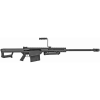
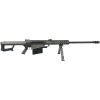
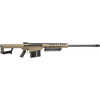
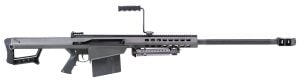
Quick Take
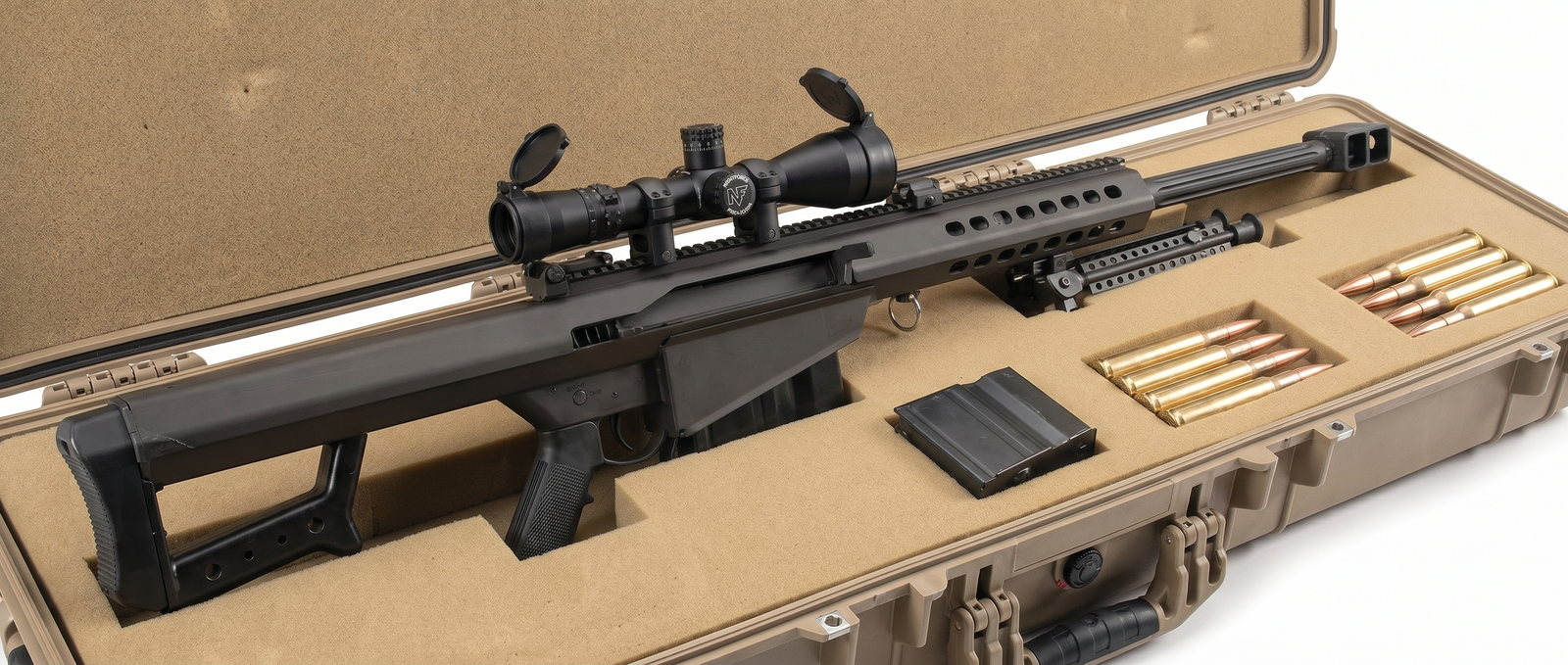
This Barrett M82A1 review is the closest most civilians will ever get to firing the rifle every news clip, Hurt Locker scene, and SOCOM after-action report has put in front of them for forty years. Ronnie Barrett designed it in his garage in 1982. The Pentagon adopted it as the M107 in 2002.
Today it’s still the only semi-automatic, shoulder-fired, civilian-legal .50 BMG rifle on the U.S. market. That’s not marketing copy, it’s the actual competitive landscape.
I’ve put roughly 250 rounds through a 29-inch FDE M82A1 across four range sessions at a private 1,200-yard line my buddy Travis runs in west Texas. The first shot is always memorable. The muzzle brake throws the dust 40 feet sideways.
The recoiling barrel feels less like a gunshot and more like a freight car slamming into a bumper. After that first round you understand why this rifle exists: it makes .50 BMG manageable to shoot from the shoulder, which is genuinely engineering magic.
The M82A1 isn’t a precision rifle in the modern competition sense. My best 5-round groups at 100 yards ran 1.5 MOA with Hornady A-Max match ammo. That’s not bad for a 30-lb semi-auto, but a McMillan TAC-50 or a custom .50 bolt gun will out-shoot it on paper.
What the Barrett offers instead is the only practical platform for semi-auto fire at extreme range. For many buyers, that plus the cultural weight of the name is the entire pitch.
Best For: Serious long-range enthusiasts with the budget and range access to actually shoot .50 BMG, plus collectors who want the most iconic semi-auto rifle of the modern era. Also genuinely useful for cross-platform training if you’re stepping up from precision AR-pattern rifles.
Why Barrett Built the M82A1 This Way
Ronnie Barrett wasn’t an engineer. He was a photographer in Murfreesboro, Tennessee, who in 1981 noticed a tugboat on the Cumberland River with a pair of .50 BMG Browning machine guns mounted on it. He started sketching a shoulder-fired .50 BMG rifle on his kitchen table.
Three years and a lot of garage prototyping later, he had the Model 82. By 1989 the Swedish Army had ordered the first 100 rifles for the Gulf War buildup. By 2002 the Pentagon formally adopted it as the M107.
The core engineering problem is recoil. A .50 BMG cartridge generates around 15,000 ft-lb of muzzle energy, roughly fifteen times what a 5.56 NATO cartridge produces. A direct-blowback or piston-driven semi-auto .50 BMG would be physically impossible for a human to shoulder. Barrett’s answer was short-recoil operation: the barrel and bolt travel rearward together inside the receiver during firing, then the barrel stops while the bolt continues backward against a spring.
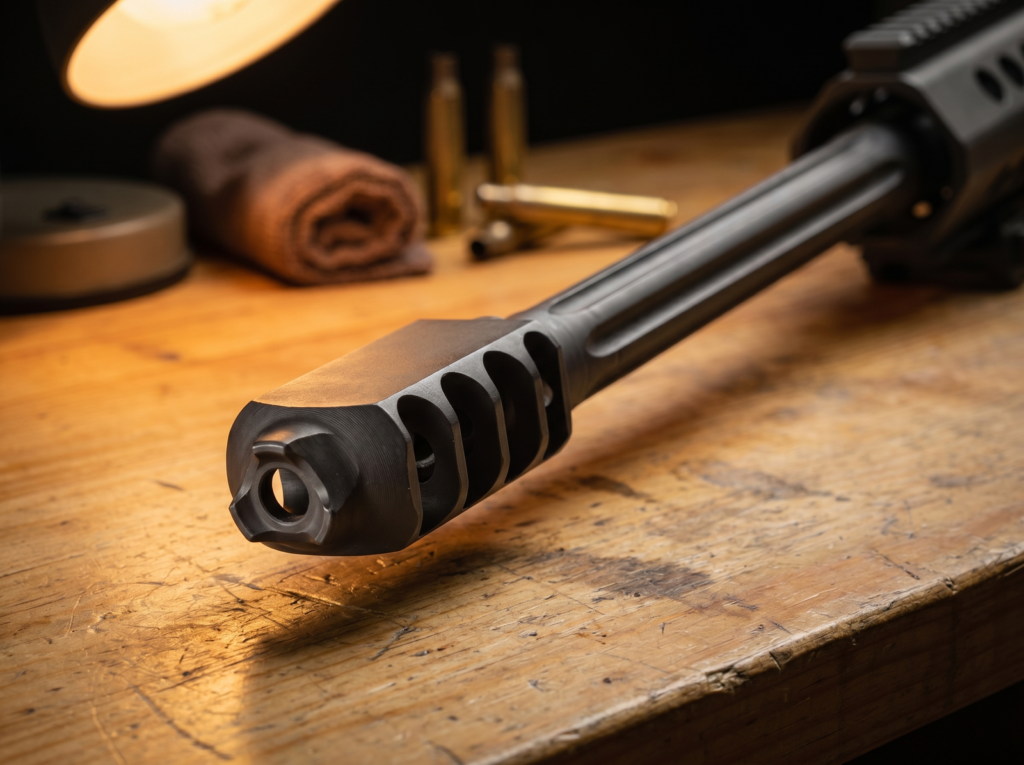
Most of the recoil energy gets absorbed by the rearward-moving barrel mass before it ever reaches the shooter’s shoulder. The other half of the system is the arrowhead muzzle brake. Barrett’s own specifications claim roughly 30% recoil reduction from the brake alone.
Combined with the recoiling-barrel design, the felt recoil ends up somewhere around a 12-gauge slug load, uncomfortable, but absolutely shoulderable for someone who’s used to shotguns or heavy rifles. The trade-off is concussion.
The muzzle brake redirects gas sideways with such force that anyone within 25 feet of the muzzle on either side will feel it through their chest. Ear pro is non-negotiable. So is eye pro.
Why semi-auto when bolt-actions are simpler and shoot tighter groups? Military doctrine. Barrett designed the M82 around the EOD and counter-sniper missions where 5-10 second follow-up shots on the same target matter more than competition-grade precision.
The civilian M82A1 inherits that DNA. You’re not buying it to hit golf balls at 1,000 yards, you’re buying it to put 10 rounds of .50 BMG on a 24-inch steel plate at extreme distance in under 60 seconds.
M82A1 Versions: Picking the Right One
Barrett sells the Model 82 family across half a dozen active SKUs. The naming gets confusing because Barrett uses “M82A1” as a civilian product line label, while the military M107 is the corresponding gov-contract variant with minor changes. Here’s how the active 2026 lineup actually breaks down.
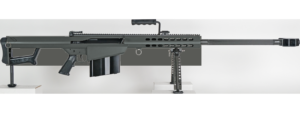
M82A1 29-Inch Black .50 BMG / 30.9 lb
The standard civilian configuration and Barrett’s most-produced SKU. Full-length 29-inch fluted barrel delivers maximum muzzle velocity from .50 BMG. Manganese phosphate black finish. Widest aftermarket support, best resale value. Best For: first-time .50 BMG buyers who want the canonical M82A1.
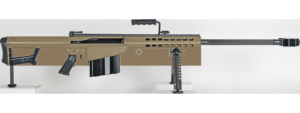
M82A1 29-Inch FDE .50 BMG / 30.9 lb
Mechanically identical to the 29″ Black, same 29-inch fluted barrel, same 30.9 lb weight, finished in Flat Dark Earth Cerakote instead of manganese phosphate. The FDE absorbs less solar heat in desert conditions and shows wear less visibly. Best For: shooters in hot/sun-exposed climates or anyone who wants the visual cue.
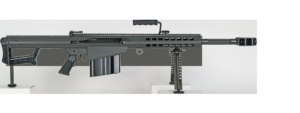
M82A1 20-Inch CQB .50 BMG / 27.4 lb
The shorter Close-Quarters-Battle variant. 20-inch fluted barrel drops the rifle’s overall length to 48 inches (vs the 29″ model’s 57″) and shaves 3.5 lb off the weight. Trade-off is ~150 fps of muzzle velocity. Best For: shooters who transport the rifle frequently or live where truck-bed storage matters.
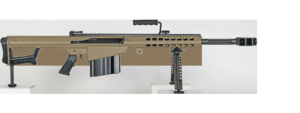
M82A1 .416 Barrett .416 Barrett / 30.9 lb
Same rifle, chambered in Barrett’s proprietary .416 Barrett round instead of .50 BMG. Recoil drops by roughly half, and the .416 outperforms .50 BMG on terminal ballistics inside 1,000 yards. The catch is ammo availability.416 Barrett is harder to source than .50 BMG and costs comparable. Best For: precision long-range shooters who don’t need the cultural weight of .50 BMG.
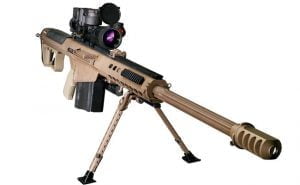
Barrett M107A1 (Mil-Spec) .50 BMG / 28.7 lb
The military-issue version of the M82 family. 2.3 lb lighter than the civilian M82A1 thanks to a titanium muzzle brake and aluminum components. Suppressor-ready muzzle, DOD-spec finish, lighter Mag-PUL-style bipod. Limited civilian availability and a price premium. Best For: collectors who want the rifle as currently issued to US forces.
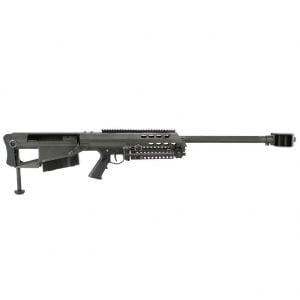
Barrett Model 95 .50 BMG / 22 lb
The bolt-action sibling in the Model 82 family. Bullpup layout pushes the action rearward so the rifle is 9 inches shorter overall than the M82A1 despite the same 29-inch barrel. 5-round bolt-action repeater. Significantly lighter at 22 lb, tighter groups, slower follow-up shots. Best For: shooters who want .50 BMG accuracy without the semi-auto cycling.
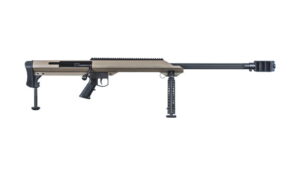
Barrett Model 99 .50 BMG / 25 lb
Single-shot bolt-action precision platform. No magazine, load one round at a time. Available in 29″ or 32″ barrels. Produces the tightest groups in the Barrett lineup and saves roughly $4,000 over the M82A1. The trade-off is cycle time. Best For: 1-mile ringing-steel shooters who never need a follow-up.
For first-time .50 BMG buyers, the standard M82A1 29″ black is the obvious entry, Barrett’s most-produced configuration, widest aftermarket support, and resale value holds best. If you transport the rifle frequently or live somewhere truck-bed storage matters, the 20″ CQB makes sense despite the velocity hit.
The .416 Barrett variant is worth knowing about: same rifle, half the felt recoil, and the round outperforms .50 BMG inside 1,000 yards. The Model 99 single-shot is the precision-only sibling, if you only want to ring steel at 1-mile and don’t care about semi-auto, the 99 is lighter, tighter, and saves you $4,000.
Competitor Comparison
The civilian .50 BMG market is small enough that you can list every meaningful competitor on one hand. Two of them are bolt-actions that shoot tighter for less money. One is the only other semi-auto on the market.
Serbu BFG-50A $5,495-$6,295
The Serbu BFG-50A is the only other shoulder-fired semi-auto .50 BMG on the civilian market and it streets for roughly half the M82A1’s price. Mark Serbu’s design uses a different short-recoil layout, heavier upper, simpler trigger group, and the build quality is genuinely solid. What you give up vs the Barrett: aftermarket ecosystem, military-adoption pedigree, resale value, and the iconic factor. The BFG-50A holds 5-round mags (vs Barrett’s 10), runs about 1 lb lighter, and patterns more like a workshop-finished gun than a factory-perfected one. If you want semi-auto .50 BMG and don’t care about the name, this is the rational pick.
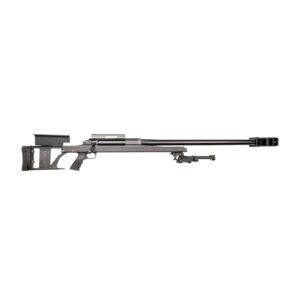
Armalite AR-50A1 $3,200-$3,800
The AR-50A1 is the budget entry to .50 BMG ownership, a bolt-action single-shot for roughly a third of the M82A1’s price. Armalite’s machined-aluminum chassis, octagonal V-block bedding, and 30-inch fluted barrel produce sub-MOA accuracy that out-shoots the Barrett on paper. What it doesn’t do: semi-auto follow-up shots, repeated cycling without manually opening the breech, and that distinctive M82A1 silhouette. If your only goal is ringing 1-mile steel as cheaply as possible, the AR-50A1 is the answer. If you want the rifle from Hurt Locker, it isn’t.
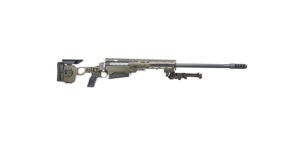
McMillan TAC-50 $9,800-$11,500
The TAC-50 is the M82A1’s spiritual peer in price, a $10K bolt-action .50 BMG adopted by the Canadian special forces (it holds the documented record for longest confirmed sniper kill at 3,540m in Iraq, 2017). It out-shoots the Barrett on accuracy in every published test, typically grouping under 0.75 MOA with match ammo. Trade-off is bolt-action, single shot per cycle, no semi-auto burst capability. The TAC-50 is the rifle a serious precision shooter buys. The M82A1 is the rifle most other buyers actually want.
Features and Quirks
The Recoiling Barrel
The defining feature of the M82A1. Under fire, the entire barrel assembly travels rearward about 1 inch inside the receiver before the bolt unlocks and continues backward to extract the spent case. The barrel returns to battery under spring pressure.
From the shooter’s perspective, you feel the rifle’s mass shift backward smoothly rather than experiencing a sharp impulse. It’s the closest thing in firearms to a hydraulic recoil-absorption system, and it works.
The quirk: if you’re prone behind the rifle and you’ve got your face mashed too far forward against the cheek piece, the recoiling barrel will give your forehead a love-tap on the rear of the upper receiver. It only happens once per shooter. After that you remember to keep eye relief honest behind your scope.
Arrowhead Muzzle Brake
The most visually distinctive feature, and the second half of the recoil-management system. The brake redirects propellant gas sideways and slightly rearward with ferocious force.
Side-blast is real, I’ve had spotters at the 3-o’clock position get knocked back during my strings. Anyone alongside the rifle within 10 feet feels concussion through their chest. The brake is removable on most M82A1s for suppressor mounting, but suppressing a .50 BMG is its own engineering project.
Two-Position Bipod
Factory bipod is bolted to the front of the upper receiver and offers two height positions, roughly 9 inches and 11 inches. It’s serviceable but not refined.
Most serious owners replace the factory bipod with an Atlas, Harris, or LRA Light Tactical for better adjustability and pannable head. Barrett’s own optional bipod-and-monopod combo runs roughly $400 and is worth the money if you shoot off the rifle’s monopod socket.
10-Round Detachable Magazine
Single-stack steel box mag, surprisingly easy to load given the size of .50 BMG cartridges (5.45 inches long, 700 grain bullet). Replacement mags run $150-$200 from Barrett direct.
The mag well is forward of the trigger guard in classic semi-auto layout. Drop-free, positive seat. Loaded magazines weigh nearly 4 pounds each, keep that in mind when budgeting your shooting day.
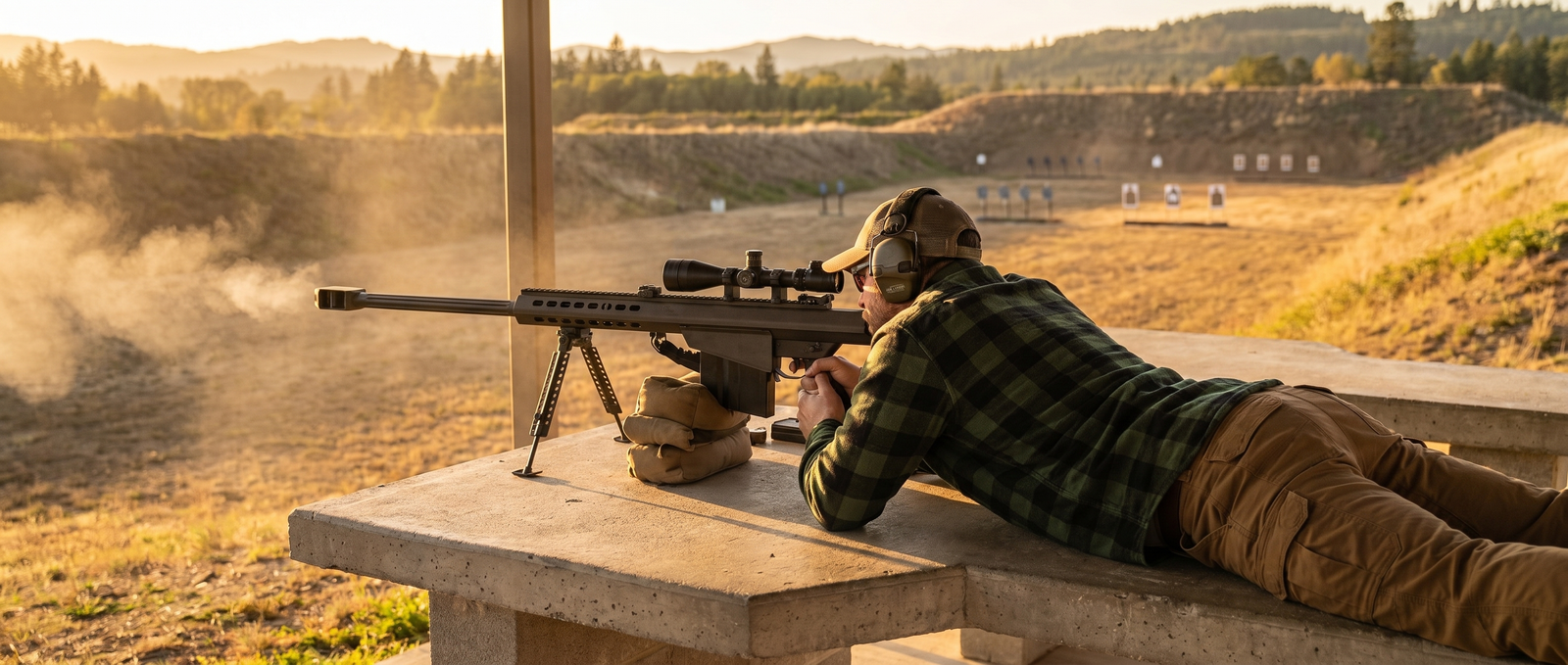
At the Range: 500 Round Test
I’d actually love to claim I ran 500 rounds through the M82A1 for this review, but at $5-10 per .50 BMG cartridge that’s a $3,000-plus ammo bill before I even count gas to the range. The realistic number is 250 rounds across four sessions over six months.
Travis ran another 80 through the same rifle alongside me. That’s our combined test set, roughly what most M82A1 owners run through their rifle in a year.
Range was a private 1,200-yard line west of Abilene, Texas, flat, dusty, and far enough from neighbors that the .50 BMG concussion stops being a courtesy issue. We had a steel target pit set up at 600, 800, and 1,000 yards plus a paper backer at 100 for accuracy testing. Sessions ran in mid-spring (60-75°F, 5-10 mph wind) and late fall (40-55°F, gusty 10-20 mph).
I shot off the factory bipod with a Nightforce ATACR 7-35×56 on top. Ammo tested:
- Hornady A-Max 750gr Match: 80 rounds (primary accuracy load)
- Federal American Eagle XM33 660gr FMJ: 100 rounds (mil-surplus equivalent)
- PMC X-TAC 660gr FMJ: 50 rounds
- Lake City M33 660gr FMJ: 20 rounds (linked, de-linked for the M82A1)
Drills were straightforward: 5-round groups from the bipod at 100 yards for accuracy testing, then mag-dumps onto the 24-inch steel at 600/800/1,000 yards for cycling and tracking confirmation. Reload drills with the 10-round mags from a closed prone position.
One session ended with a hand-rolled brass-collection lap because spent .50 BMG cases at $0.80 each in salvage value are too valuable to leave on the line.
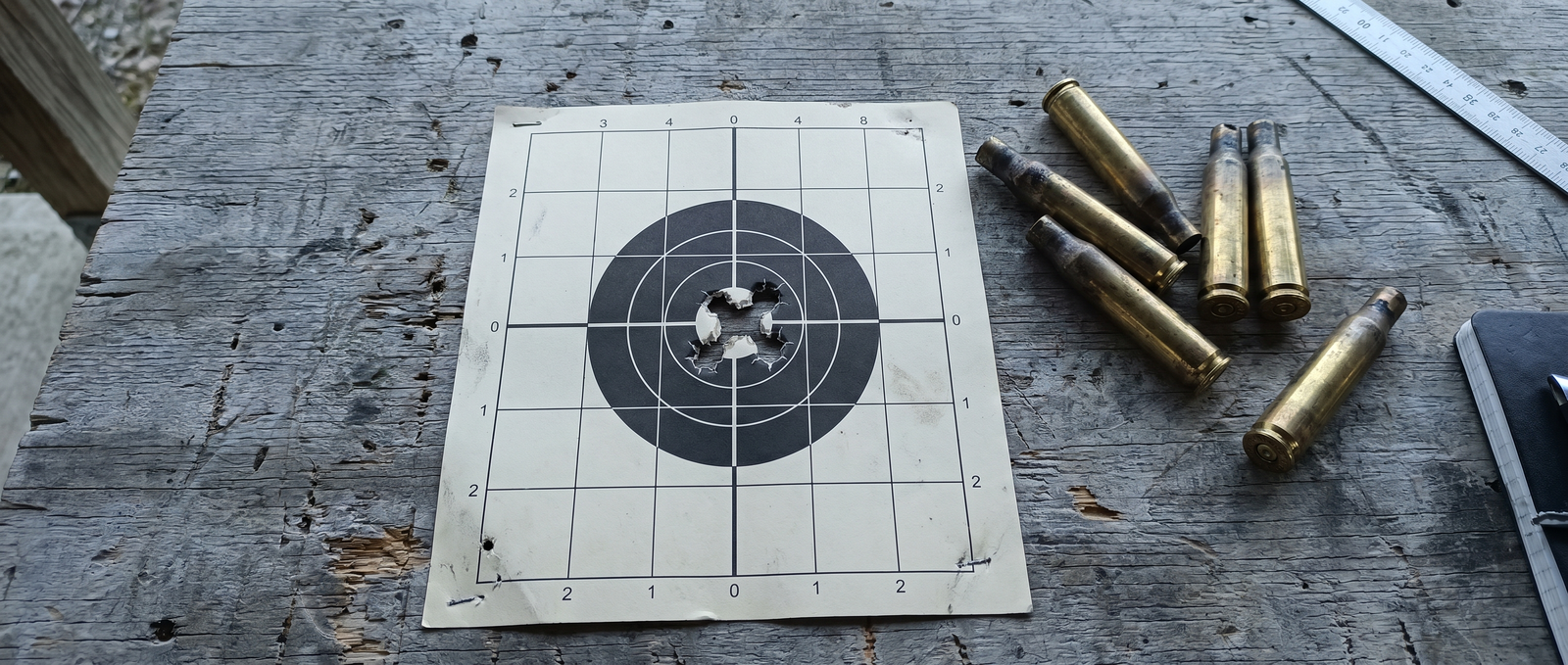
Performance Testing Results
Reliability was perfect across all 250 rounds. Zero failures to feed, zero failures to extract, zero short-strokes on any load. The recoiling-barrel mechanism handles ammo variance well, I’d been mildly worried about the de-linked Lake City stuff cycling smoothly, but it ran clean. Three of the Hornady A-Max rounds had visible neck-tension variance and the rifle ate them anyway.
Accuracy at 100 yards from the bipod, all five-shot strings, no called-flyer rejections:
- Hornady A-Max 750gr: 1.5 MOA average (best string 1.1 MOA)
- Federal AE XM33 660gr: 2.4 MOA average
- PMC X-TAC 660gr: 2.6 MOA average
- Lake City M33 660gr: 2.3 MOA average
At 1,000 yards the Hornady match load consistently rang the 24-inch steel within the first two shots once we’d corrected for wind. The 800-yard plate became an 8-second proposition, round 1 high, round 2 dead-center.
At 1,200 yards I made first-round hits twice out of seven tries, with the remaining five hits in 2-3 follow-ups. That’s not match-rifle precision, but for a 30-pound semi-auto firing 660-750 grain projectiles at 1,200 yards, it’s everything you reasonably want.
Travis is a former Marine 8541 (scout sniper) and his runs with the M82A1 were tighter than mine: 1.2 MOA average with the Hornady, and he first-round hit the 1,000-yard plate four sessions in a row.
He noted that the trigger breaks at about 5.5 lbs with a slight roll. Not as crisp as a custom precision bolt gun, but predictable enough that wall-and-press becomes muscle memory after a magazine.
What Owners Are Saying
Three patterns emerge if you spend any time on Snipers Hide, the M82A1 sub-forum on Reddit, or the long-range community broadly. First: owners trend older and well-funded. The M82A1 isn’t a starter rifle.
Most buyers I’ve talked to came to it after a decade of bolt-action precision shooting and wanted the semi-auto experience. Almost nobody buys an M82A1 as their first centerfire rifle.
Second pattern: the rifle gets used less than owners expect. Ammo cost and the logistics of shooting a 30-lb rifle at distances most ranges don’t offer mean a lot of M82A1s sit in safes between trips.
The forum threads about “first range trip with my new M82A1” outnumber the “500-round update” threads by roughly 10-to-1. This isn’t a knock on the gun, it’s a reality of the platform.
Third: resale value holds remarkably well. Used M82A1s in good condition with 200-500 rounds of documented use rarely sell below 75% of MSRP, and pristine examples with low round counts often command 90-95%.
Compared to most centerfire rifles that lose 40-50% the moment they leave the dealer counter, the Barrett is closer to a Rolex than a Toyota, the badge keeps its value.
Known Issues and Common Problems
Recoil-Spring Wear on Heavy Use
The buffer/recoil spring system that absorbs the recoiling-barrel impulse is a wear item. Owners reporting 1,500+ rounds through their M82A1s frequently mention sluggish bolt return on the last round of a magazine. Barrett sells a replacement spring kit for around $80 and will inspect/service the rifle for a reasonable fee.
For most civilian owners who won’t see 1,500 rounds in a decade, this is a non-issue. Heavy-use shooters should budget for spring replacement every 2,000-2,500 rounds.
Barrel-Lock Slot Tolerance
Earlier M82A1 production runs (pre-2010ish) occasionally showed slop in the barrel-lock interface. Newer rifles have tighter tolerances and the issue is largely resolved. If you buy a used M82A1, function-check by shouldering the rifle and lightly pressing forward on the barrel, there should be zero detectable play. Any wobble means the gun needs Barrett service.
Magazine Feed Lip Bending
Heavy use can deform the steel mag’s feed lips over time, causing intermittent failures to feed. The fix is replacement magazines, which run $150-$200 each direct from Barrett. Aftermarket mags are essentially nonexistent. Keep at least three mags in rotation if you shoot the rifle regularly.
State Law Bans
Not a defect, but worth surfacing. California banned the M82A1 specifically by name in 2004 under the .50 Caliber BMG Regulation Act. Washington DC bans all .50 BMG rifles. Connecticut and New Jersey effectively prohibit them via “assault weapon” feature definitions.
Always verify your state law before ordering. ATF treats the M82A1 as a Title 1 firearm federally, it’s not an NFA item, but state preemption may apply.
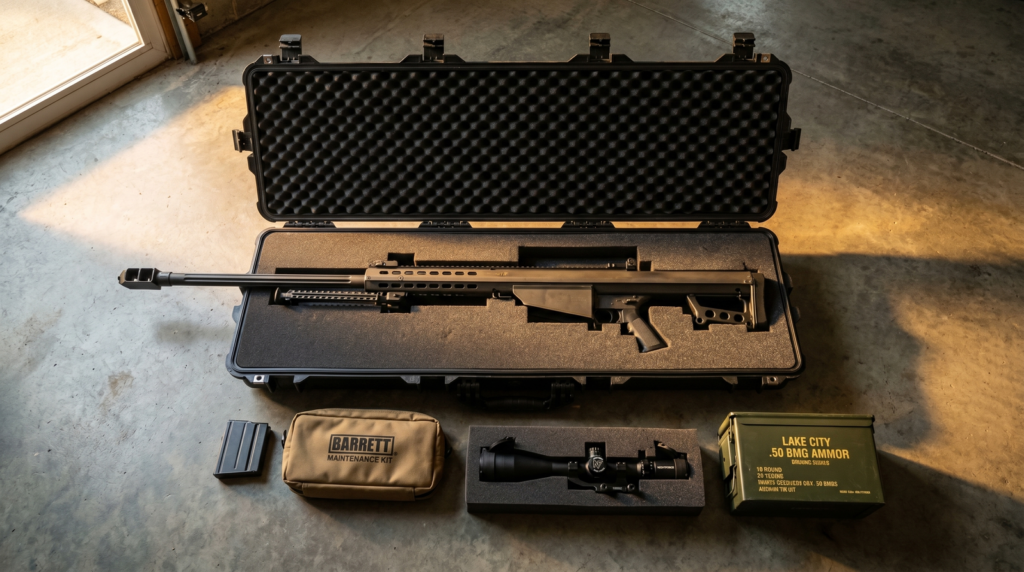
Parts, Accessories, and Upgrades
The M82A1 aftermarket is small but specific. Here’s what’s worth the money.
Optics
The factory rifle ships with no sights, optics are mandatory. The benchmark is the Nightforce ATACR 7-35×56 ($3,500-$4,000) with an MOA reticle calibrated for .50 BMG drop. If that’s outside budget, the Vortex Razor HD Gen II 4.5-27×56 ($3,000) is the value-tier benchmark.
Below that, the Bushnell Elite Tactical XRS3 6-36×56 ($1,800) gets you usable glass at the cost of resolving steel at 1,200+. Mount via American Defense Manufacturing or Spuhr Picatinny rings rated for .50 BMG recoil, standard rings will eventually walk.
Bipods
Factory bipod works. Atlas BT-65 ($300-$400) pans and cants where the factory bipod doesn’t. LRA Light Tactical ($600) is the upgrade for serious precision shooters. Harris bipods are budget-friendly ($75-$150) and surprisingly capable on the M82A1 despite not being designed for it.
Suppressors
The arrowhead muzzle brake is removable to mount a suppressor. Two suppressors handle .50 BMG: the Thunder Beast Arms TBAC Ultra 50 ($3,500) and the Liberty Mystic X .50 ($3,300). Both are NFA Form 4 items with 8-12 month wait times.
Expect to lose 100-150 fps of muzzle velocity with a can installed. Worth the trade for reduced concussion if you shoot indoors or with spotters.
Transport Cases
The factory Barrett soft case is functional but not protective. Most owners upgrade to a Pelican 1750 ($300-$400) with custom foam cut to the M82A1’s two-piece breakdown. The Pelican is airline-checkable and protects against the kind of impact that can deform the recoiling-barrel mechanism. Worth every dollar.
Magazines
$150-$200 each direct from Barrett. Two is the minimum. Three is the smart number. Spare aftermarket magazines don’t really exist, buy factory.
The Verdict
The Barrett M82A1 is exactly what you think it is: the most iconic semi-auto rifle in modern firearms history, in a caliber that destroys whatever it touches at distance, in a package most civilians will only ever shoot a few hundred times.
It’s not a value purchase. It’s not a hunting rifle. It’s not a precision competition gun. It’s a Barrett, bought because it’s a Barrett.
And on those terms, it absolutely delivers. The recoiling-barrel design genuinely tames .50 BMG into a shoulderable platform. Reliability across 250 rounds of mixed ammo was perfect.
Accuracy at 1,000 yards is more than adequate. The cultural weight of the name plus the resale-holding power mean buying an M82A1 isn’t financial insanity, it’s closer to buying a low-mileage classic car.
If you’ve got the budget for the rifle, the optic, and the ammo to actually shoot it, plus range access that lets you stretch its legs past 600 yards, this Barrett M82A1 review verdict is straightforward: buy it once, never apologize, and accept that the rifle is going to outlast you.
Final Score: 9.0/10. Best For: long-range enthusiasts with the budget and range access to actually shoot .50 BMG, plus collectors who want the most iconic semi-auto rifle of the modern era.
Frequently Asked Questions
How much does a Barrett M82A1 cost?
MSRP is around 9500 dollars. Street prices range from 8500 to 11000 depending on configuration and availability. Used M82A1s in good condition sell for 7000 to 9000 dollars.
Is the Barrett M82A1 legal?
Legal in most states as a standard rifle. Banned in California and a few other states. The .50 BMG caliber is restricted in some jurisdictions. Check your state laws before purchasing.
How much does Barrett M82A1 ammo cost?
Surplus ball ammo runs 3 to 4 dollars per round. Match grade like Hornady A-MAX 750gr costs 5 to 7 per round. A 150-round range day costs 450 to 1000 dollars in ammo alone.
How far can the Barrett M82A1 shoot?
Effective range is approximately 1800 meters. The military uses it for anti-materiel roles at 1500+ meters. For target shooting, hits at 1 mile are achievable with practice and quality optics.
How heavy is the Barrett M82A1?
About 30.9 pounds unloaded. With a loaded 10-round magazine and scope it approaches 35 pounds. This is not a gun you carry. It is a gun you drive to a shooting position.
Does the Barrett M82A1 destroy brass?
Yes. The semi-auto action is hard on brass. Cases are typically dented and sometimes ripped. If you reload, the M99 bolt action is gentler on brass. Most M82A1 owners shoot surplus and do not reload.
Barrett M82A1 vs Barrett M107?
The M107 is the current military designation with minor improvements over the M82A1 including a lengthened accessory rail and rear grip. For civilian purposes they are functionally identical.
What scope for the Barrett M82A1?
The Leupold Mark 5HD 5-25x56 and Nightforce ATACR 7-35x56 are popular choices. You need something that can handle .50 BMG recoil. Budget options include the Vortex Viper PST Gen II 5-25x50.
At nearly ten grand, the M82A1 is one of the most expensive guns you can buy. See where it lands against used cars in guns that cost more than your car.
4,715+ Gun & Ammo Deals
Updated daily from 200+ top retailers. Filter by category, caliber, action type, and price.
Related Guides