

Last updated September 2026 · By Nick Hall, USPSA Carry Optics competitor
The CZ Shadow 2 OR and the Walther Q5 Match Steel Frame are the two best Carry Optics pistols for 2026, the most-used guns in USPSA CO division thanks to their heavy steel frames and low recoil. The Canik SFx Rival-S is the best value under 1,000 dollars, the Sig P320 X-Five Legion is the best striker option, and a Glock 34 is the proven budget benchmark. Carry Optics is now the most popular division in practical shooting, and the right gun comes down to weight, the optic cut, and a 140mm magazine. This guide ranks ten with full specs, pros and cons, live prices, and the CO rules that decide what is legal.
Carry Optics, or CO, has exploded into the most popular division in USPSA and one of the biggest in IDPA, because it pairs a red dot, which most shooters find faster and easier to aim, with a gun close to what people actually carry. The division has its own rules and its own ideal gun, which is why it deserves a dedicated guide rather than a single line in a general pistol roundup. If you want the full cross-division picture, see my best competition pistols roundup, and to understand the division itself, read what USPSA is. This list is purely about going fast in Carry Optics.
Table of Contents
How we tested: Every pick here is ranked against our testing methodology. Minimum round counts, accuracy and reliability protocols, the failures that disqualify a gun.
Best Carry Optics Pistols 2026: Quick Comparison
| Pistol | Best for | Action | Weight | Capacity | From |
|---|---|---|---|---|---|
| CZ Shadow 2 OR | Best overall | DA/SA hammer | 46.5 oz | 17+1 | $1,229 |
| Walther Q5 Match SF | Best striker overall | Striker | 42 oz | 15+1 | $1,099 |
| Sig P320 X-Five Legion | Best modular striker | Striker | 43.5 oz | 17+1 | $1,099 |
| Canik SFx Rival-S | Best value | Striker | 41.8 oz | 18+1 | $899 |
| Walther PDP Pro | Best trigger value | Striker | 27 oz | 18+1 | $739 |
| Glock 34 MOS | Best budget benchmark | Striker | 25 oz | 17+1 | $649 |
| Shadow Systems DR920 | Best Glock upgrade | Striker | 26 oz | 17+1 | $799 |
| Springfield Echelon | Best new striker | Striker | 23 oz | 17+1 | $599 |
| Beretta 92X Performance | Best hammer alternative | DA/SA hammer | 44.7 oz | 15+1 | $999 |
| Staccato P | Best premium 2011 | 2011 single action | 33 oz | 17+1 | $2,599 |
Prices move with the market. Notice the weight column: the most-winning Carry Optics guns are heavy steel-frame pistols, because mass tames recoil and keeps the dot flat. Lighter polymer guns are more affordable and conceal better, but you work harder to control them on the clock. I cover that trade-off, the CO rules, and optic pairing in depth after the picks.
1. CZ Shadow 2 OR: Best Carry Optics Pistol Overall
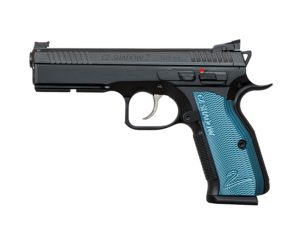
The CZ Shadow 2 OR is the most-used gun in Carry Optics under 2,000 dollars, and it earns that spot with physics. Its 46.5-ounce steel frame and the lowest bore axis of any production pistol mean recoil is almost lazy, so the dot barely lifts between shots, and the famously smooth DA/SA trigger breaks at roughly 3.5 pounds in single action. The OR, or Optics Ready, model adds the slide cut the standard Shadow 2 lacks, so you can mount a red dot directly.
On a stage, that low bore axis and heavy frame let you run splits that lighter guns struggle to match, which is exactly why you see racks of Shadow 2s at any serious CO match. The trade-offs are honest: it is heavy, which is a feature on the clock and a burden on a belt, and the double-action first shot takes practice to master. A Cajun Gun Works kit makes the trigger even better. See the platform at CZ-USA, and the hammer-fired family in my best 9mm DA/SA pistols picks.
Pros
- Lowest bore axis of any production pistol
- Heavy steel frame tames recoil
- Superb DA/SA trigger
- Most-used gun in CO division
Cons
- Heavy to carry off the clock
- DA first shot needs practice
- Premium price for the OR model
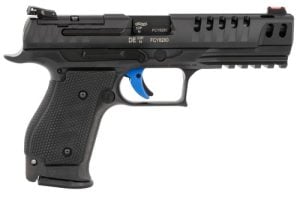
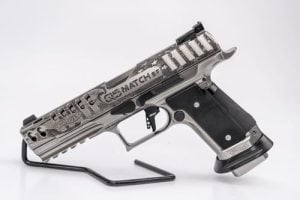
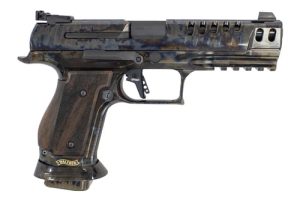
2. Walther Q5 Match Steel Frame: Best Striker Carry Optics Pistol
The Walther Q5 Match Steel Frame is the other gun splitting the Carry Optics podium, and it brings Walther’s best-in-class trigger to a 42-ounce steel-frame striker pistol. The striker trigger breaks around 5.6 pounds with a short, fast, tactile reset that many shooters rate the best factory striker trigger made, and the grip ergonomics are superb. With a 5-inch barrel and an optic-ready slide, it’s a CO natural.
For a shooter who wants steel-frame recoil control without learning a double-action first shot, the Q5 Match SF is the answer, and it competes head to head with the Shadow 2. The aftermarket is smaller than CZ’s or Glock’s, so parts take a little more hunting, but the gun needs almost nothing to compete. See it at Walther.
Pros
- Best-in-class striker trigger
- Heavy steel frame, flat recoil
- Excellent grip ergonomics
- Striker simplicity, no DA pull
Cons
- Smaller aftermarket than CZ or Glock
- Heavy for daily carry
- Pricey for a striker gun
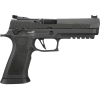
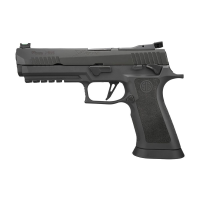
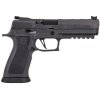
3. Sig P320 X-Five Legion: Best Modular Carry Optics Pistol
The Sig P320 X-Five Legion is what happens when Sig builds a striker gun purely for the timer. The tungsten-infused TXG grip module pushes weight to 43.5 ounces and makes it dead flat in recoil, the 5-inch bull barrel aids accuracy, and the Legion-tuned trigger breaks around 4.5 pounds. The optic-ready slide makes it a CO natural, and capacity runs 17+1 standard or 21+1 with extended magazines.
What sets the P320 apart is its modular fire-control unit, the serialized part that lets you move between grip modules and slides, so one gun can resize and adapt. It is heavy, which some shooters love and others find tiring, and the trigger is very good without quite reaching 2011 territory. For the dots that make it sing, see my best competition red dots picks.
Pros
- Tungsten grip, very flat recoil
- Modular fire-control system
- Optic-ready, high capacity
- Clean Legion trigger
Cons
- Heavy at 43.5 ounces
- Trigger short of a 2011
- Premium price

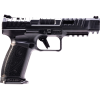
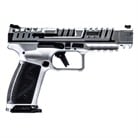
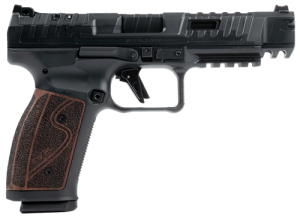
4. Canik SFx Rival-S: Best Value Carry Optics Pistol
Nothing has lowered the cost of entry into Carry Optics like the Canik SFx Rival-S, the best competition pistol under 1,000 dollars in 2026. For around 900 dollars you get a 41.8-ounce steel frame, a 5-inch match barrel, a flat-face aluminum trigger with a short positive reset, a flared magwell, and a multi-footprint optic plate system, all in the box. That steel-frame weight at two-thirds the price of comparable guns is the headline.
A new shooter can show up to a CO match with a Rival-S and not feel out-gunned by guns costing three times as much, and the included optic plates fit most popular dots without buying an adapter. The aftermarket and resale don’t run as deep as a Glock or CZ, and the finish shows holster wear faster, but as a value entry into the division it is unbeatable.
Pros
- Steel frame under 1,000 dollars
- Match barrel and flat trigger
- Multi-footprint optic plates included
- Flared magwell stock
Cons
- Smaller aftermarket and resale
- Finish wears faster
- Less prestige than CZ or Sig

5. Walther PDP Pro: Best Trigger Value in Carry Optics
If you want the Walther trigger without the steel-frame price, the polymer Walther PDP Pro delivers most of it for around 740 dollars. It pairs Walther’s superb Performance Duty Trigger with a longer slide, an optic cut, and an aggressive grip texture built for speed. At 27 ounces it’s far lighter than the steel guns, which means more recoil to manage but a gun you could also carry.
For a Carry Optics shooter on a budget who prioritizes a great trigger over steel-frame weight, the PDP Pro is a smart buy that competes well in the polymer class. The lighter weight is the trade-off, since you give up some of the dot-flatness the heavy guns deliver, but that excellent trigger flatters a newer shooter’s splits.
Pros
- Superb Walther trigger
- Optic-ready, long slide
- Light enough to also carry
- Great value near 740 dollars
Cons
- Polymer, more recoil than steel guns
- Smaller aftermarket
- Gives up steel-frame flatness
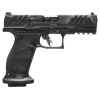
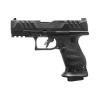
6. Glock 34 MOS: The Carry Optics Budget Benchmark
The Glock 34 is the oldest design in this group and still one of the most popular Carry Optics guns, for good reason. The MOS, or Modular Optic System, version adds the optic cut, and at around 650 dollars you get the deepest aftermarket of any pistol, legendary reliability, and a long 5.3-inch sight radius. Nearly every holster, magazine, sight, and trigger part you could want already exists for it.
A used or new Glock 34 MOS is one of the smartest first Carry Optics buys precisely because you can upgrade it endlessly: a better trigger, a magwell, a tungsten guide rod for weight, all off the shelf. It’s light at 25 ounces, so it recoils more than the steel guns and demands more from your grip, but as a budget benchmark that grows with you, nothing matches its ecosystem.
Pros
- Deepest aftermarket of any pistol
- Legendary Glock reliability
- Long sight radius
- Endlessly upgradable
Cons
- Light, more felt recoil
- Stock trigger is mediocre
- Needs upgrades to optimize
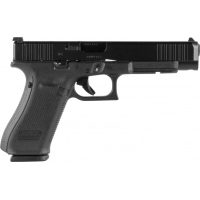
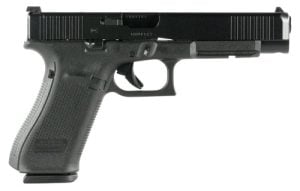
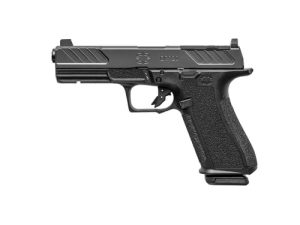
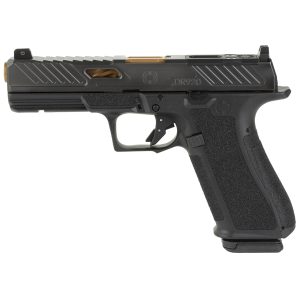
7. Shadow Systems DR920: Best Glock-Pattern Upgrade
The Shadow Systems DR920 is what you get when a company takes the Glock 34 formula and refines every detail. It runs on Glock-pattern geometry, so it uses Glock magazines and much of the aftermarket, but it adds a better barrel, an improved trigger, an optic cut with a multi-plate system, and a far nicer grip texture straight from the factory. At around 800 dollars it is a turnkey upgrade over a stock Glock. If you want the same idea in a Glock 19-size carry gun, our Shadow Systems MR920 review covers its compact sibling.
For a shooter who likes the Glock platform but wants the upgrades already done, the DR920 is a compelling middle ground between a bare Glock 34 and a steel-frame race gun. It is still a light polymer gun, so it doesn’t match the steel guns for recoil control, but it shoots noticeably better than a stock Glock out of the box and keeps the Glock-mag convenience.
Pros
- Refined Glock-pattern build
- Better barrel and trigger stock
- Glock-magazine compatible
- Multi-plate optic cut
Cons
- Polymer, lighter than steel guns
- Pricier than a base Glock
- Still benefits from a trigger tune
8. Springfield Echelon: Best New Striker for Carry Optics
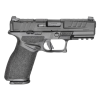
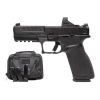
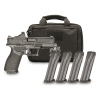
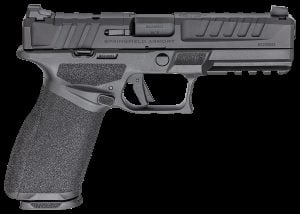
The Springfield Echelon is the newest serious entry, a modern striker pistol with a clever Variable Interface System that lets a wide range of red dots mount directly to the slide without an adapter plate, which solves the single most annoying part of setting up a CO gun. At around 600 dollars with a 17+1 capacity and a good factory trigger, it’s a lot of modern pistol for the money.
The direct-mount optic system is genuinely useful and the gun shoots well, making it a strong value pick for a shooter who wants a fresh platform rather than a Glock or CZ. As a newer design the competition aftermarket is still growing, and at 23 ounces it is a light gun that recoils more than the steel options, but the direct optic mounting and price make it a standout newcomer.
Pros
- Direct-mount optic, no plate needed
- Modern ergonomics, good trigger
- Strong value near 600 dollars
- 17+1 capacity
Cons
- Newer, smaller aftermarket
- Light polymer, more recoil
- Less proven in competition
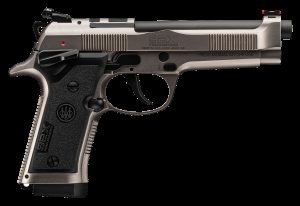
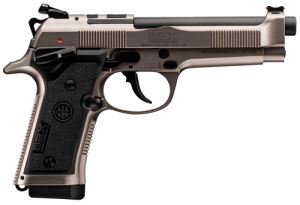
9. Beretta 92X Performance: Best Hammer-Fired Alternative
For a shooter who loves a hammer gun but wants an alternative to the CZ, the Beretta 92X Performance is a superb option. Beretta built it specifically for competition, taking the legendary 92 and adding a heavy Vertec-style steel frame, a competition trigger that breaks around 4 pounds in single action, an adjustable rear sight, and a lightened slide. At 44.7 ounces it’s soft-shooting and supremely reliable.
While it is primarily a Production-division gun, optic-mounting solutions make it viable in Carry Optics for a dedicated Beretta shooter, and the rotating-barrel-free 92 design with that heavy frame stays remarkably flat. The DA first pull has a learning curve, the gun is heavy, and capacity trails the 2011 crowd, but nothing else feels quite like a tuned 92. See more in my best full-size 9mm pistols roundup.
Pros
- Heavy steel frame, flat recoil
- Competition-tuned 92 trigger
- Supremely reliable
- Adjustable sights
Cons
- Optic mounting less native
- DA first shot learning curve
- Lower capacity than rivals
10. Staccato P: Best Premium 2011 for Carry Optics
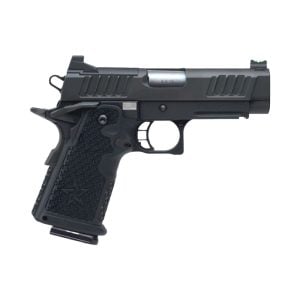
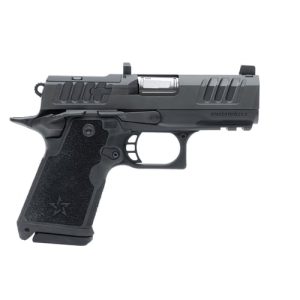
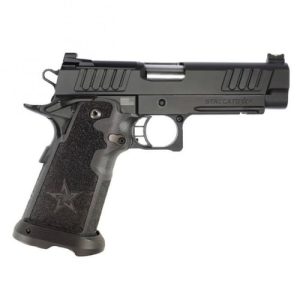
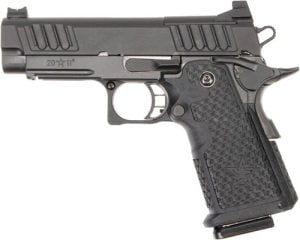
If budget is no object and you want the best, the Staccato P is the 2011 that took over the top of Carry Optics. It pairs a steel-and-aluminum 2011 frame with a 17-round magazine, a glass-rod trigger breaking at 4 to 4.5 pounds, and recoil so flat at 33 ounces that you can call your shots in a Bill Drill, all while being reliable in a way the old race-only 2011s never were.
At around 2,600 dollars before a dot and magazines it’s a serious investment, and a committed competitor wants a backup, so it is overkill for a casual shooter. But it’s the gun that carries you from C-class to Grand Master, and many top CO shooters consider it the ceiling of the division. Read the full Staccato 2011 review for the deep dive.
Pros
- Best trigger and recoil control here
- 2011 capacity and feel
- Reliable unlike old race 2011s
- Carries you to the top
Cons
- Very expensive near 2,600 dollars
- Overkill for casual shooters
- Wants a backup gun too
Our retailers are not currently listing the Staccato P itself. The Staccato 2011s they do stock are below.
Best Carry Optics Pistol by Use Case
Sorted by what you actually need, here’s how these guns stack up.
- Best overall: CZ Shadow 2 OR or Walther Q5 Match Steel Frame.
- Best value: Canik SFx Rival-S.
- Best budget: Glock 34 MOS or Springfield Echelon.
- Best striker: Walther Q5 Match SF or Sig P320 X-Five Legion.
- Best for a Glock shooter: Shadow Systems DR920.
- Best premium: Staccato P.
- Best that also carries: Walther PDP Pro or Springfield Echelon, the lighter guns.
USPSA Carry Optics Rules: What Makes a Gun Legal
Before you buy, know what the division actually allows, because a few rules shape the ideal gun. Carry Optics has specific equipment limits that keep the playing field level, and a gun that violates them bumps you into Open against full race guns.
- A slide-mounted red dot. The optic must mount to the slide, not the frame, which is why an optic-ready or milled slide is essential. The dot is the defining feature of the division.
- A 140mm magazine limit. Magazines can be no longer than 140mm, which caps capacity and is why you see 17 to 23 round counts rather than the giant sticks of Open division.
- A maximum weight limit. The pistol with an empty magazine must weigh under a set limit, currently 45 ounces in USPSA, which is why the heaviest steel guns sit right at the edge and tungsten parts are popular.
- No compensators or barrel porting. Unlike Open, you can’t run a comp, so recoil control comes from gun weight and technique alone.
- Minor power factor. Carry Optics is scored at minor, so there’s no advantage to loading hot, and most shooters run soft 9mm.
Those rules explain the whole list: heavy steel frames right at the weight limit, no comps, a slide-mounted dot, and 9mm minor loads. Understanding them keeps you from buying a gun that is not division-legal. For the full division breakdown, see what USPSA is.
Steel Frame vs Polymer for Carry Optics
The biggest decision in Carry Optics is steel frame versus polymer, and it shapes both how the gun shoots and what it costs. A heavy steel-frame gun like the Shadow 2, Q5 Match SF, or P320 X-Five Legion soaks up recoil through sheer mass, so the dot barely lifts and tracking is faster. That is why the most-winning CO guns are heavy, and why so many shooters add tungsten guide rods and magwells to push polymer guns toward the weight limit.
A polymer gun like the Glock 34, PDP Pro, or Echelon is lighter, cheaper, and easier to also carry, but you manage more muzzle rise, which costs a little time over a stage until your grip is dialed. The honest take: if competition is your priority and the gun lives in a range bag, buy steel. If you want a gun that competes and could double as a carry piece, or if budget rules, a quality polymer gun with a good trigger will still take you far. Many shooters start polymer and graduate to steel as they get serious.
Pairing the Right Red Dot
A Carry Optics gun is only as good as the dot on top, and the optic is half the setup. For competition you want a large window so the dot is easy to find on the draw and stays visible through recoil, which is a different priority than a small carry dot. The Trijicon SRO is the CO benchmark, the Holosun 507COMP is the value choice, and the enclosed Aimpoint ACRO P-2 suits heavy outdoor schedules.
Match the optic footprint to your slide cut before you buy, since a dot that does not fit your milling is a frustrating surprise. Guns like the Canik Rival-S, Shadow Systems DR920, and Springfield Echelon include multi-plate or direct-mount systems that simplify this. My full best competition red dots roundup covers window size, footprints, and dot size in depth.
Common Carry Optics Mistakes to Avoid
- Buying a light gun and fighting the recoil. A bargain polymer gun saves money up front, but if you’re serious, the steel guns track faster. Know the trade-off before you choose.
- Mismatching the optic footprint. Confirm your slide cut matches your red dot, or buy a gun with a multi-plate system. This is the most common setup headache.
- Running too small a dot window. A carry-size micro dot makes you hunt for the dot on the draw. Use a large-window competition optic.
- Ignoring the weight limit. If you load a polymer gun with tungsten parts, confirm it stays under the 45-ounce division limit with an empty magazine.
- Skipping the trigger. On a Glock or budget gun, the stock trigger holds back your splits. A drop-in is the highest-value upgrade.
How to Choose a Carry Optics Pistol
Pull it together and the decision comes down to a few questions, in this order.
- Steel or polymer? Steel for maximum recoil control if the gun lives in a range bag; polymer if you want it to also carry or budget rules.
- Hammer or striker? A hammer gun like the Shadow 2 has the lowest bore axis and a tunable DA/SA trigger; a striker like the Q5 Match or P320 is simpler with no double-action first shot.
- What is your budget, all in? Add a red dot, often 250 to 550 dollars, and four magazines to the gun price.
- Does the optic mount easily? Favor guns with a multi-plate or direct-mount system unless you already know your dot fits.
The Bottom Line
For most competitors who want the best, the CZ Shadow 2 OR or the Walther Q5 Match Steel Frame are the guns to beat, heavy steel frames that keep the dot flat. If value matters, the Canik SFx Rival-S gives you a steel frame under 1,000 dollars, and my best budget competition pistols roundup covers every value pick, and if budget rules, a Glock 34 MOS or Springfield Echelon gets you on the line and grows with you. Match a large-window dot to your slide, stay under the weight limit, and remember that the gun matters far less than the reps. New to all of this? Start with my complete guide to competition shooting.
Torn between the two top Carry Optics guns? See my Staccato 2011 vs CZ Shadow 2 head-to-head.
Related Guides
- Best Red Dot Sights for Pistols, the optic half of a Carry Optics build
- Best Holographic Sights, the holo alternative and where it makes sense
- Best Steel Challenge Guns, the other action-shooting discipline to shoot the same pistol in
Frequently Asked Questions
- Treat every gun as loaded
- Point the muzzle in a safe direction
- Keep your finger off the trigger until you’re ready to shoot
- Know your target and what’s beyond
What is the best Carry Optics pistol?
The CZ Shadow 2 OR and the Walther Q5 Match Steel Frame are the two best Carry Optics pistols for 2026, the most-used guns in USPSA CO division thanks to their heavy steel frames and low recoil. The Canik SFx Rival-S is the best value under 1,000 dollars, the Sig P320 X-Five Legion is the best modular striker, and a Glock 34 MOS is the proven budget benchmark.
What is USPSA Carry Optics division?
Carry Optics, or CO, is a USPSA division for pistols wearing a slide-mounted red dot. It limits magazines to 140mm, caps the gun's weight, bans compensators, and scores at minor power factor. It has become the most popular division in practical shooting because a red dot is easier to aim and the guns are close to what people carry. IDPA has a Carry Optics division too.
Why are Carry Optics guns so heavy?
The most-winning Carry Optics guns are heavy steel-frame pistols because mass tames recoil, keeping the red dot flat so you can shoot faster. The division allows guns up to a weight limit, currently 45 ounces in USPSA, so top shooters run guns right at that edge and add tungsten parts to polymer guns. Without a compensator allowed, weight is the main way to control recoil.
What is the best budget Carry Optics pistol?
The Canik SFx Rival-S at around 900 dollars is the best value Carry Optics pistol, giving you a steel frame, match barrel, and multi-plate optic system for two-thirds the price of comparable guns. For less, a Glock 34 MOS around 650 dollars is the proven budget benchmark with the deepest aftermarket, and the Springfield Echelon offers direct optic mounting for around 600 dollars.
Should a Carry Optics pistol be steel frame or polymer?
A heavy steel-frame gun like the CZ Shadow 2 OR or Walther Q5 Match SF controls recoil better and tracks the dot faster, which is why the top guns are steel. A polymer gun like the Glock 34 or Walther PDP is lighter, cheaper, and easier to also carry, but you manage more recoil. Buy steel if competition is your priority, polymer if budget or carry matters.
What red dot is best for Carry Optics?
A large-window optic is best for Carry Optics so the dot is easy to find on the draw and stays visible through recoil. The Trijicon SRO is the benchmark, the Holosun 507COMP is the value pick, and the enclosed Aimpoint ACRO P-2 suits outdoor matches. Match the optic footprint to your slide cut, or choose a gun like the Canik Rival-S with a multi-plate system.
What magazine length is legal in Carry Optics?
USPSA Carry Optics limits magazines to 140mm in length, which caps practical capacity at around 17 to 23 rounds of 9mm depending on the gun and base pad. This is shorter than the long magazines allowed in Open division. The limit's one of the defining rules of CO, so confirm your magazines and base pads measure under 140mm before a match.
Can you use the same gun for Carry Optics in USPSA and IDPA?
Often yes. Both USPSA and IDPA have Carry Optics divisions for optic-equipped pistols, and a gun like a Glock 34 MOS, CZ Shadow 2 OR, or Walther Q5 Match works in both. The rules differ in details like weight and magazine limits, and IDPA adds concealment and cover requirements, so check each sport's division rules, but most CO guns are legal in both.
Is Carry Optics good for beginners?
Yes, Carry Optics is one of the best divisions for new shooters because a red dot is easier and faster to aim than iron sights, which builds confidence quickly. A budget gun like a Glock 34 MOS or Canik SFx Rival-S gets you started affordably, and the division is the most popular, so matches are easy to find. It's a great on-ramp to practical pistol competition.
How much does a Carry Optics setup cost?
A complete Carry Optics setup runs from around 900 dollars to over 3,000. A budget build pairs a Glock 34 MOS or Canik Rival-S around 650 to 900 dollars with a red dot of 250 to 550 dollars, plus magazines and a holster. A premium steel-frame gun like a Staccato P costs 2,600 dollars before the optic. Budget for the dot and four magazines on top of the gun.
What is the difference between Carry Optics and Open division?
Carry Optics allows a slide-mounted red dot, a 140mm magazine limit, a weight cap, and no compensator, scored at minor power factor. Open division is the no-limits class with frame-mounted optics, compensators, big magazines, and major scoring. CO is closer to a real carry gun and far cheaper to run, while Open is the full race-gun arena. Most shooters compete in CO.
4,021+ Gun & Ammo Deals
Updated daily from 200+ top retailers. Filter by category, caliber, action type, and price.
Related Guides