

Affiliate disclosure: This Ruger Precision Rifle review contains affiliate links. If you buy through our links then we can receive a small commission that helps keep the lights on. You don’t pay anything more.
- Treat every gun as loaded
- Point the muzzle in a safe direction
- Keep your finger off the trigger until you’re ready to shoot
- Know your target and what’s beyond

Review: Ruger Precision Rifle 6.5 Creedmoor – The Rifle That Changed Everything
Our Rating: 8.5/10
- MSRP: $1,999
- Street Price: $1,299-$1,599 (Check our live pricing for the best current deal)
- Caliber: 6.5 Creedmoor
- Action: Bolt-action
- Barrel Length: 24″
- Overall Length: 38.25″ – 41.75″ (adjustable)
- Folded Length: 30.6″
- Twist Rate: 1:8 RH
- Weight: 10.7 lbs (unloaded)
- Capacity: 10 rounds
- Stock: Folding, adjustable LOP and comb height
- Magazine: AICS-pattern / M110/SR-25/DPMS/Magpul compatible
- Barrel: Cold hammer-forged, medium contour, threaded 5/8″-24
- Rail: 20 MOA Picatinny
- Trigger: Ruger Marksman Adjustable (2.25 – 5.0 lbs)
- Grip: AR-style, compatible with any AR grip
- Made in: USA (Prescott, Arizona)
Pros
- Sub-MOA accuracy out of the box with quality ammo
- Folding stock makes transport and storage dead simple
- AICS mag compatibility opens up a massive aftermarket
- AR-style ergonomics and controls feel immediately familiar
- Adjustable everything: LOP, comb height, trigger weight
- Threaded barrel ready for your suppressor or brake
Cons
- Fit and finish feels mass-produced compared to $2K+ customs
- 10.7 lbs before glass means you’re hauling serious weight
- Bolt has noticeable chatter and rattle in the raceway
- Handguard alignment can be slightly off from the factory
Quick Take
The Ruger Precision Rifle didn’t just enter the precision rifle market. It kicked the door down, set the house on fire, and rebuilt it at half the price. Before the RPR showed up in 2015, your options for a serious long-range bolt gun were either a $3,000+ custom build or some janky chassis conversion that rattled like a toolbox going down a gravel road. Ruger looked at that and said “nah.”
I’ve now put 500 rounds through the RPR in 6.5 Creedmoor and I can tell you this: it’s not the prettiest rifle at the range. It’s not the smoothest. But when you settle behind it at 600 yards and watch steel fall with boring consistency, none of that matters. This thing shoots.
Genius move was building a bolt gun that an AR shooter can pick up and run without thinking. Same grip angle. Same safety location. Folding stock for your truck or gun case. AICS mags so you’re not hunting for proprietary garbage. Every decision Ruger made here was practical, not pretty.
Best For: Shooters getting into precision rifle competitions, long-range enthusiasts who want sub-MOA performance without a custom rifle budget, and anyone who appreciates AR-style ergonomics on a bolt gun. If you’re eyeing your first PRS match or want to ring steel past 1,000 yards, pair this with a solid scope from our best rifle scopes guide and you’re in business.
Why Ruger Built the RPR This Way
Back in 2015, precision rifle shooting was basically a rich man’s hobby. You either dropped $3,000 to $5,000 on a custom action stuffed into a chassis, or you tried to make a hunting rifle work at PRS matches and got humbled. Ruger’s engineering team saw a gap wide enough to drive a truck through and they floored it.
RPR was built from the ground up as a precision chassis rifle. Not a hunting action bolted into an aftermarket stock. Not a repurposed military design. Ruger started with their pre-fit barrel nut system, which lets you swap barrels with nothing more than a wrench and a headspace gauge. That alone was a significant upgrade for competitive shooters burning through barrels every 2,000-3,000 rounds.
Then they went all-in on the AR platform familiarity. Same grip interface. Same safety selector location. Folding stock that collapses the gun down to 30.6 inches for transport. The multi-magazine interface accepts both AICS-pattern and AR-10 style mags. Every single one of these choices was deliberate, aimed at shooters who grew up running ARs and wanted to transition to bolt guns without relearning everything.
And here’s the thing that really shook the industry: the original MSRP was $1,399. Street price around $1,100. That forced every other manufacturer to either lower their prices or add features. The Bergara B-14 HMR exists because of this rifle. The Savage 110 Tactical got its chassis upgrade because of this rifle. Ruger didn’t just build a gun. They restructured an entire market segment.
Prices have climbed since then. The current MSRP sits at $1,999, with street prices running $1,299-$1,599 depending on the model. That’s a significant bump from the early days, and it puts the RPR in more competitive territory than it used to occupy. But the feature set has grown too, and you’re still getting a lot of rifle for the money.
Competitor Comparison
Bergara B-14 HMR (~$950)
Bergara B-14 HMR is probably the RPR’s toughest competitor right now, and it’s not even close in price. At roughly $950 street, you’re getting a rifle that many shooters actually prefer for raw accuracy. The Bergara barrel is outstanding, the trigger is crisp, and the fit and finish is noticeably better than the RPR. Where it falls short is features: no folding stock, no AR-style controls, and limited magazine compatibility compared to the RPR’s multi-mag interface.
If you’re building a range precision rifle and don’t care about the tactical features, the Bergara saves you $400+ and might actually outshoot the RPR. If you want the folding stock, AR ergonomics, and PRS-ready feature set, the RPR is worth the premium.
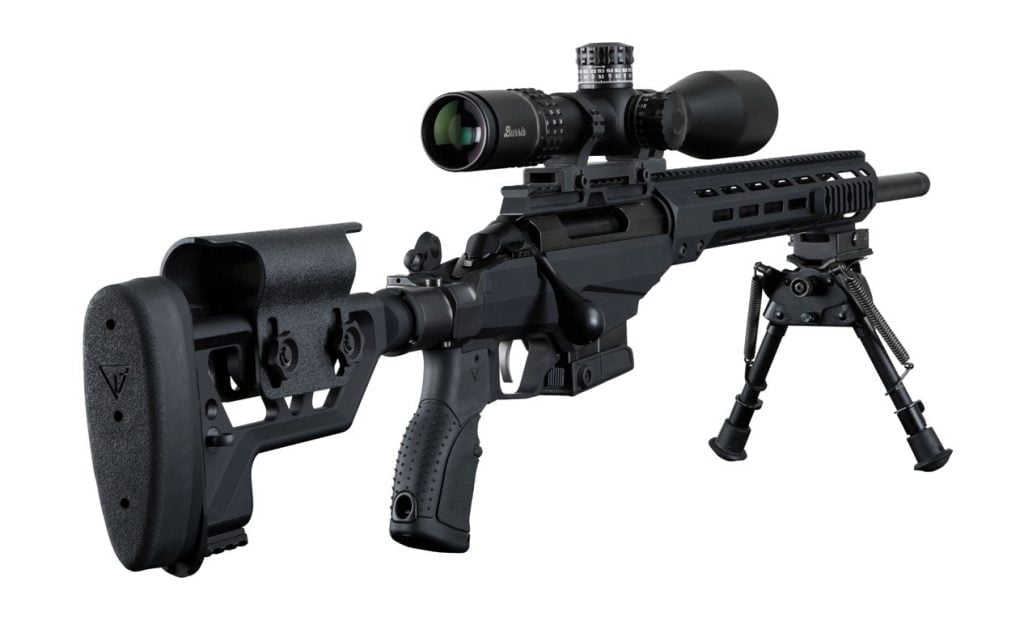
Tikka T3x TAC A1 (~$1,800)
The Tikka is the one that keeps RPR owners up at night. That bolt action is buttery smooth in a way that makes the Ruger feel like you’re cycling a ratchet wrench. The accuracy is there, the build quality is clearly a step above, and the chassis is solid. But at $1,800, you’re paying more for what amounts to a similar feature set. The Tikka doesn’t fold, and the aftermarket is smaller.
Honestly? If money isn’t tight and you value the shooting experience over pure feature count, the Tikka is the better rifle. But feature for feature, dollar for dollar, the RPR still wins on paper. It just depends on what you prioritize.

Savage 110 Tactical (~$750)
Budget king. If you just want to shoot sub-MOA at distance and you don’t care about folding stocks or AR grips, the Savage does it for about half the RPR’s price. The AccuTrigger is genuinely excellent, the AccuFit system lets you customize the stock, and the accuracy is respectable. It’s not as feature-rich and it doesn’t look as cool at the range, but your wallet will thank you. We’ve got a full Savage 110 Tactical review if you want the deep dive.
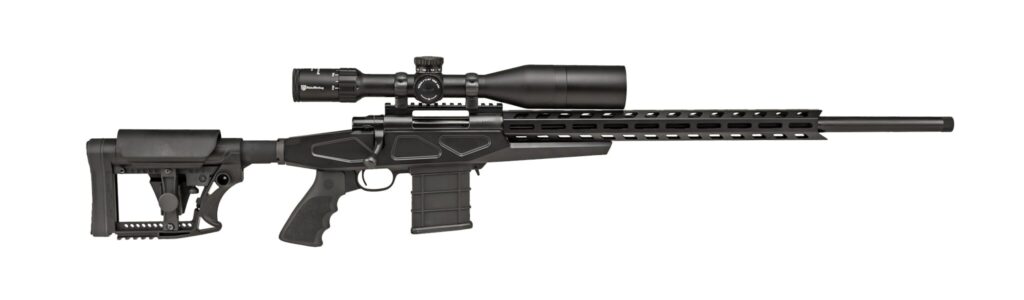
Howa 1500 Chassis (~$700)
Dark horse. Howa’s been making excellent barrels for decades and the 1500 action is smooth, reliable, and accurate. In a chassis like the Oryx or MDT, you can build a solid precision rig for $700-900. It won’t have the RPR’s multi-mag interface or folding stock, but the Howa barrel will hang with anything in this price range. It’s the builder’s choice for people who want to customize from the ground up.
Features and Technical Deep Dive
The Chassis and Stock System
RPR’s chassis is CNC-machined aluminum, and it’s the backbone of everything that makes this rifle work. The handguard is a free-floated KeyMod design with plenty of rail real estate for bipods, bags, and whatever else you want to bolt on. It runs the full length of the barrel shroud and gives you a rigid platform for accessories.
The stock folds to the left side and locks up tight. No wobble, no play. When folded, the rifle drops to 30.6 inches, which is compact enough to fit in a standard rifle case or behind a truck seat. Unfolded, you can adjust the length of pull using spacers and dial in comb height to match your scope setup. It’s not as quick to adjust as the Magpul PRS, but it gets the job done.
One complaint I do have: the handguard fit isn’t perfect on every rifle. Mine had a slight cant that didn’t affect accuracy but bugged me aesthetically. Forum reports suggest this is fairly common. Functional? Yes. Instagram-worthy? Debatable.
Barrel and Action
24-inch cold hammer-forged barrel with a 1:8 twist is well-suited for the popular 6.5 Creedmoor bullet weights between 120 and 147 grains. It stabilizes the heavier, high-BC projectiles that long-range shooters gravitate toward, and the medium contour keeps the weight manageable. Threading is 5/8″-24 for your suppressor or muzzle brake.
Here’s where the RPR really separates itself: the barrel nut system. When your barrel is shot out, you don’t need a gunsmith. Buy a pre-fit barrel, grab a wrench, check your headspace, and you’re back in business. For competitive shooters who burn through barrels, this saves hundreds of dollars and weeks of downtime over the life of the rifle. It’s probably the single most underappreciated feature on the entire gun.
Trigger
Ruger Marksman Adjustable Trigger is decent. Not mind-blowing, but decent. Out of the box mine broke at about 3.2 pounds with a hint of creep. I dialed it down to 2.5 pounds and it cleaned up noticeably. It’s no Timney or TriggerTech, and you can feel the difference if you’ve ever pulled a truly great trigger. But for a factory trigger, it’s perfectly serviceable for precision work.
Adjustment range is 2.25 to 5.0 pounds. Most precision shooters will run it at the light end and be happy enough. If you’re chasing competition wins, a $150 aftermarket trigger is money well spent. But for general long-range shooting and getting started in PRS? The factory unit works fine.
Magazine System
Ruger’s patented multi-magazine interface is a genuinely clever piece of engineering. It accepts AICS-pattern magazines and AR-10/SR-25/DPMS-pattern magazines. That means you’ve got access to the entire Magpul PMAG lineup, the Accurate Mag AICS boxes, and basically every precision rifle magazine on the planet. No proprietary nonsense.
The rifle ships with one 10-round Magpul PMAG, which is fine. You’ll want to buy a few more. The good news is they’re $30-40 each and available everywhere. Try finding spare mags for a Tikka at that price.
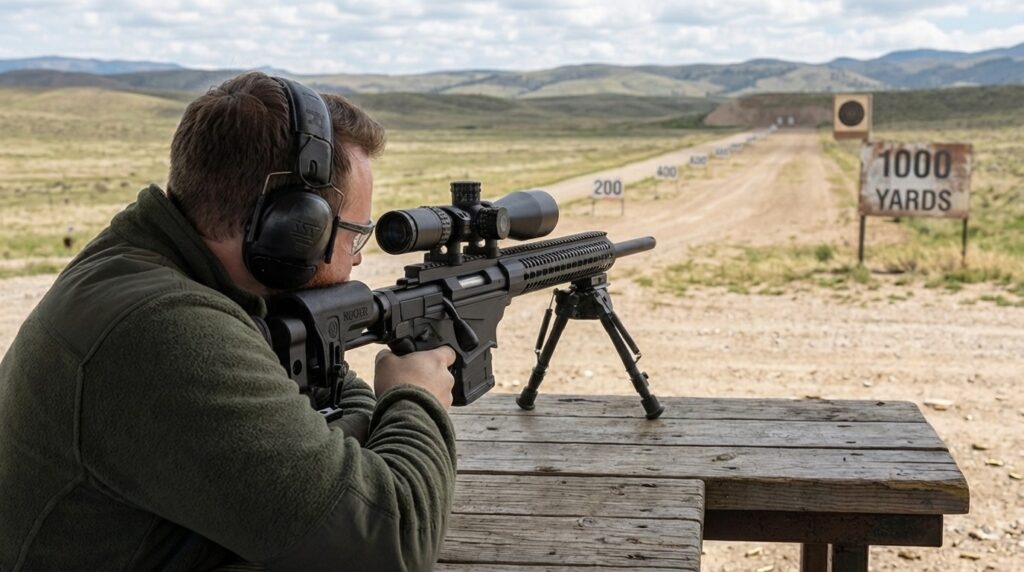
At the Range: 500 Round Test
Break-In and First Impressions
I’m not a barrel break-in believer in the traditional sense, but I shot the first 20 rounds slowly and cleaned between groups just to establish a baseline. Groups with Federal Gold Medal 140gr Bergers ran about 0.7 inches at 100 yards right out of the box. Not spectacular, not bad. The bore was a little rough initially and copper fouled quickly.
By round 50, things started tightening up. The barrel settled in and groups dropped to a consistent 0.5-0.6 inches with the same ammo. That’s when I started to feel like I had a real precision rifle in my hands, not just a chassis gun pretending to be one.
Ammo Log
- Federal Gold Medal 140gr Berger Hybrid: 150 rounds – Best groups, 0.4″ average at 100 yds
- Hornady ELD Match 147gr: 120 rounds – Excellent, 0.55″ average at 100 yds
- Hornady ELD Match 140gr: 100 rounds – Solid, 0.6″ average at 100 yds
- Prime 130gr OTM: 50 rounds – Good, 0.65″ average at 100 yds
- Sig Sauer Elite Hunter 130gr: 40 rounds – Acceptable, 0.8″ average at 100 yds
- Federal American Eagle 140gr OTM: 40 rounds – Budget option, 0.9″ average at 100 yds
For the best ammo to pair with this rifle, check our guide on the best 6.5 Creedmoor ammo.
Reliability
Zero malfunctions across 500 rounds. Not a single failure to feed, failure to extract, or any other hiccup. I ran the bolt deliberately for the first 100 rounds, then started cycling it with authority. A few rounds needed a touch more guidance into the chamber when I really slammed the bolt home, but that’s a technique issue more than a rifle issue. Slow down by about 10% and everything chambers clean.
Extraction was positive every time, even with the cheaper ammo that sometimes has softer brass. The ejector threw cases consistently to the right. No complaints here. It runs.
Accuracy Testing
Here’s where the RPR earns its reputation. With Federal Gold Medal 140gr Bergers, I was printing consistent 0.4-inch five-shot groups at 100 yards from a bench. That’s not cherry-picked best-ever territory. That was my average over ten groups. Best group was a ragged hole measuring 0.28 inches. Worst was 0.62 inches. For a factory rifle at this price? That’s excellent.
At 600 yards, I was holding right around 1 MOA with the 147gr ELD Match, which translates to roughly 6-inch groups. Wind was the variable, not the rifle. Steel at 1,000 yards was a first-round hit about 60% of the time in moderate conditions. The 6.5 Creedmoor cartridge and this barrel are clearly a happy couple.
One thing that stood out: this rifle is not ammo-picky. Even the budget Federal American Eagle stayed under MOA. It shot everything well, but it clearly preferred the heavier match-grade bullets. That 1:8 twist wants something in the 140-147 grain range. Give it what it wants.
Performance Testing Results
Reliability: 9/10
Five hundred rounds, zero issues. The bolt action is reliable in any conditions I tested, and extraction was positive every single time. The only reason it’s not a 10 is the bolt chatter when cycling quickly. It works fine, but it doesn’t inspire the same confidence as a Tikka’s glass-smooth action. Function over form here, and the function is flawless.
Accuracy: 8/10
Consistent sub-MOA with match ammo, occasional half-MOA groups that make you grin like an idiot. It’s not a custom-barreled tack driver that’ll print 0.2 MOA all day, but for a factory production rifle, the accuracy is genuinely impressive. Most shooters will run out of skill before they run out of rifle.
Ergonomics: 8/10
If you’ve run an AR, you’ll feel at home immediately. The grip angle, the safety location, the mag release. It all translates. The adjustable stock lets you dial in your position, and the folding mechanism is solid. Dings for weight: 10.7 pounds before glass means your complete setup will push 14-15 pounds. That’s a lot of gun to haul to a shooting position. Your back will know about it at an all-day match.
Fit and Finish: 7/10
This is where the RPR shows its mass-production roots. The chassis finish is fine but not exceptional. The bolt raceway has visible tool marks and the bolt itself rattles when unlocked. Handguard alignment was slightly off on my rifle. None of this affects performance, and honestly, a competition rifle is going to get beaten up anyway. But if you’re coming from a $2,500 Tikka or a custom build, the RPR will feel like a step down in craftsmanship. It is. It also costs less. Pick your priority.
What Owners Are Saying
I’m not the only one putting rounds through the RPR, and owner feedback from long-range shooting forums paints a consistent picture. Here’s what the community is reporting after extended use.
One Sniper’s Hide member put it bluntly: the workmanship and build quality is “just OK,” but the specimen he received was absolutely a shooter. Another long-range forum user reported hitting 36-inch steel at 2,500 yards and eggs at 500 and 700 yards with his RPR. That’s not the rifle, that’s the whole system working. But the rifle has to hold up its end of the bargain, and clearly it does.
A common refrain from owners is that the RPR performs way above its price point. One reviewer who tested it alongside an Accuracy International AXMC noted that both rifles are functionally 0.25 MOA guns. The AI costs $12,000. Let that sink in for a moment.
Complaint that comes up most often? The bolt action feel. “Chatter,” “rattle,” and “rough” are words that appear in almost every honest review. Nobody disputes the accuracy. Nobody disputes the value. But everyone wishes the bolt cycled smoother. It’s the one area where every competitor in this class has the RPR beat.
Multiple owners on long-range forums report that accuracy tightens after the first 50-100 rounds, with best groups settling in around 0.4 inches with premium ammo. The 147gr ELD Match and 140gr Berger Hybrid are the community favorites for this barrel. If you’re loading your own ammo, the rifle apparently loves the 140gr Berger Hybrid pushed to around 2,700 fps.
Forum consensus from Sniper’s Hide: it’s a “fine entry-level PRS rifle” that punches well above its weight class. Not the nicest gun you’ll ever own, but possibly the best value in precision rifles. Hard to argue with that.
Known Issues and Common Problems
Bolt Chatter and Rough Cycling
This is the number one complaint across every forum and review. The bolt raceway has visible machine marks, and there’s noticeable play between the bolt body and receiver. When unlocked, the bolt rattles and chatters as you cycle it. It doesn’t affect function or accuracy, but it feels cheap on a rifle at this price point. Some owners polish the raceway and report improvement. Others just live with it.
Handguard Alignment
A number of rifles ship with a slight handguard cant relative to the barrel. Again, this is cosmetic and doesn’t impact accuracy since the barrel is free-floated. But it’s annoying when you notice it, and you will notice it. Some owners have shimmed or reseated the handguard to fix it.
Bolt Shroud Safety Recall
Ruger issued a safety bulletin for certain RPR rifles with aluminum bolt shrouds that could cause interference with the cocking piece. This could result in light primer strikes or failure to fire. If you have an older RPR, check Ruger’s website with your serial number. They’ll fix it for free. This is a known issue that Ruger has addressed, but it’s worth checking if you’re buying used.
Fast Bolt Cycling and Feeding
When you really slam the bolt forward with authority, rounds can occasionally hang up instead of centering on the bolt face. Back off the speed by about 10% and this goes away completely. It’s a technique adaptation, not a defect, but it’s worth mentioning because it catches new RPR owners off guard. Be deliberate with the bolt. It rewards smooth over fast.
Parts, Accessories, and Upgrades
RPR has one of the deepest aftermarket support networks of any bolt gun. Because it uses AR-compatible grips and buttstocks, plus AICS magazines, you’ve got a massive ecosystem to pull from. Here are the upgrades that actually matter.
| Upgrade Category | Recommended Component | Why It Matters | Cost Estimate |
|---|---|---|---|
| Trigger | TriggerTech Diamond or Timney Calvin Elite | Drops pull weight to under 1 lb with zero creep | $150-$250 |
| Muzzle Brake | Area 419 Hellfire | Nearly eliminates recoil for faster follow-up shots | $120-$150 |
| Bipod | Atlas BT46-LW17 PSR | Rock-solid platform with smooth pan and cant | $250-$300 |
| Scope | Vortex Viper PST Gen II 5-25×50 | Clear glass, reliable tracking, proven at competition | $600-$700 |
| Scope Rings | Vortex Precision Matched Rings | Solid mount without breaking the bank | $80-$120 |
| Grip | Magpul MOE-K2+ | More vertical angle suits prone shooting better | $20-$25 |
| Magazines | Magpul PMAG 10 AC (AICS) | Reliable feeding, affordable spares | $30-$40 each |
| Barrel (replacement) | Criterion or Bartlein pre-fit | When factory barrel is shot out, step up to match-grade | $350-$500 |
You can find triggers, grips, and accessories at Brownells and bipods at Palmetto State Armory. For glass, EuroOptic usually has the best prices on quality optics.
The Verdict
The Ruger Precision Rifle is not a perfect gun. The bolt feels rough. The fit and finish won’t win any beauty contests. And at its current price point, it’s no longer the screaming bargain it was when it launched. But here’s what still makes it special: no other rifle in this price range gives you a folding stock, AICS magazine compatibility, AR-style controls, user-swappable barrels, and sub-MOA accuracy in one package. Nobody.
Is the Bergara smoother? Yes. Is the Tikka nicer to cycle? Absolutely. Is the Savage cheaper? Way cheaper. But none of them check every box the RPR does. This is still the Swiss Army knife of precision bolt guns, and after 500 rounds, I’m convinced it earns that reputation honestly.
If you’re getting into PRS, building your first long-range rig, or you want a do-everything precision rifle that speaks AR, the RPR belongs on your short list. Pair it with a quality optic from our best rifle scopes roundup, feed it the good stuff from our best 6.5 Creedmoor ammo guide, and go ring some steel. You won’t be disappointed.
Final Score: 8.5/10
Best For: Entry-level PRS competitors, long-range enthusiasts wanting sub-MOA performance on a budget, AR shooters transitioning to bolt guns, and anyone who values features and versatility over boutique fit and finish.
Compare prices on our gun deals page before you buy, or use our price comparison tool to find the lowest price from 15+ online retailers.
FAQ: Ruger Precision Rifle
Is the Ruger Precision Rifle accurate?
Very accurate. Sub-MOA is achievable with match ammo. We consistently shot 0.8 to 1.2 MOA groups with Hornady ELD Match. The RPR democratized precision shooting by putting sub-MOA capability under 1600 dollars.
RPR vs Bergara HMR?
The Bergara is slightly more accurate and lighter. The RPR has AR ergonomics, folding stock, and AICS mag compatibility. The Bergara is the better shooter. The RPR is the more modular and versatile platform.
What caliber RPR should I get?
6.5 Creedmoor for best all-around precision. 308 Win if you want cheaper practice ammo. 6mm Creedmoor for competition. 338 Lapua for ELR. Most shooters should start with 6.5 Creedmoor.
Does the RPR fold?
Yes. The stock folds to the left side for compact storage and transport. The rifle cannot fire with the stock folded. This is a significant advantage for transport and vehicle storage.
What magazines does the RPR use?
AICS pattern magazines standard. Magpul AICS PMAGs work perfectly and cost about 35 dollars. The rifle also ships with an AICS to AR mag well adapter.
Is the RPR good for PRS?
Good entry-level PRS rifle. Many local and regional competitors run RPRs successfully. At the national level most shooters have moved to custom builds, but the RPR is a capable starting platform.
Where is the RPR made?
Manufactured at Ruger facilities in the United States. Ruger makes all firearms domestically.
What trigger does the RPR have?
Ruger Marksman Adjustable trigger, externally adjustable from 2.25 to 5 pounds without removing the action from the stock. It breaks cleanly and most owners find it adequate without aftermarket replacement.
Author

14,517+ Gun & Ammo Deals
Updated daily from 10+ top retailers. Filter by category, caliber, action type, and price.
Related Guides