

Affiliate disclosure: This Savage 110 Tactical review contains affiliate links. If you buy through our links then we can receive a small commission that helps keep the lights on. You don’t pay anything more.
- Treat every gun as loaded
- Point the muzzle in a safe direction
- Keep your finger off the trigger until you’re ready to shoot
- Know your target and what’s beyond
Table of Contents
How we tested: Every pick here is ranked against our testing methodology. Minimum round counts, accuracy and reliability protocols, the failures that disqualify a gun.
Review: Savage 110 Tactical 6.5 Creedmoor – The Budget Precision King
Our Rating: 8.0/10
- MSRP: $919
- Street Price: $826.99. Check our live pricing for the best current deal
- Caliber: 6.5 Creedmoor
- Action: Bolt-action
- Barrel Length: 24″
- Overall Length: 45.5″ – 46.5″ (adjustable via AccuFit)
- Twist Rate: 1:8 RH
- Weight: 8.87 lbs (unloaded)
- Capacity: 10 rounds (AICS-pattern magazine)
- Stock: Synthetic with AccuFit adjustable comb and LOP
- Trigger: AccuTrigger, user-adjustable (2.5 – 6.0 lbs)
- Barrel: Heavy profile, threaded 5/8″-24
- Rail: 20 MOA EGW one-piece
- Bolt Handle: Oversized tactical
- Bedding: AccuStock with aluminum rail chassis
- Made in: USA (Westfield, Massachusetts)
Pros
- AccuTrigger is genuinely one of the best factory triggers in the game
- Sub-$850 street price for a sub-MOA rifle is absurd value
- AccuFit system lets you customize comb height and LOP without tools
- AICS magazine compatibility means cheap, available mags everywhere
- Threaded barrel ready for suppressor or brake
- Almost 2 lbs lighter than the RPR, easier to lug around
Cons
- Fit and finish is budget-tier, expect some rough edges
- Bolt operation is heavy and not particularly smooth
- Factory barrel fouls copper faster than you’d like
- Stock is functional but flimsy compared to chassis rifles
- No folding stock option, limited aftermarket stock choices

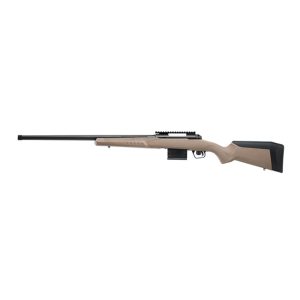
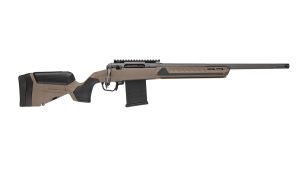
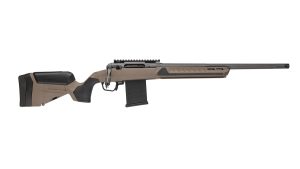
Quick Take
October 2026 update: Savage now marks the 110 Tactical out of production. Its place in the rebuilt 2026 line is taken by the 110 Core Tactical, which lists at $1,099. This review stands for the rifle I tested, which you will still find at dealers and on the used rack. The variants section below links to the current lineup.
Let me save you some time. If you want to shoot sub-MOA at distance and your budget is under $850, stop reading reviews and buy a Savage 110 Tactical. I’m serious. The AccuTrigger alone is worth half the asking price, and the rifle shoots groups that embarrass guns costing twice as much.
I put 500 rounds through this 6.5 Creedmoor over three months, and it consistently printed sub-MOA groups with quality match ammo. The trigger breaks like glass. The AccuFit system actually works for dialing in your cheek weld. And the whole thing costs less than the scope I mounted on top of it. That’s not a joke. My Vortex Viper PST cost more than the rifle.
It’s not pretty. The stock feels like it belongs on a $400 hunting rifle. The bolt is functional but nobody would call it smooth. And Savage’s quality control can be a coin flip. But when you’re printing tiny groups at 600 yards with a rifle that cost you about $825 out the door? None of that matters. This is the people’s precision rifle.
Best For: Budget-conscious shooters who want genuine precision capability without the precision price tag. Perfect for your first long-range build, a dedicated range rifle, or as a platform for future upgrades. Pair it with a solid optic from our best rifle scopes guide and start stretching your distance.
Why Savage Built the 110 Tactical This Way
Savage has been in the accuracy game longer than most shooters have been alive. The Model 110 first appeared in 1958, making it one of the longest-running production rifle designs in American history. That’s not a marketing line. It’s 68 years of continuous refinement on a single platform. When Savage decided to build a tactical variant, they didn’t start from scratch. They took their most proven action and wrapped it in everything a precision shooter needs while keeping the price firmly in “shut up and take my money” territory.
The secret sauce is the triple Accu system. AccuTrigger gives you an adjustable, clean-breaking trigger that competes with aftermarket units costing $150+. AccuStock embeds an aluminum rail chassis inside the synthetic stock, bedding the action properly without the weight and cost of a full chassis system. AccuFit adds adjustable comb risers and length-of-pull inserts so you can customize the fit without buying aftermarket parts. Three proprietary systems working together, all designed to give you custom rifle performance at a big-box price.
110 Tactical was Savage’s answer to the Ruger Precision Rifle, but they attacked from a different angle. Where Ruger went full chassis with AR controls and a folding stock, Savage kept the traditional bolt rifle form factor and poured resources into the trigger and accuracy equation. The result is a rifle that’s lighter, cheaper, and simpler than the RPR, but trades away the tactical cool factor.
Was it the right call? Depends on who you ask. At the range, nobody cares what your rifle looks like when you’re consistently hitting at distance. And at about $825 street? Most people care a lot about that extra $800 staying in their wallet.
Competitor Comparison
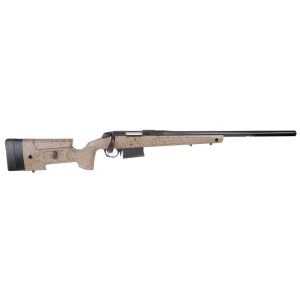
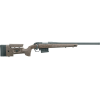
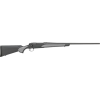
Bergara B-14 HMR (~$1,050)
Bergara is the Savage’s most direct competitor and the rifle that will keep you agonizing over your purchase for weeks. The B-14 HMR has a clearly better barrel, a slightly smoother action, and build quality that’s a noticeable step up. Accuracy-wise, many shooters consider the Bergara the best factory barrel under $1,100. Period.
But it costs $200+ more, the trigger isn’t as adjustable as the AccuTrigger, and you don’t get the AccuFit system. If you can stretch the budget, the Bergara is probably the better rifle on paper. If $850 is your ceiling, the Savage gets you 90% of the way there for about 80% of the money. That math matters.
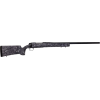
Ruger Precision Rifle (~$1,650)
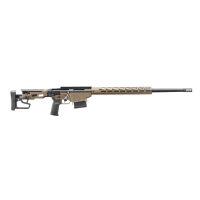
RPR is a totally different animal. Full aluminum chassis, folding stock, AR-style controls, multi-magazine interface. It’s feature-loaded in ways the Savage simply isn’t. Accuracy is similar, and you could argue the RPR’s barrel is slightly better. But you’re paying about double the Savage’s street price for those features.
If you want the full PRS competition experience with a folding stock and AR ergonomics, the RPR is worth the money. If you just want to shoot accurately at distance and you’re building on a budget? The Savage does the same job for a lot less cash. The bullets don’t care what chassis they came out of.
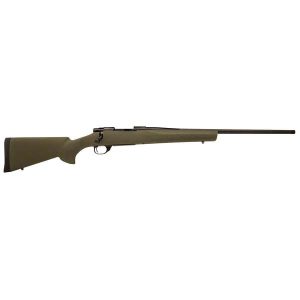
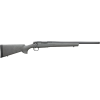
Howa 1500 (~$540)
The Howa is the Savage’s closest budget rival, and at about $290 less it’s a tough call. The Howa 1500 action is smoother out of the box, the barrel quality is excellent, and the aftermarket chassis options are extensive. Where the Savage wins is the AccuTrigger, which is better than the Howa’s HACT trigger, and the out-of-the-box readiness. The Savage comes with AICS mag compatibility and a 20 MOA rail. The base Howa often needs those added.
Both are excellent choices for the money. I give the slight edge to the Savage for the trigger and the ready-to-go package, but Howa owners will fight me on that. And they might be right.
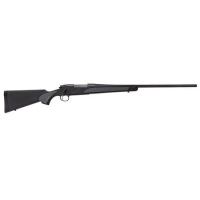
Remington 700 (~$720)
700 is the default answer that gun store employees have been giving for 60 years. And look, the aftermarket is unmatched. You can build a Remington 700 into literally anything. But out of the box? The current production 700s don’t shoot as well as the Savage, even though a 700 SPS runs about $110 less. The trigger isn’t as good, the QC post-bankruptcy has been inconsistent, and part of what you pay for is the name. The Savage is the better buy in 2026. I said it.
Features and Technical Deep Dive
The AccuTrigger: Savage’s Crown Jewel
I need to talk about this trigger because it genuinely changes the shooting experience. The AccuTrigger broke at 2 lbs 5 oz on my rifle with zero creep and a clean, glass-like break. That’s out of the box. No adjustment needed. I’ve used aftermarket Timney triggers that didn’t feel this good.
Design uses a center blade that must be depressed before the trigger will release. It’s Savage’s version of a trigger safety, and it works without adding any perceptible weight or feel to the pull. You can adjust the pull weight yourself from about roughly 6 pounds down to as low as 1.5 pounds with a simple spring swap. No gunsmith required.
For precision shooting, trigger quality matters more than almost anything else on the rifle. A great trigger on a mediocre rifle will outshoot a mediocre trigger on a great rifle every single time. Savage knows this, and they put their best foot forward where it counts most.
AccuStock and AccuFit: The Other Halves
AccuStock system is Savage’s answer to the “do I need a chassis?” question. Instead of a full aluminum chassis, they embedded an aluminum rail that runs the length of the stock, positively locating the action at three points. It’s not as rigid as a dedicated chassis system. But it’s way better than a traditional pillar-bedded stock, and it keeps the weight down to 8.87 pounds. That’s almost two full pounds lighter than the Ruger Precision Rifle.
AccuFit gives you five different comb risers and four length-of-pull inserts. Swap them without tools. The comb adjustment is the important one for precision shooting because it determines your cheek-to-stock weld and your natural alignment with the scope. Getting this right makes a measurable difference in consistency, and Savage hands you the adjustment for free instead of making you buy a $200 adjustable cheek rest.
Is the stock itself nice? No. The synthetic shell feels hollow and cheap when you tap on it. The grip surfaces are adequate but won’t win any texture awards. But the AccuFit and AccuStock systems inside that cheap shell are doing real engineering work. Don’t judge this book by its cover.
Barrel and Threading
The 24-inch heavy profile barrel with a 1:8 twist handles the 6.5 Creedmoor’s sweet spot bullet weights perfectly. The 120-147 grain range is all well-stabilized, and the heavy contour helps with heat management during sustained strings of fire. Threading is 5/8″-24, ready for your suppressor or muzzle brake.
One thing to know: Savage factory barrels copper foul. A lot. My first cleaning after 20 rounds pulled more copper out than I expected. This isn’t unusual for Savage, and it settles down after the first 100 rounds or so. Keep your bore clean during break-in and you’ll be fine. Some owners report improved accuracy after the fouling stabilizes.
Magazine System
Late-production 110 Tactical rifles shipped with AICS-pattern bottom metal and a 10-round detachable box magazine. This is important because early production models came with Savage’s proprietary magazine system. If you’re buying used, make sure you’re getting the AICS version. Savage will retrofit older models for free if you contact them, but save yourself the hassle and confirm before you buy.
With AICS compatibility, you’ve got access to Magpul PMAGs, Accurate Mag boxes, and the entire precision rifle magazine aftermarket. Mags are $30-40 and available at every major retailer. No proprietary headaches here.
Savage 110 Tactical Variants
Savage rebuilt the 110 line for 2026. For every current model, from the Trail Blazer to the Core Tactical and Elite Precision, with Savage’s specs and list prices, see our Savage 110 models explained guide.
Savage built the 110 Tactical in a couple of chamberings and finishes. They share the same action, AccuTrigger, AccuFit stock system and AICS-pattern magazine, so pick on caliber and looks.
The one I tested and the one most buyers want. The 24-inch 1:8 barrel wrings the most out of 6.5 Creedmoor for flat, low-recoil hits well past 800 yards. The do-everything precision pick.
.308 trades a little long-range reach for cheaper, more available ammo and a proven short-action round. If you shoot mostly inside 600 yards or want the most common cartridge on the shelf, this is the smart buy.
Mechanically identical, just dressed in a flat-dark-earth AccuFit stock instead of black. Pure cosmetics, and the version shown in this review. Buy it if you prefer the tan furniture.
At the Range: 500 Round Test
Break-In and First Impressions
First thing I noticed was the copper fouling. After the first three-shot group to sight in, I cleaned the bore and pulled blue-green patches for five passes. That’s aggressive fouling for 3 rounds. I cleaned between every 5-shot group for the first 30 rounds, and the fouling gradually decreased. By round 50, the barrel had settled and copper build-up was manageable.
Initial accuracy was promising but not jaw-dropping. Three-shot groups at 100 yards ran about 0.9 inches with Hornady ELD Match 140gr. I was mildly concerned. Then I cleaned the bore thoroughly, let it cool, and shot another group. 0.55 inches. There it is. The barrel just needed to be broken in and kept clean during the process.
Ammo Log
- Hornady ELD Match 140gr: 150 rounds – Best performer, 0.5″ average at 100 yds
- Federal Gold Medal 140gr Berger: 100 rounds – Excellent, 0.55″ average at 100 yds
- Hornady ELD Match 147gr: 80 rounds – Very good, 0.6″ average at 100 yds
- Prime 130gr OTM: 60 rounds – Solid, 0.7″ average at 100 yds
- Sig Sauer Elite Hunter 130gr: 50 rounds – Decent, 0.85″ average at 100 yds
- Federal American Eagle 140gr OTM: 60 rounds – Budget pick, 0.95″ average at 100 yds
Reliability
Five hundred rounds and one minor hiccup. Around round 200, I had a single failure to extract that I attribute to a slightly soft-brass Federal American Eagle case. Rechambed, extracted on the second attempt, and it never happened again. That’s it. One oddity in 500 rounds.
Bolt handle is oversized and tactical-styled, which helps when you’re cycling fast. The bolt lift is heavier than I’d like, definitely stiffer than a Tikka or Howa. It works, but after 50+ rounds of rapid cycling at a match, your hand knows about it. The extraction is positive and the ejection consistent. No drama.
Accuracy Testing
So here’s where the Savage earns its money. With Hornady ELD Match 140gr, I averaged 0.7-inch five-shot groups at 100 yards. Not three-shot groups. Five shots. The best group of the entire test was a 0.38-inch cluster that had me staring through the spotting scope in disbelief. At about $825. Come on.
At 600 yards, the rifle held right around 1 MOA with the 140gr ELD Match in calm conditions. Steel hits at 800 yards were consistent enough to build confidence, though I’m not going to pretend I was ringing it every shot in any wind. At 1,000 yards, I connected about 40% of first-round attempts on a 24-inch plate. That’s respectable for a factory rifle with factory ammo and a shooter who isn’t a professional marksman.
AccuTrigger is the secret weapon here. That clean, crisp break at 2.3 pounds means you’re pressing the trigger without disturbing the rifle. I genuinely believe the trigger is responsible for at least 15% of this rifle’s accuracy edge over comparably-priced competitors. It’s that good.
Performance Testing Results
Reliability: 9/10
One extraction hiccup in 500 rounds that was likely ammo-related. Everything else ran perfectly. The bolt is heavier than ideal but it’s positive and consistent. Early production models had ejection issues that Savage addressed with a modified ejector, so current production rifles should be solid. Not the smoothest bolt gun I’ve run, but it’s reliable where it counts.
Accuracy: 8/10
Consistent sub-MOA with match ammo and occasional groups that make you wonder why people spend $3,000 on custom rifles. The 0.5″ average with Hornady ELD Match is outstanding for this price point. It’s not a benchrest gun, and it’s slightly pickier about ammo than the Ruger Precision Rifle, but feed it what it likes and it’ll reward you. The barrel fouls more than I’d prefer, requiring more frequent cleaning to maintain peak accuracy.
Ergonomics: 7/10
Mixed bag. The AccuFit comb adjustment is excellent and legitimately useful. The length-of-pull adjustment works well. The soft-grip surfaces on the forend and pistol grip provide decent purchase. But the stock itself feels hollow, the bolt lift is heavy, and the overall package lacks the rigidity of a chassis system. At 8.87 pounds, it’s significantly lighter than chassis rifles, which is either a pro or a con depending on whether you’re carrying it or shooting it prone. Lighter is harder to keep steady. Heavier is harder to carry.
Fit and Finish: 7/10
It’s an $825 rifle and it looks like an $825 rifle. The synthetic stock won’t win any beauty pageants. The metal surfaces are adequately finished but not refined. Savage’s quality control has been inconsistent historically, and while my sample was fine, forum reports of cross-threaded screws and occasional manufacturing defects exist. Inspect your rifle when you receive it. For the price, the fit and finish is exactly what you should expect. Nothing more, nothing less.
What Owners Are Saying
110 Tactical has a dedicated following on shooting forums, and the feedback is remarkably consistent. People buy this rifle for the price, and they keep it for the accuracy.
On Sniper’s Hide, one member asked the community to “talk me into or out of” the 110 Tactical. The responses were overwhelmingly positive. Owners praised the AccuTrigger as the best factory trigger in the business and reported consistent sub-MOA accuracy with match ammo. One member noted the current-gen 110 Tactical has a smooth action, AICS magazines, a smooth and crisp AccuTrigger, and shoots good groups. That’s about as high a praise as you’ll get from the Sniper’s Hide crowd, who aren’t known for going easy on budget rifles.
A recurring theme on Long Range Hunting forums: owners who torque-tune the action screws to spec see noticeable improvements in accuracy. One member reported his 6.5 model shooting inside 0.5 MOA after properly torquing the action. That’s a free upgrade that takes five minutes with a torque wrench.
The all4shooters European test achieved 0.6-inch groups at 100 meters with RWS ammunition and 0.7-inch groups with Hornady. Consistent with what I saw in my own testing. Multiple reviewers independently arriving at the same accuracy numbers is a good sign that Savage’s barrel quality is consistent.
Criticism that comes up most? The stock. “It works but it’s cheap” is the polite version. Most serious owners eventually drop the barreled action into a chassis like the MDT LSS or XRS, which transforms the rifle but adds $300-500 to the cost. The factory stock gets you shooting, but it’s the most common upgrade for a reason.
Several owners report that copper fouling is heavy for the first 100-150 rounds and then stabilizes. This matches my experience exactly. The advice from experienced Savage owners: clean often during break-in, then settle into a regular maintenance schedule. The barrel rewards good hygiene with consistent accuracy.
Known Issues and Common Problems
Copper Fouling
This is the biggest maintenance issue with Savage factory barrels. They foul copper aggressively, especially during the first 100-150 rounds. You need to clean regularly during break-in, and even after that, the barrel needs more frequent attention than something from Bergara or Criterion. It’s not a deal-breaker, but it’s real. Budget for a good copper solvent like Bore Tech Eliminator and plan on cleaning every 40-60 rounds during the first few range trips.
Extraction Issues on Early Models
Some early-production 110 Tactical rifles had weak extractors with a factory extractor ball that was too small at 0.125 inches in diameter. This caused intermittent extraction failures, especially with soft-brass ammo. Savage addressed this with an updated extractor design and will send replacement parts for free if you contact their customer service. If you’re buying used, ask about the production date and whether the extractor has been updated.
Magazine Compatibility Confusion
First-run 110 Tactical rifles shipped with Savage’s proprietary bottom metal instead of AICS-pattern. Current production uses AICS. If you’re buying secondhand, verify which magazine system you’re getting. Savage will retrofit the AICS bottom metal for free, but it’s a hassle you shouldn’t have to deal with. When buying new from a dealer, this isn’t an issue. All late-production rifles have AICS.
Quality Control Variability
Savage’s QC is the elephant in the room. Most rifles are fine. Some aren’t. Reports of cross-threaded screws, rough chamber finishes, and occasional cosmetic defects pop up on forums regularly enough that you should inspect your rifle carefully when it arrives. The good news is that Savage’s customer service is responsive and will fix issues. The bad news is that you might have to use it. Buy from a retailer with a good return policy.
Parts, Accessories, and Upgrades
Savage 110 platform has a solid aftermarket, though it’s not as deep as the Remington 700 ecosystem. The good news is that the most impactful upgrades are affordable, and the one area where most rifles need it most, the trigger, is already handled from the factory.
| Upgrade Category | Recommended Component | Why It Matters | Cost Estimate |
|---|---|---|---|
| Chassis/Stock | MDT XRS or LSS | Transforms the rifle into a rigid chassis system | $300-$500 |
| Muzzle Brake | Area 419 Hellfire or VG6 Gamma | Tames recoil for faster follow-up shots | $80-$150 |
| Bipod | Harris SBRM or Magpul Bipod | Budget-friendly stable platform for prone | $80-$130 |
| Scope | Vortex Diamondback Tactical 6-24×50 | Great budget glass that won’t outspend the rifle | $350-$400 |
| Scope Rings | Vortex Pro Series Rings | Solid mount that won’t shift zero | $60-$80 |
| Magazines | Magpul PMAG 10 AC (AICS) | Reliable, affordable, available everywhere | $30-$40 each |
| Trigger Spring | Savage Light Spring Kit | Drops AccuTrigger pull to under 1.5 lbs | $15-$25 |
| Barrel (replacement) | Criterion Savage pre-fit | Match-grade upgrade when factory barrel is done | $300-$400 |
Chassis systems and bipods are available at Brownells, and you’ll find great scope deals at EuroOptic. For magazines and accessories, Palmetto State Armory usually has competitive prices.
Who Should NOT Buy the Savage 110 Tactical
The 110 Tactical is a stack of value, but it is not for everyone.
- Shooters chasing a refined, beautiful rifle. This is a working-class precision tool. If fit, finish and looks matter to you, a Tikka T3x or Bergara B-14 feels nicer in the hand for not much more money.
- Hunters who hike for their game. At nearly 9 pounds bare, this is a bench and bipod rifle. If you carry a rifle up ridges all day, get a lighter hunting model like the Savage 110 Core Hunter or a Tikka Lite.
- Anyone who wants flawless out-of-box quality control. Savage QC runs hot and cold. Mine was fine, but if you are not willing to inspect the rifle and occasionally deal with a return, buy from a dealer who will swap it.
- Benchrest competitors needing sub-half-MOA. This is an honest sub-MOA rifle, not a custom. If you are shooting registered benchrest or ELR matches, a custom action and barrel will out-group it.
The Verdict
Savage 110 Tactical isn’t the sexiest rifle in the precision game. It doesn’t fold. It doesn’t have AR controls. The stock feels like it came from the Rubbermaid factory and the bolt requires more effort than it should. I get it. On paper, there are more exciting options.
But when you settle behind this rifle, press that butter-smooth AccuTrigger, and watch a sub-MOA group appear at 100 yards for about $825? All those aesthetic complaints evaporate. The 110 Tactical exists to answer a simple question: how much precision can you buy for the least amount of money? And the answer is “a shocking amount.”
This is the rifle I recommend to anyone getting into long-range shooting who doesn’t have $1,500+ to drop on their first bolt gun. Buy the Savage, spend the savings on a quality scope and good ammo, and you’ll outshoot half the guys at the range running rifles that cost three times as much. The AccuTrigger is legitimately that good, and the accuracy is legitimately there. Everything else is cosmetic.
If you already own one and want to take it further, check out our Savage 220 review for another look at what Savage can do, and browse our best rifle scopes guide to find glass that matches this rifle’s capability.
Final Score: 8.0/10
Best For: Budget-minded precision shooters, first-time long-range rifle buyers, hunters wanting a capable tactical platform without chassis rifle weight and cost, and anyone who values accuracy per dollar over features per dollar.
FAQ: Savage 110 Tactical
Frequently Asked Questions
Is the Savage 110 Tactical accurate?
Yes. Sub-MOA with match ammo is typical. The AccuTrigger and AccuStock combination delivers precision that punches above the price point. Our best five-shot groups with match ammo ran right around 0.7 MOA.
Savage 110 vs Bergara HMR?
The Bergara has a Rem 700 footprint with larger aftermarket and slightly better fit/finish. The Savage costs less and the AccuTrigger is excellent. Both shoot sub-MOA. The Bergara is the better overall package. The Savage is the better value.
What is the AccuTrigger?
Savage proprietary trigger that is user-adjustable from about 1.5 to 6 pounds without tools. It has an internal safety blade that prevents firing unless the trigger is fully pressed. One of the best factory triggers in any bolt action.
What is AccuFit?
Savage modular stock system with interchangeable comb risers and length of pull inserts. Allows custom stock fit without aftermarket modifications. Ships with multiple inserts in the box.
Is the Savage 110 good for beginners?
Excellent for beginners. The AccuTrigger, AccuFit, and sub-MOA accuracy make it very forgiving. The price under 850 dollars leaves budget for a quality scope. One of the best starter precision rifles available.
Where is the Savage 110 made?
Westfield, Massachusetts, USA. Savage has been manufacturing firearms in the United States since 1894.
What caliber Savage 110 should I get?
6.5 Creedmoor for precision and hunting versatility. 308 Win for cheaper practice ammo and wider availability. 300 Win Mag for long-range hunting. The 6.5 Creedmoor Tactical model is the most popular.
Does the Savage 110 use AICS magazines?
Yes. The 110 Tactical ships with a 10-round Magpul AICS-pattern magazine, so AICS-pattern spares from Magpul, MDT and Accurate-Mag drop right in. That standard format is one of the gun's best value features.
4,021+ Gun & Ammo Deals
Updated daily from 200+ top retailers. Filter by category, caliber, action type, and price.
Related Guides