
Affiliate disclosure: This Staccato P 2011 review contains affiliate links. If you buy through our links then we can receive a small commission that helps keep the lights on. You don’t pay anything more.
- Treat every gun as loaded
- Point the muzzle in a safe direction
- Keep your finger off the trigger until you’re ready to shoot
- Know your target and what’s beyond
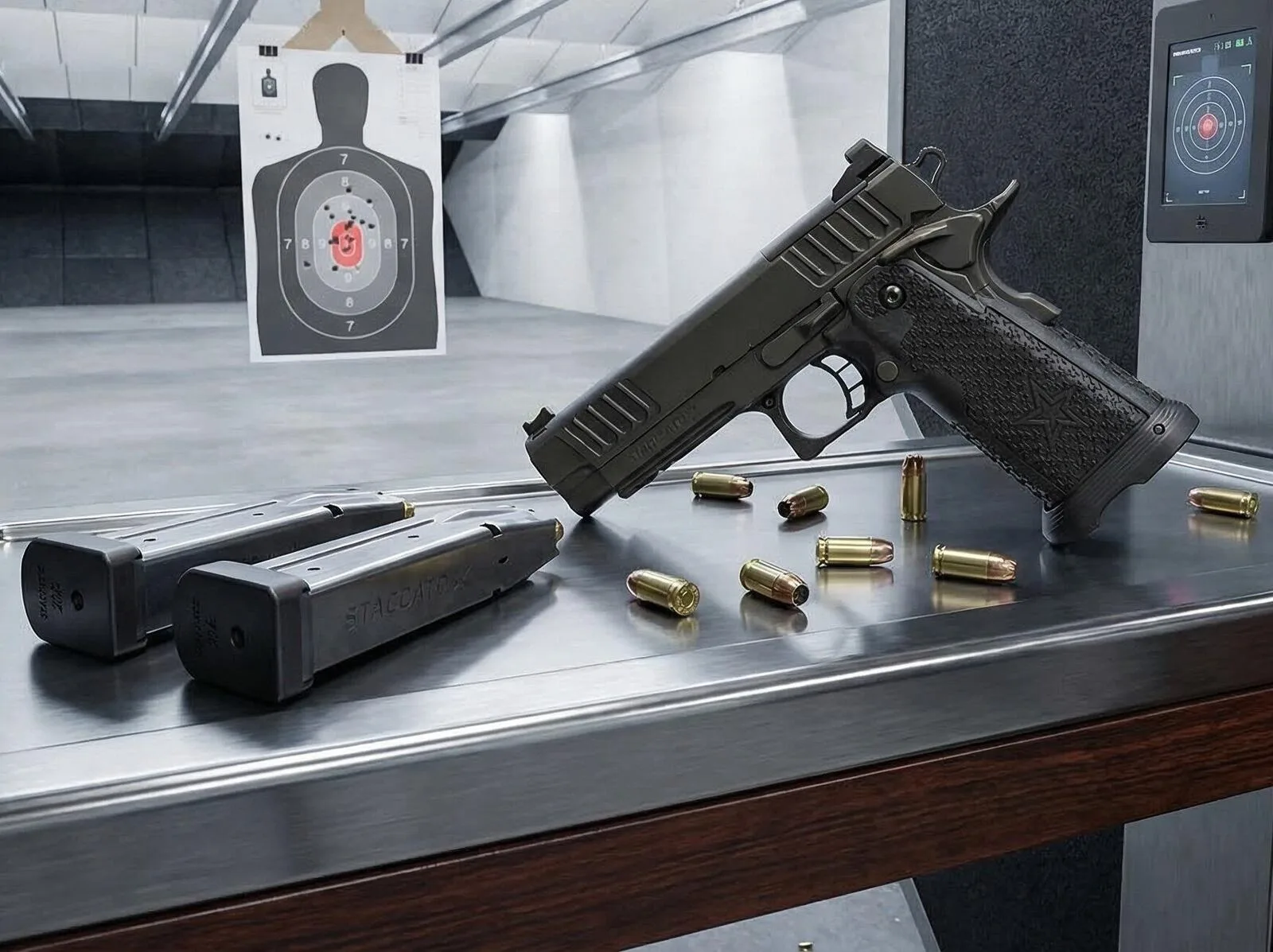
Review: Staccato P 2011 – The $2,200 Question
Our Rating: 8.5/10
- RRP: $2,599 (standard) / $2,799 (DPO optics-ready)
- Street Price: $2,300-$2,700 (Check our live pricing for the best current deal)
- Caliber: 9mm Luger
- Action: Hammer-fired, single-action, semi-automatic (2011 platform)
- Barrel Length: 4.4″ (bull barrel)
- Overall Length: 8.1″
- Height: 5.5″
- Width: 1.5″
- Weight (Unloaded): 33 oz (steel frame) / 28 oz (aluminum frame)
- Capacity: 17+1 (standard) / 20+1 (extended magazine)
- Frame: Polymer grip module with steel receiver (aluminum option available)
- Slide: Steel, DLC finished
- Trigger: ~4 lbs, adjustable, single-action
- Sights: Fiber optic front, U-notch rear (standard) / Optics-ready (DPO model)
- Optics: DPO model accepts direct-mount optics (RMR footprint)
- Safety: Ambidextrous thumb safety, grip safety
- Grip: Polymer with star-pattern texture (replaceable modules)
- Made in: Georgetown, Texas, USA
Pros
- Outstanding single-action trigger out of the box (crisp 4 lb break)
- 17+1 capacity in a 1911-style platform
- Bull barrel delivers excellent accuracy (1.5″ groups at 25 yards)
- Duty-rated reliability, approved by multiple law enforcement agencies
- Ambidextrous thumb safety and intuitive grip safety
- DPO model offers clean optics mounting with dedicated low-profile Dawson Precision mounting plates
- Made in Texas with strong customer service reputation
Cons
- $2,200 is a big ask when a Sig Legion runs half the price
- Polymer grip module feels less premium than expected at this price
- Limited aftermarket compared to standard 1911 parts
- Proprietary magazines are expensive ($60-$70 each)
- Some early production runs had QC inconsistencies (largely resolved)
- Not truly “custom” at this price point despite the 2011 premium
Staccato P 2011 - Best Prices
Quick Take
I bought my Staccato P with my own money. No loaner, no press gun, no special treatment. I wanted to know if the hype around the Staccato 2011 platform was justified or if I was paying a $1,200 premium over a Sig Legion just for the privilege of saying “I shoot a 2011.” After 2,000 rounds, I have my answer. It is a genuinely excellent pistol. But excellent and worth it are two different conversations.
The Staccato P shoots like a gun that costs $2,200. The trigger is the best factory trigger I have ever felt on a production pistol, the accuracy is bordering on match-grade, and the reliability has been nearly flawless after a brief break-in.
When you pick it up and run a magazine through steel at 25 yards, you understand immediately what your money bought. The question is whether you could get 80% of that experience for half the money. Honestly, you probably could.
What keeps me from giving it a 9 or higher is the value equation. The polymer grip module, while functional, does not feel like a $2,200 component. The magazines cost $50 each. And the 2011 tax is real. You are paying a premium for the platform itself, not just the performance.
For duty use, competition, or anyone who simply wants the best-shooting production pistol available, the Staccato P delivers. For casual range shooters, the math gets harder to justify.
Best for: Competitive shooters who want a production-legal 2011, law enforcement officers looking for a duty-rated full-size 9mm, 1911 enthusiasts ready to step into the double-stack 2011 world, and anyone who prioritizes trigger quality and accuracy above all else.
Why Staccato Built the P This Way
To understand the Staccato P, you need to understand what a 2011 actually is. Back in 1993, Virgil Tripp and Sandy Strayer created the 2011 platform at STI International. The concept was simple: take everything shooters loved about the 1911 (the trigger, the grip angle, the manual of arms) and fix its biggest limitation (single-stack capacity).
They widened the grip frame to accept a double-stack magazine and used a modular two-piece design with a separate grip module and receiver. The result was a double-stack 1911 that could hold 17 or more rounds of 9mm while keeping the legendary single-action trigger.
STI International rebranded as Staccato in 2020. The name change was part of a larger strategic shift away from the competition-only market and toward duty use and everyday carry.
The Staccato P was purpose-built to be a law enforcement sidearm, not just a race gun. That meant it needed to run in all conditions, handle tens of thousands of rounds without hand-fitting, and pass the kind of drop-testing and abuse protocols that department armorers demand.
The polymer grip module was a deliberate choice. Traditional 2011s used metal grip frames that required careful fitting. By switching to a precision-molded polymer module, Staccato could mass-produce a consistent product that did not need a gunsmith to assemble. It also cut weight.
The standard P weighs 33 ounces, which is manageable for all-day carry on a duty belt. Critics call the polymer grip a cost-cutting measure. Staccato calls it an engineering decision. The truth is probably somewhere in between.
Georgetown, Texas is where every Staccato is built. The company invested heavily in CNC machining and in-house quality control after the rebrand. They also pursued and won law enforcement contracts aggressively. Multiple agencies across the country now authorize the Staccato P as a duty weapon, which is a significant endorsement of its reliability. You do not get on an approved carry list by being fragile.
Competitor Comparison
The Staccato P sits in an interesting spot. It is too expensive to compete directly with mainstream polymer pistols, but it is far less expensive than true custom 2011s from shops like Atlas or Nighthawk. Here is how it stacks up against the guns most cross-shoppers are considering.
CZ Shadow 2 ($1,300-$1,550)
The CZ Shadow 2 is the go-to competition pistol for USPSA Production division shooters. It is an all-metal, DA/SA hammer-fired gun with one of the best factory triggers in the business. The Shadow 2 costs roughly $800 to $1,000 less than the Staccato P, and in the hands of a skilled shooter, it can match the Staccato’s accuracy at the range.
The fundamental difference is the platform. The Shadow 2 gives you a heavier all-steel pistol with a DA/SA trigger, while the Staccato gives you a lighter single-action-only 2011 with higher capacity. For pure competition value, the Shadow 2 is hard to beat. For duty carry and single-action preference, the Staccato wins.
CZ Shadow 2 - Best Prices
Sig Sauer P320 X-Five Legion ($800-$1,000)
This is the comparison that keeps Staccato’s marketing team up at night. The Sig P320 X-Five Legion offers a tungsten-infused polymer grip, an outstanding flat trigger, and genuine competition accuracy for less than half the price of a Staccato P. I have shot both extensively, and the performance gap is real but smaller than the price gap suggests. The Staccato’s single-action trigger is better. The Staccato tracks flatter in recoil. But the Legion is 90% of the gun at 45% of the cost. If budget is any consideration at all, the Legion deserves serious thought before you pull the trigger on a Staccato.
Sig Sauer P320 X-Five Legion - Best Prices
Walther PDP Match Steel Frame ($1,800-$1,900)
The Walther PDP Match Steel Frame has been one of the best surprises in the pistol market over the past two years. A full steel frame, a factory trigger that rivals guns costing twice as much, and superb ergonomics. At roughly 70% of the Staccato P’s price, it delivers a shooting experience that genuinely competes. The PDP is a striker-fired gun, so the trigger feel is different. But in terms of practical accuracy and shootability, it punches well above its price. The Staccato still has the edge in trigger quality and the intangible feel of the 2011 platform, but the Walther makes you question whether that edge is worth a thousand extra dollars.
Walther PDP Match Steel Frame - Best Prices
Taran Tactical Innovations Pit Viper ($7,499)
If the Staccato P is the production end of the 2011 spectrum, the TTI Pit Viper is the bespoke end. This is the hand-fitted, custom-tuned 2011 that John Wick carries on screen. At $7,500, it costs more than three Staccato Ps. Is it three times better? No. Is it noticeably better? Yes. The trigger is glass-rod crisp, the fit is hand-to-glove perfect, and every surface has been refined by a human being. But for most shooters, the Staccato P gets you into 2011 territory at a price point that does not require a second mortgage. The TTI is for collectors, serious competitors, and people who simply want the best regardless of cost. For a look at a more accessible TTI collaboration, check out our Canik TTI Combat review.
Taran Tactical Pit Viper 2011 - Best Prices
Bul Armory SAS II ($1,500-$1,800)
The Israeli-made Bul Armory SAS II is the strongest direct competitor to the Staccato P. It is a true 2011 with a similar modular grip design, comparable capacity, and a single-action trigger that many shooters prefer to the Staccato’s. The SAS II typically runs $400 to $700 less than the P, which makes it a compelling value play. Build quality is good, and Bul has a solid track record in the competition world. The Staccato’s advantages are its U.S. manufacturing, stronger law enforcement track record, and slightly better aftermarket support. But if you want 2011 performance and the Staccato’s price tag gives you pause, the Bul deserves a hard look.
Bul Armory SAS II - Best Prices
Technical Deep Dive
Frame and Construction
The Staccato P uses a two-piece modular design that defines the 2011 platform. The upper portion is a steel receiver that houses the fire control group, while the lower portion is a removable polymer grip module. This is fundamentally different from a traditional 1911 where the frame is a single piece of steel or aluminum. The modular approach allows Staccato to offer different grip sizes and textures without changing the serialized component.
The polymer grip module features Staccato’s star-pattern texturing, which is aggressive enough for a solid purchase without being abrasive against skin during concealed carry. It is replaceable, and Staccato sells different grip options. I will say this honestly: the polymer module is functional and well-designed, but it does not feel like a $2,200 component in your hand. Pick up a CZ Shadow 2 or an all-steel 1911, and the perceived quality difference is noticeable. This is the tradeoff Staccato made for weight reduction and manufacturing consistency.
An aluminum frame option is available and brings the weight down to 28 ounces. For duty carry where every ounce matters over a 12-hour shift, the aluminum frame makes sense. For range and competition use, I prefer the heft of the standard 33-ounce steel receiver version. The extra weight helps manage recoil during fast follow-up shots.
Barrel and Accuracy System
The Staccato P uses a 4.4-inch bull barrel without a barrel bushing. Bull barrels are thicker at the muzzle end than standard barrels, which adds rigidity and eliminates the need for a bushing to index the barrel at lockup. The result is more consistent barrel-to-slide fit and, typically, better inherent accuracy. It also simplifies disassembly since there is no bushing to wrangle.
The barrel is finished to a high standard with clean, even rifling. My example showed consistent lockup with zero perceptible play when in battery. The DLC (Diamond-Like Carbon) coating on the slide extends the service life of the barrel and slide contact surfaces while reducing friction. DLC is harder and more durable than traditional bluing or even Cerakote, which is part of why Staccato chose it for a duty-rated pistol.
Trigger
This is where the Staccato P earns its keep. The single-action trigger breaks at approximately 4 pounds with minimal take-up, a clean wall, and a crisp break. Reset is short and tactile. After about 500 rounds, the trigger on my example got even better, smoothing out to what I would estimate around 3.5 pounds with an almost glass-rod feel at the break.
There is no comparison between this trigger and a typical striker-fired gun. Even good striker triggers like the Walther PDP or Sig Legion feel mushy and indistinct by comparison. The Staccato’s trigger is one of those components where you pick up the gun, press the trigger once, and immediately understand why people pay $2,200 for a 2011. It is adjustable for overtravel, and the factory setting was nearly perfect on my example. I made one quarter-turn adjustment and left it alone.
[IMAGE: Close-up of Staccato P trigger, showing the flat-faced trigger shoe, grip safety, and ambidextrous thumb safety in the engaged position]Sights and Optics
The standard Staccato P ships with a fiber optic front sight and a serrated U-notch rear. The fiber optic dot picks up light well and is fast to acquire in most conditions. The U-notch rear is a modern touch that funnels your eye toward the front sight naturally. For iron sight shooting, this is an above-average factory setup.
The DPO (Dawson Precision Optic) model is what most buyers should consider. It comes with the slide pre-milled for a proprietary Dawson Precision optic mounting system that requires model-specific adapter plates (~$130). The red dot sits lower than older DUO-style plates for a better co-witness. The DPO adds $200 to the price, but if you are spending $2,200 on a pistol in 2026, not having it optics-ready seems like a missed opportunity. Staccato partnered with Dawson Precision for the optic cut, and the execution is clean.
Safety Systems
The Staccato P carries the classic 1911 safety DNA: an ambidextrous thumb safety and a grip safety. The ambi safety is a meaningful upgrade over traditional left-side-only 1911 safeties, and it engages and disengages with a positive, audible click. There is enough tension to prevent accidental disengagement, but it sweeps off smoothly under your thumb when you need it.
The grip safety requires a proper firing grip to disengage, which adds a layer of passive security. Some shooters dislike manual safeties on defensive pistols, but the 1911/2011 safety system has over a century of proven service. For law enforcement agencies that mandate a manual safety, the Staccato checks that box while still offering a fast draw-to-first-shot time once you train the thumb sweep into muscle memory.
Magazines and Capacity
The Staccato P ships with two 17-round magazines, giving you 17+1 capacity. Extended 20-round magazines are available. The magazines are proprietary to the 2011 platform and cost approximately $60 to $70 each, which is a significant ongoing expense compared to $20 Glock magazines or $30 Sig mags. The magazines are well-made with steel bodies and polymer baseplates, and both of mine have been completely reliable.
Capacity is one of the 2011’s strongest selling points over a traditional 1911. Going from 7 or 8 rounds to 17 or 20 in the same basic platform fundamentally changes the gun’s usefulness for duty and defensive applications. It also makes the 2011 competitive with modern polymer wonder-nines on round count while offering a vastly superior trigger.
Staccato P 2011 - Best Prices
At the Range: 2,000 Round Test
I ran the Staccato P through 2,000 rounds over approximately three months. This was not a single marathon session. I shot it across eight range trips, in temperatures ranging from 40 degrees to 85 degrees, and I deliberately varied my ammunition to stress the gun. Here is the complete ammo log.
- PMC Bronze 115gr FMJ: 600 rounds
- Blazer Brass 124gr FMJ: 500 rounds
- Federal HST 147gr JHP: 200 rounds
- Speer Gold Dot 124gr +P JHP: 200 rounds
- Hornady Critical Duty 135gr +P FlexLock: 200 rounds
- Winchester White Box 115gr FMJ: 300 rounds
Break-In Period
During the first 200 rounds, I experienced one failure to feed. It happened on round 147, a PMC Bronze 115gr that nosed down into the feed ramp. I cleared it, racked the slide, and kept shooting. That was the only malfunction across the entire 2,000-round test. Staccato recommends a 200-round break-in period, and based on my experience, that advice tracks. After the first couple hundred rounds, the action smoothed out noticeably and the slide started returning to battery with more authority.
I cleaned and lubricated the gun before the first range session using a light coat of Slip 2000 EWL on the rails and barrel hood. After that, I cleaned it every 500 rounds. The gun never gave me a reason to clean it more frequently, but I am a creature of habit.
Reliability
One malfunction in 2,000 rounds is an excellent result. After the single failure to feed during break-in, the Staccato P ate everything I put through it without complaint. The +P loads from Speer and Hornady cycled perfectly. The 115gr light loads cycled perfectly. I mixed magazine brands (both factory Staccato mags performed identically) and varied my grip pressure from tight competition grip to loose one-handed shooting. No issues.
The extractor maintained consistent tension throughout testing. Brass ejected in a tight pattern, landing 5 to 8 feet to the right and slightly behind me. I saw no signs of case bulging, excessive primer strike depth, or any other pressure-related concerns. The gun ran like a sewing machine, which is exactly what you want from a pistol being marketed to law enforcement.
Accuracy Testing
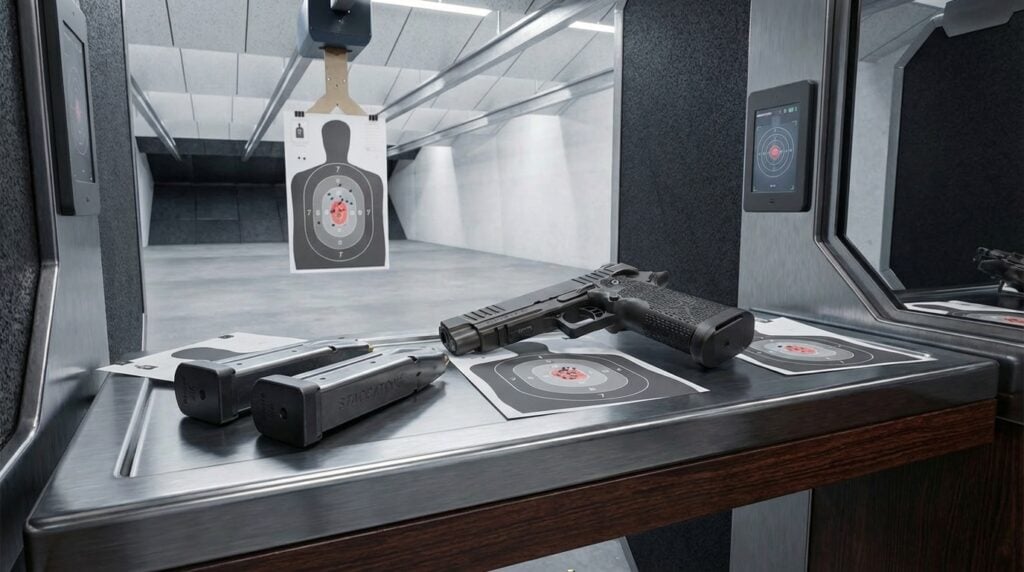
I shot five 5-round groups at 25 yards from a sandbag rest with each ammunition type. The results speak to the bull barrel’s capability.
Federal HST 147gr was the accuracy winner, averaging 1.5-inch groups with a best single group of 1.2 inches. This is outstanding for a production pistol with a 4.4-inch barrel. Speer Gold Dot 124gr +P averaged 1.8 inches. Hornady Critical Duty 135gr +P came in at 1.9 inches. The practice ammo was predictably larger: Blazer Brass 124gr averaged 2.1 inches, PMC Bronze 115gr averaged 2.3 inches, and Winchester White Box 115gr averaged 2.4 inches.
The point of impact was slightly left of center with the factory sights, about 1 inch at 25 yards. This is within the range of normal for a production gun and easily corrected with a slight drift of the rear sight. The fiber optic front was easy to pick up and consistent across different lighting conditions. Shooting at speed, I was able to keep all rounds inside a 4-inch circle at 15 yards during controlled pairs, which felt effortless thanks to the trigger and the flat-shooting 9mm recoil impulse.
Performance Testing Results
| Category | Score | Notes |
|---|---|---|
| Reliability (2,000 rds) | 9 / 10 | One FTF during break-in, flawless after 200 rounds |
| Accuracy (25 yd avg) | 9 / 10 | 1.5″ best group (HST 147gr), 2.1″ avg with practice ammo |
| Trigger Quality | 9.5 / 10 | ~4 lb SA, crisp break, short reset, improved with use |
| Recoil Management | 9 / 10 | Very flat shooting, fast follow-up shots, minimal muzzle flip |
| Sight Acquisition | 8 / 10 | Fiber optic front is fast, DPO model would score higher |
| Ergonomics | 9 / 10 | 2011 grip angle is natural, ambi safety is well-placed |
Reliability: 9/10
One malfunction in 2,000 rounds is a 99.95% reliability rate. The single failure to feed occurred during the break-in window that Staccato openly acknowledges. After round 200, the gun was completely trouble-free across six different ammunition types, including light 115gr loads and hot +P defensive rounds. For a gun marketed as duty-ready, this is exactly the kind of performance that earns agency approvals.
Accuracy: 9/10
The bull barrel and tight lockup deliver accuracy that borders on match-grade. Sub-2-inch groups at 25 yards with quality ammunition is genuinely impressive from a production pistol. The gun is more accurate than most shooters will ever be able to exploit, which is the best compliment you can pay a barrel. Only a few production guns I have tested (notably the CZ Shadow 2 and Sig X-Five) have come close to these numbers, and neither of them quite matched the HST groups.
Ergonomics and Recoil: 9/10
The 2011 grip angle is one of the platform’s greatest strengths. If you have ever picked up a 1911 and thought “this points naturally,” the Staccato P takes that feeling and adds a wider, more comfortable grip that fills the hand better. The controls are exactly where your thumb and fingers expect them. The recoil impulse with standard 9mm is mild. With +P loads, it is still very manageable. I shot 200 rounds of +P Speer Gold Dot in a single session and had zero hand fatigue.
Fit and Finish: 8/10
The DLC coating on the slide is excellent. It is hard, uniform, and shows no wear after 2,000 rounds of holster draw practice and general use. The machining on the slide serrations is clean, and the barrel hood fit is tight. Where I dock a couple of points is in the details that separate a $2,200 production gun from a true custom piece. The polymer grip module seam lines are visible if you look closely. The internal surfaces are functional but not polished. My example had a very slight burr on the inside of the magwell that I smoothed with emery cloth. These are minor things, but at this price, I notice them. Early production Staccato Ps had more frequent QC reports (trigger pin walkout was one that circulated online), but those issues appear to have been addressed in current production.
Known Issues and Common Problems
No gun review is complete without an honest look at the problems owners have reported. I track online forums, Reddit threads, and armorer feedback to give you the full picture.
Break-in period required. Staccato recommends 200 rounds of break-in, and many owners (myself included) experience minor feeding issues during this window. This is not unusual for a tightly fitted pistol, and it resolves with use. If you are buying this as a duty gun, run your break-in rounds before you trust it on shift.
Trigger pin walkout (early production). Some early Staccato P pistols experienced trigger pin migration, where the pin would slowly walk out of the frame during firing. Staccato addressed this with updated pins and improved staking in later production runs. If you buy a used early-production P, check the trigger pin. Staccato’s customer service will fix this for free.
Grip module fit tolerance. A small number of owners have reported slight play between the polymer grip module and the steel receiver. This does not affect function or accuracy, but it can be felt as a faint click if you squeeze the grip module laterally. Shimming with a thin piece of tape on the grip module rails fixes it completely if it bothers you.
Magazine cost and availability. Staccato 2011 magazines run $60 to $70 each, and third-party options are limited compared to platforms like the Glock or Sig P320. If you are used to stocking up on $20 magazines, the 2011 ecosystem will feel expensive. Budget for at least four to five magazines, which adds $200 or more to your total investment.
Light primer strikes with certain ammo. A handful of owners have reported light primer strikes with ammunition that uses harder primers (some imported brands in particular). I did not experience this with any of my six tested ammunition types, but it is worth noting. If you encounter this, a slightly stronger mainspring typically resolves it.
Parts, Accessories, and Upgrades
The 2011 aftermarket is not as vast as the 1911 aftermarket, but it has grown significantly since Staccato’s rise in popularity. Here are the upgrades worth considering, ranked by priority.
| Upgrade | Recommended Product | Est. Cost | Priority |
|---|---|---|---|
| Red Dot Optic | Trijicon RMR Type 2 (3.25 MOA) or Holosun 509T | $400 – $550 | High (DPO model) |
| Extra Magazines | Staccato 17-rd or 20-rd extended mags | $60 – $70 each | High |
| Weapon Light | Surefire X300U-B or Streamlight TLR-1 HL | $200 – $300 | High (duty/home defense) |
| Grip Module | Staccato Gen 2 grip or aftermarket stippled module | $100 – $250 | Medium |
| Magwell | Dawson Precision ICE Magwell | $80 – $120 | Medium (competition) |
| Recoil Spring | DPM recoil reduction system | $70 – $90 | Low |
| Holster | Safariland 7378 (duty) or PHLster Floodlight (concealment) | $50 – $200 | High (if carrying) |
| Trigger Work | Not needed. Factory trigger is excellent | $0 | Skip |
You can find optics, lights, and accessories at Brownells or Palmetto State Armory. For Staccato-specific parts like magazines and grip modules, ordering direct from Staccato’s website is usually the fastest option. EuroOptic is another solid source for premium optics to pair with the DPO model.
The 2011 vs. 1911 Question
If you are reading this review and wondering what exactly makes a 2011 different from a 1911, here is the short version. A 1911 is John Browning’s original single-stack design from 1911. It typically holds 7 to 8 rounds of .45 ACP (or 9 to 10 rounds of 9mm in a single-stack 9mm variant) and uses a narrow, single-stack grip frame. A 2011 takes that same operating system (single-action hammer, thumb safety, grip safety, same trigger mechanism) and wraps it in a wider frame that accepts a double-stack magazine.
The practical difference is capacity and grip width. A 2011 in 9mm holds 17 to 20 rounds versus 8 to 10 in a single-stack 9mm 1911. The grip is wider, which fills larger hands better but can be a challenge for shooters with small hands. The trigger system is identical in principle, which is why 2011 triggers feel so similar to good 1911 triggers. If you love the way a 1911 shoots but wish it held more ammunition, the 2011 is the answer that Tripp and Strayer came up with three decades ago.
The other key difference is the modular frame. Traditional 1911s are one-piece frames. The 2011 splits the frame into a serialized upper receiver and a removable grip module. This is what allows companies like Staccato and other 2011 manufacturers to offer different grip sizes and materials without changing the core fire control group.
Law Enforcement Adoption
One of the strongest arguments in the Staccato P’s favor is its growing presence in law enforcement holsters across the country. Multiple agencies, including departments in Texas, California, and several federal units, have approved the Staccato P for duty carry. This is not a marketing gimmick. Getting on an agency approved list requires extensive testing, including drop testing, round count endurance testing, and evaluation by department armorers.
The law enforcement angle matters because it validates the Staccato’s reliability claims in a way that YouTube reviews and forum posts cannot. When an agency stakes officer safety on a weapon, the testing standard is far higher than “it worked fine at the range.” Staccato has leaned into this market aggressively, offering law enforcement pricing and dedicated armorer courses. Whether this matters to you as a civilian buyer depends on your priorities, but knowing that your pistol passed duty-grade testing provides a level of confidence that price tags alone do not.
The single-action trigger has been both a selling point and a concern for some agencies. Departments that previously only authorized striker-fired guns have had to evaluate whether the 1911-style manual of arms (cocked and locked carry with a manual safety) is appropriate for their officers. The agencies that have approved it clearly decided the performance advantages of the single-action trigger outweigh the additional training requirements.
Who Should (and Should Not) Buy the Staccato P
This is a $2,200 pistol. Not everyone needs to spend $2,200 on a pistol, and I think being honest about that is more useful than pretending the Staccato P is the right gun for everyone.
Buy the Staccato P if: You are a competitive shooter who wants a production-class 2011 that can run USPSA or IDPA without modification. You are a law enforcement officer or armed professional who wants the best-shooting duty pistol available. You are a 1911 enthusiast who wants the double-stack experience without going full custom. Or you simply want the best factory trigger on a production pistol and the budget is not a concern.
Skip the Staccato P if: You are a casual range shooter who goes to the range once a month. The Sig Legion or Walther PDP Match will make you equally happy at half the cost. You are on a budget and need to factor in magazines, optics, and holster costs (add $500 to $800 on top of the gun price for a complete setup). You have small hands, as the double-stack 2011 grip can be challenging for some shooters. Or you are buying a gun primarily for concealed carry, as the Staccato C or CS models are better suited than the full-size P.
The Verdict
The Staccato P is the best production 2011 pistol on the market in 2026. That is not a controversial statement. It runs reliably, shoots accurately, and offers a trigger that makes everything else in your gun safe feel like a compromise. After 2,000 rounds, I understand why law enforcement agencies are adopting it and why competition shooters keep choosing it over traditional platforms. The gun flat-out performs.
The harder question is whether it is worth $2,200. I keep coming back to the value score of 6/10, and I think that is fair. You are paying a “2011 tax” that gets you a polymer grip module, proprietary magazines, and a limited aftermarket compared to more established platforms. A Sig P320 X-Five Legion at $900 or a Walther PDP Match Steel Frame at ~$1,800 will give you 80% to 90% of the shooting experience for 40% to 60% of the money. The last 10% to 20% of performance is where the Staccato lives, and it charges accordingly.
For shooters who demand the best and are willing to pay for it, the Staccato P delivers. For everyone else, shoot one first. Rent it at the range. Put 50 rounds through it. If the trigger and the way it tracks in recoil make you forget about the price tag, you have your answer. That is exactly what happened to me, and I do not regret the purchase. I just wish the magazines were not fifty bucks each.
Final Score: 8.5 / 10
Best for: Competitive shooters running USPSA/IDPA production divisions, law enforcement officers seeking a duty-rated 2011, full-size 9mm enthusiasts who prioritize trigger quality above all else, and 1911 fans looking to upgrade to the double-stack 2011 platform without going full custom.
Staccato P 2011 - Best Prices
What is the difference between a 2011 and a 1911?
A 2011 is essentially a double-stack version of the 1911 platform. It uses the same single-action trigger system, manual thumb safety, and grip safety as a traditional 1911, but the frame is wider to accept a double-stack magazine. This gives the 2011 significantly higher capacity (17 to 20 rounds of 9mm versus 7 to 10 in a standard 1911). The 2011 also uses a modular two-piece frame design with a separate grip module and serialized receiver, whereas a traditional 1911 has a one-piece frame.
Is the Staccato P reliable enough for duty carry?
Yes. The Staccato P has been approved for duty carry by multiple law enforcement agencies across the United States. In my 2,000-round test, I experienced only one malfunction during the recommended 200-round break-in period. After break-in, the gun was completely reliable with six different ammunition types, including +P defensive loads. Staccato recommends a 200-round break-in before trusting the gun for duty or defensive use.
What is the difference between the Staccato P and the Staccato C?
The Staccato P is the full-size model with a 4.4-inch barrel, 8.1-inch overall length, and 17+1 capacity. The Staccato C is the compact model with a 3.9-inch barrel, shorter grip, and 16+1 capacity. The C is designed primarily for concealed carry, while the P is built for duty use, competition, and home defense. Both share the same trigger system and operating principles. If concealed carry is your primary purpose, the C (or the even smaller CS) is a better fit.
Should I buy the standard Staccato P or the DPO model?
If your budget allows it, buy the DPO (Dawson Precision Optics) model. The $300 premium gets you a slide that is factory-milled for low-profile optic mounting via Dawson Precision plates on an RMR footprint. This is a cleaner and more secure mounting solution than aftermarket adapter plates. In 2026, most serious shooters are running red dot optics on their pistols, and having the gun ready for an optic from the factory avoids the cost and hassle of aftermarket slide milling later.
Is the Staccato P worth the money compared to a Sig P320 X-Five Legion?
That depends on what you value most. The Staccato P has a significantly better trigger (single-action vs. striker-fired), slightly better accuracy in my testing, and the prestige of the 2011 platform. The Sig P320 X-Five Legion costs roughly half as much, has a massive aftermarket, accepts inexpensive magazines, and is nearly as accurate in practical terms. If trigger quality is your top priority, the Staccato wins. If overall value matters more, the Sig is extremely hard to beat. I would recommend shooting both before deciding.