

Last updated September 6th 2026 · By Nick Hall. I have hunted and shot both cartridges; this comparison pulls from that range time plus published ballistic data.
Some of the links below are affiliate links, meaning at no additional cost to you, we may earn a commission if you click through and make a purchase.
Table of Contents
How we tested: Every pick here is ranked against our testing methodology. Minimum round counts, accuracy and reliability protocols, the failures that disqualify a gun.
The Short Answer
Take the .308 Winchester unless you have a specific reason not to. It does nearly everything the .30-06 does, in a shorter, lighter rifle, with more choice in guns and match ammunition. Take the .30-06 when you want heavy bullets, 200 grains and up, for elk, moose and bear, or when you already own a rifle chambered for it.
Here is the part that shortens the argument: at the bullet weights most people actually shoot, these two are within about 90 feet per second of each other. That is not a meaningful difference on an animal. The real decision is not ballistics at all, it is action length, and the section on that is the one worth reading.
.308 vs .30-06: Specs at a Glance
| Spec | .308 Winchester | .30-06 Springfield |
|---|---|---|
| Introduced | 1952 | 1906 |
| Bullet diameter | .308 in | .308 in |
| Case length | 2.015 in (51mm) | 2.494 in (63mm) |
| Common bullet weights | 150 to 178 gr | 150 to 220 gr |
| 150 gr muzzle velocity | ~2,820 fps | ~2,910 fps |
| 180 gr muzzle velocity | ~2,620 fps | ~2,700 fps |
| Action length | Short action | Long action |
| Recoil | Moderate | Moderate to stout |
| Semi-auto options | Many (M1A, AR-10, SCAR, FAL) | Fewer (M1 Garand, BAR) |
| Practical effective range | ~800 to 1,000 yards | ~800 to 1,000 yards |
Figures from published manufacturer ballistic data and ANSI/SAAMI cartridge standards, cross-checked September 2026.
Pros
- Short action means a lighter rifle
- Best match ammo and barrel selection
- Far more semi-auto platforms
Cons
- Runs out above 180 grain bullets
- Slightly less case capacity
- Less margin on the biggest game
Pros
- Pushes 200 and 220 grain bullets
- More margin on elk and moose
- Century of hunting ammo behind it
Cons
- Long action, heavier rifle
- More recoil with heavy loads
- Fewer semi-auto options
They Are Closer Than the Argument Suggests
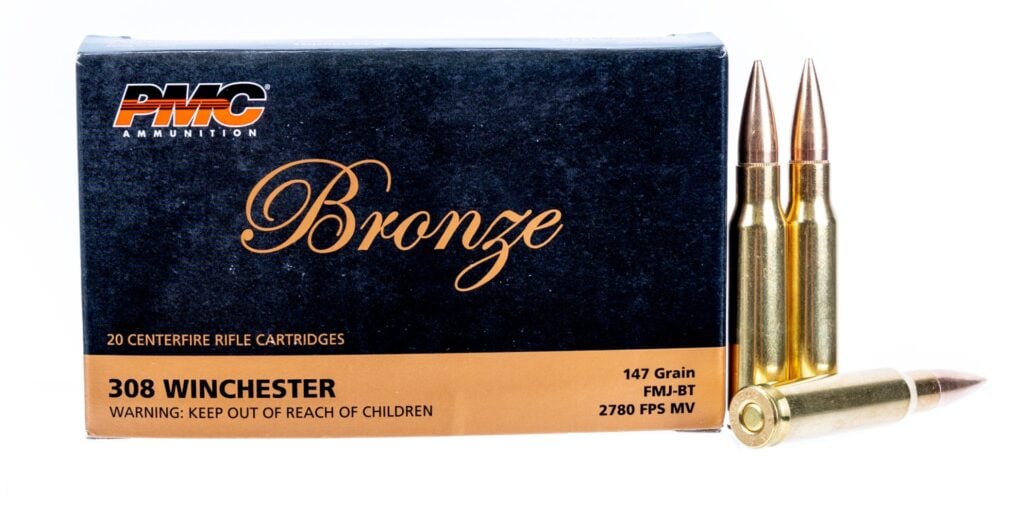
Look at the velocity rows in that table again, because they settle most of this. A 150-grain bullet leaves a .308 at roughly 2,820 fps and a .30-06 at roughly 2,910. At 180 grains it is 2,620 against 2,700. Both gaps are under 100 feet per second.
Ninety feet per second is nothing on an animal. It is inside the variation you get between two boxes of the same ammunition from different lots, and well inside the difference a cold barrel makes on the first shot of the morning. No deer, elk or paper target has ever been able to tell which one hit it at that margin.
The .30-06 has more case capacity and it does pull genuinely ahead, but only where the .308 stops: at 200 and 220 grains, which the shorter case cannot push efficiently. If you are never going to shoot a bullet that heavy, and most hunters never do, you are choosing between two cartridges that perform close enough to be interchangeable. Which is why the honest version of this comparison is about the rifle.
Short Action vs Long Action: The Real Difference
The .308 was designed to do most of the .30-06’s work in a case nearly half an inch shorter, and that shorter case is the whole point. It fits a short action, and a short action means a shorter receiver, a shorter bolt throw, and less metal. A .308 hunting rifle runs a few ounces to half a pound lighter than the same model in .30-06, and it cycles a fraction quicker because the bolt travels less.
Carry a rifle up a mountain and you notice half a pound. Work a bolt fast on a second shot and you notice the throw. Neither is dramatic, and over a long hunting career they are the reason the .308 quietly took over the space the .30-06 used to own.
The short action also decided where the precision world went. Because .308 fits actions that are stiffer for their length and easier to bed consistently, and because the military adopted it, the .308 got the match barrels, the match ammunition, the chassis systems and the semi-auto platforms. The M1A, the AR-10, the SCAR 17 and the FAL all run .308. The .30-06’s semi-auto list is essentially the M1 Garand and the BAR, both of which are historical rather than current choices.
Is 7.62 NATO the Same as .308 Winchester?
This comes up constantly, so here is the straight answer. The .308 Winchester and 7.62×51 NATO are dimensionally close enough to be treated as the same size, and most modern commercial .308 rifles fire 7.62 NATO without trouble. They are not technically identical. The military round is loaded to a slightly lower pressure spec and its brass is often thicker, which means a bit less internal capacity.
The practical takeaway: shooting 7.62 NATO in a quality modern .308 chamber is routine. Going the other way, firing full-pressure commercial .308 in an older military 7.62 chamber, is where people get cautious, because chamber and headspace tolerances on surplus rifles vary. When there is any doubt, follow your rifle manufacturer’s guidance rather than internet consensus.
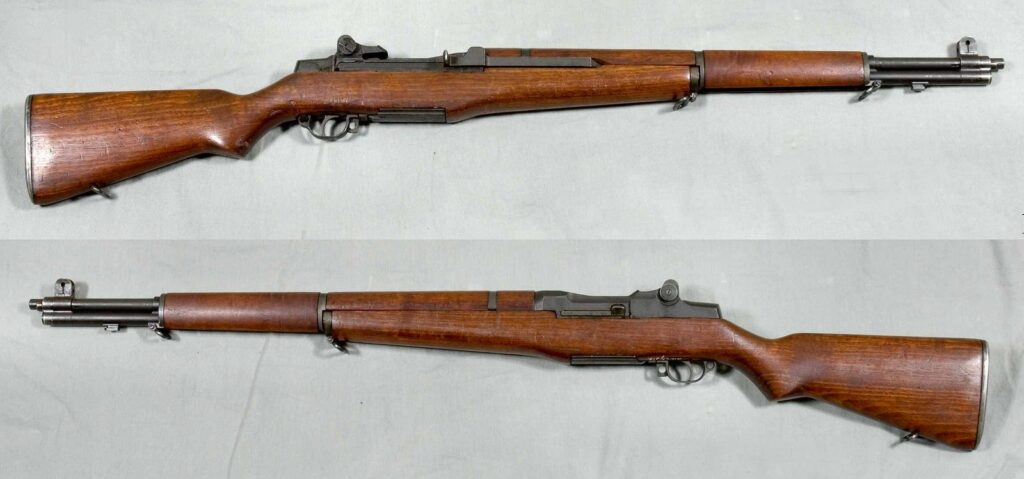
The .30-06 has a related rule of its own, and it catches people out on the M1 Garand specifically. The Garand’s gas system was designed around 1940s-era powders, and modern commercial hunting loads, especially heavy ones, can generate enough gas port pressure to bend the operating rod. Garand shooters either buy ammunition loaded for the rifle or fit an adjustable gas plug. It is a real thing, not a myth, and it is worth knowing before you feed a family heirloom with whatever was on the shelf.
Heavy Bullets and Big Game
This is where the .30-06 earns its keep and the only place the gap is real. Its longer case pushes 200 and 220-grain bullets at useful velocity, which the .308 cannot do efficiently. On elk, moose and bear, that heavy bullet penetrates through heavy bone and thick muscle with margin the lighter loads do not have.
Be honest with yourself about whether you will use it. A great many .30-06 rifles have never had anything heavier than a 180-grain factory load through them, and for that hunter the ’06 is a slightly heavier rifle delivering .308 performance. If elk and moose are genuinely on your calendar, buy the ’06 and buy the heavy premium bullets to go with it. If they are a someday, the .308 with a good 180-grain load covers everything you will actually shoot.
Recoil
Both are moderate and neither should scare anybody off. At matched bullet weights the .30-06 recoils a little harder because it burns more powder to make slightly more velocity, and at 150 or 165 grains that difference is small enough that rifle weight and stock fit matter more than the headstamp does.
Load the ’06 with 200 or 220-grain bullets and the gap opens properly. That is the load where you feel you are shooting a bigger cartridge, and it is also the load that justifies owning one. There is a neat symmetry to it: the .30-06’s advantage and its recoil penalty arrive in the same box of ammunition.
Accuracy, Barrel Life and Ownership
Both are accurate cartridges and neither has an inherent precision advantage in a quality rifle. The .308 has a reputation for accuracy that is real but partly circumstantial: it got the match ammunition, the match barrels and the competition attention, so more accurate .308 rifles exist because more people built them.
Barrel life is generous on both. Neither is an overbore magnum, so a hunting rifle in either chambering will outlast most owners’ interest in it, and a hard-used match .308 barrel still measures its life in thousands of rounds rather than hundreds. This is not a differentiator, and if someone tells you it is, they are selling something.
Ownership is easy on both too, and this is worth weighing against fashionable new cartridges. Every gun shop in America stocks .308 and .30-06 hunting ammunition, including the small-town hardware store you end up in when the airline loses your rifle case. Rings, bases, dies and used rifles are everywhere for both. That boring availability is worth more on a hunt than a hundred feet per second, and it is something the newest short magnum on the shelf cannot offer you yet.
What They Cost to Shoot
Close, with a small edge to the .308. Across the retailers we track as I write this, .308 Winchester from a trusted seller starts around $1.23 a round and .30-06 starts near $1.25. That gap is noise.
Where the .308 pulls ahead is at the cheap end and the precise end simultaneously. Surplus and bulk 7.62 NATO gives it a practice-ammo tier the .30-06 has no equivalent for, and match-grade .308 is made by everybody because of the competition market. The ’06 sits in the middle: plenty of good hunting ammunition, less bulk plinking, less match. Our best .308 ammo guide covers the loads worth buying. Both cards below pull live prices so you can check the current spread yourself.
Reloading and Handloading
Both are excellent to reload and both have deep published load data. The .308 has an edge in brass availability and consistency, because so much of it is made for match shooting and because once-fired 7.62 NATO brass is everywhere and cheap. The shorter case is also slightly more forgiving of powder charge variation, which is part of why it has an accuracy reputation.
The ’06 rewards handloading differently. Its extra case capacity means a handloader can tailor heavy-bullet loads that no factory offers in useful variety, which is exactly the .30-06’s strong suit. If you reload and you hunt big animals, the ’06 gives you more to work with. If you reload for precision, the .308 gives you more to start from.
One caution that applies to both and to the ’06 in particular: work up from published starting loads and never chase the last fifty feet per second. The whole argument on this page is that ninety fps changes nothing on an animal, and that cuts both ways. There is no prize for running a hot load in a cartridge that already does the job, and a stiff bolt lift on a cold morning in elk country is a bad time to learn where your pressure limit was.
Best First Big-Game Rifle
The .308, for most people. A lighter rifle you can carry, in a chambering with the widest selection of guns, ammunition and optics packages, doing everything a first big-game hunter needs. You are giving up the heavy-bullet ceiling and you are not going to hit it in your first few seasons.
The exception worth naming: if you already have a .30-06 in the family, shoot it. A rifle you have and know beats a marginally better cartridge you have to buy, and the performance difference at normal hunting weights is not big enough to justify replacing a working rifle. Our best .30-06 rifles guide covers the current options if you want one anyway.
My Recommendation
Choose the .308 Winchester if…
You want a lighter rifle, the widest choice of guns and ammunition, or any interest in precision shooting or a semi-auto. You hunt deer, hogs and the occasional elk with premium 180-grain bullets. You reload for accuracy. This covers most hunters and effectively all target shooters, and our best sniper rifles guide shows where it sits at the precision end.
Choose the .30-06 Springfield if…
You want 200 to 220-grain bullets for elk, moose or bear and you will actually buy them. You already own one. You like the history and you want the cartridge that has taken more North American game than anything else. All good reasons, and the first one is the only one that is about performance.
If you are still torn, here is the tiebreaker I would use. Walk into a shop, pick up the same rifle model in both chamberings, and shoulder them. The .308 will be the shorter, lighter one. If that difference matters to how you hunt, take it, because the ballistic difference will not matter at all. And if you want the tier down, our .223 vs .308 and .270 vs .30-06 comparisons cover the neighbours.
.308 Winchester Ammo: Live Prices


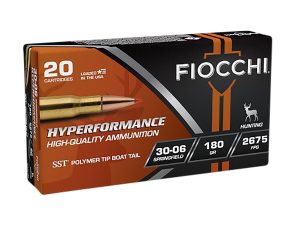
.30-06 Springfield Ammo: Live Prices


FAQ: .308 vs .30-06
Is the .308 or .30-06 more powerful?
The .30-06 is slightly more powerful because its larger case holds more powder, giving about 80 to 100 fps more velocity with the same bullet weight and the ability to drive heavier 180 to 220 grain bullets. With standard 150 to 165 grain hunting bullets the difference is small.
Is the .308 good for elk?
Yes, the .308 is effective on elk with good 165 to 180 grain bullets at reasonable ranges. The .30-06 has a slight edge for elk because it drives heavier bullets faster, which helps on big bone at distance, but well-placed .308 shots take elk every year.
Why is the .308 more popular for precision shooting?
The .308 has a short, efficient case that meters powder consistently and is easy to load accurately, and it fits short-action rifles. It became the military sniping and competition standard, so the precision ecosystem of rifles, barrels and match ammo is built around it.
Can a .30-06 shoot .308 ammo?
No. They are different cartridges with different case lengths and are not interchangeable. A .308 round will not chamber and fire safely in a .30-06 rifle or vice versa. Always shoot only the cartridge stamped on your barrel.
Which has less recoil, .308 or .30-06?
The .308 recoils a little less because it burns less powder, especially compared to the heavy 180 to 220 grain .30-06 loads. Felt recoil also depends on rifle weight, so a light .308 can kick as much as a heavier .30-06.
Is the .30-06 obsolete?
Not at all. The .30-06 remains one of the most versatile and widely available big-game cartridges in North America, with an enormous selection of hunting loads. It is over a century old and still an excellent choice, especially for the largest game.
How much faster is the .30-06 than the .308?
Less than the argument suggests. At 150 grains the .308 runs about 2,820 fps against roughly 2,910 for the .30-06, and at 180 grains it is about 2,620 against 2,700. Both gaps are under 100 feet per second, which is inside the variation between two lots of the same ammunition and well inside what a cold barrel does to your first shot. The .30-06 only pulls genuinely ahead at 200 and 220 grains, which the shorter .308 case cannot push efficiently and which most hunters never buy.
Can I shoot 7.62 NATO in a .308 rifle?
In a quality modern commercial .308 chamber, yes, and it is routine. The two are dimensionally close enough to be treated as the same size, though the military round is loaded to a slightly lower pressure spec with thicker brass. The direction that needs caution is the reverse: firing full-pressure commercial .308 in an older military 7.62 chamber, where headspace tolerances on surplus rifles vary. When there is any doubt, follow your rifle manufacturer's guidance.
Is there anything special about feeding an M1 Garand?
Yes, and it catches people out. The Garand's gas system was designed around 1940s-era powders, and modern commercial hunting loads, especially heavy ones, can generate enough gas port pressure to bend the operating rod. Garand shooters either buy ammunition loaded specifically for the rifle or fit an adjustable gas plug. It is a real mechanical issue rather than a myth, so check before feeding a family heirloom with whatever .30-06 was on the shelf.
3,979+ Gun & Ammo Deals
Updated daily from 200+ top retailers. Filter by category, caliber, action type, and price.
Related Guides