
Last updated March 18th 2026
Some of the links below are affiliate links, meaning at no additional cost to you, we may earn a commission if you click through and make a purchase.
- Treat every gun as loaded
- Point the muzzle in a safe direction
- Keep your finger off the trigger until you’re ready to shoot
- Know your target and what’s beyond

Is a .357 Magnum Good for Home Defense?
Short answer: yes, with caveats. The .357 Magnum is one of the most effective handgun cartridges ever designed for stopping a threat. It has decades of real-world data backing its terminal performance, and in the right configuration, it’s an excellent home defense option.
But “right configuration” is the key phrase, because a .357 Magnum fired indoors from a short barrel comes with noise, muzzle blast, and over-penetration concerns that you need to understand before choosing it for home defense.
This guide covers the pros and cons of using a .357 Magnum for home defense, the over-penetration reality, why most .357 owners should load .38 Special +P for home use, and which specific guns and loads work best. For the full revolver lineup, see our 10 best .357 Magnum revolvers.
Why the .357 Magnum Works for Home Defense
The .357 Magnum has one of the strongest track records in real-world defensive use. In the era before modern 9mm hollow points, the .357 Magnum was the gold standard for law enforcement stopping power.
The famous 125gr JHP at 1,450 fps from a 4″ barrel had some of the best one-shot-stop statistics of any handgun cartridge ever documented. While those exact statistics are debated, the .357 Magnum’s terminal effectiveness is not.
A .357 Magnum revolver also has the operational advantage that revolver fans love: absolute simplicity. Pick it up, pull the trigger, it fires. No slide to rack, no safety to disengage, no magazine to seat. For someone who keeps a home defense gun in a biometric safe and may not practice regularly, a revolver’s simplicity is a genuine advantage in a 3 AM panic situation.
And the .357 Magnum’s dual-caliber capability is a major advantage. You can load .38 Special or .38 Special +P for reduced recoil and noise, or load .357 Magnum for maximum stopping power. That flexibility lets you choose the right load for your specific living situation.
The Over-Penetration Problem
Full-power .357 Magnum rounds penetrate. A lot. A 158gr JSP .357 load can punch through multiple layers of drywall and still retain lethal energy. In an apartment or a house with thin interior walls and family members sleeping in adjacent rooms, that’s a serious concern.
You are responsible for every round you fire, and a round that passes through an intruder and then through two walls into your kid’s bedroom is not an acceptable outcome.
The over-penetration risk varies dramatically by ammunition type. Full metal jacket and hard-cast .357 loads are the worst offenders and should never be used for home defense.
Quality hollow points (like Speer Gold Dot, Federal HST, or Hornady Critical Defense) expand reliably and dump their energy into the target, dramatically reducing the risk of through-and-through penetration. But even expanding .357 Magnum loads penetrate more than expanding 9mm loads in most testing.
This is the strongest argument for loading your home defense .357 with .38 Special +P instead of full-power Magnum loads. A good .38 Special +P hollow point (like the Speer Gold Dot Short Barrel 135gr) achieves 12 to 15 inches of penetration in ballistic gel, which is within the FBI standard, with significantly less risk of exiting the target and continuing through your walls.
You give up some velocity and energy compared to .357 Magnum, but you gain a margin of safety that matters inside a house.
Noise and Muzzle Blast Indoors
Nobody talks about this enough. A .357 Magnum fired indoors without hearing protection will cause immediate, potentially permanent hearing damage.
We’re talking 164+ dB from a 4″ barrel in an enclosed room. For reference, the threshold for pain is 125 dB, and permanent hearing damage begins at 140 dB. A .357 Magnum in a hallway will disorient you, your family members, and possibly the intruder. The muzzle flash from a short barrel in the dark will temporarily blind you.
.38 Special +P is significantly quieter (roughly 152 to 156 dB from a 4″ barrel). Still painfully loud without protection, but the difference between 156 dB and 164 dB is significant when it comes to disorientation and hearing damage. The reduced muzzle blast also means less flash in low light, which helps you maintain visual awareness of the threat.
For this reason alone, many experts recommend loading a home defense .357 Magnum revolver with .38 Special +P rather than full-power Magnum loads. You get 90% of the terminal effectiveness with significantly less blast, flash, and hearing damage risk.
Best .357 Magnum Loads for Home Defense
If Loading .38 Special +P (Recommended for Most Homes)
- Speer Gold Dot Short Barrel 135gr +P: The gold standard for snub-nose revolvers. Designed specifically for reliable expansion from short barrels. 12 to 14 inches of penetration.
- Federal HST Micro .38 Special +P 130gr: Excellent expansion and penetration from short to medium barrels.
- Hornady Critical Defense .38 Special +P 110gr FTX: The FTX bullet tip prevents hollow point clogging through heavy clothing. Reliable expansion from all barrel lengths.
If Loading .357 Magnum (Rural Homes, No Adjacent Bedrooms)
- Speer Gold Dot .357 Magnum 135gr: Designed to expand at Magnum velocities. Good balance of expansion and penetration.
- Hornady Critical Defense .357 Magnum 125gr FTX: Controlled expansion, lighter recoil than 158gr loads.
- Federal HST .357 Magnum 158gr: Maximum expansion and energy. Use only when over-penetration is not a concern.
For our complete ammunition guide, see best .357 Magnum ammo. For the broader self-defense ammo picture, see best defensive ammo.
Best .357 Revolvers for Home Defense
For home defense specifically, a medium to full-size .357 Magnum revolver with a 4″ to 6″ barrel is ideal. The longer barrel gives you better velocity, reduced muzzle blast, a longer sight radius for accuracy, and more weight to absorb recoil. Concealability doesn’t matter for a gun that lives in your nightstand safe.
- S&W 686 Plus (4″): 7-round capacity, L-frame absorbs recoil well, adjustable sights, excellent trigger. The best all-around .357 for home defense.
- Ruger GP100 (4.2″): 6 rounds, overbuilt for durability, best value. The tank option.
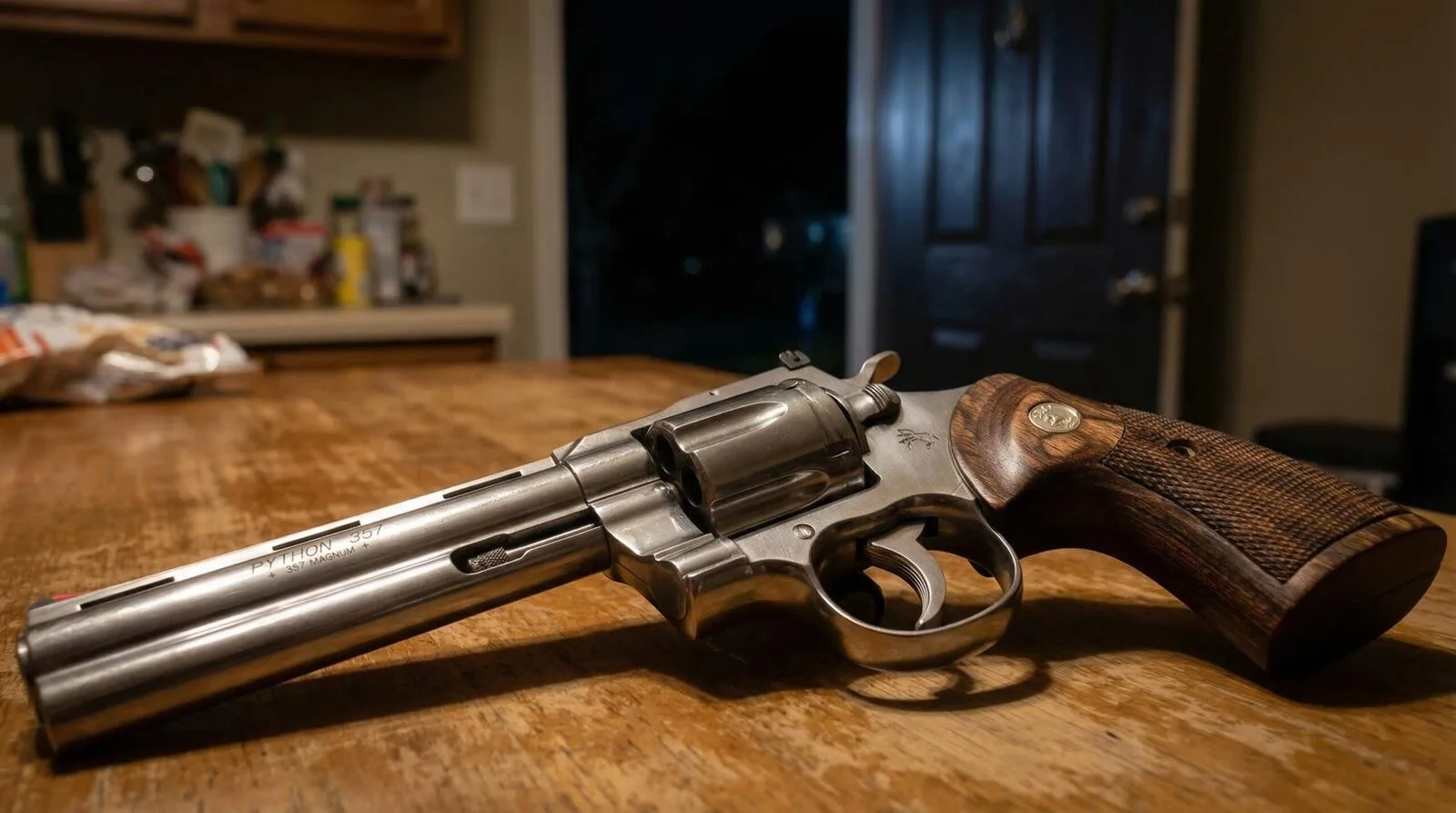
- Colt Python (4.25″): 6 rounds, the finest trigger available, premium pricing. The luxury option.
Add a weapon light (Streamlight TLR-6 or similar) for target identification in the dark. This is non-negotiable for a home defense gun. See our best guns for home defense and home defense strategies guides for the complete picture.
.357 Magnum vs Other Home Defense Options
Is the .357 the best home defense option? It depends on your situation. A full-size 9mm with 15+ rounds and a weapon light is objectively more practical (more ammo, faster reloads, less recoil). A 12-gauge shotgun is more devastating at close range. An AR-15 offers 30 rounds of 5.56 with less wall penetration than both .357 Magnum and buckshot. See our shotgun vs AR-15 comparison.
The .357 Magnum revolver makes sense for home defense when: you prefer revolver simplicity, you’re comfortable with 5 to 7 rounds, you appreciate the dual-caliber flexibility of loading .38 Special for reduced blast, and you’re willing to practice enough to be accurate with a DA revolver under stress. For those shooters, a quality .357 loaded with .38 Special +P is an excellent bedside gun.
The Bottom Line
The .357 Magnum is a proven, effective home defense cartridge with one critical caveat: most people should load their home defense .357 with .38 Special +P, not full-power Magnum loads. The reduced blast, flash, and over-penetration risk make .38 +P the smarter choice for indoor use, while the revolver itself gives you the option to load .357 Magnum when the situation calls for it. Pick a 4″ or longer barrel, add a weapon light, load quality hollow points, and practice your trigger pull. It’s not the highest-capacity option, but it’s one of the most reliable.
FAQ: .357 Magnum for Home Defense
Is a .357 Magnum too powerful for home defense?
Full-power .357 Magnum can over-penetrate through interior walls, creating a risk to family members in adjacent rooms. However, the revolver's dual-caliber capability is the solution: load .38 Special +P for home defense to get effective terminal performance with significantly less penetration, noise, and muzzle blast. The .357 Magnum capability remains available for specific situations where maximum power is needed.
Should I use .38 Special or .357 Magnum for home defense?
For most home defense situations, .38 Special +P is the better choice. Quality .38 +P hollow points like Speer Gold Dot Short Barrel 135gr achieve FBI-standard penetration (12 to 15 inches) with less over-penetration risk, less noise (roughly 8 dB quieter), and less muzzle flash than .357 Magnum. Use .357 Magnum loads only in rural settings where over-penetration is not a concern.
Will a .357 Magnum go through walls?
Yes. Full-power .357 Magnum rounds, especially FMJ and hard-cast loads, will penetrate multiple layers of standard interior drywall and remain lethal. Quality hollow point ammunition reduces this risk significantly by expanding on impact and dumping energy into the target. .38 Special +P hollow points penetrate even less. Never use FMJ or hard-cast ammunition for home defense.
What is the best .357 Magnum revolver for home defense?
The Smith and Wesson 686 Plus with a 4-inch barrel is the best overall choice: 7-round capacity, manageable recoil from the L-frame, adjustable sights, and an excellent trigger. The Ruger GP100 with a 4.2-inch barrel is the best value option. For bedside use, choose a 4-inch or longer barrel for reduced muzzle blast and better accuracy over a snub-nose.
Author

Related Guides