

Last updated September 2026 · By Nick Hall. Reviewed against Massad Ayoob’s In the Gravest Extreme (1980) and Deadly Force (2014), Tom Givens’s training curriculum at Rangemaster, the FBI’s modern ammunition testing protocol, and Greg Ellifritz’s compiled defensive-shooting statistics.
Some of the links below are affiliate links, meaning at no additional cost to you, we may earn a commission if you click through and make a purchase.
Table of Contents
How to Choose a Gun for Self-Defense
“What is the best gun for self-defense” is the most common question new buyers ask and the most overrated question to ask first. The honest answer is that the best gun depends on a decision matrix, your mission, your body type, your home layout, your training cadence, your budget, and the laws of your state, that has between three and ten meaningful inputs. Most buyers default to whatever their friend at the range shoots, or whatever the gun store clerk happens to be enthusiastic about that week, and end up with a setup that does not match their actual situation. The result is usually a pistol that lives in a safe.
This guide walks through the decision in roughly the order it should be made: define the mission first, choose the platform second, choose the specific model third, choose the caliber fourth, choose the storage and access setup fifth, and commit to the training cadence sixth. None of those choices is independent of the others. A defensive handgun setup for a 5’4″ woman with arthritis who lives alone in a small apartment is not the same setup as one for a 6’2″ police veteran with a family of five in a rural home, and treating the question as if there is a universal answer is the single most common mistake the gun industry makes.
Sources cited throughout: Massad Ayoob’s In the Gravest Extreme (1980) and Deadly Force (2014); Tom Givens’s training curricula and incident-data analysis at Rangemaster; the FBI Handgun Wounding Effectiveness Studies (1989) and the 2014 Ammunition Solicitation testimony returning the agency to 9mm; Greg Ellifritz’s An Alternate Look at Handgun Stopping Power (2011); ANSI/SAAMI cartridge specifications; and the experience of instructors who have trained tens of thousands of armed citizens on the practical question of how their gun choices held up under stress.
Self-Defense Platform Matrix at a Glance
The table below maps the major self-defense firearm platforms to the missions they actually do well at. Reading the table top to bottom shows you the platform; reading it left to right shows you the trade-offs. The platform that wins every column does not exist. The platform that wins the columns that matter to your specific situation is the platform to buy.
| Platform | Home defense | Concealed carry | Cost (typical) | Training threshold | Best for |
|---|---|---|---|---|---|
| Full-size 9mm pistol | Excellent | Poor (hard to conceal) | $450-$700 | Moderate | Home-defense primary, range gun, duty use |
| Compact 9mm (Glock 19 class) | Excellent | Good | $450-$650 | Moderate | Dual-purpose home + carry, all-day comfort |
| Subcompact 9mm (P365 class) | Good | Excellent | $500-$700 | Higher (smaller pistols are harder) | Deep concealment, athletic builds, t-shirt carry |
| .38 Special revolver | Good | Adequate | $400-$800 | Low | Limited hand strength, simple manual of arms, retired/elderly |
| .380 ACP subcompact | Moderate | Excellent (deepest conceal) | $300-$550 | Moderate | Pocket carry, dress-up concealment, backup gun |
| 12-gauge shotgun | Outstanding | N/A | $350-$900 | Moderate (recoil, manual of arms) | Stationary home defense, intimidation factor |
| AR-15 / 5.56 carbine | Excellent | N/A | $600-$1,500 | Higher (more controls) | Home defense, rural property, multi-attacker |
| Pistol-caliber carbine (9mm PCC) | Very good | N/A | $500-$900 | Lower than AR-15 | Suppressor-friendly HD, recoil-sensitive shooters |
Step 1: Define Your Mission
The single most consequential decision a self-defense buyer makes is also the one most often skipped. What is the gun actually for? The answers fall into roughly four categories: concealed carry primary, home defense primary, both (the dual-purpose pistol), and specialized use cases like vehicle carry or backup gun. Each of these missions has a different right answer, and the buyer who tries to optimize for all of them simultaneously typically ends up with a pistol that does none of them well.
For concealed carry primary, the constraint is concealability under realistic clothing eighteen hours a day. The compact 9mm class (Glock 19, S&W M&P 9 Compact, Walther PDP Compact) is the dominant answer for most body types in most climates. The subcompact class (SIG P365 family, S&W Shield Plus, Hellcat, Glock 43X) wins for deeper concealment, smaller body types, and warm-weather t-shirt carry. The full-size 9mm class is rarely the right CCW primary except for athletic builds in cold-weather climates with cover garments. The full CCW cluster sits in best concealed carry handguns and the concealed carry guide.
For home defense primary, the constraint is decisive engagement at five to fifteen yards inside a residential structure. Here the calculus flips. A pistol is the bare minimum; a shotgun or rifle delivers far more capability per shot, particularly against multiple attackers or barriers. The 12-gauge pump-action shotgun loaded with low-recoil 00 buckshot remains the most common American home-defense long gun. The AR-15 in 5.56 NATO is now equally common and offers significant capacity and follow-up advantages. The 9mm pistol-caliber carbine occupies a useful middle ground. The full taxonomy is in best guns for home defense and shotgun vs AR-15 for home defense.
For dual purpose, the compact 9mm class is the right answer for nearly every buyer. A Glock 19, M&P 9 M2.0 Compact, or P365XL conceals well enough for daily carry and shoots accurately enough for serious home-defense use. The one-pistol-for-both-missions setup is the cleanest practical choice and the one most experienced instructors recommend for the typical American buyer. The deeper case for the dual-purpose pistol, and the manual-of-arms benefit of using the same platform in both contexts, is the strongest argument against the “different gun for different mission” approach that gun stores tend to push.
Self-Defense Handguns: Your Primary Options
The American defensive handgun market has converged on five practical categories. The full-size striker-fired 9mm (Glock 17, M&P 9 M2.0 Full-Size, SIG P320 Full, Walther PDP Full, FN 509) carries 15-17 rounds, has the longest sight radius, and is the easiest to shoot well. The compact striker-fired 9mm (Glock 19, M&P 9 M2.0 Compact, PDP Compact, Springfield Hellcat Pro) carries 15+ rounds in a frame that conceals well for most carriers. The subcompact 9mm (SIG P365 family, Shield Plus, Hellcat, Glock 43X) carries 10-15 rounds in the smallest practical frame for serious defensive carry. The .380 ACP subcompact (Ruger LCP MAX, S&W Bodyguard 2.0, SIG P365-380) carries 10-13 rounds in the smallest concealment package available. And the revolver.38 Special or .357 Magnum, remains a legitimate choice for specific use cases.
The current market leader in essentially every category is Glock, with SIG Sauer and Smith & Wesson the closest competitors. The Glock 19 is the most-carried defensive handgun in America by a wide margin. The Glock 17, 19, and 43X cover the full-size, compact, and subcompact slots respectively, and the manual-of-arms consistency between them is a serious training advantage for buyers who eventually own more than one. The full Glock landscape is in best Glock pistols; the current Gen 6 of the Glock 19 specifically in our Glock 19 Gen 6 review. The competing SIG Sauer M17/M18 (civilian P320) market is in our 1,500-round M18 / P320 review; the Smith & Wesson alternatives in the M&P 2.0 Compact review.
The revolver case deserves its own paragraph. The double-action revolver in .38 Special, particularly the Smith & Wesson J-frame, Ruger LCR, and Colt Cobra, is the right choice for buyers with limited hand strength, those who cannot reliably manipulate a semi-automatic slide, those who want the simplest possible manual of arms (no slide release, no magazine, just point and pull), and those whose use case involves rare practice rather than ongoing training cadence. The trade-offs are real: five or six rounds versus 13-17, slower reload, harder trigger pull. But for the right user, the revolver is the better choice. The cluster on revolvers sits in best revolvers and best .38 Special revolvers; the 9mm revolver category, increasingly viable with modern moon-clip designs, in best 9mm revolvers.
Shotguns and Rifles for Self-Defense
For home defense specifically, not for concealed carry, the case for a long gun over a pistol is strong. A 12-gauge shotgun delivers seven to nine pellets of 00 buckshot per shot, each approximately the diameter of a 9mm bullet, producing the most decisive single-shot terminal effect available to the American civilian. The AR-15 in 5.56 NATO delivers 28-30 rounds of intermediate-cartridge precision capability with less over-penetration than typical pistol ammunition (the 5.56 round fragments rapidly in soft tissue and drywall in ways the 9mm does not). The pistol-caliber carbine in 9mm threads the needle: lower recoil than a 12-gauge, more capacity than a shotgun, and shares ammunition and magazines with the house pistol.
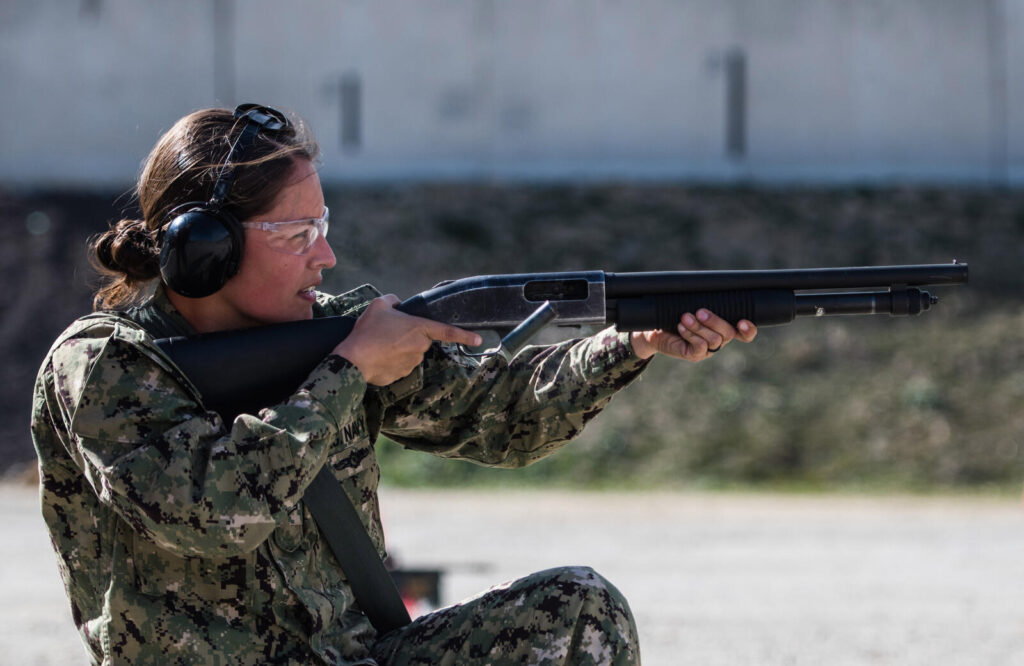
The 12-gauge pump-action shotgun, Mossberg 500/590, Remington 870, Benelli Nova, Beretta 1301, is the traditional American home-defense long gun for good reason. The intimidation factor of a pumped shotgun action is documented in numerous defensive-shooting accounts. The terminal effect at home-defense distances is unmatched. The trade-offs are recoil (substantial, particularly for smaller shooters), capacity (typically 5+1 to 7+1 in standard configurations), and a manual of arms that requires practice. Low-recoil buckshot loads, Federal Premium Personal Defense, Hornady Critical Defense 12ga, have made the 12-gauge significantly more accessible to recoil-sensitive shooters than the 1990s loads were. See best shotguns for home defense and the ammunition discussion in home defense shotgun: slugs vs buckshot; the pump-action category in best pump-action shotguns.
The AR-15 is the modern alternative. Lower recoil than the shotgun, dramatically higher capacity (28-30 rounds standard), faster follow-up shots, longer effective range, and a wide accessory ecosystem (optics, weapon lights, suppressors). The 5.56 NATO cartridge’s reputation for excessive penetration through interior walls is largely backwards: ballistic gel and drywall testing consistently shows 5.56 fragmenting in fewer interior walls than 9mm hollow-points or 00 buckshot. The case for the AR-15 as a home-defense primary has strengthened materially over the last decade. The full AR-15 buyer’s landscape is in best AR-15 rifles and the ammunition discussion in best AR-15 ammo. The trade-off analysis between the two long-gun options lives in shotgun vs AR-15 for home defense.
Caliber: What Actually Matters
The caliber question gets vastly more internet attention than it deserves. Modern 9mm hollow-point defensive ammunition matches .40 S&W and .45 ACP in FBI-protocol penetration and expansion. The 9mm wins on capacity (15-17 rounds vs 12-14 for .40 and 8-10 for .45), on recoil (notably lower), on cost (30-40% cheaper per round), on platform availability (every major manufacturer builds 9mm; .45 is shrinking), and on follow-up shot speed. The .380 ACP, with modern Federal HST Micro and Hornady Critical Defense loads, meets the FBI gel-protocol threshold and is a legitimate choice for deep-concealment subcompacts. The full caliber-comparison treatment sits in why does everybody use 9mm.
What actually matters more than caliber is that you have personally fired at least 200 rounds of your chosen defensive load through your specific pistol without a malfunction. This is the function-test threshold every serious instructor teaches and every casual buyer skips. A 9mm pistol that runs 200 rounds of Federal HST without a hiccup is more useful than a .45 ACP pistol that chokes once every 300 rounds. Reliability beats caliber. Capacity beats caliber. Trigger control beats both. The full coverage of defensive ammunition sits in best defensive ammo and the 9mm-specific rotation in best 9mm ammo.
What to Look for in a Self-Defense Gun
Five attributes matter for a defensive firearm, and they should be evaluated in this order: reliability, ergonomic fit, sights, trigger, and accessory compatibility. Reliability comes first because all the other attributes are negotiable around an unreliable gun, a pistol that fails to feed once every 200 rounds is not a defensive firearm regardless of how well it shoots when it does work. The reliability test is empirical: run 500 rounds of your chosen practice ammunition plus 200 rounds of your chosen carry load. If you get zero malfunctions across that 700-round window, the platform is reliable enough. If you get more than one, find a different platform or send the pistol back.
Ergonomic fit is second because a pistol that does not fit your hand will never shoot well, no matter how well-engineered it is. The trigger reach (distance from the back of the grip to the trigger face) must allow your trigger finger to contact the trigger at the pad, not the tip and not the joint. The grip circumference must allow your firing hand to wrap around fully without straining. The control reach (slide release, magazine release, safety if equipped) must be reachable without breaking grip. SIG’s P320 and Glock’s interchangeable backstraps have made grip fitting dramatically more flexible than the fixed-frame era; even the M&P Shield Plus and Hellcat now come with multiple backstraps. Buy the gun that fits, not the gun that shoots best for someone else.
Sights, trigger, and accessory compatibility are tertiary but real. Modern factory iron sights are usable; aftermarket night sights or fiber-optic fronts are a $100-200 upgrade that pays back in low-light visibility. Trigger quality varies materially between platforms and within them; the Glock factory trigger is the floor against which other striker-fired pistols compete. Optic-cut slides for red-dot sights have become standard in the last five years, if you are buying new in 2026, get an optic-ready model even if you are not yet a red-dot shooter. The full red-dot coverage is in best red dot sights for pistols; the related accessory ecosystem in the concealed carry guide.
Storage, Access, and Home Security
The defensive firearm has to be accessible in the situation that demands it and secure in all other situations. These two requirements conflict, and most American gun owners resolve the tension by failing on one or both sides. A pistol locked in a thumbprint-keyed gun safe in the master closet is more secure than accessible. A pistol on the nightstand is more accessible than secure. The right answer for most homes is a biometric-locked rapid-access safe within arm’s reach of where you sleep, with a separate long-gun safe for everything else.
The biometric safe market has matured since 2018. Vaultek, SecureIt, GunBox, and Hornady make rapid-access biometric safes that open in roughly one second to a registered fingerprint and offer multiple backup access methods (PIN code, mechanical key). The price range for a competent unit is $200-450. The cluster on biometric storage sits in best biometric gun safes; the concealment-furniture market for hiding firearms in plain sight in best concealed gun safes.
The single most-neglected aspect of home defense is the security of the rest of the house. The defensive firearm is the last line, not the first or middle. Hardened entry points (deadbolts, reinforced strike plates, exterior doors with steel reinforcement), exterior lighting, a working alarm system, and a neighborhood-watch awareness all sit between the attacker and the gun. A defensive layout that depends on the gun alone is a defensive layout that has skipped the cheaper, lower-stress steps that resolve most threats before they ever reach the bedroom door. The deeper case for layered home defense sits in home defense strategies with firearms.
Training and Legal Preparation
The firearm purchase is the beginning of the project, not the end. Training is what converts the purchased pistol into a useful defensive tool, and the gap between “owns a gun” and “carries a usable defensive capability” is roughly a hundred hours of structured practice. The serious training cadence: a multi-day defensive pistol course every twelve to eighteen months from a serious instructor (Tom Givens at Rangemaster, Massad Ayoob Group, Gunsite, Thunder Ranch), one USPSA or IDPA match per month, three to five minutes of dry fire daily, and one range session per month with a deliberate practice plan rather than ad-hoc plinking.
Legal preparation matters as much as physical preparation. The ethical and legal frameworks that govern when force can be used vary enormously by state, and the carrier who has not studied the framework before the encounter is the carrier who pays for the gap afterwards. The cluster on the moral and legal dimensions sits in the ethics of lethal force in self-defense, with the state-by-state legal frame in what is self-defense with a gun: the laws, the post-incident dimension in legal issues after a defensive shooting, and the financial hedge in why you need concealed carry insurance now. The training cluster sits in firearms training: why you must get better and the daily-carry discipline in concealed carry tips and techniques.
The Bottom Line
The right self-defense firearm for the typical American buyer, in 2026, is a compact 9mm striker-fired pistol from a major manufacturer (Glock 19 / 19X, S&W M&P 9 M2.0 Compact, SIG P320 Compact, Walther PDP Compact, or the optic-ready variants of any of these). It is followed by a 12-gauge pump shotgun or an AR-15 for home defense, depending on the household. It is supported by a biometric rapid-access safe within arm’s reach of the bed. It is fed with FBI-protocol-passing defensive ammunition (Federal HST, Speer Gold Dot, Winchester Ranger T, Hornady Critical Duty). And it is operated by a trained shooter who has function-tested the platform with at least 200 rounds of their carry load and who has a working knowledge of the legal framework in their state.
The takeaway: gun selection is not a single answer to a single question. It is a small set of decisions made in the right order, with reliability and ergonomic fit as the floor and accessory ecosystem and training cadence as the ceiling. Get the floor right and the ceiling is reachable. Get the floor wrong and no ceiling helps. The platform you carry every day, train regularly with, and have function-tested rigorously is the one that does the work when it is needed.
Related Guides
- Best Concealed Carry Handguns, the current CCW market.
- Best Glock Pistols, the dominant defensive platform.
- Best Guns for Home Defense, long-gun and pistol picks for in-home use.
- Why Does Everybody Use 9mm, the caliber question in detail.
- Concealed Carry Tips and Techniques, how to actually live with a daily-carry setup.
- The Ethics of Lethal Force, the moral framework before the moment of decision.
- Legal Issues After a Defensive Shooting, the courtroom aftermath.
- Firearms Training: Why You Must Get Better, the ongoing-training argument.
- Home Defense Strategies with Firearms, the broader home-security frame.
- Best Biometric Gun Safes, rapid-access storage market.
Sources and Further Reading
- Massad Ayoob, In the Gravest Extreme (Police Bookshelf, 1980).
- Massad Ayoob, Deadly Force: Understanding Your Right to Self Defense (Gun Digest Books, 2014).
- Tom Givens, Concealed Carry Class: The ABCs of Self-Defense Tools and Tactics (Gun Digest Books, 2019).
- U.S. Federal Bureau of Investigation, FBI Handgun Wounding Effectiveness Studies (1989) and the 2014 Ammunition Solicitation testimony.
- Greg Ellifritz, An Alternate Look at Handgun Stopping Power (Buckeye Firearms Foundation, 2011).
- Lucky Gunner, Self-Defense Ammo Ballistic Tests, published gel-protocol results across all major calibers and loads.
- ANSI/SAAMI Voluntary Industry Performance Standards for Centerfire Pistol & Revolver Ammunition.
Frequently Asked Questions
What is the best gun for self-defense?
There is no single best gun for self-defense because it depends on your specific situation. For home defense, a full-size 9mm pistol, 12-gauge shotgun, or AR-15 are all excellent choices. For concealed carry, a compact or subcompact 9mm like the Glock 19, Sig P365, or S&W Shield Plus is ideal. For people with limited hand strength, a .380 ACP pistol or .38 Special revolver works well. The best self-defense gun is the one you can operate confidently, shoot accurately, and carry consistently.
Is 9mm enough for self-defense?
Yes. 9mm is the most recommended caliber for self-defense by most firearms instructors, law enforcement agencies, and the FBI. Modern 9mm hollow point ammunition performs as well as larger calibers in FBI-standard ballistic testing while offering lower recoil, higher capacity, and cheaper practice ammo. Most professional shooters and law enforcement officers carry 9mm.
Should I get a revolver or semi-auto for self-defense?
For most people, a semi-automatic pistol is the better choice. Semi-autos offer higher capacity (15+ rounds vs 5-6), faster reloads, lighter trigger pulls, and more options for accessories like lights and red dots. Revolvers are simpler to operate (no slide to rack, no magazine), which makes them good for people who will not train extensively or who have physical limitations. Both are effective with proper ammunition and training.
What is better for home defense: a pistol, shotgun, or AR-15?
All three are effective for home defense with different tradeoffs. A shotgun loaded with buckshot is the most devastating at close range but has limited capacity and significant recoil. An AR-15 offers 30-round capacity, low recoil, and good accuracy, with 5.56 rounds that actually penetrate fewer walls than pistol rounds. A pistol is the most maneuverable and can be operated with one hand. Most experts recommend whichever platform you are most comfortable and trained with.
What caliber should I choose for concealed carry?
9mm is the best all-around caliber for concealed carry. It offers the best balance of stopping power, low recoil, high capacity, and affordable practice ammo. If 9mm recoil is too much.380 ACP is a viable alternative with modern defensive ammunition. Avoid going below .380 for self-defense purposes. The .40 S&W and .45 ACP are also effective but offer no meaningful advantage over 9mm while adding recoil and reducing capacity.
How much should I spend on a self-defense gun?
You can get a reliable, proven self-defense handgun for 400 to 600 dollars. The Glock 19, Smith & Wesson M&P 2.0, Sig P320, and Ruger Security-9 all fall in this range. Budget an additional 150 to 300 dollars for a quality holster, weapon light, extra magazines, and defensive ammunition. You do not need to spend over 1,000 dollars on a gun to have an effective self-defense setup. Invest the money you save into training and ammo for practice.
How much should I spend on my first defensive firearm?
The right price range for a serious defensive handgun in 2026 is $450-$700 for a new compact 9mm from a major manufacturer (Glock, S&W, SIG, Walther, FN). Below $400 you are typically buying either a budget-tier polymer pistol with reliability question marks, or a used factory pistol that may or may not have been treated well by its prior owner. Above $1,000 you are paying for premium features (Nighthawk Custom 1911, Wilson Combat, custom Glock work) that benefit experienced shooters but do not meaningfully improve outcomes for new buyers. Add roughly $200 for a quality holster, $100-200 for an aftermarket sight upgrade, $50-100 for two extra magazines, and $300-500 for a serious first defensive pistol class. A complete defensive-firearm starter kit, done right, runs $1,200-1,700 all in.
Is a revolver still a viable choice for self-defense?
Yes, for specific use cases. The double-action revolver in .38 Special, particularly the Smith & Wesson J-frame, Ruger LCR, and Colt Cobra, is the right choice for buyers with limited hand strength who cannot reliably manipulate a semi-automatic slide, those who want the simplest possible manual of arms (no slide release, no magazine, just point and pull), backup-gun roles, and shooters whose use case involves infrequent practice rather than ongoing training cadence. The trade-offs are real: 5-6 rounds versus 13-17, slower reload, harder trigger pull. For most new buyers under 65 with normal hand strength, a compact 9mm is the better default. For the cohort the revolver actually fits, it remains an excellent defensive choice.
Should I get a red-dot sight on my defensive pistol?
For a new shooter, irons first. The red-dot adds roughly 0.1-0.3 seconds to presentation time until you have logged 1,000+ rounds with the optic, after which it produces faster shooting at any distance past arm's reach. The optic-cut slide is now standard on most defensive pistols (Glock MOS, S&W Performance Center, SIG Optic-Ready, Springfield OSP); buying an optic-ready model gives you the upgrade path without committing to the dot immediately. For shooters past the 3,000-round mark with their pistol, the dot is a serious upgrade and worth the investment.
4,021+ Gun & Ammo Deals
Updated daily from 200+ top retailers. Filter by category, caliber, action type, and price.