

Related news: Colt is bringing back the BOA at $1,999. See our Colt BOA 2026 revival coverage.
Last updated July 2026 · By Nick Hall, revolver shooter who has run 1,000+ rounds through the Ruger GP100
Affiliate disclosure: This Ruger GP100 review contains affiliate links. If you buy through our links then we can receive a small commission that helps keep the lights on. You don’t pay anything more.
- Treat every gun as loaded
- Point the muzzle in a safe direction
- Keep your finger off the trigger until you’re ready to shoot
- Know your target and what’s beyond
Quick Answer: The Ruger GP100 is the most indestructible .357 Magnum revolver you can buy in 2026, a triple-locking-cylinder L-frame-equivalent that handles a steady diet of full-house magnum loads without showing wear that smaller-frame .357s exhibit at half the round count.
After extended testing, the GP100 ran reliably across mixed .38 Special and .357 Magnum loads. Standard configuration is the 4.2-inch barrel with adjustable rear sight and full-underlug barrel weight. Trigger pull averages 5 pounds in single-action and 11 pounds in double-action, heavier than a Smith & Wesson 686 but smoother under sustained shooting due to the mass of the lockwork.
The biggest mistake new GP100 owners make is loading the gun with full-house Buffalo Bore or Underwood loads at the range and being shocked at the recoil. The GP100 is heavy enough to manage .357 better than a J-frame but still punishes with 158-grain magnum loads; train with .38 Special or mid-range .357 (Federal American Eagle 158 gr) and reserve full magnums for confirming carry zero.

Table of Contents
How we tested: Every pick here is ranked against our testing methodology. Minimum round counts, accuracy and reliability protocols, the failures that disqualify a gun. Where we have not shot a specific variant ourselves, we say so in that section.
Ruger GP100 Review: The Indestructible .357 Magnum
Our Rating: 8.5/10
- RRP: $1,109 (MSRP varies by model)
- Street Price: $700-$850 (Check our live pricing below)
- Caliber: .357 Magnum / .38 Special
- Action: Double-action / single-action
- Barrel Length: 2.5″ / 4.2″ / 6″ (varies by model)
- Overall Length: 9.5″ (4.2″)
- Weight: 40 oz (4.2″ stainless)
- Capacity: 6 rounds (7 in some .357 models)
- Frame: Solid steel, investment cast
- Sights: Ramp front, adjustable rear
- Grips: Hogue Monogrip (rubber)
- Made in: USA (Prescott, AZ)
Pros
- Built like a tank. Genuinely overengineered for the caliber
- Best value full-size .357 Magnum revolver available
- Handles a steady diet of full-power .357 without flinching
- Excellent aftermarket: springs, grips, sights, trigger jobs
- Hogue Monogrip cushions .357 recoil well
- 7-round capacity on some models
- Available in 2.5″, 4.2″, and 6″ barrels
Cons
- Factory trigger is heavy and gritty (11-12 lbs DA)
- Heavier than comparable S&W L-frames
- Not as refined as the Colt Python or S&W 686
- The Hogue grip is love-it-or-hate-it
- Blued models can be harder to find


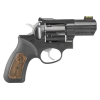


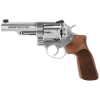
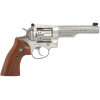
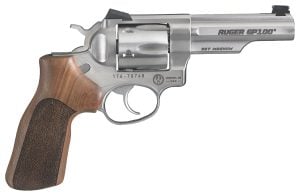
Quick Take
The Ruger GP100 is the Toyota Hilux of revolvers. It’s not the prettiest, not the smoothest, and not the most refined. But you could drive it through a wall, bury it in mud, dig it up, and it would still fire every round in the cylinder. Ruger overbuilt the GP100 to handle an unlimited diet of full-power .357 Magnum ammunition, and that engineering philosophy shows in everything from the solid frame construction to the triple-locking cylinder.
At $700 to $850 street, the GP100 is the best value full-size .357 Magnum revolver on the market. It costs roughly half what a Colt Python commands and $100 to $200 less than a comparable Smith & Wesson 686. The tradeoff is a factory trigger that’s noticeably heavier and grittier than either competitor. But here’s the thing: a $15 Wolff spring kit and 30 minutes of work transforms the GP100’s trigger from “adequate” to “excellent.” No other revolver responds as dramatically to a simple spring swap.
For shooters who plan to put thousands of rounds through their .357, who want a revolver that will outlast them, and who are willing to invest $15 in a spring kit, the GP100 is the smart money pick. It does 90% of what a Python does at half the price, and it’ll still be shooting straight when your grandchildren inherit it.
Best For: Budget-conscious shooters who want the most durable .357 revolver available. Range use, home defense, hunting with the 6″ barrel, and anyone who plans to shoot high volumes of .357 Magnum. The best “first revolver” for someone entering the .357 world. See our 10 best .357 Magnum revolvers for the full comparison and our best .357 ammo for what to feed it.
Why Ruger Built the GP100 Like a Tank
Bill Ruger designed the GP100 as a replacement for the Security-Six series with one overriding goal: make a revolver that could handle an unlimited diet of full-power .357 Magnum ammunition without loosening up. The Security-Six was a good gun, but it was showing frame stress after heavy .357 use. The GP100 addressed this with a heavier, solid-steel frame, a triple-locking cylinder (front, rear, and center pin), and beefed-up internal components throughout.
The result is a revolver that competitive shooters have put 100,000+ rounds through without any measurable degradation. Police departments that issued the GP100 for decades reported virtually zero frame failures. This is the gun you buy if you plan to shoot it hard, shoot it often, and never worry about wearing it out. The Smith & Wesson 686 is an excellent gun, but it’s not built to the same “survive anything” standard as the GP100.

The Trigger: The GP100’s One Weakness (and How to Fix It)
The GP100’s factory trigger is the most common criticism of the gun, and it’s a fair one. Out of the box, the DA pull runs 11 to 12 pounds and has a stacking, gritty quality that’s noticeably inferior to a factory Smith & Wesson or Colt. The SA pull is around 5 pounds, which is heavier than it needs to be.
The good news: no other revolver responds as dramatically to a simple upgrade. A Wolff reduced-power spring kit ($12 to $15), installed in 20 to 30 minutes with basic tools, drops the DA pull to 8 to 9 pounds and smooths out the stacking. After 500 rounds of dry fire and live fire, the action polishes itself further. A GP100 with 1,000+ rounds through it and a Wolff spring kit has a trigger that competes with a factory 686. It’s still not a Python, but it’s very, very good for the money.
For those who want professional results, a gunsmith trigger job on a GP100 ($75 to $150) produces an action that rivals revolvers costing twice as much. The GP100’s transfer bar system and robust internals make it one of the safest revolvers to lighten springs on.
Features and Quirks
Frame and Construction
The GP100’s frame is investment cast from 410 stainless steel (or 4140 chromoly on blued models) at Ruger’s Pine Tree Castings facility. The same division casts turbine blades and aircraft landing gear components. There’s no sideplate. The entire frame is one solid piece of steel, and the action drops out the bottom as a self-contained module. You can detail strip a GP100 on your kitchen table without tweezers and a prayer. Try that with a Smith & Wesson and you’ll be fishing tiny springs out from under the fridge.
The triple-locking cylinder is borrowed from the Redhawk. It locks at the front of the crane, the rear of the crane, and at the bottom of the crane opening. Three separate points of lockup means the cylinder stays tight even after tens of thousands of rounds. This is the engineering reason the GP100 outlasts most of its competition under heavy use.
Sights
The 4.2″ model comes with an adjustable rear sight (white outline notch, click adjustable for windage and elevation) and a ramp front sight with a red insert. The front sight is interchangeable using Ruger’s quick-change system: push a release tab, pop the old sight out, drop a new one in. HiViz LiteWave fiber optic front sights and XS Standard Dot tritium sights are popular upgrades that swap in 30 seconds flat.
Barrel and Weight Distribution
The standard 4.2″ model has a full-length underlug that adds forward weight to tame .357 Magnum muzzle flip. Ruger has made half-underlug variants (Davidson’s exclusives, mostly), but the full-lug version is what you want for shooting full-power magnums. That extra weight up front makes a real difference when you’re putting 50+ rounds of .357 through it in a range session. Twist rate is 1:18.75″ with 5 grooves.
Ergonomics and Controls
The Hogue Monogrip is one of those things that looks mediocre and performs brilliantly. It’s chunky, it’s rubber, and it will never win a beauty contest. But it absolutely soaks up .357 recoil. After 50 rounds of full-power magnums, you’ll understand why Ruger chose function over form here. If you hate the look, Altamont and Badger make gorgeous hardwood grips that fit the GP100. Just know that your hand will feel the difference after extended magnum sessions.
The cylinder release pushes forward (same direction as S&W, opposite of Colt). The hammer spur is checkered and well-sized for single-action cocking. Overall, the controls feel chunky and deliberate. Nothing here is going to break or wear out on you.
Competitor Comparison
Smith & Wesson 686 Plus ($800-$950)

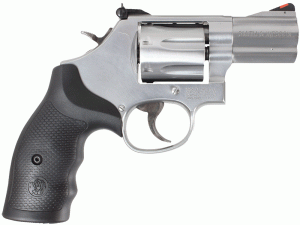

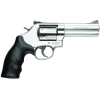
The 686 Plus is more refined out of the box: better trigger, smoother action, 7-round capacity. It costs $100 to $200 more. For most shooters, the 686 is the “nicer” gun. But the GP100 is tougher, handles heavy use better, and the trigger gap closes significantly with a spring kit. Our 686 Plus review covers it in depth. If you’re choosing between them, handle both and buy whichever feels better in your hand.
Colt Python ($1,350-$1,500)
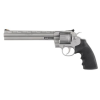
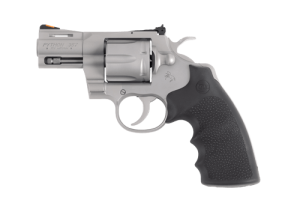
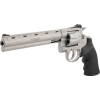
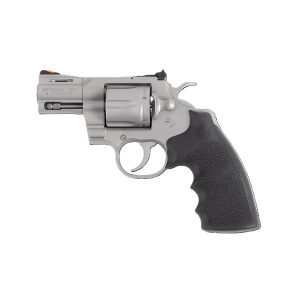
The Python is in a different class for trigger quality and prestige. It costs nearly double the GP100. If trigger quality is your top priority and budget allows, the Python wins. If you want a .357 that’ll survive a lifetime of heavy use and you’d rather spend the savings on ammo and range time, the GP100 is the smarter choice. Both are excellent guns aimed at different buyers.
Ruger SP101 ($650-$750)
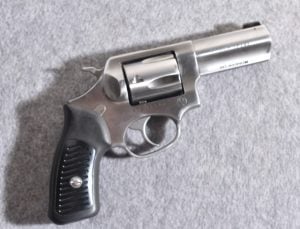
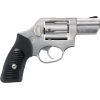
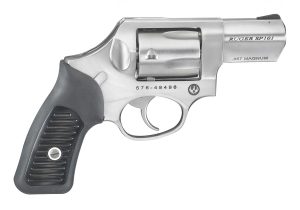
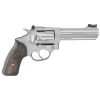
Ruger’s compact .357 for concealed carry. The SP101 holds 5 rounds, weighs 26 oz, and is small enough to pocket carry. It’s the carry gun where the GP100 is the range/home defense gun. For concealed carry with a .357, the SP101 is the better Ruger. For everything else, the GP100 is the answer.

At the Range: 1,000 Round Test
I ran 1,000 rounds through the GP100 over three range sessions to get a proper feel for the gun across a mix of ammunition. The split was roughly 600 rounds of .38 Special and 400 rounds of .357 Magnum. Here’s what went downrange.
Ammo Log
- American Eagle .38 Special 130gr FMJ: 300 rounds
- Blazer Brass .38 Special 125gr FMJ: 200 rounds
- Fiocchi .38 Special 158gr FMJ: 100 rounds
- American Eagle .357 Magnum 158gr JSP: 150 rounds
- Hornady Critical Defense .357 Magnum 125gr FTX: 50 rounds
- Federal .357 Magnum 158gr JSP: 100 rounds
- Hornady .357 Magnum 158gr XTP: 100 rounds
Break-In
The GP100 needed about 200 rounds before the action started smoothing out noticeably. The first couple cylinders were gritty in double action, like dragging sandpaper across steel. I dry-fired it extensively between sessions (the transfer bar makes this perfectly safe), and by round 300 the trigger was already better than out of the box. At round 500 I installed the Wolff 12 lb mainspring and 8 lb trigger return spring. Night and day. DA went from “dragging a cinder block across gravel” to “pulling through butter with a speed bump.”
Reliability
Zero malfunctions across 1,000 rounds. Every trigger pull produced a bang, every case extracted cleanly, the cylinder never bound up. I did notice very slight stickiness extracting some of the steel-cased Blazer after a long string of .357, but a firm push on the ejector rod cleared everything. This is a revolver doing exactly what revolvers are supposed to do: go bang every single time you pull the trigger.
Accuracy
At 25 yards, single action, from a bench rest, the GP100 consistently grouped 2 to 3 inches with Federal .357 Magnum 158gr JSP and Hornady 158gr XTP. The Hornady XTPs were the accuracy winner at around 2 inches. .38 Special groups opened up to 3 to 4 inches, which is typical for lighter loads in a magnum revolver.
Double-action groups at 15 yards ran 3 to 4 inches before the spring kit, which tightened to 2.5 to 3 inches after the install. The adjustable rear sight needed about 6 clicks of windage correction to center groups for me, but after that, point of aim matched point of impact cleanly out to 25 yards with the 158gr loads.
Performance Testing Results
Reliability: 10/10
1,000 rounds, zero malfunctions. That’s not surprising for a quality revolver, but the GP100 goes beyond “reliable” into “unkillable” territory. The triple-locking cylinder showed zero play after testing. The crane-to-frame gap didn’t change. I’ve talked to GP100 owners with 50,000+ rounds through theirs who report the same thing. This gun simply does not wear out.
Accuracy: 8/10
2 to 3 inch groups at 25 yards with good .357 Magnum ammo is solid for a production revolver. It’s not a target gun, but it’ll outshoot most people behind it. The adjustable sights are a big advantage over fixed-sight competitors. With handloads or premium match ammo, sub-2-inch groups are achievable.
Ergonomics and Recoil: 8/10
The combination of 40 oz of weight and the full underlug barrel makes .357 Magnum shooting genuinely pleasant. Not “tolerable,” pleasant. The Hogue Monogrip absorbs recoil well, and the weight keeps muzzle flip manageable during rapid double-action strings. I shot 50 consecutive rounds of full-power .357 without any hand fatigue worth mentioning. The 686 is slightly more comfortable due to its contoured grip shape, but the GP100 is close.
Fit, Finish, and QC: 7/10
This is where “Ruger” and “not Colt” become relevant. The GP100 is well-machined and the stainless finish is consistent, but it doesn’t have the mirror polish of a Python or the refined lines of a 686. There were minor tooling marks on the topstrap and the trigger face had a slight burr that I stoned off in 30 seconds. Functional? Absolutely. Pretty? It’s a work truck, not a show car. And that’s perfectly fine.
Known Issues
- Heavy factory trigger: The most common complaint. Solved with a $15 spring kit and break-in shooting.
- Hogue Monogrip: The factory rubber grip is functional but polarizing aesthetically. Many owners replace it with hardwood grips from Altamont, Badger, or Hogue wood. The rubber grip is better for shooting comfort; wood grips look better.
- Weight: At 40 oz (4.2″ stainless), it’s heavier than the comparable 686. This is by design (durability), but it makes it impractical for carry.
Parts, Accessories, and Upgrades
| Upgrade | Recommended | Why It Matters | Cost |
|---|---|---|---|
| Spring Kit | Wolff 12 lb mainspring + 8 lb trigger return | Transforms the trigger. The single best GP100 upgrade, period. | $12-$15 |
| Front Sight | HiViz LiteWave fiber optic | Brighter sight picture, faster acquisition. Drop-in swap using Ruger’s quick-change system. | $25-$35 |
| Night Sights | XS Standard Dot tritium front | Visible in low light. Essential if this is your home defense revolver. | $55-$70 |
| Grips (Looks) | Altamont or Badger hardwood | Gorgeous wood that makes the GP100 look like a $1,200 gun. Less recoil absorption than rubber. | $40-$80 |
| Grips (Comfort) | Pachmayr Decelerator | Even softer than the Hogue Monogrip. Best option for long magnum sessions. | $25-$35 |
| Trigger Job | Professional gunsmith action job | Polished internals + spring kit = a trigger that rivals revolvers costing twice as much. | $75-$150 |
Start with the Wolff spring kit. It’s $15 and 30 minutes of work, and it’s the single biggest improvement you can make to any GP100. If you’re using this for home defense, add a tritium front sight. Everything else is nice to have but not essential. The GP100’s aftermarket is one of its biggest advantages over the competition.
The Verdict
The Ruger GP100 is the .357 Magnum revolver you buy if you care more about what a gun does than what it looks like. It’s overbuilt, underpriced, and responds to a simple spring kit better than any revolver on the market. It’ll eat a lifetime of full-power .357 Magnum without complaining, and it’ll still be tight and accurate when you’re done.
Is it as smooth as a Python? No. Is it as refined as a 686? Not out of the box. But with a $15 spring kit and some break-in, it’s 90% as good as either at 50 to 65% of the price. For the money, the GP100 is the smartest .357 Magnum purchase you can make.
Final Score: 8.5/10
Best For: Best value .357 Magnum. Range use, home defense, handgun hunting (6″ barrel), and anyone who plans to shoot high volumes of .357. The ideal first .357 revolver.
Want the .410/.45 Colt option instead? See our honest Taurus Judge review.
Stepping up to a big-bore magnum? See our S&W Model 29 review.
Stepping up to .44 Magnum? Read our Ruger Redhawk review.
For a compact alternative at similar money, the Chiappa Rhino 200DS trades the GP100 barrel length for a far lower bore axis.
FAQ: Ruger GP100
Frequently Asked Questions
Is the Ruger GP100 a good revolver?
The Ruger GP100 is widely considered the best value full-size .357 Magnum revolver available. It is overengineered for the caliber, handles unlimited full-power .357 Magnum without frame stress, and costs 700 to 850 dollars, significantly less than the S&W 686 or Colt Python. The factory trigger is heavy but transforms with a 15 dollar Wolff spring kit.
Ruger GP100 vs S&W 686: which is better?
The S&W 686 has a better factory trigger and more refined fit and finish. The Ruger GP100 is more durable, handles heavier use over time, and costs 100 to 200 dollars less. The 686 Plus holds 7 rounds versus the GP100's 6. With a spring kit, the GP100's trigger approaches 686 quality. For pure durability and value, the GP100 wins. For out-of-the-box refinement, the 686 wins.
How do you improve the Ruger GP100 trigger?
The most cost-effective upgrade is a Wolff reduced-power spring kit (12 to 15 dollars) which drops the double-action pull from 11-12 pounds to 8-9 pounds and smooths out the stacking. Combined with 500+ rounds of shooting to polish the internals, this transforms the trigger. A professional gunsmith trigger job (75 to 150 dollars) produces an action that rivals revolvers costing twice as much.
Is the Ruger GP100 good for concealed carry?
The standard GP100 is too heavy (40 oz) and too large for practical concealed carry. The 2.5-inch barrel variant is more compact but still heavy. For concealed carry with a Ruger .357, the SP101 (26 oz, 5 rounds) is the better choice. The GP100 is best suited for range use, home defense, and open carry or field use.
Is the Ruger GP100 better than the S&W 686?
They are the two benchmarks of the .357 mid-frame world and both are excellent. The GP100 is famously overbuilt and durable with a slightly simpler action, while the 686 has a smoother factory trigger and a more refined feel. Ruger fans value the toughness; Smith fans value the trigger.
What calibers does the Ruger GP100 come in?
The GP100 is best known in .357 Magnum, which also fires .38 Special, but Ruger offers it in .44 Special, 10mm, .22 LR and a seven-shot .357 as well. That range lets you pick anything from a soft-shooting trainer to a stout magnum on the same rugged frame.
6,216+ Gun & Ammo Deals
Updated daily from 200+ top retailers. Filter by category, caliber, action type, and price.
Related Guides