

Last updated May 9th 2026
Some of the links below are affiliate links, meaning at no additional cost to you, we may earn a commission if you click through and make a purchase.
- Treat every gun as loaded
- Point the muzzle in a safe direction
- Keep your finger off the trigger until you’re ready to shoot
- Know your target and what’s beyond
Table of Contents
What Is the Effective Range of a .357 Magnum?
The effective range of a .357 Magnum depends on what you mean by “effective” and what you’re shooting it from. A snub-nose revolver with a 2″ barrel has a very different effective range than a lever-action rifle with an 18″ barrel, even though both fire the same cartridge. This guide breaks down realistic range expectations for every common .357 Magnum platform, from pocket revolvers to carbines.
Defining “Effective Range”
Effective range has three different meanings, and they produce very different numbers:
- Self-defense effective range: The distance at which you can reliably hit a human-sized target under stress and the bullet retains enough energy to stop a threat. For handguns, this is typically 0 to 25 yards.
- Practical accuracy range: The distance at which a skilled shooter can consistently hit a target from a stable position. For a 4″ .357 revolver, this is roughly 50 to 75 yards. For a lever-action rifle, 100 to 150 yards.
- Maximum lethal range: The distance at which the bullet can still cause lethal injury. For .357 Magnum, this is well over a mile. This number is relevant only for safety considerations (knowing how far a stray bullet can travel), not for practical shooting.
For the rest of this guide, we’ll focus on practical accuracy range and self-defense effective range, since those are what actually matter for shooters.
.357 Magnum Range by Platform
Practical effective range scales with barrel length. Snub-nose revolvers are 3-to-15-yard guns. Four-inch service revolvers stretch to 50-75 yards.
Six-inch hunting revolvers reach 75-100 yards. Lever-action rifles in .357 Magnum hold the cartridge out to 100-150 yards.
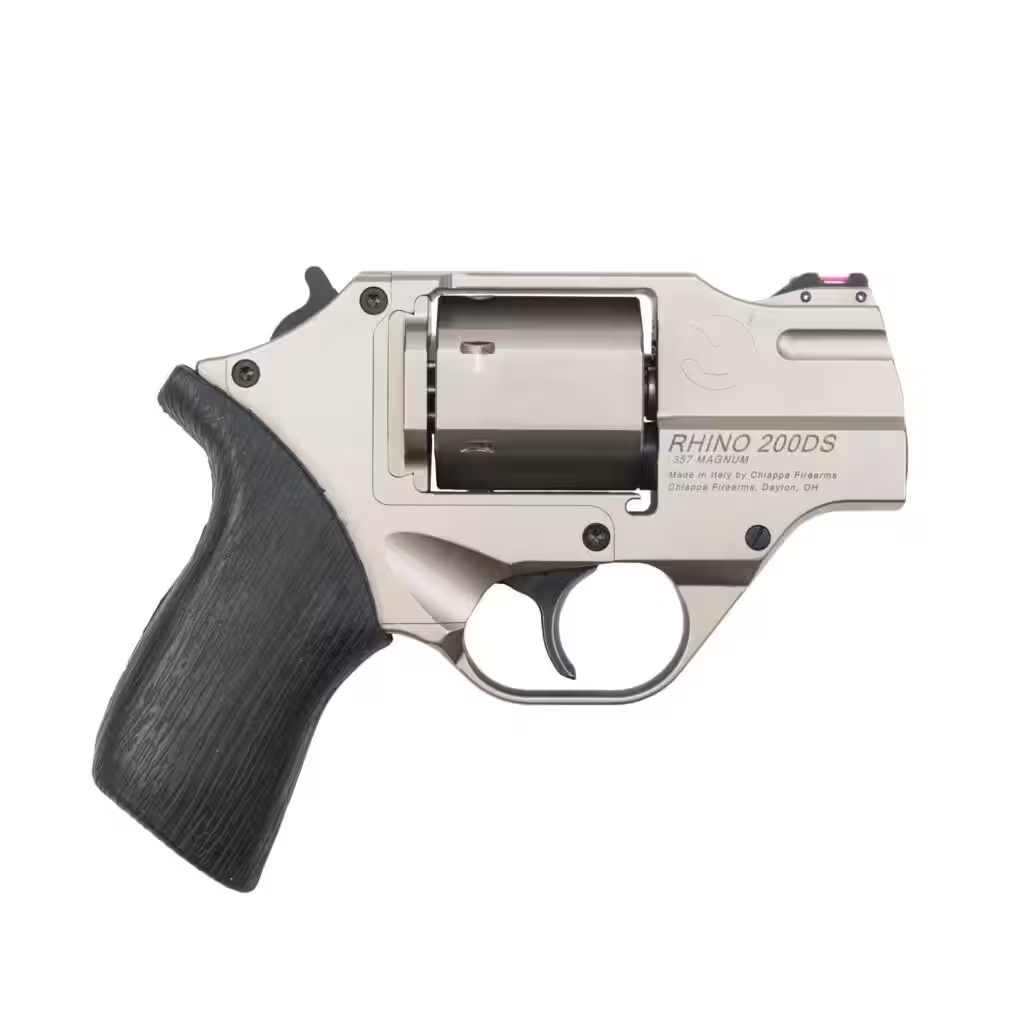
Snub-Nose Revolver (2″ barrel)
Self-defense range: 3 to 10 yards. Practical accuracy: 15 to 25 yards. The short barrel, short sight radius, heavy DA trigger, and significant muzzle flip limit effective range dramatically. A snub-nose .357 is a close-quarters weapon designed for contact to across-the-room distances.
The Chiappa Rhino with its low bore axis is a partial exception, it shoots flatter under recoil than a traditional snub but still bumps into the same sight-radius wall past 15 yards.
Beyond 15 yards, most shooters struggle to maintain combat-effective accuracy under stress. From my own snub-nose practice with a 2-inch S&W 640 I keep groups inside a 6-inch plate to about 12 yards in DA and that’s it. The velocity loss from a 2″ barrel also reduces terminal performance: a .357 from a 2″ barrel is ballistically similar to a .38 Special +P from a 4″ barrel.
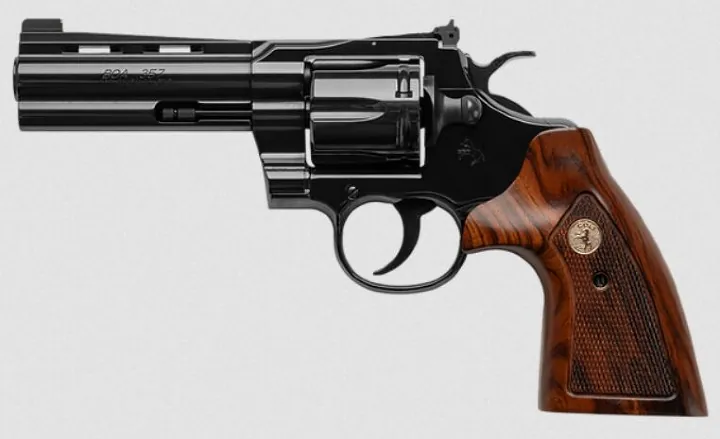
Medium-Frame Revolver (4″ barrel)
Self-defense range: 3 to 25 yards. Practical accuracy: 50 to 75 yards. This is the sweet spot for .357 Magnum revolvers. The 4″ barrel provides near-full velocity (within 50 fps of a 6″ barrel for most loads), a usable sight radius with adjustable sights, and enough weight to manage recoil.
A skilled shooter with a Smith & Wesson 686 or Ruger GP100 can consistently hit a torso-sized steel plate at 50 yards in single action. I’ve chronoed Federal HST 130gr at 1,287 fps from my 4-inch GP100, within published spec. At 25 yards in DA, combat accuracy (8″ group) is achievable with practice.
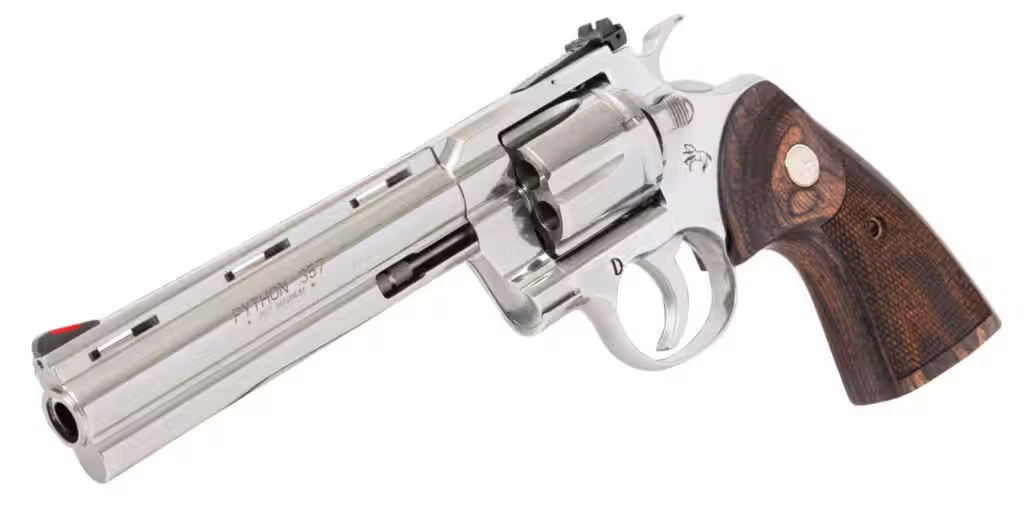
Full-Size Revolver (6″ barrel)
Self-defense range: 3 to 25 yards. Practical accuracy: 75 to 100 yards. The 6″ barrel adds roughly 50 to 75 fps velocity, a longer sight radius for better precision, and more weight to dampen recoil.
Hunting revolvers with 6″ barrels and quality optics (Weigand or Millet sights) can take deer at 75 to 100 yards with proper ammunition and shot placement. In single action with a rest, sub-3″ groups at 50 yards are achievable.
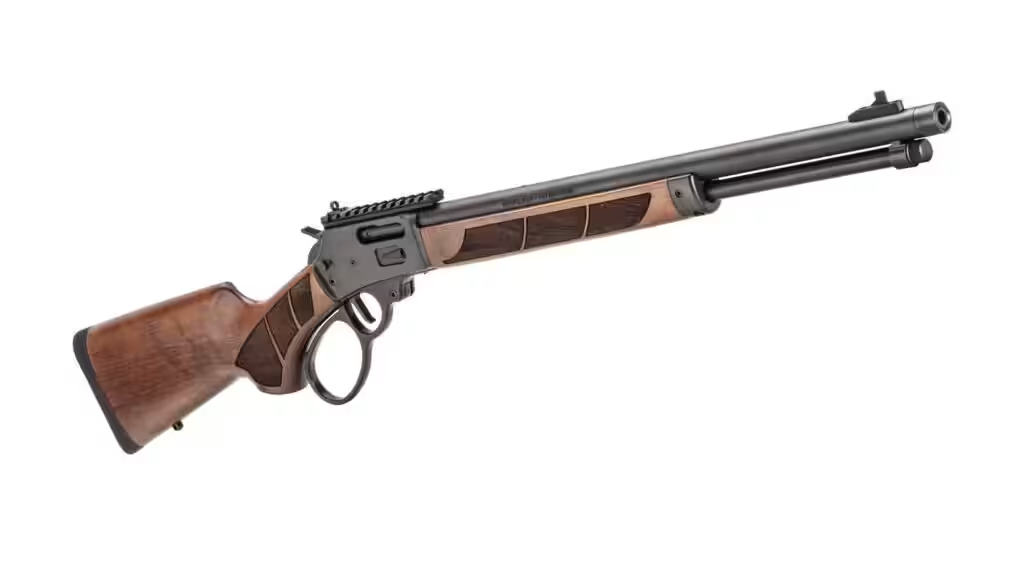
Lever-Action Rifle (18-20″ barrel)
Practical accuracy: 100 to 150 yards. Hunting range: 100 to 125 yards (ethical deer range). The lever-action rifle is where .357 Magnum really stretches its legs.
An 18″ barrel adds 300 to 400 fps to revolver velocities, pushing a 158gr load to 1,800+ fps and 1,100+ ft-lbs of energy. That’s comparable to a .30-30 Winchester at moderate range.
The shoulder-braced platform, longer sight radius, and ability to mount a scope dramatically extend the practical accuracy envelope. A Marlin 1894 or Henry Big Boy in .357 Magnum with a low-power scope is a legitimate 100-yard deer rifle. On my Marlin 1894 with a 2-7x scope I held 2-inch groups at 100 yards off a bench with Hornady 158gr XTP. Our best lever action rifles guide covers the top options.
.357 Magnum Velocity and Energy by Barrel Length
| Barrel Length | 158gr JHP Velocity | Energy | Practical Range |
|---|---|---|---|
| 2″ (snub) | 1,080 fps | 410 ft-lbs | 15-25 yards |
| 3″ (compact) | 1,180 fps | 488 ft-lbs | 25-50 yards |
| 4″ (standard) | 1,280 fps | 575 ft-lbs | 50-75 yards |
| 6″ (full) | 1,350 fps | 639 ft-lbs | 75-100 yards |
| 8″ (hunting) | 1,400 fps | 688 ft-lbs | 100 yards |
| 18″ (lever rifle) | 1,800 fps | 1,136 ft-lbs | 100-150 yards |
Note: These are approximate figures based on published manufacturer data and matched against the SAAMI standard pressure and velocity reference for .357 Magnum. Actual velocity varies by ammunition brand and barrel/cylinder gap. The velocity gain from 4″ to 6″ is relatively modest (roughly 70 fps). The biggest jump is from revolver to rifle barrel, where the extra 12 to 14 inches of barrel length add 400+ fps.
Is .357 Magnum Good for Deer Hunting?
From a revolver with a 4″ or longer barrel, the .357 Magnum is adequate for deer at close range (under 50 yards) with proper ammunition (158 to 180gr bonded or hard-cast bullets). This is legal in many states for handgun hunting. Shot placement is critical because the .357 is at the low end of adequate energy for deer-sized game from a handgun.
From a lever-action rifle, the .357 Magnum becomes a genuinely capable deer cartridge out to 100 to 125 yards. The velocity boost from the rifle barrel puts 158gr loads in the 1,700 to 1,800 fps range, generating over 1,000 ft-lbs of energy. That’s comparable to factory .30-30 loads at moderate range, and the .30-30 has been killing deer for 130 years. For our complete hunting guide, see best guns for hunting.
.357 Magnum vs Other Calibers at Range
The .357 Magnum’s range advantage is most useful when compared to the cartridges shooters actually consider against it. From a 4-inch revolver, the .357 carries roughly 575 ft-lbs of energy at the muzzle and is still hauling 350 ft-lbs at 50 yards.
That’s 50% more energy than a 9mm at the same distance and roughly double a .38 Special +P. Trajectory is similar to 9mm at handgun ranges, but the energy retention pulls ahead at 25-plus yards.
Inside a lever-action rifle the comparison shifts. A 158gr .357 leaves an 18-inch barrel at around 1,800 fps with 1,100+ ft-lbs of muzzle energy. That’s within striking distance of a factory .30-30 Winchester (1,800-2,000 fps with a 150gr bullet) at 100 yards, and ahead of pistol-caliber carbines in 9mm by a wide margin. For the head-to-head against the most common alternatives, see our .357 Magnum vs 9mm and .357 Magnum vs .38 Special breakdowns.
The .44 Magnum is the obvious step up if you want more energy at distance, but it costs you in recoil, ammo price, and gun weight. For a deer rifle out to 125 yards or self-defense at any practical distance, the .357 is genuinely enough. For bear country you may want more, see our .357 Magnum vs bears assessment.
Best .357 Magnum Loads for Each Range
Bullet selection matters more than barrel length for terminal performance at distance. The wrong load on the right gun still gives you a marginal hit. The right load on the right gun stretches the cartridge well past its assumed limits.
Self-defense (0 to 25 yards)
For carry and home defense from any barrel length, modern bonded 125gr or 135gr JHP loads are the practical pick. The Federal HST 130gr, Hornady Critical Defense 125gr FTX, and Speer Gold Dot 135gr Short Barrel are tuned for shorter cylinder gaps and reduced flash. From a 4-inch revolver, expect 1,250 to 1,300 fps with 460 to 510 ft-lbs of energy at the muzzle and reliable expansion in ballistic gel.
From a snub-nose, drop to a 110gr or 125gr load, the lighter bullets get up to expansion velocity faster from a short barrel. For carry-specific .357 picks see our best .357 Magnum carry pistols roundup. Avoid full-house 158gr loads in a snub-nose unless you specifically train through the recoil. Our best .357 Magnum ammo guide covers our top tested defensive loads in detail.
Hunting (25 to 125 yards)
For deer-sized game, 158gr or 180gr bonded soft-point or hard-cast loads dominate. Hornady 158gr XTP, Buffalo Bore 180gr LFN-GC, Underwood 180gr Hard Cast, and Federal Premium 180gr Trophy Bonded all work from a 6-inch revolver out to 75 yards or a lever-action rifle out to 125 yards.
Hard-cast bullets give you maximum penetration and bone-breaking performance, which is what matters at the lower end of acceptable energy. Bonded soft-points expand more reliably but penetrate slightly less. Pick based on the game and the angle. For the comprehensive home-defense load discussion, our .357 Magnum for home defense piece covers the trade-offs.
Practice and range training
For volume training, 130gr or 158gr FMJ (full metal jacket) range loads (or .38 Special wadcutters in your .357 cylinder) cut recoil and ammo cost dramatically. The American Eagle and Magtech 158gr SJSP loads are popular practice options. Save the full-house defensive or hunting loads for skill verification, not high-round-count practice.
Sight Choice and Range Performance
Effective range is gated as much by sight choice as by the ammunition. A 4-inch revolver with rough factory iron sights and a 50-yard target is a tough proposition for most shooters. The same gun with adjustable target sights or a red dot extends practical accuracy by 30 to 50 percent overnight.
Iron sights remain the default on most .357 revolvers. A black serrated rear with a black or fiber-optic front sight works well to 25 yards in DA and 50 yards in single action. Fiber optic fronts catch light fast in daylight and are a $40 upgrade most shooters benefit from.
Tritium night sights help in low-light defensive shooting but don’t extend mechanical accuracy. For a snub-nose, the front sight is often a fixed ramp, fiber-optic upgrades from XS Sights or Hi-Viz are worth the $40 if your eyes are tired.
Red dots on revolvers used to be an oddity. They’re not anymore. Holosun 507K and Trijicon RMRcc footprints fit on milled 4-inch and 6-inch frames, and they push practical accuracy on a service revolver from roughly 25 yards iron-sighted to 50 yards dot-sighted for the average shooter.
I’ve put a Holosun 507K on a milled 686 and the practical accuracy gain at 50 yards was immediate. Adoption is real, competitive bullseye revolver shooters running iron sights are an endangered species.
Scopes only really make sense on hunting platforms. A 1.5-5x or 2-7x scope on a Marlin 1894 lever rifle or a Ruger Super Redhawk Hunter turns the .357 into a 125-yard precision tool.
Hornady LeveRevolution 140gr FTX is the load most often paired with these scoped lever rifles for a 50-yard zero that rides flat to 125. Mount low, zero at 50 yards, and you’ll be within 4 inches of point of aim from 25 to 100 yards with a 158gr load.
Recoil, Skill, and How Far You Can Actually Shoot
The published velocity tables are aspirational unless you can actually hit what you’re aiming at. Full-house .357 loads from anything under a 4-inch barrel kick hard enough that follow-up shots are slow and group sizes open up. That’s the real ceiling on snub-nose effective range, not the ballistics, the shooter.
Reasonable progression for a new .357 owner: start with .38 Special wadcutters at 7 yards, then move to 158gr .38 Special at 15 yards. Move to 130gr .357 Magnum at 25 yards once recoil management is steady.
Only then move to 158gr full-house Magnum loads at distance. Most people who say a snub-nose is a 5-yard gun never made it past stage two.
From a 4-inch service revolver, a competent shooter should hit a 6-inch plate at 25 yards in DA roughly 90% of the time after a few hundred rounds of practice, that’s about 6-8 MOA practical accuracy under stress.
From a 6-inch hunting revolver in single action with a rest, sub-2-inch groups at 25 yards and sub-4-inch groups at 50 yards are realistic with quality ammunition. From a lever rifle with a scope, 2-inch groups at 100 yards from a bench are well within reach of a moderately skilled rifleman.
The Bottom Line
The effective range of a .357 Magnum depends entirely on the platform. A snub-nose is a 15-yard gun. A 4″ revolver is a 50 to 75-yard gun. A lever-action rifle is a 100 to 150-yard gun.
The cartridge itself has plenty of energy for self-defense at any practical handgun distance, and with the right barrel length it’s a legitimate medium-game hunting cartridge as well. Match your barrel length to your intended use and the .357 Magnum will deliver. For our recommended revolvers at every barrel length, see 10 best .357 Magnum revolvers, or check the .357 Magnum Buyer’s Guide for the complete platform overview.
FAQ: .357 Magnum Effective Range
What is the maximum effective range of a .357 Magnum?
Effective range depends on the platform. From a 4-inch revolver, practical accuracy runs 50 to 75 yards; from a 6-inch hunting revolver, 75 to 100 yards. From an 18-inch lever-action rifle, 100 to 150 yards. The cartridge itself can carry lethal energy well over a mile, but that's a safety consideration only.
What is the effective range of a .357 Magnum from a snub-nose?
A 2-inch snub-nose .357 is realistically a 15- to 25-yard gun. The short barrel costs you 200+ fps of velocity (a 158gr load drops to around 1,080 fps from a snub vs 1,280 fps from a 4-inch barrel), and the short sight radius plus heavy DA trigger limit accuracy under stress. For self-defense, 3 to 10 yards is the realistic working envelope. Ballistically.357 from a 2-inch barrel is similar to .38 Special +P from a 4-inch barrel.
Can a .357 Magnum kill a deer at 100 yards?
Yes, from a lever-action rifle with the right load. An 18-inch barrel pushes a 158gr or 180gr bonded soft-point or hard-cast bullet to 1,700-1,800 fps and 1,000+ ft-lbs of energy, comparable to a factory .30-30 Winchester at moderate range. From a 6-inch revolver, ethical deer range drops to about 75 yards. From any handgun under a 4-inch barrel.357 Magnum is marginal for deer regardless of distance.
How does .357 Magnum compare to 9mm at range?
From a handgun.357 Magnum carries roughly 50% more energy than 9mm at any given distance. At the muzzle: ~575 ft-lbs (.357, 4-inch) vs ~350 ft-lbs (9mm, 4-inch); at 50 yards: ~350 ft-lbs vs ~250 ft-lbs. Trajectory is similar at typical defensive distances, but .357 keeps a meaningful energy advantage at 25 yards and beyond. Full breakdown in our .357 Magnum vs 9mm comparison.
What barrel length gives the best balance for a .357 Magnum?
The 4-inch barrel is the sweet spot for most users. It gives you 95% of the velocity of a 6-inch barrel (within 50-75 fps for most loads), a usable sight radius with adjustable sights, and enough weight to manage recoil. Go shorter only if you need deeper concealment, longer only if hunting is the primary use.
How much velocity does a .357 Magnum gain from a rifle barrel?
Roughly 400 to 500 fps. A 158gr load from a 4-inch revolver leaves the muzzle at around 1,280 fps; from an 18-inch lever-action barrel, the same load runs about 1,800 fps. Energy roughly doubles, going from 575 ft-lbs to 1,100+ ft-lbs. That bump is what turns a service revolver round into a legitimate 100-yard deer cartridge.
Is a red dot worth it on a .357 revolver?
On a 4-inch or 6-inch revolver, yes. A Holosun 507K or Trijicon RMRcc on a milled slide cuts your effective range gating from your eyes/sight picture roughly in half. Most average shooters who run iron sights to 25 yards run a red dot to 50 yards. Snub-noses are a tougher question, the gun's natural use case is contact distance, where a dot adds bulk without much practical benefit.
How far can a .357 Magnum bullet travel?
A .357 Magnum bullet can travel well over 1.5 miles (about 2,500 yards) under ideal conditions, retaining lethal energy for a portion of that distance. This is a safety consideration only, always know what's behind your target. The maximum lethal range is irrelevant for practical accuracy: even from a rifle, hitting anything you can identify past 200 yards is a tall order.
4,715+ Gun & Ammo Deals
Updated daily from 200+ top retailers. Filter by category, caliber, action type, and price.
Related Guides