
Last updated September 2026 · By Nick Hall, who checked every rating below against the maker’s own product page, the California DOJ roster and the CPSC recall database
Some of the links below are affiliate links, meaning at no additional cost to you, we may earn a commission if you click through and make a purchase.
- Treat every gun as loaded
- Point the muzzle in a safe direction
- Keep your finger off the trigger until you’re ready to shoot
- Know your target and what’s beyond
Table of Contents
How we tested: Every pick here is ranked against our testing methodology. Minimum round counts, accuracy and reliability protocols, the failures that disqualify a gun. Where we have not shot a specific variant ourselves, we say so in that section.
Gun Safe Fire Ratings Explained: The Short Answer
A gun safe fire rating is two numbers: how many minutes the inside stayed below 350 degrees Fahrenheit, and how hot the furnace was outside. “60 minutes at 1,200 degrees” means exactly that and nothing more. It isn’t a promise that the safe is fireproof, and on almost every gun safe sold in America it is not an independent test either.
We checked 23 popular gun safes and 4 recalled biometric lines against primary sources. Here’s what we found:
- Not one maker names an independent lab for its fire rating. Of the 15 safes with a fire claim, every figure is the maker’s own number.
- Only Liberty states a UL burglary listing for the safe body (USA, Colonial, Lincoln and Presidential). The Lincoln is the only one that spells out “Residential Security Container.” Browning says “UL Listed” without saying which listing.
- Test temperatures run from 1,200 to 1,875 degrees, so two “60 minute” ratings from different brands aren’t the same claim.
- The California DOJ roster isn’t a recall list. A Bulldog biometric vault that CPSC recalled in 2024 still appears on it.
If you just want a safe, start with our gun safe buying guide or compare live prices across 200+ retailers in our gun safes and storage section. If you want to know what the label on the door is really worth, read on.
Gun Safe Certification Database
Every row below comes from the maker’s own product page, the California DOJ Roster of Firearm Safety Devices Certified for Sale, or CPSC. Where the maker doesn’t say, the cell says “not stated.” We do not fill gaps with guesses. Use the filters to narrow it down by brand, fire claim, UL listing, California approval or recall status.
| Safe | Burglary rating | Fire claim (maker) | Independent fire cert | CA DOJ | Steel | Bolts | CPSC recall | Source |
|---|---|---|---|---|---|---|---|---|
| Centurion (CN 12/18/24/32) Liberty SafeLiberty's own spec table lists 30 minutes for all four sizes while its text gives 40 minutes for the 24 and 32. | UL-listed lock only; no RSC listing stated for the body | 30 min at 1200°F (CN 12, 18); 40 min at 1200°F (CN 24, 32) | none named | Yes (maker states; roster lists Liberty models by code only) | 14 | 7 | none | Source 2026-09-23 |
| USA (30/36/48/50) Liberty Safe | UL-listed safe body (maker states) | 60 min at 1200°F | none named (maker says "certified" without naming a lab) | Yes (maker states; roster lists Liberty models by code only) | 12 | up to 8 | none | Source 2026-09-23 |
| Colonial (23/30/50) Liberty Safe | UL-listed body (maker states) | 75 min at 1200°F | none named | Yes (maker states; roster lists Liberty models by code only) | 12 | 8 to 10 | none | Source 2026-09-23 |
| Fat Boy / Fat Boy Jr. Liberty Safe | not stated | 75 min (Jr.) / 110 min (Fat Boy) | none named (maker says "certified" without naming a lab) | not stated | 12 | 8 | none | Source 2026-09-23 |
| Lincoln (25/40/50) Liberty Safe | UL Residential Security Container (RSC), UL-listed 10-gauge body (maker states) | 120 min at 1200°F | none named | Yes (maker states; roster lists Liberty models by code only) | 10 | 10 to 15 | none | Source 2026-09-23 |
| Presidential (25/40/50) Liberty Safe | UL-listed safe body (maker states) | 150 min (2.5 hr) at 1200°F | none named | Yes (maker states; roster lists Liberty models by code only) | 7 | 12 to 18 (1/2 in) | none | Source 2026-09-23 |
| Sporter 20 Browning (ProSteel) | "UL Listed" (maker states; listing type not specified) | 95 min at 1200°F | none named | not stated (not found on roster under this name) | 12 | 8 (1 in) | none | Source 2026-09-23 |
| Sporter 23 Browning (ProSteel) | "UL Listed" (maker states; listing type not specified) | 95 min at 1200°F | none named | not stated (not found on roster under this name) | 12 | 8 (1 in) | none | Source 2026-09-23 |
| Sporter 33 Browning (ProSteel) | "UL Listed" (maker states; listing type not specified) | 95 min at 1200°F | none named | not stated (not found on roster under this name) | 12 | 8 (1 in) | none | Source 2026-09-23 |
| Hunter 49 Browning (ProSteel) | "UL Listed" (maker states; listing type not specified) | 95 min at 1200°F | none named | not stated (not found on roster under this name) | 11 | 9 (1 in) | none | Source 2026-09-23 |
| Bandit 14 Winchester Safes | not stated (maker says "Exceeds California DOJ Requirements") | 45 min at 1400°F | none named | Yes (on roster: Bandit 14) | 14 | 8 (1 in; 4 dead, 4 active) | none | Source 2026-09-23 |
| Bandit 19 Winchester Safes | not stated (maker says "Exceeds California DOJ Requirements") | 45 min at 1400°F | none named | Yes (on roster: Bandit 19) | 14 | 10 (1 in; 5 dead, 5 active) | none | Source 2026-09-23 |
| SW592216 (16 long gun) Steelwater | not stated | 60 min at 1875°F | none named | Yes (on roster: SW592216) | not stated | 10 (1.5 in; 7 active, 3 inactive) | none | Source 2026-09-23 |
| Essential 23 (EGS23) Stealth Safes | not stated | 30 min at 1200°F | none named | Yes (on roster: STL-EGS23; maker states) | 14 | 8 (1 in) | none | Source 2026-09-23 |
| Handgun Hanger (electronic) Stealth SafesStealth sells 3-gun and 5-gun Handgun Hanger versions; these specs are for the 3-gun model on the maker page. | not stated | none stated | none | Yes (on roster: STL-HHS) | 16 (body); 3/8 in door | latch | none | Source 2026-09-23 |
| Handgun Hanger (biometric) Stealth SafesStealth sells 3-gun and 5-gun Handgun Hanger versions; these specs are for the 3-gun model on the maker page. | not stated | none stated | none | Yes (on roster: STL-HHS-BIO) | 16 (body); 3/8 in door | latch | none | Source 2026-09-23 |
| Fireproof Keypad Safe (95407) HornadyHornady's own page gives the door as 9-gauge in one place and 8-gauge in another. | not stated | 30 min up to 1400°F | none named | not found on roster | 16 (body); door 8 or 9 | not stated | none | Source 2026-09-23 |
| RAPiD Safe Night Guard (98215) Hornady | not stated | none stated | none | Yes (on roster: 98215; maker states) | not stated | not stated | none | Source 2026-09-23 |
| RS500i Vaultek | not stated | none stated | none | Yes (on roster: RS500i) | 14 | 4 | none | Source 2026-09-23 |
| RS800i Vaultek | not stated | none stated | none | Yes (on roster: RS800i-BK, listed as a cabinet) | 14 | 4 | none | Source 2026-09-23 |
| Smart Station DS2i Vaultek | not stated | none stated | none | Yes (on roster: DS2i Smart Station) | not stated | not stated | none | Source 2026-09-23 |
| Barikade Series 2 Vaultek | not stated | none stated | none | not found on roster | 14 | not stated | none | Source 2026-09-23 |
| LifePod 20 Vaultek | not stated | none stated | none | Yes (on roster: BLP20 LifePod 20 Biometric, VLP20-BK) | not steel (maker describes a proprietary material blend) | latches | none | Source 2026-09-23 |
| Magnum Biometric Pistol Vaults BD4030B, BD4040B, BD4055B Bulldog Cases | n/a | n/a | n/a | BD4055B still appears on the CA roster; the roster is not a recall list | n/a | n/a | RECALLED: CPSC 24-130, Feb 22 2024, about 33,500 units. Biometric lock can let unauthorized users open the safe; use the key only. | Source 2026-09-23 |
| Sports Afield Home Defense 4-Gun Biometric; Sanctuary Quick Access Biometric Home Safe SA Consumer Products (Sports Afield / Sanctuary) | n/a | n/a | n/a | n/a | n/a | n/a | RECALLED: CPSC 24-255, Jun 6 2024, about 133,370 units (both brands). | Source 2026-09-23 |
| Biometric safes incl. 11B20, 44B10, 44B20, 55B20 Fortress Safe (also sold as Cabela's, Gettysburg, Legend Range & Field) | n/a | n/a | n/a | n/a | n/a | n/a | RECALLED: CPSC 24-011, Oct 19 2023, about 61,000 units. | Source 2026-09-23 |
| Biometric safes, pistol vaults and lock boxes (model numbers ending -B) Stack-On / Alpha Guardian | n/a | n/a | n/a | n/a | n/a | n/a | CPSC WARNING (2025), not a recall: stop using the biometric feature; about 183,000 units. Keypad (-E) models are not covered. | Source 2026-09-23 |
How to read it. “Burglary rating” is what the maker says about a UL or other listing for the safe itself. A UL-listed lock is not a listed safe, so we mark those separately. “Fire claim” is quoted in the maker’s own terms. “Independent fire cert” names the outside lab that ran the fire test, if the maker names one. Nobody did.
UL 1037 RSC: The Burglary Rating Most Gun Safes Carry
RSC stands for Residential Security Container, a listing under the UL 1037 anti-theft standard. It’s the only independent burglary test that most gun safes ever go through, and it’s the one California accepts as an alternative to its own construction standard.
UL describes three attack levels for the standard as revised on August 1, 2017:
- Level One: a five-minute attack by one technician using common hand tools.
- Level Two: a ten-minute attack by two technicians with more aggressive tools, including carbide drills and pressure devices, trying to open a six-square-inch hole.
- Level Three: a ten-minute attack with the most advanced toolsets, where the safe must hold against a breach of just two square inches.
UL also adds a drop test for products of 750 pounds or less, which covers most gun safes a homeowner can get up a set of stairs. The five-minute baseline sounds short, and it is. That’s the point of the rating: it stops a smash-and-grab burglar with a pry bar and a hammer, not a crew with a plasma cutter. For the difference between an RSC and a true burglary safe, see our RSC vs true safe guide.
What to check: the label should say “Residential Security Container” and carry the UL mark. “UL-listed lock” or “UL listed electronic lock” only covers the lock. The Liberty Centurion is a good example: its lock is UL listed, but Liberty doesn’t claim an RSC listing for the body.
UL 72 Class 350: The Fire Test Almost No Gun Safe Has
UL 72 is the independent fire standard for record protection equipment, the one used for document safes and filing cabinets. According to UL’s scope for the standard, the equipment “is exposed to a fire endurance test and an explosion test.” Units built for impact resistance also get a fire and impact test that includes “falling 30 ft (9.1 m).”
The class number is the interior temperature limit:
- Class 350: keeps the inside below 350 degrees. Rated for paper records, and the class that matters for guns.
- Class 150: for magnetic media and film.
- Class 125: for digital media such as flash drives and hard drives.
The listing then adds a duration, such as “Class 350, 1 hour.” That’s the rating you want to see if you’re relying on a fire claim for an insurance policy. Among the 23 safes in our database, none names a UL 72 listing. That doesn’t mean the maker’s number is false. It means nobody outside the company has verified it.
Intertek ETL: The Other Independent Lab
UL isn’t the only lab that can test a safe. Intertek, whose certification mark is ETL, is a Nationally Recognized Testing Laboratory on OSHA’s NRTL list, the same list UL is on. California’s gun safe rule refers to an NRTL, not to UL alone. So an RSC listing run by Intertek counts the same way as one run by UL.
An ETL mark is only as good as its listing, though. If a safe says “ETL verified,” ask which property was tested (fire, water or burglary), for how long, and for the listing or report number. Then look it up in Intertek’s public directory. None of the gun safe makers in our database cite an Intertek fire listing.
California DOJ: A Standard and a Roster
California is the only state that sets a written construction standard for gun safes. The DOJ gun safe standard requires:
- Lock: at least 10,000 possible combinations, protected by a drill-resistant plate hardened to Rockwell C 60 or more.
- Bolts: at least three steel locking bolts, each at least 1/2 inch thick.
- Walls: at least 12-gauge steel on a single-walled safe, or layers that add up to at least 0.100 inch.
- Door: one layer of 7-gauge steel plate, or two layers of 12-gauge steel.
- Hinges: protected, so cutting them doesn’t open the door.
There’s a second route in. A safe that is “certified to/listed as meeting Underwriters Laboratories Residential Security Container rating standards by a Nationally Recognized Testing Laboratory” also qualifies. Several 14-gauge safes in our table, including the Liberty Centurion and the Winchester Bandit, are sold as California approved. The standard alone won’t tell you which route a model took, so check the roster rather than the steel gauge.
The roster is the proof. The DOJ keeps a searchable roster of certified firearm safety devices. We searched it maker by maker. Winchester, Steelwater, Stealth, Hornady and Vaultek list most models by name. Liberty lists its safes by internal code only, so you can’t match a Liberty model to a roster row from the outside; our table marks those as “maker states.” For more on buying in California, see our California gun safe guide.
The roster is not a recall list. Bulldog’s BD4055B Magnum biometric vault was recalled by CPSC in February 2024 because the fingerprint reader could let unauthorized users open it. It still appears on the California roster. “California approved” tells you the design met the construction standard at certification. It tells you nothing about recalls.
B-Rate and C-Rate: Construction Labels, Not Tests
You’ll see “B-rate” and “C-rate” on safe listings. These come from insurance underwriting, and they describe steel thickness. Nobody attacks the safe to earn them.
- B-rate: a steel box with a door under 1 inch thick and a body under 1/2 inch. Nearly every gun safe sold at a big-box store fits here.
- C-rate: a door of at least 1 inch of solid steel and a body of at least 1/2 inch. Heavy, expensive, and rare in the gun safe market.
A B-rate safe can still carry an RSC listing, because RSC is a separate attack test. The two labels answer different questions: B and C describe what the safe is made of, and RSC describes how it held up when a technician went at it.
TL-15 and TL-30: Where True Safes Begin
TL-15 and TL-30 are UL 687 burglary ratings, the ones jewelers and banks buy. A TL-15 safe resisted 15 minutes of working time against the door face using hand tools, power tools, drills and grinders. A TL-30 held for 30. A rating such as TL-15X6 means all six sides were tested, not just the door.
These safes usually weigh 750 pounds or more and cost several times what a residential gun safe does. None of the gun safes in our database claims a TL rating. If a listing calls a gun safe “TL-rated” without a listing number, treat it as marketing until you see the label. Our gun safe vs gun cabinet guide covers the other end of the scale.
Maker Fire Claims vs Independent Tests
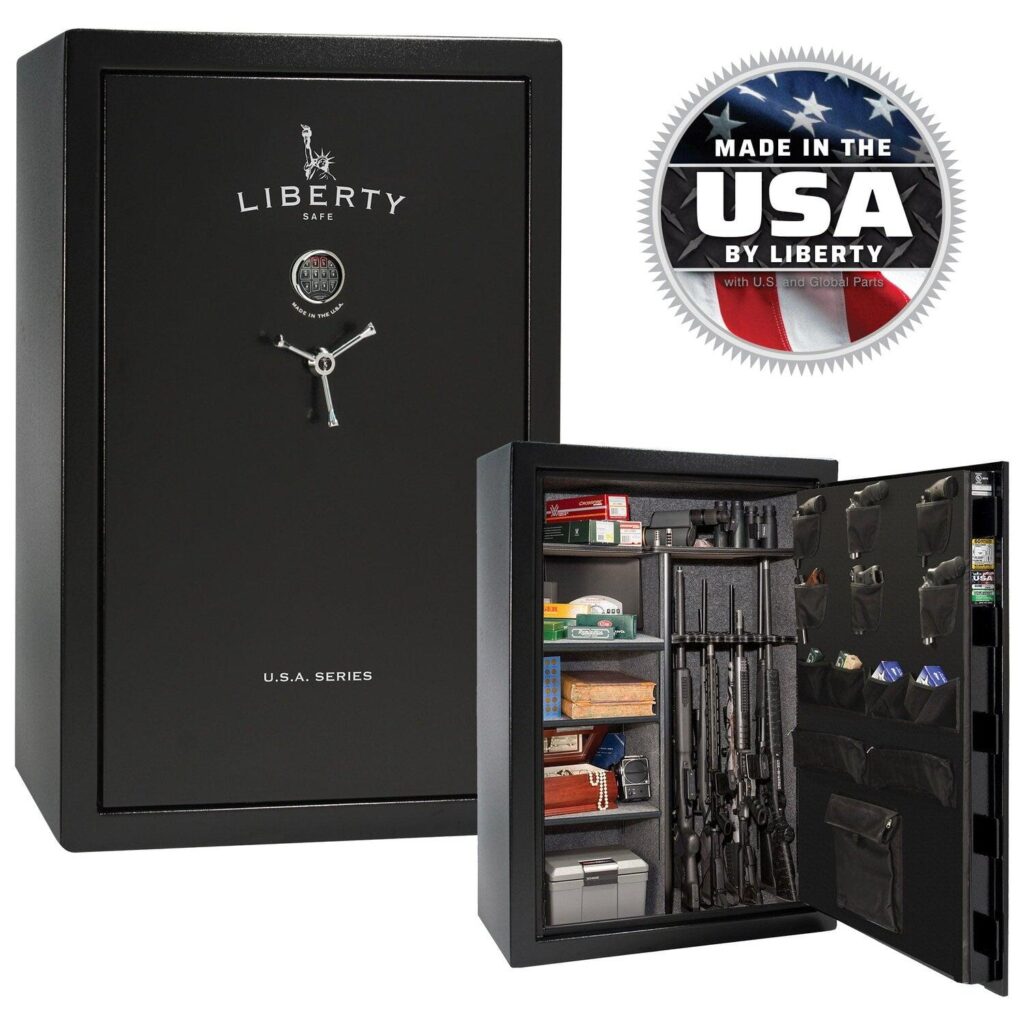
Here’s how a maker fire test works. The safe goes into a furnace heated to a set temperature. Sensors inside track the interior temperature. When the inside passes 350 degrees, the clock stops, and that time becomes the rating. It’s a sensible method. The problem is that the maker picks the furnace, the temperature, the sensor placement and the pass line, and nobody outside checks the result.
The temperatures in our database show why that matters:
- 1,200 degrees: Liberty, Browning and Stealth.
- 1,400 degrees: Winchester (Bandit 14 and 19, 45 minutes) and Hornady (95407, 30 minutes “up to” 1,400).
- 1,875 degrees: Steelwater (SW592216, 60 minutes).
A 45-minute rating at 1,400 degrees and a 60-minute rating at 1,200 degrees cannot be ranked against each other on the numbers alone. The hotter test is harsher, but neither result was checked by an outside lab, so there’s no common yardstick. Compare duration and temperature together, and treat both as the maker’s word.
Makers sometimes disagree with themselves. While building the database we found two cases where the maker’s own page gives two answers:
- Liberty Centurion: the spec table lists 30 minutes for all four sizes, while the text gives 40 minutes for the Centurion 24 and 32.
- Hornady 95407: the door is described as 9-gauge in one place and 8-gauge in another.
We show both figures in the table rather than picking one. When the difference matters to you, email the maker and ask for the test report.
What Fire Rating Do You Actually Need?
Your safe has to hold from ignition until firefighters have water on the fire. Room flashover can come within minutes, and the National Fire Protection Association tracks how long departments take to arrive. With that in mind:
- Urban or suburban, station within 10 minutes: 30 minutes is the floor.
- Rural, 15 minutes or more to a station: 60 minutes or longer.
- Wildfire country: 60 minutes or more, with the highest test temperature you can afford. Response can be slow when a whole area is burning.
- Irreplaceable guns: buy the longest rating you can, and keep the paperwork outside the safe.
Then check the door seal. A heat-expanding seal, such as Palusol, swells in a fire and blocks the smoke and hot gas that ruin finishes even when the walls hold. A rubber gasket melts and does nothing. For our picks by rating, see the best fireproof gun safes.
Fire Ratings and Insurance
Some homeowners policies and firearms riders ask for a “UL rated” safe or a minimum fire rating. Ask your agent which one they mean. A UL RSC listing is a burglary rating. It says nothing about fire. If the policy wants a UL fire rating, you’re looking for a UL 72 listing, and none of the gun safes in our database has one.
After a fire you’ll need the model, serial number, receipt and a photo of the door label. Keep copies somewhere other than the safe.
Biometric Safe Recalls and the Stack-On Warning
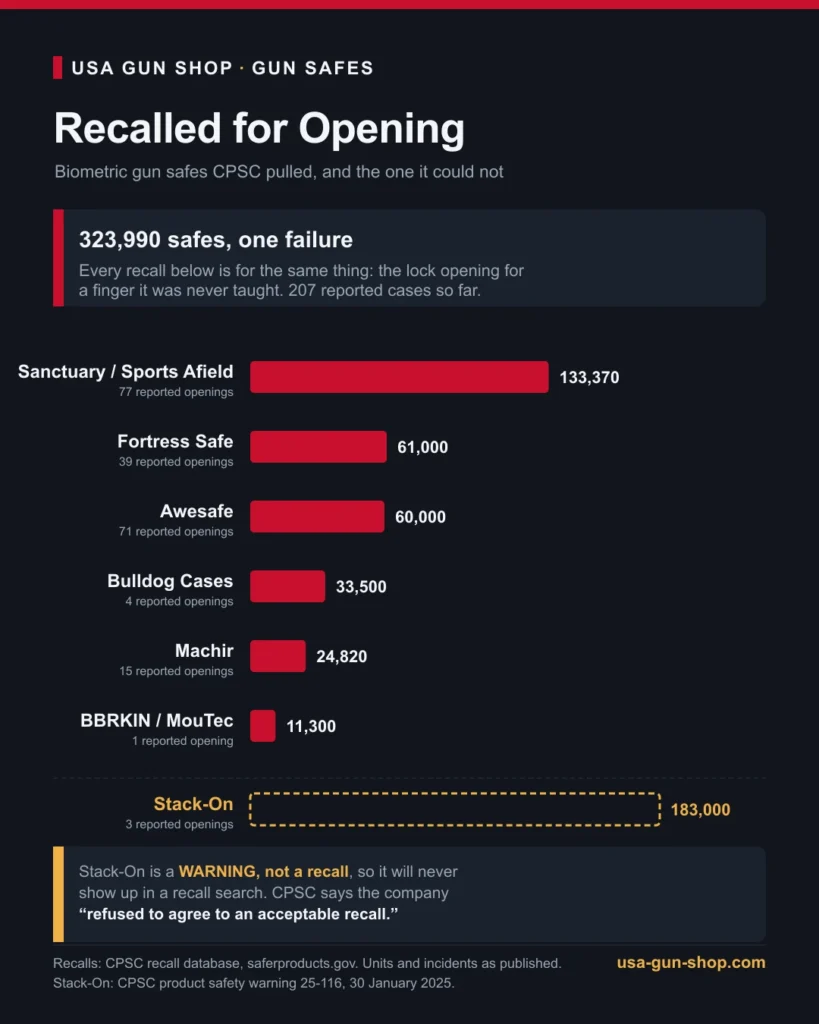
No rating standard covers whether a fingerprint reader lets the wrong person in. CPSC has recalled several biometric gun safe lines for exactly that failure. The database includes the recalls that touch brands we cover:
- Bulldog Magnum biometric vaults (BD4030B, BD4040B, BD4055B): recalled February 22, 2024, about 33,500 units.
- Sports Afield Home Defense 4-Gun Biometric and Sanctuary Quick Access Biometric: recalled June 6, 2024, about 133,370 units across both brands.
- Fortress biometric safes, also sold under the Cabela’s, Gettysburg and Legend Range & Field names: recalled October 19, 2023, about 61,000 units.
- Stack-On biometric safes (model numbers ending in -B): a 2025 CPSC warning, not a recall, telling owners to stop using the biometric feature. Keypad models ending in -E aren’t covered.
A recall doesn’t take a device off California’s roster, either. The DOJ’s own recall notice confirms the three recalled Bulldog vaults, BD4055B included, are roster devices, so a roster listing doesn’t mean a safe is recall-free.
Our biometric gun safe guide covers every CPSC biometric recall, including brands outside this database.
How We Built This Database
Every row was checked on September 23, 2026, against these sources, in this order:
- The maker’s own product page. Burglary listing, fire claim, test temperature, steel gauge and bolt count are taken from the maker’s page, in the maker’s words. Dealer listings and review sites were not used, because they often repeat old or wrong specs.
- The California DOJ roster. We searched the roster by manufacturer and matched model names. “Yes (on roster)” means we found the model by name. “Maker states” means the maker claims approval but the roster lists that brand by code, so we couldn’t match it ourselves.
- CPSC. Recalls come from the CPSC recall database. The Stack-On entry is a CPSC warning, which is a different action, and we label it that way.
What we don’t claim. We did not fire test or attack these safes, and this database doesn’t rank them. “Not stated” means the maker’s page is silent, not that the safe fails. We left out brands whose model pages we couldn’t confirm on the maker’s own site. Each row links to its source so you can check it yourself.
Corrections. Makers change specs without notice. If you have a label photo or a listing number that disagrees with a row, send it through our contact page and we’ll recheck the row against the source.
A UL-Listed Safe Currently on Sale
Below is live pricing for the Liberty USA 50, one of the safes in our database whose maker states a UL burglary listing for the safe body. Its 60-minute fire rating is still Liberty’s own figure. For every other safe and price point, browse the gun safes and storage section or our gun safe guide.
UL-listed body per Liberty, 60 min at 1,200 degrees (Liberty's rating)
FAQ: Gun Safe Fire Ratings and Certifications
What does a gun safe fire rating mean?
A fire rating is two numbers: how many minutes the inside of the safe stayed below 350 degrees Fahrenheit, and how hot the furnace was outside. A rating of 60 minutes at 1,200 degrees means the interior stayed under 350 degrees for 60 minutes in a 1,200-degree furnace. Always read both numbers together.
Are gun safe fire ratings independently tested?
Almost never. We checked 23 popular gun safes and none of the makers names an independent lab for its fire rating. Every figure is the maker's own test. An independent fire rating would be a UL 72 listing, such as Class 350 for 1 hour, and none of the safes in our database carries one.
What does RSC mean on a gun safe?
RSC stands for Residential Security Container, a burglary listing under UL 1037. The baseline test is a five-minute attack by one technician using common hand tools. It says nothing about fire. A UL-listed lock is not the same thing as an RSC-listed safe.
What is UL 72 Class 350?
UL 72 is the independent fire standard for record protection equipment. It includes a fire endurance test and an explosion test, and some units also get a fire and impact test with a 30-foot drop. Class 350 means the interior stays below 350 degrees, the limit for paper and the one that matters for guns.
What does California DOJ approved mean for a gun safe?
It means the safe meets California's gun safe standard, or holds a UL Residential Security Container listing from a Nationally Recognized Testing Laboratory. The standard calls for at least 10,000 lock combinations, three steel bolts of at least 1/2 inch, 12-gauge walls and a 7-gauge door or two layers of 12-gauge. The DOJ roster is not a recall list, so check CPSC as well.
What is the difference between B-rate, C-rate and TL-15?
B-rate and C-rate are insurance labels for steel thickness, not tests. B-rate means a door under 1 inch and a body under 1/2 inch; C-rate means at least 1 inch and 1/2 inch. TL-15 is a UL 687 burglary rating where the door face held for 15 minutes against hand and power tools. None of the gun safes in our database claims a TL rating.
Why do gun safe makers test at different temperatures?
Each maker picks its own furnace temperature. In our database Liberty, Browning and Stealth quote 1,200 degrees, Winchester and Hornady quote 1,400, and Steelwater quotes 1,875. A hotter test is harsher, but because none of these results was checked by an outside lab, ratings from different brands can't be ranked on the numbers alone.
Does a UL listed gun safe satisfy my insurance policy?
Ask your agent which UL rating they mean. A UL Residential Security Container listing is a burglary rating and says nothing about fire. If the policy wants a UL fire rating, that is a UL 72 listing, which none of the gun safes in our database has. Keep the model, serial number, receipt and a photo of the door label outside the safe.
Which biometric gun safes have been recalled?
CPSC has recalled Bulldog Magnum biometric vaults (February 2024, about 33,500 units), Sports Afield Home Defense 4-Gun Biometric and Sanctuary Quick Access Biometric safes (June 2024, about 133,370 units) and Fortress biometric safes (October 2023, about 61,000 units). Stack-On biometric safes got a 2025 CPSC warning to stop using the fingerprint feature, which is not a recall.
How much fire rating do I need in a gun safe?
30 minutes is the floor if a fire station is within about 10 minutes. Go for 60 minutes or more on a rural property or in wildfire country. Check the door seal as well: a heat-expanding seal such as Palusol blocks smoke and hot gas, while a rubber gasket melts.
4,617+ Gun & Ammo Deals
Updated daily from 200+ top retailers. Filter by category, caliber, action type, and price.
Related Guides