

Last updated September 3rd 2026 · By Nick Hall, gun safe owner who has weighed and installed safes from 100 lbs to 800 lbs
Some of the links below are affiliate links, meaning at no additional cost to you, we may earn a commission if you click through and make a purchase.
Short answer: a steel cabinet runs 60 to 150 pounds, an entry fire-rated safe 200 to 400, a full-size safe 400 to 800, and a vault-grade one past 1,000. But the number that matters is not the total. It is how much of that total is steel, and on a fire-rated safe the answer is about half. Here is the arithmetic, and how to use it to catch a spec sheet lying to you.
Table of Contents
How we tested: Every pick here is ranked against our testing methodology. Minimum round counts, accuracy and reliability protocols, the failures that disqualify a gun. Where we have not shot a specific variant ourselves, we say so in that section.
What Gun Safes Actually Weigh
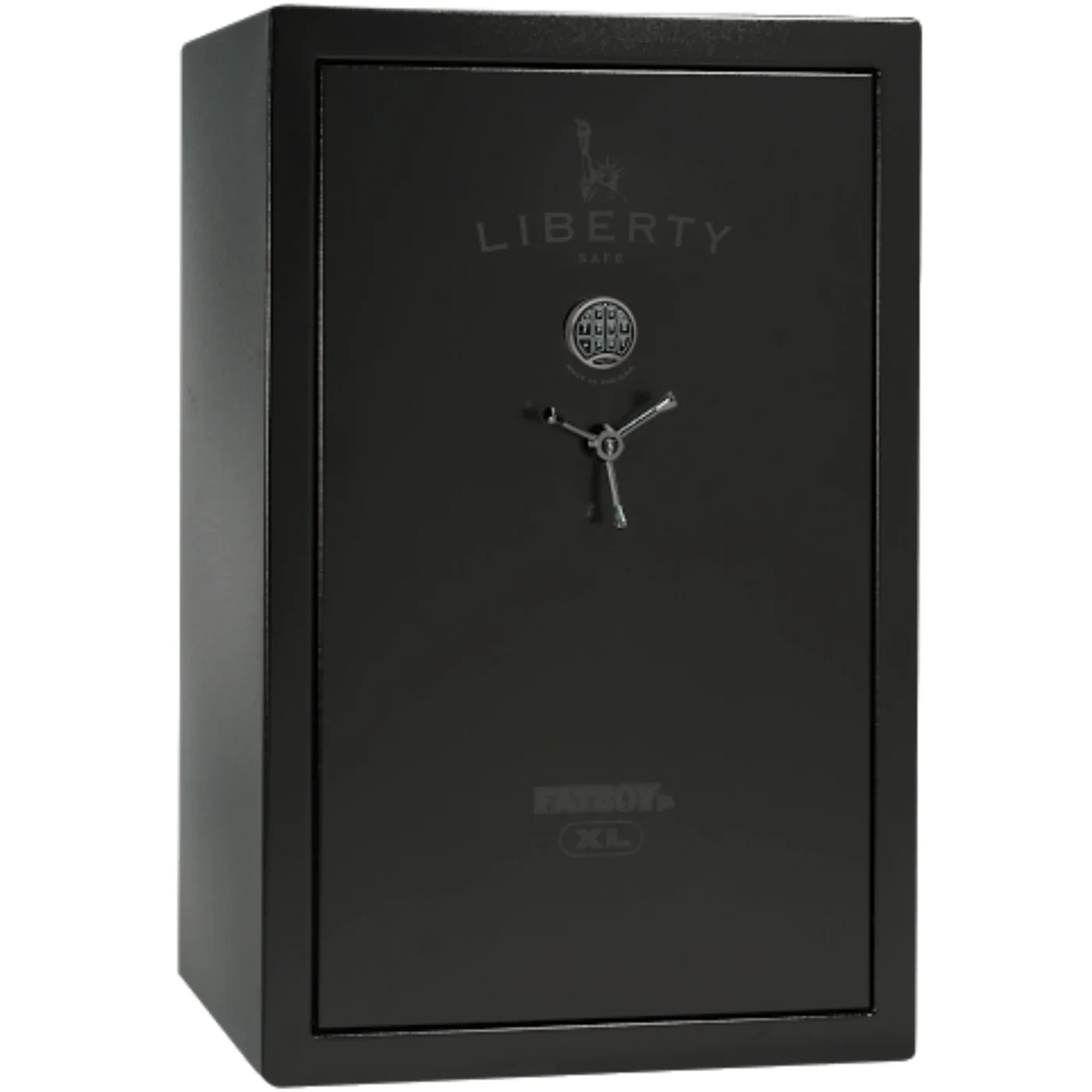
Liberty Safe publish these bands: entry level 200 to 600 pounds, mid range 600 to 1,000, high end 1,000 to 1,600, and commercial grade anywhere from 2,000 to 5,000. Those are a manufacturer’s numbers for a manufacturer’s range, and they run heavier than what most people actually buy, but they are the honest top end of the market.
Down where most of us shop it looks like this.
| Class | Typical weight | What you get |
|---|---|---|
| Pistol box | 7-25 lbs | Quick access, no fire rating |
| Steel cabinet | 60-150 lbs | Thin steel, no fire lining |
| Entry fire-rated safe | 200-400 lbs | 14 gauge, 30 minute rating |
| Full-size safe | 400-800 lbs | 12 gauge, 45-60 minutes |
| Premium safe | 800-1,200 lbs | 10 gauge, composite door |
| Vault-grade | 1,200-2,000+ lbs | 7 gauge, plate steel doors |
Those bands are useful for shipping and for planning a delivery. What they will not tell you is whether the safe is any good, and the rest of this page is about why.
Gauge Runs Backwards, and It Is Not a Thickness
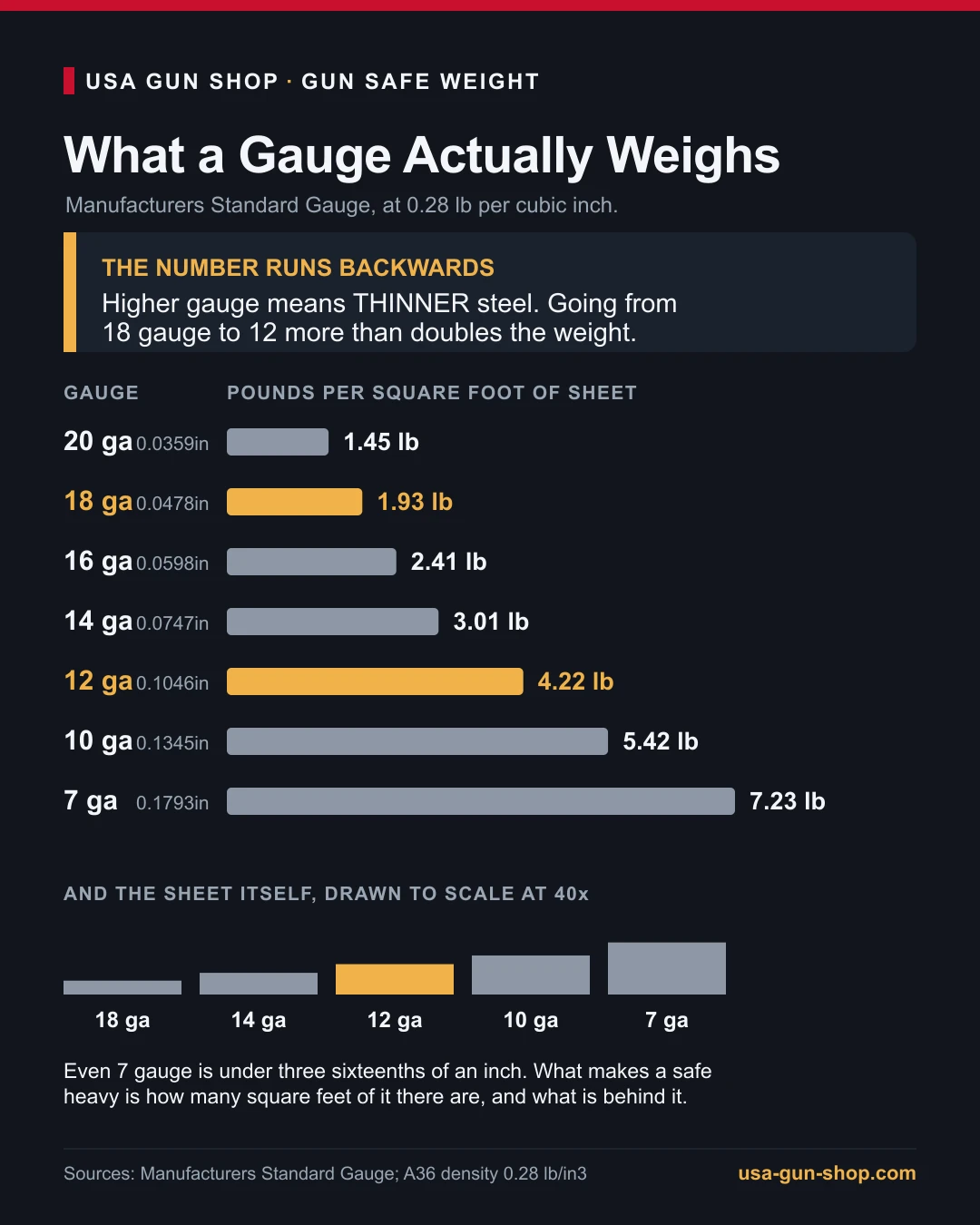
Steel gauge is a traditional, non-linear number, not a measurement. The larger the gauge number, the thinner the metal. ASTM go as far as discouraging its use entirely, and one gauge number means different thicknesses under different standards, which is worth knowing before you compare two spec sheets.
Under the Manufacturers’ Standard Gauge, which is what the safe trade uses, here is what each gauge actually is. The last column is the one nobody prints: multiply the thickness by 144 and by 0.28 pounds per cubic inch and you get the weight of one square foot of it.
| Gauge | Thickness | Weight per sq ft |
|---|---|---|
| 20 gauge | 0.0359 in | 1.45 lb |
| 18 gauge | 0.0478 in | 1.93 lb |
| 16 gauge | 0.0598 in | 2.41 lb |
| 14 gauge | 0.0747 in | 3.01 lb |
| 12 gauge | 0.1046 in | 4.22 lb |
| 10 gauge | 0.1345 in | 5.42 lb |
| 7 gauge | 0.1793 in | 7.23 lb |
Two things fall out of that table. Going from 18 gauge to 12 more than doubles the weight of every square foot, which is why a real safe is so much heavier than a cabinet of the same size. And even 7 gauge, the vault-grade stuff, is under three sixteenths of an inch. Steel is heavy because there is a lot of area, not because any of it is thick.
Half the Weight Is Not Steel
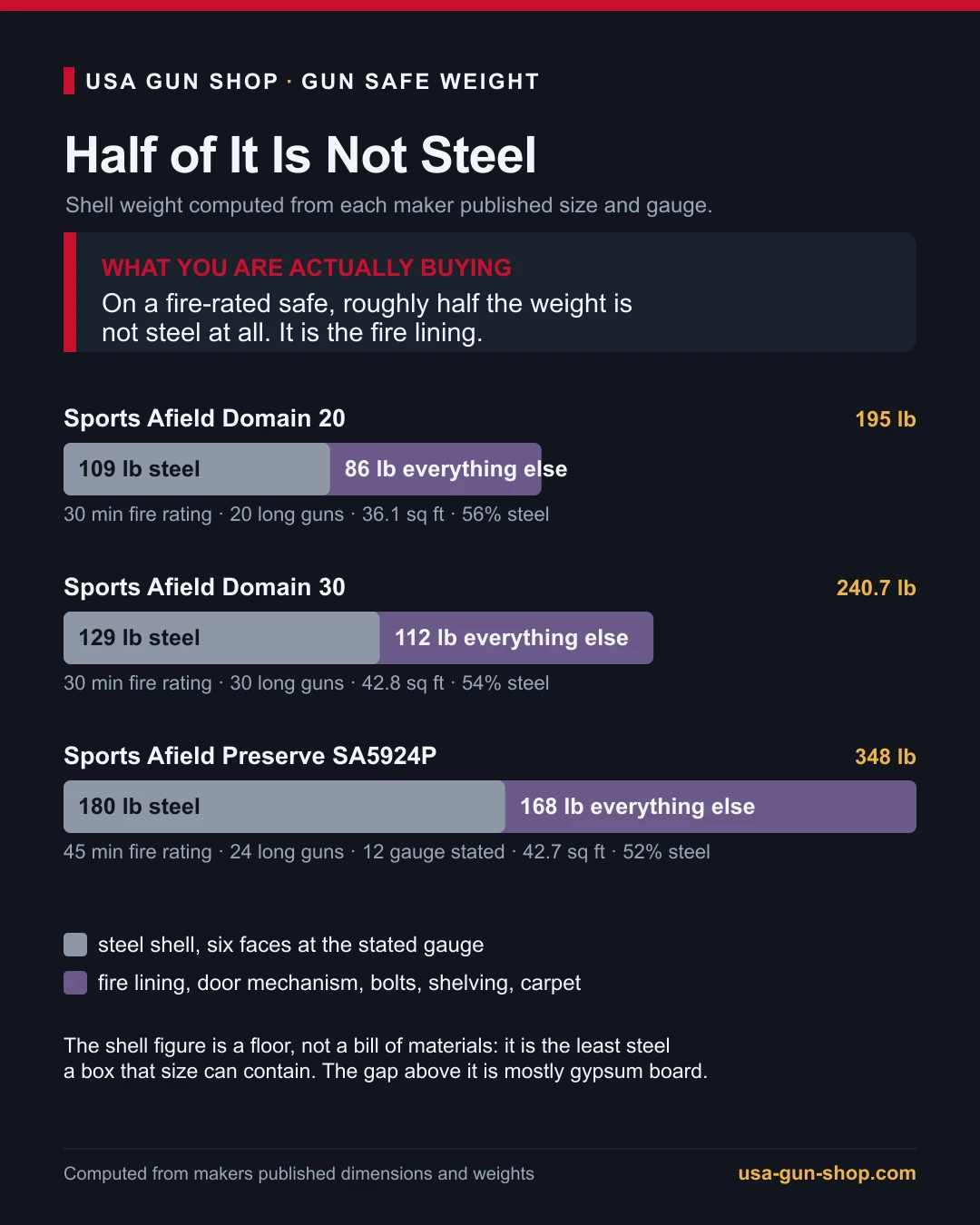
Now put those two numbers together. A safe is a box, so its outside surface is easy arithmetic, and the shell weight follows from the gauge. Compare that against what the maker says the whole safe weighs and you find out what the rest of it is.
| Safe | Published weight | Surface | Steel shell | Steel % |
|---|---|---|---|---|
| Sports Afield Domain 20 | 195 lb | 36.1 sq ft | 109 lb | 56% |
| Sports Afield Domain 30 | 240.7 lb | 42.8 sq ft | 129 lb | 54% |
| Sports Afield Preserve SA5924P | 348 lb | 42.7 sq ft | 180 lb | 52% |
The Domain 20 is 55 by 19.5 by 20.5 inches and 195 pounds. That is 36.1 square feet of surface. At 14 gauge the steel comes to 109 pounds, so 86 pounds of that safe is something other than steel. On the Preserve SA5924P, which Sports Afield build at 12 gauge, it is 168 pounds of not-steel out of 348.
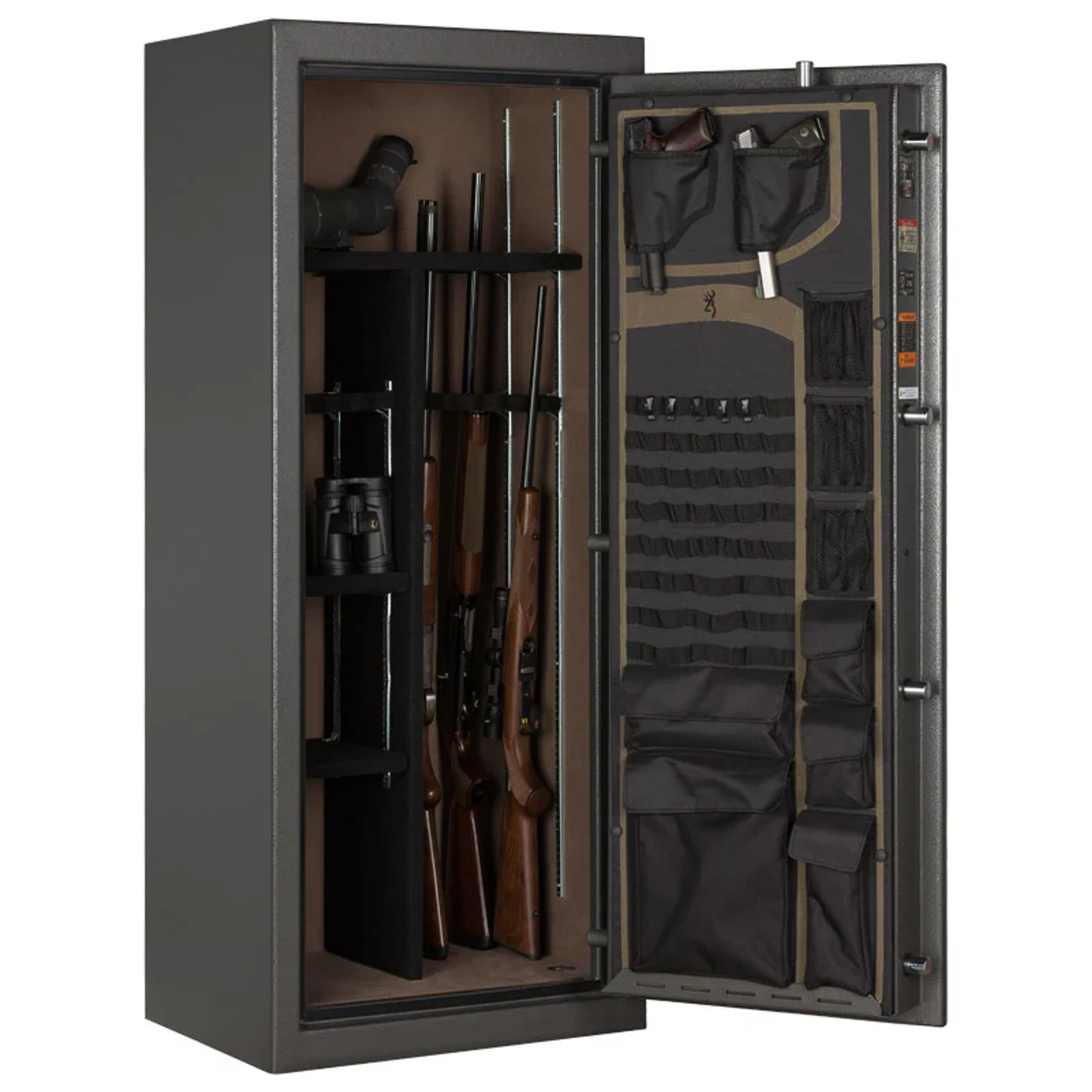
That missing half is mostly gypsum board. Fire lining is layers of drywall sandwiched into the body and the door, and it is heavy, cheap and does nothing whatsoever to stop a pry bar. Open a safe and look at the door edge: the thickness you are looking at is mostly board, with a skin of steel on each side of it.
So the honest version of “heavy means secure” is narrower than the way it gets said. Weight tracks security within a class, because a thicker gauge really is heavier. Across classes it breaks down, because a 45 minute fire rating can add a hundred pounds of drywall without adding a single pound of burglary resistance. Two safes at 350 pounds can hold very different amounts of steel.
One caveat on my own numbers. The shell figure is a floor, not a bill of materials. It assumes six flat faces at the stated gauge and ignores the frame, the bolt work, the hinges and the fact that most doors are thicker than the body. Real steel content is higher than my figure. The gap between shell and total is still the direction of travel, and it is large.
How to Catch a Spec Sheet Lying to You
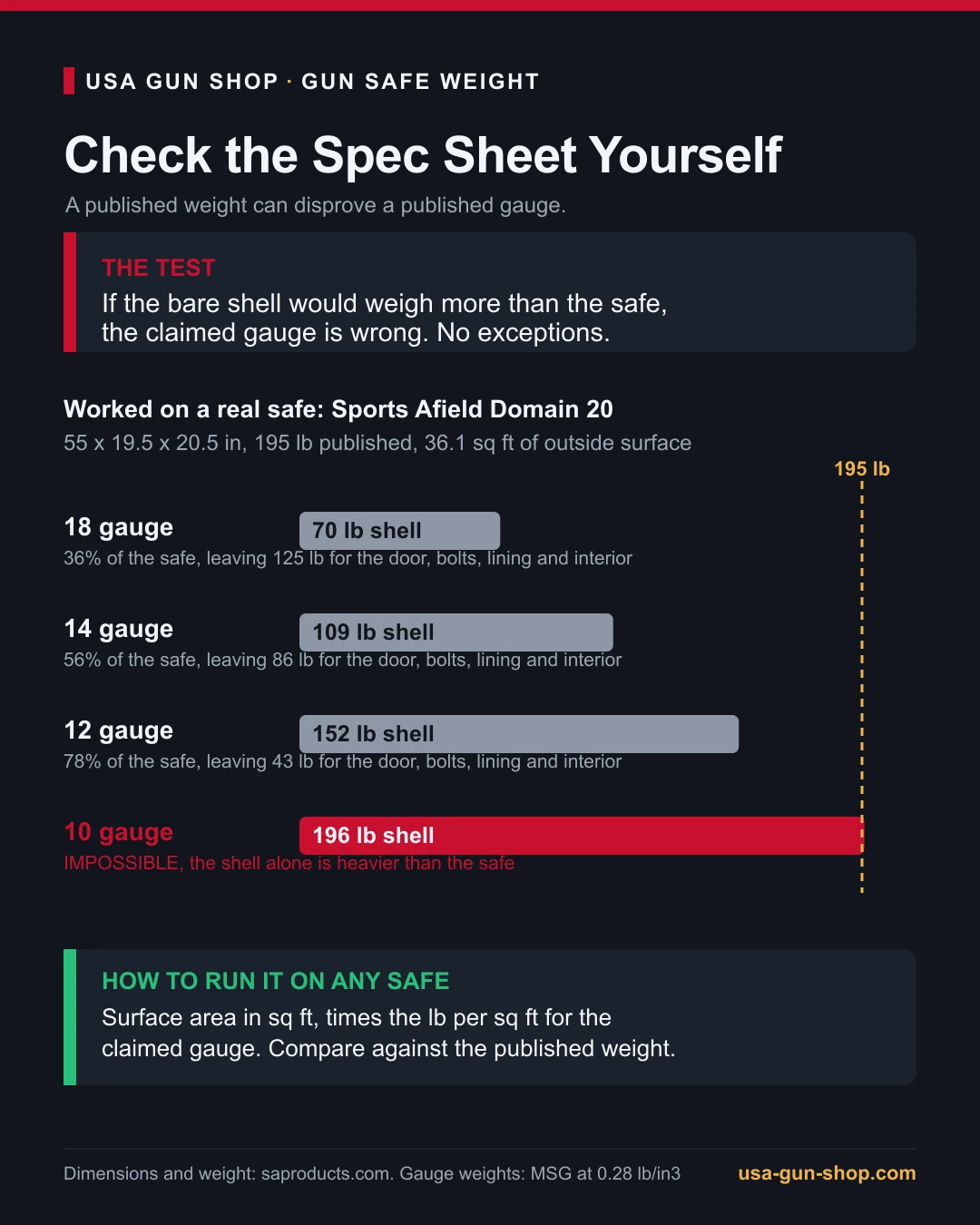
This is the useful part. Because the shell weight is arithmetic, a published weight can disprove a published gauge, and listings on this product get the gauge wrong constantly.
Take the Domain 20 again. If a listing claimed a 10 gauge body, the shell alone would come to 196 pounds against a safe that weighs 195. The claim is impossible, and you can show it in thirty seconds with the exterior dimensions off the same listing that made the claim.
- Take the exterior dimensions in inches, height by width by depth
- Surface area in square feet is (2HW plus 2HD plus 2WD) divided by 144
- Multiply by the pounds per square foot for the claimed gauge, from the table above
- Compare against the published weight. A shell over about 70 percent of the total on a fire-rated safe means the gauge claim is optimistic. Over 100 percent means it is wrong
If you would rather not do the arithmetic, find the size closest to yours below. These are shell weights, so subtract them from the published weight of the safe to see what is left for lining and hardware.
| Size | H x W x D | Surface | Shell at 14 ga | Shell at 12 ga |
|---|---|---|---|---|
| Small cabinet | 55 x 20 x 11 in | 26.7 sq ft | 81 lb | 113 lb |
| Narrow safe | 55 x 20 x 20 in | 36.1 sq ft | 109 lb | 152 lb |
| Standard safe | 59 x 24 x 20 in | 42.7 sq ft | 129 lb | 180 lb |
| Wide-body safe | 60 x 30 x 22 in | 52.5 sq ft | 158 lb | 221 lb |
| Big safe | 72 x 40 x 25 in | 78.9 sq ft | 238 lb | 333 lb |
It cuts the other way too. If a 400 pound safe of ordinary size is claimed at 18 gauge, the steel is only about 80 pounds and you are buying 320 pounds of lining and hardware. That might be exactly what you want if fire is your worry. It is not a burglary-resistant safe.
What the Security Standard Actually Measures
Here is the part that should end the weight argument. The common certification on a gun safe is Residential Security Container, UL 1037. RSC certification requires the safe to resist five minutes of attack by an expert using hand tools, screwdrivers and adjustable wrenches among them.
Five minutes. Not an hour, not overnight. And nowhere in that standard is there a weight requirement, because weight is not what the test measures. A 900 pound safe and a 300 pound one can carry the identical RSC rating.
That is not a reason to buy the light one. It is a reason to stop treating the shipping weight as a security specification and start reading the rating, the gauge, the bolt count and whether the thing is anchored to your floor.
Weight by Price, and What to Buy at Each One
Under $300: a steel cabinet, and know what it is not
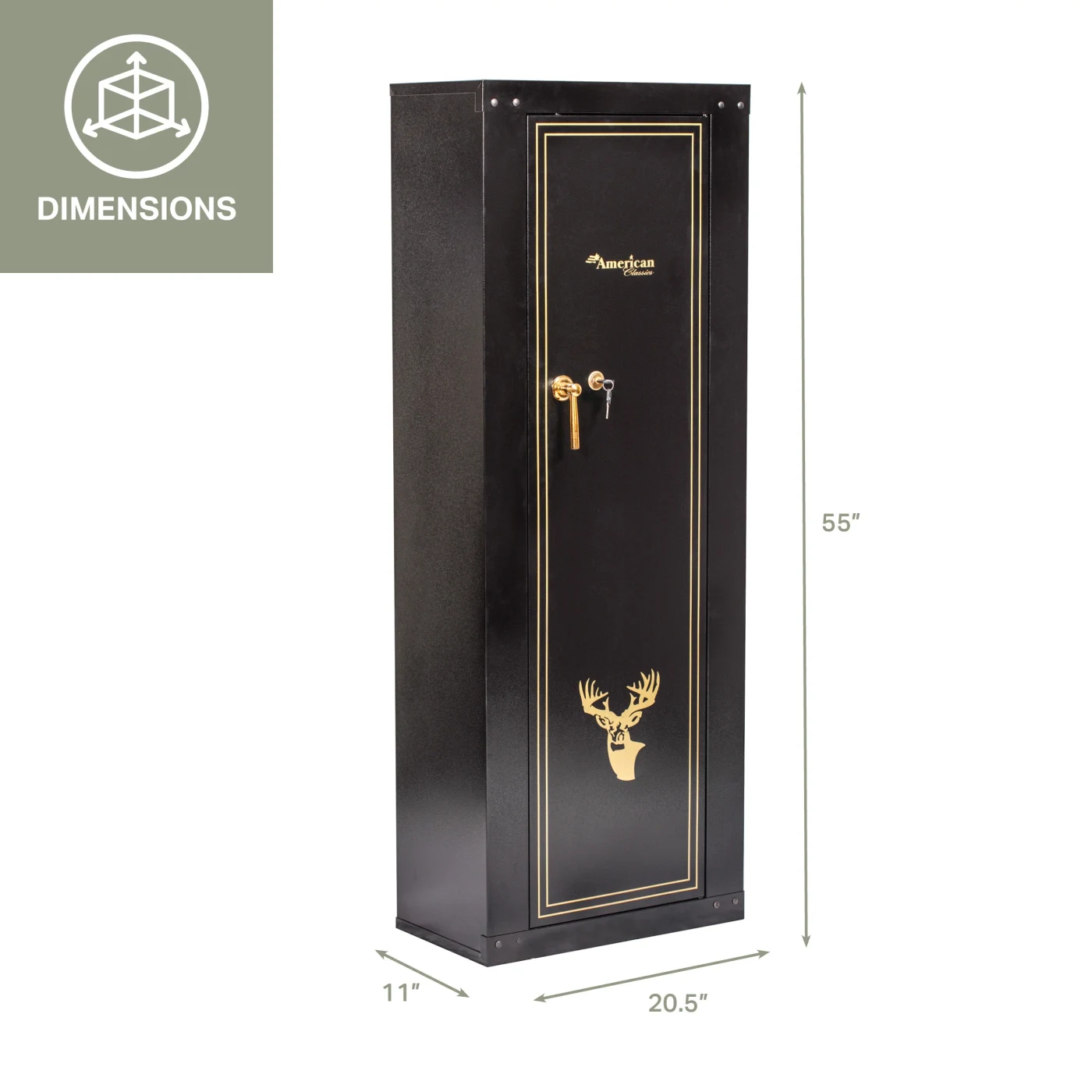
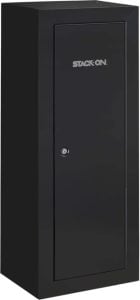
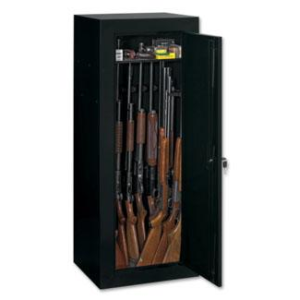
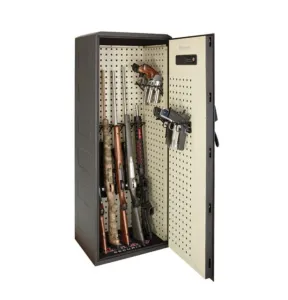
A cabinet is 18 or 20 gauge, 60 to 150 pounds, and it has no fire lining at all. The one above is 55 by 20.5 by 11 inches on the maker’s own drawing, which is 27.2 square feet, so at 18 gauge it holds about 52 pounds of steel. Almost the whole weight of a cabinet is steel, which is the opposite of a fire safe and sounds like a compliment until you remember it is 18 gauge.
It stops a curious child and an opportunist. It will not stop someone with a pry bar and five minutes, and it will not survive a house fire. Buy one for what it is: better than a closet, and light enough to go anywhere. Our safe versus cabinet comparison is blunt about the trade.
60 to 150 lbs, live pricing
$800 to $1,000: the lightest safe with a real fire rating
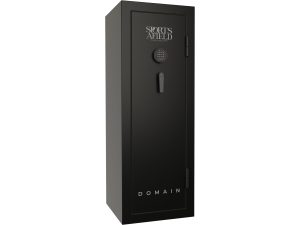
This is where fire lining starts and where weight roughly triples. The Domain 20 at 195 pounds is about as light as a genuinely fire-rated full-size safe gets, which makes it the one people put upstairs. You are buying 30 minutes at 1,400 degrees and five 1-inch bolts.
195 lbs, 30 minute fire rating
$750 to $1,000: the full-size benchmark
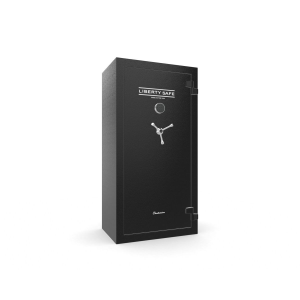
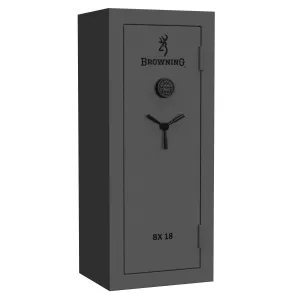
The Liberty Centurion 24 is the safe most people end up comparing everything else against, and at roughly 375 pounds it is nearly twice the Domain. Some of that is more steel and some of it is more board, which is the whole point of this page. Either way it is a two-person-and-a-trolley job, not a carry-it-in-yourself one.
About 375 lbs, live pricing

Will the Floor Take It?
On a ground floor slab, yes, and there is nothing more to think about. Upstairs the honest answer needs the right number, and the one that circulates on this subject is the wrong one.
You will read everywhere that a residential floor is designed for 40 pounds per square foot. That is the figure for rooms other than bedrooms. A sleeping area is designed for 30, and a bedroom is where most upstairs safes actually go. The code also sets no point-load value for a room floor at all, so no table answers the question directly. Placement does most of the work: against a load-bearing wall, ideally in a corner. Our gun safe on a second floor guide has the code tables and the arithmetic.
Rule of thumb that survives contact with the code: under 600 pounds against a wall is a non-event on any sound floor. Between 600 and 1,000, get it over a bearing wall. Past 1,000 pounds upstairs, spend the $200 to $400 on a structural engineer.
Bolting It Down Beats Buying It Heavier
If the RSC rating is five minutes, the job is to make the burglar’s five minutes useless. Weight helps. Anchoring helps far more, and it is cheaper than the next hundred pounds of safe.
An unanchored 300 pound safe goes onto an appliance dolly and out of the door. The same safe through four anchors into a slab has to be attacked in place, which is the whole point: a safe that cannot leave has to be opened where it stands, in your house, making noise. Most safes come pre-drilled and the hardware is in the box. Our bolt-down guide has the anchor sizes, hole depths and edge distances, and the edge distances matter more than people expect because safes live in corners.
If you are choosing between a heavier safe and a lighter one you can actually anchor properly, anchor the lighter one.
Getting It Into the House
Weight decides the delivery, and the delivery is where budgets get a surprise. Free shipping on a safe almost always means curbside: a pallet at the end of the drive, and the rest is your problem. Room-of-choice delivery runs $200 to $500 depending on weight and stairs, and past about 400 pounds it is money well spent.
Measure before you order, and measure the narrowest point rather than the doorway you were thinking of. A staircase is the usual killer: the code requires 36 inches of clear width only above handrail height, and as little as 27 inches down where a safe on a dolly actually travels. Our guide to moving a gun safe covers the method and the kit.
Taking the door off first removes 30 to 40 percent of the weight on many full-size safes, though plenty of models do not have owner-removable doors, so check yours before you plan the day around it.
The Short Version
Buy for the fire rating and the gauge, not the shipping weight. Check the gauge claim against the weight with the arithmetic above, because it is wrong on listings more often than it is right. Then anchor whatever you buy, because five minutes is all the standard promises you and the floor bolts are what turn that into a problem somebody else has to solve.
Shop Gun Safes by Weight
Best-scored accessories across 200+ retailers · Updated every 4 hours

FAQ: Gun Safe Weight
How much does a gun safe weigh?
A steel cabinet is 60 to 150 pounds, an entry fire-rated safe 200 to 400, a full-size safe 400 to 800, and a vault-grade one 1,200 and up. Liberty publish slightly heavier bands for their own range, starting at 200 to 600 pounds for entry level. The Sports Afield Domain 20 is 195 pounds and the Preserve SA5924P is 348, both from the maker's own spec sheets.
Does a heavier gun safe mean better security?
Within a class, yes, because thicker steel really is heavier. Across classes it falls apart. On a fire-rated safe roughly half the weight is gypsum fire lining, which adds pounds and nothing at all to pry resistance. Two safes at the same weight can hold very different amounts of steel, so read the gauge and the rating rather than the shipping weight.
How much of a gun safe's weight is actually steel?
About half on a fire-rated safe. The Sports Afield Domain 20 is 195 pounds with 36.1 square feet of outside surface, so at 14 gauge the shell is around 109 pounds and 86 pounds is lining, door mechanism, bolts and interior. On the 12 gauge Preserve SA5924P it is 180 pounds of steel in a 348 pound safe. A cabinet with no fire lining is almost entirely steel by comparison.
What does steel gauge mean on a gun safe?
Gauge is a traditional non-linear number where a higher figure means thinner metal. Under the Manufacturers' Standard Gauge, 18 gauge is 0.0478 inches and weighs 1.93 pounds per square foot, 14 gauge is 0.0747 inches and 3.01 pounds, 12 gauge is 0.1046 inches and 4.22 pounds, and 10 gauge is 0.1345 inches and 5.42 pounds. Going from 18 to 12 more than doubles the weight of every square foot.
Can I tell if a listed steel gauge is wrong?
Yes, with a calculator. Work out the surface area from the exterior dimensions, multiply by the pounds per square foot for the claimed gauge, and compare against the published weight. If the bare shell would weigh more than the whole safe, the gauge claim is impossible. A 195 pound safe the size of a Domain 20 cannot have a 10 gauge body: the shell alone works out at 196 pounds.
What does an RSC rating actually require?
Residential Security Container under UL 1037 requires the safe to resist five minutes of attack by an expert with hand tools including screwdrivers and adjustable wrenches. It sets no weight requirement at all, so a 300 pound safe and a 900 pound safe can carry the same rating. Five minutes is the promise, which is why anchoring matters more than the last hundred pounds.
Will my floor hold a heavy gun safe?
On a ground floor slab, always. Upstairs, note that the widely quoted 40 pounds per square foot is the figure for rooms other than bedrooms. A sleeping area is designed for 30. Under 600 pounds against a wall is a non-event, 600 to 1,000 should sit over a load-bearing wall, and past 1,000 pounds upstairs is worth an engineer's opinion.
Is bolting down better than buying a heavier safe?
Almost always, and it is cheaper. An unanchored 300 pound safe leaves on an appliance dolly. The same safe anchored into a slab has to be attacked where it stands, which takes tools, noise and time the burglar does not have. If the choice is a heavier safe or a lighter one you can anchor properly, anchor the lighter one.
4,617+ Gun & Ammo Deals
Updated daily from 200+ top retailers. Filter by category, caliber, action type, and price.
Related Guides