

Affiliate disclosure: This post contains affiliate links. If you buy through our links we may receive a small commission at no extra cost to you.
Last updated September 2026 · By Nick Hall, shotgun shooter with 20+ years behind every gauge and shell type on this list
- Treat every gun as loaded
- Point the muzzle in a safe direction
- Keep your finger off the trigger until you’re ready to shoot
- Know your target and what’s beyond
Quick Answer: Shotgun shells are categorized by gauge (the bore diameter, with smaller numbers meaning larger bore) and shell length (2¾”, 3″, and 3½” being the most common). Inside the shell, shot size ranges from #9 (smallest pellets, used for clay shooting and small birds) to 000 buck (largest, used for self-defense and large game). The most common load for home defense is 12-gauge 2¾” #00 buckshot, with 9 pellets per shell.
Birdshot (#7-#9) is for clays and small birds. Buckshot (#4 buck through 000 buck) is for self-defense and deer. Slugs are single-projectile rounds for deer and home defense at distance.
The biggest mistake new shotgun owners make is using 3″ or 3½” magnum loads when 2¾” loads cover 99% of practical use. Magnum loads kick harder, cost more, and rarely improve real-world performance. Match the load to the job, not the maximum power available.
Table of Contents
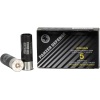
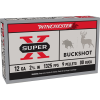
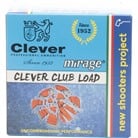
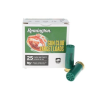
I remember standing in front of the shotgun shell wall at my local gun shop for a solid ten minutes, completely lost. Walk into any gun shop and stare at that wall for five minutes. It’s a lot. 2¾”, 3″, 3½”. #7½ shot, #4 shot, 00 buck, 1-ounce slugs, 1⅜-ounce magnums. TSS, bismuth, steel, lead. Dram equivalents that seem to reference nothing. The box designs don’t help either.
The good news: it’s not as complicated as it looks. Once you understand the basic framework, it all clicks into place. I’ve been shooting shotguns for over 20 years and still learn something new about loads every season. This guide to shotgun shell sizes breaks down shell length, shot size, shot material, and how to actually read a box without a decoder ring.
How we tested: Every pick here is ranked against our testing methodology. Minimum round counts, accuracy and reliability protocols, the failures that disqualify a gun.
Shotgun Gauge: What It Actually Means
Gauge is a weird old measurement. It tells you how many lead balls of that bore diameter you’d need to equal one pound. Twelve balls to the pound means 12 gauge. Smaller number, bigger bore. That’s why a 10 gauge is physically larger than a 12 gauge, and a 20 gauge is smaller.
12 gauge is the dominant platform in the US. It’s the one with the deepest ammo selection, the most gun options, and the most versatility from dove loads to deer slugs. The 20 gauge is a legit option for smaller-framed shooters and youth hunters. The 28 gauge and .410 bore are specialty tools. We’ve got a full shotgun gauge breakdown if you want the deep dive on the comparison.
Key point here: gauge determines what shells fit your gun. You can’t safely put a 20 gauge shell in a 12 gauge gun (they’ll chamber and fire with catastrophic results). Always match gauge to gun.
Shell Length: 2¾”, 3″, and 3½” Explained
Shell length is measured when the shell is fired and the crimp has opened up. The 2¾” shell you’re holding is actually closer to 2½” with the crimp still folded. This trips people up constantly.
Most 12 gauge shotguns have a chamber length stamped on the barrel. That number tells you the maximum shell length you can shoot safely. A gun with a 3″ chamber can fire 2¾” and 3″ shells. A gun with a 2¾” chamber should only shoot 2¾” loads. Running a longer shell in a shorter chamber creates dangerous pressure spikes.
| Shell Length | Common Name | Gauges Available | Best Used For |
|---|---|---|---|
| 2¾” | Standard | 12, 20, 28, .410 | Clay sports, upland birds, home defense, general use |
| 3″ | Magnum | 12, 20 | Waterfowl, turkey, larger game at distance |
| 3½” | Super Magnum | 12 only | Long-range waterfowl, high-volume goose hunting |
For most shooters, the 2¾” shell handles everything from trap to turkey if you pick the right load. Longer shells hold more powder and more shot, which sounds appealing until you’re on the receiving end of that recoil. The 3½” 12 gauge is genuinely punishing. Hunters who shoot hundreds of rounds at clay targets have zero reason to go there.
Shot Size Chart: From #9 to #000 Buck
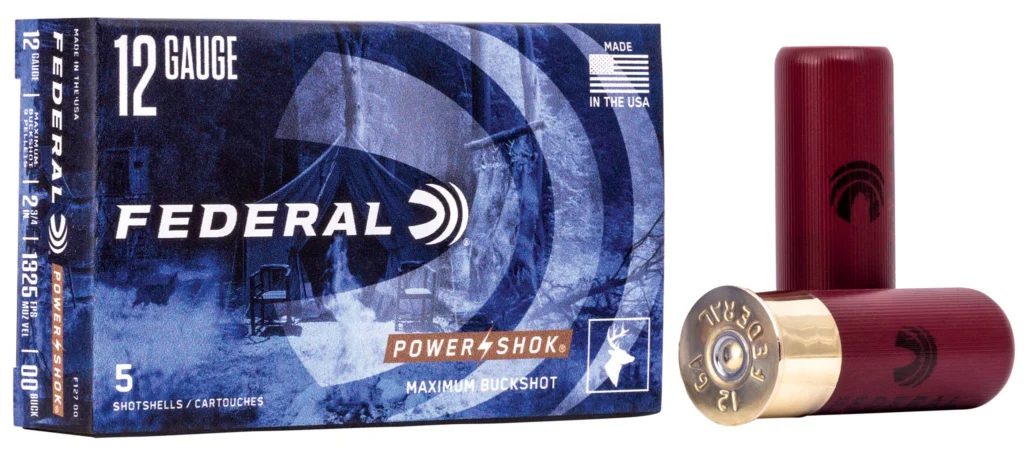
Shot size is an inverse scale: the higher the number, the smaller the pellet. #9 shot is tiny. #2 shot is much larger. Then you cross into buckshot territory with “0” designations, where more zeros means bigger pellets. It’s counterintuitive until you just memorize the pattern.
| Shot Size | Diameter (inches) | Approx. Pellet Count (1 oz. load) | Common Uses |
|---|---|---|---|
| #9 | 0.080″ | 585 | Skeet, trap, close-range sporting clays |
| #8 | 0.090″ | 410 | Trap, sporting clays, dove |
| #7½ | 0.095″ | 350 | Trap, dove, quail, light upland birds |
| #6 | 0.110″ | 225 | Pheasant, squirrel, rabbit, grouse |
| #5 | 0.120″ | 170 | Pheasant, turkey (at shorter range), rabbits |
| #4 | 0.130″ | 135 | Geese (steel), larger upland birds, home defense (some use) |
| #2 | 0.150″ | 87 | Geese, large ducks, coyote (lead), turkey |
| BB | 0.180″ | 50 | Snow geese, large geese at range |
| #4 Buck | 0.240″ | 27 (2¾” 12ga) | Home defense, deer (close range), coyote |
| #1 Buck | 0.300″ | 16 (2¾” 12ga) | Deer, home defense |
| 0 Buck | 0.320″ | 12 (2¾” 12ga) | Deer, home defense |
| 00 Buck | 0.330″ | 9 (2¾” 12ga) | Home defense, deer, law enforcement standard |
| 000 Buck | 0.360″ | 6-8 (2¾” 12ga) | Large game, heavy-duty defense |
00 buck (double-ought) is the most popular defensive load on the planet for a reason. It’s what I keep loaded in my home defense shotgun, and it’s what I recommend to anyone who asks. Nine pellets, each roughly .33 caliber, hitting in a tight pattern at typical indoor distances. That’s a lot of energy delivered fast. The tradeoff is pellet count: if you need dense patterns for fast-moving birds, small shot is the tool. For a deeper look at how these loads compare for specific purposes, check out our buckshot vs. slugs vs. birdshot breakdown.
Birdshot vs. Buckshot vs. Slugs: The Big Three
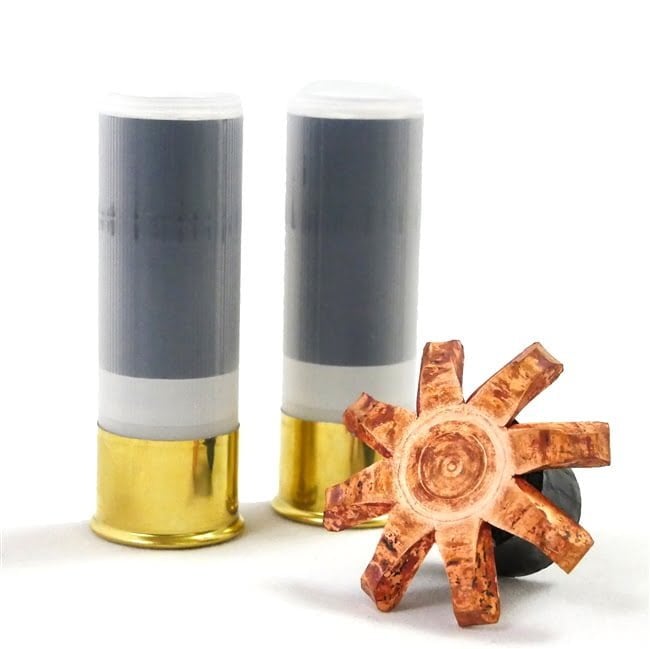
Birdshot is anything from #9 through roughly #2. Lots of small pellets, dense pattern, short effective range. Perfect for clay targets and small game. Won’t reliably cycle semi-auto guns at very low velocities, so check minimum velocity specs on your gun before grabbing the lightest dove loads.
Buckshot starts at #4 buck and runs up through 000 buck. Fewer, much larger pellets. Designed for deer-sized game and defensive use. At typical home defense distances (under 15 yards), the pattern stays tight enough that you’re essentially hitting with one large projectile cluster. Pattern opens up fast beyond 25-30 yards with most chokes.
Slugs are a single projectile. Foster slugs (rifled), Brenneke slugs, and sabot slugs (for rifled barrels) give you rifle-like accuracy from a shotgun. Sabot slugs from a rifled barrel can reach out to 150+ yards accurately. Standard rifled Foster slugs are more in the 75-100 yard range. Slugs are the serious deer hunting load in shotgun-only zones and work fine for bear defense. We’ve got a full guide on the best 12 gauge slugs for defense and hunting if you want specific recommendations.
Shot Materials: Lead, Steel, Bismuth, and TSS
Lead is dense, soft, and ballistically excellent. It patterns well, holds velocity, and is cheap to manufacture. The catch: it’s banned for waterfowl hunting in the US (since 1991, per US Fish & Wildlife Service regulations) and increasingly restricted in other areas. For upland birds on private land, lead is still legal in most states and remains the performance benchmark.
Steel is the waterfowl standard. It’s less dense than lead (density of 7.9 g/cc vs. lead’s 11.3 g/cc), which means you need larger pellet sizes to deliver comparable energy at range. The general rule: go two sizes up from your lead load. Using #2 lead for ducks? Step up to BB steel. Steel is also hard, which can damage older thin-walled choke tubes, so check your choke compatibility before stuffing steel through a vintage full choke.
Bismuth is a non-toxic alternative that’s much denser than steel (9.6 g/cc) and soft enough to use in any choke, including older fixed-choke guns. Performance is closer to lead. Price is considerably higher. It’s the preferred choice for shooting antique guns or classic side-by-sides where steel isn’t safe to use.
TSS (Tungsten Super Shot) is the premium option. Density of 18 g/cc, which is significantly denser than lead. That density lets manufacturers load very small shot sizes with more downrange energy than much larger traditional pellets. TSS #9 shot for turkey is now a real thing. Small pellets, insane pellet counts, brutal energy. It works. It’s expensive as hell, but it genuinely delivers at distances that would be marginal with lead.
| Material | Density (g/cc) | Legal for Waterfowl? | Choke Compatibility | Relative Cost |
|---|---|---|---|---|
| Lead | 11.3 | No (US federal) | Any choke | $ |
| Steel | 7.9 | Yes | Modified or more open (check gun) | $$ |
| Bismuth | 9.6 | Yes | Any choke | $$$ |
| Tungsten (TSS) | 18.0 | Yes | Any approved TSS choke | $$$$ |
What’s Inside a Shotgun Shell
Every shotgun shell is built from the same five components. Knowing what each one does makes it easier to understand why different loads perform differently.
The hull is the outer case, usually plastic (high brass or low brass base, plastic body). High-brass hulls are associated with higher-power loads, though the actual brass height doesn’t determine pressure on its own. The hull’s job is containment: it holds everything together and expands to seal the chamber during firing, then rebounds enough for extraction.
The primer sits at the base of the shell. When the firing pin strikes it, it ignites the powder charge. Shotgun primers are sensitive and reliable but not interchangeable with rifle or pistol primers. Size and type matter if you reload.
The powder (propellant) is what actually launches the shot. Shotgun powders burn fast. Different loads use different powder charges, which is why you can have two 12 gauge shells with identical shot weights that feel completely different at the trigger. A light dove load and a turkey magnum both hold 1¼ oz of shot but the powder charges are vastly different.
The wad sits between the powder and the shot. It does two things: seals the propellant gases behind the shot column (driving band), and cushions the shot during acceleration (shot cup). The shot cup wraps around the pellets as they travel down the bore and peels away after muzzle exit. Higher-quality wads with better shot cups generally produce tighter patterns.
The shot (or slug) is the payload. Pellets sit in the shot cup portion of the wad. The crimp at the top of the hull holds everything in place until firing. Fold crimps (the standard pinwheel crimp) and roll crimps (used on slugs and some older shells) both work fine.
Dram Equivalent: What It Actually Means
This one confuses everyone. “Dram equivalent” is a historical reference to the weight of black powder in drams that would produce comparable velocity. Modern shells use smokeless powder, which is far more efficient. A shell labeled “3¼ DE” isn’t using 3¼ drams of anything.
In practice, dram equivalent is a relative velocity indicator. Higher dram equivalent means higher velocity. A 3¼ DE load is faster than a 2¾ DE load with the same shot weight. The actual velocities are printed on most boxes in feet per second these days, which is far more useful. When you see velocity (like 1,300 fps or 1,550 fps), use that number. Ignore the dram equivalent unless you’re comparing loads that don’t list velocity.
Higher velocity isn’t always better. Faster shot pellets deform more under acceleration, which can open your pattern. Premium loads with hardened shot or plated pellets mitigate that. For turkey and long-range waterfowl, tight patterns matter more than raw speed.
How to Read a Shotgun Shell Box
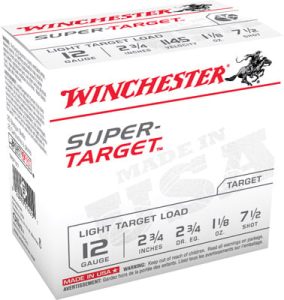
A typical 12 gauge shell box will list several pieces of information. Here’s how to decode the most common format.
Gauge is always listed prominently. Can’t miss it. Make sure it matches your gun.
Shell length is typically shown in inches, like “2¾ inch” or “3 inch”. This is the fired length. Match to your chamber specification.
Shot weight is listed in ounces (or grams in some markets): “1 oz.”, “1¼ oz.”, “1⅜ oz.” More ounces means more pellets of the same size, which means a denser pattern. Heavier loads also recoil more.
Velocity is in feet per second (fps). Common values range from about 1,100 fps on the low end (reduced recoil loads) to 1,600+ fps on magnum turkey and waterfowl loads. Some boxes still show dram equivalent instead of or in addition to velocity.
Shot size is the number or designation: #7½, #4, #2, 00 Buck, Slug, etc. This is usually the biggest number on the box because it’s what most hunters care about first.
Shot material may be listed on the front (Lead, Steel, Bismuth, TSS, Hevi-Shot, etc.) or in the fine print on the back. Check this before buying waterfowl loads to confirm it’s a legal non-toxic shot.
Some boxes also list the number of pellets per shell, which is useful for buckshot comparisons. A standard 2¾” 00 buck shell holds 9 pellets. A 3″ shell holds 12. That difference matters in a defensive context.
Choosing the Right Load for the Job
For clay target sports (trap, skeet, sporting clays), any quality 2¾” target load in #7½ or #8 shot is the move. Low recoil, inexpensive, and designed to break clay. Don’t overthink it. Spend the money you save on more shells.
Upland bird hunting is more nuanced because birds vary in size and distances vary by terrain. Quail and dove hunters typically run #7½ or #8. Pheasant hunters often run #5 or #6 for denser cover, or #4 for open fields where shots are longer. Grouse is usually #6 or #7½. The gun and choke combination affects pattern density as much as the load does.
Waterfowl hunting requires non-toxic shot by federal law. Most hunters run steel at two sizes larger than their lead equivalent. Serious long-range waterfowlers are moving to bismuth and tungsten loads. For close-range pond hunting, steel #3 or #4 is fine. For 50-yard honkers, you want heavier shot (BB, BBB, T-shot in steel, or bismuth/TSS equivalents).
Home defense is where the shotgun really earns its reputation. 00 buckshot in a 2¾” shell is the standard. It balances pellet count, pattern density, and penetration depth. We’ve broken down the best shotgun ammo for home defense if you want specific loads tested and ranked. Reduced-recoil 00 buck from Federal and Hornady patterns almost as well as standard loads at defensive distances and is significantly easier to shoot fast.
If you’re still figuring out which shotgun platform is right for you before worrying about ammo, start with our shotgun buying guide to nail down the platform first.

Common Mistakes to Avoid
Running shells longer than your chamber is the big one. Check the barrel stamp before shooting anything other than standard 2¾” shells. If you don’t know your chamber length, measure it or look up the gun’s specs. This isn’t something to guess at.
Running steel shot through fixed full choke tubes on older guns can damage the choke and barrel. Most modern screw-in choke systems handle steel fine at modified or more open constrictions, but check the manufacturer’s guidance. Some specialized “steel shot” full choke tubes exist for waterfowl, but they’re designed for that purpose specifically.
Using birdshot for home defense is a persistent myth that I’ve argued about more times than I can count. Small birdshot like #7½ or #8 doesn’t penetrate deeply enough to reliably stop a threat. It’s genuinely dangerous to depend on it for that purpose. The FBI ballistic standard requires at least 12″ of gel penetration. Light birdshot rarely gets there. Use buckshot or a slug for defensive purposes.
Understanding shotgun shell sizes means knowing that shot size and pellet count are not the same thing. Two shells with identical shot weight but different shot sizes have very different pellet counts and pattern densities. A 1 oz. load of #8 shot has roughly 410 pellets. A 1 oz. load of #4 shot has about 135. Same weight, wildly different performance on target.
Bottom Line
Shotgun shells aren’t complicated once you strip away the jargon. Match gauge to gun. Match shell length to chamber. Pick shot size for your target. Choose the right material for where you’re hunting. And for home defense, load 00 buckshot and stop overthinking it. Everything else is fine-tuning for specific situations, and you’ll dial that in with experience.
FAQ: Shotgun Shell Sizes Explained
Frequently Asked Questions
What do the numbers on shotgun shells mean?
The numbers indicate shot size. Smaller numbers mean larger pellets. #9 shot has tiny pellets for clay targets. #00 (double-ought) buckshot has large .33-inch pellets for defense and deer. The box also shows gauge, shell length, shot weight, and velocity.
What is the most common shotgun shell size?
2.75-inch (2 3/4") 12 gauge shells are the most common. They fit every 12 gauge shotgun and are available in every shot size from birdshot through slugs. Most target loads, field loads, and defensive loads come in this length.
What shot size is best for home defense?
#00 buckshot is the most popular home defense load. #1 buckshot offers a good balance of pellet count and penetration. #4 buckshot reduces over-penetration risk while still being effective at room distances.
What is the difference between 2.75 and 3-inch shells?
Three-inch shells hold more shot or powder than 2.75-inch shells, producing more pellets or higher velocity. They generate more recoil. Only shotguns chambered for 3-inch shells can fire them. All 3-inch chambers also accept 2.75-inch shells.
What does dram equivalent mean on a shotgun shell?
Dram equivalent is a holdover from black powder days. It indicates the velocity class of the load relative to an equivalent black powder charge. Higher dram equivalent means higher velocity. Most modern shells list actual velocity in fps instead.
Can I shoot steel shot through any choke?
Do not shoot steel shot through Full or Extra Full chokes unless they are specifically rated for steel. Steel is harder than lead and can damage tight chokes. Modified and more open chokes are safe for steel. Check your choke markings for steel compatibility.
What is TSS shot?
Tungsten Super Shot is an ultra-dense shot material (18 g/cc vs lead at 11.3 g/cc). It allows smaller pellets that hit as hard as larger lead pellets, dramatically increasing pellet count and pattern density. TSS is expensive but has revolutionized turkey hunting.
What shot size should I use for dove?
Number 7.5 or 8 shot is standard for dove hunting. These small pellets provide dense patterns at 25-35 yard crossing shots without excessive meat damage. Use 1 oz or 1 1/8 oz loads in 12 gauge or 7/8 oz in 20 gauge.
5,031+ Gun & Ammo Deals
Updated daily from 200+ top retailers. Filter by category, caliber, action type, and price.
Related Guides