
Last updated October 2026 · By Nick Hall, reads the state gun bills and the court dockets behind them for USA Gun Shop readers
Quick take: Maryland’s convertible pistol law, Chapter 771 of 2026, took effect on October 1, 2026, but the part that stops sales doesn’t start until January 1, 2027. The Maryland State Police still has to publish the list of covered models, and the judge hearing the federal challenge has not filed a written ruling.
- What happened: Senate Bill 334, approved by Governor Wes Moore on May 26, 2026 as Chapter 771, took effect on October 1, 2026.
- Why it matters: On or after January 1, 2027, no one in Maryland may manufacture, sell, offer for sale, purchase, receive or transfer a “machine gun convertible pistol,” a definition built around the cross-shaped cruciform trigger bar.
- What’s next: The Department of State Police must adopt regulations and publish a list of prohibited models, and the legislature’s own analysts doubted it could finish by January 1.
- Who to watch: Judge Richard D. Bennett, who heard two preliminary injunction motions in Bathras v. Moore on September 25 and has no written ruling on the docket.
Maryland’s assault weapons law names its banned pistols model by model, from the UZI to the TEC-9. This one describes a part inside the gun, then hands the State Police the job of working out which models have it. I read the chapter law, the Attorney General’s review letter, the fiscal note and the court filings so you don’t have to. Here’s what changed on October 1, what changes on January 1, and what the law leaves alone.
Deals of the Day
Today's best discounts · Updated 3x daily
Ammo Deals
See All →



Table of Contents
What Chapter 771 Bans, and When
The effective-date clause is one line. Section 2 of Chapter 771 says: “That this Act shall take effect October 1, 2026.” Governor Moore approved it on May 26, 2026, after a 28 to 16 Senate vote on March 19 and a 91 to 40 House vote on final passage on April 9.
But the ban carries its own date. New section 4-305.2(a) of the Criminal Law Article says that “on or after January 1, 2027, a person may not manufacture, sell, offer for sale, purchase, receive, or transfer a machine gun convertible pistol.”
So October 1 switched on the definitions, the exemptions and the State Police’s homework. January 1 switches on the ban.
One piece did take hold on October 1. The act adds “pistol converter” to the list of devices that count as a rapid fire activator under Maryland law, and making, possessing, selling or buying a rapid fire activator was already a crime under section 4-305.1. The Attorney General’s review letter puts it plainly: pistol converters “are also added to the existing definition” of a rapid fire activator.
Break the new section and the subtitle’s existing penalty applies. That is a misdemeanor, with “imprisonment not exceeding 3 years or a fine not exceeding $5,000 or both.”
How Maryland Defines a Machine Gun Convertible Pistol
The core definition, section 4-301(o)(1), covers “any semiautomatic pistol with a cruciform trigger bar that can be readily converted by hand or by using common household tools into a machine gun by the installation or attachment of a pistol converter as a replacement for the slide’s backplate.”
A cruciform trigger bar is a part that “serves as a link between the trigger and the firing pin” and “has its sear incorporated into a cross-shaped surface.” A pistol converter is the device that replaces the backplate and lets the gun fire more than one shot with a single function of the trigger, and the definition reaches one made on a 3D printer.
The tool list is wide. “Common household tool” includes a screwdriver, a pipe wrench, pliers, a hacksaw, a crowbar, an electric drill, a rotary tool, a hammer, a chisel, a file and a crescent wrench.
Two clauses decide most of the fight. A blocking tab on the back of the frame does not take a pistol out of the definition if the tab “can be readily removed with a common household tool.” Hammer-fired pistols are out entirely, and so are striker-fired pistols without a cruciform trigger bar.
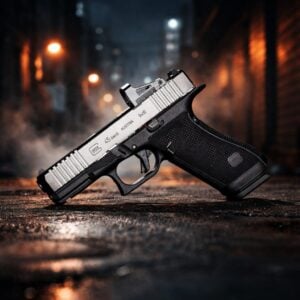
The law never says Glock. The plaintiffs suing over it say it doesn’t need to. Their complaint states that “all factory stock models of Glock pistols have a cruciform trigger bar,” Gen 6 and V series included.
Not every plaintiff reads the newest guns the same way. The State’s brief quotes the second group of plaintiffs as saying Gen 6 and V series Glocks “are designed to prevent . . . the installation of existing ‘switches.'” Whether a gun like the Glock 17 Gen 6 is “readily” convertible is exactly the call the State Police list will have to make.
What the Maryland Convertible Pistol Ban Does Not Do
It does not ban possession. The verbs in section 4-305.2(a) are manufacture, sell, offer for sale, purchase, receive and transfer. Possess isn’t one of them.
The State agrees. In its August 21 opposition brief, the Attorney General’s office wrote: “It is undisputed that to the extent certain Plaintiffs already possess pistols subject to SB 334, they may keep them.”
Family transfers survive. A person who lawfully obtained and possesses a covered pistol may sell or give it to an immediate family member who is not barred from having a gun, and the act defines that family as a spouse, child, stepchild, parent, stepparent, sibling or stepsibling.
Repairs survive too. The act exempts a temporary transfer to a licensed dealer or gunsmith for servicing and the return to its lawful owner afterward. It also exempts inheritance, surrender to police or a federally licensed dealer, a “temporary gratuitous exchange,” and sales to or by current law enforcement officials and retired officers who hold a valid federal retired-officer credential.
Dealers get an exit, and it leads out of state. A licensed dealer may still sell a covered pistol to a dealer in another state, or to a buyer in another state through a licensed dealer. I found no clause letting a Maryland dealer sell existing inventory to an ordinary Maryland customer after January 1.
And the rest of the handgun market is untouched by its own terms. Even the State’s brief says it is “highly likely that most of the handgun market will remain unaffected by SB 334.”
The State Police List That Has to Come First
Section 4-305.2(b) says the Department of State Police “shall adopt regulations to implement this section, including publishing a list of prohibited machine gun convertible pistols.” The bill as introduced said “may.” The enacted text says “shall.”
The statute sets no deadline for the list, and nothing in section 4-305.2(a) makes the January 1 date wait for it.
The legislature’s analysts saw the problem coming. The fiscal and policy note says the State Police reported more than 5,000 handgun models on the state’s handgun roster, and that at least half of them need to be evaluated for a cruciform trigger bar. It budgeted $220,216 for fiscal 2027 to hire one trooper and one administrative officer to do it.
Its conclusion was blunt: “it is unlikely that DSP can complete the list by January 1, 2027, the date on which the bill’s prohibitions take effect.”
In August, the State’s own brief said the Handgun Roster Board “has not yet promulgated regulations concerning which handgun models will be subject to SB 334.” A ban with a date and no list. That’s the frame.
Where Bathras v. Moore Stands
The federal challenge was filed the day the governor signed. Bathras v. Moore (1:26-cv-02074, District of Maryland) was filed on May 26, 2026 by the National Rifle Association, Firearms Policy Coalition and Second Amendment Foundation, and Atlantic Guns and two Maryland residents joined them on the preliminary injunction motion filed on July 20.
A second suit, Duffy v. Moore (1:26-cv-02647), brought by Maryland Shall Issue, Engage Armament, The Machine Gun Nest and two individual plaintiffs, was consolidated with it on July 23.
Their argument is short. The complaint calls the law a handgun ban and says: “The fact that the ban targets only one category of popular handguns does not make it constitutional.”
Maryland’s own Attorney General saw risk on both sides. Anthony G. Brown approved the bill for constitutionality and legal sufficiency on May 6 and wrote that it has “a reasonable likelihood of withstanding Second Amendment scrutiny,” while noting that because pistol converters are new to the courts, “it is uncertain how a court would rule.”
Judge Richard D. Bennett set a hearing on both preliminary injunction motions for September 25 and held it that day. As of the docket’s October 2 update, that hearing entry is the last filing, and no written order on the motions appears.
That is the contrast with Connecticut, where a federal judge blocked the convertible pistol ban on September 30, the day before it took effect. Maryland’s law has no injunction against it on the docket.
What Maryland Buyers Should Do Before January 1
If you want a Glock or a Glock-pattern pistol in Maryland, the window is the next three months. Until January 1, 2027, section 4-305.2 doesn’t stop the sale, and every other Maryland rule for buying a handgun, covered in our Maryland gun laws guide, still applies.
If you already own one, nothing in the text takes it from you. You can still pass it to a spouse, parent, child or sibling who can legally own a gun.
If you hold a dealer’s license, read section 4-302 before you reorder covered pistols for 2027.
October 1 was the paperwork. January 1 is the ban. The list that tells you which guns it covers is still on somebody’s desk.
Frequently Asked Questions
When does Maryland's convertible pistol ban start?
Chapter 771 of 2026 (Senate Bill 334) took effect on October 1, 2026. The prohibition itself, in section 4-305.2(a) of the Criminal Law Article, applies on or after January 1, 2027. From that date a person may not manufacture, sell, offer for sale, purchase, receive or transfer a machine gun convertible pistol, subject to the exceptions in the law.
Can I still buy a Glock in Maryland?
Until January 1, 2027, section 4-305.2 does not stop the sale, though every other Maryland handgun rule still applies. From January 1, 2027, buying a pistol that meets the definition of a machine gun convertible pistol is prohibited unless an exception applies, such as a transfer from an immediate family member. The State Police must publish a list of prohibited models.
Do I have to give up a covered pistol I already own?
No. Section 4-305.2(a) bans manufacturing, selling, offering for sale, purchasing, receiving and transferring a machine gun convertible pistol, and possession is not on that list. In its August 21, 2026 court filing, the State wrote that plaintiffs who already possess pistols subject to SB 334 may keep them.
What is a cruciform trigger bar?
Maryland's law defines it as a component in a semiautomatic pistol that serves as a link between the trigger and the firing pin and has its sear incorporated into a cross-shaped surface. A pistol is covered only if it has one and can be readily converted into a machine gun with a pistol converter fitted in place of the slide's backplate.
Which pistols are on the Maryland State Police list?
The law requires the Department of State Police to adopt regulations and publish a list of prohibited machine gun convertible pistols, but it sets no deadline. The legislature's fiscal note said it is unlikely the list can be completed by January 1, 2027, and the State told the court in August that the regulations had not been promulgated.
Can I give a covered pistol to a family member after January 1, 2027?
Yes. A person who lawfully obtained and possesses a machine gun convertible pistol may sell or transfer it to an immediate family member who is not prohibited from possessing a firearm. The law defines immediate family member as a spouse, child, stepchild, parent, stepparent, sibling or stepsibling.
What is the penalty for violating Maryland's convertible pistol law?
A violation is a misdemeanor under the existing penalty in section 4-306(a) of the Criminal Law Article, with imprisonment of up to 3 years, a fine of up to $5,000, or both.
Has a court blocked Maryland's convertible pistol law?
No injunction appears on the docket. Judge Richard D. Bennett of the US District Court for the District of Maryland held a hearing on September 25, 2026 on the preliminary injunction motions in Bathras v. Moore and the consolidated Duffy v. Moore, and no written order on the motions appeared as of the docket's October 2 update. A different federal judge blocked Connecticut's similar law on September 30, 2026.
Related Reading
- Glock Sues Connecticut Over Its Convertible Pistol Ban
- Connecticut Glock Ban Blocked by Federal Judge
- California Says Its Glock Ban Skips the Second Amendment
- Maryland Gun Laws (2026): HQL, Wear and Carry Permit, AWB and Sensitive Places
- US Gun Laws by State: 2026 Legal Directory
4,611+ Gun & Ammo Deals
Updated daily from 200+ top retailers. Filter by category, caliber, action type, and price.