
Last updated August 2026 · By Nick Hall, has watched California argue that each new restriction is the one that somehow does not touch the right
Quick take: The federal Justice Department is suing California over its ban on the sale of Glocks and other striker-fired handguns. California’s own Department of Justice has now responded to the request for a preliminary injunction, and its position is that the Second Amendment is not implicated at all. That argument has been made before and it has not aged well.
- What happened: California’s Department of Justice filed its response to the federal government’s request for a preliminary injunction against the state’s striker-fired handgun sales ban.
- The state’s position: That the Second Amendment is not implicated by the restriction, meaning the court need not reach any constitutional scrutiny at all.
- Who is suing: The United States Department of Justice, which brought the action against the state over the ban.
- What’s at stake: Whether Glocks and comparable striker-fired pistols, among the most commonly owned handguns in America, can lawfully be barred from sale in the largest state.
There is a move that appears in almost every one of these cases, which is to argue that whatever has just been banned falls outside the right rather than being a justified limit on it. It is the strongest available argument and it is also the hardest one to make about a Glock.
Deals of the Day
Today's best discounts · Updated 3x daily
Gun Deals
See All →
Ammo Deals
See All →




Table of Contents
The Argument California Is Making
There are two ways to defend a firearms restriction after Bruen. You can concede the Second Amendment applies and argue the restriction fits the nation’s historical tradition of firearms regulation, or you can argue the conduct falls outside the right’s scope entirely so no historical analysis is needed.
California has taken the second route. Its filing says the Second Amendment is not implicated by the ban.
That is not a foolish argument in the abstract. Courts do accept that some conduct falls outside the right. It is a harder argument to sustain about a category of handgun that Americans own by the tens of millions.
The state publishes its firearms positions and regulatory guidance through the California Attorney General’s office, which is also where the roster and its requirements are maintained. It is the primary source for what is actually enforceable in the state at any given moment.
Why a Glock Is a Difficult Thing to Argue Around
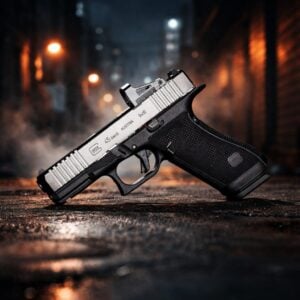
Striker-fired polymer-framed pistols are not exotic. They are the default American handgun, they dominate law enforcement duty use, and the Glock 17 and 19 alone account for an enormous share of the civilian market.
The common-use analysis that has driven Second Amendment litigation since Heller asks what arms Americans actually own for lawful purposes. It is difficult to construct a version of that test in which the single most widely carried handgun design in the country falls outside it.
That is the wall the state’s argument has to get over, and it is a high one.
What the Federal Suit Is Actually About
The Justice Department suing a state over its firearms law is not routine, and the significance of that is easy to miss underneath the substance. Federal enforcement action against state gun restrictions represents a considerable shift in how these disputes get litigated.
Historically the work was done by private plaintiffs and advocacy organisations, who have to establish standing, fund years of litigation and survive mootness. A federal plaintiff carries none of those problems in the same way.
A preliminary injunction, if granted, would stop the ban operating while the case proceeds, which is a materially different position from the New Jersey situation where a favourable ruling sits stayed and unenforceable.
What It Means for California Buyers Now
Nothing has changed. The ban operates, the roster operates, and the practical effect for someone walking into a California gun shop today is exactly what it was last month.
California’s handgun availability problem is layered. The roster requirements are one restriction, microstamping is another, and this striker-fired ban sits on top of both. Each one individually narrows what is on the shelf, and the combined effect is a market that looks nothing like the rest of the country.
Our California-legal handgun guide covers what you can actually buy right now, and our California gun laws guide covers the framework around it.
The Broader Pattern
California passes a restriction. Litigation follows. Years pass. A court rules, the ruling is appealed, and a stay keeps the restriction alive through most of the process. By the time anything resolves, there is a new restriction and the cycle restarts.
That pattern is the actual mechanism of California firearms policy, and understanding it explains why the state’s legal positions can afford to be aggressive. A losing argument that delays for three years has accomplished most of what a winning one would.
But the federal government as plaintiff changes the arithmetic on that, because the Justice Department does not run out of money or standing halfway through.
Whether that is a welcome development depends entirely on your view of federal power, and the same mechanism would be available to a future administration with opposite priorities. A tool is a tool regardless of who is currently holding it.
What to Watch
Watch the preliminary injunction ruling, which is the near-term decision point and will come well before any final judgment. That is the thing that would change what a California buyer can actually purchase.
Watch whether the court engages with the scope argument or moves straight to historical analysis. A judge who declines to accept that the Second Amendment is uninvolved has effectively decided the harder half of the case.
And watch the Supreme Court’s AR-15 case, because whatever test it articulates will govern how every one of these disputes is analyzed afterwards.
The most common handgun in America. Banned in the largest state. And the state says the Second Amendment does not enter into it.
Frequently Asked Questions
What is California's Glock ban?
A state restriction on the sale of Glocks and other striker-fired handguns. It sits alongside California's existing handgun roster and microstamping requirements, which already limit which pistols can be sold new in the state.
Who is suing California over it?
The United States Department of Justice. The federal government has asked the court for a preliminary injunction that would stop the ban operating while the case proceeds.
What is California's legal argument?
That the Second Amendment is not implicated by the restriction at all. If a court accepts that, it does not have to apply any constitutional scrutiny or historical analysis to the ban.
Why is that argument difficult to sustain?
Because striker-fired polymer pistols are the most commonly owned handgun design in the United States, and the common-use analysis courts apply asks precisely what arms Americans own for lawful purposes.
Does this change what I can buy in California today?
No. The ban remains in force while the litigation proceeds. Nothing about California handgun availability has changed as a result of this filing.
What would a preliminary injunction do?
It would suspend the ban's operation while the case is decided, rather than waiting for a final judgment. That is different from a ruling that is granted and then stayed, which changes nothing in practice.
How does this relate to the microstamping issue?
They are separate restrictions that compound. Microstamping requirements limit which new models can join the roster, and the striker-fired ban removes a further category from sale. Together they narrow California's market considerably.
Why does it matter that the federal government is the plaintiff?
Private plaintiffs have to establish standing, fund years of litigation and survive mootness challenges. A federal plaintiff faces none of those obstacles in the same way, which changes the dynamics of the case substantially.
Related Reading
- California-legal handguns explained
- California gun laws explained
- The best California CCW guns
- The best 9mm pistols
- The federal review of microstamping
4,335+ Gun & Ammo Deals
Updated daily from 200+ top retailers. Filter by category, caliber, action type, and price.