

Last updated July 2026 · By Nick Hall, defensive shooter who has chronographed and gel-tested both 9mm and .45 ACP loads
Affiliate disclosure: This 9mm vs .45 ACP comparison contains affiliate links. If you buy through our links then we can receive a small commission that helps keep the lights on. You don’t pay anything more.
- Treat every gun as loaded
- Point the muzzle in a safe direction
- Keep your finger off the trigger until you’re ready to shoot
- Know your target and what’s beyond
Quick Answer: 9mm wins for most shooters in 2026. 45 ACP almost entirely, while 9mm offers double the magazine capacity, half the recoil, and 30-50% lower training cost per round.
45 ACP loads on penetration depth and expansion. 45 ACP still makes sense for shooters who already own 1911-platform pistols, prefer subsonic suppressed ammunition, or want maximum heavy-bullet penetration on barriers.
The biggest mistake new shooters make is choosing a caliber on stopping-power myths from the 1980s. Real-world police shooting data and FBI lab data both show shot placement matters more than caliber within the major service-cartridge tiers. Every comparison on this page is backed by chronograph and gel-test data.
Table of Contents
Also see our head-to-head comparison: .380 ACP vs 9mm.
How we tested: Every pick here is ranked against our testing methodology. Minimum round counts, accuracy and reliability protocols, the failures that disqualify a gun. Where we have not shot a specific variant ourselves, we say so in that section.
Quick Verdict: 9mm Wins for Most People
Let me save you 4,000 words of reading if you’re in a hurry. For the vast majority of shooters, 9mm is the better choice in 2026. It’s not even particularly close. You get more rounds in the magazine, less recoil, cheaper ammo for practice, and modern hollow point ammunition has effectively closed the terminal performance gap that .45 ACP fans have been hanging their hats on for decades.
The .45 ACP still has a place, and I’ll give it a fair shake in this article. It’s a legitimate choice for 1911 enthusiasts, suppressor hosts, and people who simply prefer shooting a big, slow bullet. If you shoot .45 well and you like it, nobody should talk you out of it. Personal preference matters.
But here’s the thing: the FBI settled this debate in 2015. After decades of caliber experimentation (moving from 9mm to 10mm to .40 S&W and then back again), the Bureau concluded that 9mm with modern hollow points offered the best combination of terminal performance, shootability, and capacity. If it’s good enough for the FBI’s Hostage Rescue Team, it’s good enough for your nightstand gun.
Ballistics: The Numbers Don’t Lie
Before we get into opinions, let’s look at the raw numbers. I’ve compiled ballistic data from Federal, Speer, and Hornady test results, along with independent gel testing from sources like Lucky Gunner’s extensive ammunition tests. These are real-world numbers from calibrated ballistic gelatin, not marketing fluff.
| Metric | 9mm 124gr | 9mm 147gr | .45 ACP 230gr | .45 ACP 185gr +P |
|---|---|---|---|---|
| Muzzle Velocity | 1,150 fps | 1,000 fps | 830 fps | 1,050 fps |
| Muzzle Energy | 364 ft-lbs | 326 ft-lbs | 352 ft-lbs | 453 ft-lbs |
| Gel Penetration (JHP) | 14-16″ | 13-15″ | 12-14″ | 13-15″ |
| Expanded Diameter | .55-.72″ | .60-.70″ | .70-.85″ | .65-.80″ |
| SAAMI Max Pressure | 35,000 psi | 35,000 psi | 21,000 psi | 23,000 psi |
| Typical Recoil Energy | ~6.5 ft-lbs | ~7.0 ft-lbs | ~8.5 ft-lbs | ~10.0 ft-lbs |
| Bullet Diameter | .355″ | .355″ | .452″ | .452″ |
A few things jump out of this table. First, the muzzle energy numbers are surprisingly close between standard 9mm 124gr and .45 ACP 230gr loads. We’re talking 364 ft-lbs versus 352 ft-lbs. That’s a 3% difference. The .45 ACP only pulls ahead meaningfully with hot +P loads, and not everyone wants to shoot +P through their carry gun on a regular basis.
Second, look at the gel penetration. Both calibers land squarely in the FBI’s ideal 12-18 inch window when loaded with quality JHP ammunition. The 9mm 124gr actually penetrates slightly deeper on average, which matters when you consider shots that have to pass through barriers like heavy clothing or a car door.
Where the .45 ACP does have a genuine advantage is in expanded diameter. A .45 ACP hollow point that opens up to .85 inches is creating a larger wound channel than a 9mm that expands to .65 inches. That’s real, and it’s worth acknowledging. The question is whether that larger wound channel is worth the tradeoffs in capacity, recoil, and cost. For most people, it isn’t.
FBI Protocol Testing: What Actually Matters
The FBI’s ammunition testing protocol is the gold standard for evaluating defensive handgun ammunition. It involves shooting through six different barriers (bare gelatin, heavy clothing, steel, wallboard, plywood, and automotive glass) and measuring penetration depth and expansion in calibrated 10% ballistic gelatin. The standard they established requires a minimum of 12 inches and a maximum of 18 inches of penetration.
Both 9mm and .45 ACP meet this standard with quality JHP ammunition. Federal HST, Speer Gold Dot, and Hornady Critical Duty all pass the protocol in both calibers. This is the core reason why the caliber debate is less important than it was 30 years ago. Modern bullet engineering has made 9mm hollow points reliably expand to .55 to .72 inches while still penetrating 14 to 16 inches. That’s a performance level that simply wasn’t achievable with the technology available in the 1980s and 1990s.
The FBI’s decision to return to 9mm in 2015 wasn’t made lightly. They spent years testing and evaluating, and their conclusion was straightforward: 9mm with modern JHP ammunition provides adequate terminal performance while allowing agents to shoot faster, more accurately, and with higher capacity. The Bureau specifically noted that shot placement is the single most important factor in stopping a threat, and 9mm’s lower recoil helps agents place their shots better under stress.
A brief history lesson here. The FBI adopted 10mm Auto after the infamous 1986 Miami shootout, where agents armed with .38 Special revolvers and 9mm pistols (loaded with the hollow points available at the time) failed to stop two bank robbers quickly enough. Eight agents were wounded and two were killed. The Bureau wanted more power, but 10mm proved too much for many agents to handle. They downloaded the 10mm to a lighter load, and Smith & Wesson essentially shortened the case to create the .40 S&W. Eventually, the FBI realized that the advantages of the bigger caliber were being negated by slower follow-up shots and lower hit rates in qualification. The circle completed when they went back to 9mm.
Stopping Power: The Myth That Won’t Die
“Stopping power” is the most misused term in the gun world. People throw it around as if there’s a magical force that some calibers have and others don’t. There isn’t. What actually stops a threat is either a hit to the central nervous system (brain or upper spine) or sufficient blood loss to cause incapacitation. Both of those outcomes are driven by shot placement, not by how big the bullet is.
The best real-world data we have on this comes from Greg Ellifritz, a retired law enforcement trainer who analyzed over 1,800 actual shooting incidents across all common handgun calibers. His findings were eye-opening. The one-shot-stop percentages for 9mm and .45 ACP were remarkably similar: roughly 34% for 9mm and 39% for .45 ACP. That 5% difference is within the margin of error for a study of this type, and it certainly doesn’t justify the capacity, recoil, and cost penalties that come with .45 ACP.
Here’s what Ellifritz’s data actually showed matters: the number of rounds that hit the target. Across all calibers, the average number of rounds required to incapacitate an attacker was between 2 and 3. The people who stopped threats effectively were the people who put multiple hits on target quickly. This is where 9mm’s lower recoil and higher capacity become decisive advantages.
I want to be clear about something. I’m not saying .45 ACP doesn’t work. It absolutely does. It’s been stopping threats since 1911, and it will continue to do so. What I’m saying is that the idea of some inherent “stopping power” advantage over 9mm is not supported by the data. A .45 ACP that misses is worth less than a 9mm that hits. And a 9mm is easier to hit with for most shooters.
Recoil: The Practical Difference
This is where the rubber meets the road for most shooters. In a compact pistol, 9mm generates roughly 6 to 7 ft-lbs of recoil energy. The .45 ACP generates 8 to 10 ft-lbs in a similar-sized frame. That 30-40% increase in felt recoil translates directly to slower split times, more muzzle flip, and worse accuracy for the average shooter, especially under the stress of a defensive encounter.
I shoot both calibers regularly. My split times (the time between shots on a shot timer) are consistently 0.15 to 0.20 seconds faster with 9mm compared to .45 ACP in similarly-sized handguns. On a Bill Drill (six shots on an IPSC target at 7 yards), that adds up to nearly a full second of difference. In a gunfight, a full second is an eternity.
The recoil difference is even more pronounced for newer shooters, smaller-framed shooters, and anyone who doesn’t train regularly. I’ve taught concealed carry classes for years, and I can tell you from direct observation that students consistently shoot tighter groups and maintain better accuracy with 9mm than with .45 ACP. It’s not a subtle difference.
There’s also the issue of recoil anticipation, or “flinching.” Heavier-recoiling handguns tend to produce more flinch in shooters, which causes shots to go low and left (for right-handed shooters). This is the number one accuracy killer I see at the range, and it’s significantly worse with .45 ACP than with 9mm. You can train through it, but why make your job harder?
Capacity: The Math Advantage
Capacity is one of those advantages that sounds theoretical until you need it. The standard Glock 19 holds 15+1 rounds of 9mm. The Glock 21, which is Glock’s full-size .45 ACP, holds 13+1. That’s only two rounds difference in full-size guns, but the Glock 19 is a compact that you can actually conceal. The Glock 21 is a full-size duty pistol that’s difficult to carry concealed for most people.
The capacity gap becomes even more dramatic in the micro-compact category. The Sig P365 holds 12+1 rounds of 9mm (or 15+1 with an extended magazine) in a package that weighs under 18 ounces. There is simply no .45 ACP equivalent in that size class. If you want a high-capacity concealed carry gun, 9mm is your only realistic option.
| Pistol | Caliber | Capacity | Weight (unloaded) | Size Class |
|---|---|---|---|---|
| Glock 19 Gen 5 | 9mm | 15+1 | 23.6 oz | Compact |
| Glock 21 Gen 4 | .45 ACP | 13+1 | 29.3 oz | Full-Size |
| Sig P365 XL | 9mm | 12+1 | 20.7 oz | Micro-Compact |
| Sig P220 | .45 ACP | 8+1 | 30.4 oz | Full-Size |
| S&W M&P Shield Plus | 9mm | 13+1 | 20.2 oz | Sub-Compact |
| Springfield 1911 Garrison | .45 ACP | 7+1 | 39.0 oz | Full-Size |
More rounds means more chances to hit the target. In a defensive shooting, you’re not going to have perfect accuracy. Stress, adrenaline, movement, and low-light conditions all degrade your shooting performance. Studies of law enforcement shootings consistently show hit rates between 20% and 40%. With a 15-round magazine, a 30% hit rate gives you 4 to 5 hits. With an 8-round 1911, that same hit rate gives you 2 to 3 hits. The math favors 9mm.
Cost: The Training Factor
This might be the most underrated advantage of 9mm, and it’s the one I bring up first when friends ask me what caliber to buy. As of early 2026, you can buy quality 9mm FMJ practice ammunition for $0.20 to $0.30 per round. The same quality in .45 ACP costs $0.35 to $0.50 per round. That’s roughly 60-70% more expensive for every trigger pull.
Let’s put that in perspective. If you shoot 1,000 rounds per year (which is a reasonable amount for someone who takes self-defense seriously), you’re spending $200 to $300 on 9mm versus $350 to $500 on .45 ACP. That’s $150 to $200 in savings every year. Over five years, that’s potentially $1,000 that could go toward training classes, better gear, or just more ammunition.
The person who practices more shoots better. Full stop. If your ammo budget is $300 per year, you can shoot 1,000 to 1,500 rounds of 9mm or 600 to 850 rounds of .45 ACP. Those extra hundreds of rounds per year compound into measurably better skills over time. I’d rather face a threat with a 9mm and 1,500 rounds of practice behind me than a .45 with 600 rounds of practice.
Defensive JHP ammunition shows a similar price gap. Federal HST 124gr 9mm runs about $0.90 to $1.10 per round. Federal HST 230gr .45 ACP costs $1.10 to $1.40 per round. You should be cycling your carry ammo every 6 to 12 months and verifying that it runs reliably in your specific gun. Cheaper ammo makes that a less painful proposition.
When .45 ACP Still Makes Sense
I’ve spent a lot of this article explaining why 9mm is the better choice for most people. But I’m not here to trash the .45 ACP. It’s a legendary cartridge with over a century of proven performance, and there are legitimate reasons to choose it. Here’s where the .45 still makes sense.
1911 Enthusiasts
The 1911 was designed around the .45 ACP cartridge. John Moses Browning built them as a matched pair, and there’s something about shooting a 1911 in its original chambering that just feels right. The recoil impulse of .45 ACP through a steel-framed 1911 is actually very manageable (the weight of the gun absorbs much of it), and the trigger on a good 1911 is still one of the best in the business. If you love the 1911 platform, shoot .45 ACP in it. That’s what it was born to do.
Suppressor Hosts
This is the .45 ACP’s secret weapon. Standard 230gr .45 ACP ammunition travels at approximately 830 fps, which is well below the speed of sound (roughly 1,125 fps at sea level). That means every standard .45 ACP load is inherently subsonic. You don’t need special subsonic ammunition. Screw on a suppressor and you get a genuinely quiet shooting experience without any velocity or performance penalty.
With 9mm, you need to buy specialty subsonic ammo (typically 147gr loads) to avoid the supersonic crack. Standard 115gr and 124gr 9mm loads will still crack even through a suppressor. If you’re building a suppressed home defense gun.45 ACP is a strong choice.
Hand Size and Ergonomics
Some people with larger hands find that full-size .45 ACP frames like the Glock 21 or the HK USP 45 fit their grip better than compact 9mm options. Grip fit is one of the most important factors in accurate shooting, and if a .45 ACP pistol points more naturally in your hands, that’s a legitimate reason to choose it.
Close-Range Terminal Performance
At contact distance to about 5 yards (the range at which most defensive shootings occur), the .45 ACP does create a larger wound channel with expanding ammunition. A .45 ACP HST that opens up to .85 inches is punching a meaningfully bigger hole than a 9mm HST that opens to .65 inches. In a situation where you’re putting one or two rounds into an attacker at bad-breath distance, that bigger hole could make a difference.
Personal Preference Is Valid
I’m a data-driven guy, and the data says 9mm. But shooting is also a skill that requires confidence, and you shoot what you’re confident with better. If you’ve been carrying a .45 for 20 years, you train with it regularly, and you shoot it well, there is absolutely no reason to switch calibers because some guy on the internet (that’s me) told you to. The best defensive caliber is the one you shoot accurately and carry consistently.
Best 9mm Guns for Self-Defense
If you’ve decided that 9mm is the way to go (and statistically, you should), here are my top three picks across different size categories and budgets. All three are proven, reliable, and widely available.
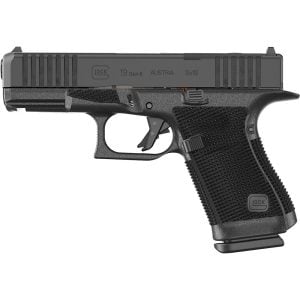
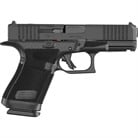
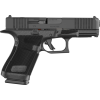
Glock 19 Gen 6 (~$600)
The Glock 19 is the default answer to “what 9mm should I buy” for good reason. It’s the perfect size for both concealed carry and home defense, it holds 15+1 rounds, and it runs reliably with virtually any ammunition you feed it. The Gen 6 added a factory optics cut and improved ergonomics over the already-excellent Gen 5. Holster support is unmatched, with literally hundreds of options from every major manufacturer. If you can only own one handgun, this is it.
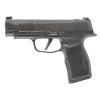
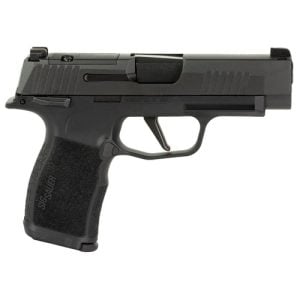
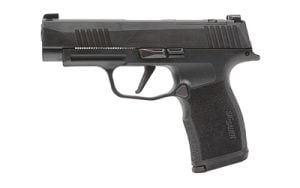
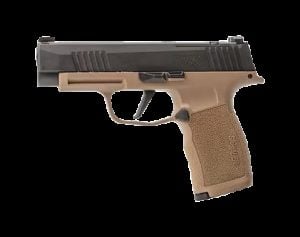
Sig Sauer P365 XL (~$599)
The P365 XL redefined what’s possible in a concealed carry pistol. You get 12+1 rounds of 9mm (15+1 with the extended mag) in a package that’s barely bigger than the old single-stack subcompacts that held 6 or 7 rounds. The flat trigger is excellent, the sights are usable, and it comes optics-ready from the factory. This is my top pick for everyday concealed carry when deep concealment is the priority.
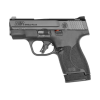
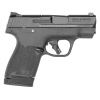
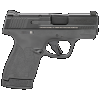
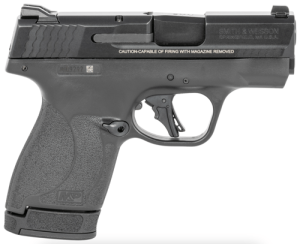
Smith & Wesson M&P Shield Plus (~$449)
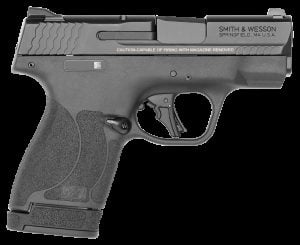
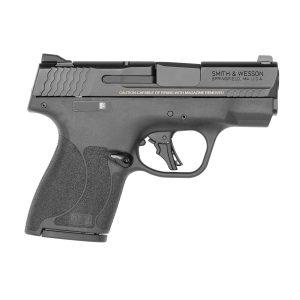
The Shield Plus is the budget pick that doesn’t feel like a budget pick. For around $450, you get a 13+1 capacity micro-compact with a flat-face trigger that rivals guns costing $200 more. The M&P ergonomics work well for most hand sizes, and the aftermarket support is strong. If you’re buying your first carry gun and want to keep costs down, the Shield Plus gives you the most rounds per dollar of any micro-compact on the market.
Best .45 ACP Guns for Self-Defense
If you’ve weighed the data and you still want a .45 (respect), here are the guns I’d recommend. Each one brings something different to the table.
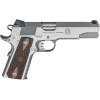
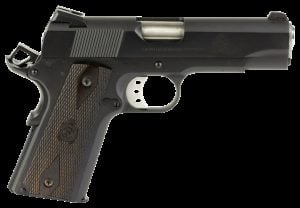
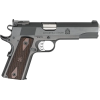
Springfield Armory 1911 Garrison (~$849)
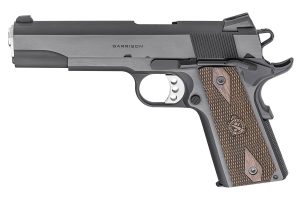
If you’re going .45 ACP, you might as well go 1911. The Springfield Garrison is the best value in a quality 1911 right now. You get a forged steel frame, a Series 70 firing system (no firing pin block to gum up the trigger pull), and genuine Novak sights. The trigger on mine broke at a clean 4.5 pounds out of the box. It’s a proper 1911 at a price that doesn’t require a second mortgage. Just remember: 7+1 capacity means you need to make your shots count.

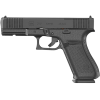
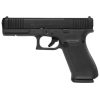
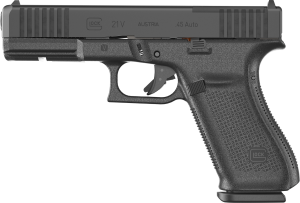
Glock 21 (~$550)
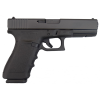
The Glock 21 is the highest-capacity .45 ACP option on this list at 13+1 rounds. It’s a big, chunky gun that’s tough to conceal, but it’s one of the most reliable .45 ACP pistols ever made. Special operations units around the world have used it. If you want .45 ACP in a modern, no-nonsense polymer pistol with maximum capacity, this is the pick. It’s also significantly cheaper than most .45 ACP alternatives.

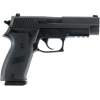
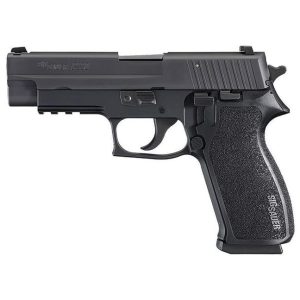
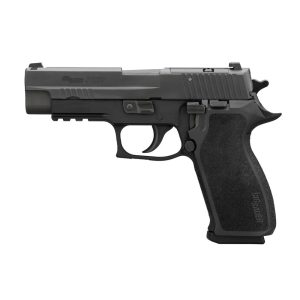
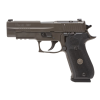
Sig Sauer P220 (~$1,100)
The P220 is for the shooter who wants old-world quality in a .45 ACP platform. This is a DA/SA pistol with an alloy frame, and the fit and finish are a cut above anything in the polymer world. The single-action trigger pull is outstanding. The P220 has been a law enforcement and military sidearm around the world for decades. The downside is the 8+1 capacity and the price tag, but you’re paying for craftsmanship and a silky-smooth action that you won’t find in a Glock.
Best Defensive Ammo for Each Caliber
Your carry gun is only as good as the ammunition you load it with. Here are the top defensive loads for each caliber, all of which pass the FBI protocol testing and are trusted by law enforcement agencies nationwide.
Best 9mm Self-Defense Ammo
- Federal HST 124gr: The gold standard. Consistent expansion to .55-.72 inches, 14-16 inches of penetration. This is what most law enforcement agencies carry. If you only test one load, make it this one.
- Speer Gold Dot 124gr: A bonded bullet that performs exceptionally well through barriers like heavy clothing and auto glass. Slightly less expansion than the HST but more consistent penetration. Another law enforcement favorite.
- Hornady Critical Duty 135gr +P: Designed specifically for duty-size pistols with 4-inch or longer barrels. The FlexLock bullet resists clogging from clothing material, which gives it very consistent expansion. The +P loading adds velocity but also adds recoil.
For a deeper dive on 9mm ammunition options, check out our complete guide to the best 9mm ammo for self-defense and practice.
Best .45 ACP Self-Defense Ammo
- Federal HST 230gr: The .45 ACP version of the FBI’s chosen load. Expands to a massive .80-.90 inches while still penetrating 12-14 inches. The standard 230gr loading keeps recoil manageable (for a .45) and feeds reliably in everything from 1911s to Glocks.
- Speer Gold Dot 230gr: Another bonded bullet with excellent performance through barriers. The Gold Dot’s bonding process prevents jacket separation, which is particularly important in a big-bore caliber where the forces on the bullet during expansion are significant.
- Hornady Critical Duty 220gr +P: The heaviest-hitting option on this list. The +P loading pushes velocities into the 1,000 fps range, but be aware that not all .45 ACP pistols are rated for sustained +P use. Check your owner’s manual before running +P loads as your carry ammo.
For more .45 ACP ammunition recommendations, see our guide to the best .45 ACP ammo.
The Bottom Line
The 9mm vs .45 ACP debate has been raging since before the internet existed, and it’ll probably keep going after we’re all gone. But the data is clear. Modern 9mm JHP ammunition delivers terminal performance that is functionally equivalent to .45 ACP in the metrics that matter (penetration depth and the FBI protocol). Where 9mm pulls ahead is in everything else: capacity, recoil management, cost per round, and the sheer variety of excellent firearms chambered for it.
If you’re buying your first defensive handgun, buy a 9mm. If you’re looking to upgrade your carry gun, buy a 9mm. If you already own a .45 ACP, shoot it well, and train with it regularly, keep shooting your .45. The caliber you train with is the caliber that will save your life.
For me, the choice is 9mm and it’s not close. I carry a 9mm every day, I compete with a 9mm, and I teach with a 9mm. The combination of 15+ round capacity, fast follow-up shots, and affordable practice ammunition makes it the most practical defensive caliber available. The .45 ACP is a fine cartridge with a storied history, but in 2026, 9mm is simply the better tool for the job.
Where to buy 9mm and .45 ACP ammo and firearms: Palmetto State Armory | Brownells | EuroOptic
FAQ: 9mm vs .45 ACP
Frequently Asked Questions
Is 9mm or .45 ACP better for self-defense?
For most people, 9mm is the better self-defense choice. Modern hollow points like Federal HST perform nearly identically in both calibers for terminal effect, but 9mm gives you more capacity, less recoil, faster follow-up shots, and cheaper practice ammo. The FBI switched back to 9mm in 2014 after testing confirmed this.
Does .45 ACP have more stopping power than 9mm?
Not in any meaningful way with modern ammunition. Studies of real-world shootings show no statistically significant difference in one-shot stop rates between 9mm and .45 ACP when quality hollow points are used. Shot placement and penetration depth matter far more than bullet diameter.
Why did the FBI switch from .40 S&W back to 9mm?
The FBI conducted extensive testing and found that modern 9mm hollow point ammunition achieved equal terminal performance to .40 S&W and .45 ACP, while offering less recoil, higher capacity, and better qualification scores among agents. The switch was officially made in 2014 with the adoption of the Glock 17M and 19M.
Is .45 ACP better for suppressed shooting?
Yes. Standard .45 ACP loads (230gr at ~850 fps) are naturally subsonic, meaning every factory load works well with a suppressor. With 9mm, you need specifically labeled subsonic ammunition (typically 147gr) to stay below the sound barrier and avoid the supersonic crack.
What is the best 9mm ammo for self-defense?
Federal HST 124gr is the gold standard. It consistently expands to 0.55-0.60 inches, penetrates 14-16 inches in gel, and feeds reliably in virtually every 9mm pistol. Speer Gold Dot 124gr and Hornady Critical Defense 115gr are also excellent choices. See our full best 9mm ammo guide for detailed reviews.
Can you conceal carry a .45 ACP?
Yes, but your options are more limited. Single-stack .45s like the Springfield XD-S Mod.2 and Glock 36 are concealable but only hold 6-7 rounds. With 9mm, modern micro-compacts like the SIG P365 give you 12+ rounds in a smaller package. If capacity and size matter to you, 9mm offers far more concealed carry options.
6,057+ Gun & Ammo Deals
Updated daily from 200+ top retailers. Filter by category, caliber, action type, and price.